Question
The world long jump record is 8.95 m (Mike Powell, USA, 1991). Treated as a projectile, what is the maximum range obtainable by a person if he has a take-off speed of 9.5 m/s? State your assumptions.
Final Answer
Solution video

This is a 15-second preview. Get access to the full video by starting your free 7-day trial.
This is a 15-second preview. Get access to the full video by starting your free 7-day trial.
Calculator Screenshots
Video Transcript
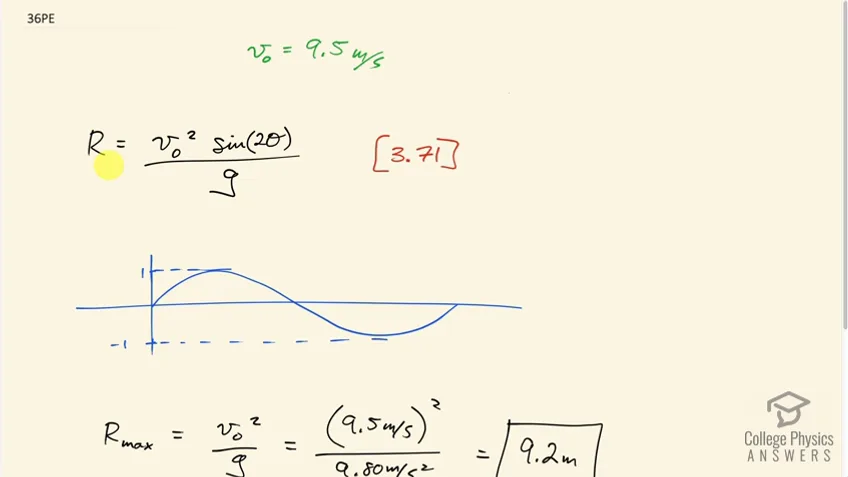
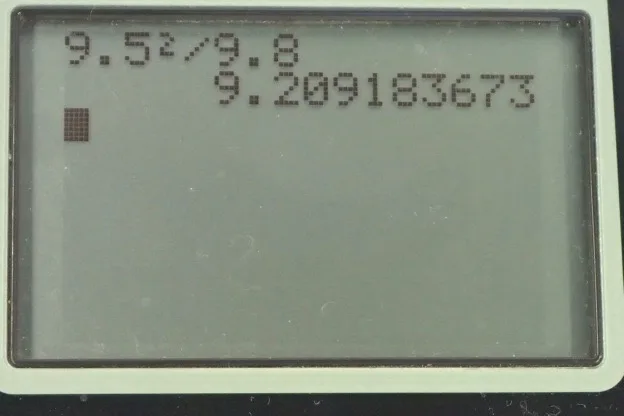
This is College Physics Answers with Shaun Dychko. A long jumper has an initial speed of 9.5 meters per second, and we're asked to figure out what is the maximum possible range that they could have. So the range formula, equation 71 in chapter three says that, the range will be; the initial speed squared, times sine of two times the launch angle, divided by acceleration due to gravity. Now the sine function has a range between one and negative one. This is a graph of the sine function. This is y equals sine theta. And since it has a maximum of one, that means we can replace this with one when we want to make a formula for the maximum range. That’s going to be v naught squared over g. So that's 9.5 meters per second squared divided by 9.8 meters per second squared. Which is 9.2 meters, is the maximum possible range.
Comments
No comments yet.