Question
Suppose you measure a standing person's blood pressure by placing the cuff on his leg 0.500 m below the heart. Calculate the pressure you would observe (in units of mm Hg) if the pressure at the heart were 120 over 80 mm Hg. Assume that there is no loss of pressure due to resistance in the circulatory system (a reasonable assumption, since major arteries are large).
Final Answer
159 mm Hg over 119 mm Hg
Solution video

This is a 16-second preview. Get access to the full video by starting your free 7-day trial.
This is a 16-second preview. Get access to the full video by starting your free 7-day trial.
Calculator Screenshots
Video Transcript
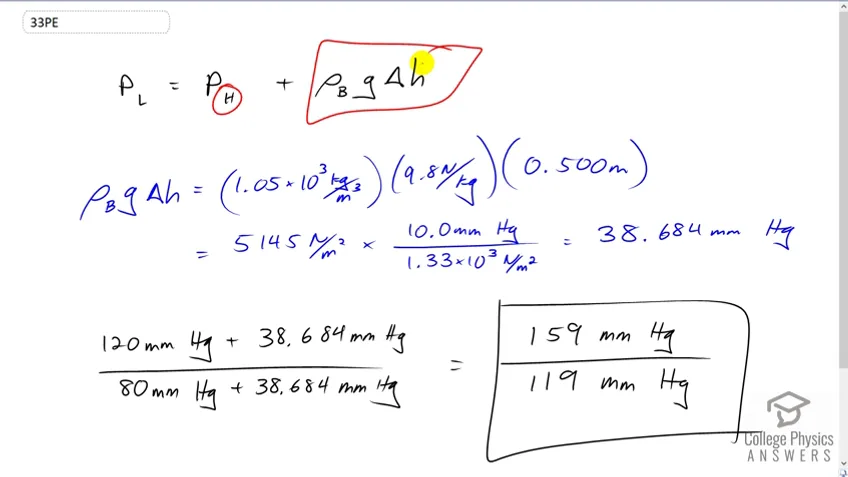
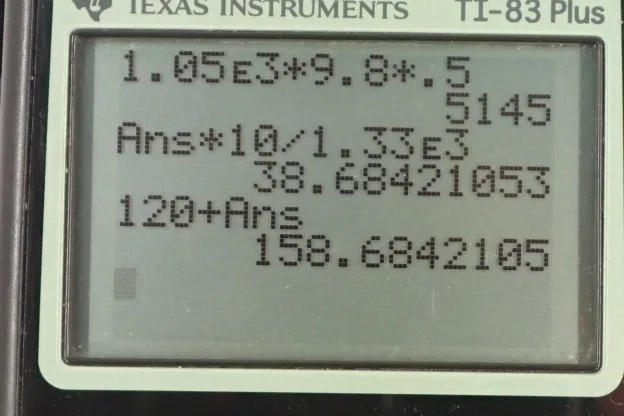
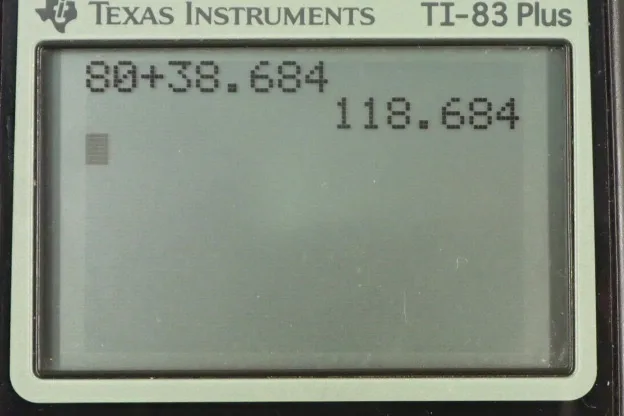
This is College Physics Answers with Shaun Dychko. The blood pressure measured in the leg is going to be the blood pressure measured at the heart level plus the pressure due to the height difference between the heart and the leg, so this is going to add some additional pressure because there is the weight of the blood above the position we’re measuring at the leg versus where the heart is. So what is this pressure due to the column of blood from the leg to the heart, this is what we’re answering here. So we have the density of blood times g times this height difference between the heart and the measurement position. So that’s 1.05 times ten to the three kilograms per cubic meter density of blood, times 9.8, times 0.5 meters between the leg and the heart, so that’s 5145 newtons per squared meter but we want to convert this into millimeters of mercury. So we multiply by this conversion factor which I looked up from the textbook, ten millimeters of mercury for every 1.33 times ten to the three newtons per meter squared, and this is 38.684 millimeters of mercury. So we add that to the 120 millimeters of mercury to get the systolic pressure of 159 and then add that to the 80 millimeters of mercury to get the diastolic pressure of 119 millimeters, so the blood pressure is going to be 159 over 119.
Comments
No comments yet.