Question
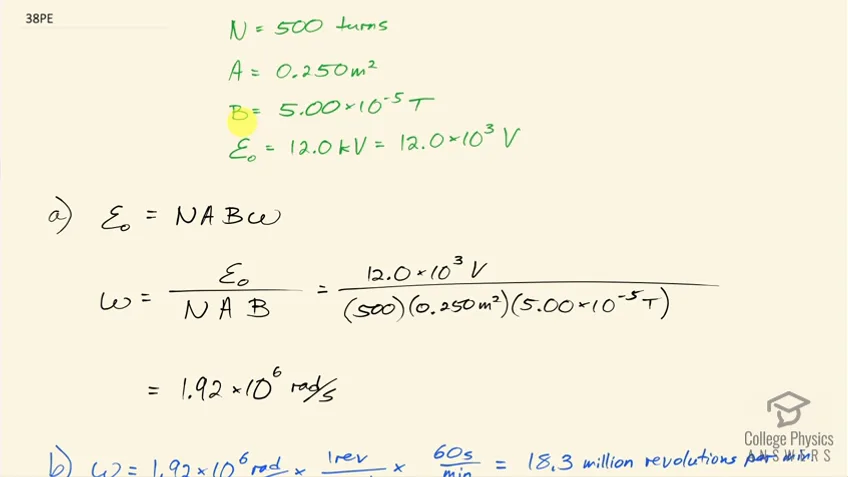
A 500-turn coil with a area is spun in the Earth's field, producing a 12.0 kV maximum emf. (a) At what angular velocity must the coil be spun? (b) What is unreasonable about this result? (c) Which assumption or premise is responsible?
Final Answer
- . This angular speed is too fast. The centripetal force needed at this speed would tear apart the coil.
- The assumption of peak EMF of is unreasonable.
Solution video

This is a 18-second preview. Get access to the full video by starting your free 7-day trial.
This is a 18-second preview. Get access to the full video by starting your free 7-day trial.
Calculator Screenshots
Video Transcript
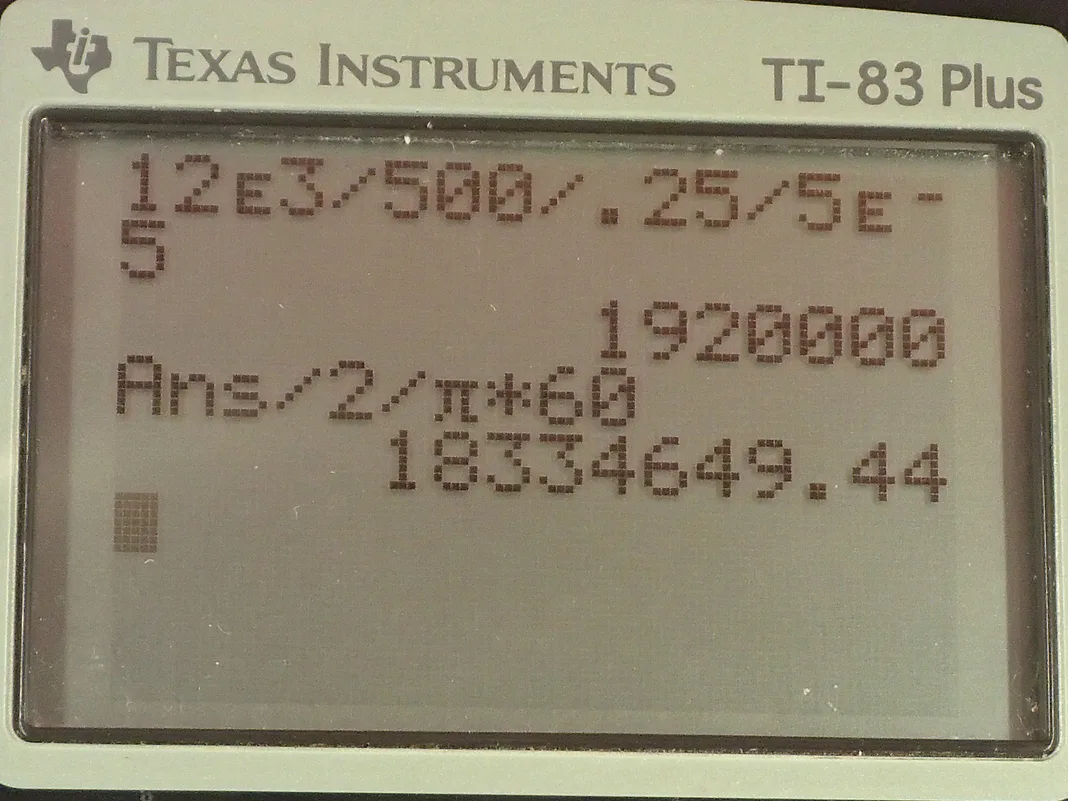
This is College Physics Answers with Shaun Dychko. A coil with 500 turns of wire and an area of 0.250 square meters is in a magnetic field with strength 5.00 times 10 to the minus 5 tesla— that's the Earth's magnetic field— and the peak emf allegedly is 12.0 kilovolts, which is 12.0 times 10 to the 3 volts and the question is what angular speed must it be turning to generate this kind of induced emf? So this peak emf is the number of turns times the area times the magnetic field strength times the angular speed so we'll divide both sides by NAB to solve for ω. So the angular speed then is 12.0 times 10 to the 3 volts divided by 500 turns times 0.250 square meter times 5.00 times 10 to the minus 5 tesla and that's 1.92 times 10 to the 6 radians per second. Now that is an unrealistically high angular speed. If we turn it into rpm in order to have a better you know sense of what this number means, we could multiply by 1 revolution for every 2π radians and then multiply by 60 seconds per minute, this is 18.3 million revolutions every minute; that angular speed is so fast that the centripetal force needed to give the centripetal acceleration to points on the perimeter of this loop would tear apart the coil, the material would just stretch and break apart. So the assumption of 12.0 kilovolt peak emf is unreasonable.
Comments
No comments yet.