
thomasd.jacob·
Small typo on the units for part a, although it's correct in the video.
Like
ShaunDychko·
Another great catch Thomas, thank you so much!
Best wishes,
Shaun
Like
Question
This is a 23-second preview. Get access to the full video by starting your free 7-day trial.
This is a 23-second preview. Get access to the full video by starting your free 7-day trial.
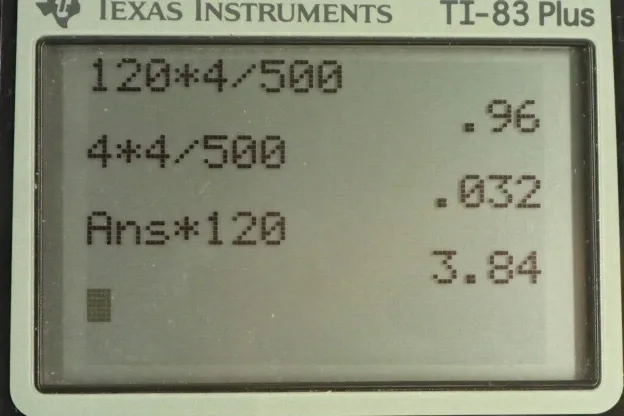
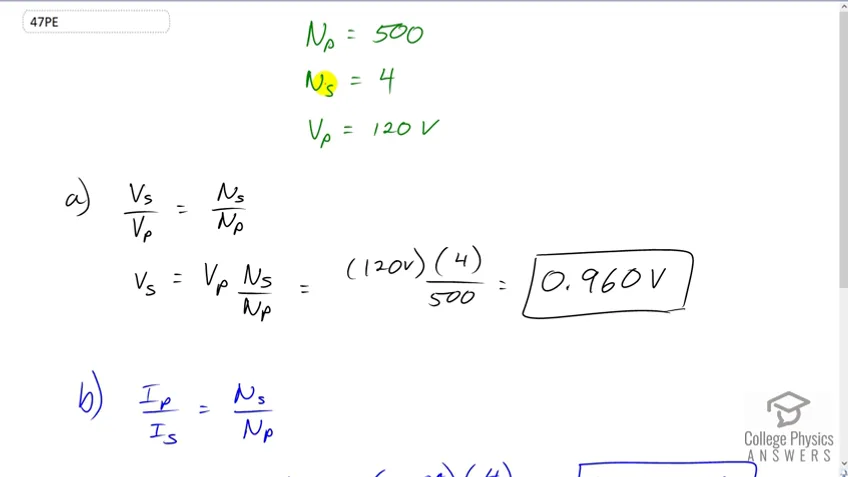
This is College Physics Answers with Shaun Dychko. A transformer is being plugged into a wall outlet at 120 volts and the number of turns in the primary is 500 and the number of turns in the secondary is four. So the question is what voltage will that be in the secondary. Now since this is a chance for me being used to charge flashlight batteries we're expecting the secondary voltage to be very small because batteries are only one and a half volts. So we have voltage in the secondary divided by voltage in the primary equals the number of turns in the secondary divided by number of turns in the primary. This is the transformer equation and we’ll solve this for Vs by multiplying both sides by Vp. And so the voltage in the he secondary will be that of the primary times the secondary turns divided by primary turns. So it’s 120 volts times four divided by 500 which gives 0.960 volts. Now as for the currents, current in the primary divided by the current in the secondary equals the number of turns in the secondary divided by the number of turns in the primary. And so we’ll multiply both sides by Is to solve for Ip and so we end up with four amps because that's what we're told is the current in the secondary. So that's the current in the output. And that's multiplied by four turns in the secondary divided by 500 turns in the primary which is 0.032 amps. The power input is the current in the primary times voltage in the primary. So that's 0.032 amps times 120 volts which is 3.84 watts.