Question
A 25.0 H inductor has 100 A of current turned off in 1.00 ms. (a) What voltage is induced to oppose this? (b) What is unreasonable about this result? (c) Which assumption or premise is responsible?
Final Answer
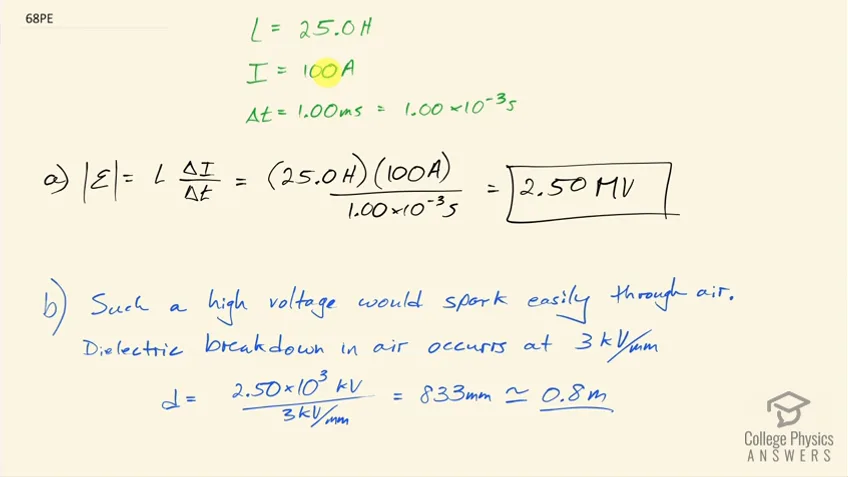
- Such a high voltge would spark easily through air. Dielectric breakdown in air occurs at 3 kV/mm, which means a voltage of 2.50 MV could spark over a distance of 83cm. This is far to dangerous to work with or use in any appliance.
- Such a large current with such a large inductor can not be shut off in such a short time.
Solution video

This is a 23-second preview. Get access to the full video by starting your free 7-day trial.
This is a 23-second preview. Get access to the full video by starting your free 7-day trial.
Calculator Screenshots
Video Transcript
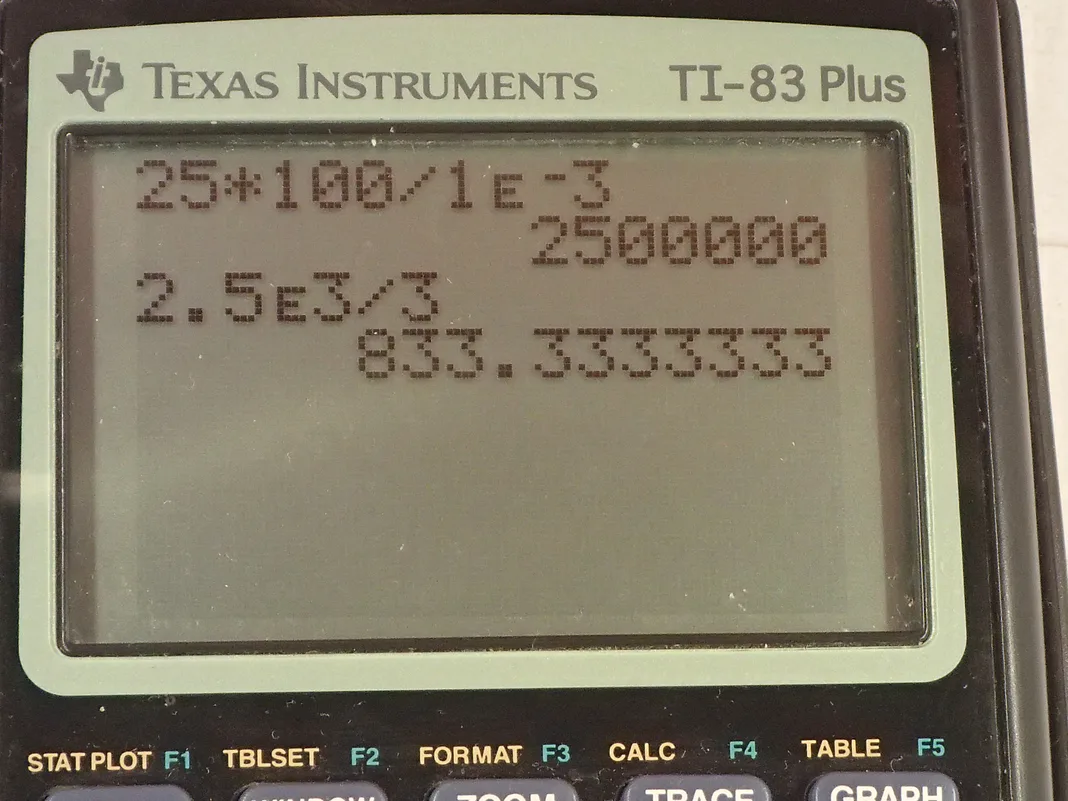
This is College Physics Answers with Shaun Dychko. We are told that 100 amps is flowing through an inductor with an inductance of 25.0 henries and that current is turned off in 1.00 millisecond, which is 1.00 times 10 to the minus 3 seconds. So part (a) asks what is the induced emf? I am taking the absolute value of the emf because its direction is not important; this formula is technically emf equals negative L times ΔI over Δt but we can ignore the minus there by just taking its magnitude— that's all we are interested in here. So this is the inductance times the change in current divided by change in time; the current is being turned off so the change in current is the initial current— 100 minus 0 or 0 minus 100, if you want to put it that way final current minus initial current— but in any case, we are just interested in magnitudes so the order of the final minus initial current doesn't matter, it's just 100 amps is the change in current times by 25.0 henries divided by 1.00 millisecond and that's 2.50 megavolts. That is a very high voltage that would spark easily through air; the dielectric breakdown of air occurs at about 3.00 kilovolts for every millimeter so if you have a distance of 1.00 millimeter and a potential between these two points of 3.00 kilovolts and this is just air in between, a spark will happen or any voltage higher than that, a spark will happen and this is 2.50 megavolts, it's three orders of magnitude greater than this and so the distance over which a spark can occur is 2.50 times 10 to the 3 kilovolts— turning this megavolts into units of kilovolts by multiplying by 10 to the 3 here— divided by 3 kilovolts per millimeter is 833 millimeters or 0.8 meters. This is the distance over which 2.50 megavolts could spark; that's a pretty large distance so this is not a safe voltage to work with. And the thing that's unreasonable in the data given is probably this change in time; this is too quick to turn off such a high current flowing through such a high inductor.
Comments
No comments yet.