
18310174593marshal·
Nevermind! I was not fluent with the fundamental idea of torque, I understand now!
Like
Question
This is a 16-second preview. Get access to the full video by starting your free 7-day trial.
This is a 16-second preview. Get access to the full video by starting your free 7-day trial.
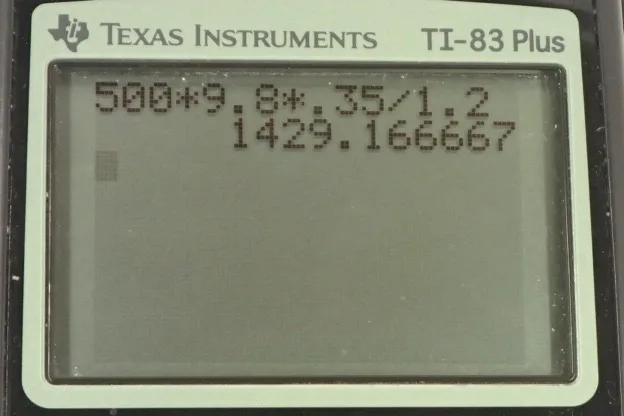
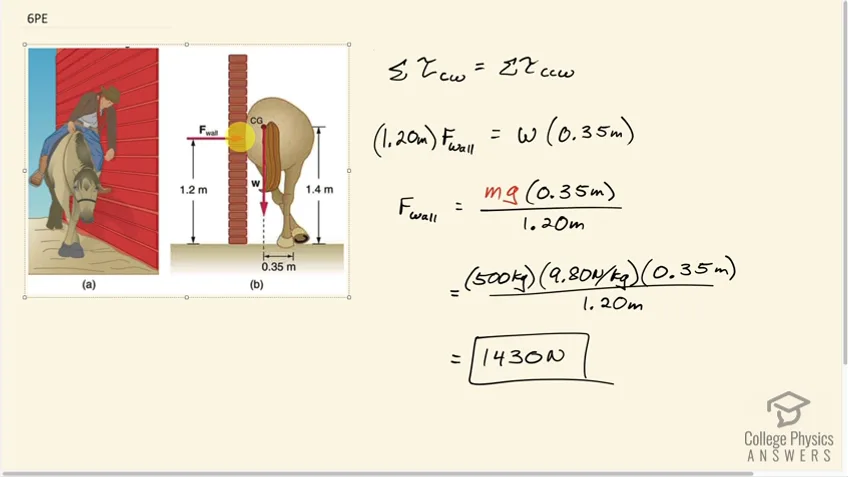
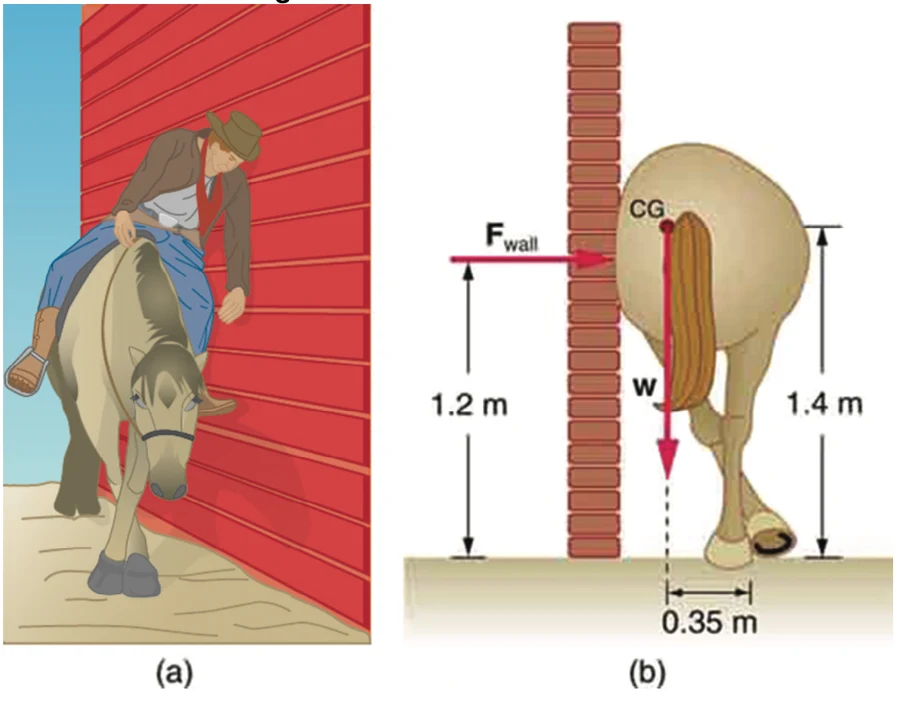
This is College Physics Answers with Shaun Dychko. We are going to calculate the force exerted on the wall due to the horse and that's going to be the third-law counterpart— Newton's third-law counterpart— to the force exerted on the horse due to the wall and the force on the horse due to the wall exerts a torque and we can calculate what that force will be and then we'll say that the force on the wall due to the horse is the same magnitude which is the other direction. So the force exerted by the wall is 1.20 meters away from the pivot at the horse's foot and so that has a clockwise torque and that's gonna equal the total counter-clockwise torque which is due to the weight which has a perpendicular distance to the pivot of 0.35 meters so we multiply w by 0.35 meters. And then divide both sides by 1.20 meters and then substitute mass of the horse and rider times g in place of the weight w and that means the force exerted by the wall on the horse is mg times 0.35 divided by 1.20. So that's 500 kilograms times 9.80 newtons per kilogram times 0.35 meters divided by 1.20 meters which is 1430 newtons and this is also the force on the wall due to the horse.