
erancano·
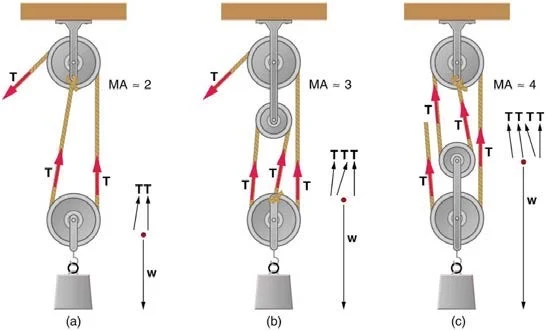
The problem says to consider a pulley as in figure a, not figure c.
Like
Question
a)
b)
This is a 25-second preview. Get access to the full video by starting your free 7-day trial.
This is a 25-second preview. Get access to the full video by starting your free 7-day trial.
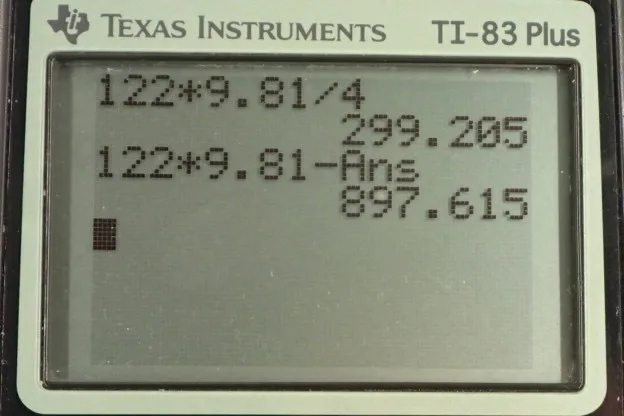
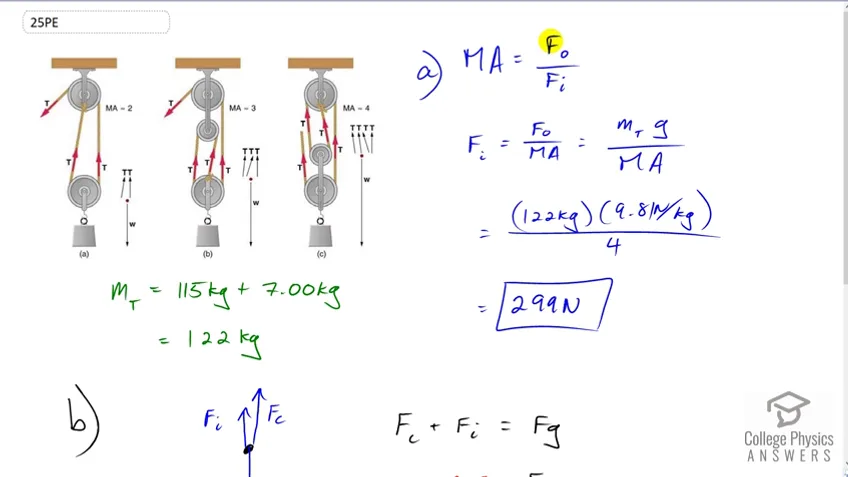
This is College Physics Answers with Shaun Dychko. We’re given the mechanical advantage of this pulley system in part c is four. We know mechanical advantage is the output force divided by the input force, so we’ll solve this for the input force by multiplying both sides by Fi over MA. Then we get the input force is the output force divided by mechanical advantage. So the output force has to be the total weight of the pulley system and the engine hanging off of it, so that’s 115 kilograms plus seven kilograms which is 122 kilograms times 9.81, and all that is divided by the mechanical advantage of four, to give an input force required of 299 newtons. And then part b asks us to find out what is the force exerted by the ceiling on the system. Well let’s first of all redraw the system as a single dot and consider the forces that are on that dot. There is gravity downwards due to the weight of the system and the engine, then there’s the force of the ceiling upwards which we’re going to find, and the way this pulley system is constructed, there’s also one force upwards which is the input force. All these other Ts inside here, these tensions, are forces that are internal to the system and they are not externally applied. So the force of the ceiling plus the input force upwards equals the total force of gravity downwards, and we’ll subtract Fi from both sides and also substitute mg in place of Fg, and we get the force applied by the ceiling, 122 kilograms times 9.81 newtons per kilogram minus 299.205 newtons input force, giving us 898 newtons is the force applied by the ceiling.