Question
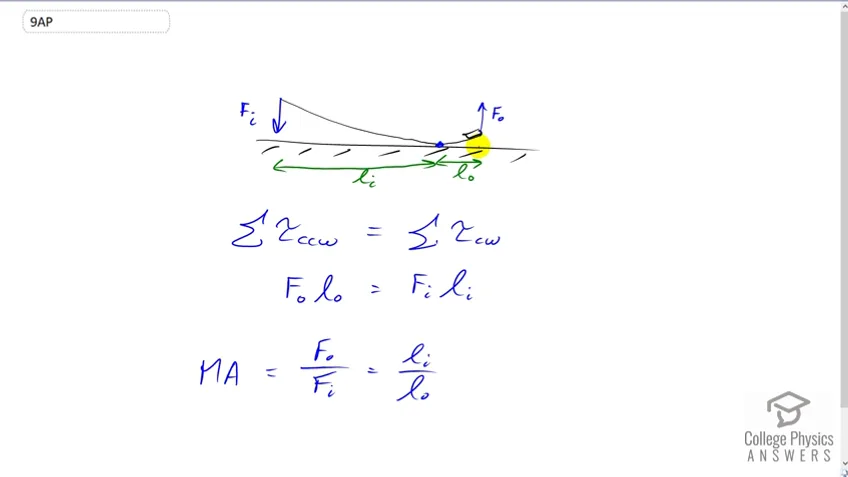
As a young student, you likely learned that simple machines are capable of increasing the ability to lift and move objects. Now, as an educated AP Physics student, you are aware that this capability is governed by the relationship between force and torque. In the space below, explain why torque is integral to the increase in force created by a simple machine. You may use an example or diagram to assist in your explanation. Be sure to cite the mechanical advantage in your explanation as well.
Final Answer
See the solution video.
Solution video

This is a 21-second preview. Get access to the full video by starting your free 7-day trial.
This is a 21-second preview. Get access to the full video by starting your free 7-day trial.
Video Transcript
This is College Physics Answers with Shaun Dychko. We're going to use a nail puller as an example to illustrate mechanical advantage due to torques. So we can see that the output force on this end of the nail puller, is going to be different from the input force and that difference results from the different lever arms. Now, the clockwise torque has to equal the counter-clockwise torque in a system in equilibrium, and that's the second condition for equilibrium. So we can see that the output torque is the output force that the nail will experience multiplied by its lever arm l naught, and that's going to equal the input force multiplied by its lever arm, l i. If we take the ratio of these two forces, we can divide both sides byF i and also divide both sides by l naught. We end up with F naught over F i equals the lever arm of the input force divided by the lever arm of the output force. This ratio of forces is called mechanical advantage and it results from different lever arms. If you had this output lever arm equal to the input lever arm, there'd be no mechanical advantage at all and there wouldn't be any purpose for the tool. I mean, except for maybe perhaps it's easier to push down than it is to pull up on something. You know, by pushing down you could result in a force that goes up but it would be an equal force if the lever arm is equal. But by shrinking the lever arm for the output torque, you get yourself mechanical advantage.
Comments
No comments yet.