Question
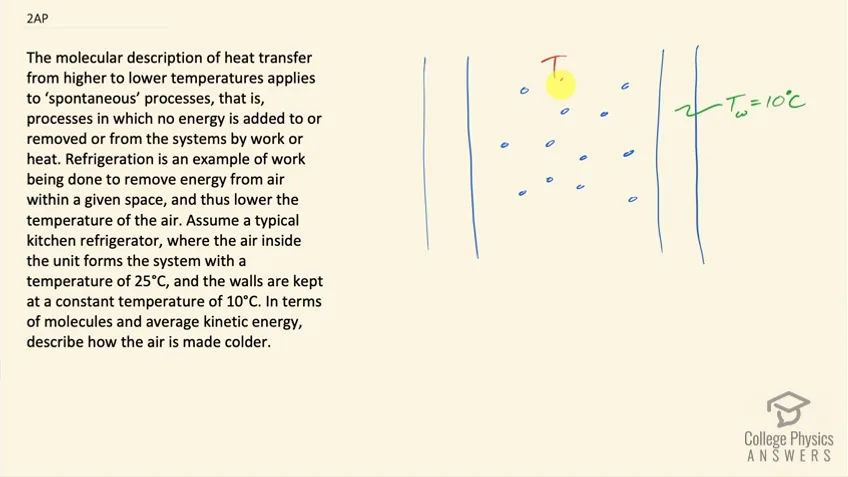
The molecular description of heat transfer from higher to lower temperatures applies to ‘spontaneous’ processes, that is, processes in which no energy is added to or removed or from the systems by work or heat. Refrigeration is an example of work being done to remove energy from air within a given space, and thus lower the temperature of the air. Assume a typical kitchen refrigerator, where the air inside the unit forms the system with a temperature of 25°C, and the walls are kept at a constant temperature of 10°C. In terms of molecules and average kinetic energy, describe how the air is made colder.
Final Answer
Please see the solution video.
Solution video

This is a 27-second preview. Get access to the full video by starting your free 7-day trial.
This is a 27-second preview. Get access to the full video by starting your free 7-day trial.
Video Transcript
This is College Physics Answers with Shaun Dychko. In terms of molecules and kinetic energy, we are gonna discuss how this air inside this refrigerator, which has an initial temperature of 25 degrees Celsius eventually cools down because the walls of the refrigerator are kept at a constant temperature of 10 degrees Celsius and some work is done by the refrigerator cooling system to keep the walls at this temperature. Now let's just talk about the air molecules inside and ignore the walls for a moment... when one molecule of air hits another molecule there might be some transfer of kinetic energy between the two and this molecule might lose kinetic energy and this one that it collides with might gain kinetic energy but the total amount of kinetic energy among these two will stay the same—we can assume that the collision is elastic— and whatever this one loses, this one gains and then this one will in turn send more kinetic energy to the next molecule that it impacts and and then this one that lost kinetic energy due to this collision initially will eventually receive some kinetic energy from some other molecule that in turn hits it and so on and the net amount of kinetic energy among all these molecules remains constant and this is thermal equilibrium. Now when these molecules impact the walls—let's consider the walls now— they will impart some kinetic energy to a wall molecule but that energy isn't gonna be coming back because the refrigerating system... the cooling system will take this kinetic energy that the wall molecule received from the air molecule and dissipate it into the room surrounding the refrigerator and so whatever kinetic energy an air molecule lost by impacting a wall molecule that energy isn't coming back later. and so this is the way in which eventually the kinetic energy of the molecules inside the refrigerator will reduce to the point where the energy that they give to the wall becomes equal to the amount they receive back and that happens when the temperatures are the same when their kinetic energies are the same in other words since kinetic energy is proportional to temperature it's 3 over 2 times Boltzmann's constant times absolute temperature. So this is sort of a description of how transfer of kinetic energy between molecules results in thermal equilibrium. Yeah... there we go!
Comments
No comments yet.