Question
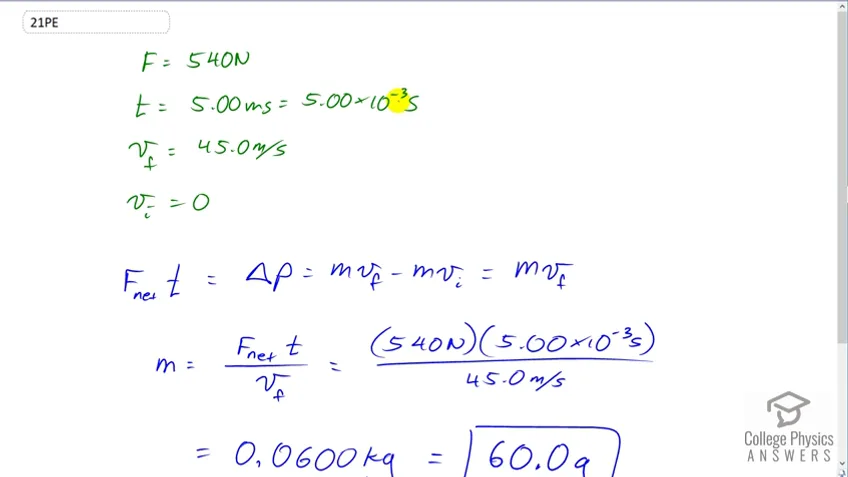
When serving a tennis ball, a player hits the ball when its velocity is zero (at the highest point of a vertical toss). The racquet exerts a force of 540 N on the ball for 5.00 ms, giving it a final velocity of 45.0 m/s. Using these data, find the mass of the ball.
Final Answer
Solution video

This is a 15-second preview. Get access to the full video by starting your free 7-day trial.
This is a 15-second preview. Get access to the full video by starting your free 7-day trial.
Calculator Screenshots
Video Transcript
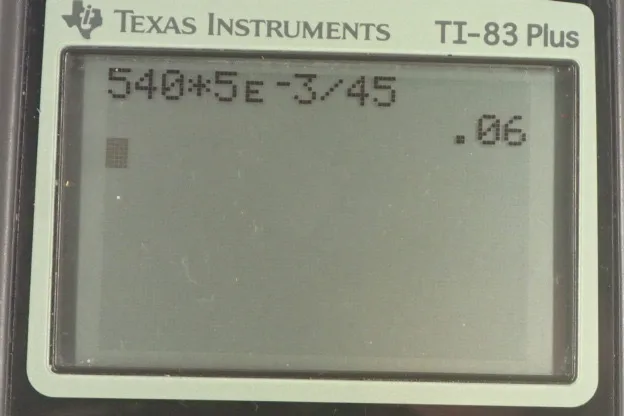
This is College Physics Answers with Shaun Dychko. The tennis racquet exerts a force of 540 newtons on the tennis ball for five milliseconds which is five times ten to the minus three seconds, giving a final velocity for the ball of 45 meters per second, and it starts from rest. So the force that the racquet applies on the ball will be the net force on the ball because the -- let's assume that the force is horizontal and so there is no component of gravity in the direction of the force is being applied by the tennis racquet. So this force by the tennis racquet is therefore the net force in the x direction and we can multiply it by time to get the impulse which is the change of momentum, mass times final velocity minus mass times initial velocity. The initial velocity was zero and so this reduces to m v f. So we'll divide both sides by v f in order to solve for the mass of the ball. So the mass is net force times time divided by final velocity. That's 540 newtons, times five times ten to the minus three seconds, divided by 45 meters per second, which works out to 60.0 grams must be the mass of the ball.
Comments
No comments yet.