Question
Antiballistic missiles (ABMs) are designed to have very large accelerations so that they may intercept fast-moving incoming missiles in the short time available. What is the takeoff acceleration of a 10,000-kg ABM that expels 196 kg of gas per second at an exhaust velocity of
Final Answer
Solution video

This is a 12-second preview. Get access to the full video by starting your free 7-day trial.
This is a 12-second preview. Get access to the full video by starting your free 7-day trial.
Calculator Screenshots
Video Transcript
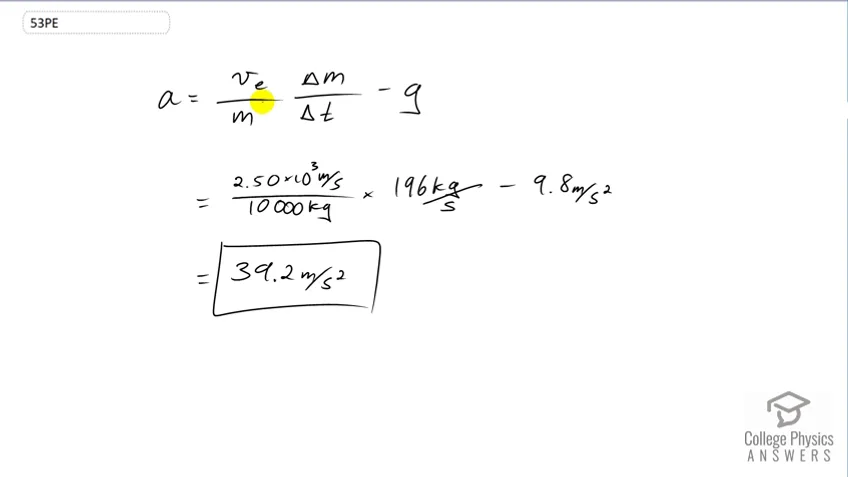
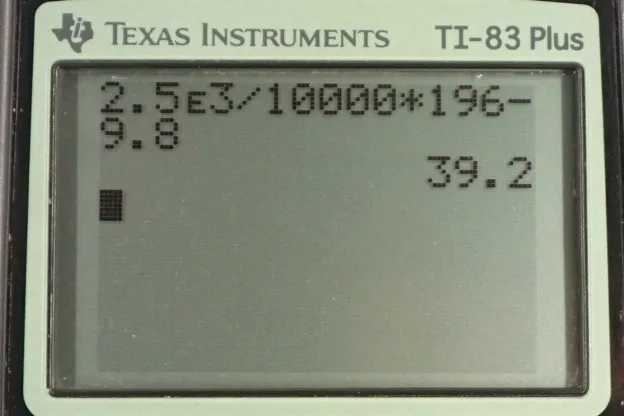
This is College Physics Answers with Shaun Dychko. Here's an approximation for the acceleration of a rocket given to us by the textbook. The exhaust velocity is divided by the mass of the rocket, multiplied by the rate at which gas is expelled from the rocket. So, that's the change in the rocket's mass divided by time and then minus acceleration due to gravity. So we're told that the exhaust is ejected at a speed of 2.5 times ten to the three meters per second and the rocket has a mass of 10,000 kilograms and there is 196 kilograms of exhaust expelled every second. So this has units of mass over time and so this single thing substitutes for delta m over delta t. Then minus 9.8 meters per second squared gives us 39.2 meters per second squared is the acceleration of the rocket.
Comments
No comments yet.