Question
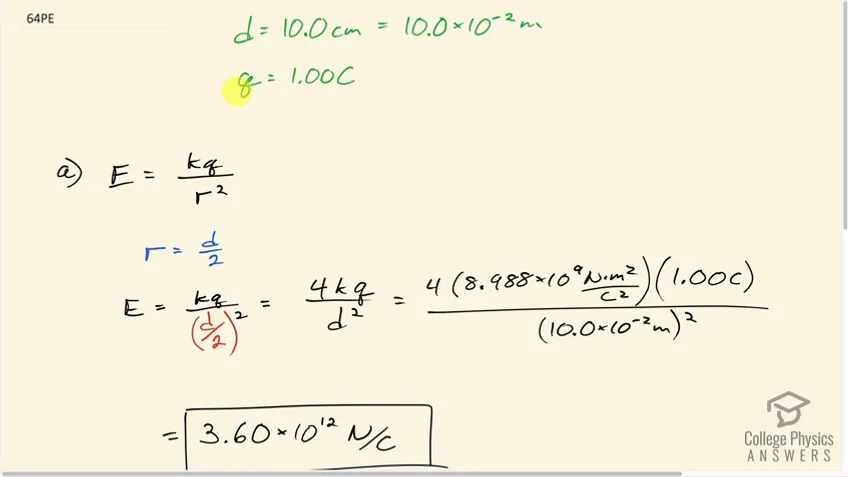
(a) Calculate the electric field strength near a 10.0 cm diameter conducting sphere that has 1.00 C of excess charge on it. (b) What is unreasonable about this result? (c) Which assumptions are responsible?
Final Answer
- This electric field is too large in air. Dielectric breakdown occurs at , which is many orders of magnitude less than the field outside this sphere. Sparks would occur before reaching the field strength of
- The charge is excessive.
Solution video

This is a 19-second preview. Get access to the full video by starting your free 7-day trial.
This is a 19-second preview. Get access to the full video by starting your free 7-day trial.
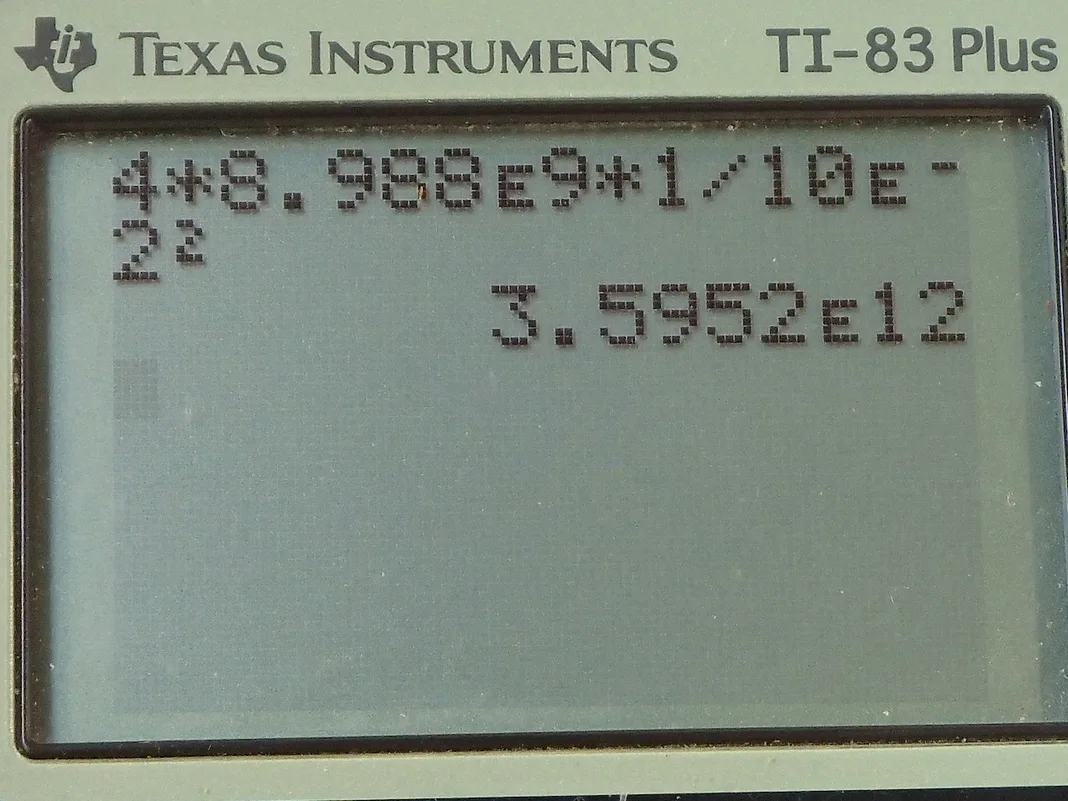
Calculator Screenshots
Video Transcript
This is College Physics Answers with Shaun Dychko. A conducting sphere of the diameter of 10.0 centimeters has 1.00 coulomb of charge on it supposedly. Now the electric field near this sphere we will take to be the electric field on the surface of the sphere and that can be modeled as a point charge because a sphere can be modeled as a point charge with the charge at the center of the sphere. So this distance r in this formula for the electric field is going to be the radius of the sphere and the radius is half the diameter so we'll substitute that in for r and this works out to 4 times Coulomb's constant times the charge divided by the diameter squared. So the electric field is 4 times Coulomb's constant times 1.00 coulomb of charge divided by 10.0 centimeters squared and that's 3.60 times 10 to the 12 newtons per coulomb. And this is a very large electric field— it's too large in fact—because air starts to conduct electricity at 3 times 10 to the 6 newtons per coulomb; this electric field will cause dielectric breakdown and it's this electric field which causes a spark or fields bigger than this might cause lightning as well. So this kind of field will never occur on an object in air and so this 1.00 coulomb of charge is excessive on the surface of the sphere.
Comments
No comments yet.