Question
A force is applied to accelerate an object on a smooth icy surface. When the force stops, which of the following will be true? (Assume zero friction.) (a) The object’s acceleration becomes zero.
(b) The object’s speed becomes zero.
(c) The object’s acceleration continues to increase at a constant rate.
(d) The object accelerates, but in the opposite direction.
Final Answer
(a)
Solution video

This is a 14-second preview. Get access to the full video by starting your free 7-day trial.
This is a 14-second preview. Get access to the full video by starting your free 7-day trial.
Video Transcript
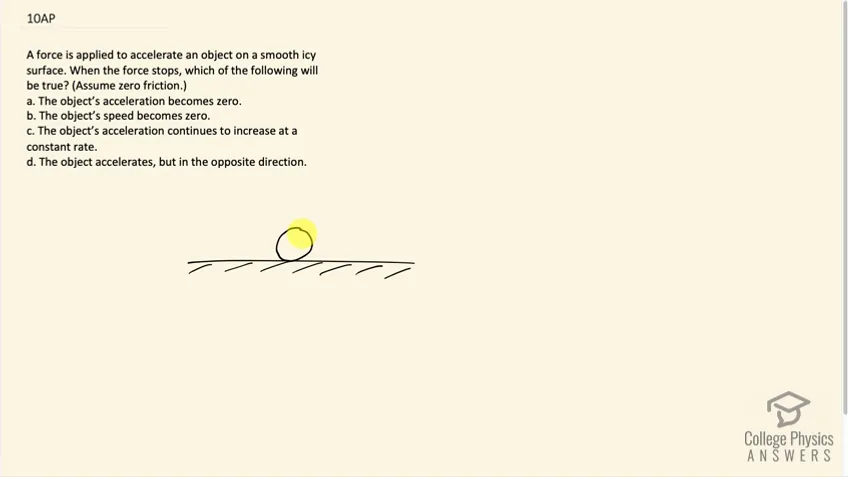
This is College Physics Answers with Shaun Dychko. Here's a free body diagram of this object on a smooth icy surface and here's an arrow indicating its velocity. There are no arrows indicating any forces because we assume that while there's sure there's the force of gravity downwards and then equal but opposite force upwards and normal force so that there's no vertical acceleration. Horizontally speaking, there are no forces either because we're told that this is a smooth surface and icy so there's no friction, and the force that was used to accelerate the object has stopped and so there's no force forwards either. This object will continue along in a straight line with no acceleration. That is Newton's first law. Things will move at constant velocity unless acted upon by an unbalanced or in other words, net force. We'll say acceleration becomes zero. Yes, it's going to move at constant speed, so no acceleration, and it will continue moving so it can't be B. There's nothing to accelerate it so it can't be C. Well, same reason can't be D. So answer is A.
Comments
No comments yet.