
jzablocki·
what would the direction for this be? how would you calculate it?
Like
Question
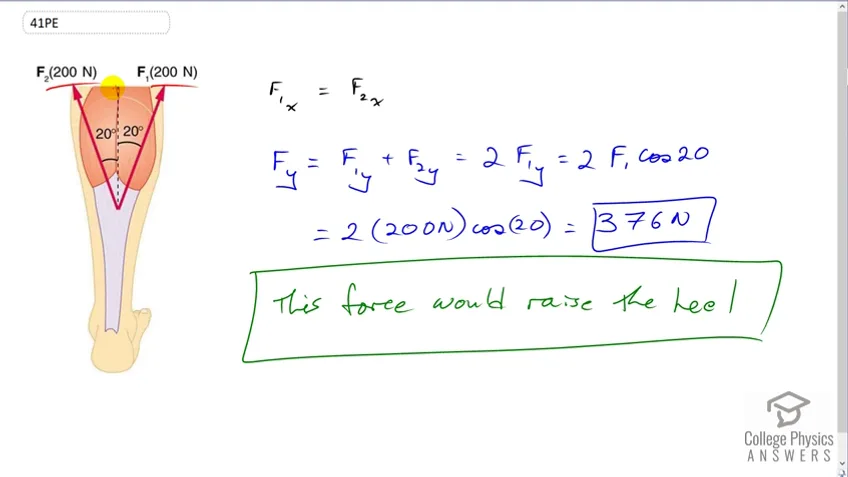
This force would raise the heel.
This is a 17-second preview. Get access to the full video by starting your free 7-day trial.
This is a 17-second preview. Get access to the full video by starting your free 7-day trial.
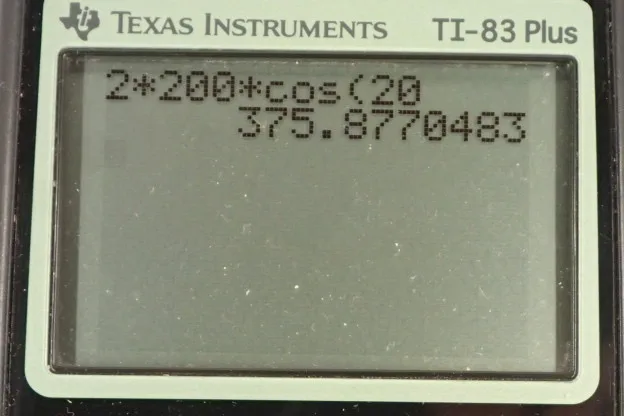
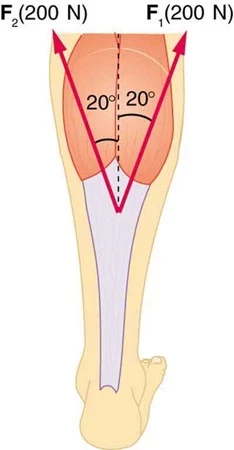
This is College Physics Answers with Shaun Dychko. We can see these two forces being exerted on the Achilles tendon and they are of equal magnitude, both being 200 newtons, and they're at equal angles, 20 degrees and so this means the x component of each will be the same but in opposite directions and they'll cancel out. So we define the net force here or the total force exerted by the muscles on the tendon, we need to only think about the y components. So the total force in the y direction is going to be the force one in the y direction plus the force two in the y direction but since they're equal magnitude and equal angles with respect to the vertical, we can just say two times the y component of one of them. So that's going to be F one times cos 20 and it's the cosine because we're looking for the adjacent leg of this triangle and so this portion here vertically is F one times cosine of 20. So we have two times 200 times cosine of twenty gives us 376 newtons total and that force would raise the heel because it is lifting up on the heel here.