
#catchurlifedhk·
I do not know how to work my calculator fx-991ex
Like
Question
This is a 15-second preview. Get access to the full video by starting your free 7-day trial.
This is a 15-second preview. Get access to the full video by starting your free 7-day trial.
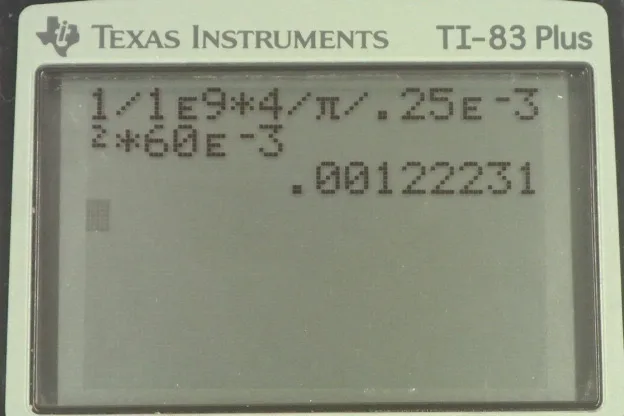
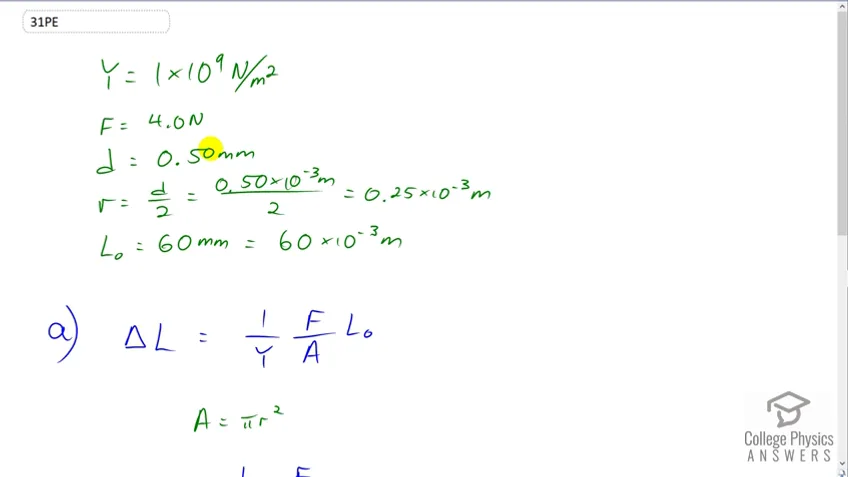
This is College Physics Answers with Shaun Dychko. Since these questions on stress and strain have a lot of data in them, it's extra important to write down all the data at the beginning of the question. So the Young's Modulus for pencil lead is one times ten the nine newtons per meter and the force applied to the lead is 4.0 newtons, the diameter is 0.5 millimeters but we're going to need radius in our work because the cross sectional area of the lead will be pi times radius squared. So let's divide that diameter by two, also convert its units into meters. So 0.5 times ten to the minus three meters divided by two gives 0.25 times ten to the minus three meters radius. The original length is 60 millimeters which is 60 times ten to the minus three meters. So the change in length of the lead is one over the Young's Modulus of lead, times the force applied, divided by its cross sectional area, times its original length. So area being pi r squared, we can substitute that in for a here, and then plug in numbers. So we have one over one times ten to the nine newtons per square meter, Young's Modulus for lead, times four newtons applied, divided by pi times 0.25 time ten to the minus three meters radius squared, times 60 times ten to the minus three meters, original length, and this gives about 1.2 millimeters of compression of the lead. That's probably reasonable since lead seems to be quite flexible so it would make sense that it could be compressible that much.