Question
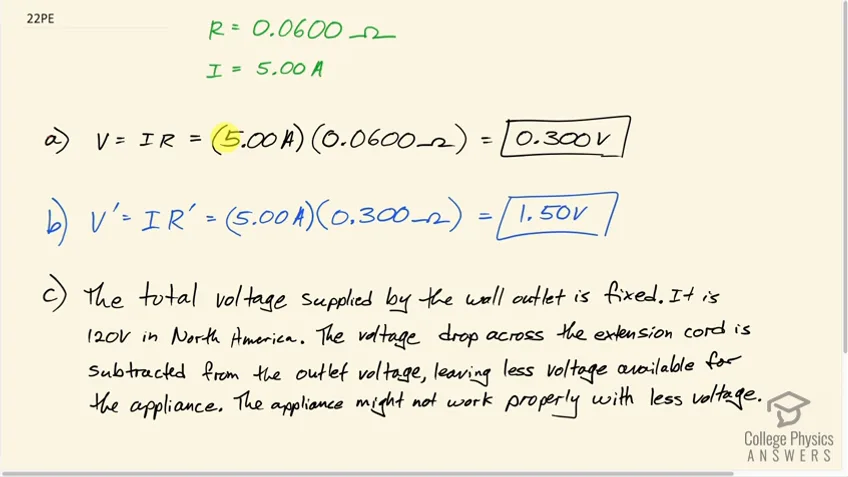
(a) Find the voltage drop in an extension cord having a resistance and through which 5.00 A is flowing. (b) A cheaper cord utilizes thinner wire and has a resistance of . What is the voltage drop in it when 5.00 A flows? (c) Why is the voltage to whatever appliance is being used reduced by this amount? What is the effect on the appliance?
Final Answer
- The total voltage supplied by the wall outlet is fixed. It is 120V in North America. The voltage drop across the extension cord is subtracted from the outlet voltage, leaving less voltage available for the appliance. The appliance might not work properly with less voltage.
Solution video

This is a 19-second preview. Get access to the full video by starting your free 7-day trial.
This is a 19-second preview. Get access to the full video by starting your free 7-day trial.
Calculator Screenshots
Video Transcript
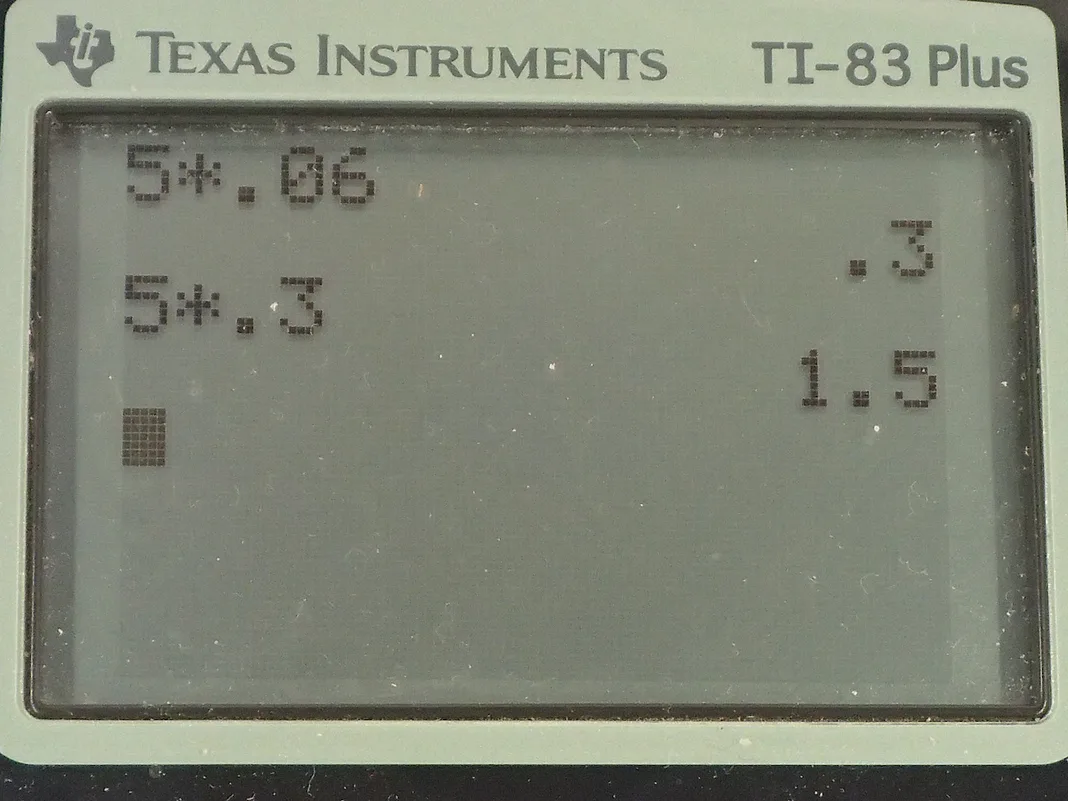
This is College Physics Answers with Shaun Dychko. In part (a), we imagine an extension cord is being used that has a resistance of 0.0600 ohms and it's carrying a current of 5.00 amps and we want to know what is the voltage drop across the cord and that would be 0.300 volts since the voltage is current multiplied by resistance. And then in part (b), we are told that there's a new extension cord that's cheaper and it has a higher resistance— it probably has less copper in it— and so its resistance is 0.300 ohms and we multiply that by 5.00 amps to get 1.50 volts would be the voltage drop in that case. And this voltage drop across the extension cord is going to reduce the voltage available for the appliance that's plugged into the extension cord because the total voltage supplied by the wall outlet is fixed at some standard depending on what country you are in— in North America, it's 120 volts— and so that means that this voltage drop across the extension cord is going to be subtracted by whatever the standard is, 120 volts for example, and the appliance is probably designed to work with 120 volts and so it's going to be working with less than that as a result of this extension cord and that might cause the appliance to not work properly although only 1.50 volt drop probably is not significant. But you know if you have a heater plugged into an extension cord that's too small, the current will be very high and the heater, you know, it might not work properly or even more importantly, the cord might get very hot and present a fire hazard. Some appliances like a circular saw, for example, or anything with a strong motor in it might get damaged by having a reduced voltage as a result of this drop across the extension cord.
Comments
No comments yet.