
Chapter 22: Magnetism
105 problems solved · Free preview of every solution shows how it’s started · Watch the full videos with a free 7-day trial →
Image: United States Air Force photo by Senior Airman Joshua Strang


Section
22.4 Magnetic Field Strength: Force on a Moving Charge in a Magnetic Field
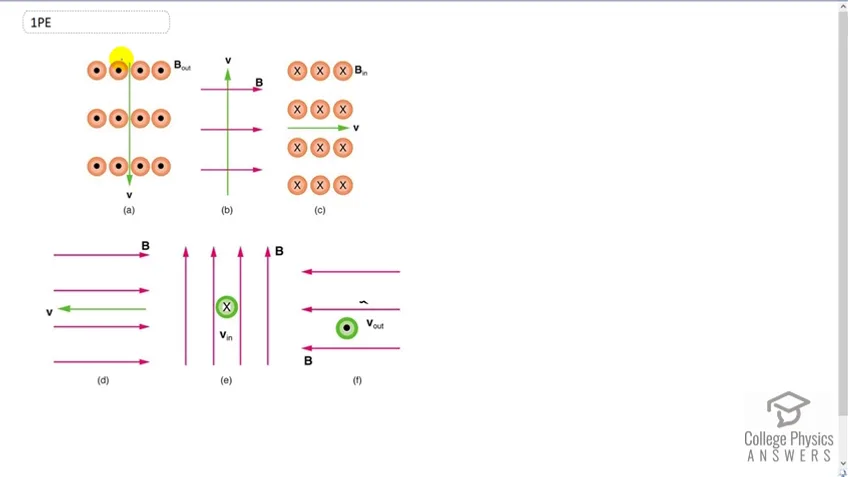 2:59Problem 1FreeWhat is the direction of the magnetic force on a positive charge that moves as shown in each of the six cases shown in Figure 22.50?
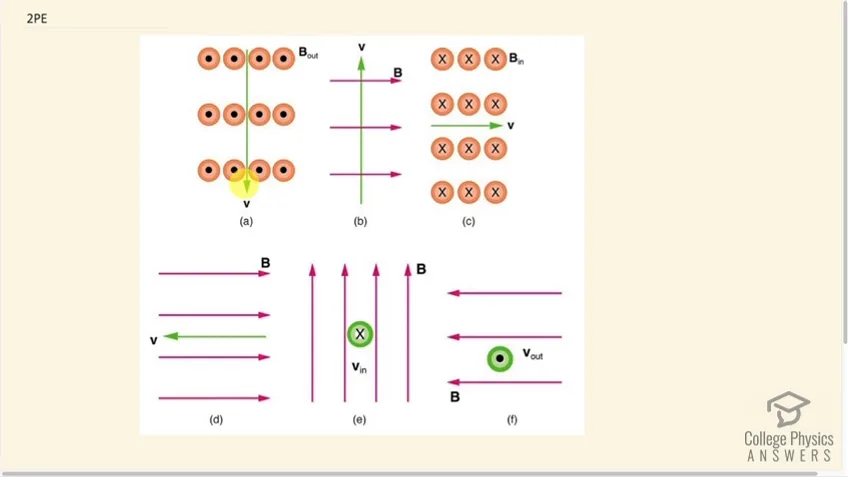 3:56PreviewProblem 2Full video with free trialWhat is the direction of the magnetic force on a negative charge that moves as shown in each of the six cases shown in Figure 22.50?
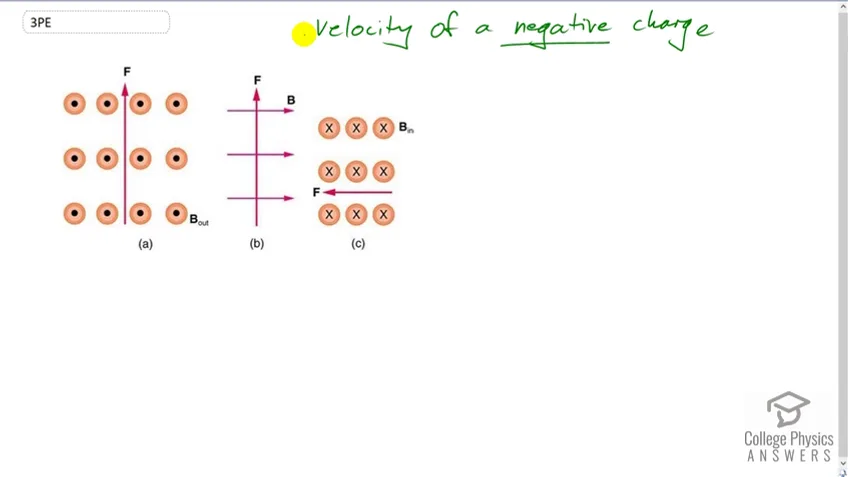 2:44PreviewProblem 3Full video with free trialWhat is the direction of the velocity of a negative charge that experiences the magnetic force shown in each of the three cases in Figure 22.51, assuming it moves perpendicular to .
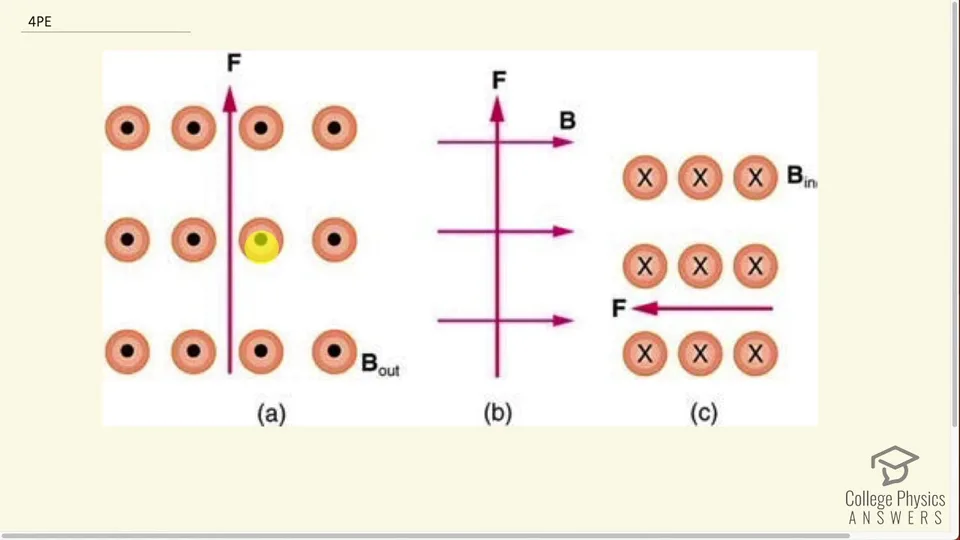 1:59PreviewProblem 4Full video with free trialWhat is the direction of the velocity of a positive charge that experiences the magnetic force shown in each of the three cases in Figure 22.51, assuming it moves perpendicular to ?
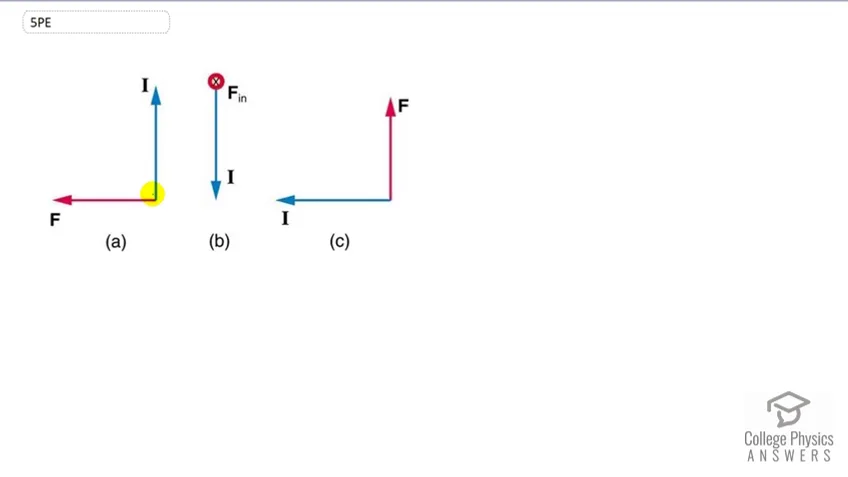 1:48PreviewProblem 5Full video with free trialWhat is the direction of the magnetic field that produces the magnetic force on a positive charge as shown in each of the three cases in the figure below, assuming is perpendicular to ?
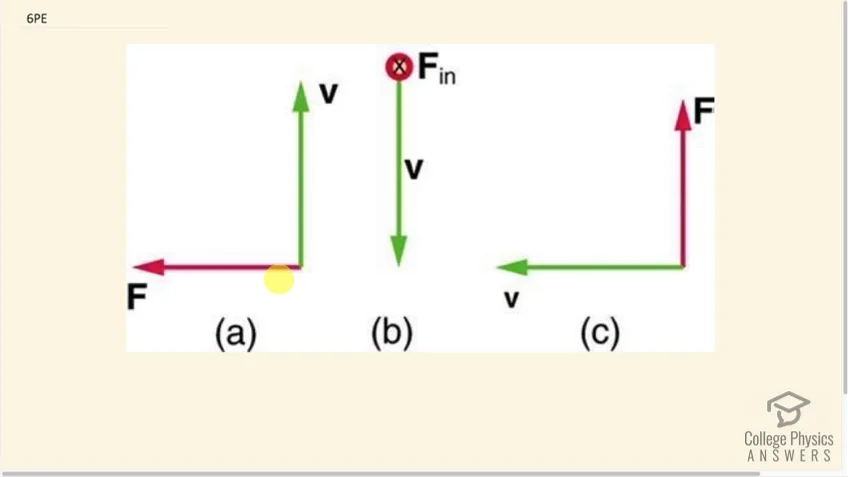 1:52PreviewProblem 6Full video with free trialWhat is the direction of the magnetic field that produces the magnetic force on a negative charge as shown in each of the three cases in the figure below, assuming is perpendicular to ?
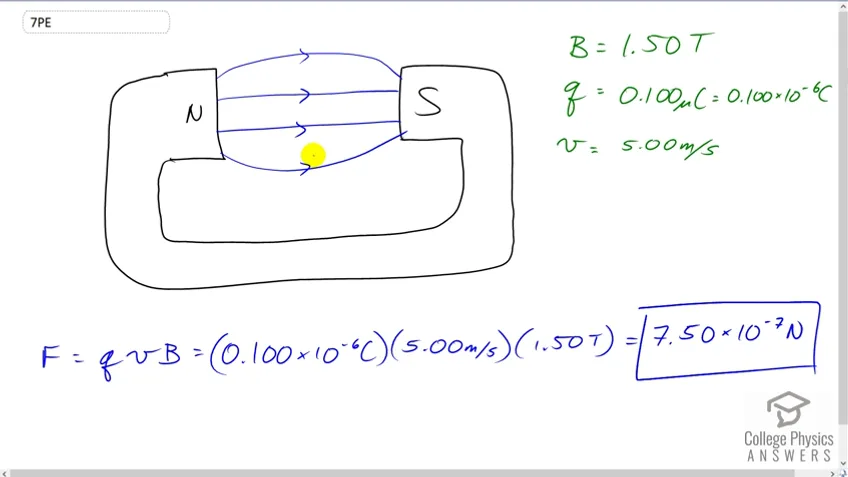 1:32PreviewProblem 7Full video with free trialWhat is the maximum magnitude of the force on an aluminum rod with a charge that you pass between the poles of a 1.50 T permanent magnet at a speed of 5.00 m/s? In what direction is the force?
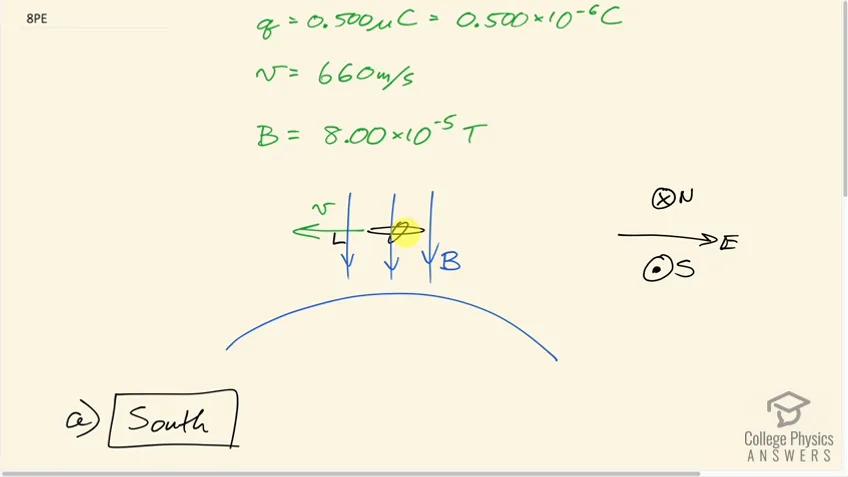 2:09PreviewProblem 8Full video with free trial(a) Aircraft sometimes acquire small static charges. Suppose a supersonic jet has a charge and flies due west at a speed of 660 m/s over the Earth’s magnetic south pole (near Earth's geographic north pole), where the magnetic field points straight down. What are the direction and the magnitude of the magnetic force on the plane? (b) Discuss whether the value obtained in part (a) implies this is a significant or negligible effect.
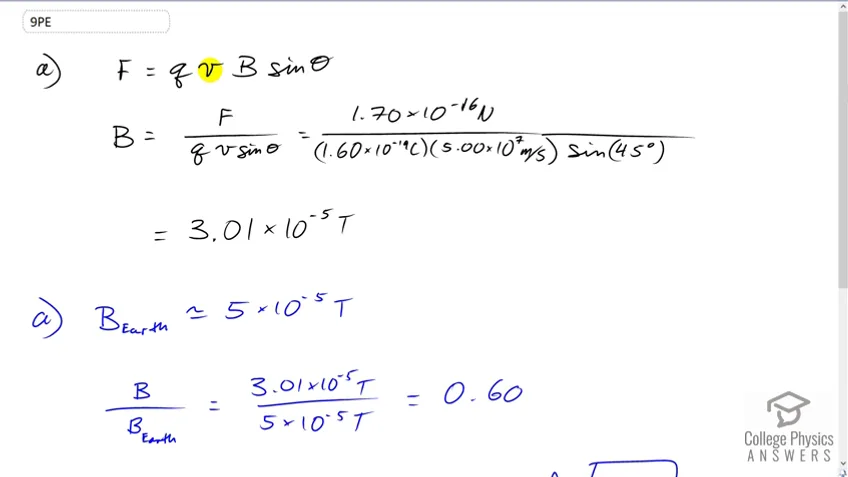 1:43PreviewProblem 9Full video with free trial(a) A cosmic ray proton moving toward the Earth at experiences a magnetic force of . What is the strength of the magnetic field if there is a angle between it and the proton’s velocity? (b) Is the value obtained in part (a) consistent with the known strength of the Earth’s magnetic field on its surface? Discuss.
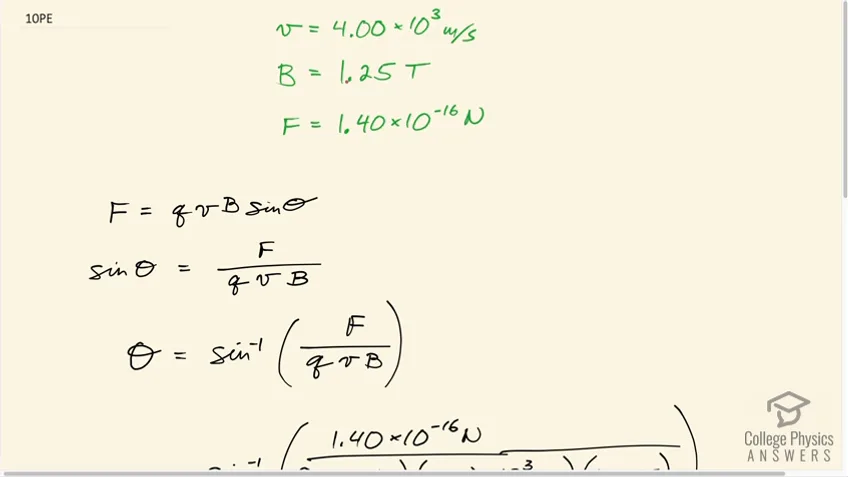 2:19PreviewProblem 10Full video with free trialAn electron moving at in a 1.25-T magnetic field experiences a magnetic force of . What angle does the velocity of the electron make with the magnetic field? There are two answers.
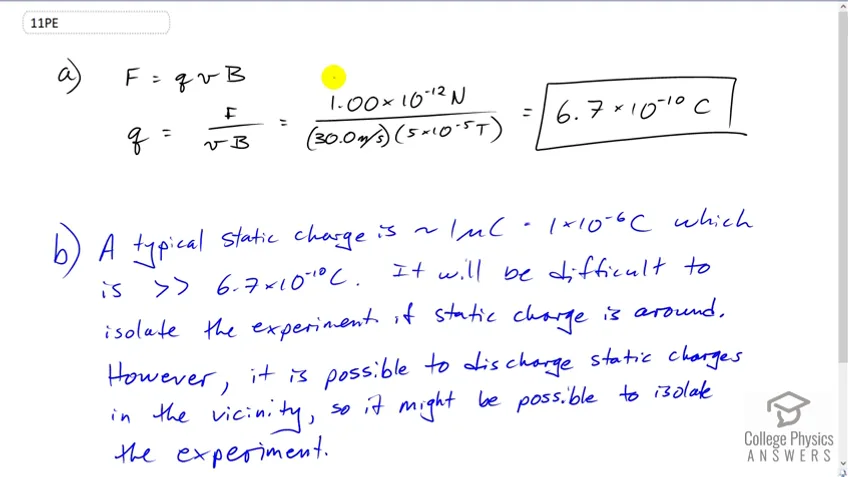 2:47PreviewProblem 11Full video with free trial(a) A physicist performing a sensitive measurement wants to limit the magnetic force on a moving charge in her equipment to less than . What is the greatest the charge can be if it moves at a maximum speed of 30.0 m/s in the Earth’s field? (b) Discuss whether it would be difficult to limit the charge to less than the value found in (a) by comparing it with typical static electricity and noting that static is often absent.
22.5 Force on a Moving Charge in a Magnetic Field: Examples and Applications
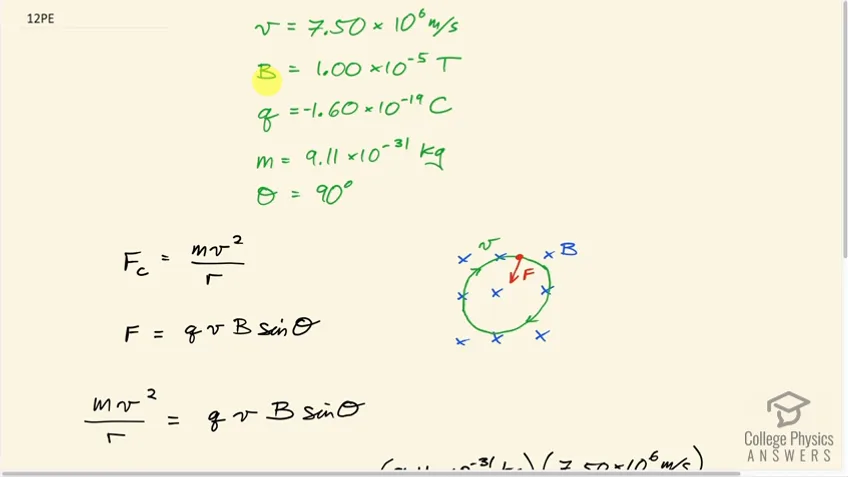 3:15PreviewProblem 12Full video with free trialA cosmic ray electron moves at perpendicular to the Earth’s magnetic field at an altitude where field strength is . What is the radius of the circular path the electron follows?
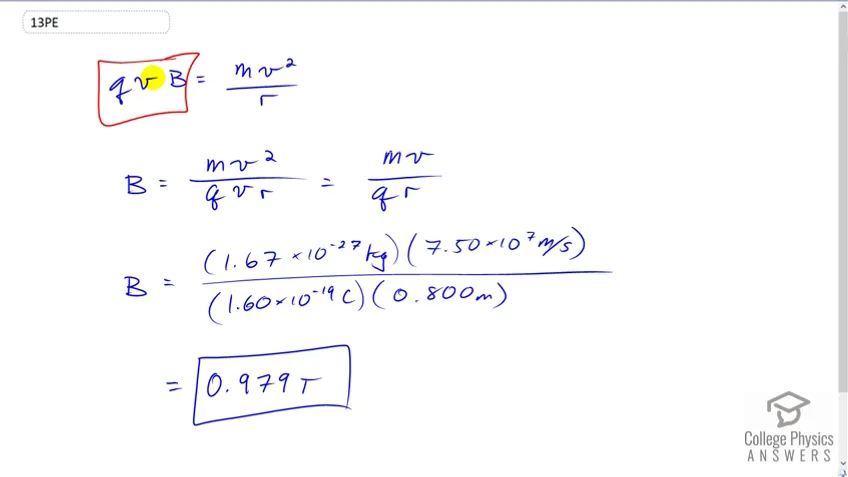 1:06PreviewProblem 13Full video with free trialA proton moves at perpendicular to a magnetic field. The field causes the proton to travel in a circular path of radius 0.800 m. What is the field strength?
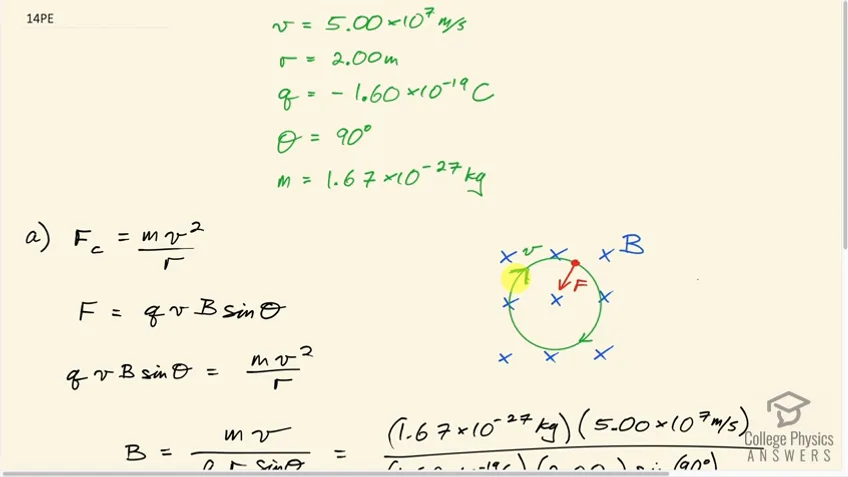 3:44PreviewProblem 14Full video with free trial(a) Viewers of Star Trek hear of an antimatter drive on the Starship Enterprise. One possibility for such a futuristic energy source is to store antimatter charged particles in a vacuum chamber, circulating in a magnetic field, and then extract them as needed. Antimatter annihilates with normal matter, producing pure energy. What strength magnetic field is needed to hold antiprotons, moving at in a circular path 2.00 m in radius? Antiprotons have the same mass as protons but the opposite (negative) charge. (b) Is this field strength obtainable with today’s technology or is it a futuristic possibility?
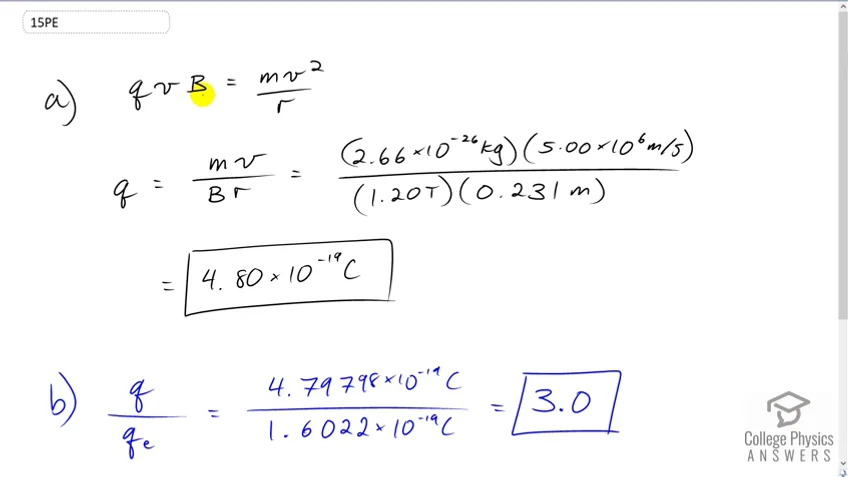 1:36PreviewProblem 15Full video with free trial(a) An oxygen-16 ion with a mass of travels at perpendicular to a 1.20-T magnetic field, which makes it move in a circular arc with a 0.231-m radius. What positive charge is on the ion? (b) What is the ratio of this charge to the charge of an electron? (c) Discuss why the ratio found in (b) should be an integer.
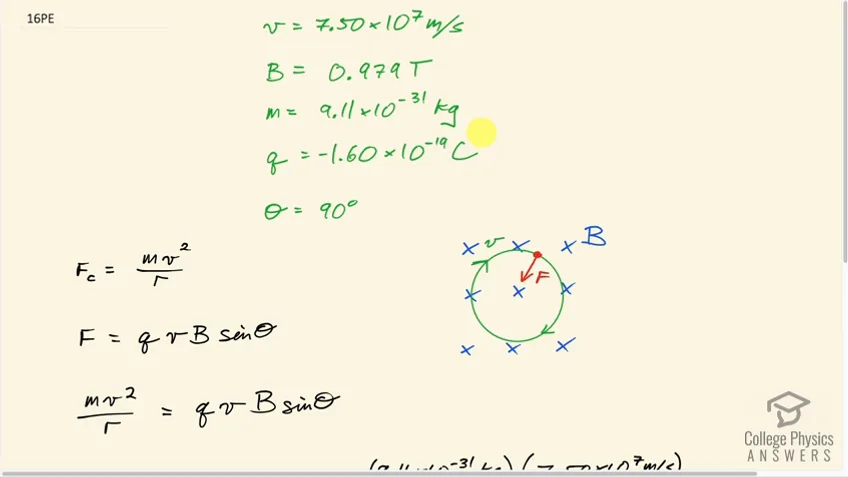 3:09PreviewProblem 16Full video with free trialWhat radius circular path does an electron travel if it moves at the same speed and in the same magnetic field as the proton in Exercise 22.13?
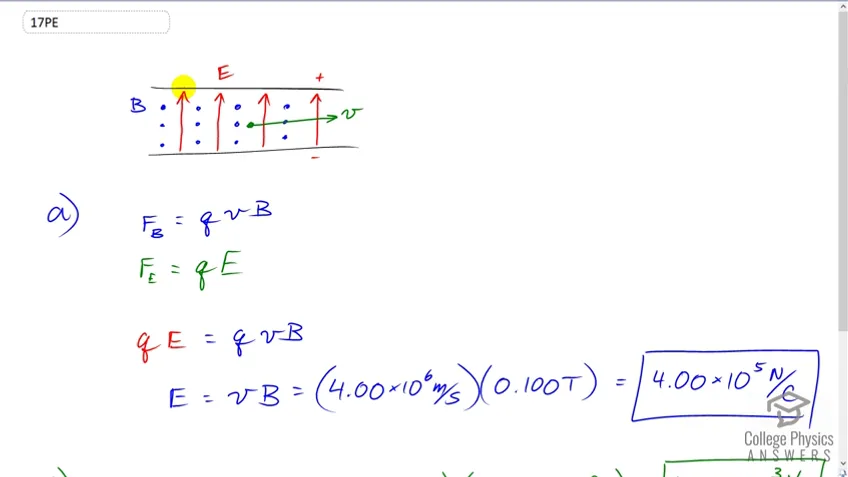 1:40PreviewProblem 17Full video with free trialA velocity selector in a mass spectrometer uses a 0.100-T magnetic field. (a) What electric field strength is needed to select a speed of ? (b) What is the voltage between the plates if they are separated by 1.00 cm?
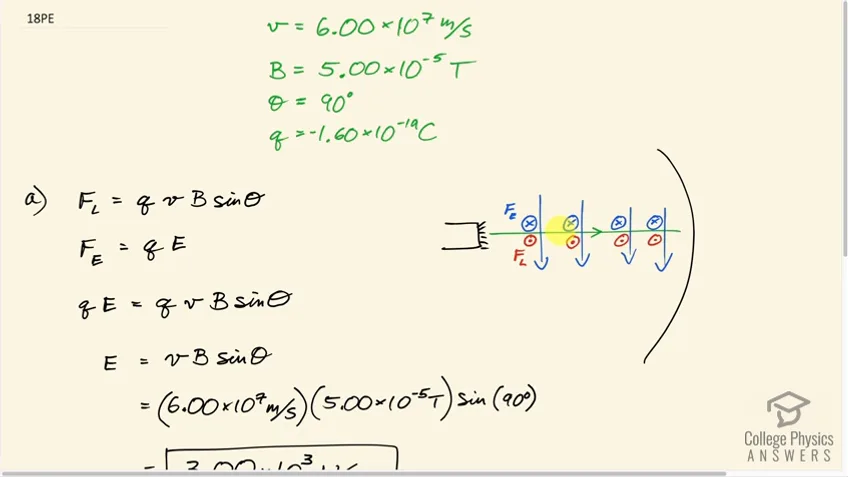 3:32PreviewProblem 18Full video with free trialAn electron in a TV CRT moves with a speed of , in a direction perpendicular to the Earth’s field, which has a strength of . (a) What strength electric field must be applied perpendicular to the Earth’s field to make the electron moves in a straight line? (b) If this is done between plates separated by 1.00 cm, what is the voltage applied? (Note that TVs are usually surrounded by a ferromagnetic material to shield against external magnetic fields and avoid the need for such a correction.)
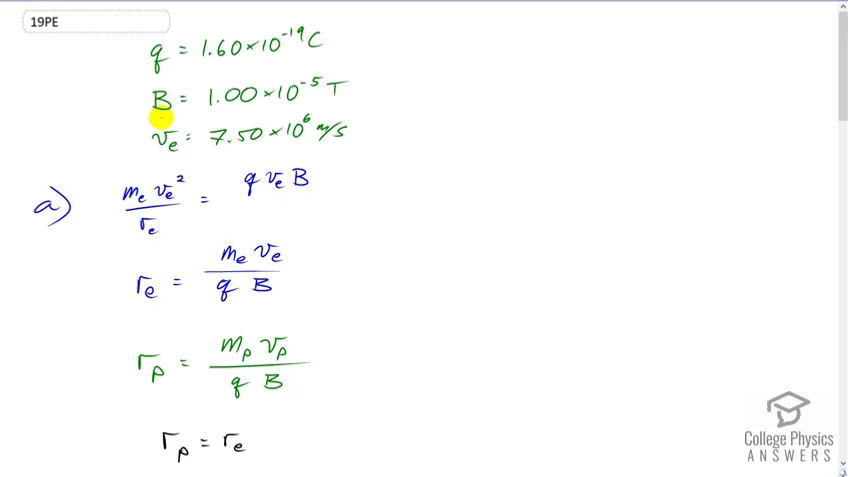 5:45PreviewProblem 19Full video with free trial(a) At what speed will a proton move in a circular path of the same radius as the electron in Exercise 22.12? (b) What would the radius of the path be if the proton had the same speed as the electron? (c) What would the radius be if the proton had the same kinetic energy as the electron? (d) The same momentum?
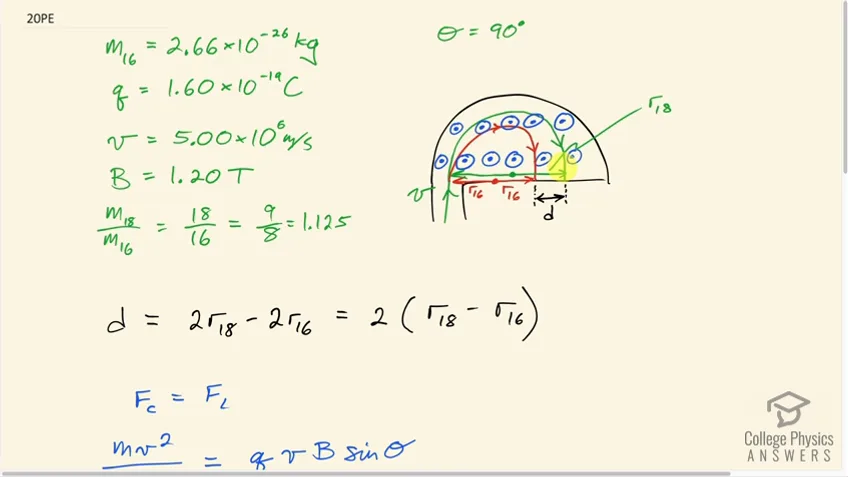 6:46PreviewProblem 20Full video with free trialA mass spectrometer is being used to separate common oxygen-16 from the much rarer oxygen-18, taken from a sample of old glacial ice. (The relative abundance of these oxygen isotopes is related to climatic temperature at the time the ice was deposited.) The ratio of the masses of these two ions is 16 to 18, the mass of oxygen-16 is , and they are singly charged and travel at in a 1.20-T magnetic field. What is the separation between their paths when they hit a target after traversing a semicircle?
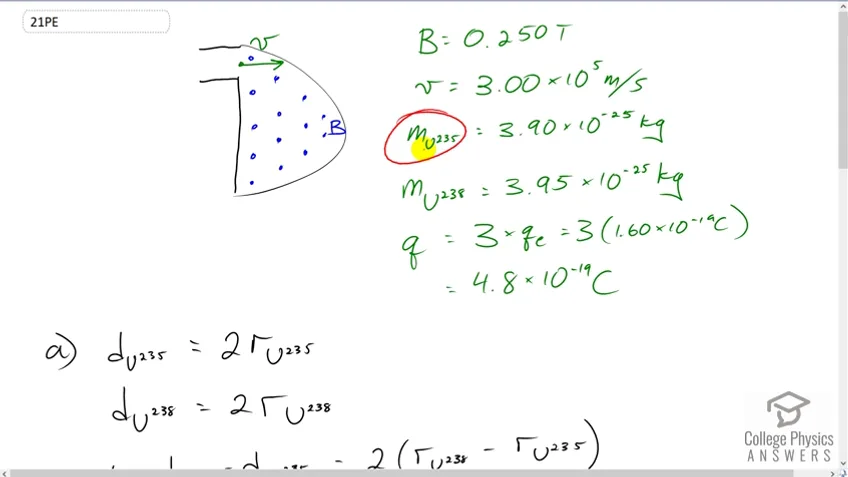 4:56PreviewProblem 21Full video with free trial(a) Triply charged uranium-235 and uranium-238 ions are being separated in a mass spectrometer. (The much rarer uranium-235 is used as reactor fuel.) The masses of the ions are and , respectively, and the travel at in a field. What is the separation between their paths when they hit a target after traversing a semicircle? (b) Discuss whether this distance between their paths seems to be big enough to be practical in the separation of uranium-235 from uranium-238.
22.6 The Hall Effect
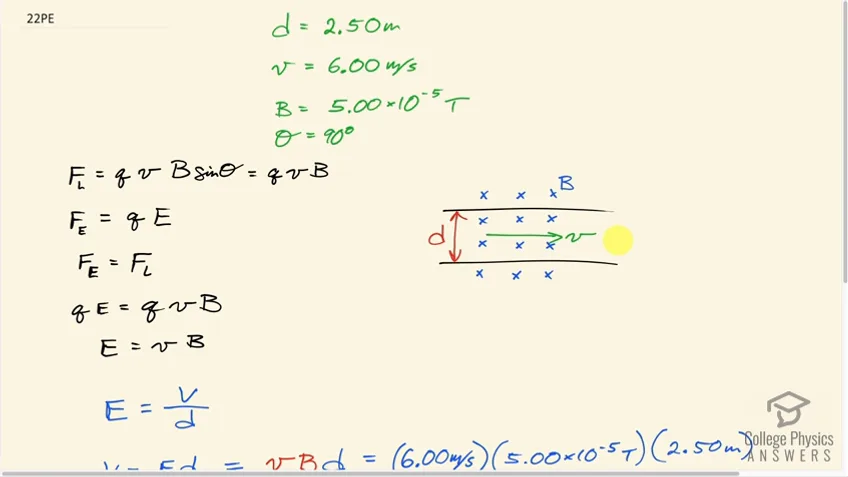 3:28PreviewProblem 22Full video with free trialA large water main is 2.50 m in diameter and the average water velocity is 6.00 m/s. Find the Hall voltage produced if the pipe runs perpendicular to the Earth’s field.
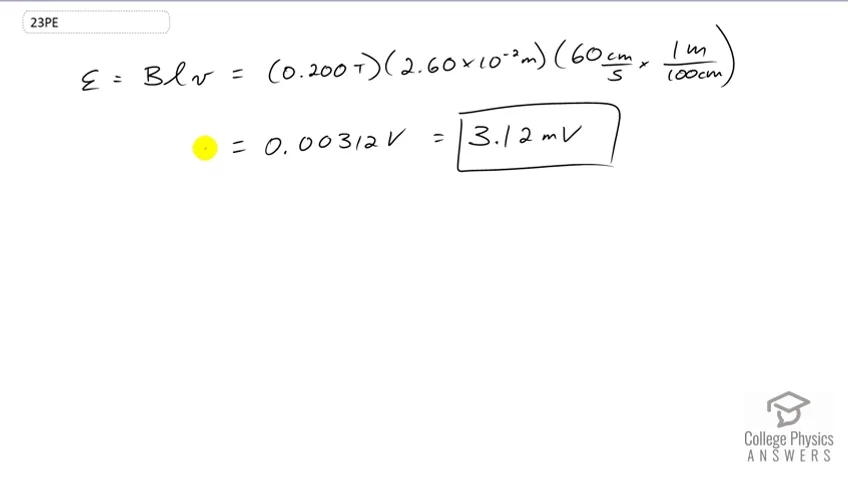 0:59PreviewProblem 23Full video with free trialWhat Hall voltage is produced by a 0.200-T field applied across a 2.60-cm-diameter aorta when blood velocity is 60.0 cm/s?
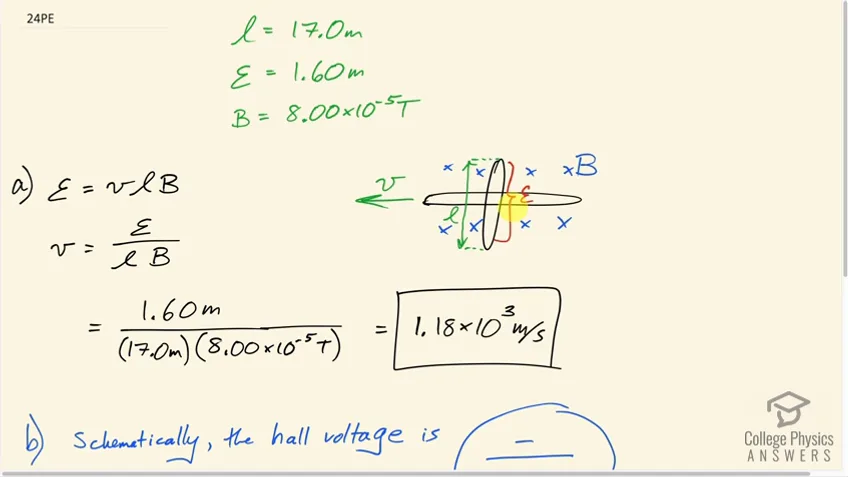 2:08PreviewProblem 24Full video with free trial(a) What is the speed of a supersonic aircraft with a 17.0-m wingspan, if it experiences a 1.60-V Hall voltage between its wing tips when in level flight over the north magnetic pole, where the Earth’s field strength is ? (b) Explain why very little current flows as a result of this Hall voltage.
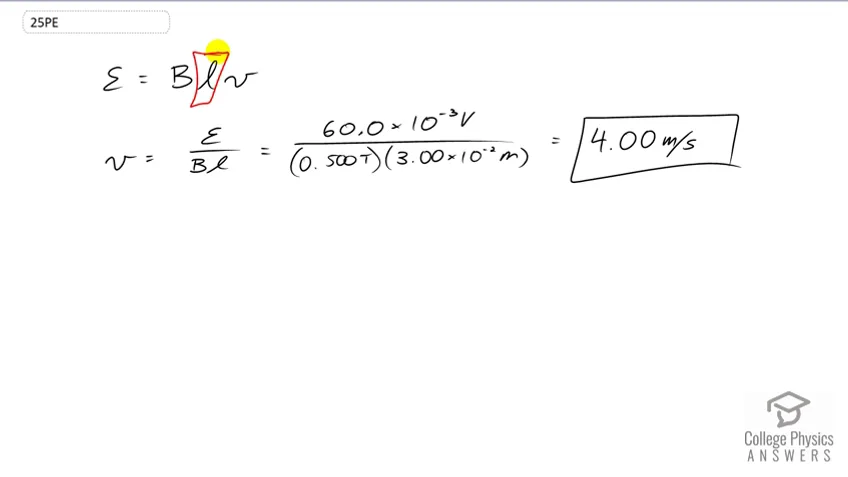 0:38PreviewProblem 25Full video with free trialA nonmechanical water meter could utilize the Hall effect by applying a magnetic field across a metal pipe and measuring the Hall voltage produced. What is the average fluid velocity in a 3.00-cm-diameter pipe, if a 0.500-T field across it creates a 60.0-mV Hall voltage?
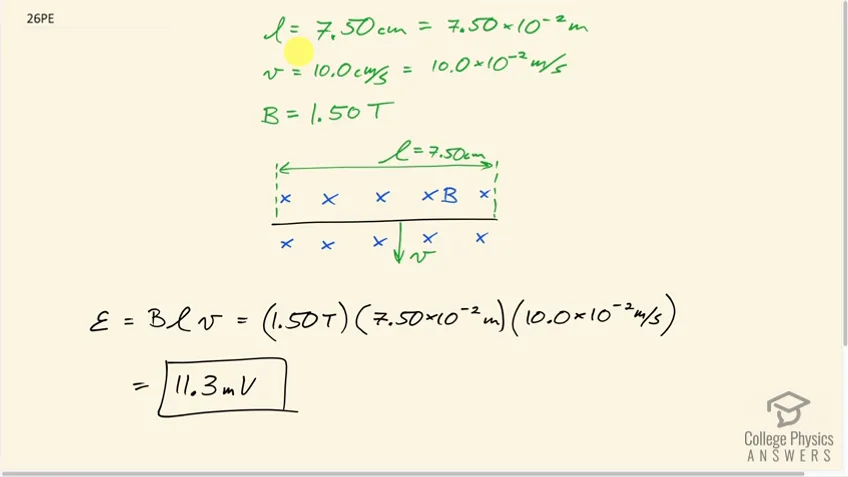 1:25PreviewProblem 26Full video with free trialCalculate the Hall voltage induced on a patient’s heart while being scanned by an MRI unit. Approximate the conducting path on the heart wall by a wire 7.50 cm long that moves at 10.0 cm/s perpendicular to a 1.50-T magnetic field.
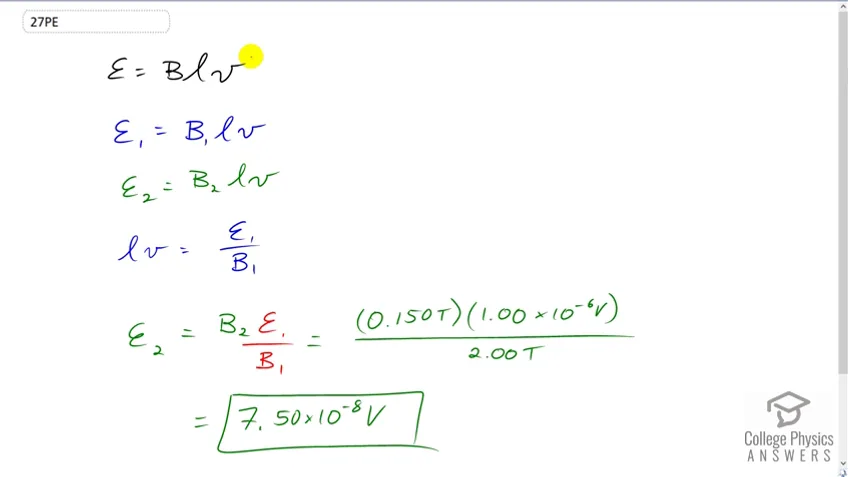 1:19PreviewProblem 27Full video with free trialA Hall probe calibrated to read when placed in a 2.00-T field is placed in a 0.150-T field. What is its output voltage?
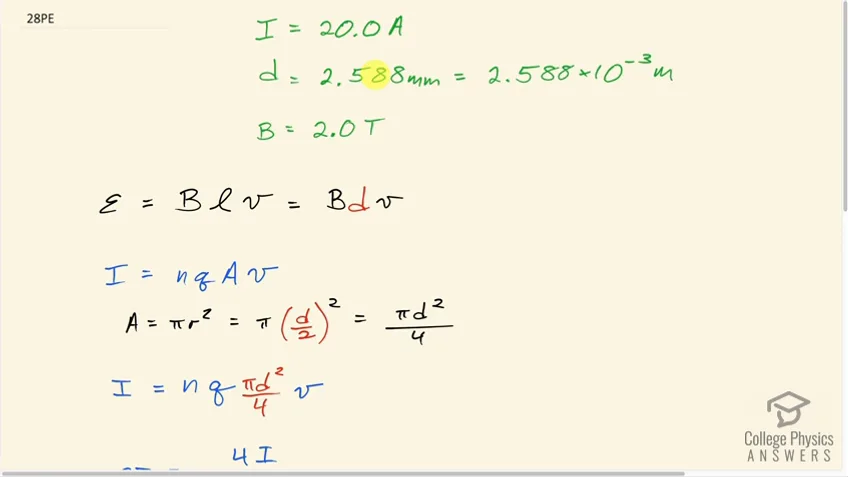 4:19PreviewProblem 28Full video with free trialUsing information in Example 20.3, what would the Hall voltage be if a 2.00-T field is applied across a 10-gauge copper wire (2.588 mm in diameter) carrying a 20.0-A current?
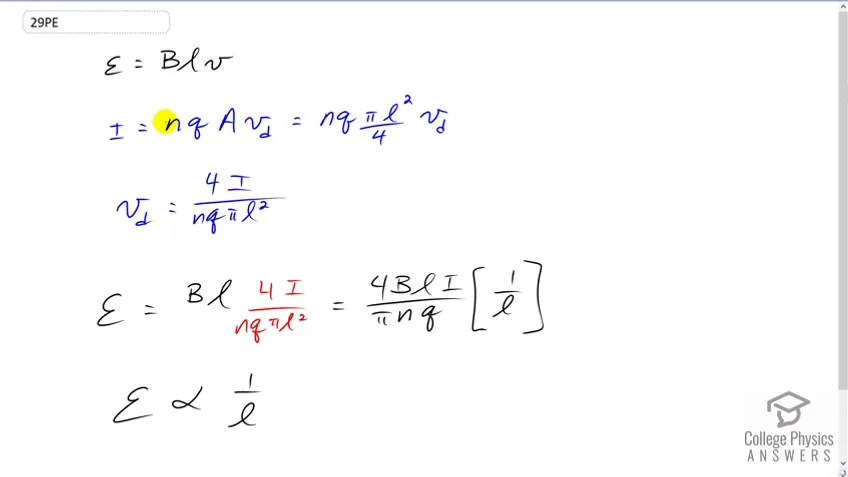 2:08PreviewProblem 29Full video with free trialShow that the Hall voltage across wires made of the same material, carrying identical currents, and subjected to the same magnetic field is inversely proportional to their diameters. (Hint: Consider how drift velocity depends on wire diameter.)
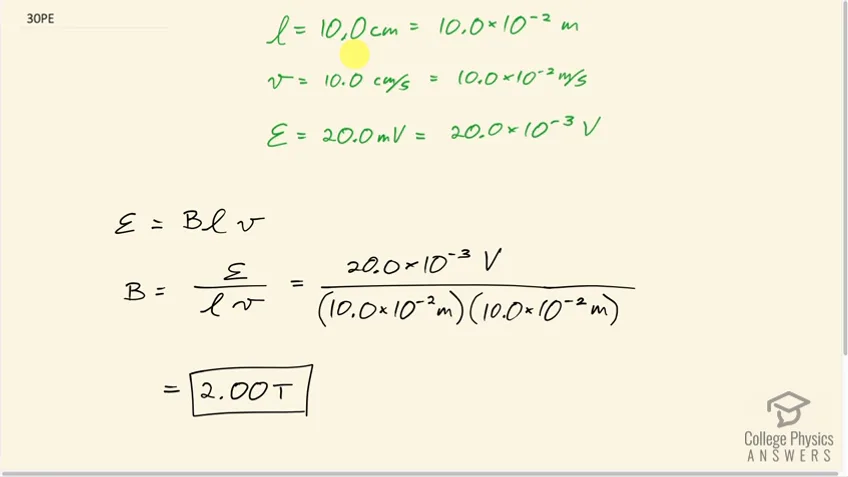 1:57PreviewProblem 30Full video with free trialA patient with a pacemaker is mistakenly being scanned for an MRI image. A 10.0-cm-long section of pacemaker wire moves at a speed of 10.0 cm/s perpendicular to the MRI unit’s magnetic field and a 20.0-mV Hall voltage is induced. What is the magnetic field strength?
22.7 Magnetic Force on a Current-Carrying Conductor
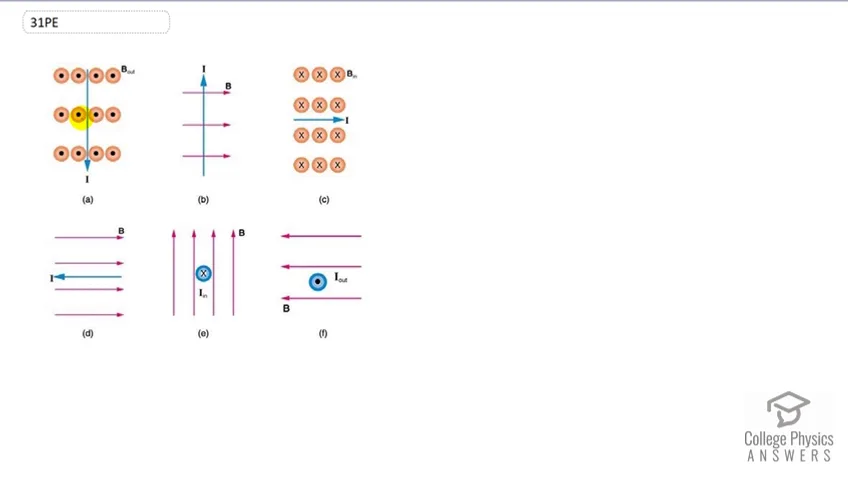 2:09PreviewProblem 31Full video with free trialWhat is the direction of the magnetic force on the current in each of the six cases in Figure 22.53?
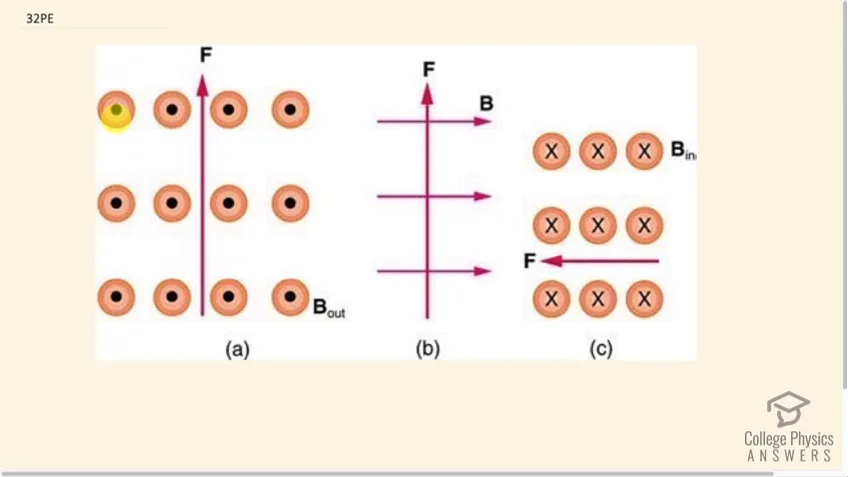 1:54PreviewProblem 32Full video with free trialWhat is the direction of a current that experiences the magnetic force shown in each of the three cases in Figure 22.54, assuming the current runs perpendicular to ?
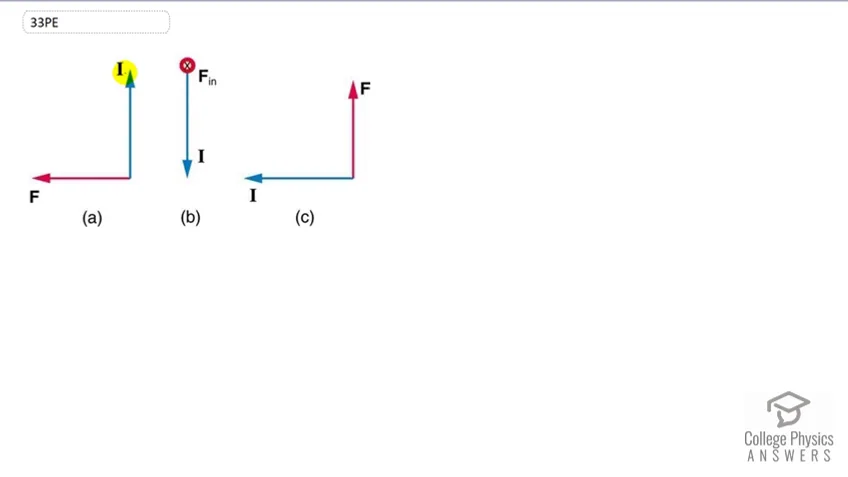 1:15PreviewProblem 33Full video with free trialWhat is the direction of the magnetic field that produces the magnetic force shown on the currents in each of the three cases in Figure 22.55, assuming is perpendicular to ?
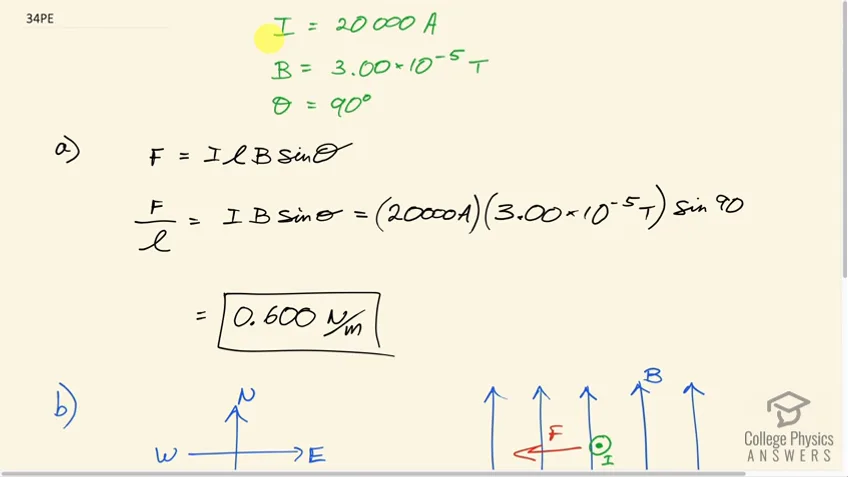 1:29PreviewProblem 34Full video with free trial(a) What is the force per meter on a lightning bolt at the equator that carries 20,000 A perpendicular to the Earth’s field? (b) What is the direction of the force if the current is straight up and the Earth’s field direction is due north, parallel to the ground?
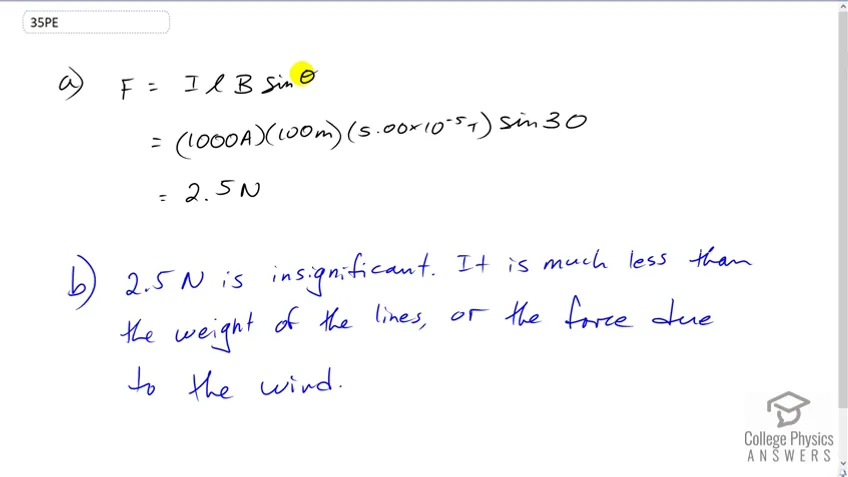 0:40PreviewProblem 35Full video with free trial(a) A DC power line for a light-rail system carries 1000 A at an angle of to the Earth’s field. What is the force on a 100-m section of this line? (b) Discuss practical concerns this presents, if any.
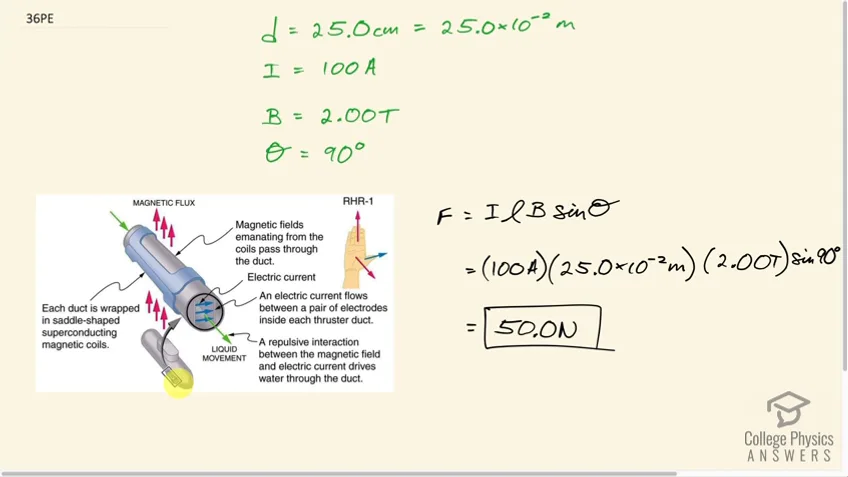 1:57PreviewProblem 36Full video with free trialWhat force is exerted on the water in an MHD drive utilizing a 25.0-cm-diameter tube, if 100-A current is passed across the tube that is perpendicular to a 2.00-T magnetic field? (The relatively small size of this force indicates the need for very large currents and magnetic fields to make practical MHD drives.)
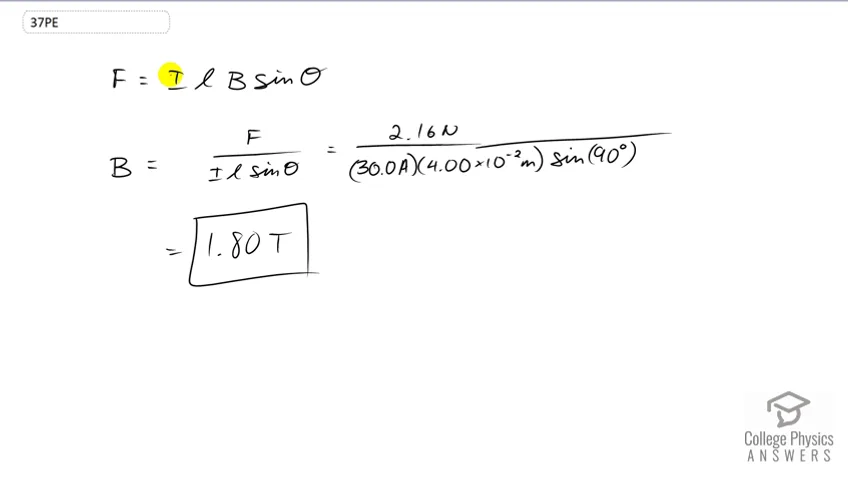 0:36PreviewProblem 37Full video with free trialA wire carrying a 30.0-A current passes between the poles of a strong magnet that is perpendicular to its field and experiences a 2.16-N force on the 4.00 cm of wire in the field. What is the average field strength?
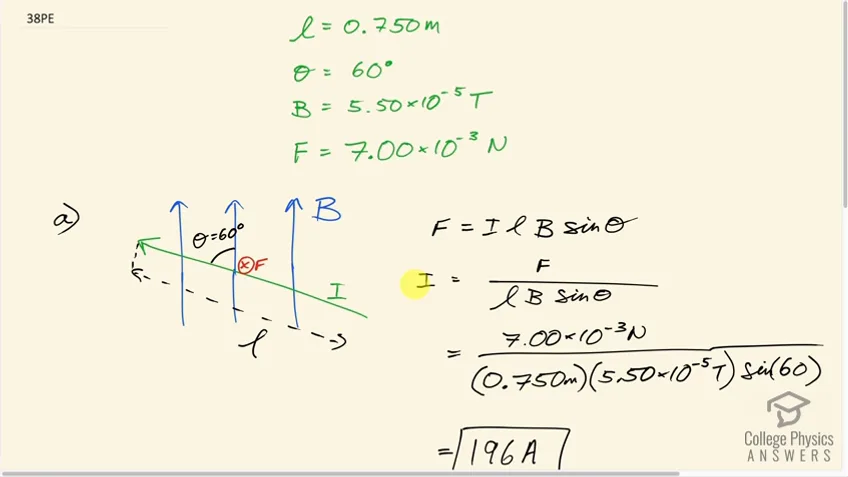 2:35PreviewProblem 38Full video with free trial(a) A 0.750-m-long section of cable carrying current to a car starter motor makes an angle of with the Earth’s field. What is the current when the wire experiences a force of ? (b) If you run the wire between the poles of a strong horseshoe magnet, subjecting 5.00 cm of it to a 1.75-T field, what force is exerted on this segment of wire?
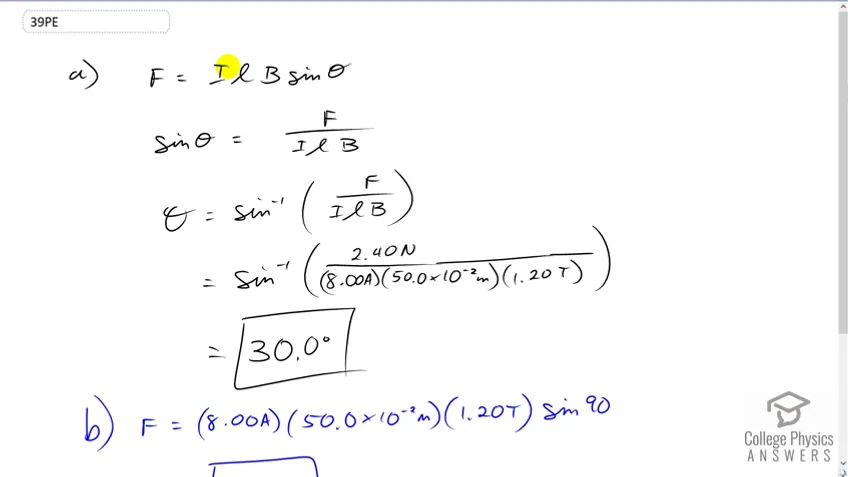 1:03PreviewProblem 39Full video with free trial(a) What is the angle between a wire carrying an 8.00-A current and the 1.20-T field it is in if 50.0 cm of the wire experiences a magnetic force of 2.40 N? (b) What is the force on the wire if it is rotated to make an angle of with the field?
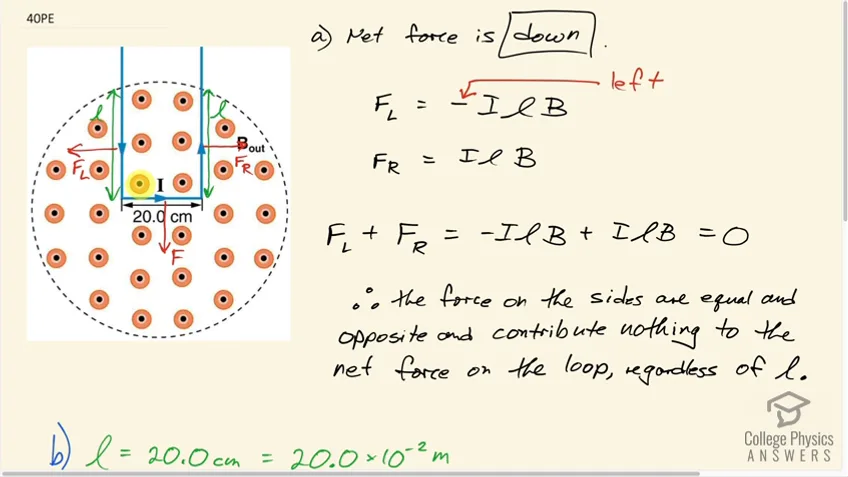 2:43PreviewProblem 40Full video with free trialThe force on the rectangular loop of wire in the magnetic field in Figure 22.56 can be used to measure field strength. The field is uniform, and the plane of the loop is perpendicular to the field. (a) What is the direction of the magnetic force on the loop? Justify the claim that the forces on the sides of the loop are equal and opposite, independent of how much of the loop is in the field and do not affect the net force on the loop. (b) If a current of 5.00 A is used, what is the force per tesla on the 20.0-cm-wide loop?
22.8 Torque on a Current Loop: Motos and Meters
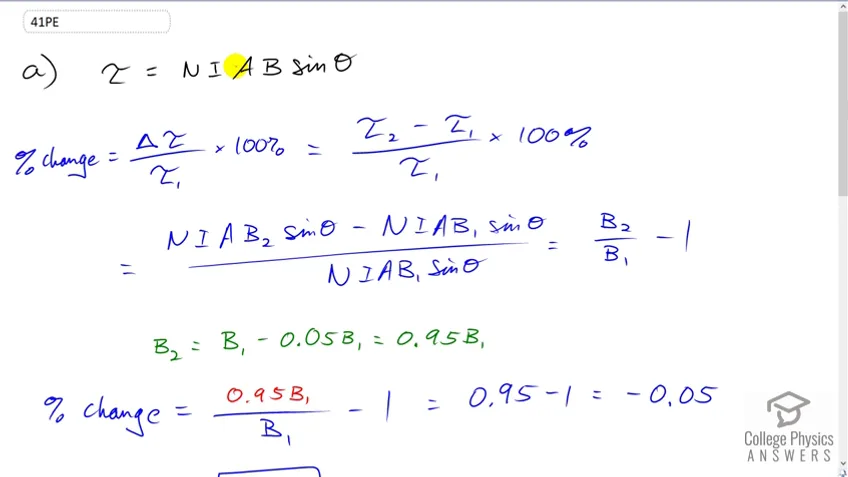 3:23PreviewProblem 41Full video with free trial(a) By how many percent is the torque of a motor decreased if its permanent magnets lose 5.0% of their strength? (b) How many percent would the current need to be increased to return the torque to original values?
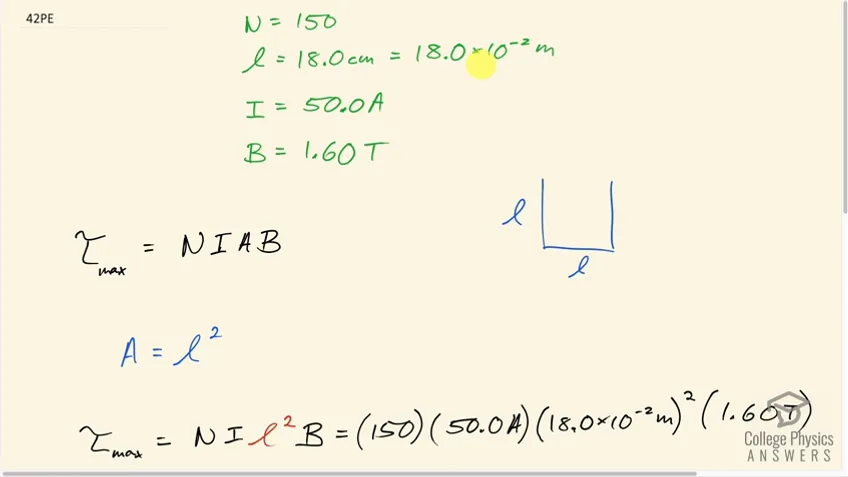 1:34PreviewProblem 42Full video with free trial(a) What is the maximum torque on a 150-turn square loop of wire 18.0 cm on a side that carries a 50.0-A current in a 1.60-T field? (b) What is the torque when is ?
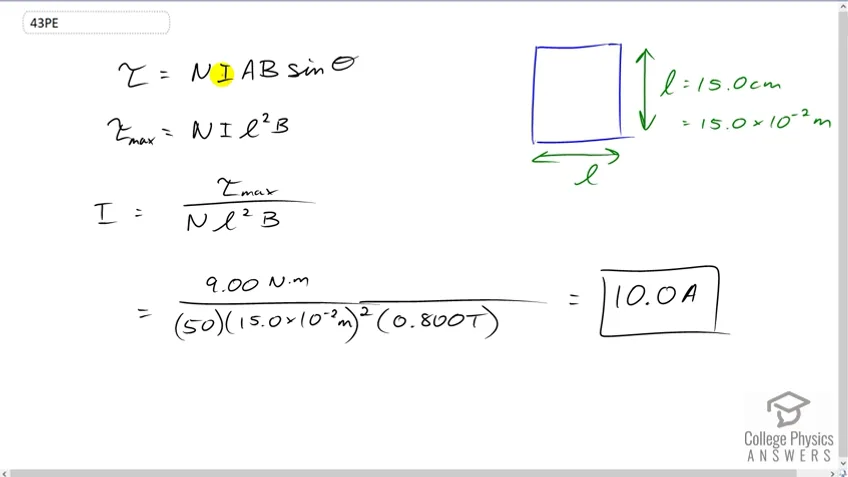 1:21PreviewProblem 43Full video with free trialFind the current through a loop needed to create a maximum torque of The loop has 50 square turns that are 15.0 cm on a side and is in a uniform 0.800-T magnetic field.
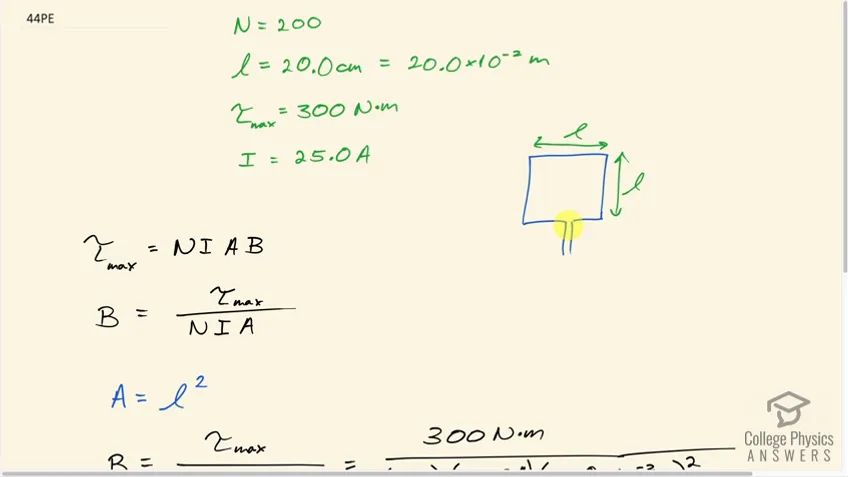 1:04PreviewProblem 44Full video with free trialCalculate the magnetic field strength needed on a 200-turn square loop 20.0 cm on a side to create a maximum torque of if the loop is carrying 25.0 A.
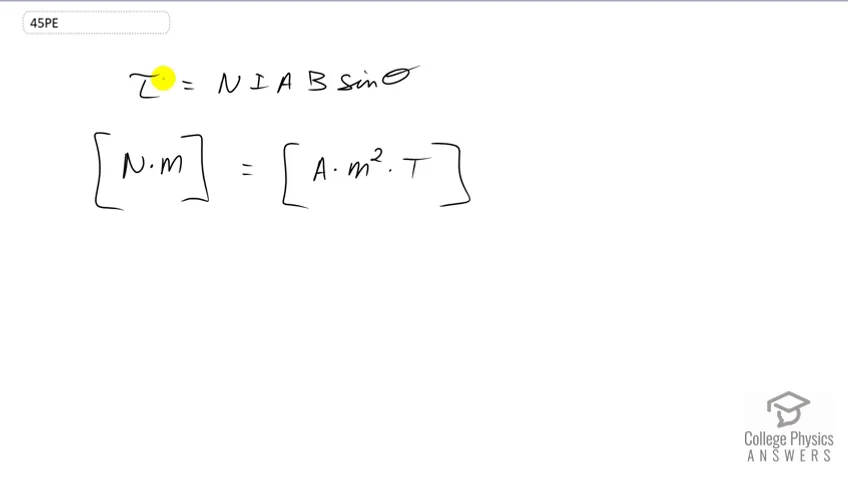 2:23PreviewProblem 45Full video with free trialSince the equation for torque on a current-carrying loop is , the units of must equal units of . Verify this.
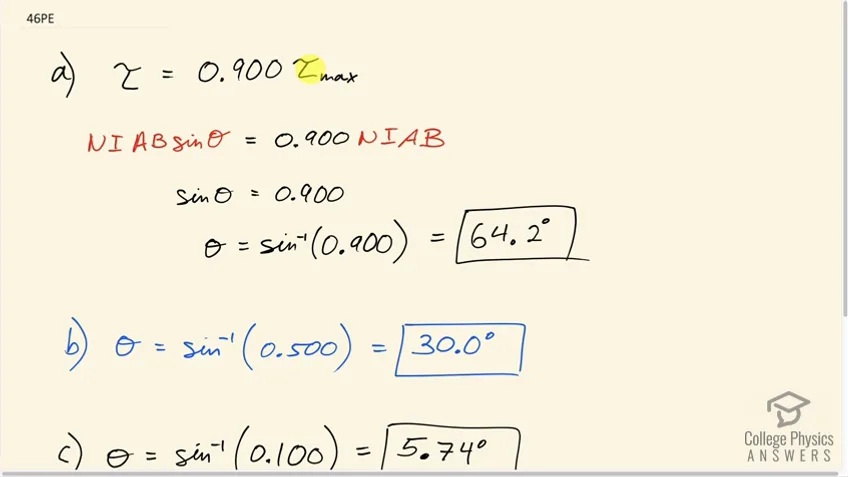 1:14PreviewProblem 46Full video with free trial(a) At what angle is the torque on a current loop 90.0% of maximum? (b) 50.0% of maximum? (c) 10.0% of maximum?
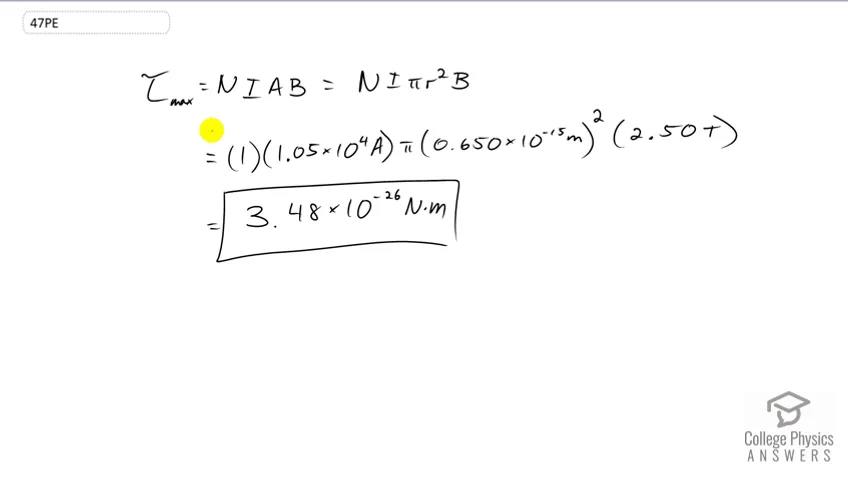 1:07PreviewProblem 47Full video with free trialA proton has a magnetic field due to its spin on its axis. The field is similar to that created by a circular current loop in radius with a current of (no kidding). Find the maximum torque on a proton in a field. (This is a significant torque on a small particle.)
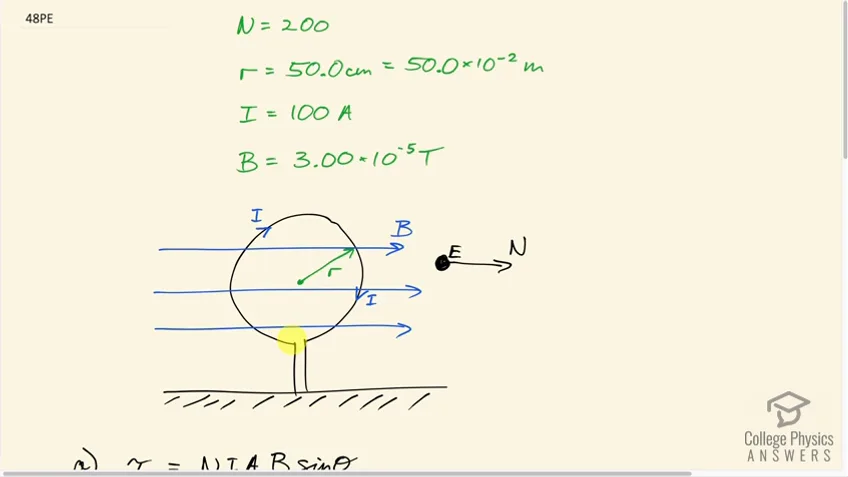 5:17PreviewProblem 48Full video with free trial(a) A 200-turn circular loop of radius 50.0 cm is vertical, with its axis on an east-west line. A current of 100 A circulates clockwise in the loop when viewed from the east. The Earth’s field here is due north, parallel to the ground, with a strength of . What are the direction and magnitude of the torque on the loop? (b) Does this device have any practical applications as a motor?
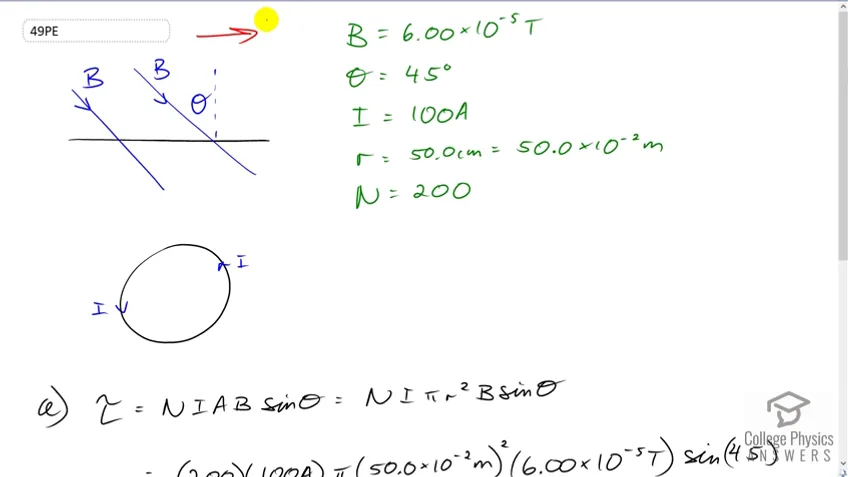 2:09PreviewProblem 49Full video with free trialRepeat Exercise 22.48, but with the loop lying flat on the ground with its current circulating counterclockwise (when viewed from above) in a location where the Earth’s field is north, but at an angle below the horizontal and with a strength of .
Exercise 22.48: (a) A 200-turn circular loop of radius 50.0 cm is vertical, with its axis on an east-west line. A current of 100 A circulates clockwise in the loop when viewed from the east. The Earth’s field here is due north, parallel to the ground, with a strength of . What are the direction and magnitude of the torque on the loop? (b) Does this device have any practical applications as a motor?
22.10 Magnetic Force between Two Parallel Conductors
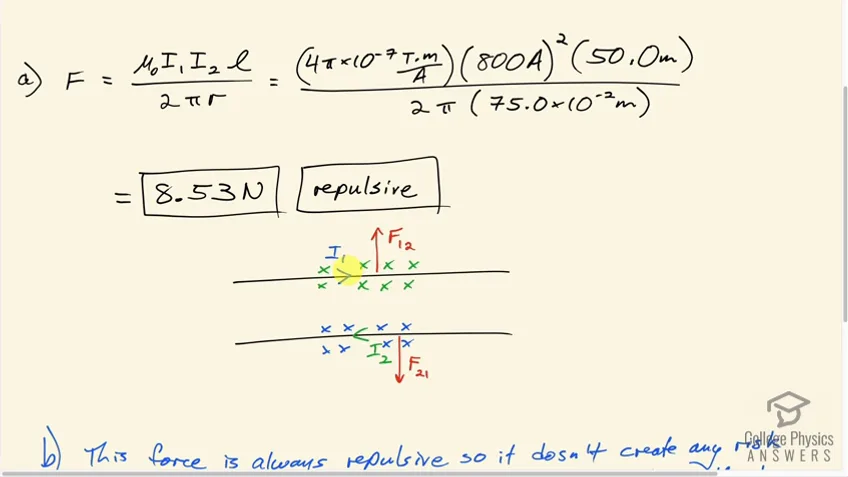 3:36PreviewProblem 50Full video with free trial(a) The hot and neutral wires supplying DC power to a light-rail commuter train carry 800 A and are separated by 75.0 cm. What is the magnitude and direction of the force between 50.0 m of these wires? (b) Discuss the practical consequences of this force, if any.
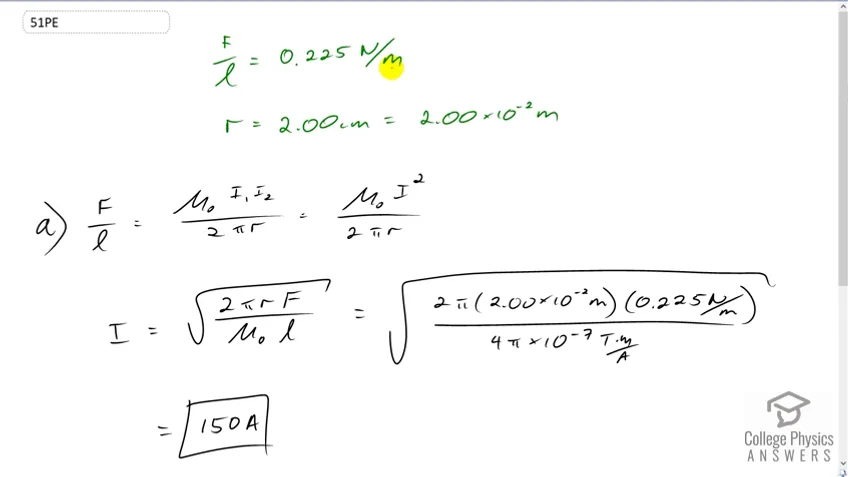 3:06PreviewProblem 51Full video with free trialThe force per meter between the two wires of a jumper cable being used to start a stalled car is 0.225 N/m. (a) What is the current in the wires, given they are separated by 2.00 cm? (b) Is the force attractive or repulsive?
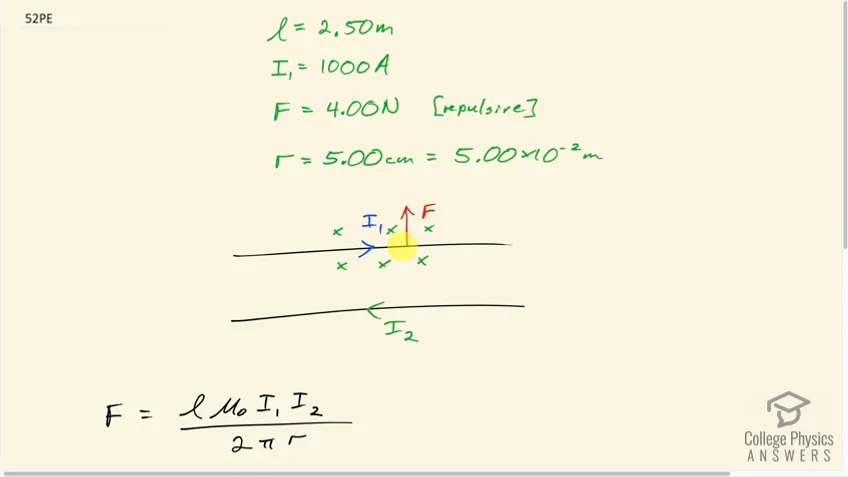 2:06PreviewProblem 52Full video with free trialA 2.50-m segment of wire supplying current to the motor of a submerged submarine carries 1000 A and feels a 4.00-N repulsive force from a parallel wire 5.00 cm away. What is the direction and magnitude of the current in the other wire?
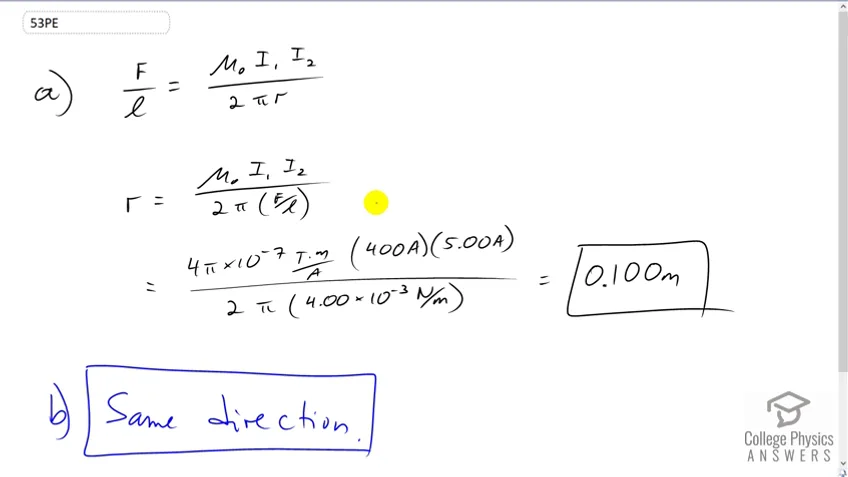 1:07PreviewProblem 53Full video with free trialThe wire carrying 400 A to the motor of a commuter train feels an attractive force of due to a parallel wire carrying 5.00 A to a headlight. (a) How far apart are the wires? (b) Are the currents in the same direction?
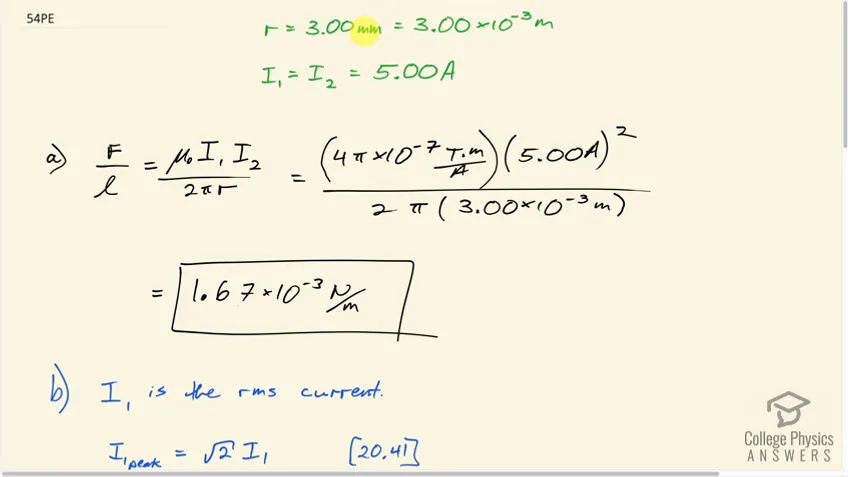 4:53PreviewProblem 54Full video with free trialAn AC appliance cord has its hot and neutral wires separated by 3.00 mm and carries a 5.00-A current. (a) What is the average force per meter between the wires in the cord? (b) What is the maximum force per meter between the wires? (c) Are the forces attractive or repulsive? (d) Do appliance cords need any special design features to compensate for these forces?
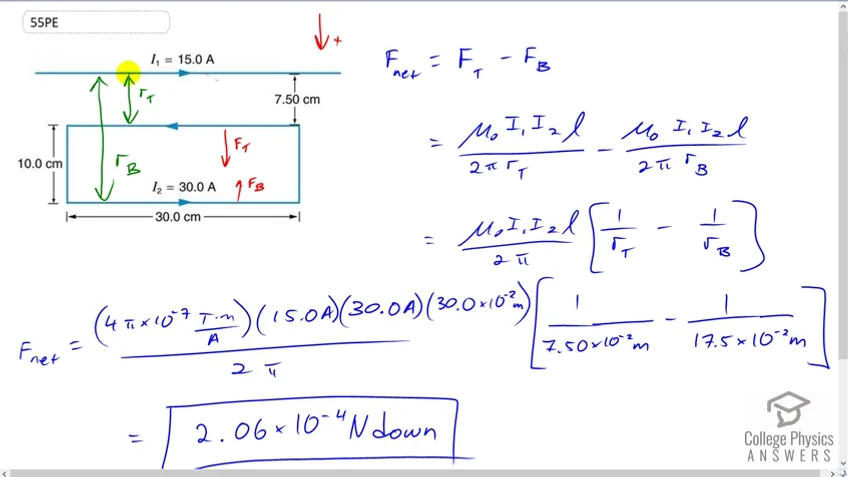 4:49PreviewProblem 55Full video with free trialFigure 22.57 shows a long straight wire near a rectangular current loop. What is the direction and magnitude of the total force on the loop?
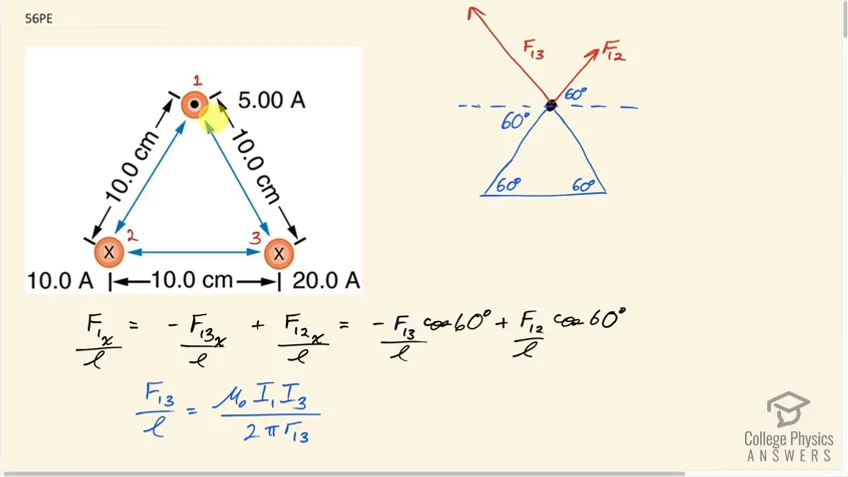 18:33PreviewProblem 56Full video with free trialFind the direction and magnitude of the force that each wire experiences in Figure 22.58(a) by, using vector addition.
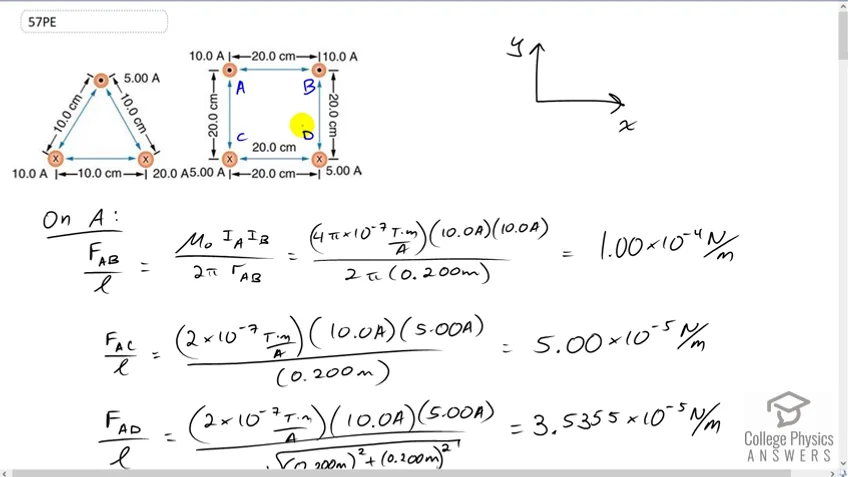 15:26PreviewProblem 57Full video with free trialFind the direction and magnitude of the force that each wire experiences in Figure 22.58(b), using vector addition.
22.11 More Applications of Magnetism
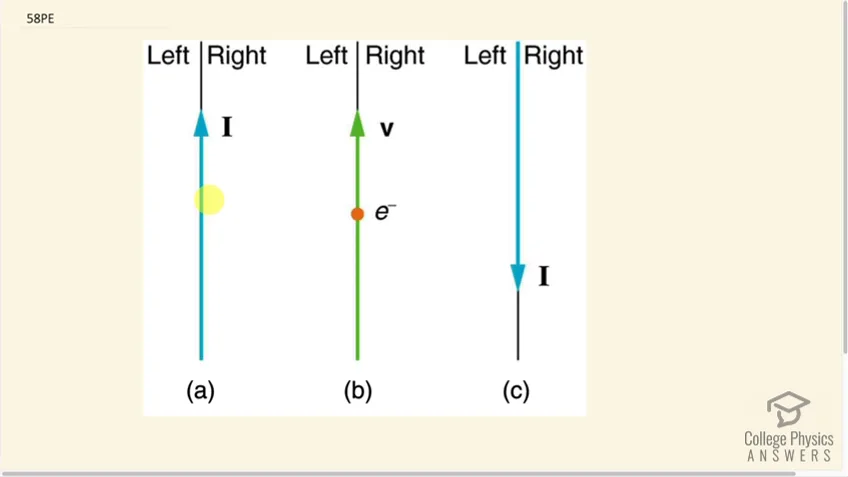 2:08PreviewProblem 58Full video with free trialIndicate whether the magnetic field created in each of the three situations shown in Figure 22.59 is into or out of the page on the left and right of the current.
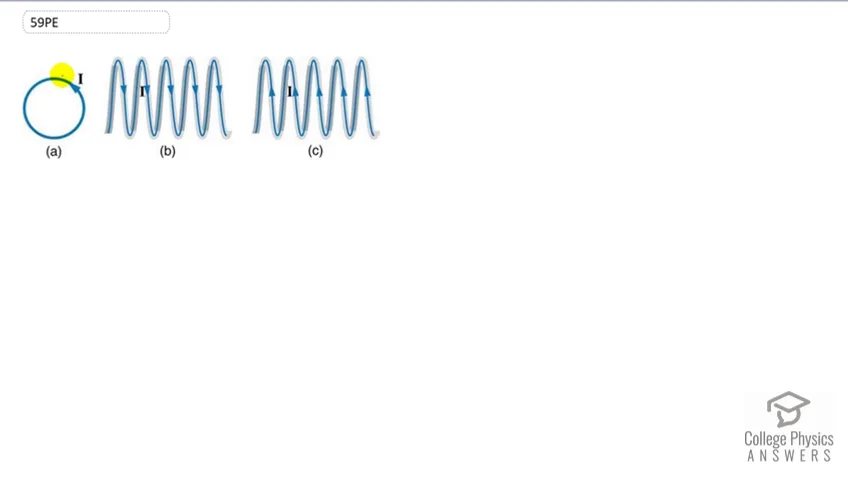 1:35PreviewProblem 59Full video with free trialWhat are the directions of the fields in the center of the loop and coils shown in Figure 22.60?
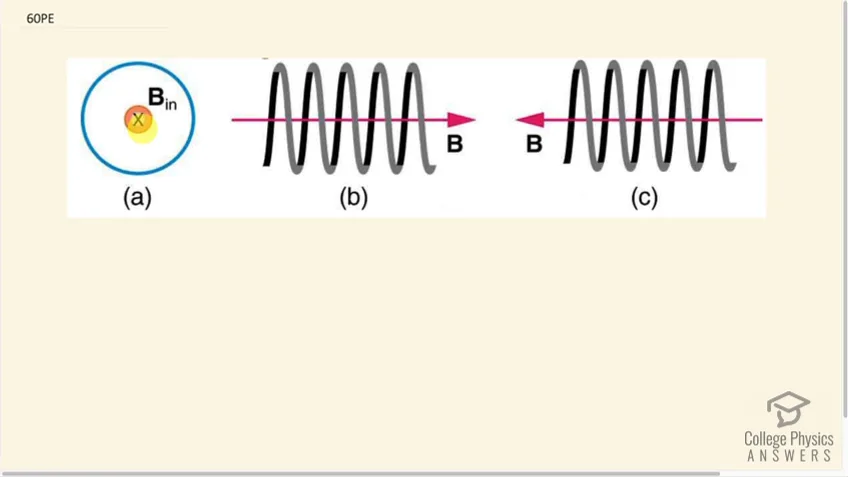 2:45PreviewProblem 60Full video with free trialWhat are the directions of the currents in the loop and coils shown in Figure 22.61?
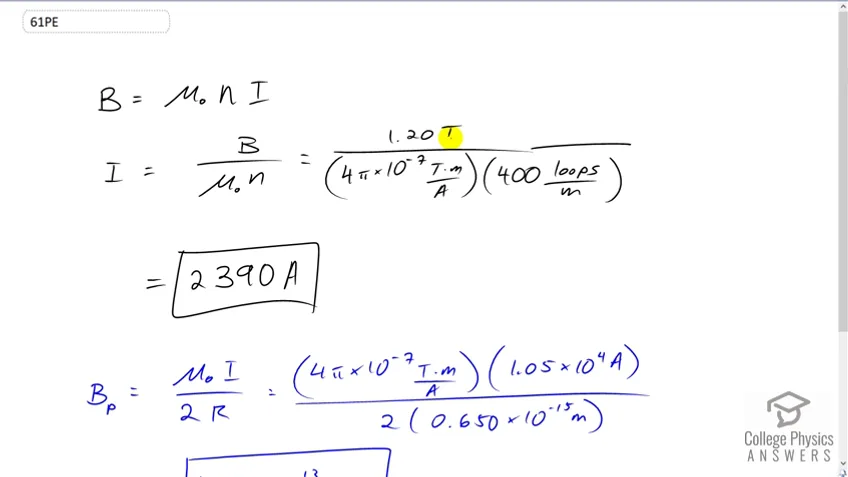 1:59PreviewProblem 61Full video with free trialTo see why an MRI utilizes iron to increase the magnetic field created by a coil, calculate the current needed in a 400-loop-per-meter circular coil 0.660 m in radius to create a 1.20-T field (typical of an MRI instrument) at its center with no iron present. The magnetic field of a proton is approximately like that of a circular current loop in radius carrying . What is the field at the center of such a loop?
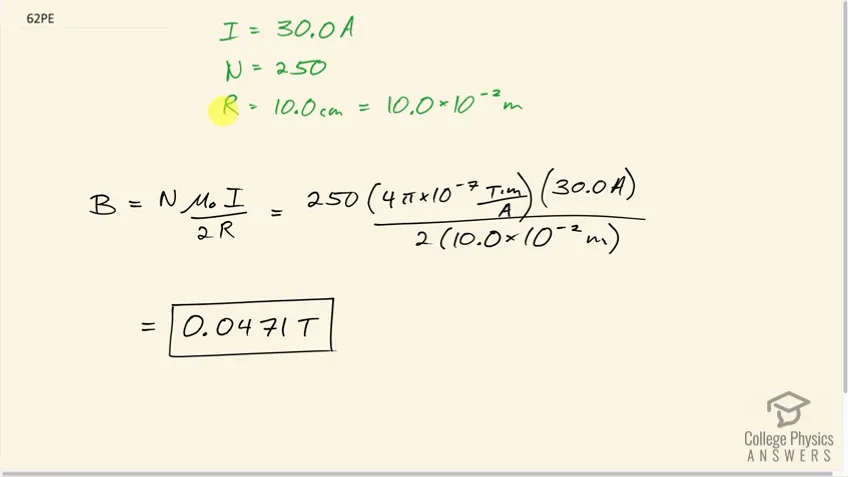 0:46PreviewProblem 62Full video with free trialInside a motor, 30.0 A passes through a 250-turn circular loop that is 10.0 cm in radius. What is the magnetic field strength created at its center?
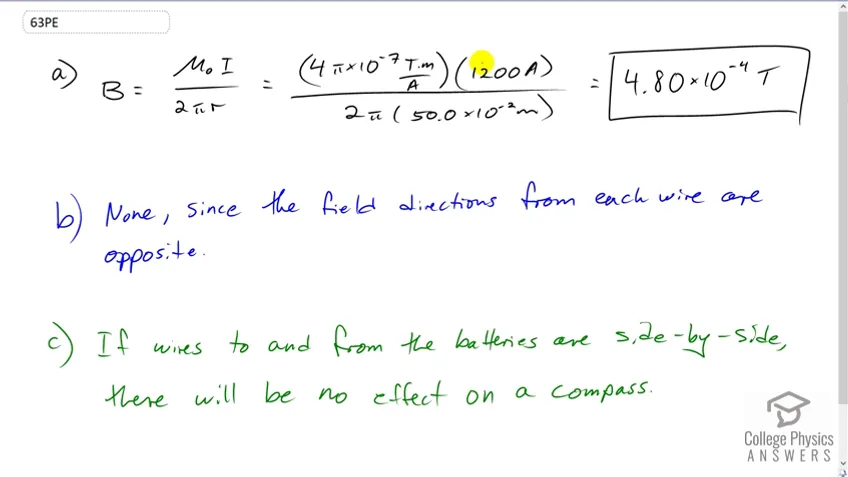 1:41PreviewProblem 63Full video with free trialNonnuclear submarines use batteries for power when submerged. (a) Find the magnetic field 50.0 cm from a straight wire carrying 1200 A from the batteries to the drive mechanism of a submarine. (b) What is the field if the wires to and from the drive mechanism are side by side? (c) Discuss the effects this could have for a compass on the submarine that is not shielded.
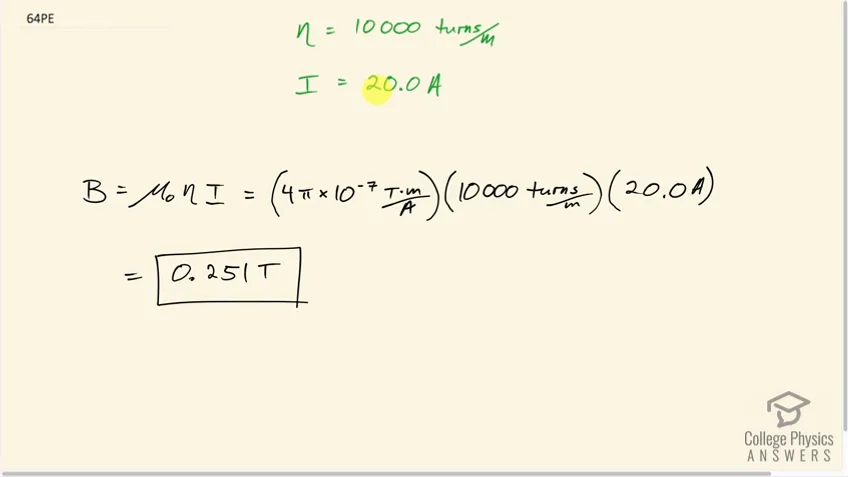 0:26PreviewProblem 64Full video with free trialHow strong is the magnetic field inside a solenoid with 10,000 turns per meter that carries 20.0 A?
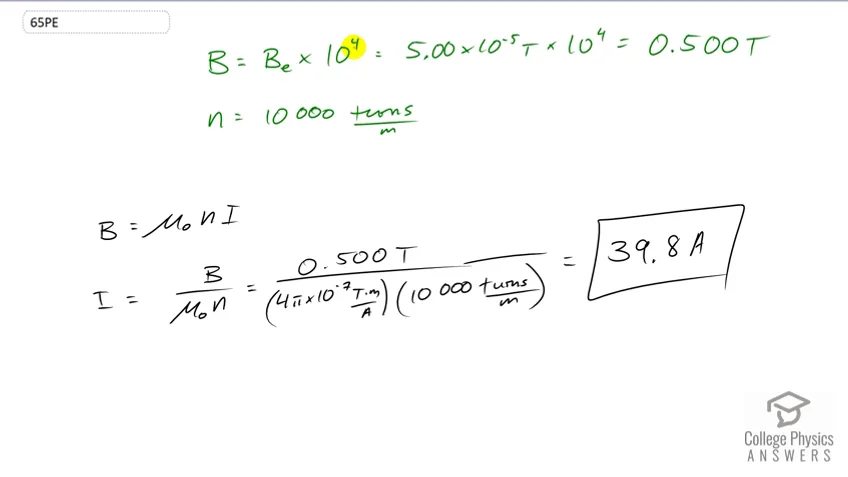 0:50PreviewProblem 65Full video with free trialWhat current is needed in the solenoid described in Exercise 22.58 to produce a magnetic field times the Earth’s magnetic field of ?
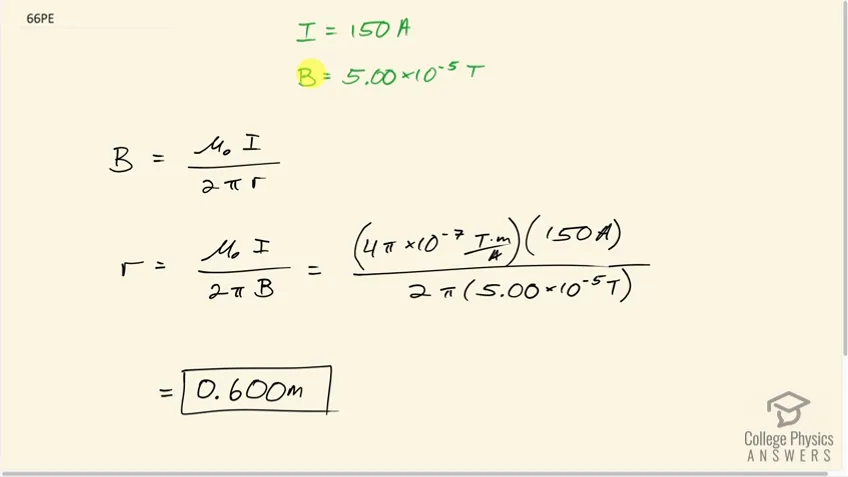 1:06PreviewProblem 66Full video with free trialHow far from the starter cable of a car, carrying 150 A, must you be to experience a field less than the Earth’s ()? Assume a long straight wire carries the current. (In practice, the body of your car shields the dashboard compass.)
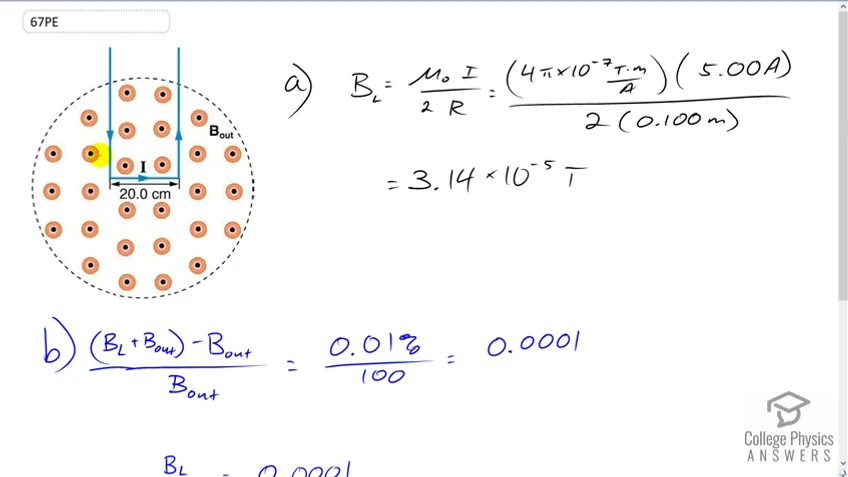 3:08PreviewProblem 67Full video with free trialMeasurements affect the system being measured, such as the current loop in Figure 22.56. (a) Estimate the field the loop creates by calculating the field at the center of a circular loop 20.0 cm in diameter carrying 5.00 A. (b) What is the smallest field strength this loop can be used to measure, if its field must alter the measured field by less than 0.0100%?
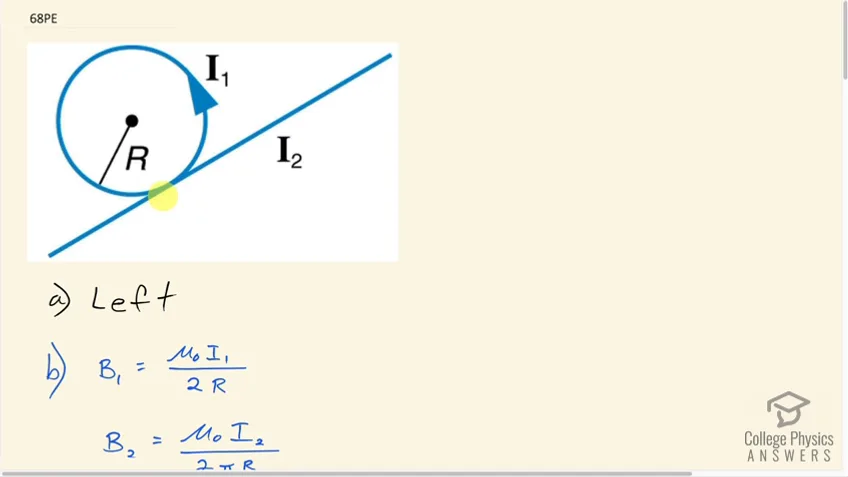 8:38PreviewProblem 68Full video with free trialFigure 22.62 shows a long straight wire just touching a loop carrying a current . Both lie in the same plane. (a) What direction must the current in the straight wire have to create a field at the center of the loop in the direction opposite to that created by the loop? (b) What is the ratio of that gives zero field strength at the center of the loop? (c) What is the direction of the field directly above the loop under this circumstance?
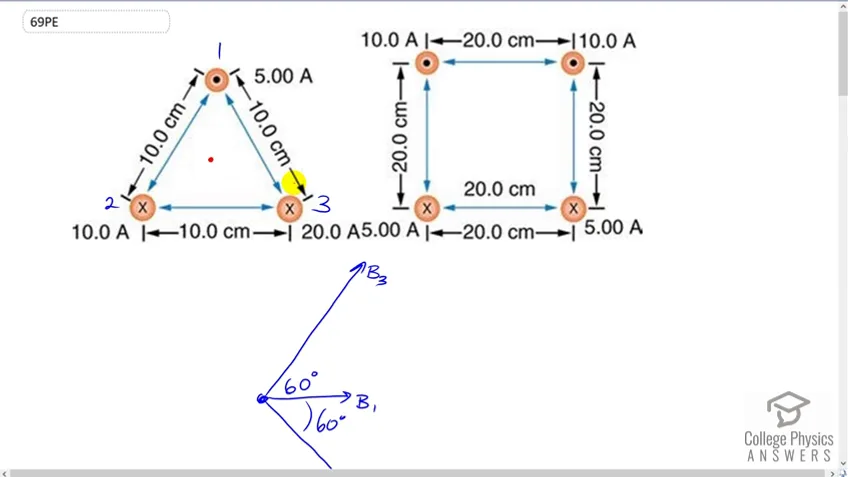 9:14PreviewProblem 69Full video with free trialFind the magnitude and direction of the magnetic field at the point equidistant from the wires in Figure 22.58(a), using the rules of vector addition to sum the contributions from each wire.
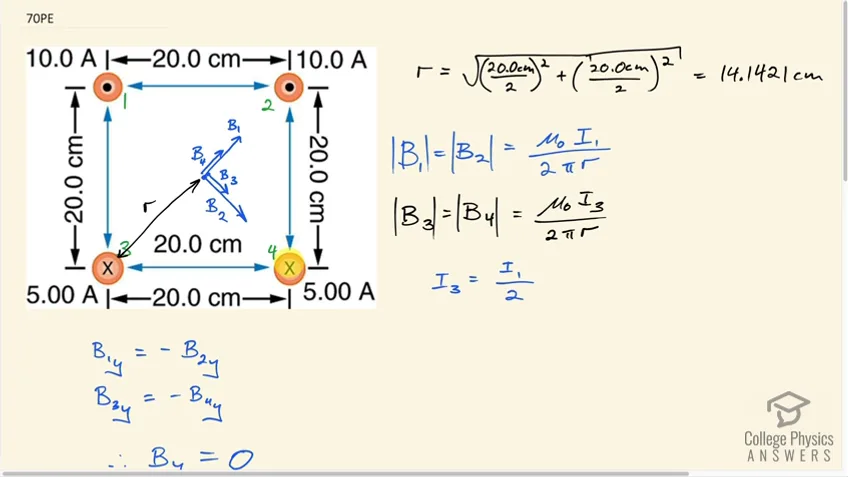 5:51PreviewProblem 70Full video with free trialFind the magnitude and direction of the magnetic field at the point equidistant from the wires in Figure 22.58(b), using the rules of vector addition to sum the contributions from each wire.
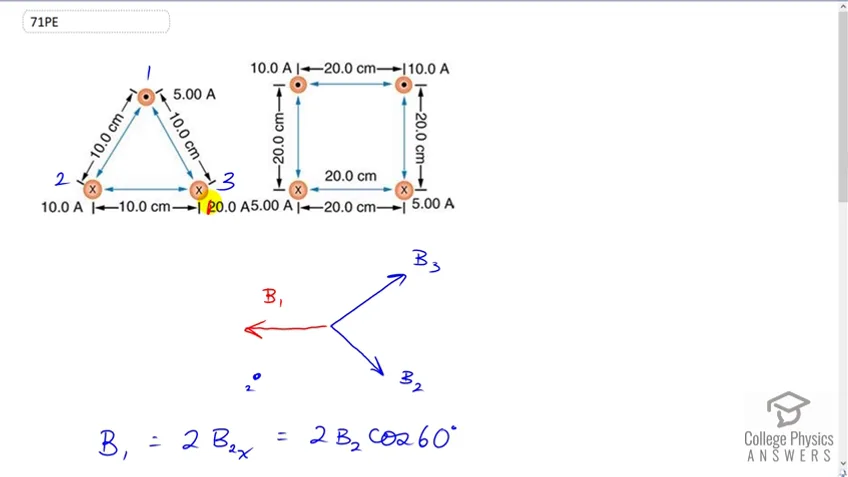 4:42PreviewProblem 71Full video with free trialWhat current is needed in the top wire in Figure 22.58(a) to produce a field of zero at the point equidistant from the wires, if the currents in the bottom two wires are both 10.0 A into the page?
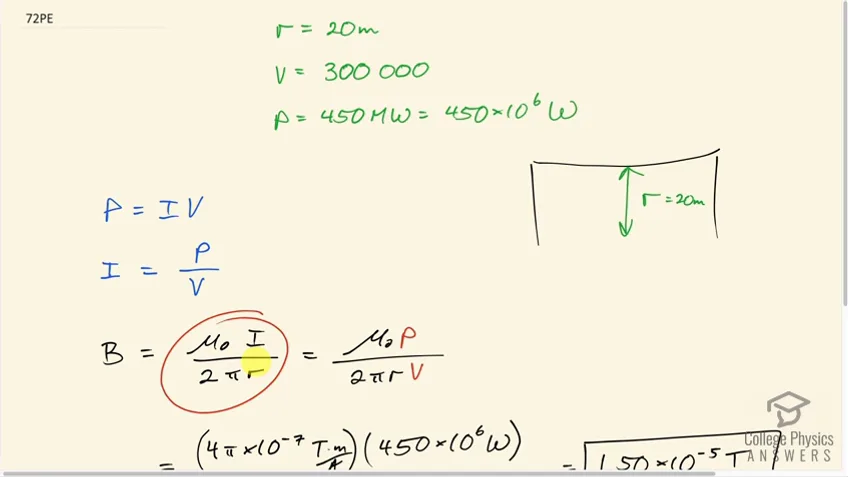 0:54PreviewProblem 72Full video with free trialCalculate the size of the magnetic field 20 m below a high voltage power line. The line carries 450 MW at a voltage of 300,000 V.
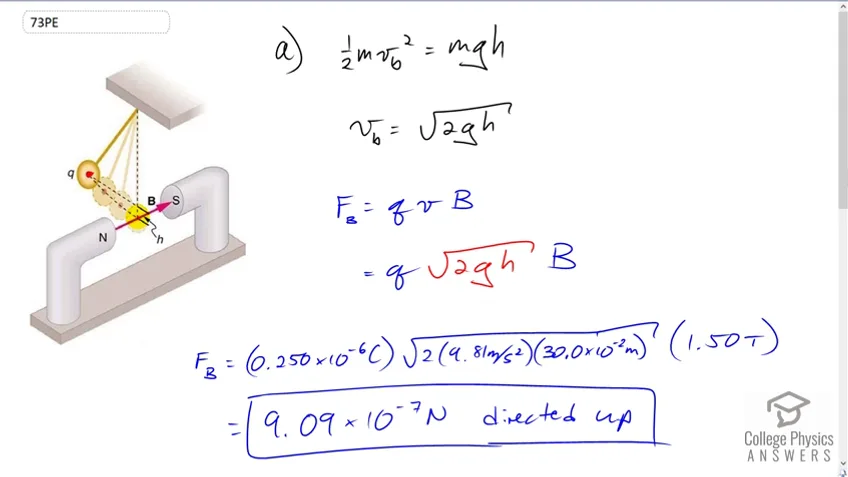 5:00PreviewProblem 73Full video with free trial(a) A pendulum is set up so that its bob (a thin copper disk) swings between the poles of a permanent magnet as shown in Figure 22.63. What is the magnitude and direction of the magnetic force on the bob at the lowest point in its path, if it has a positive charge and is released from a height of 30.0 cm above its lowest point? The magnetic field strength is 1.50 T. (b) What is the acceleration of the bob at the bottom of its swing if its mass is 30.0 grams and it is hung from a flexible string? Be certain to include a free-body diagram as part of your analysis.
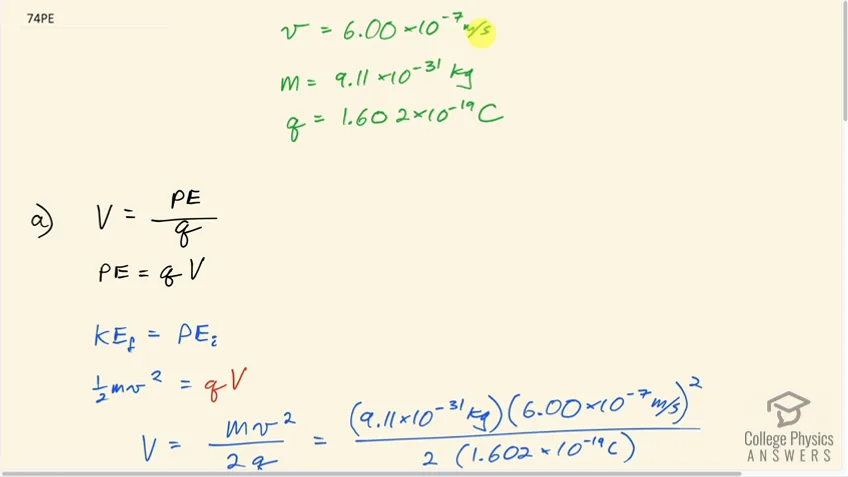 4:03PreviewProblem 74Full video with free trial(a) What voltage will accelerate electrons to a speed of ? (b) Find the radius of curvature of the path of a proton accelerated through this potential in a 0.500-T field and compare this with the radius of curvature of an electron accelerated through the same potential.
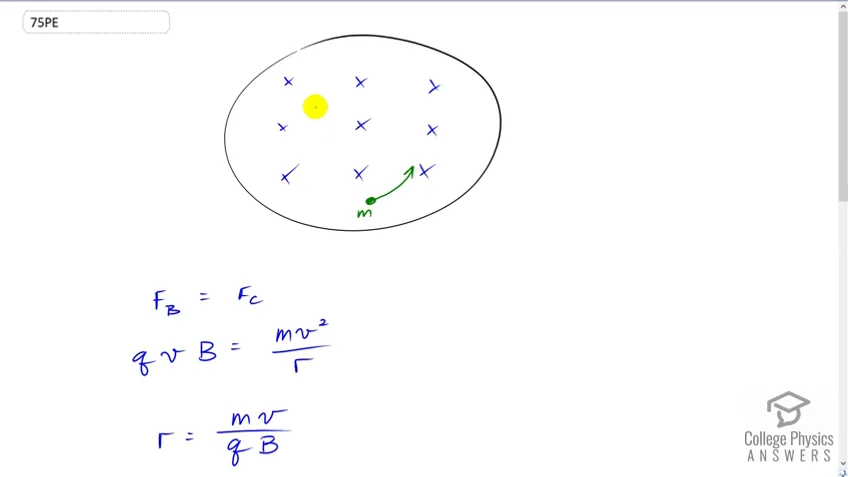 2:42PreviewProblem 75Full video with free trialFind the radius of curvature of the path of a 25.0-MeV proton moving perpendicularly to the 1.20-T field of a cyclotron.
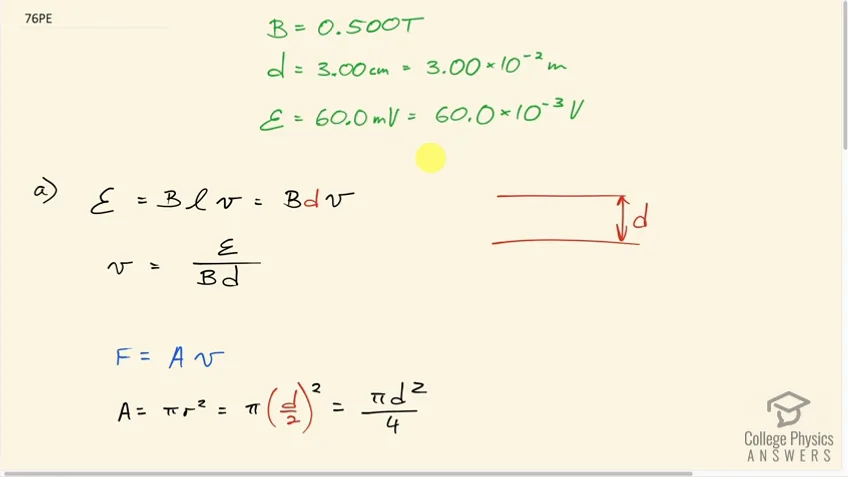 5:46PreviewProblem 76Full video with free trialTo construct a nonmechanical water meter, a 0.500-T magnetic field is placed across the supply water pipe to a home and the Hall voltage is recorded. (a) Find the flow rate in liters per second through a 3.00-cm-diameter pipe if the Hall voltage is 60.0 mV. (b) What would the Hall voltage be for the same flow rate through a 10.0-cm-diameter pipe with the same field applied?
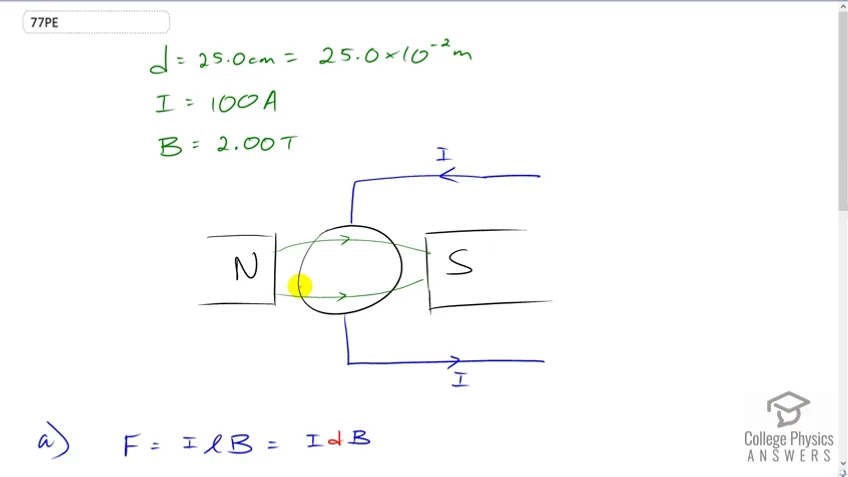 1:48PreviewProblem 77Full video with free trial(a) Using the values given for an MHD drive in Exercise 22.36, and assuming the force is uniformly applied to the fluid, calculate the pressure created in (b) Is this a significant fraction of an atmosphere?<br>Exercise 22.36: What force is exerted on the water in an MHD drive utilizing a 25.0-cm-diameter tube, if 100-A current is passed across the tube that is perpendicular to a 2.00-T magnetic field? (The relatively small size of this force indicates the need for very large currents and magnetic fields to make practical MHD drives.)
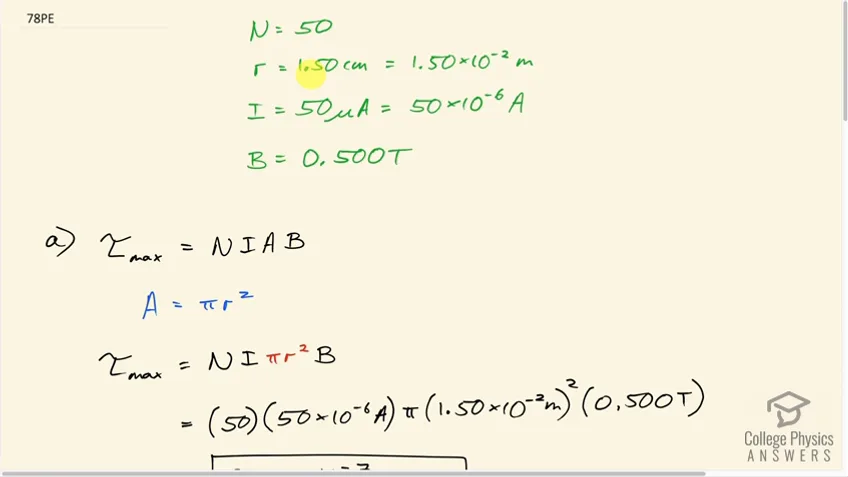 5:24PreviewProblem 78Full video with free trial(a) Calculate the maximum torque on a 50-turn, 1.50 cm radius circular current loop carrying in a 0.500-T field. (b) If this coil is to be used in a galvanometer that reads full scale, what force constant spring must be used, if it is attached 1.00 cm from the axis of rotation and is stretched by the arc moved?
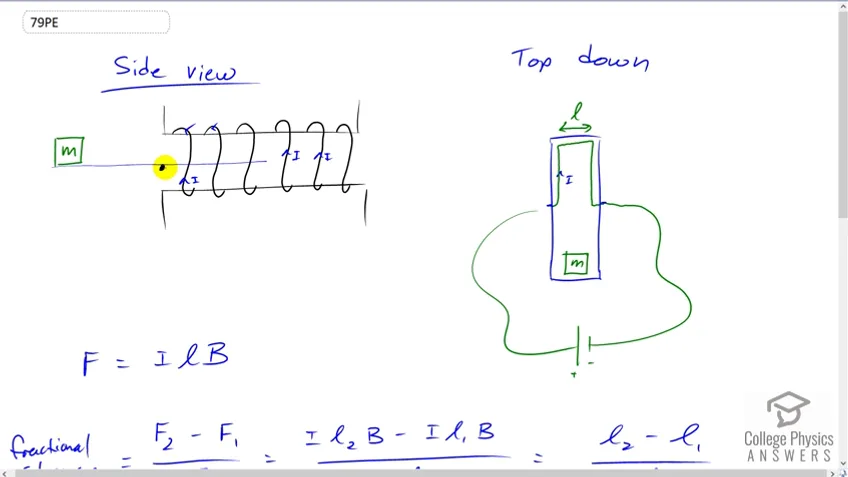 5:01PreviewProblem 79Full video with free trialA current balance used to define the ampere is designed so that the current through it is constant, as is the distance between wires. Even so, if the wires change length with temperature, the force between them will change. What percent change in force per degree will occur if the wires are copper?
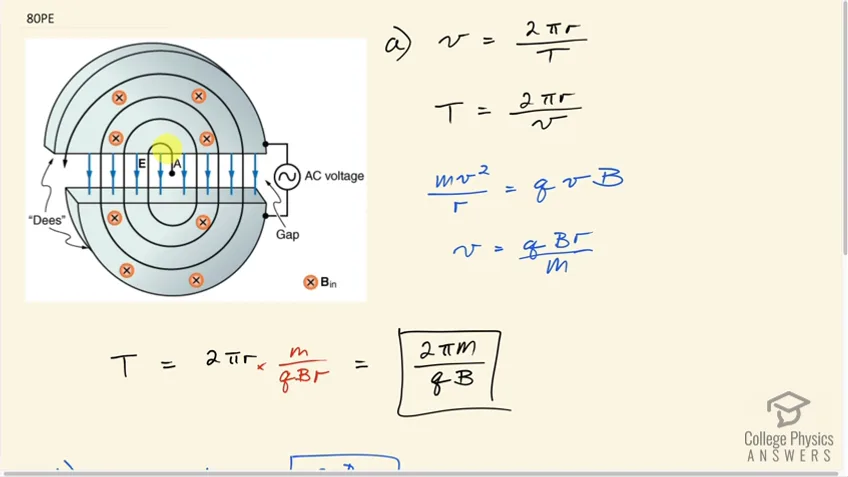 3:50PreviewProblem 80Full video with free trial(a) Show that the period of the circular orbit of a charged particle moving perpendicularly to a uniform magnetic field is . (b) What is the frequency ? (c) What is the angular velocity ? Note that these results are independent of the velocity and radius of the orbit and, hence, of the energy of the particle. (Figure 22.64.)
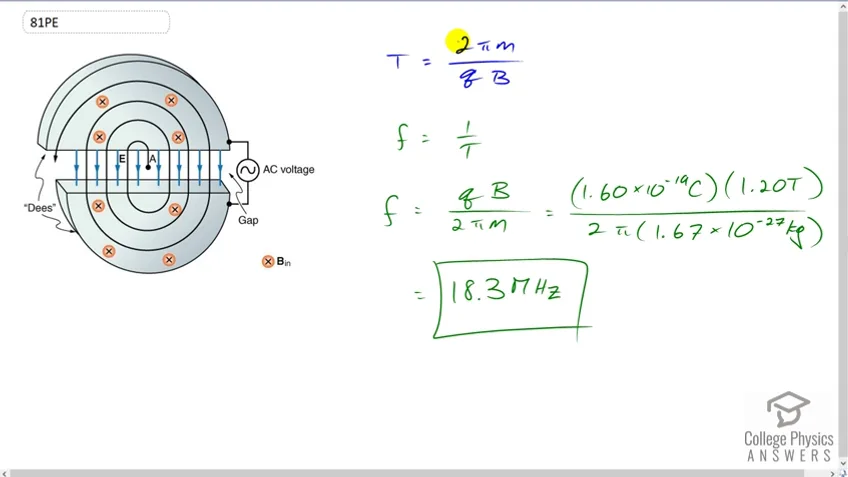 0:51PreviewProblem 81Full video with free trialA cyclotron accelerates charged particles as shown in Figure 22.64. Using the results of the previous problem, calculate the frequency of the accelerating voltage needed for a proton in a 1.20-T field.
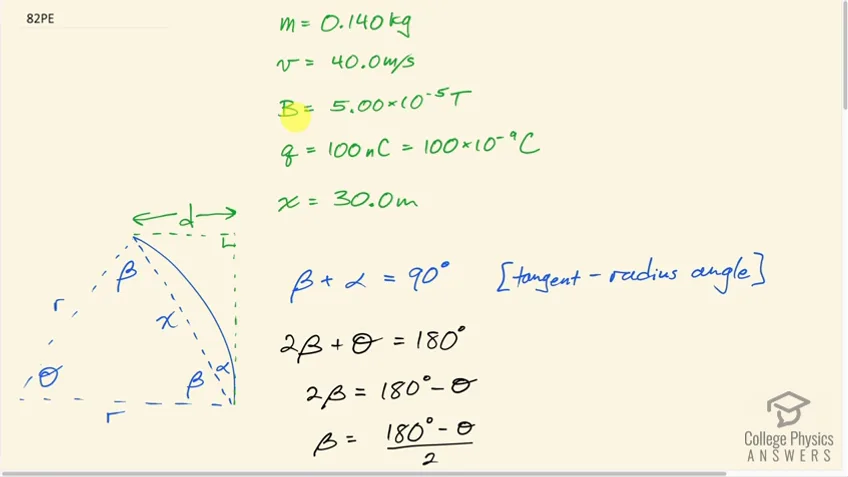 8:14PreviewProblem 82Full video with free trial(a) A 0.140-kg baseball, pitched at 40.0 m/s horizontally and perpendicular to the Earth’s horizontal field, has a 100-nC charge on it. What distance is it deflected from its path by the magnetic force, after traveling 30.0 m horizontally? (b) Would you suggest this as a secret technique for a pitcher to throw curve balls?
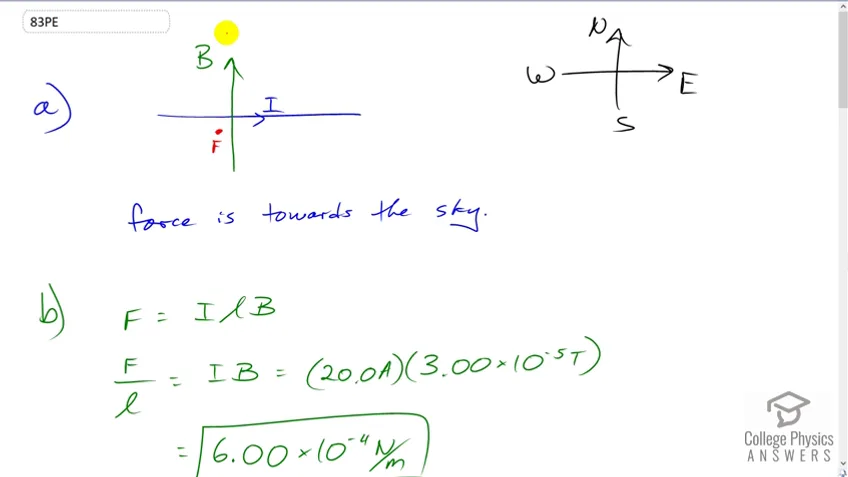 4:54PreviewProblem 83Full video with free trial(a) What is the direction of the force on a wire carrying a current due east in a location where the Earth’s field is due north? Both are parallel to the ground. (b) Calculate the force per meter if the wire carries 20.0 A and the field strength is . (c) What diameter copper wire would have its weight supported by this force? (d) Calculate the resistance per meter and the voltage per meter needed.
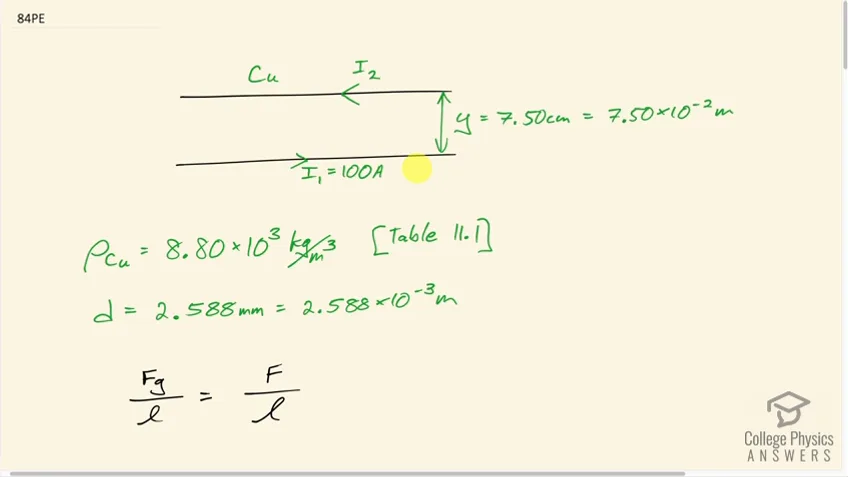 8:23PreviewProblem 84Full video with free trialOne long straight wire is to be held directly above another by repulsion between their currents. The lower wire carries 100 A and the wire 7.50 cm above it is 10-gauge (2.588 mm diameter) copper wire. (a) What current must flow in the upper wire, neglecting the Earth’s field? (b) What is the smallest current if the Earth’s field is parallel to the ground and is not neglected? (c) Is the supported wire in a stable or unstable equilibrium if displaced vertically? If displaced horizontally?
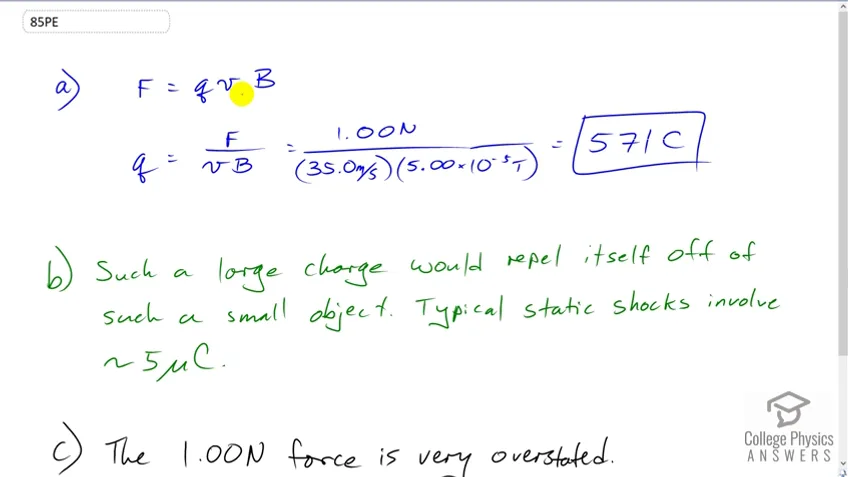 0:52PreviewProblem 85Full video with free trial(a) Find the charge on a baseball, thrown at 35.0 m/s perpendicular to the Earth’s field, that experiences a 1.00-N magnetic force. (b) What is unreasonable about this result? (c) Which assumption or premise is responsible?
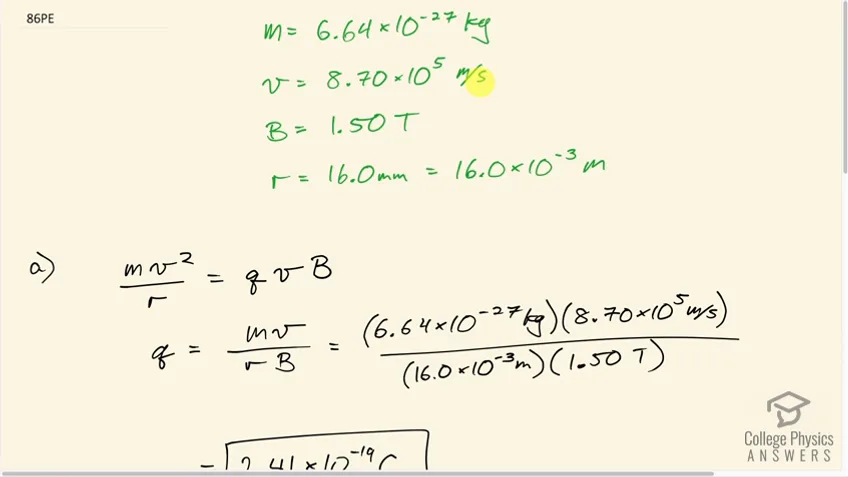 2:59PreviewProblem 86Full video with free trialA charged particle having mass (that of a helium atom) moving at perpendicular to a 1.50-T magnetic field travels in a circular path of radius 16.0 mm. (a) What is the charge of the particle? (b) What is unreasonable about this result? (c) Which assumptions are responsible?
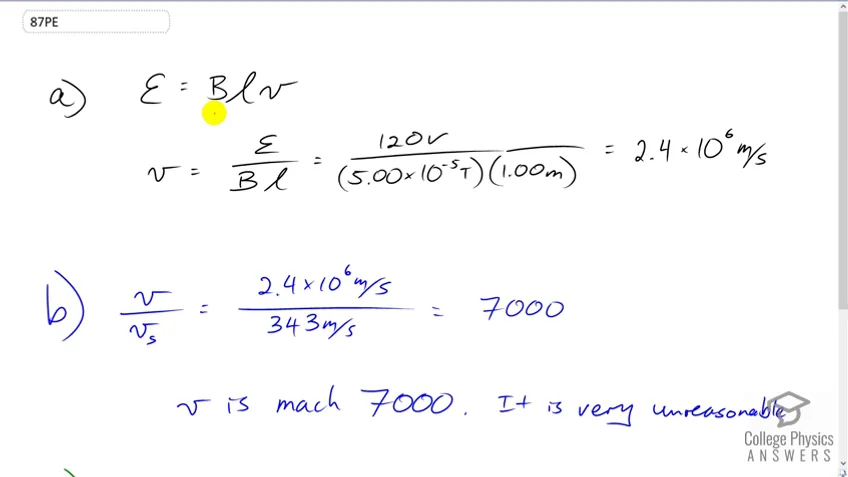 1:04PreviewProblem 87Full video with free trialAn inventor wants to generate 120-V power by moving a 1.00-m-long wire perpendicular to the Earth’s field. (a) Find the speed with which the wire must move. (b) What is unreasonable about this result? (c) Which assumption is responsible?
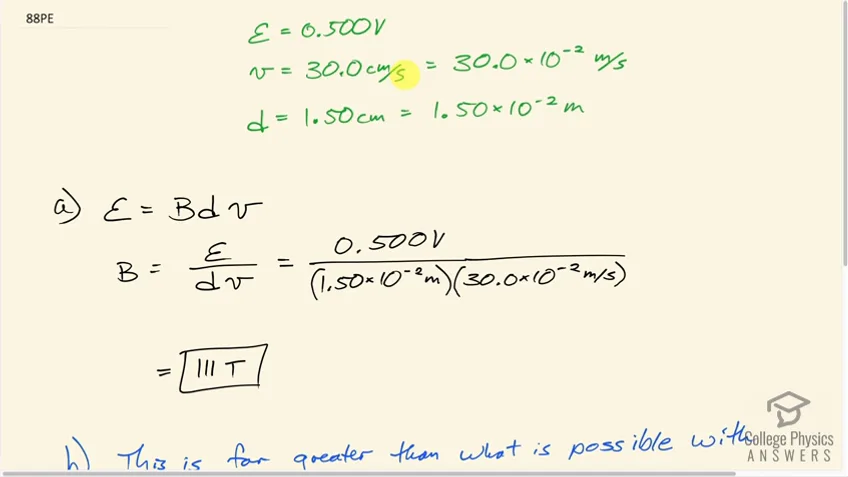 1:45PreviewProblem 88Full video with free trialFrustrated by the small Hall voltage obtained in blood flow measurements, a medical physicist decides to increase the applied magnetic field strength to get a 0.500-V output for blood moving at 30.0 cm/s in a 1.50-cm-diameter vessel. (a) What magnetic field strength is needed? (b) What is unreasonable about this result? (c) Which premise is responsible?
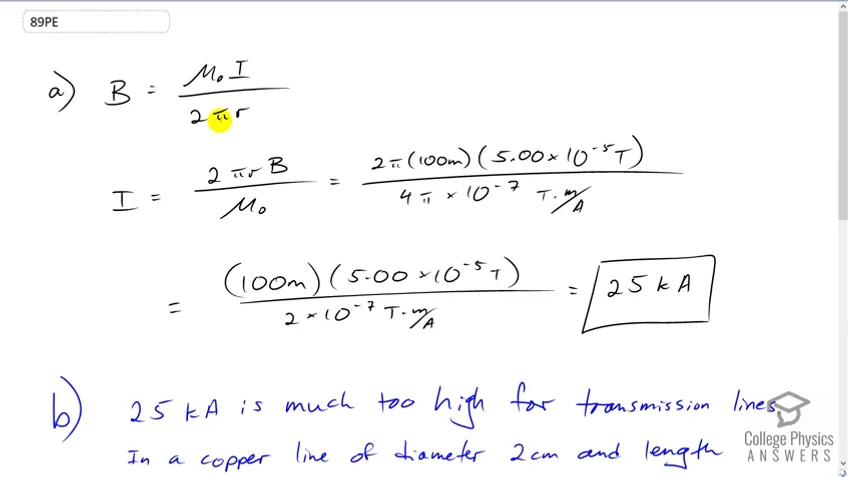 1:57PreviewProblem 89Full video with free trialA surveyor 100 m from a long straight 200-kV DC power line suspects that its magnetic field may equal that of the Earth and affect compass readings. (a) Calculate the current in the wire needed to create a field at this distance. (b) What is unreasonable about this result? (c) Which assumption or premise is responsible?
Test Prep for AP® Courses
22.2 Ferromagnets and Electromagnets
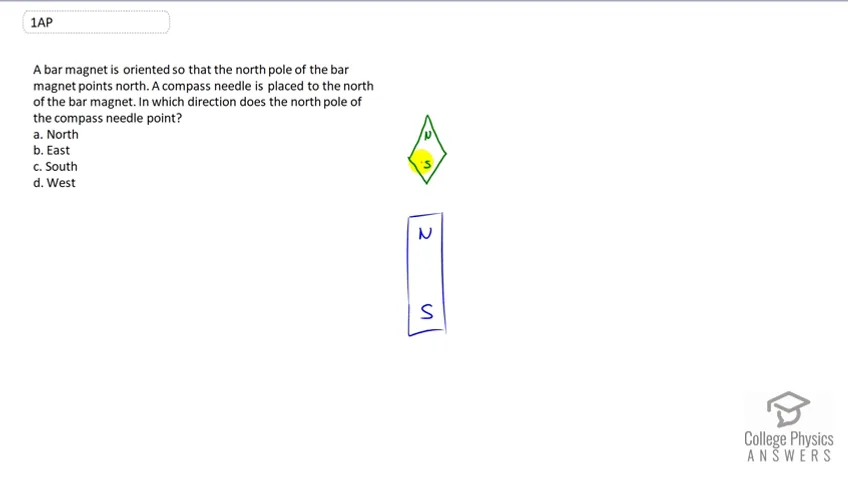 0:54PreviewProblem 1Full video with free trialA bar magnet is oriented so that the north pole of the bar magnet points north. A compass needle is placed to the north of the bar magnet. In which direction does the north pole of the compass needle point? (a) North
(b) East
(c) South
(d) West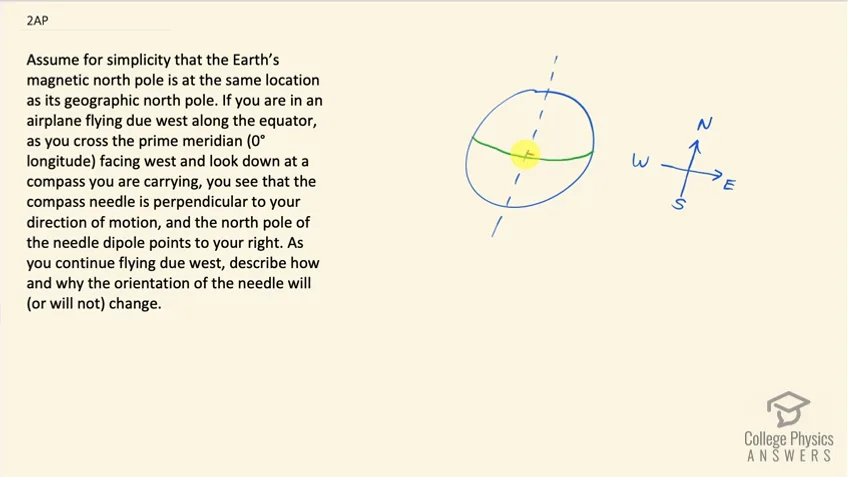 4:57PreviewProblem 2Full video with free trialAssume for simplicity that the Earth’s magnetic north pole is at the same location as its geographic north pole. If you are in an airplane flying due west along the equator, as you cross the prime meridian (0° longitude) facing west and look down at a compass you are carrying, you see that the compass needle is perpendicular to your direction of motion, and the north pole of the needle dipole points to your right. As you continue flying due west, describe how and why the orientation of the needle will (or will not) change.
 0:15PreviewProblem 3Full video with free trialDescribe how the magnetic domains in an unmagnetized iron rod will respond to the presence of a strong external magnetic field. (a) The domains will split into monopoles.
(b) The domains will tend to align with the external field.
(c) The domains will tend to orient themselves perpendicular to the external field.
(d) The domains will tend to align so as to cancel out the external field.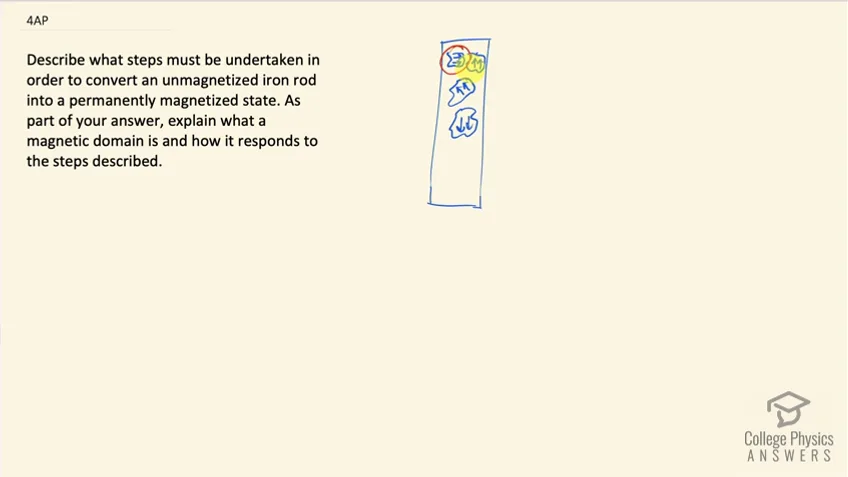 2:40PreviewProblem 4Full video with free trialDescribe what steps must be undertaken in order to convert an unmagnetized iron rod into a permanently magnetized state. As part of your answer, explain what a magnetic domain is and how it responds to the steps described.
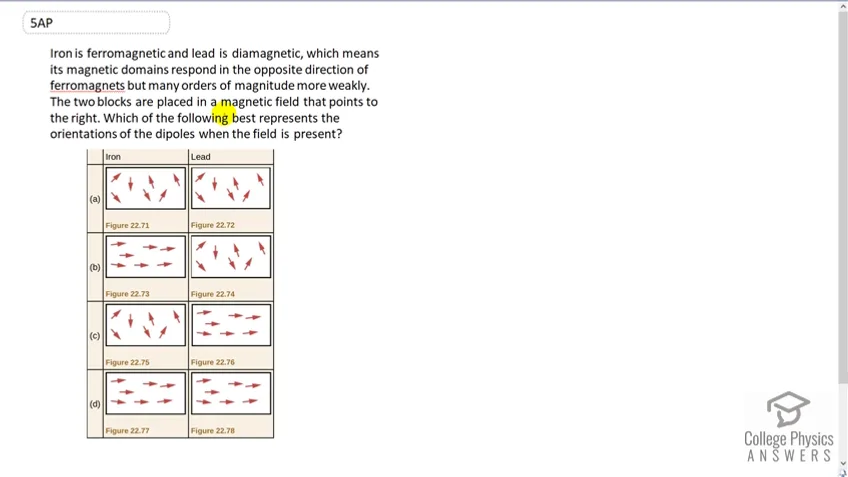 0:56PreviewProblem 5Full video with free trialIron is ferromagnetic and lead is diamagnetic, which means its magnetic domains respond in the opposite direction of ferromagnets but many orders of magnitude more weakly. The two blocks are placed in a magnetic field that points to the right. Which of the following best represents the orientations of the dipoles when the field is present?
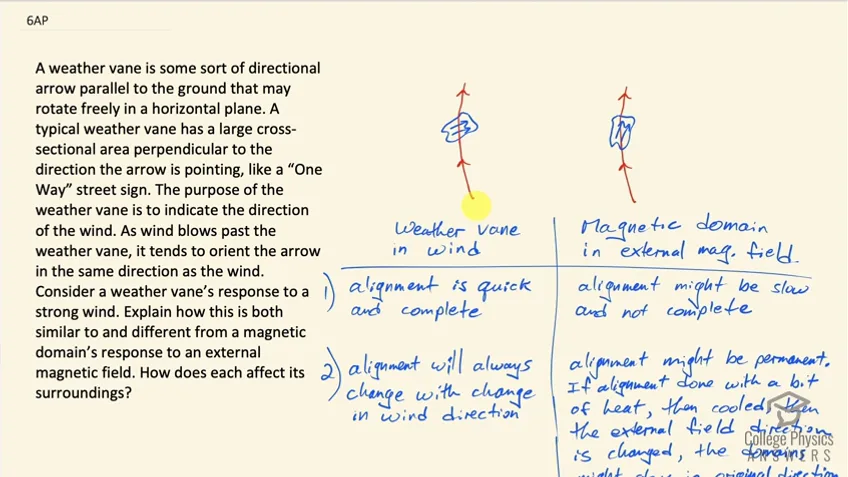 3:33PreviewProblem 6Full video with free trialA weather vane is some sort of directional arrow parallel to the ground that may rotate freely in a horizontal plane. A typical weather vane has a large cross-sectional area perpendicular to the direction the arrow is pointing, like a “One Way” street sign. The purpose of the weather vane is to indicate the direction of the wind. As wind blows past the weather vane, it tends to orient the arrow in the same direction as the wind. Consider a weather vane’s response to a strong wind. Explain how this is both similar to and different from a magnetic domain’s response to an external magnetic field. How does each affect its surroundings?
22.4 Magnetic Field Strength: Force on a Moving Charge in a Magnetic Field
 0:19PreviewProblem 7Full video with free trialA proton moves in the –x-direction and encounters a uniform magnetic field pointing in the +x-direction. In what direction is the resulting magnetic force on the proton? (a) The proton experiences no magnetic force.
(b) +x-direction
(c) −y-direction
(d) +y-direction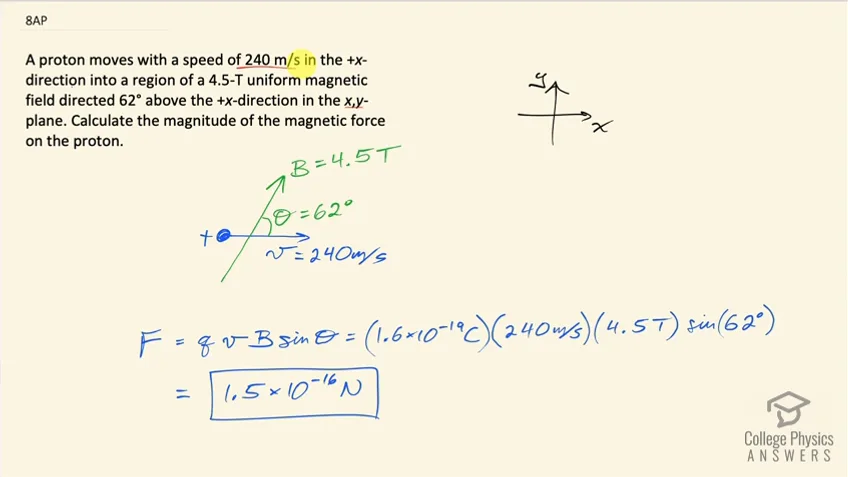 0:58PreviewProblem 8Full video with free trialA proton moves with a speed of 240 m/s in the +x-direction into a region of a 4.5-T uniform magnetic field directed above the +x-direction in the x,y-plane. Calculate the magnitude of the magnetic force on the proton.
22.5 Force on a Moving Charge in a Magnetic Field: Examples and Applications
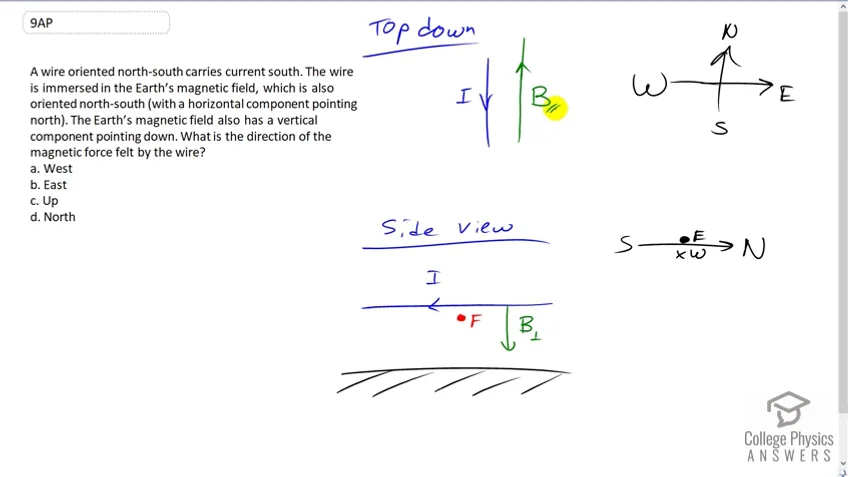 1:11PreviewProblem 9Full video with free trialA wire oriented north-south carries current south. The wire is immersed in the Earth’s magnetic field, which is also oriented north-south (with a horizontal component pointing north). The Earth’s magnetic field also has a vertical component pointing down. What is the direction of the magnetic force felt by the wire? (a) West
(b) East
(c) Up
(d) North
22.6 The Hall Effect
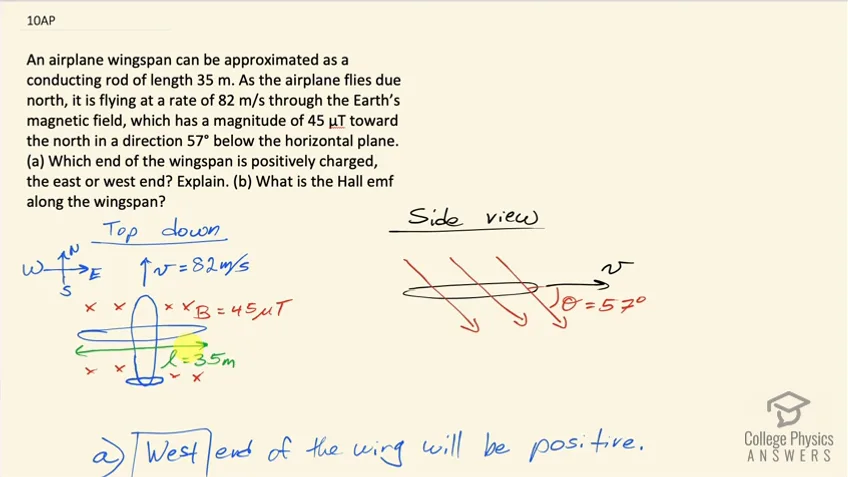 2:14PreviewProblem 10Full video with free trialAn airplane wingspan can be approximated as a conducting rod of length 35 m. As the airplane flies due north, it is flying at a rate of 82 m/s through the Earth’s magnetic field, which has a magnitude of toward the north in a direction below the horizontal plane. (a) Which end of the wingspan is positively charged, the east or west end? Explain. (b) What is the Hall emf along the wingspan?
22.9 Magnetic Fields Produced by Currents: Ampere's Law
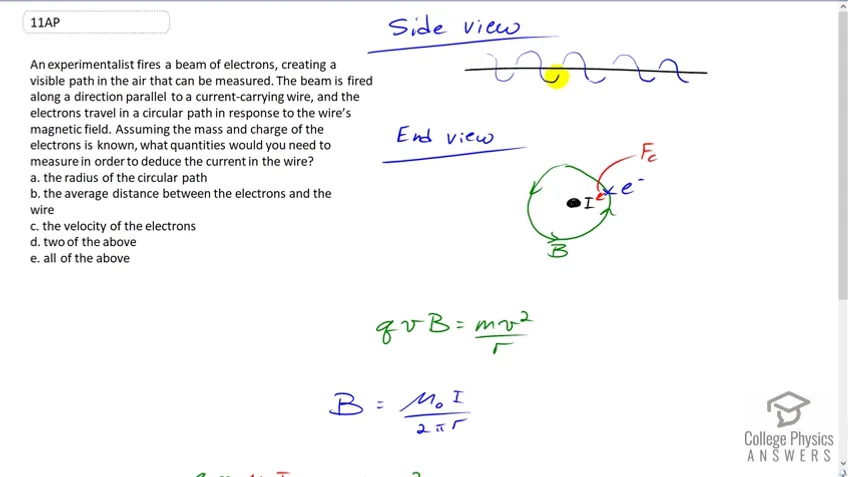 3:15PreviewProblem 11Full video with free trialAn experimentalist fires a beam of electrons, creating a visible path in the air that can be measured. The beam is fired along a direction parallel to a current-carrying wire, and the electrons travel in a circular path in response to the wire’s magnetic field. Assuming the mass and charge of the electrons is known, what quantities would you need to measure in order to deduce the current in the wire? (a) the radius of the circular path
(b) the average distance between the electrons and the wire
(c) the velocity of the electrons
(d) two of the above
(e) all of the above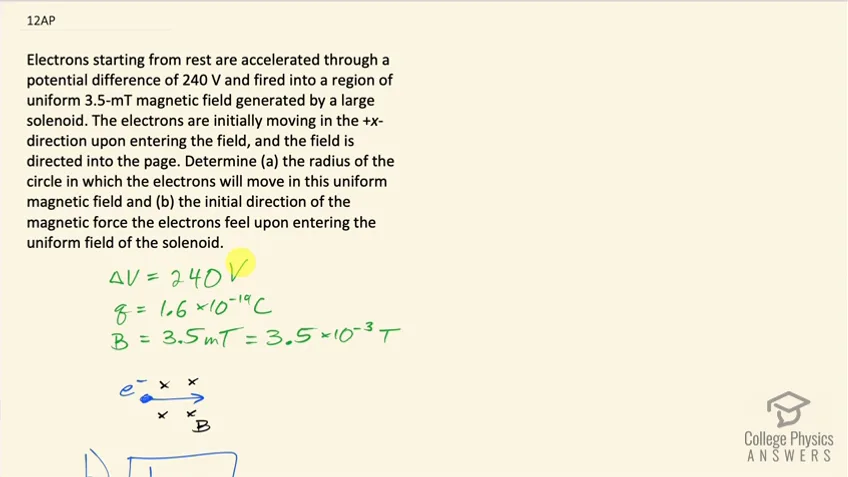 7:00PreviewProblem 12Full video with free trialElectrons starting from rest are accelerated through a potential difference of 240 V and fired into a region of uniform 3.5-mT magnetic field generated by a large solenoid. The electrons are initially moving in the +x-direction upon entering the field, and the field is directed into the page. Determine (a) the radius of the circle in which the electrons will move in this uniform magnetic field and (b) the initial direction of the magnetic force the electrons feel upon entering the uniform field of the solenoid.
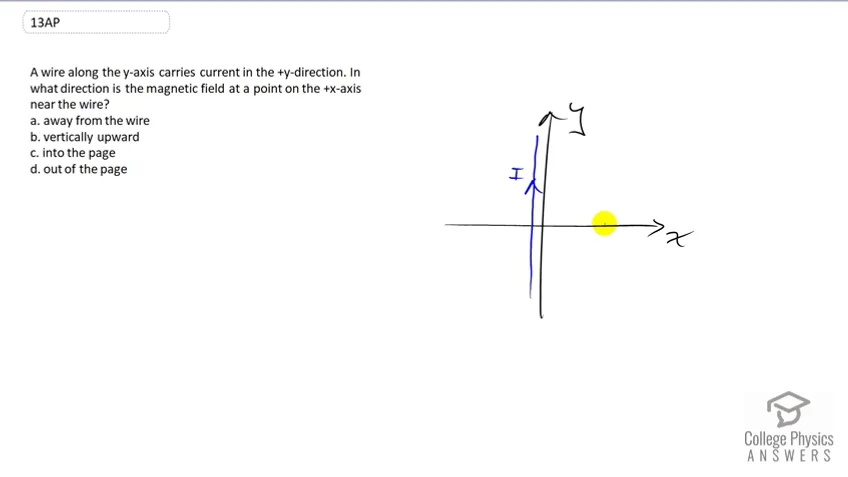 0:34PreviewProblem 13Full video with free trialA wire along the y-axis carries current in the +y-direction. In what direction is the magnetic field at a point on the +x-axis near the wire? (a) away from the wire
(b) vertically upward
(c) into the page
(d) out of the page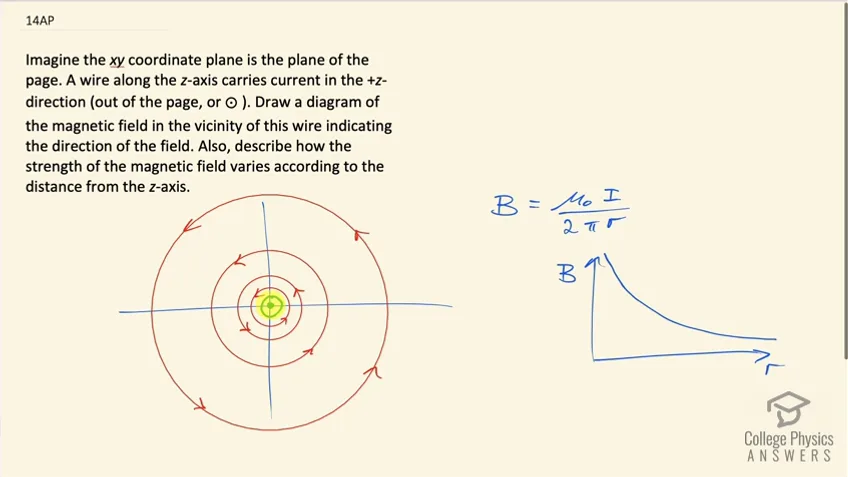 2:52PreviewProblem 14Full video with free trialImagine the xy coordinate plane is the plane of the page. A wire along the z-axis carries current in the +z-direction (out of the page, or ⊙ ). Draw a diagram of the magnetic field in the vicinity of this wire indicating the direction of the field. Also, describe how the strength of the magnetic field varies according to the distance from the z-axis.
22.10 Magnetic Force between Two Parallel Conductors
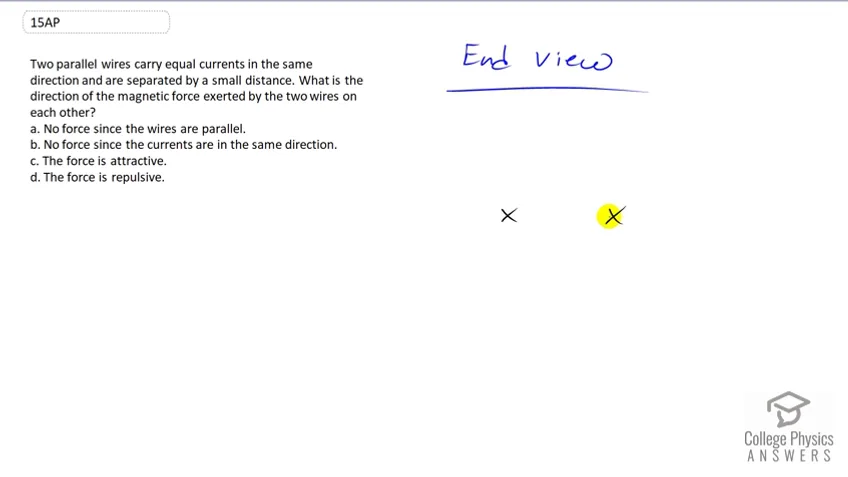 1:19PreviewProblem 15Full video with free trialTwo parallel wires carry equal currents in the same direction and are separated by a small distance. What is the direction of the magnetic force exerted by the two wires on each other? (a) No force since the wires are parallel.
(b) No force since the currents are in the same direction.
(c) The force is attractive.
(d) The force is repulsive.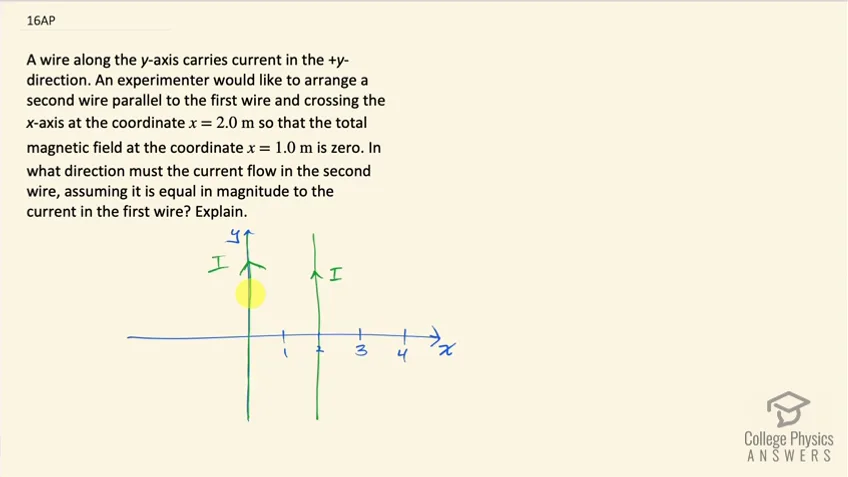 1:39PreviewProblem 16Full video with free trialA wire along the y-axis carries current in the +y-direction. An experimenter would like to arrange a second wire parallel to the first wire and crossing the x-axis at the coordinate so that the total magnetic field at the coordinate is zero. In what direction must the current flow in the second wire, assuming it is equal in magnitude to the current in the first wire? Explain.