Problem23
Section 4.6: Problem-Solving Strategies

Question

A rocket is accelerating straight up. Its engines produce of thrust, and air resistance is . What is the rocket’s acceleration? Explicitly show how you follow the steps in the Problem-Solving Strategy for Newton’s laws of motion.

Question by OpenStax is licensed under CC BY 4.0

Final Answer

6.20 m/s26.20 \textrm{ m/s}^2

Solution video

1:36

This is a 16-second preview. Get access to the full video by starting your free 7-day trial.

4.1 (7)
803 views

Calculator Screenshots

Calculator screenshot

Video Transcript

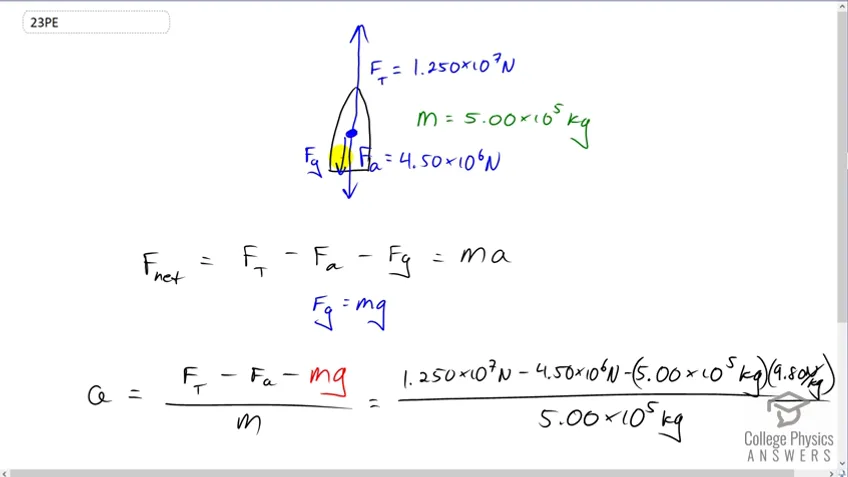
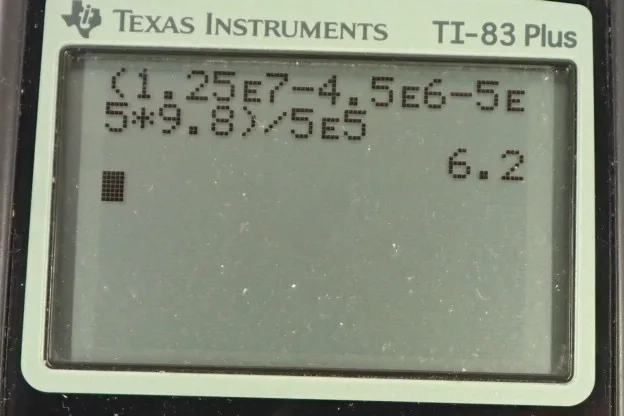
This is College Physics Answers with Shaun Dychko. One of the best ways to prepare any of your solutions is to draw a picture. So that's what I've done here. This is especially important for forces or dynamics questions because you need to draw the free body diagram to show all the forces involved. So with this rocket we have a thrust force upwards of 1.25 times ten to the seven newtons and then downwards we have gravity and then we also have the air resistance which is directed opposite to the direction of motion and so that will be downwards as well because the rocket is moving up. So the air friction down is 4.5 times ten to the six newtons. We're told that the mass of the rocket is 5 times ten to the five kilograms and so we've drawn a free body diagram and written down everything that we know. Then we can proceed to the algebra which is that the net force is the up force, up forces minus the down forces, and so we have up as the thrust force and then minus each of the down forces, air and gravity. That net force equals mass times acceleration. Gravity is mg. So we'll divide both sides by m here and then substitute for fg and we get this line here, acceleration is thrust, minus air resistance, minus mg weight, divided by the mass, m. We substitute each of those numbers in here and we end up with 6.2 meters per second squared as the acceleration of the rocket.

Comments

yesiaraujo·
can you show screenshots when using a TI-30XIS
Like
ShaunDychko·
Hi yesiaraujo, thank you for your comment. It would be time prohibitive to perform the calculations again with another calculator, so the TI-83 will have to do. All the best with your studies, Shaun
Like
AdamAstel·
Hello Shaun, I was just curious. Why does Fg=mg? thank you.
Like
GabiFerreira·
Hey Shaun , I tried putting the problem into my calculator a few different ways and I keep getting 10. Best, Karolline
Like
ShaunDychko·
Hi Karolline, thanks for the question, but I'm sorry I can't explain why the calculator would be giving 10. I would suggest carefully comparing my calculator screenshot with what you have an try to find any differences. All the best, Shaun
Like
isabellepacis·
Hi, I don't quite understand the calculator screenshots versus your solution, it looks like a totally different problem?
Like
ShaunDychko·
Hello isabellepacis, thank you so much for spotting this! I have replace the screenshot with the correct one. Best wishes with your studies, Shaun
Like
hphillips32·
i don't understand how you got the answer
Like
ShaunDychko·
Hello, in case it was confusing, the calculator screenshot was the wrong one. I have updated it with the correct screenshot. Otherwise, the main idea for this solution is to divide the net force by the mass to find the acceleration. Net force is the result of adding/subtracting all the forces. All the best, Shaun
Like