Question
This is a 13-second preview. Get access to the full video by starting your free 7-day trial.


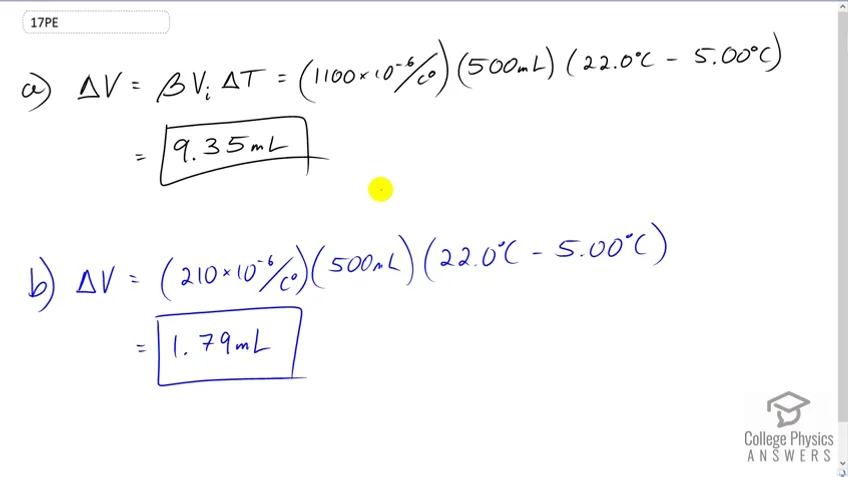
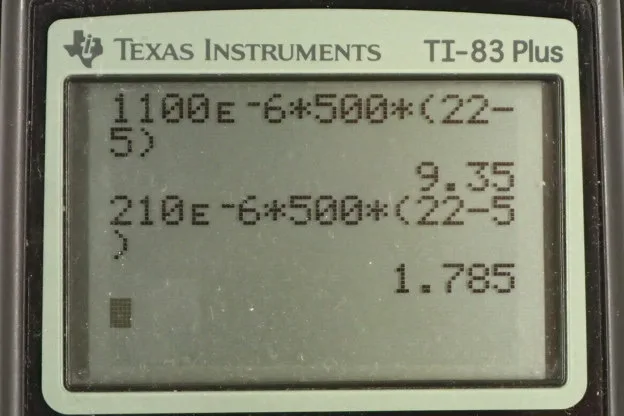
This is College Physics Answers with Shaun Dychko. We're going to assume that this ethyl Alcohol is poured into a beaker which is initially at the room temperature. So the beaker is at room temperature and the alcohol is initially at five degrees Celsius. After it sits in the beaker for a while, its temperature will increase to 22 which is room temperature. All the while, the beaker will basically stay at 22 degrees because it started at 22 degrees and the room air will keep it at 22. So that means the change in volume here, the amount of ethyl alcohol that's spills will be just due to the change in volume of the ethyl alcohol. We don't have to think about the beaker changing in volume. So we multiply the volume expansion coefficient for ethyl alcohol by its initial volume and then by the change in temperature. So that's 1100 times ten to the minus six, times 500 milliliters, times 22 degrees Celsius minus five degrees Celsius, giving 9.35 milliliters. Now if the beaker was instead filled with water and not ethyl alcohol, the only change is the expansion coefficient which will be 210 times ten to the minus six for water. That will result in a spill of volume 1.79 milliliters.