Chapter 13: Temperature, Kinetic Theory, and the Gas Laws
72 problems solved · Free preview of every solution shows how it’s started · Watch the full videos with a free 7-day trial →
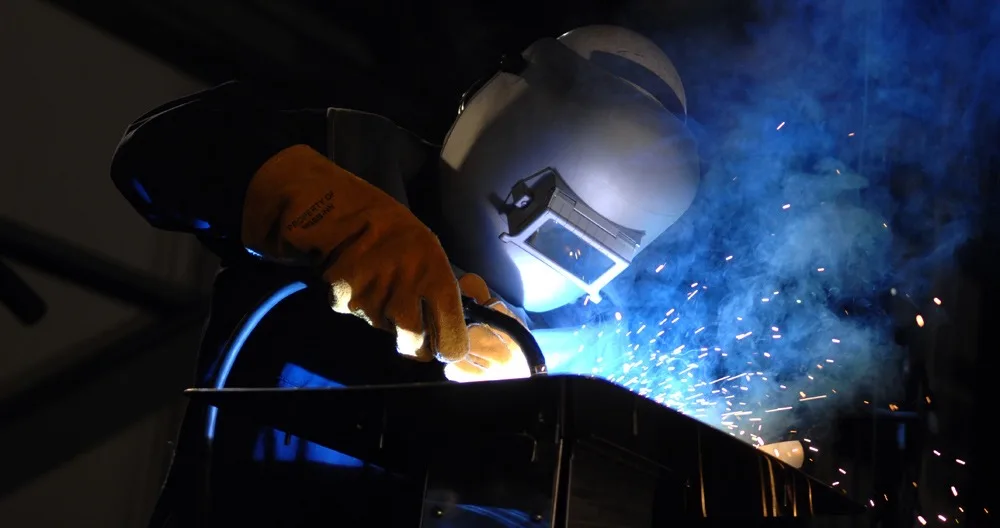
Image: U.S. Navy photo by Mass Communication Specialist 2nd Class Kevin S. O'Brien


Section
13.1 Temperature
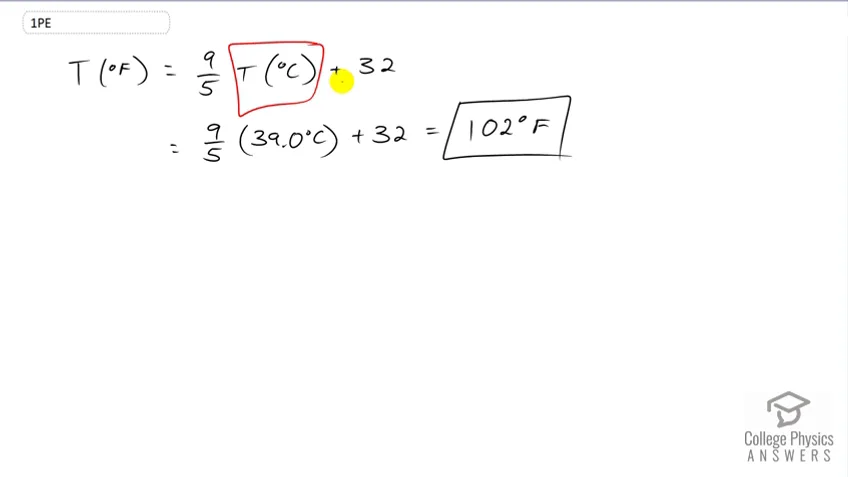 0:24Problem 1FreeWhat is the Fahrenheit temperature of a person with a fever?
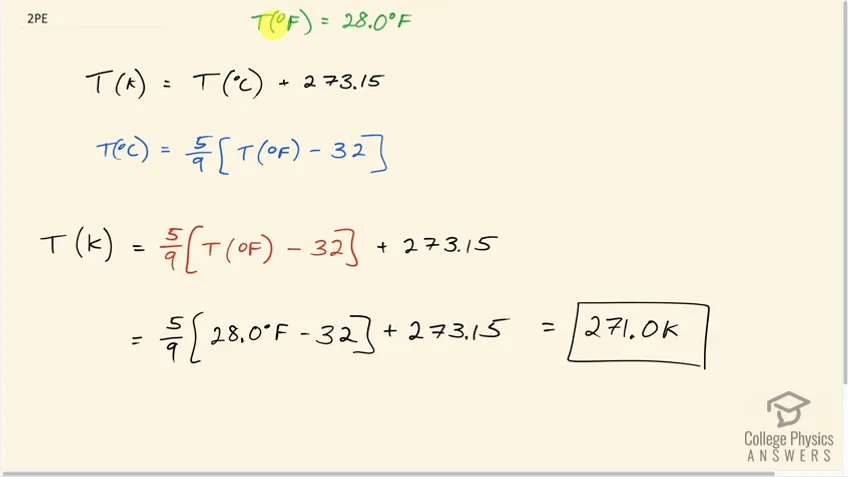 1:55PreviewProblem 2Full video with free trialFrost damage to most plants occurs at temperatures of or lower. What is this temperature on the Kelvin scale?
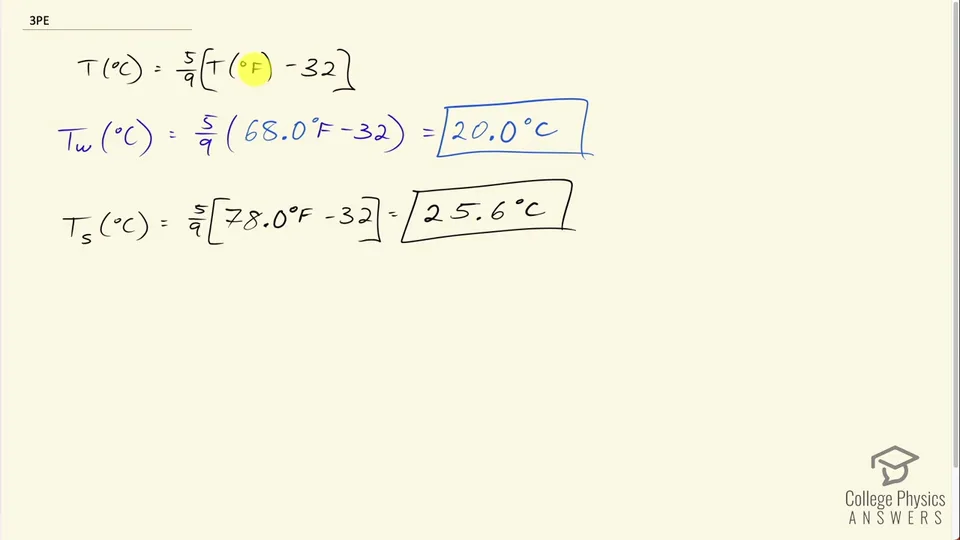 0:41PreviewProblem 3Full video with free trialTo conserve energy, room temperatures are kept at in the winter and in the summer. What are these temperatures on the Celsius scale?
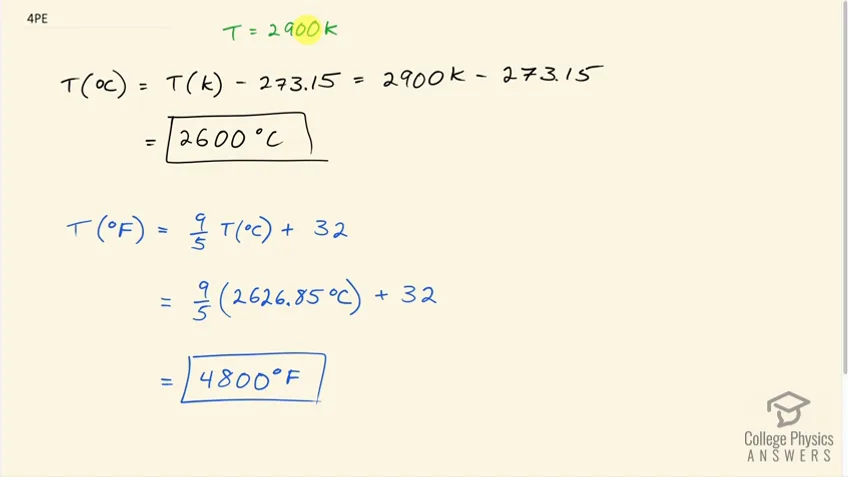 0:52PreviewProblem 4Full video with free trialA tungsten light bulb filament may operate at 2900 K. What is its Fahrenheit temperature? What is this on the Celsius scale?
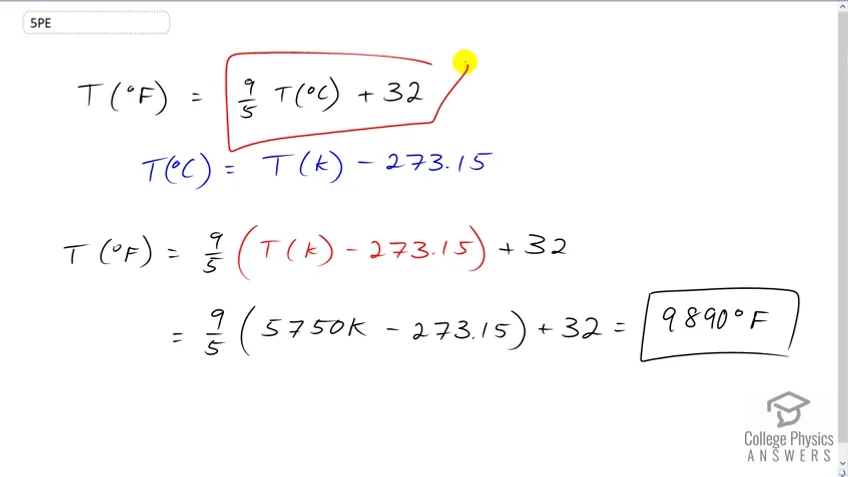 1:13PreviewProblem 5Full video with free trialThe surface temperature of the Sun is about 5750 K. What is this temperature on the Fahrenheit scale?
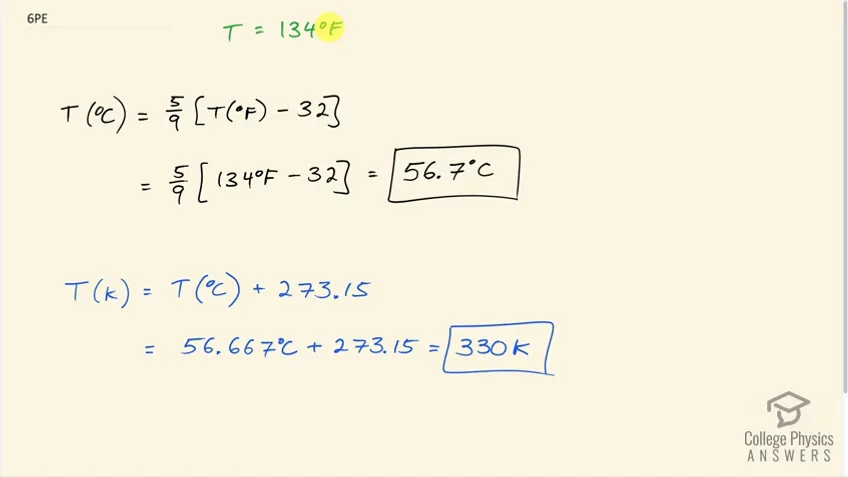 0:43PreviewProblem 6Full video with free trialOne of the hottest temperatures ever recorded on the surface of Earth was in Death Valley, CA. What is this temperature in Celsius degrees? What is this temperature in Kelvin?
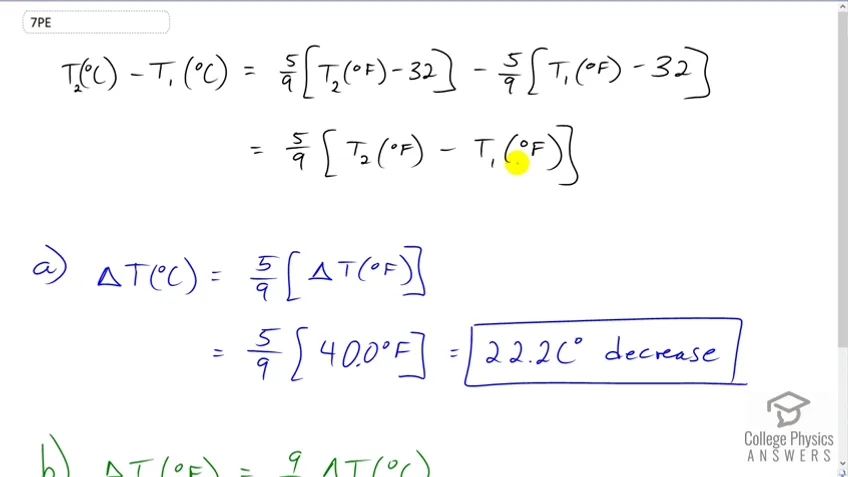 1:54PreviewProblem 7Full video with free trial(a) Suppose a cold front blows into your locale and drops the temperature by 40.0 Fahrenheit degrees. How many degrees Celsius does the temperature decrease when there is a decrease in temperature? (b) Show that any change in temperature in Fahrenheit degrees is nine-fifths the change in Celsius degrees.
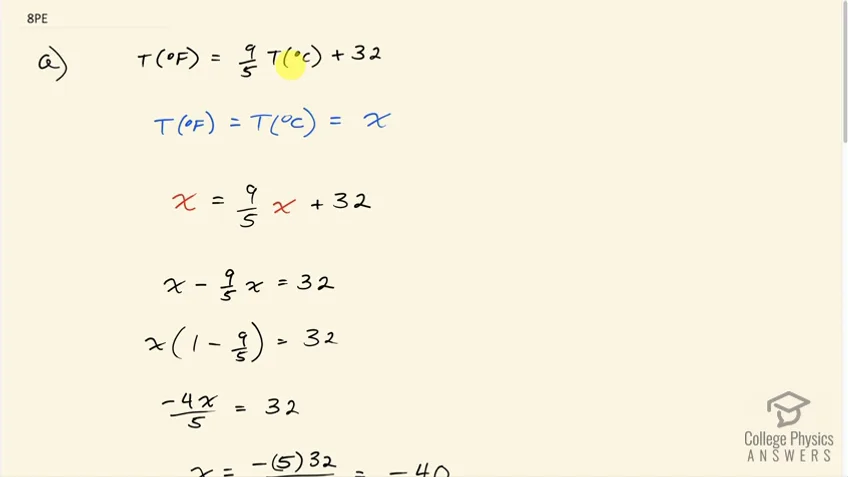 3:11PreviewProblem 8Full video with free trial(a) At what temperature do the Fahrenheit and Celsius scales have the same numerical value? (b) At what temperature do the Fahrenheit and Kelvin scales have the same numerical value?
13.2 Thermal Expansion of Solids and Liquids
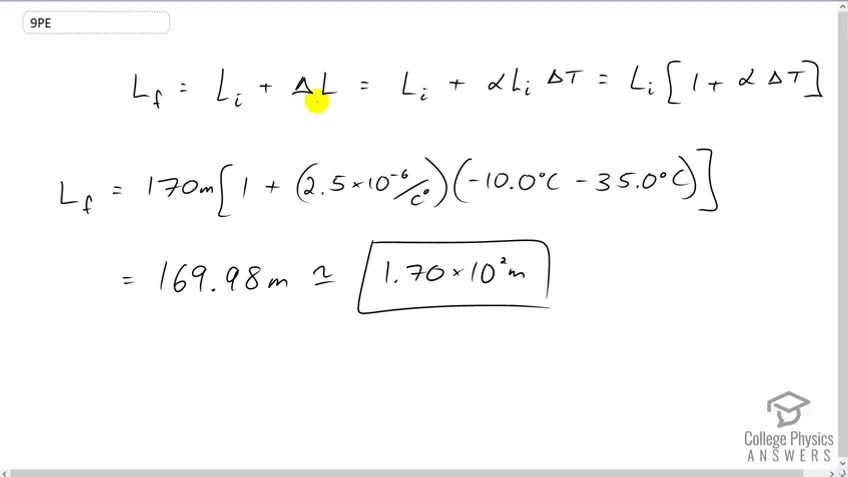 1:04PreviewProblem 9Full video with free trialThe height of the Washington Monument is measured to be 170 m on a day when the temperature is . What will its height be on a day when the temperature falls to ? Although the monument is made of limestone, assume that its thermal coefficient of expansion is the same as marble’s.
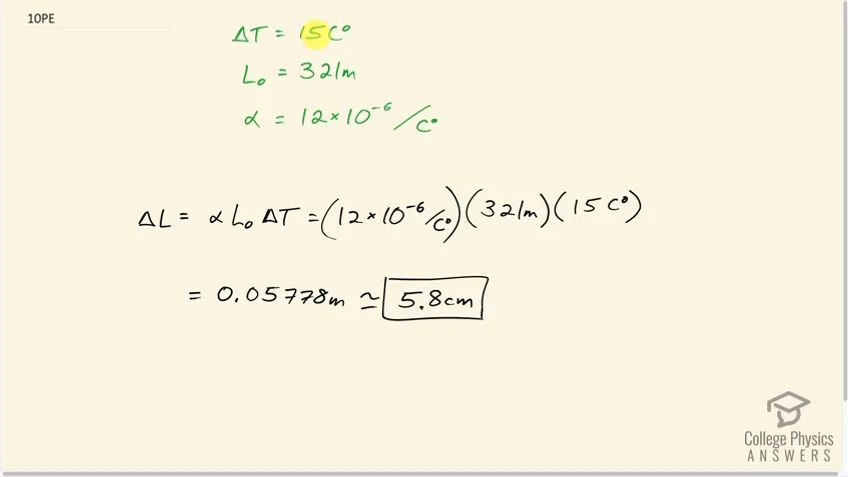 1:01PreviewProblem 10Full video with free trialHow much taller does the Eiffel Tower become at the end of a day when the temperature has increased by ? Its original height is 321 m and you can assume it is made of steel.
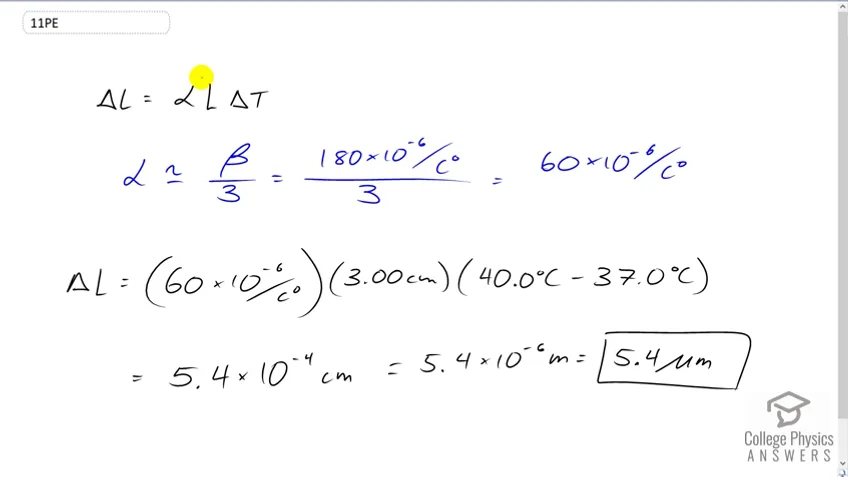 1:38PreviewProblem 11Full video with free trialWhat is the change in length of a 3.00-cm-long column of mercury if its temperature changes from to , assuming the mercury is unconstrained?
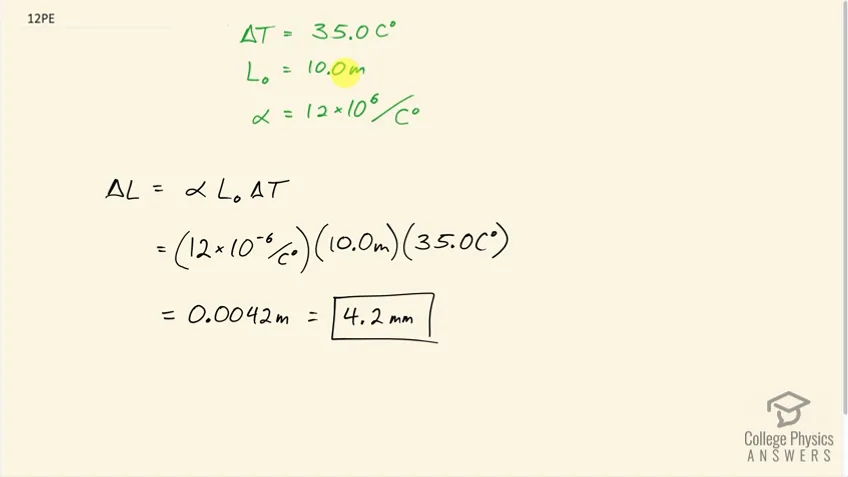 1:08PreviewProblem 12Full video with free trialHow large an expansion gap should be left between steel railroad rails if they may reach a maximum temperature greater than when they were laid? Their original length is 10.0 m.
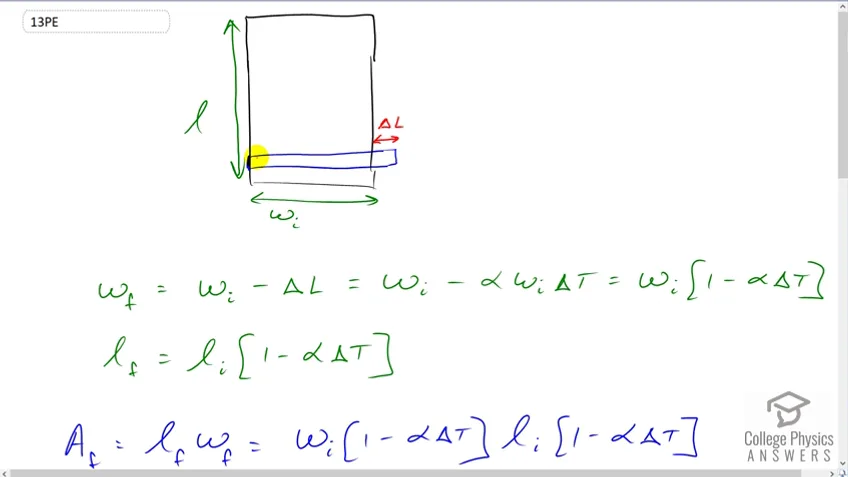 3:13PreviewProblem 13Full video with free trialYou are looking to purchase a small piece of land in Hong Kong. The price is “only” 20 \textrm{ m} \times 30 \textrm{ m}20\textrm{C}^\circ$ above normal?
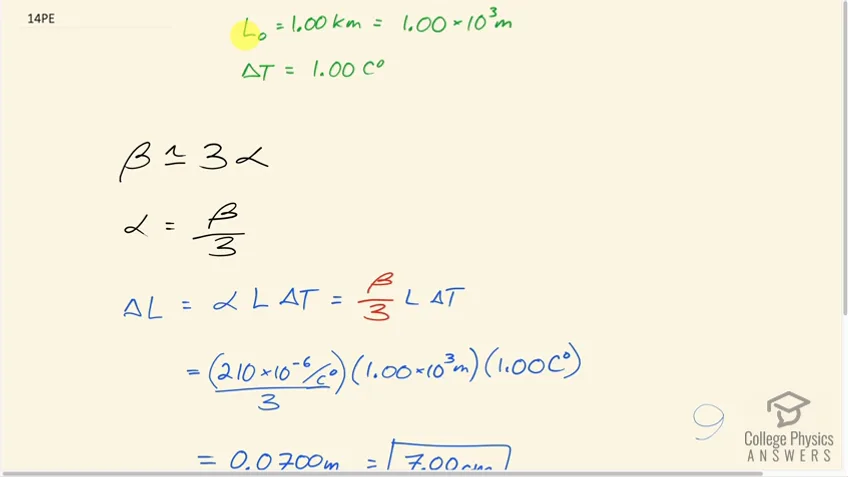 1:38PreviewProblem 14Full video with free trialGlobal warming will produce rising sea levels partly due to melting ice caps but also due to the expansion of water as average ocean temperatures rise. To get some idea of the size of this effect, calculate the change in length of a column of water 1.00 km high for a temperature increase of . Note that this calculation is only approximate because ocean warming is not uniform with depth.
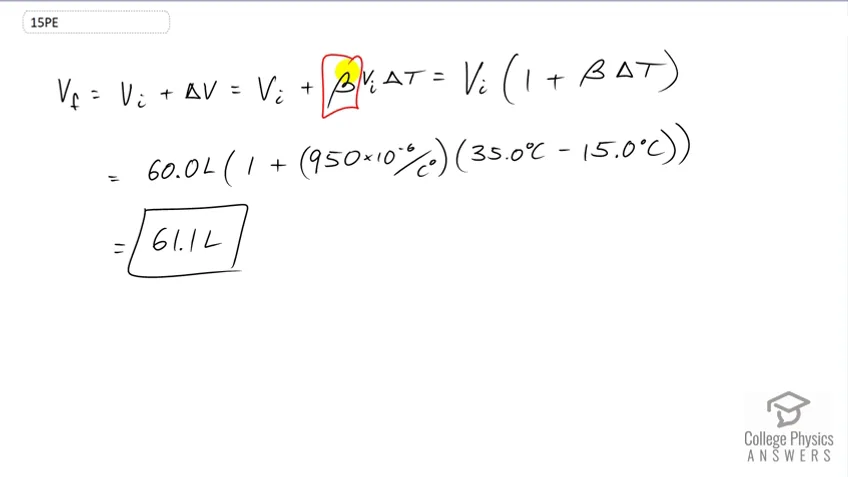 0:43PreviewProblem 15Full video with free trialShow that 60.0 L of gasoline originally at will expand to 61.1 L when it warms to as claimed in Example 13.4.
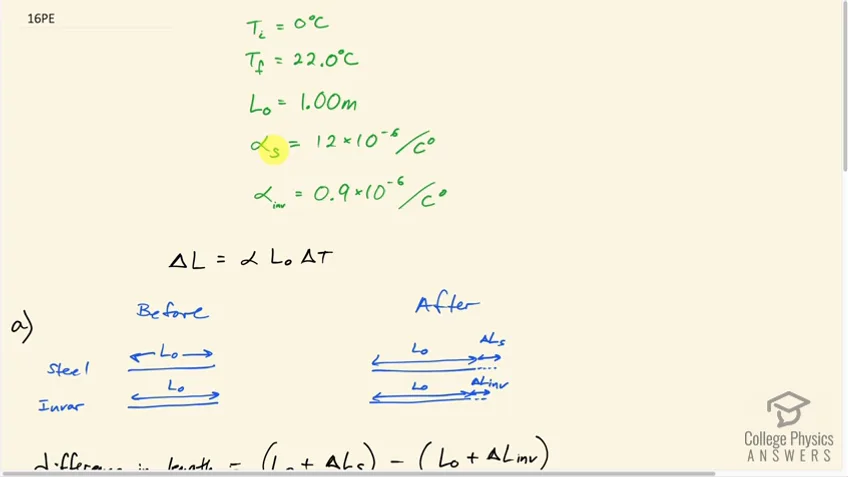 2:56PreviewProblem 16Full video with free trial(a) Suppose a meter stick made of steel and one made of invar (an alloy of iron and nickel) are the same length at . What is their difference in length at ? (b) Repeat the calculation for two 30.0-m-long surveyor’s tapes.
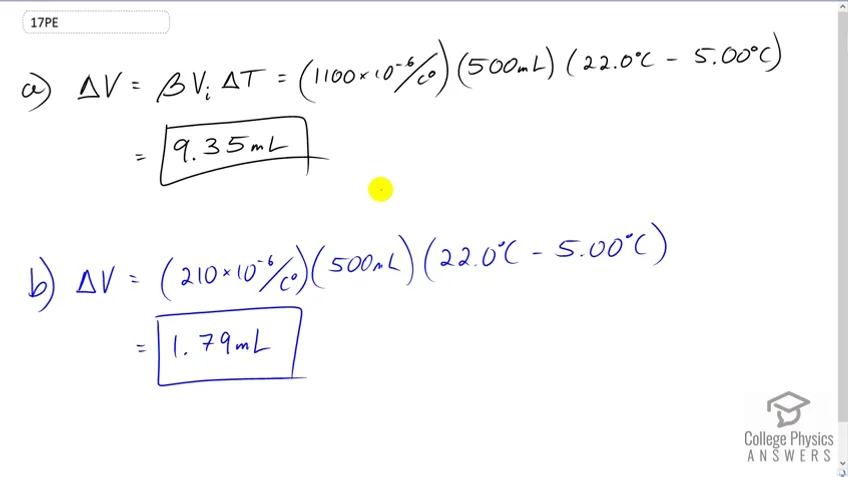 1:21PreviewProblem 17Full video with free trial(a) If a 500-mL glass beaker is filled to the brim with ethyl alcohol at a temperature of how much will overflow when its temperature reaches ? (b) How much less water would overflow under the same conditions?
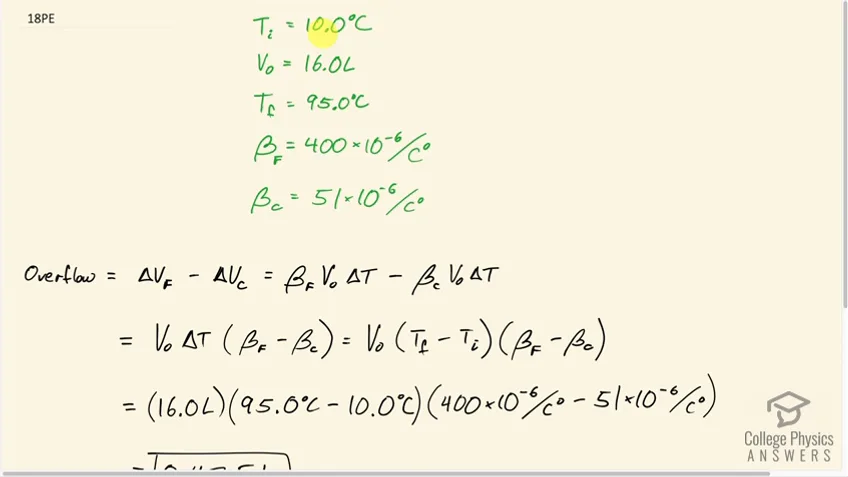 2:15PreviewProblem 18Full video with free trialMost automobiles have a coolant reservoir to catch radiator fluid that may overflow when the engine is hot. A radiator is made of copper and is filled to its 16.0-L capacity when at . What volume of radiator fluid will overflow when the radiator and fluid reach their operating temperature, given that the fluid’s volume coefficient of expansion is ? Note that this coefficient is approximate, because most car radiators have operating temperatures of greater than .
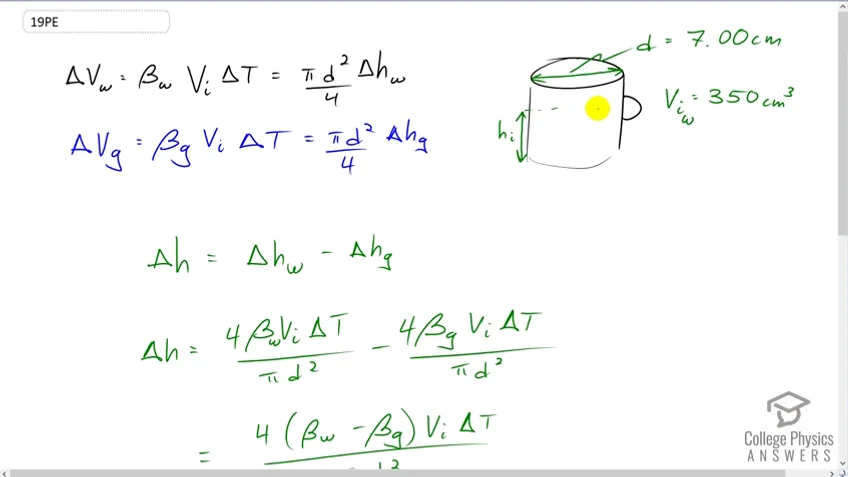 5:54PreviewProblem 19Full video with free trialA physicist makes a cup of instant coffee and notices that, as the coffee cools, its level drops 3.00 mm in the glass cup. Show that this decrease cannot be due to thermal contraction by calculating the decrease in level if the of coffee is in a 7.00-cm-diameter cup and decreases in temperature from to (Most of the drop in level is actually due to escaping bubbles of air.)
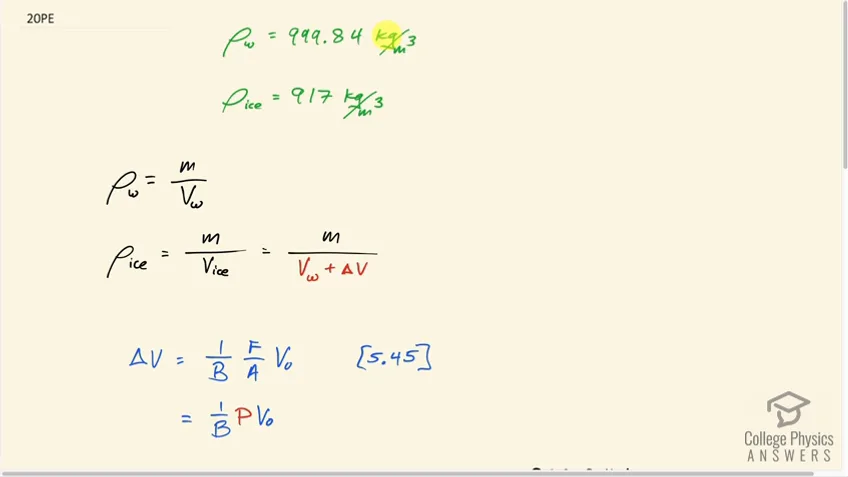 4:13PreviewProblem 20Full video with free trial(a) The density of water at is very nearly (it is actually ), whereas the density of ice at is . Calculate the pressure necessary to keep ice from expanding when it freezes, neglecting the effect such a large pressure would have on the freezing temperature. (This problem gives you only an indication of how large the forces associated with freezing water might be.) (b) What are the implications of this result for biological cells that are frozen?
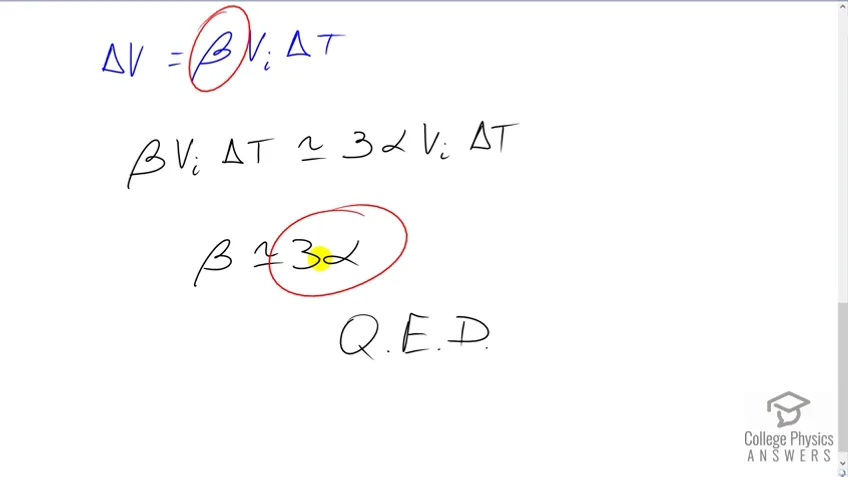 4:22PreviewProblem 21Full video with free trialShow that , by calculating the change in volume of a cube with sides of length .
13.3 The Ideal Gas Law
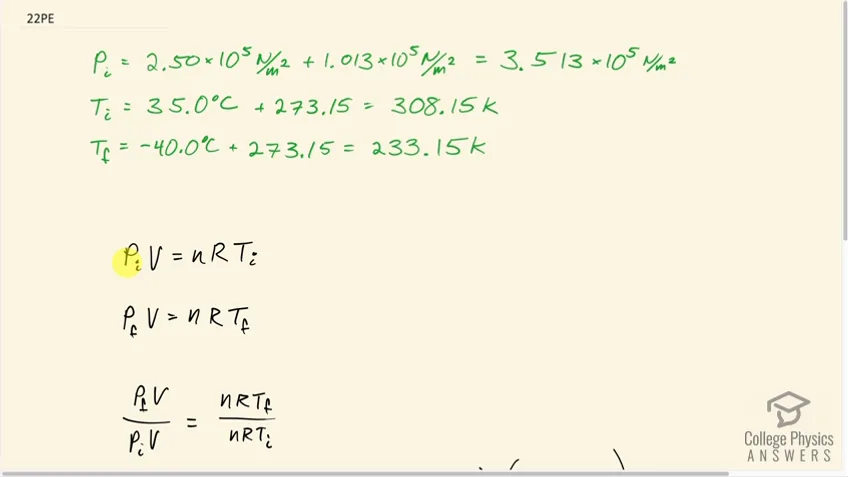 2:44PreviewProblem 22Full video with free trialThe gauge pressure in your car tires is at a temperature of when you drive it onto a ferry boat to Alaska. What is their gauge pressure later, when their temperature has dropped to ?
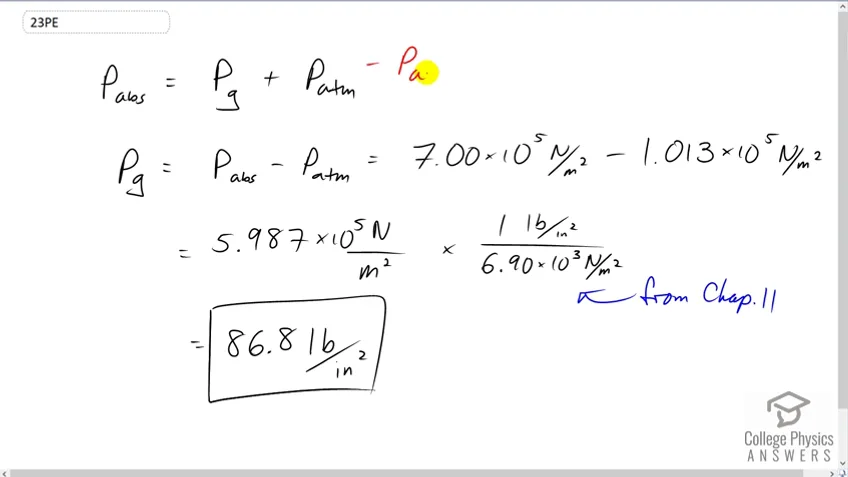 0:41PreviewProblem 23Full video with free trialConvert an absolute pressure of to gauge pressure in . (This value was stated to be just less than in Example 13.9. Is it?)
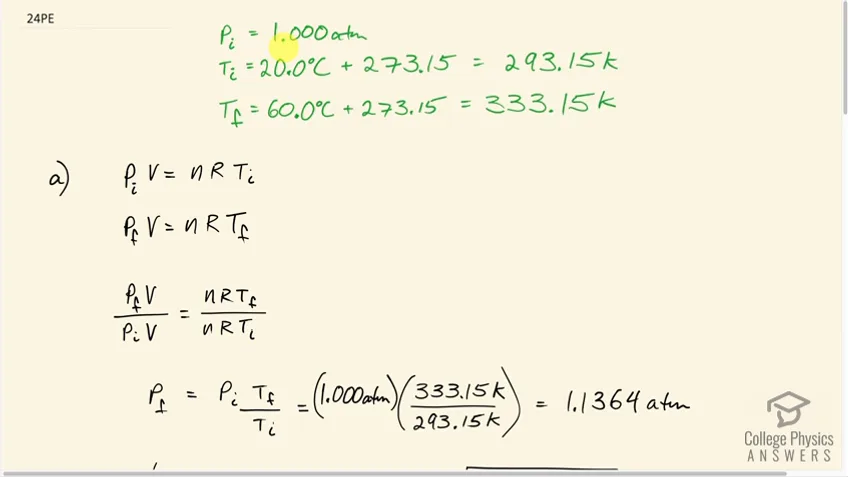 7:34PreviewProblem 24Full video with free trialSuppose a gas-filled incandescent light bulb is manufactured so that the gas inside the bulb is at atmospheric pressure when the bulb has a temperature of . (a) Find the gauge pressure inside such a bulb when it is hot, assuming its average temperature is (an approximation) and neglecting any change in volume due to thermal expansion or gas leaks. (b) The actual final pressure for the light bulb will be less than calculated in part (a) because the glass bulb will expand. What will the actual final pressure be, taking this into account? Is this a negligible difference?
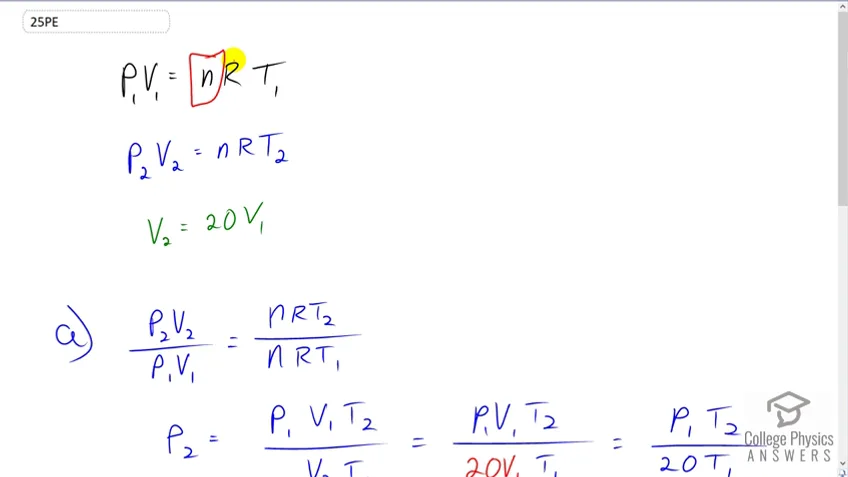 3:05PreviewProblem 25Full video with free trialLarge helium-filled balloons are used to lift scientific equipment to high altitudes. (a) What is the pressure inside such a balloon if it starts out at sea level with a temperature of and rises to an altitude where its volume is twenty times the original volume and its temperature is ? (b) What is the gauge pressure? (Assume atmospheric pressure is constant.)
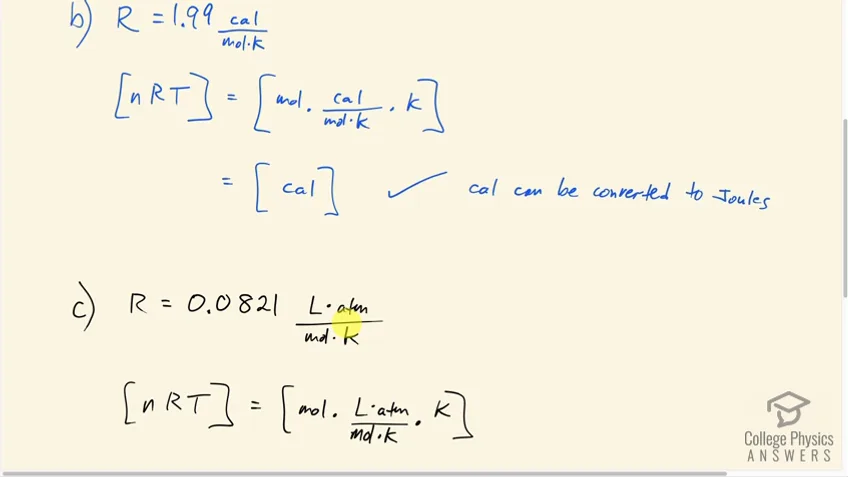 1:36PreviewProblem 26Full video with free trialConfirm that the units of are those of energy for each value of : (a) , (b) , and (c) .
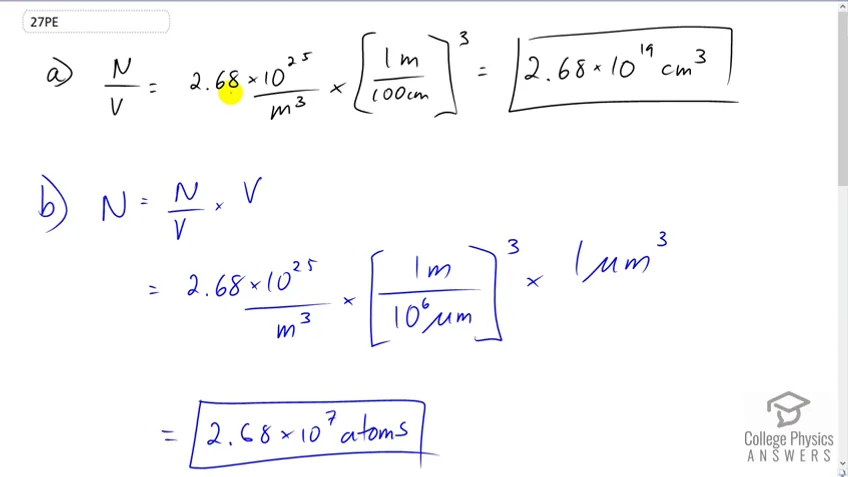 2:57PreviewProblem 27Full video with free trialIn the text, it was shown that for gas at STP. (a) Show that this quantity is equivalent to , as stated. (b) About how many atoms are there in one (a cubic micrometer) at STP? (c) What does your answer to part (b) imply about the separation of atoms and molecules?
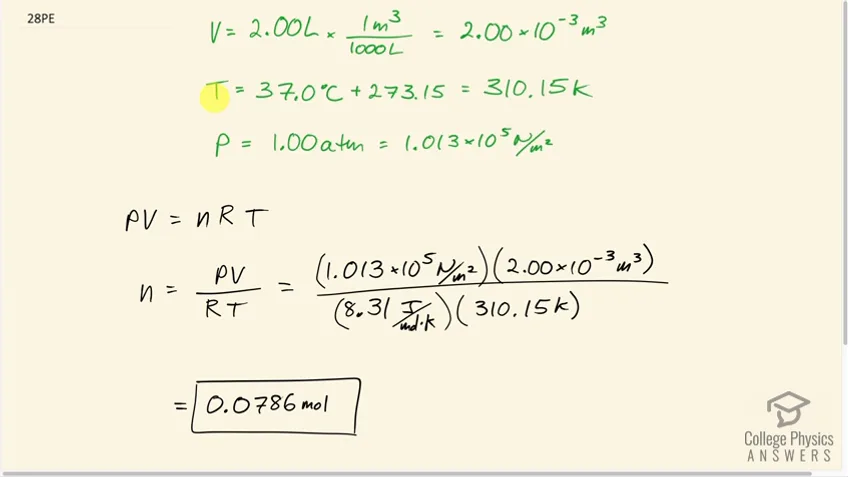 1:36PreviewProblem 28Full video with free trialCalculate the number of moles in the 2.00-L volume of air in the lungs of the average person. Note that the air is at (body temperature).
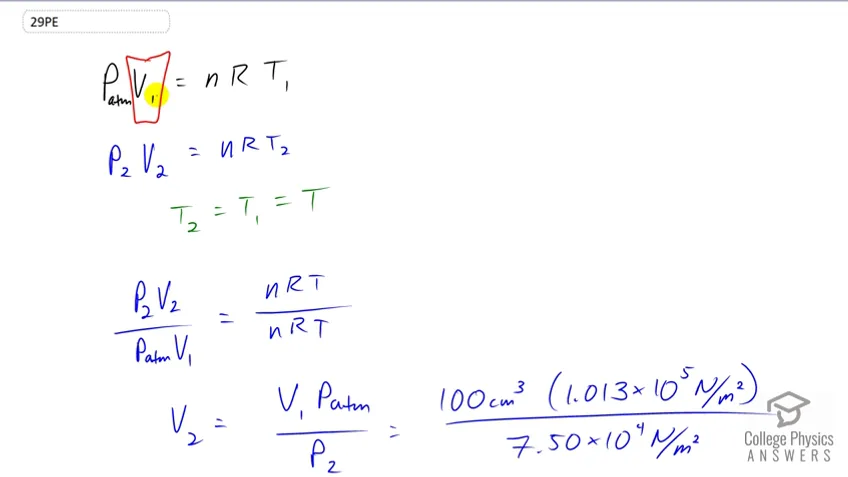 1:43PreviewProblem 29Full video with free trialAn airplane passenger has of air in his stomach just before the plane takes off from a sea-level airport. What volume will the air have at cruising altitude if cabin pressure drops to ?
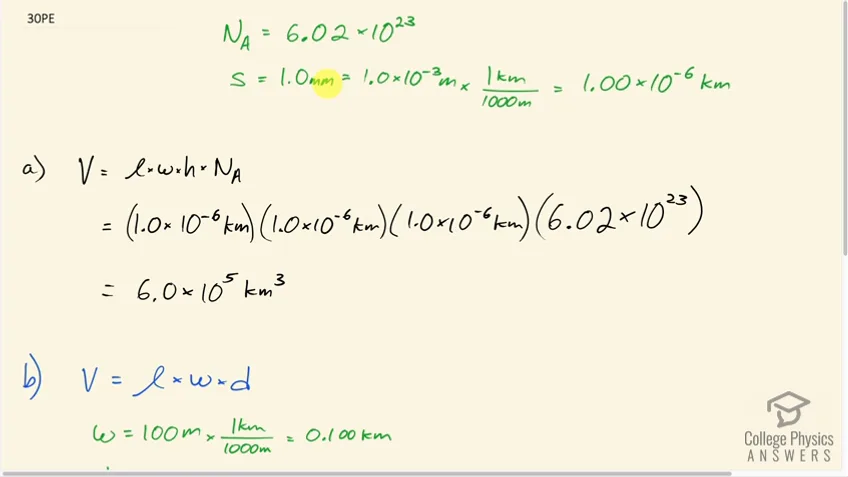 2:36PreviewProblem 30Full video with free trial(a) What is the volume (in ) of Avogadro’s number of sand grains if each grain is a cube and has sides that are 1.0 mm long? (b) How many kilometers of beaches in length would this cover if the beach averages 100 m in width and 10.0 m in depth? Neglect air spaces between grains.
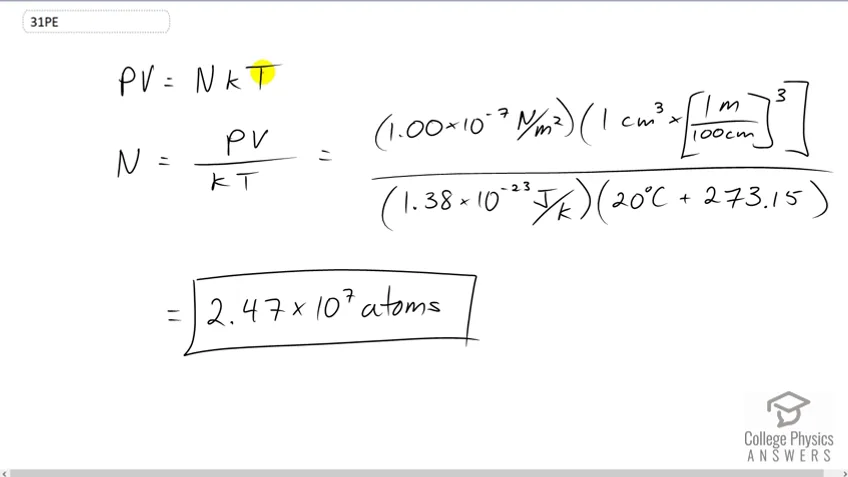 1:04PreviewProblem 31Full video with free trialAn expensive vacuum system can achieve a pressure as low as at . How many atoms are there in a cubic centimeter at this pressure and temperature?
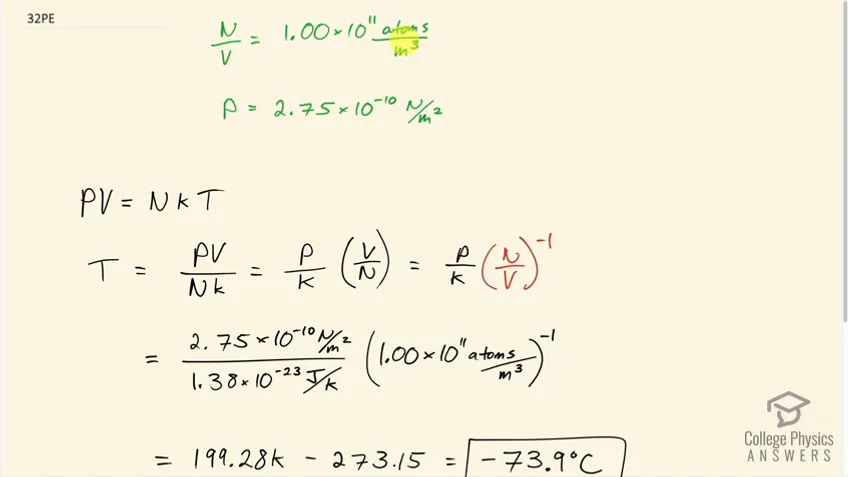 1:46PreviewProblem 32Full video with free trialThe number density of gas atoms at a certain location in the space above our planet is about , and the pressure is in this space. What is the temperature there?
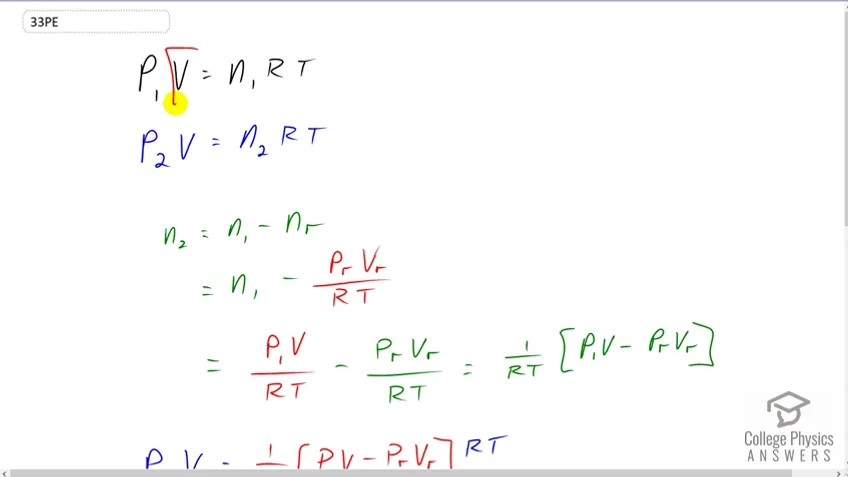 3:13PreviewProblem 33Full video with free trialA bicycle tire has a pressure of at a temperature of and contains of gas. What will its pressure be if you let out an amount of air that has a volume of at atmospheric pressure? Assume tire temperature and volume remain constant.
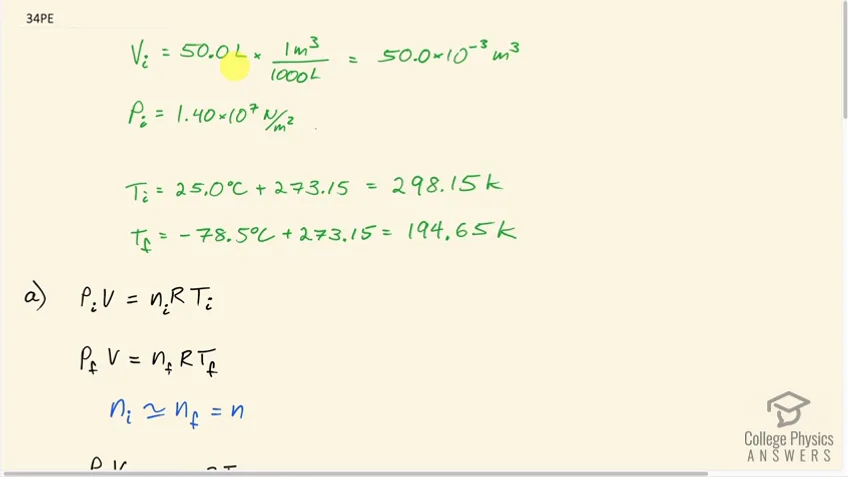 5:35PreviewProblem 34Full video with free trialA high-pressure gas cylinder contains 50.0 L of toxic gas at a pressure of and a temperature of . Its valve leaks after the cylinder is dropped. The cylinder is cooled to dry ice temperature () to reduce the leak rate and pressure so that it can be safely repaired. (a) What is the final pressure in the tank, assuming a negligible amount of gas leaks while being cooled and that there is no phase change? (b) What is the final pressure if one-tenth of the gas escapes? (c) To what temperature must the tank be cooled to reduce the pressure to 1.00 atm (assuming the gas does not change phase and that there is no leakage during cooling)? (d) Does cooling the tank appear to be a practical solution?
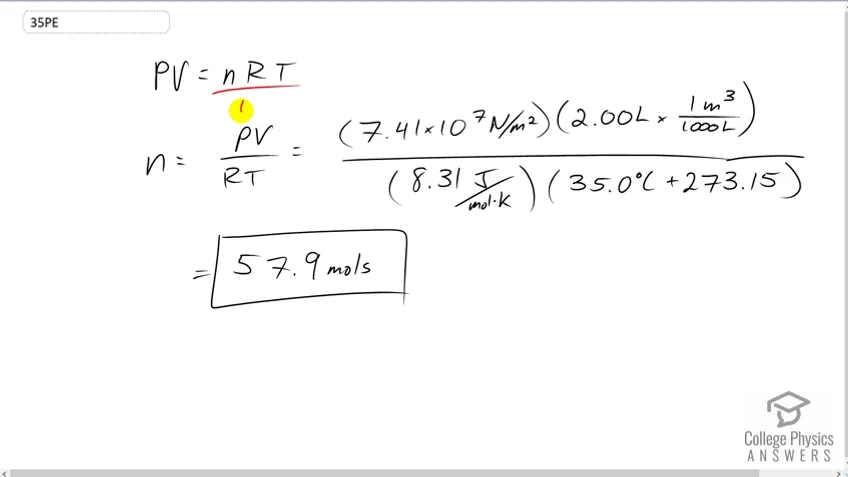 0:45PreviewProblem 35Full video with free trialFind the number of moles in of gas at and under of pressure.
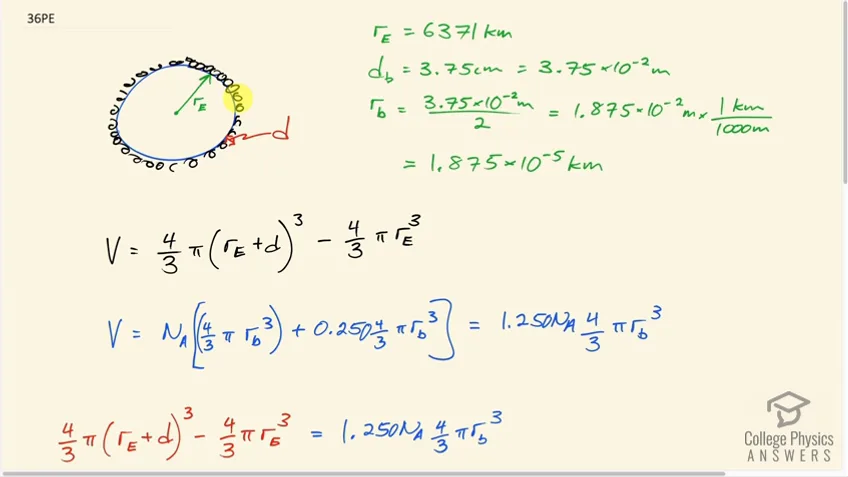 4:01PreviewProblem 36Full video with free trialCalculate the depth to which Avogadro’s number of table tennis balls would cover Earth. Each ball has a diameter of 3.75 cm. Assume the space between balls adds an extra 25.0% to their volume and assume they are not crushed by their own weight.
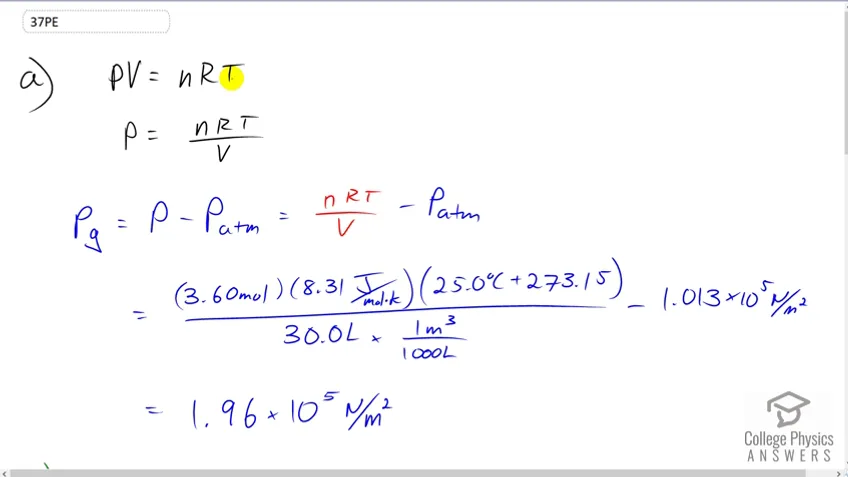 3:46PreviewProblem 37Full video with free trial(a) What is the gauge pressure in a car tire containing 3.60 mol of gas in a 30.0 L volume? (b) What will its gauge pressure be if you add 1.00 L of gas originally at atmospheric pressure and ? Assume the temperature returns to and the volume remains constant.
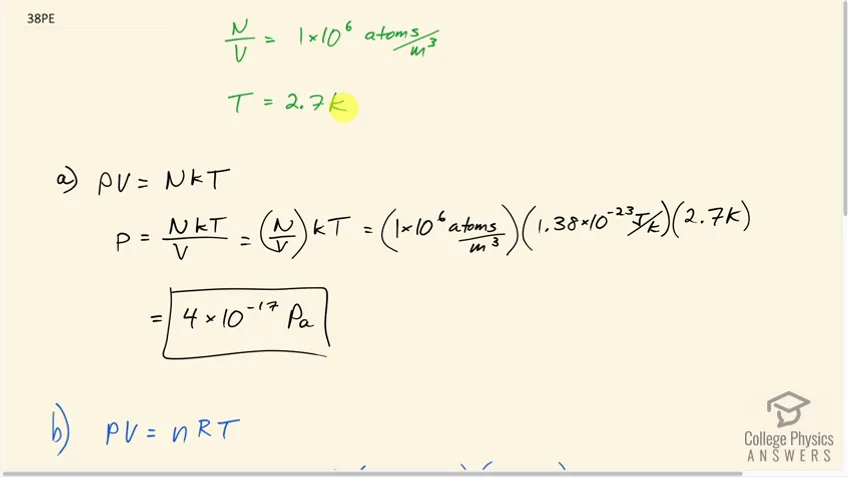 2:32PreviewProblem 38Full video with free trial(a) In the deep space between galaxies, the density of atoms is as low as , and the temperature is a frigid 2.7 K. What is the pressure? (b) What volume (in ) is occupied by 1 mol of gas? (c) If this volume is a cube, what is the length of its sides in kilometers?
13.4 Kinetic Theory: Atomic and Molecular Explanation of Pressure and Temperature
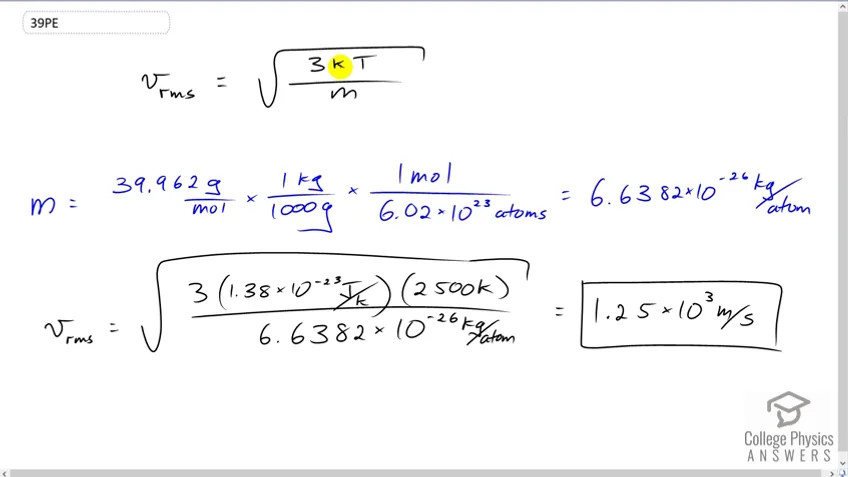 1:26PreviewProblem 39Full video with free trialSome incandescent light bulbs are filled with argon gas. What is for argon atoms near the filament, assuming their temperature is 2500 K?
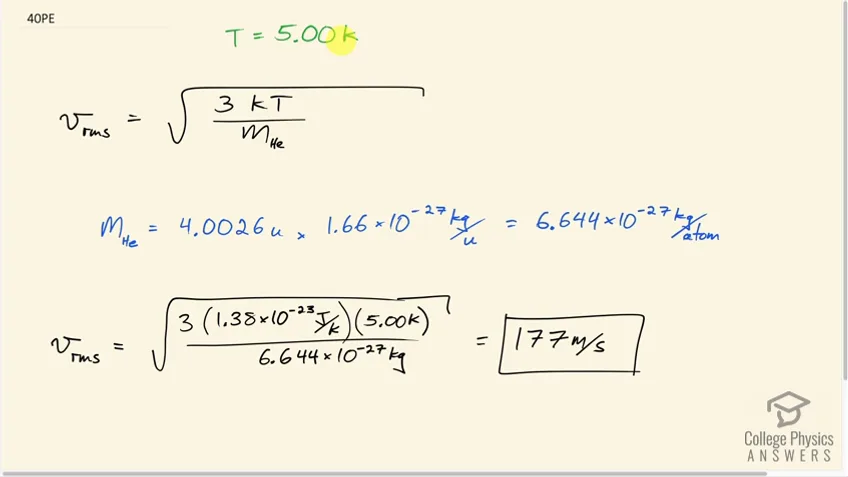 0:55PreviewProblem 40Full video with free trialAverage atomic and molecular speeds () are large, even at low temperatures. What is for helium atoms at 5.00 K, just one degree above helium’s liquefaction temperature?
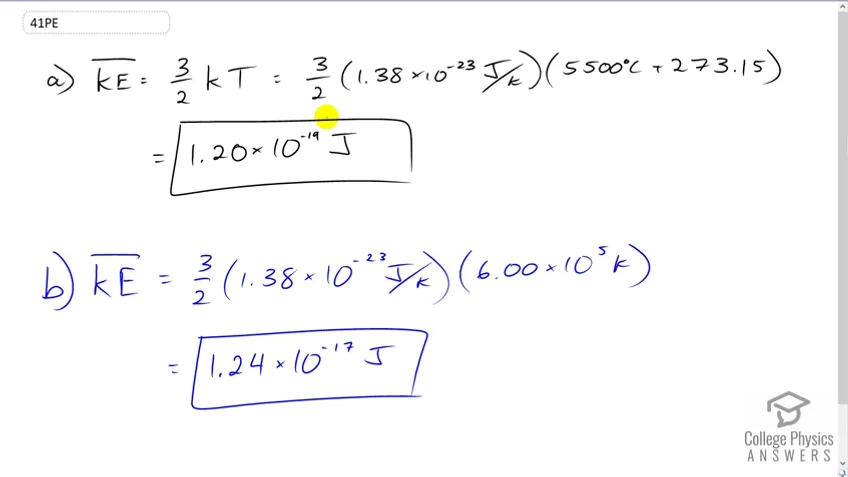 0:52PreviewProblem 41Full video with free trial(a) What is the average kinetic energy in joules of hydrogen atoms on the surface of the Sun? (b) What is the average kinetic energy of helium atoms in a region of the solar corona where the temperature is ?
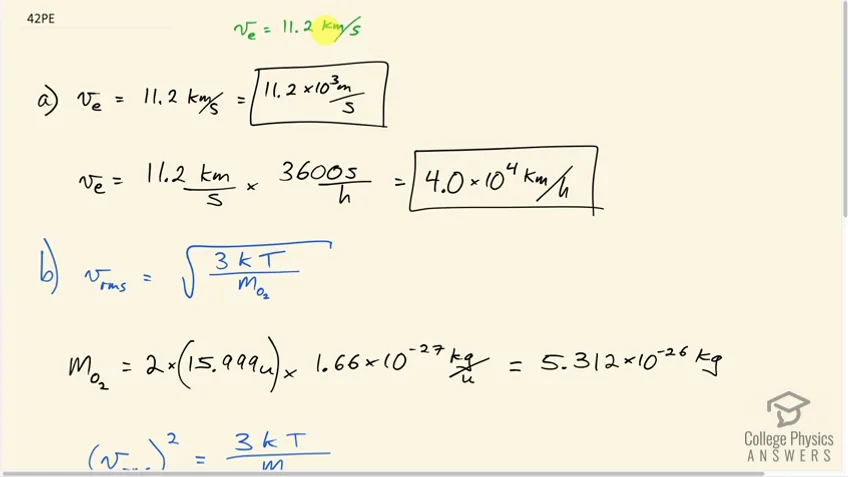 2:10PreviewProblem 42Full video with free trialThe escape velocity of any object from Earth is 11.2 km/s. (a) Express this speed in m/s and km/h. (b) At what temperature would oxygen molecules (molecular mass is equal to 32.0 g/mol) have an average velocity equal to Earth’s escape velocity of 11.1 km/s?
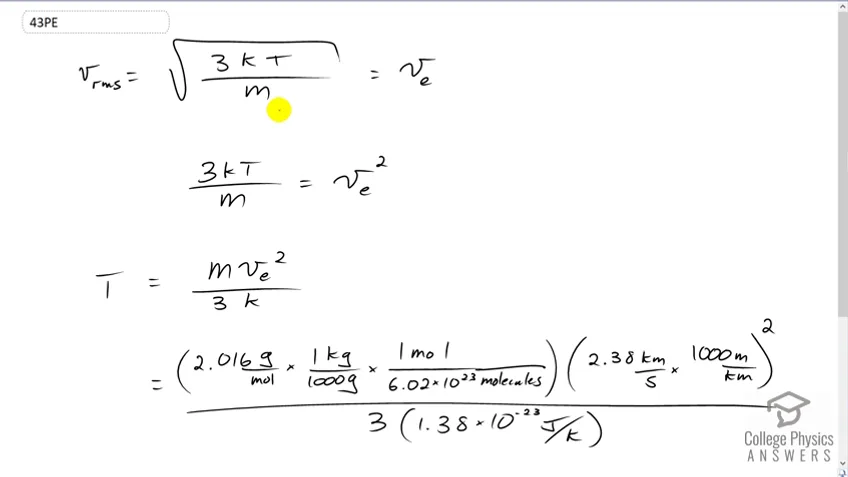 1:57PreviewProblem 43Full video with free trialThe escape velocity from the Moon is much smaller than from Earth and is only 2.38 km/s. At what temperature would hydrogen molecules (molecular mass is equal to 2.016 g/mol) have an average velocity equal to the Moon’s escape velocity?
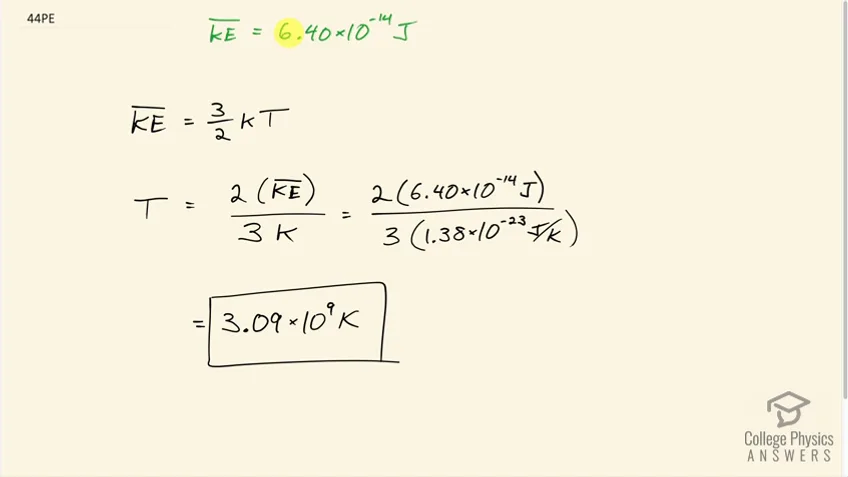 0:55PreviewProblem 44Full video with free trialNuclear fusion, the energy source of the Sun, hydrogen bombs, and fusion reactors, occurs much more readily when the average kinetic energy of the atoms is high—that is, at high temperatures. Suppose you want the atoms in your fusion experiment to have average kinetic energies of . What temperature is needed?
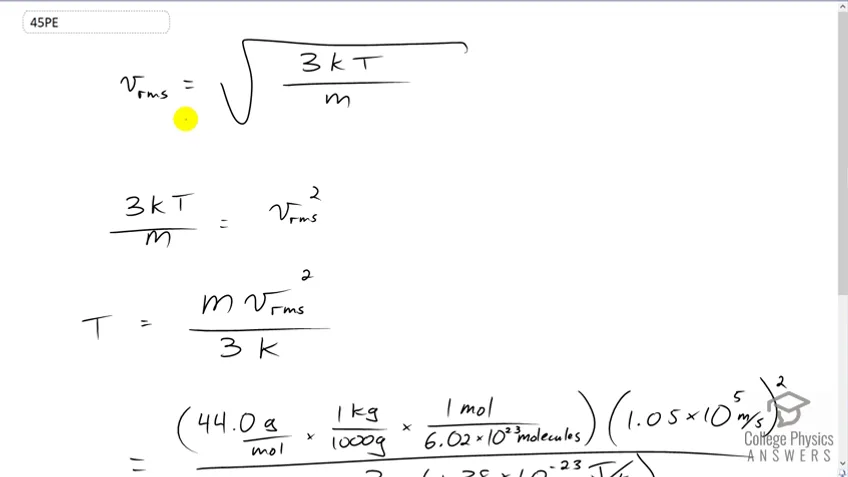 1:33PreviewProblem 45Full video with free trialSuppose that the average velocity, , of carbon dioxide molecules (molecular mass is equal to 44.0 g/mol) in a flame is found to be . What temperature does this represent?
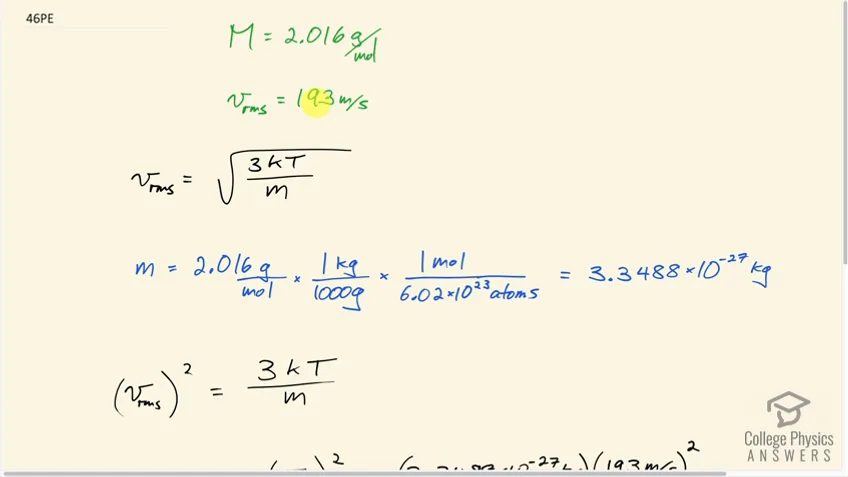 1:47PreviewProblem 46Full video with free trialHydrogen molecules (molecular mass is equal to 2.016 g/ mol) have an average velocity equal to 193 m/s. What is the temperature?
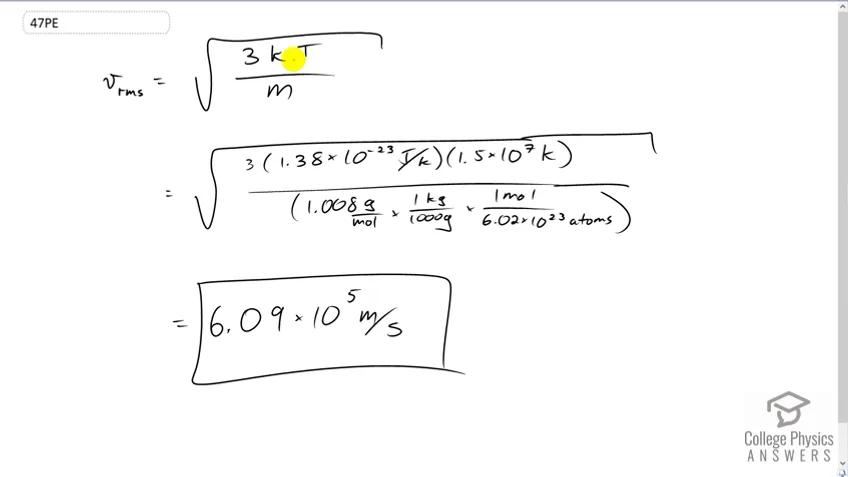 1:04PreviewProblem 47Full video with free trialMuch of the gas near the Sun is atomic hydrogen. Its temperature would have to be for the average velocity, to equal the escape velocity from the Sun. What is that velocity?
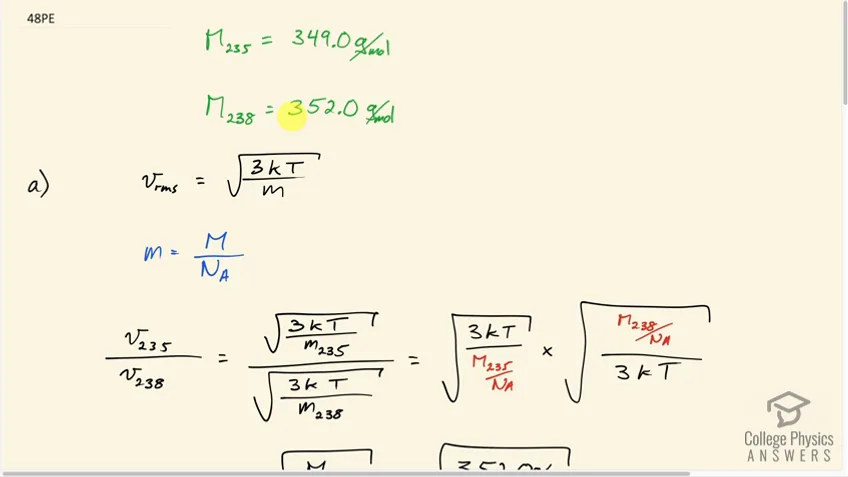 5:48PreviewProblem 48Full video with free trialThere are two important isotopes of uranium— and have different atomic masses. Only is very useful in nuclear reactors. One of the techniques for separating them (gas diffusion) is based on the different average velocities of uranium hexafluoride gas, . (a) The molecular masses for and are 349.0 g/mol and 352.0 g/mol, respectively. What is the ratio of their average velocities? (b) At what temperature would their average velocities differ by 1.00 m/s? (c) Do your answers in this problem imply that this technique may be difficult?
13.6 Humidity, Evaporation, and Boiling
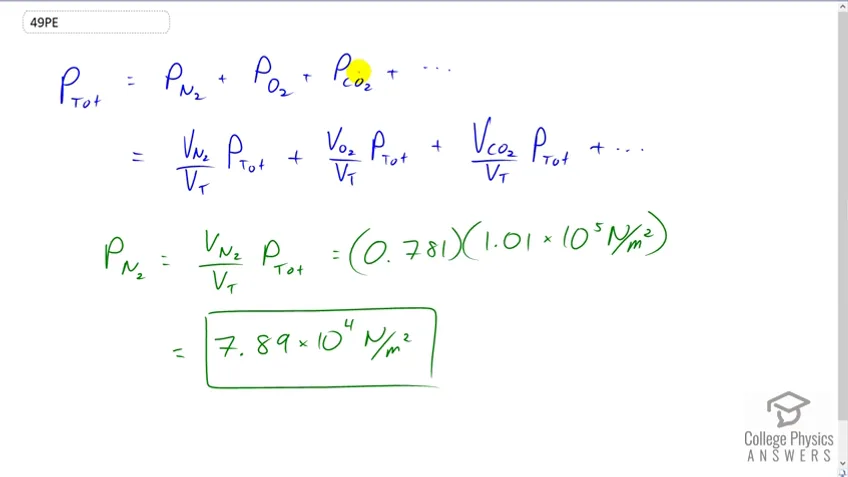 0:55PreviewProblem 49Full video with free trialDry air is 78.1% nitrogen. What is the partial pressure of nitrogen when the atmospheric pressure is ?
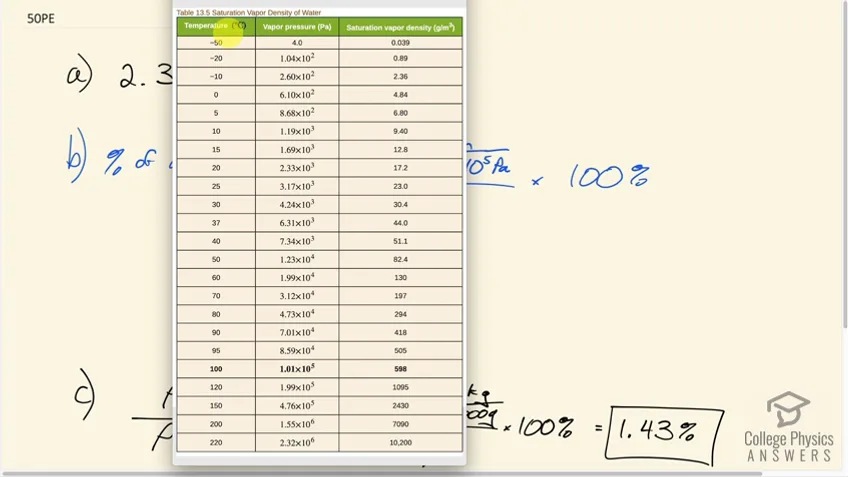 2:04PreviewProblem 50Full video with free trial(a) What is the vapor pressure of water at ? (b) What percentage of atmospheric pressure does this correspond to? (c) What percent of air is water vapor if it has 100% relative humidity? (The density of dry air at is .)
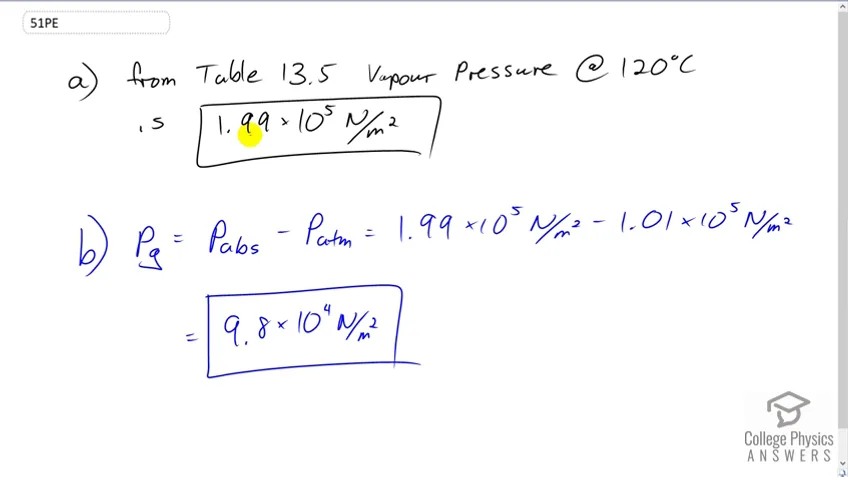 0:40PreviewProblem 51Full video with free trialPressure cookers increase cooking speed by raising the boiling temperature of water above its value at atmospheric pressure. (a) What pressure is necessary to raise the boiling point to ? (b) What gauge pressure does this correspond to?
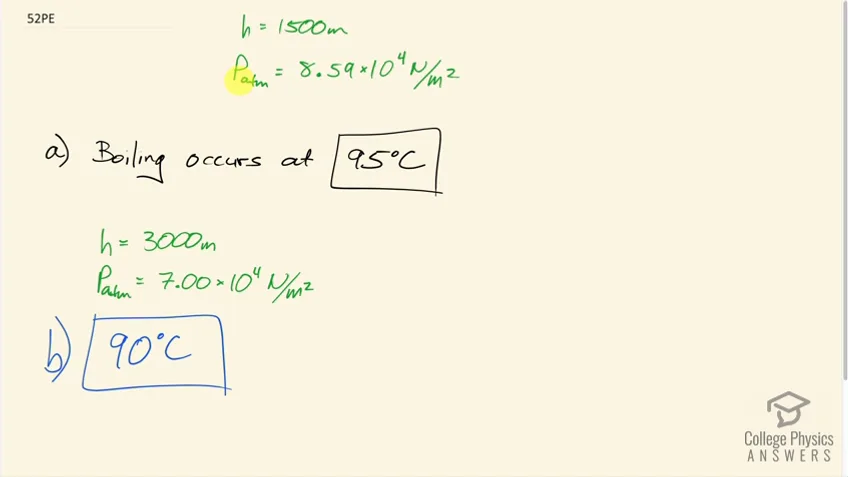 1:02PreviewProblem 52Full video with free trial(a) At what temperature does water boil at an altitude of 1500 m (about 5000 ft) on a day when atmospheric pressure is ? (b) What about at an altitude of 3000 m (about 10,000 ft) when atmospheric pressure is ?
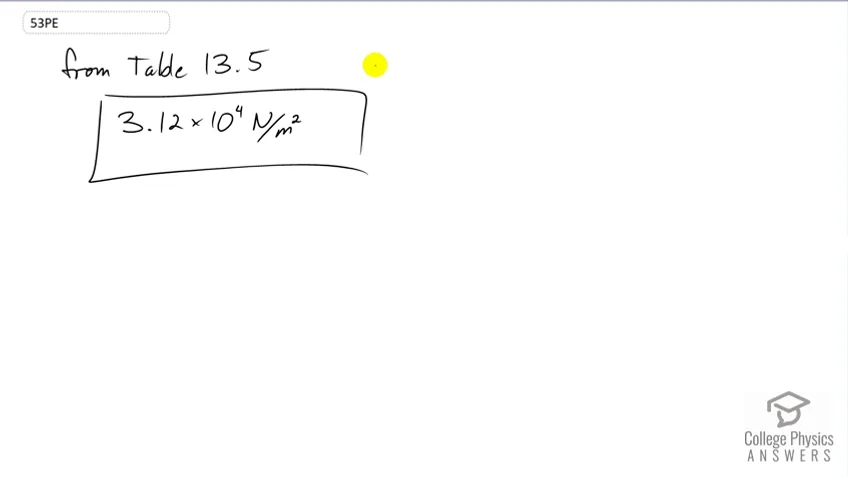 0:34PreviewProblem 53Full video with free trialWhat is the atmospheric pressure on top of Mt. Everest on a day when water boils there at a temperature of ?
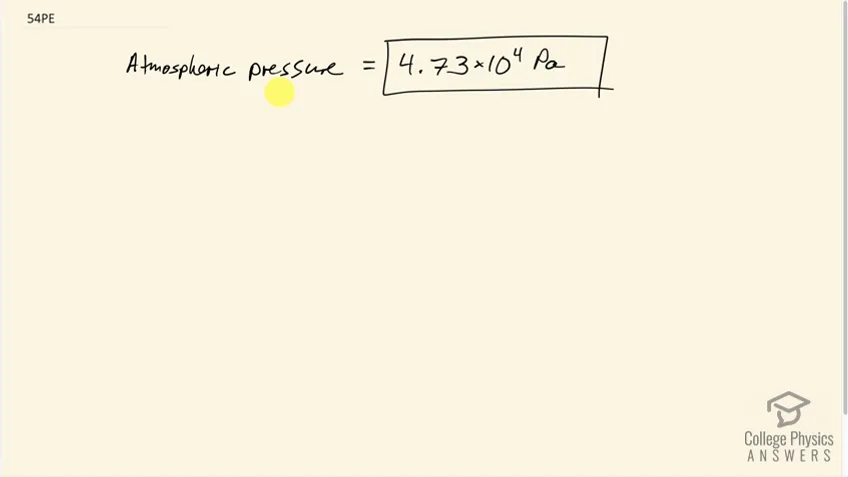 0:59PreviewProblem 54Full video with free trialAt a spot in the high Andes, water boils at , greatly reducing the cooking speed of potatoes, for example. What is atmospheric pressure at this location?
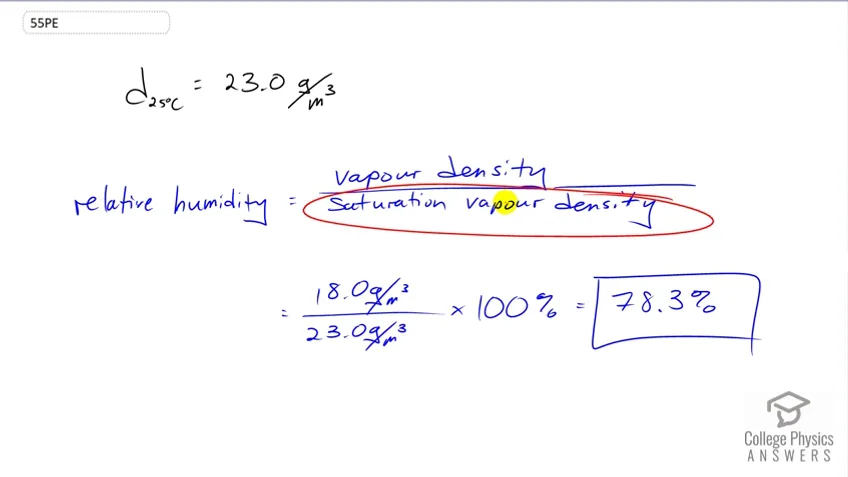 0:33PreviewProblem 55Full video with free trialWhat is the relative humidity on a day when the air contains of water vapor?
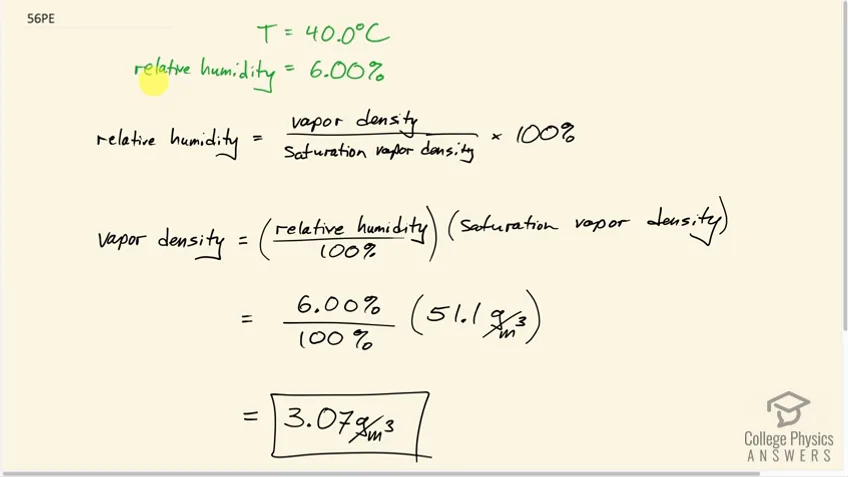 1:14PreviewProblem 56Full video with free trialWhat is the density of water vapor in on a hot dry day in the desert when the temperature is and the relative humidity is 6.00%?
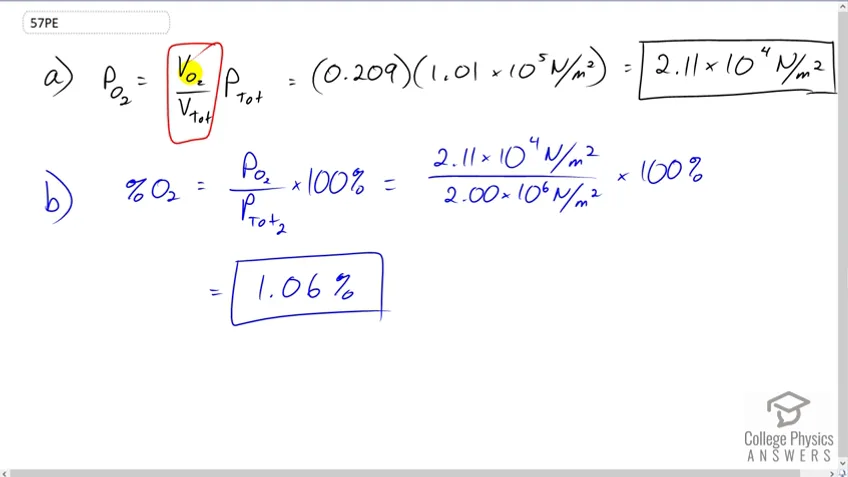 1:59PreviewProblem 57Full video with free trialA deep-sea diver should breathe a gas mixture that has the same oxygen partial pressure as at sea level, where dry air contains 20.9% oxygen and has a total pressure of . (a) What is the partial pressure of oxygen at sea level? (b) If the diver breathes a gas mixture at a pressure of , what percent oxygen should it be to have the same oxygen partial pressure as at sea level?
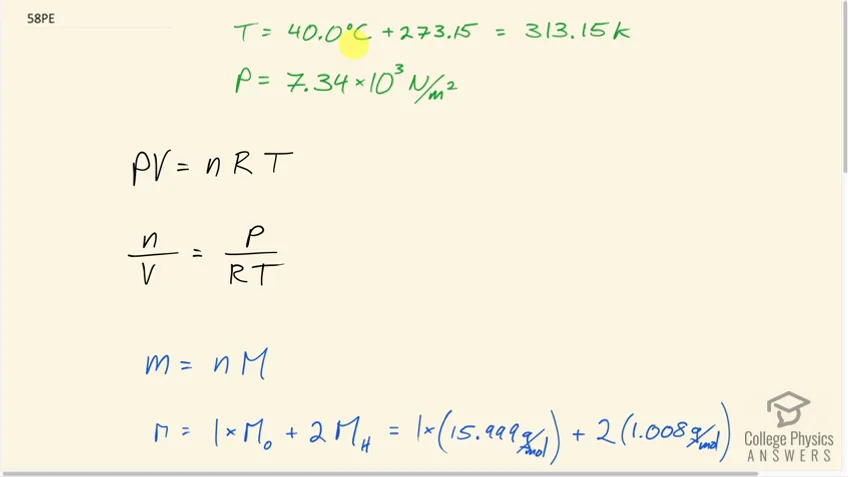 3:38PreviewProblem 58Full video with free trialThe vapor pressure of water at is . Using the ideal gas law, calculate the density of water vapor in that creates a partial pressure equal to this vapor pressure. The result should be the same as the saturation vapor density at that temperature ().
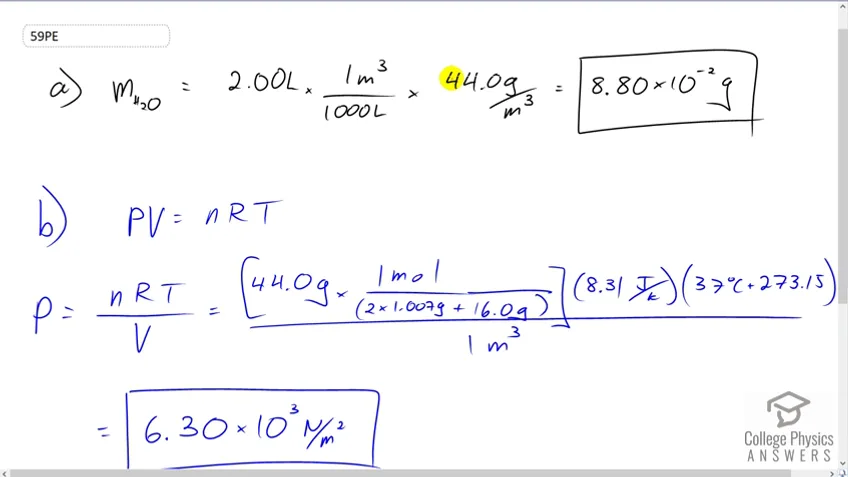 2:40PreviewProblem 59Full video with free trialAir in human lungs has a temperature of and a saturation vapor density of . (a) If 2.00 L of air is exhaled and very dry air inhaled, what is the maximum loss of water vapor by the person? (b) Calculate the partial pressure of water vapor having this density, and compare it with the vapor pressure of .
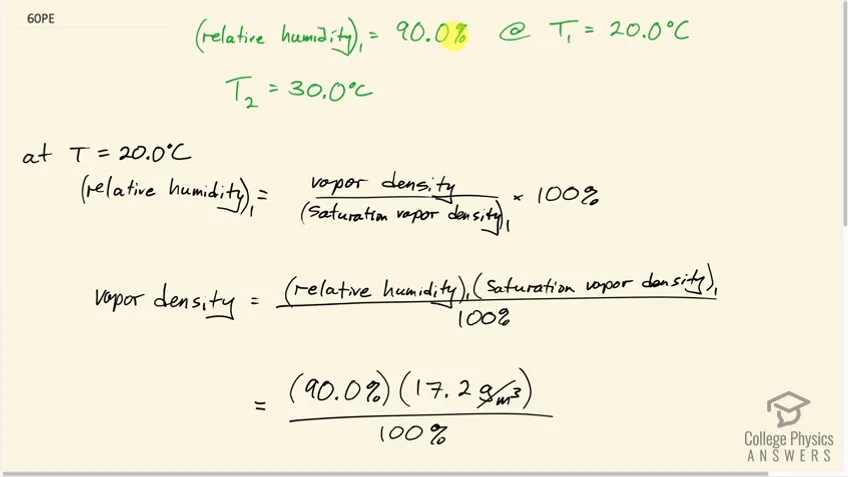 2:05PreviewProblem 60Full video with free trialIf the relative humidity is 90.0% on a muggy summer morning when the temperature is , what will it be later in the day when the temperature is , assuming the water vapor density remains constant?
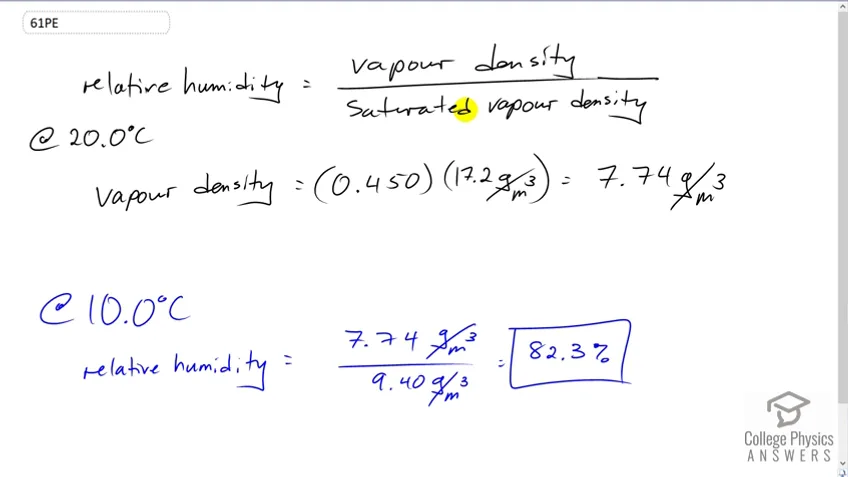 1:13PreviewProblem 61Full video with free trialLate on an autumn day, the relative humidity is 45.0% and the temperature is . What will the relative humidity be that evening when the temperature has dropped to , assuming constant water vapor density?
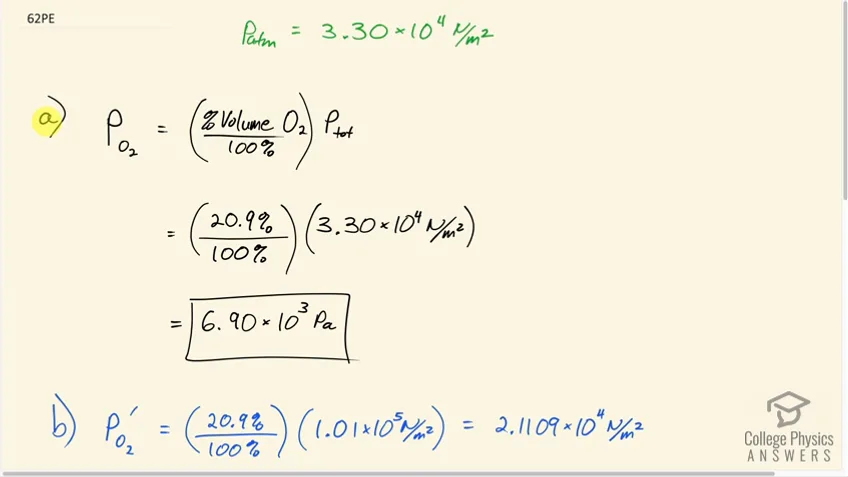 3:24PreviewProblem 62Full video with free trialAtmospheric pressure atop Mt. Everest is . (a) What is the partial pressure of oxygen there if it is 20.9% of the air? (b) What percent oxygen should a mountain climber breathe so that its partial pressure is the same as at sea level, where atmospheric pressure is ? (c) One of the most severe problems for those climbing very high mountains is the extreme drying of breathing passages. Why does this drying occur?
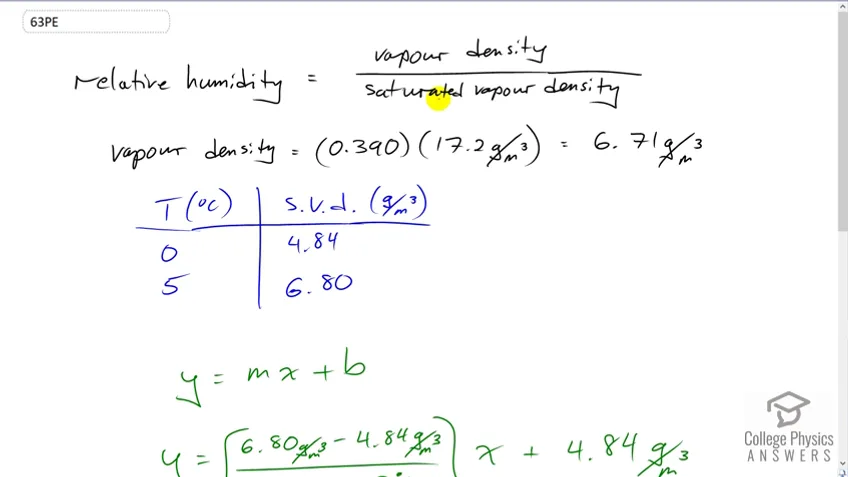 4:03PreviewProblem 63Full video with free trialWhat is the dew point (the temperature at which 100% relative humidity would occur) on a day when relative humidity is 39.0% at a temperature of ?
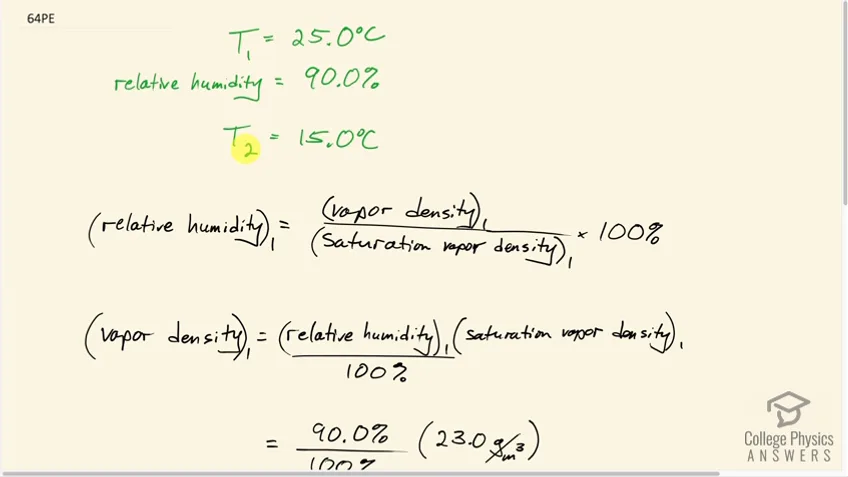 2:11PreviewProblem 64Full video with free trialOn a certain day, the temperature is and the relative humidity is 90.0%. How many grams of water must condense out of each cubic meter of air if the temperature falls to ? Such a drop in temperature can, thus, produce heavy dew or fog.
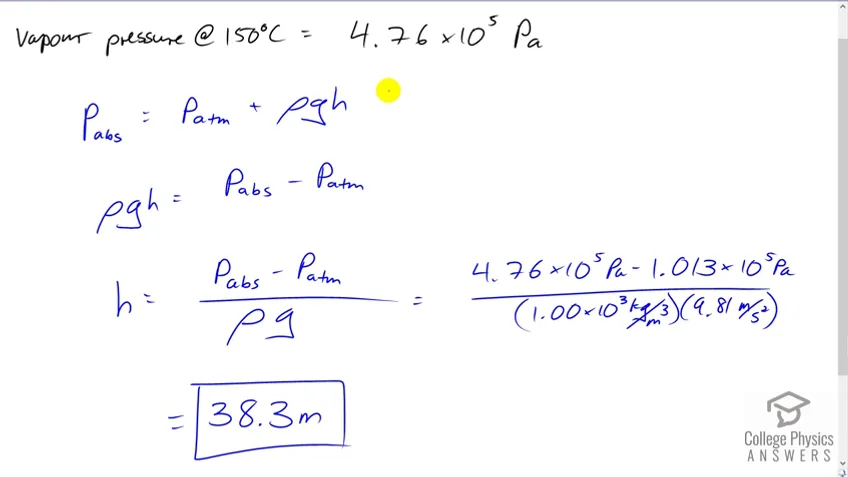 1:43PreviewProblem 65Full video with free trialThe boiling point of water increases with depth because pressure increases with depth. At what depth will fresh water have a boiling point of , if the surface of the water is at sea level?
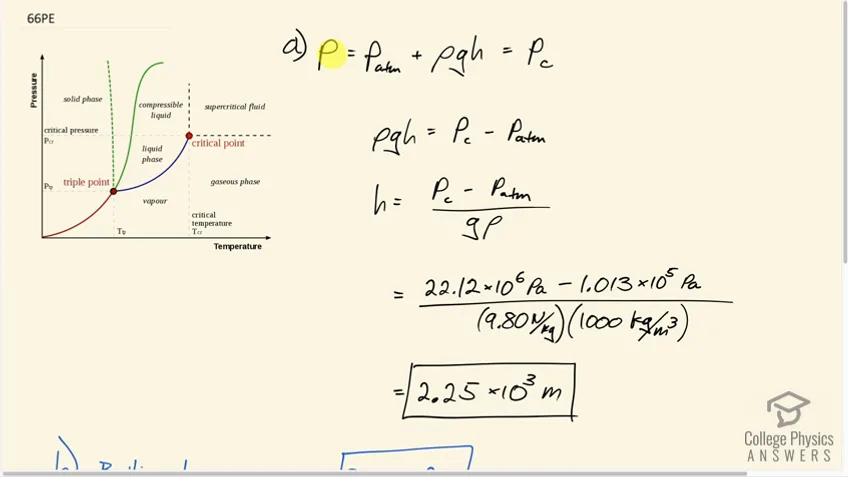 4:32PreviewProblem 66Full video with free trial(a) At what depth in fresh water is the critical pressure of water reached, given that the surface is at sea level? (b) At what temperature will this water boil? (c) Is a significantly higher temperature needed to boil water at a greater depth?
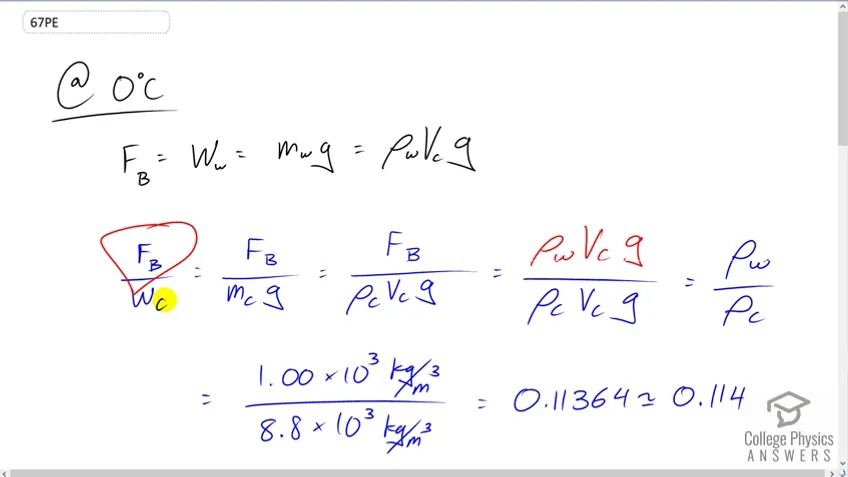 6:26PreviewProblem 67Full video with free trialTo get an idea of the small effect that temperature has on Archimedes’ principle, calculate the fraction of a copper block’s weight that is supported by the buoyant force in water and compare this fraction with the fraction supported in water.
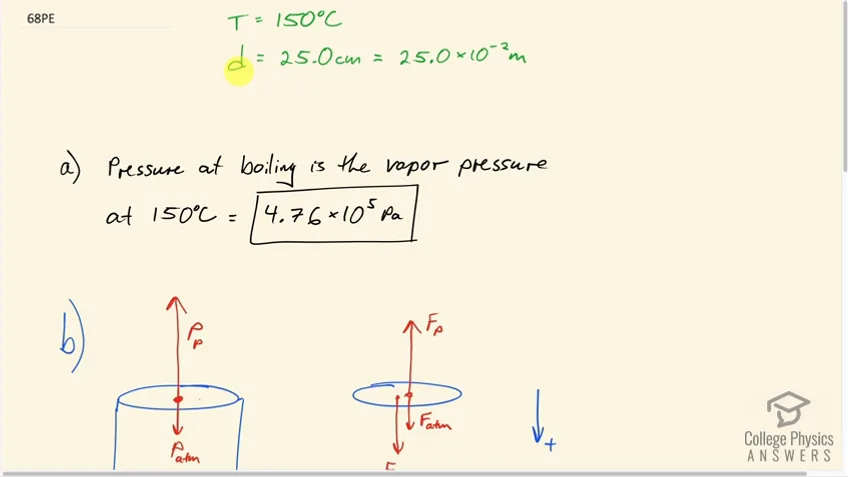 4:07PreviewProblem 68Full video with free trialIf you want to cook in water at , you need a pressure cooker that can withstand the necessary pressure. (a) What pressure is required for the boiling point of water to be this high? (b) If the lid of the pressure cooker is a disk 25.0 cm in diameter, what force must it be able to withstand at this pressure?
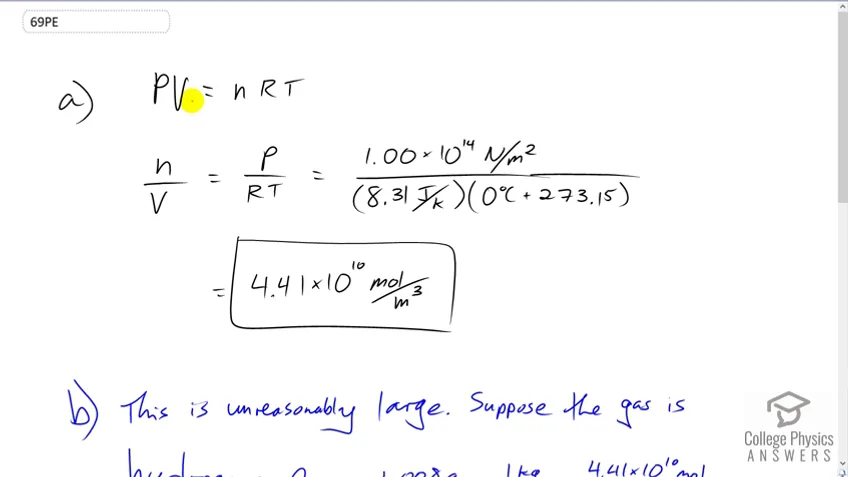 2:26PreviewProblem 69Full video with free trial(a) How many moles per cubic meter of an ideal gas are there at a pressure of and at ? (b) What is unreasonable about this result? (c) Which premise or assumption is responsible?
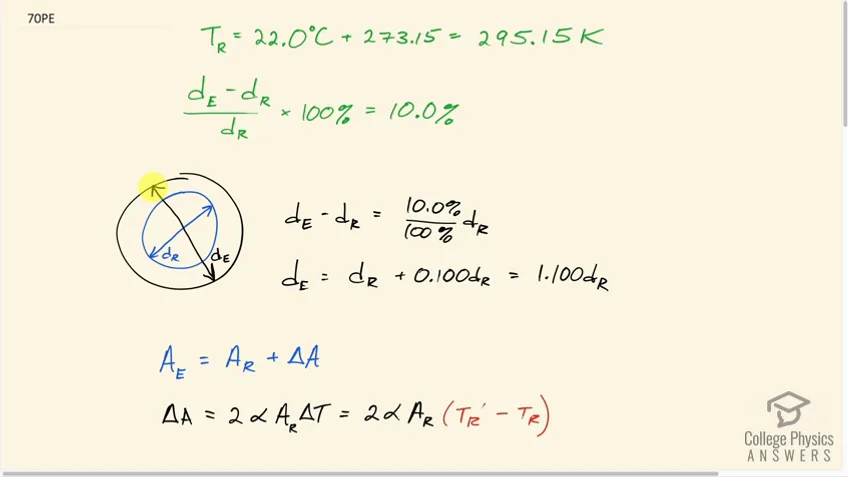 5:11PreviewProblem 70Full video with free trial(a) An automobile mechanic claims that an aluminum rod fits loosely into its hole on an aluminum engine block because the engine is hot and the rod is cold. If the hole is 10.0% bigger in diameter than the rod, at what temperature will the rod be the same size as the hole? (b) What is unreasonable about this temperature? (c) Which premise is responsible?
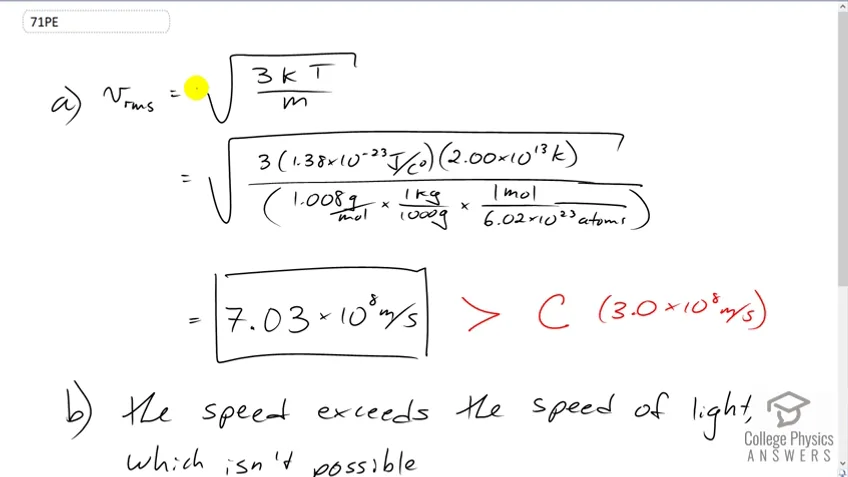 1:19PreviewProblem 71Full video with free trialThe temperature inside a supernova explosion is said to be . (a) What would the average velocity of hydrogen atoms be? (b) What is unreasonable about this velocity? (c) Which premise or assumption is responsible?
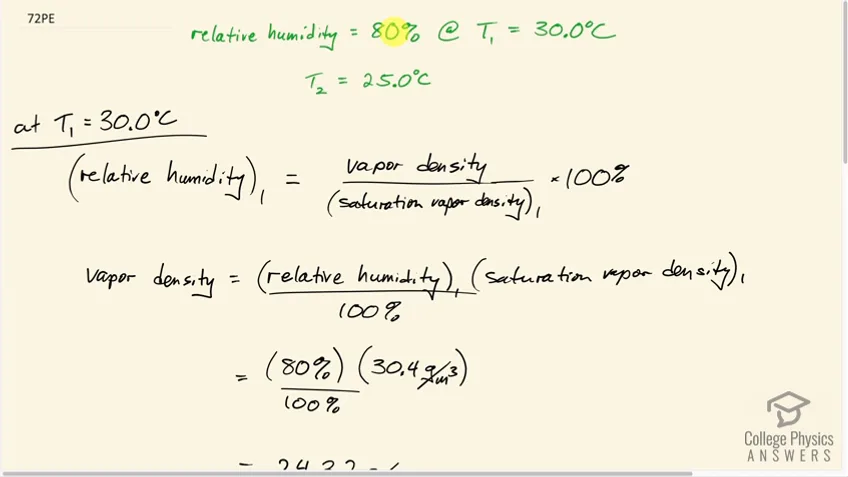 2:04PreviewProblem 72Full video with free trialSuppose the relative humidity is 80% on a day when the temperature is . (a) What will the relative humidity be if the air cools to and the vapor density remains constant? (b) What is unreasonable about this result? (c) Which premise is responsible?