Question
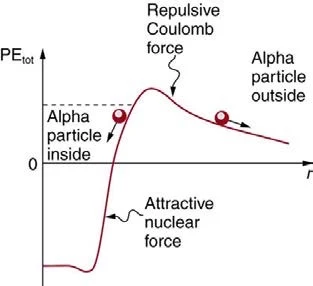
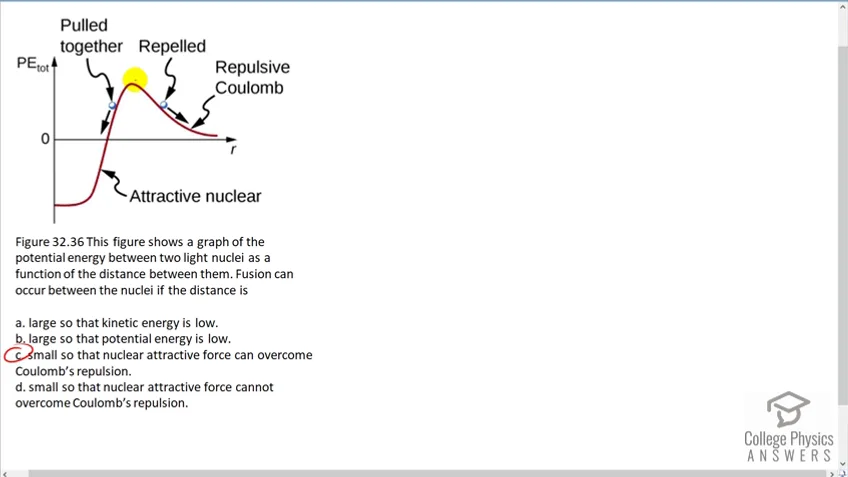
Figure 32.36 shows a graph of the potential energy between two light nuclei as a function of the distance between them. Fusion can occur between the nuclei if the distance is (a) large so that kinetic energy is low.
(b) large so that potential energy is low.
(c) small so that nuclear attractive force can overcome Coulomb’s repulsion.
(d) small so that nuclear attractive force cannot overcome Coulomb’s repulsion.
Final Answer
(c)
Solution video

This is a 15-second preview. Get access to the full video by starting your free 7-day trial.
This is a 15-second preview. Get access to the full video by starting your free 7-day trial.
Video Transcript
This is College Physics Answers with Shaun Dychko. Fusion occurs between two nuclei when they get really close to each other and that happens after it, you know gets over this threshold of potential energy to the point where the strong nuclear force can suddenly start to act because at large distances—that's what this r represents, this is the distance between the nuclei— at large distances, the strong nuclear force doesn't really work and it's the repulsive Coulomb force that applies. But once you get really close together, these nuclei will suddenly feel the strong nuclear force which is of greater strength than the repulsive Coulomb force. And so fusion can occur if the distance is so small that the nuclear attractive force overcomes Coulomb's repulsion. The answer is (c).
Comments
No comments yet.