Question
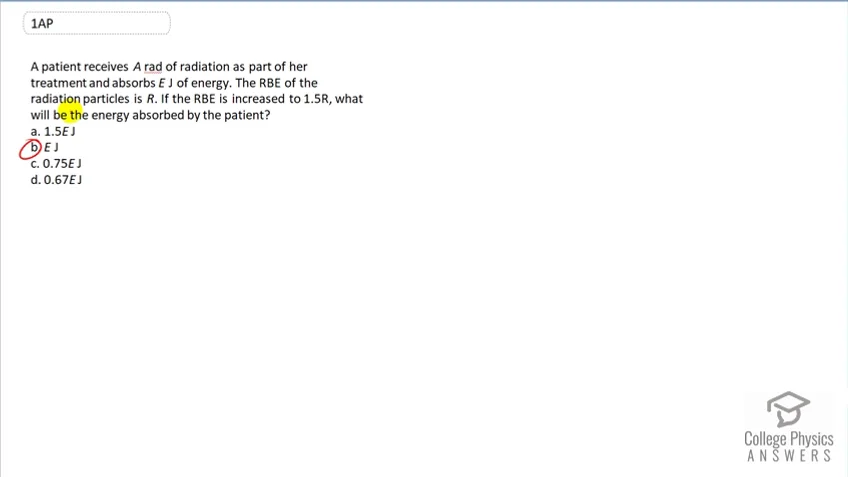
A patient receives A rad of radiation as part of her treatment and absorbs E J of energy. The RBE of the radiation particles is R. If the RBE is increased to 1.5R, what will be the energy absorbed by the patient? (a)
(b)
(c)
(d)
Final Answer
(b)
Solution video

This is a 20-second preview. Get access to the full video by starting your free 7-day trial.
This is a 20-second preview. Get access to the full video by starting your free 7-day trial.
Video Transcript
This is College Physics Answers with Shaun Dychko. This question is being a bit tricky; it says a patient receives an amount of radiation of A rads and absorbs an amount of energy E and the relative biological effectiveness of this particular type of radiation, whatever it is, is R and if that relative biological effectiveness is increased, what will the energy absorbed by the patient be? And the answer is it won't change because energy absorbed is called the absorbed dose and it has units of grays and this is short of joules per kilogram. So this is the energy absorbed per kilogram and this absorbed dose will not change because there's still this much energy going into their body. Now the relative biological effectiveness only matters when you are talking about dose equivalent and that has a different unit. Dose equivalent is in units of sieverts and when you multiply grays by the RBE that's how you get sieverts. But it's not asking that question, it's not asking what effect will this have on biological tissue; that's what this unit is made for is to account for different sensitivities, the different types of radiation for biological tissue; alpha particles being the most destructive and gamma rays and x-rays being the least. So this RBE is not gonna change the amount of energy absorbed, the grays in another words. So the answer is (b); still E joules.
Comments
No comments yet.