Question
Write the complete decay equation for the given nuclide in the complete notation. Refer to the periodic table for values of Z:
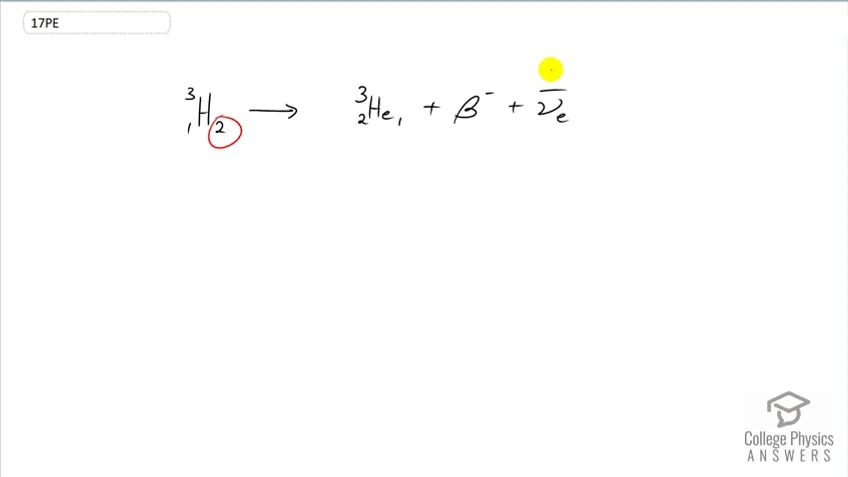
decay of (tritium), a manufactured isotope of hydrogen used in some digital watch displays, and manufactured primarily for use in hydrogen bombs.
Final Answer
Please see the solution video.
Solution video

This is a 16-second preview. Get access to the full video by starting your free 7-day trial.
This is a 16-second preview. Get access to the full video by starting your free 7-day trial.
Video Transcript
This is College Physics Answers with Shaun Dychko. β-decay means that a neutron essentially turns into a proton with the emission of an electron So we see that the number of neutrons has decreased by 1; it goes from 2 to 1 and the number of protons has increased by 1; whereas it was 1 before, it is now 2 so it's changed from hydrogen into helium. And the number of nucleons stays the same though; total number of protons plus neutrons is still 3. In order to conserve charge in this process, an electron has to be emitted or otherwise, known as a β-particle. And in order to conserve electron family number, this β-particle has an electron family number of plus 1 so we need to have the appearance of an compensating particle that has an electron family number of negative 1 which this electron anti-neutrino has. So electron family number is conserved; charge is conserved because we have a charge of 2 in this helium nucleus and a charge of negative 1 from this β-particle which is a total of 1 just as we had in the beginning, a total of positive 1. And there we go. This is β-decay of tritium.
Comments
No comments yet.