Chapter 31: Radioactivity and Nuclear Physics
81 problems solved · Free preview of every solution shows how it’s started · Watch the full videos with a free 7-day trial →
Image: United States Department of Energy, via Wikimedia Commons


Section
31.2 Radiation Detection and Detectors
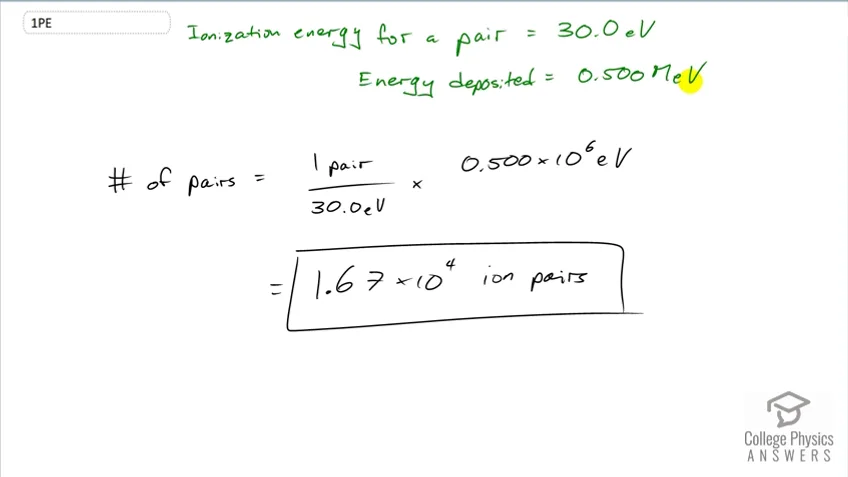 0:42Problem 1FreeThe energy of 30.0 eV is required to ionize a molecule of the gas inside a Geiger tube, thereby producing an ion pair. Suppose a particle of ionizing radiation deposits 0.500 MeV of energy in this Geiger tube. What maximum number of ion pairs can it create?
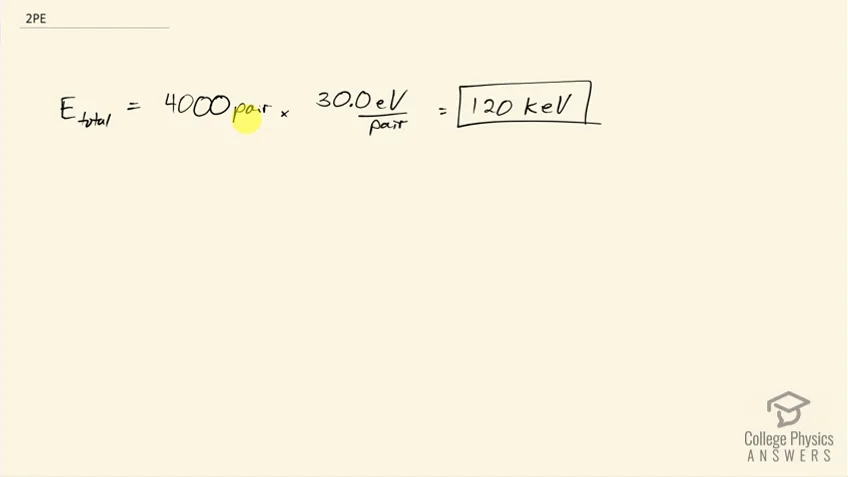 0:35PreviewProblem 2Full video with free trialA particle of ionizing radiation creates 4000 ion pairs in the gas inside a Geiger tube as it passes through. What minimum energy was deposited, if 30.0 eV is required to create each ion pair?
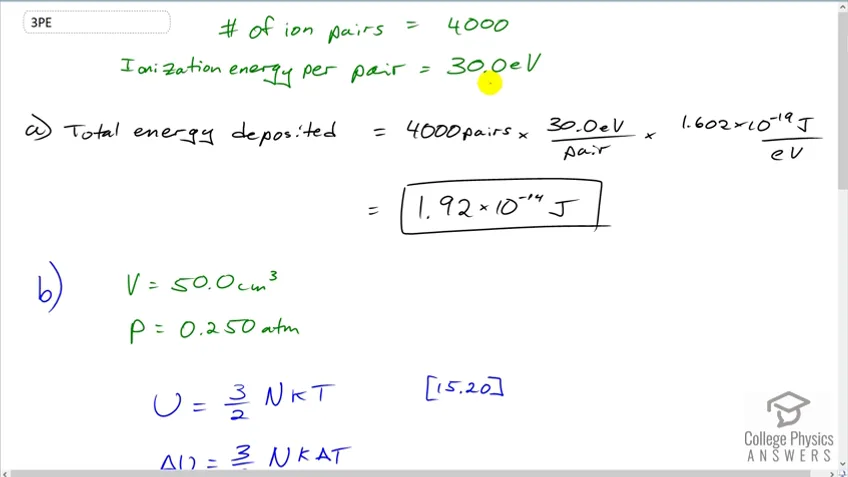 3:27PreviewProblem 3Full video with free trial(a) A particle of ionizing radiation creates 4000 ion pairs in the gas inside a Geiger tube as it passes through. What minimum energy was deposited, if 30.0 eV is required to create each ion pair? Convert the energy to joules or calories. (b) If all of this energy is converted to thermal energy in the gas, what is its temperature increase, assuming of ideal gas at 0.250-atm pressure? (The small answer is consistent with the fact that the energy is large on a quantum mechanical scale but small on a macroscopic scale.)
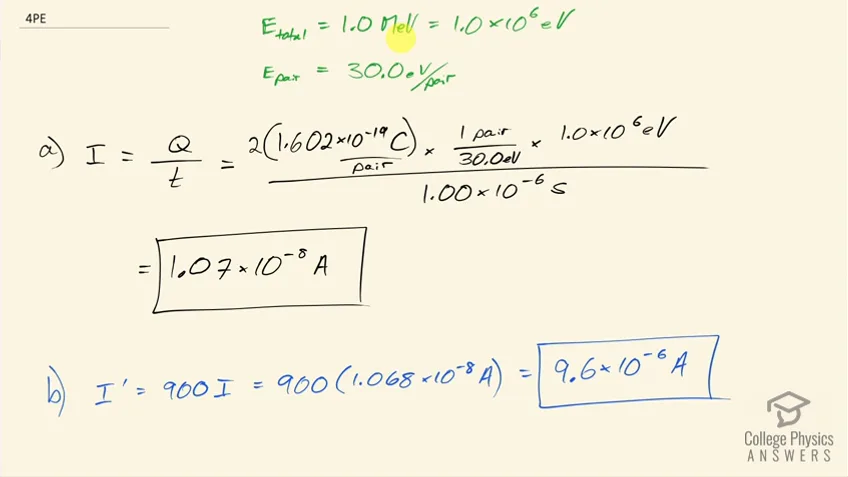 3:24PreviewProblem 4Full video with free trialSuppose a particle of ionizing radiation deposits 1.0 MeV in the gas of a Geiger tube, all of which goes to creating ion pairs. Each ion pair requires 30.0 eV of energy. (a) The applied voltage sweeps the ions out of the gas in . What is the current? (b) This current is smaller than the actual current since the applied voltage in the Geiger tube accelerates the separated ions, which then create other ion pairs in subsequent collisions. What is the current if this last effect multiplies the number of ion pairs by 900?
31.3 Substructure of the Nucleus
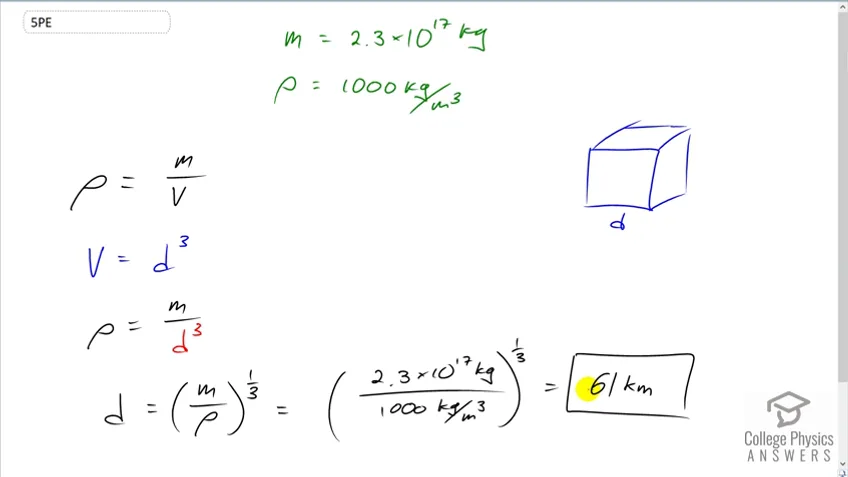 1:00PreviewProblem 5Full video with free trialVerify that a mass of water at normal density would make a cube 60 km on a side, as claimed in Example 31.1. (This mass at nuclear density would make a cube 1.0 m on a side.)
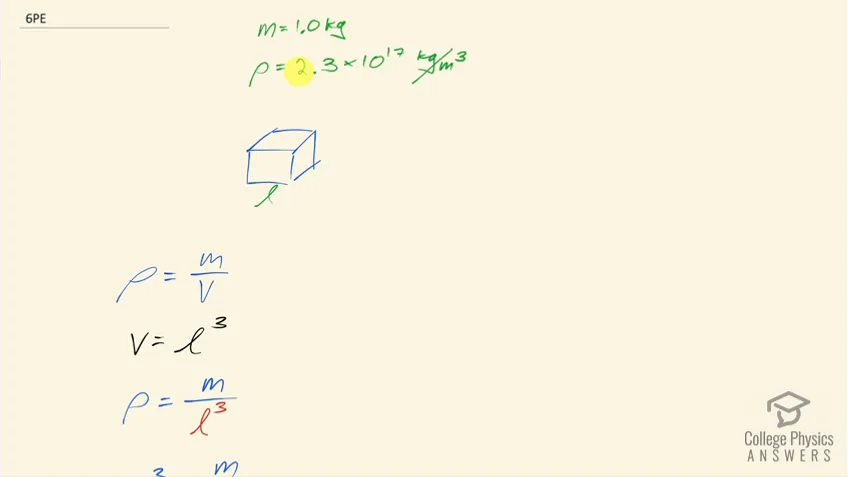 1:02PreviewProblem 6Full video with free trialFind the length of a side of a cube having a mass of 1.0 kg and the density of nuclear matter, taking this to be .
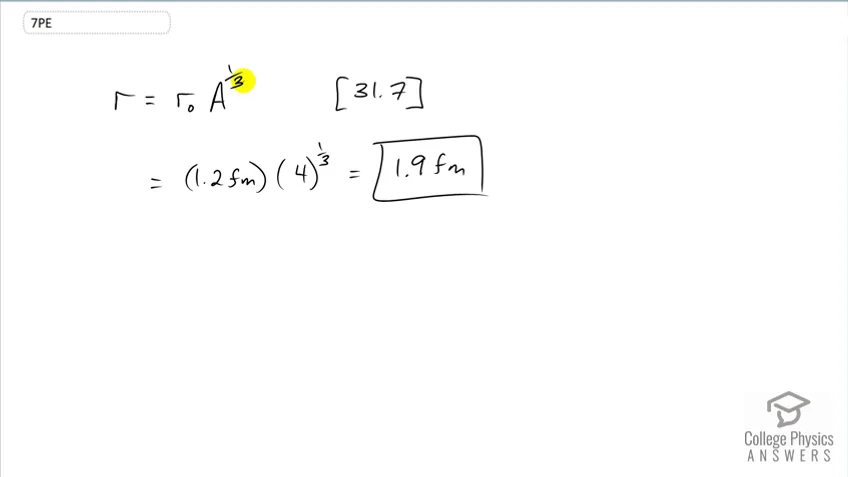 0:33PreviewProblem 7Full video with free trialWhat is the radius of an alpha particle?
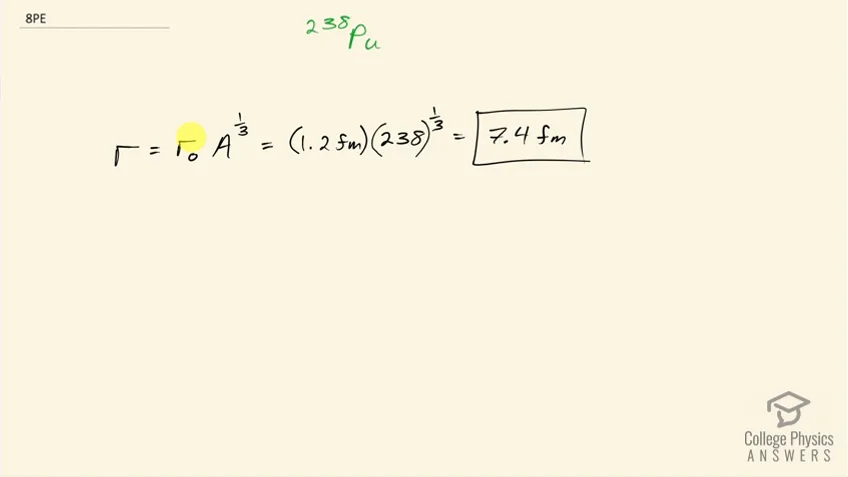 0:29PreviewProblem 8Full video with free trialFind the radius of a nucleus. is a manufactured nuclide that is used as a power source on some space probes.
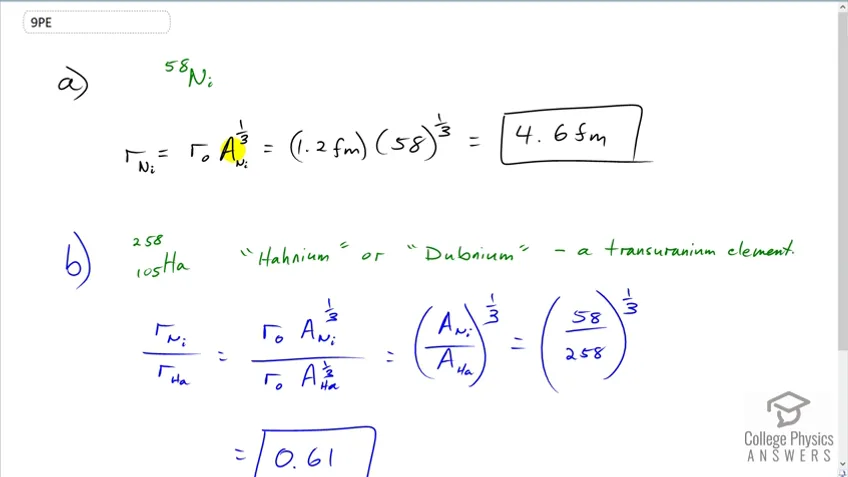 0:55PreviewProblem 9Full video with free trial(a) Calculate the radius of , one of the most tightly bound stable nuclei. (b) What is the ratio of the radius of to that of , one of the largest nuclei ever made? Note that the radius of the largest nucleus is still much smaller than the size of an atom.
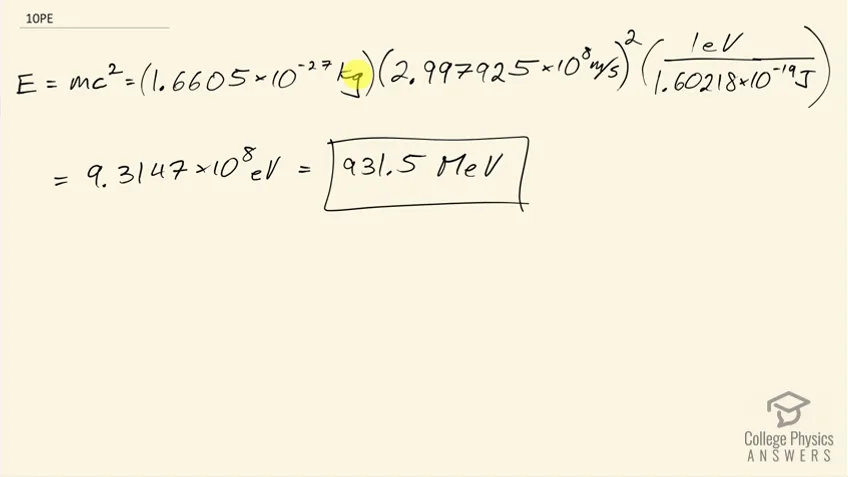 0:43PreviewProblem 10Full video with free trialThe unified atomic mass unit is defined to be . Verify that this amount of mass converted to energy yields 931.5 MeV. Note that you must use four-digit or better values for and .
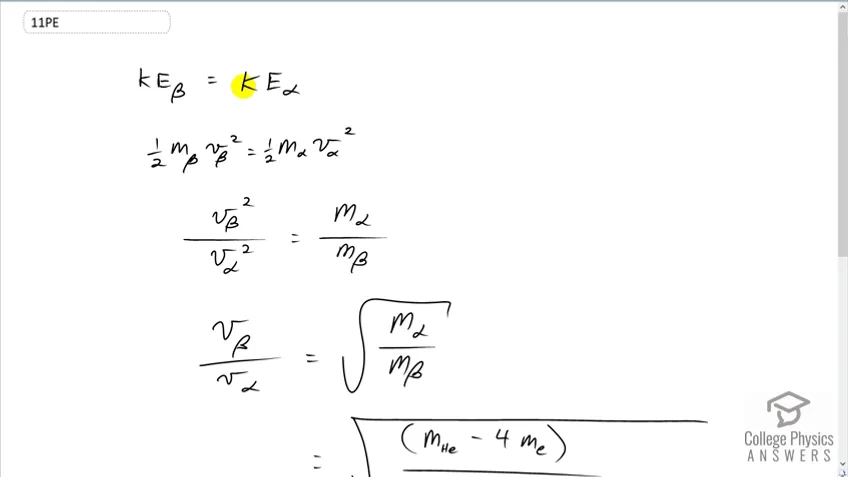 2:30PreviewProblem 11Full video with free trialWhat is the ratio of the velocity of a particle to that of an particle, if they have the same nonrelativistic kinetic energy?
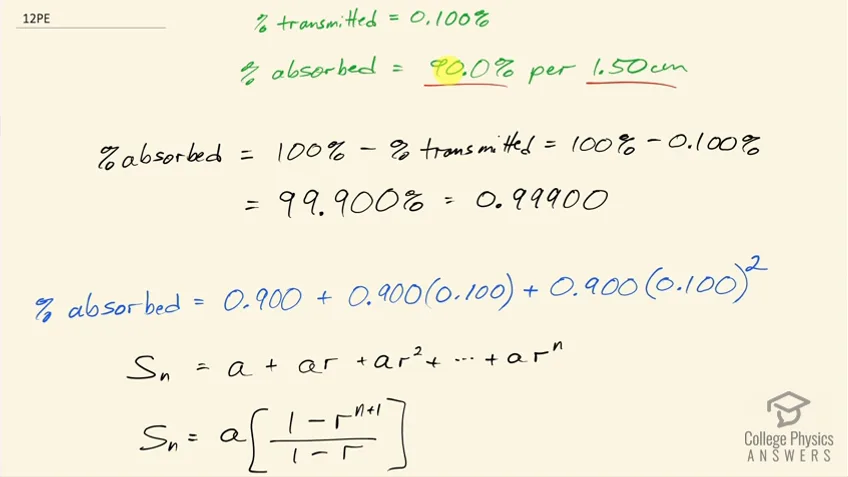 6:14PreviewProblem 12Full video with free trialIf a 1.50-cm-thick piece of lead can absorb 90.0% of the rays from a radioactive source, how many centimeters of lead are needed to absorb all but 0.100% of the rays?
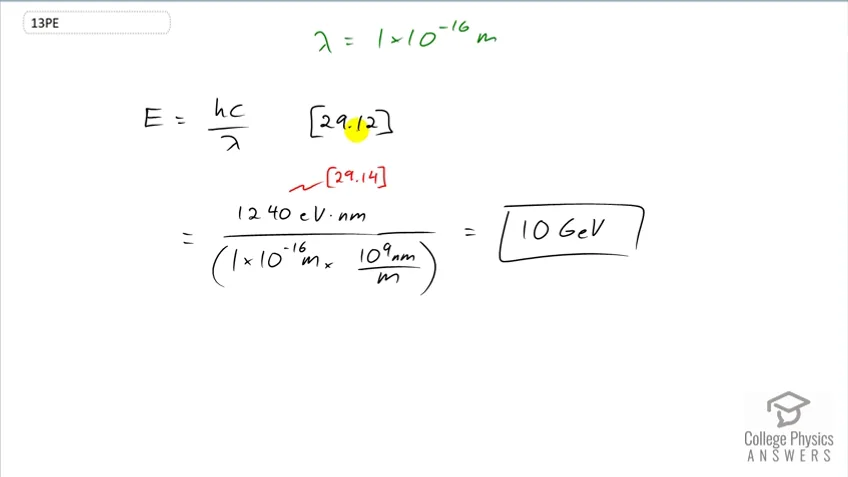 0:57PreviewProblem 13Full video with free trialThe detail observable using a probe is limited by its wavelength. Calculate the energy of a -ray photon that has a wavelength of , small enough to detect details about one-tenth the size of a nucleon. Note that a photon having this energy is difficult to produce and interacts poorly with the nucleus, limiting the practicability of this probe.
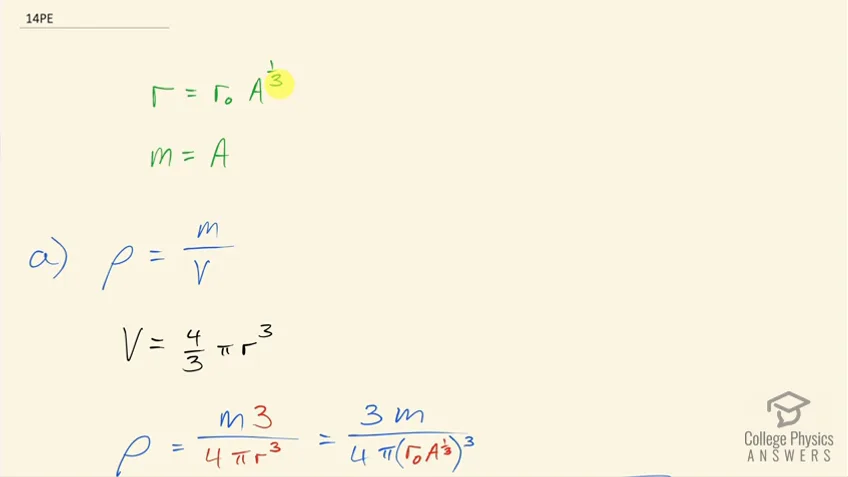 2:42PreviewProblem 14Full video with free trial(a) Show that if you assume the average nucleus is spherical with a radius , and with a mass of , then its density is independent of . (b) Calculate that density in and , and compare your results with those found in Example 31.1 for .
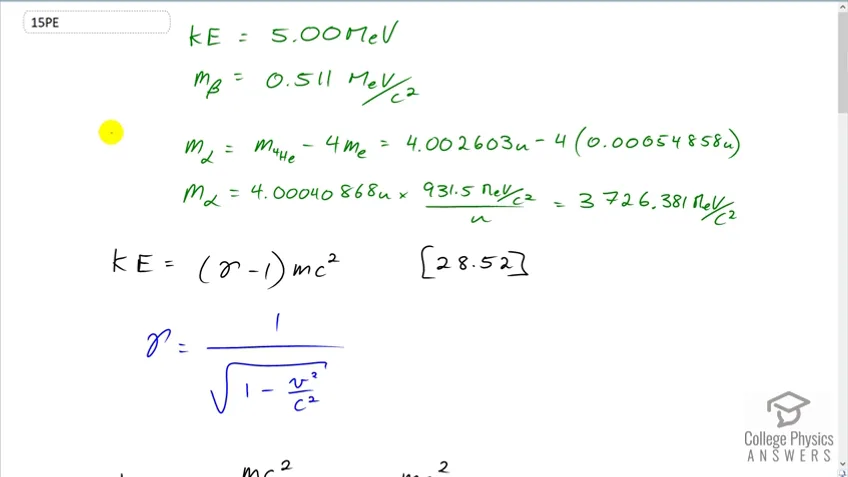 5:52PreviewProblem 15Full video with free trialWhat is the ratio of the velocity of a 5.00-MeV ray to that of an particle with the same kinetic energy? This should confirm that s travel much faster than α s even when relativity is taken into consideration.
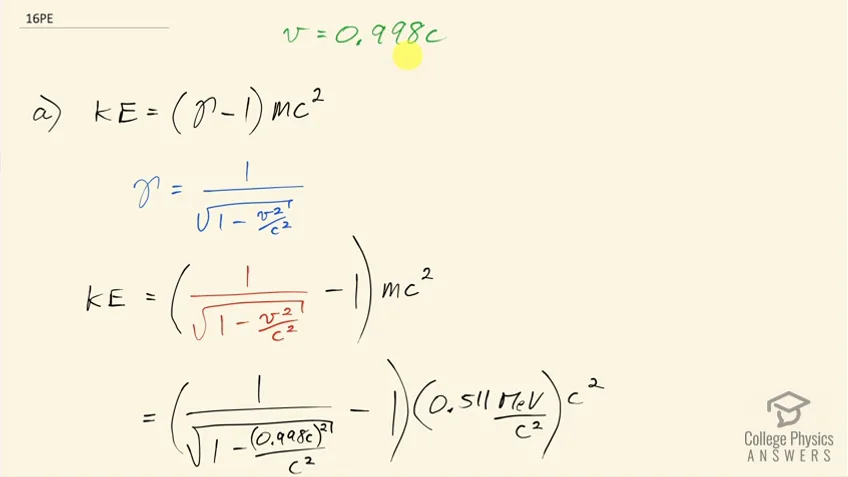 1:27PreviewProblem 16Full video with free trial(a) What is the kinetic energy in MeV of a ray that is traveling at ? This gives some idea of how energetic a ray must be to travel at nearly the same speed as a ray. (b) What is the velocity of the ray relative to the ray?
31.4 Nuclear Decay and Conservation Laws
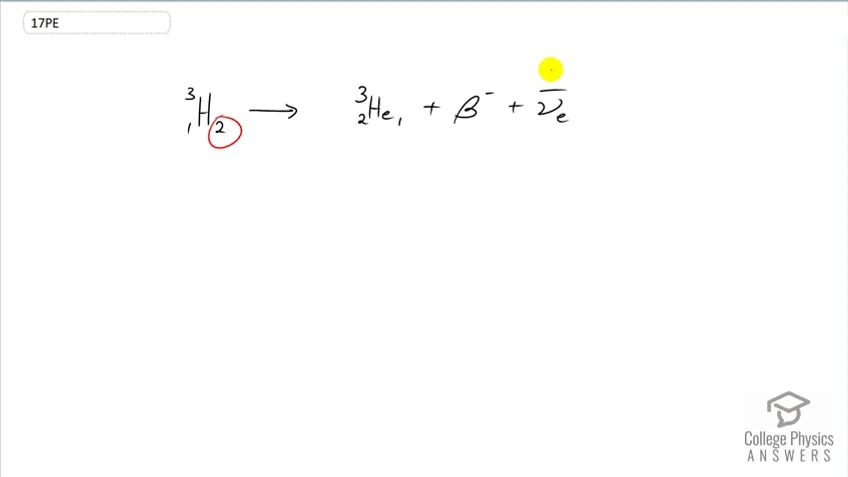 1:21PreviewProblem 17Full video with free trialWrite the complete decay equation for the given nuclide in the complete notation. Refer to the periodic table for values of Z:
decay of (tritium), a manufactured isotope of hydrogen used in some digital watch displays, and manufactured primarily for use in hydrogen bombs.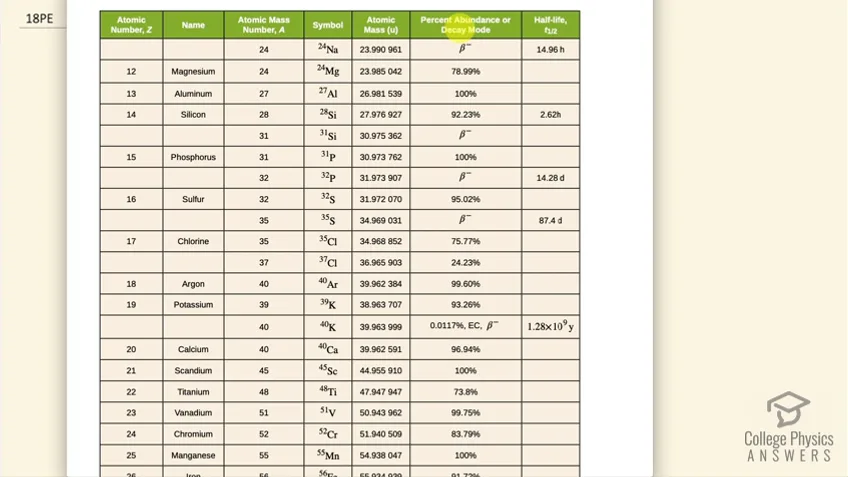 1:04PreviewProblem 18Full video with free trialWrite the complete decay equation for the given nuclide in the complete $^\textrm{A}\textrm{Z}\textrm{X}\textrm{N}$ notation: decay of , a naturally occurring rare isotope of potassium responsible for some of our exposure to background radiation.
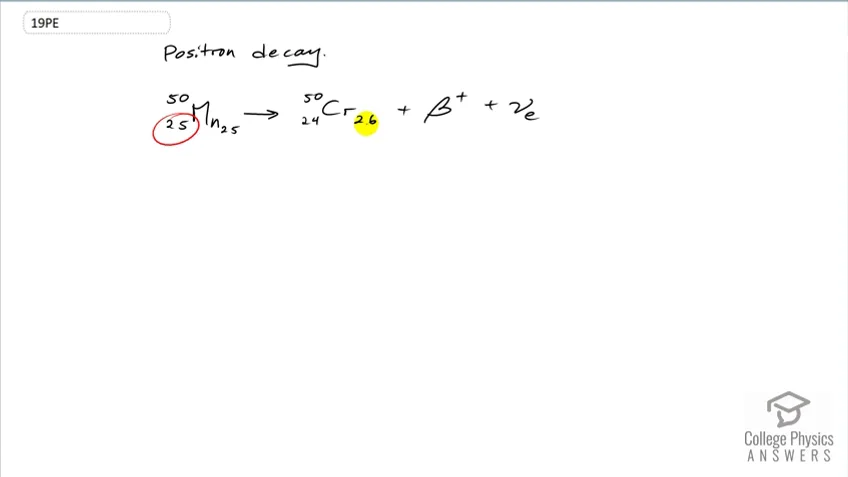 1:21PreviewProblem 19Full video with free trialWrite the complete decay equation for the given nuclide in the complete notation. Refer to the periodic table for values of Z:
decay of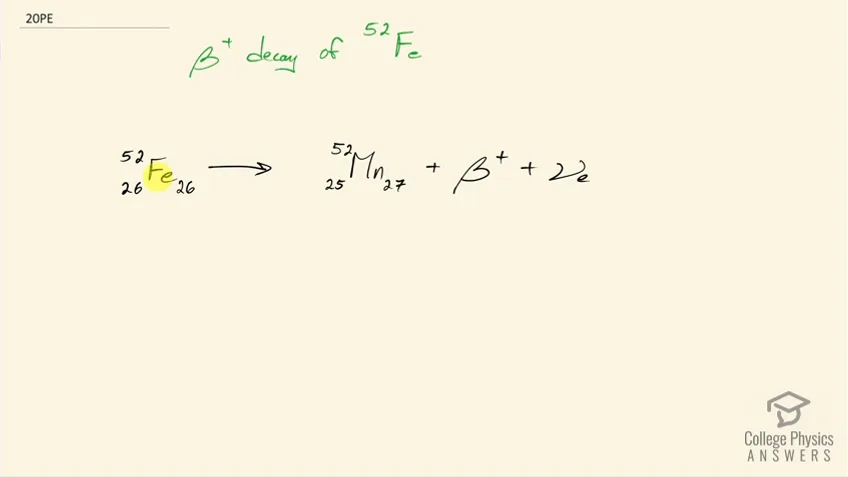 1:00PreviewProblem 20Full video with free trialWrite the complete decay equation for decay of in the complete $^\textrm{A}\textrm{Z}\textrm{X}\textrm{N}$ notation:
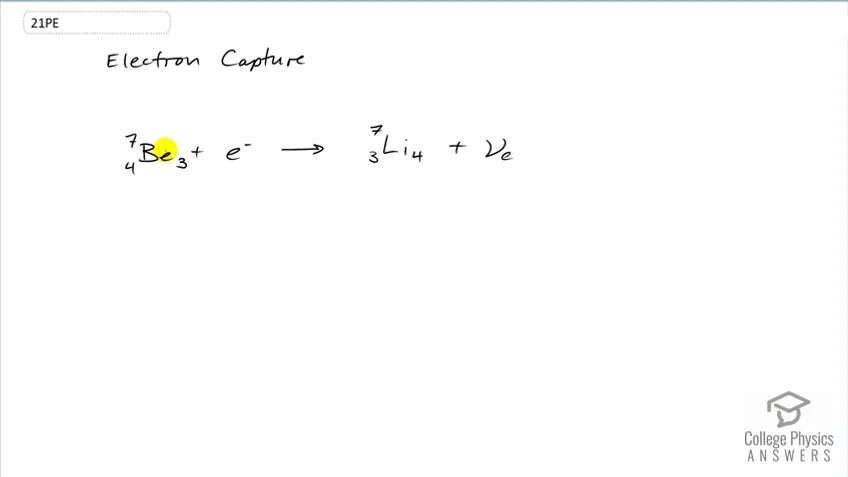 1:38PreviewProblem 21Full video with free trialWrite the complete decay equation for the given nuclide in the complete notation. Refer to the periodic table for values of Z:
Electron capture by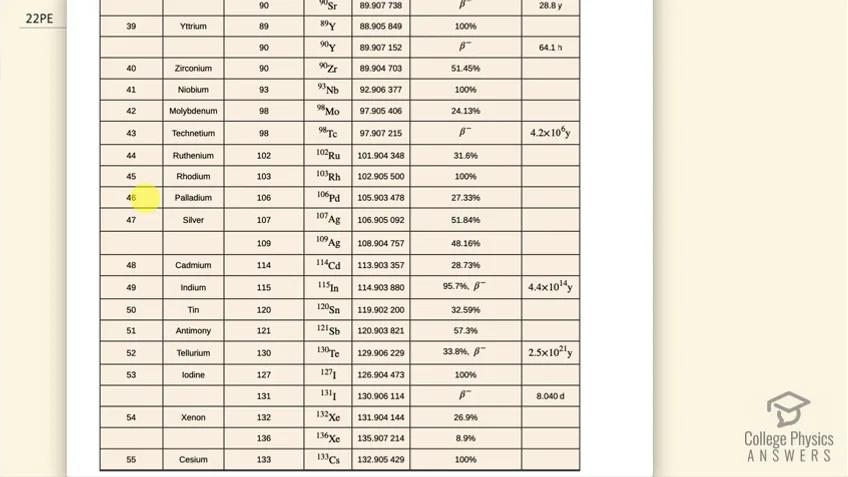 1:08PreviewProblem 22Full video with free trialWrite the complete decay equation for electron capture by in the complete $^\textrm{A}\textrm{Z}\textrm{X}\textrm{N}$ notation.
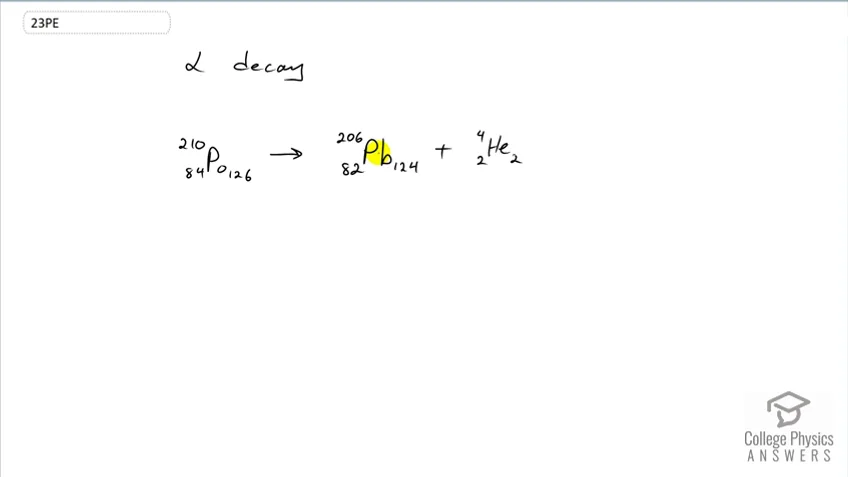 0:40PreviewProblem 23Full video with free trialWrite the complete decay equation for the given nuclide in the complete notation. Refer to the periodic table for values of Z:
decay of , the isotope of polonium in the decay series of that was discovered by the Curies. A favorite isotope in physics labs, since it has a short half-life and decays to a stable nuclide.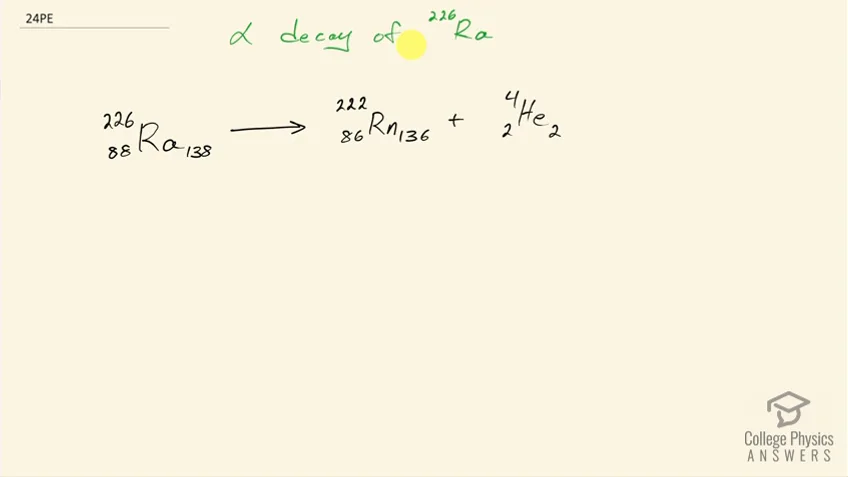 1:28PreviewProblem 24Full video with free trialWrite the complete decay equation for the given nuclide in the complete $^\textrm{A}\textrm{Z}\textrm{X}\textrm{N}alpha^{226}\textrm{Ra}^{238}\textrm{U}$, first recognized as a new element by the Curies, poses special problems because its daughter is a radioactive noble gas.
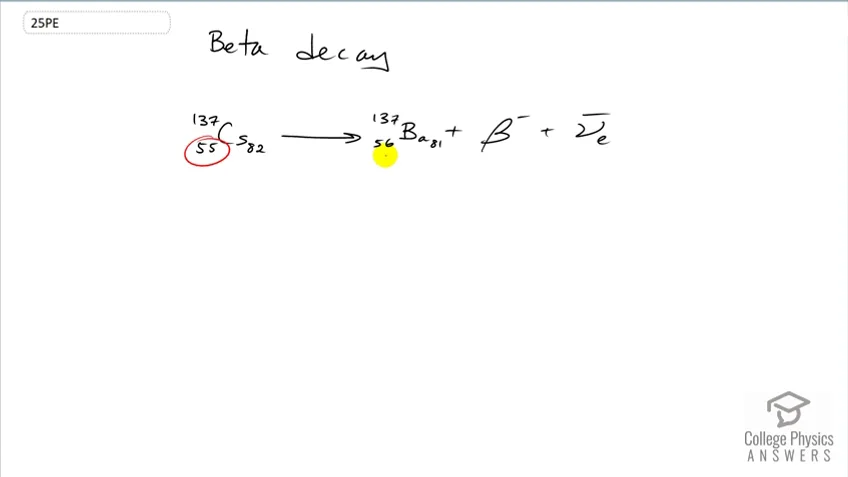 1:39PreviewProblem 25Full video with free trialWrite the complete decay equation for the given nuclide in the complete notation. Refer to the periodic table for values of Z:
decay producing . The parent nuclide is a major waste product of reactors and has chemistry similar to potassium and sodium, resulting in its concentration in your cells if ingested.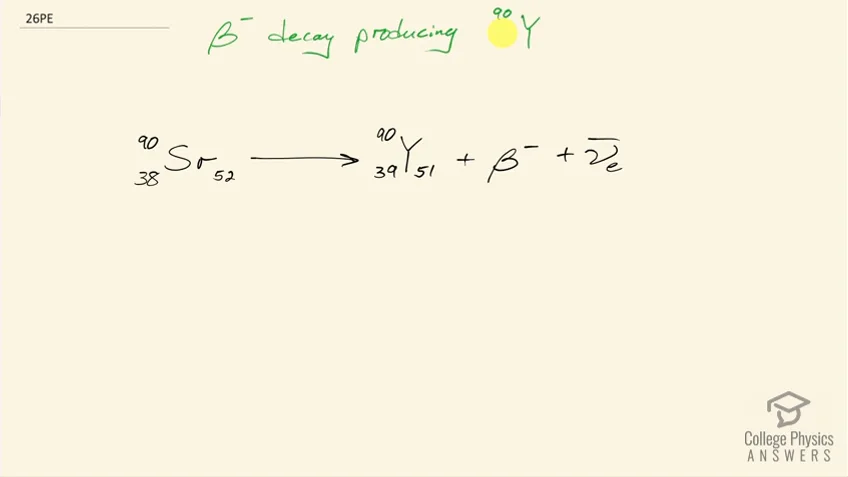 1:23PreviewProblem 26Full video with free trialIdentify the parent nuclide and write the complete decay equation in the $^\textrm{A}\textrm{Z}\textrm{X}\textrm{N}\beta^-^{90}\textrm{Y}^{90}\textrm{Y}$ is also radioactive.)
 1:46PreviewProblem 27Full video with free trialWrite the complete decay equation for the given nuclide in the complete notation. Refer to the periodic table for values of Z:
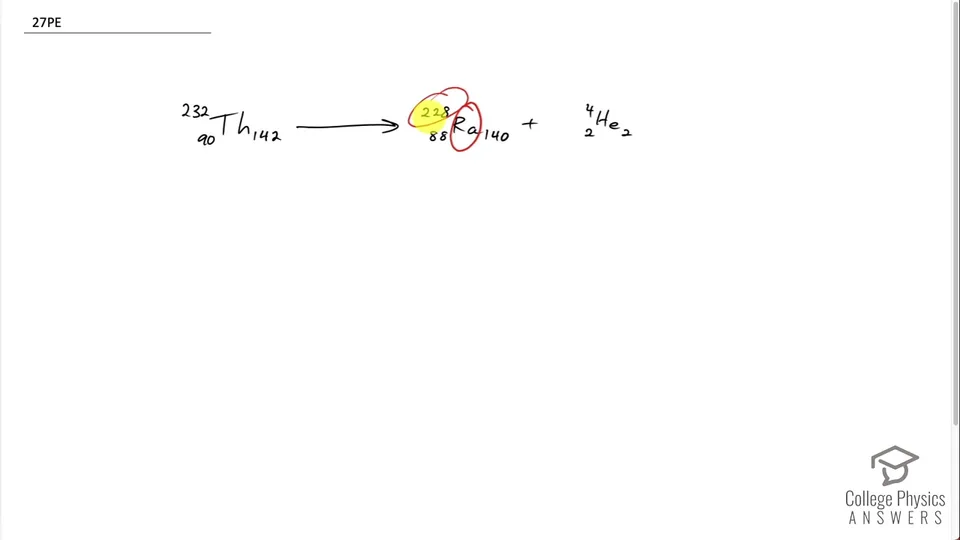
decay producing . The parent nuclide is nearly 100% of the natural element and is found in gas lantern mantles and in metal alloys used in jets ( is also radioactive).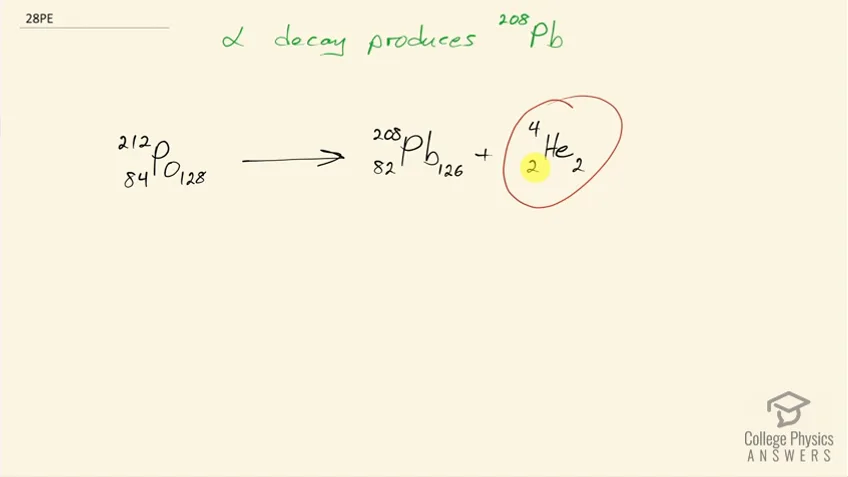 1:13PreviewProblem 28Full video with free trialIdentify the parent nuclide and write the complete decay equation in the $^\textrm{A}\textrm{Z}\textrm{X}\textrm{N}\alpha^{208}\textrm{Pb}^{232}\textrm{Th}$, the only naturally occurring isotope of thorium.
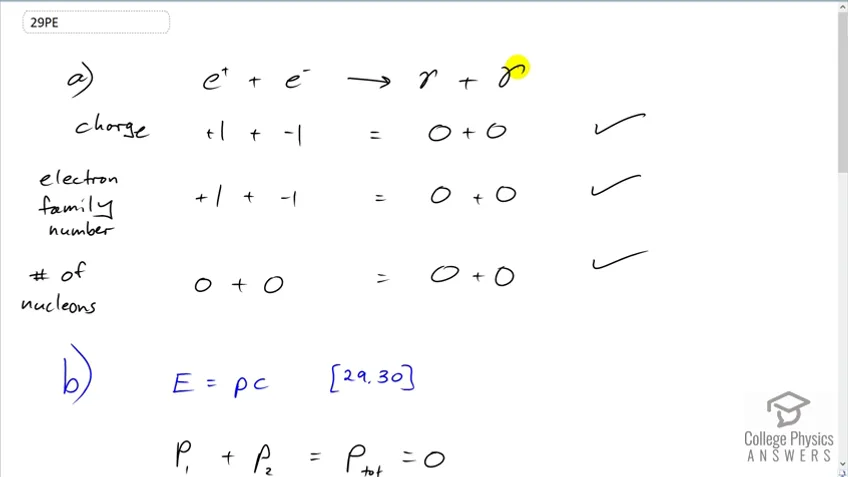 3:14PreviewProblem 29Full video with free trialWhen an electron and positron annihilate, both their masses are destroyed, creating two equal energy photons to preserve momentum. (a) Confirm that the annihilation equation conserves charge, electron family number, and total number of nucleons. To do this, identify the values of each before and after the annihilation. (b) Find the energy of each ray, assuming the electron and positron are initially nearly at rest. (c) Explain why the two rays travel in exactly opposite directions if the center of mass of the electron-positron system is initially at rest.
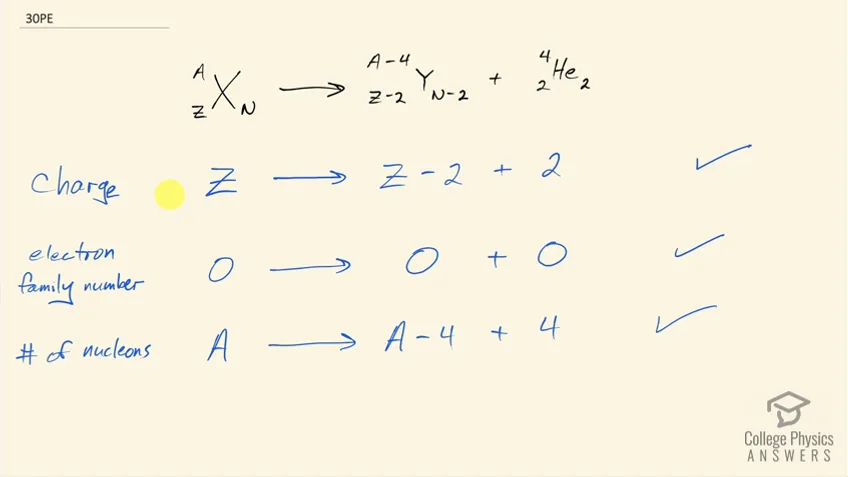 1:33PreviewProblem 30Full video with free trialConfirm that charge, electron family number, and the total number of nucleons are all conserved by the rule for α decay given in the equation $^\textrm{A}\textrm{Z}\textrm{X}\textrm{N} \to {}^{\textrm{A}-4}{\textrm{Z}-2}\textrm{Y}{\textrm{N}-2} + {}^4_2\textrm{He}_2$. To do this, identify the values of each before and after the decay.
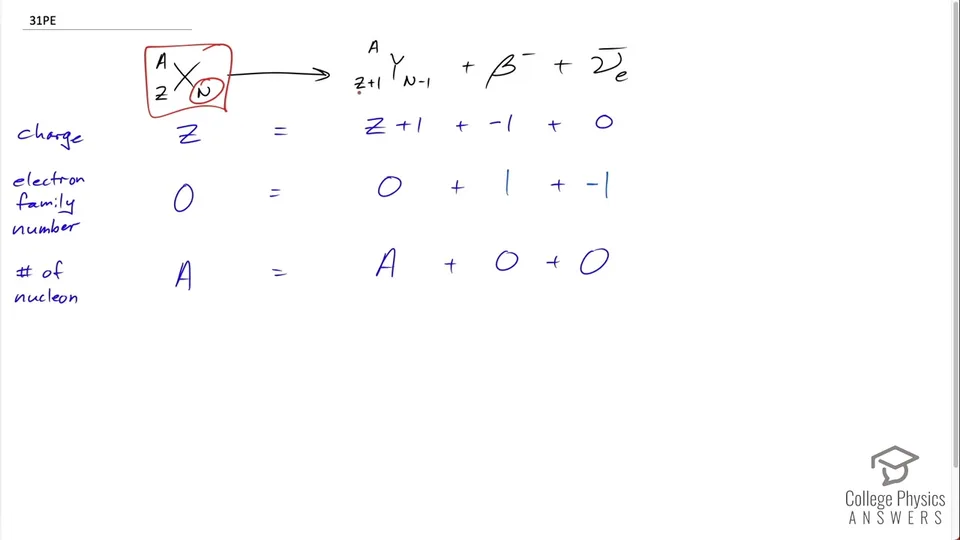 1:55PreviewProblem 31Full video with free trialConfirm that charge, electron family number, and the total number of nucleons are all conserved by the rule for decay given in the equation ${}^A_Z\textrm{X}N \to {}^A{Z+1}\textrm{Y}{N-1} + \beta^- + \bar{\nu\textrm{e}}$. To do this, identify the values of each before and after the decay.
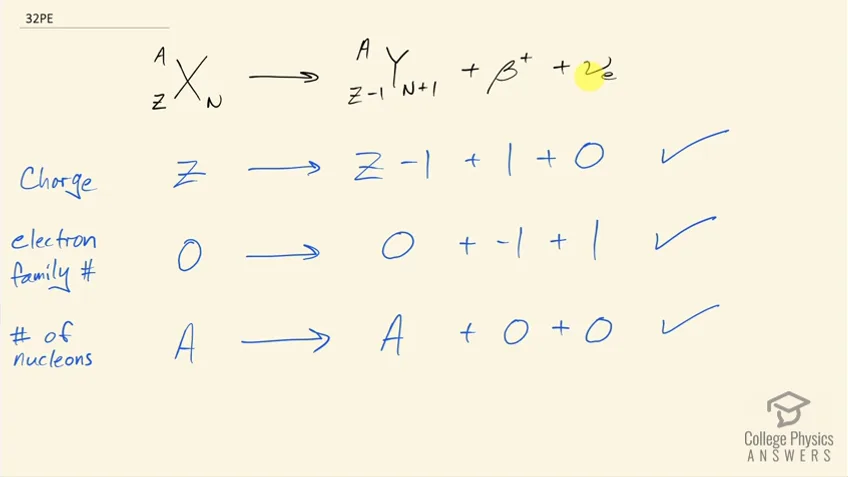 1:51PreviewProblem 32Full video with free trialConfirm that charge, electron family number, and the total number of nucleons are all conserved by the rule for β− decay given in the equation ${}^\textrm{A}\textrm{Z}\textrm{X}\textrm{N} \to {}^\textrm{A}{\textrm{Z}-1}\textrm{Y}{\textrm{N}+1} + \beta^+ + \nu_e$. To do this, identify the values of each before and after the decay.
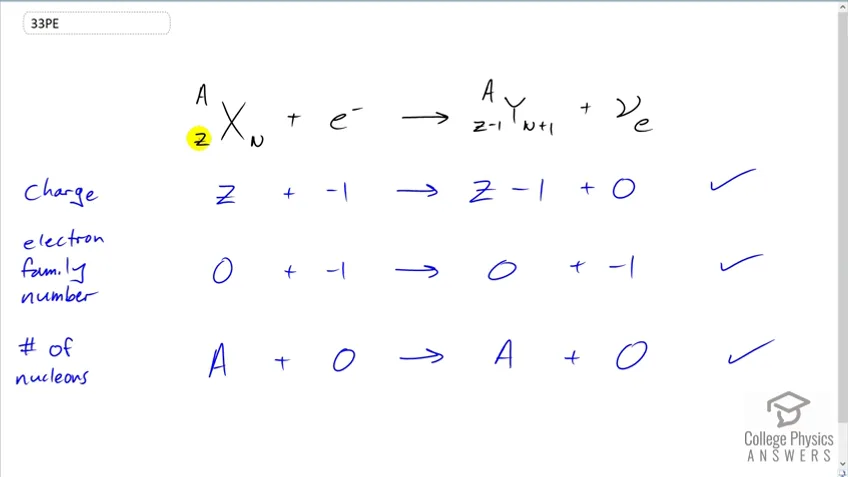 1:49PreviewProblem 33Full video with free trialConfirm that charge, electron family number, and the total number of nucleons are all conserved by the rule for electron capture given in the equation $^A_Z\textrm{X}N + e^- \to ^A{Z-1}\textrm{Y}_{N+1} + \nu_e$. To do this, identify the values of each before and after the capture.
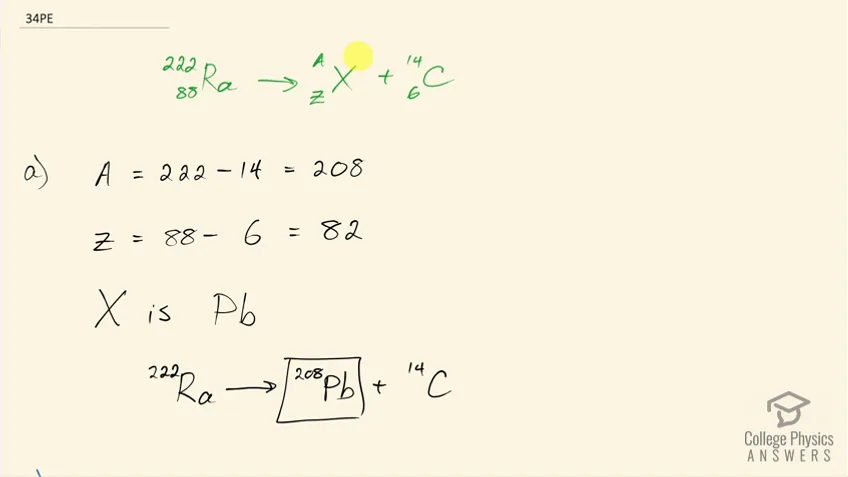 2:42PreviewProblem 34Full video with free trialA rare decay mode has been observed in which emits a nucleus. (a) The decay equation is . Identify the nuclide . (b) Find the energy emitted in the decay. The mass of is .
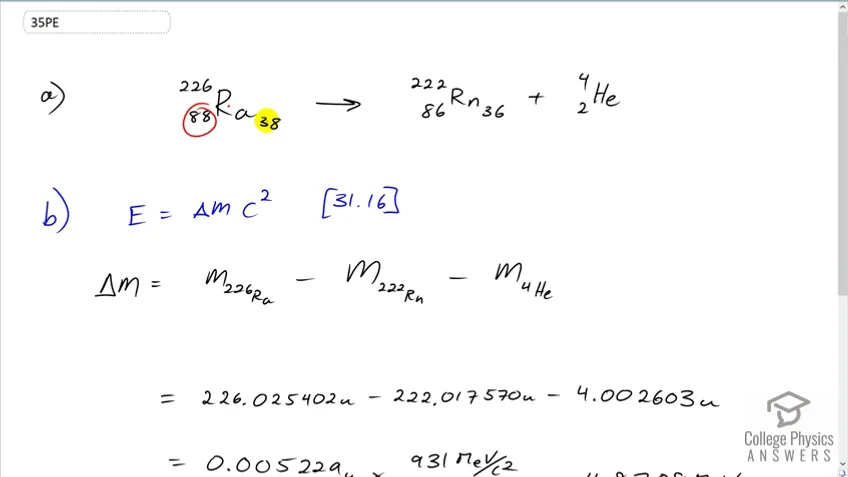 2:23PreviewProblem 35Full video with free trial(a) Write the complete decay equation for . (b) Find the energy released in the decay.
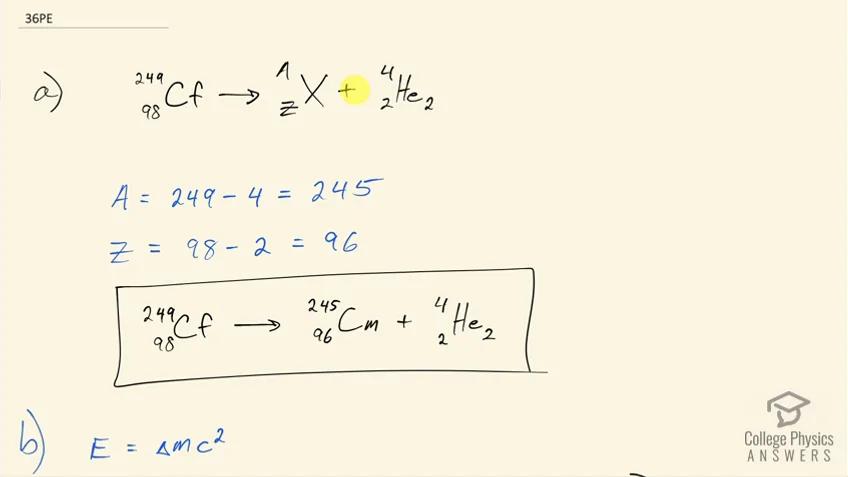 2:46PreviewProblem 36Full video with free trial(a) Write the complete decay equation for . (b) Find the energy released in the decay.
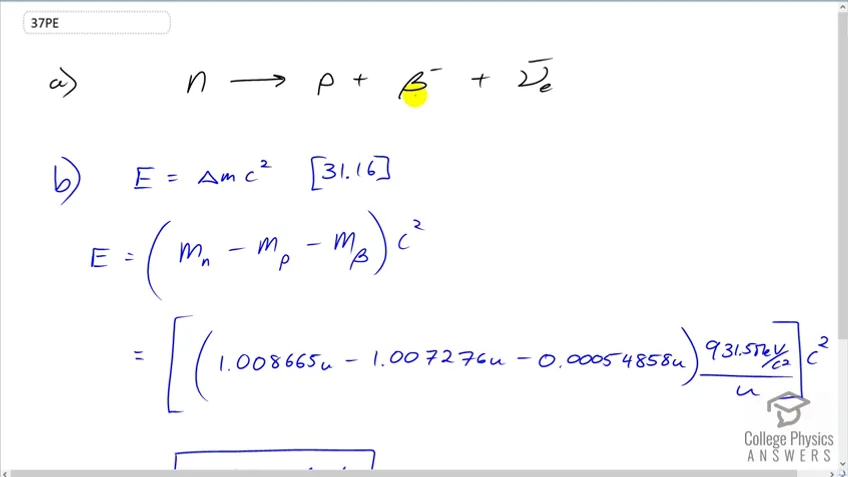 1:40PreviewProblem 37Full video with free trial(a) Write the complete decay equation for the neutron. (b) Find the energy released in the decay.
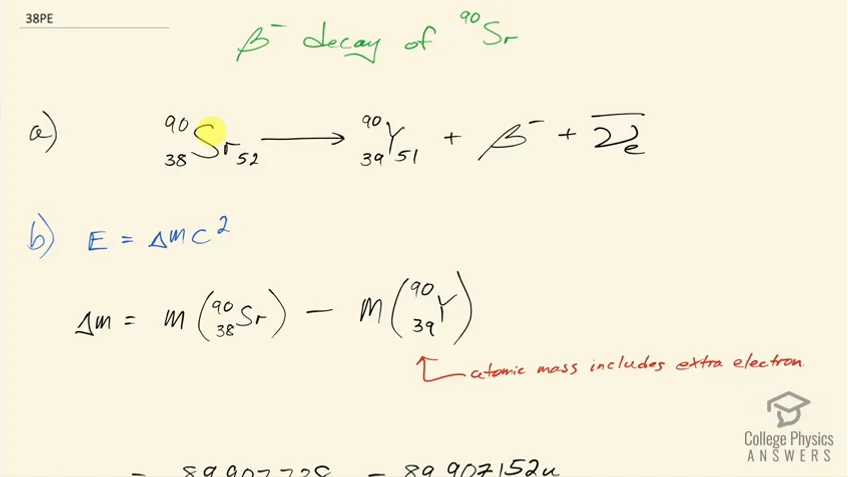 3:33PreviewProblem 38Full video with free trial(a) Write the complete decay equation for , a major waste product of nuclear reactors. (b) Find the energy released in the decay.
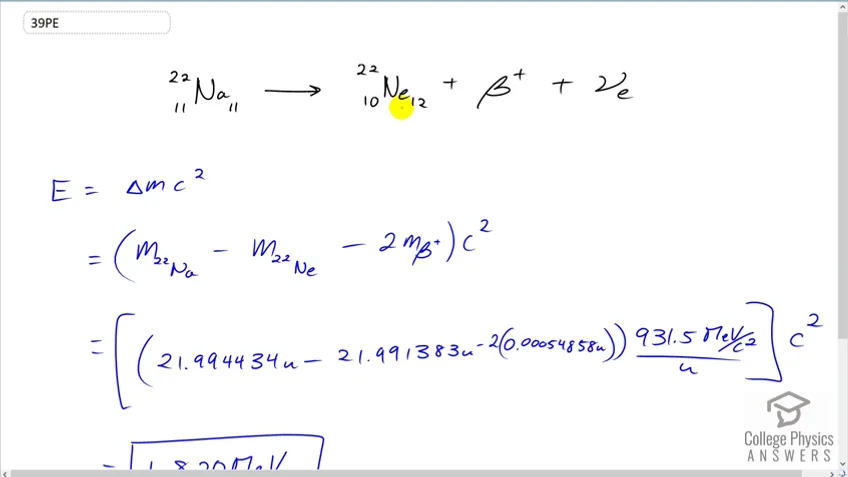 3:17PreviewProblem 39Full video with free trialCalculate the energy released in the decay of , the equation for which is given in the text. The masses of and are 21.994434 u and 21.991383 u, respectively.
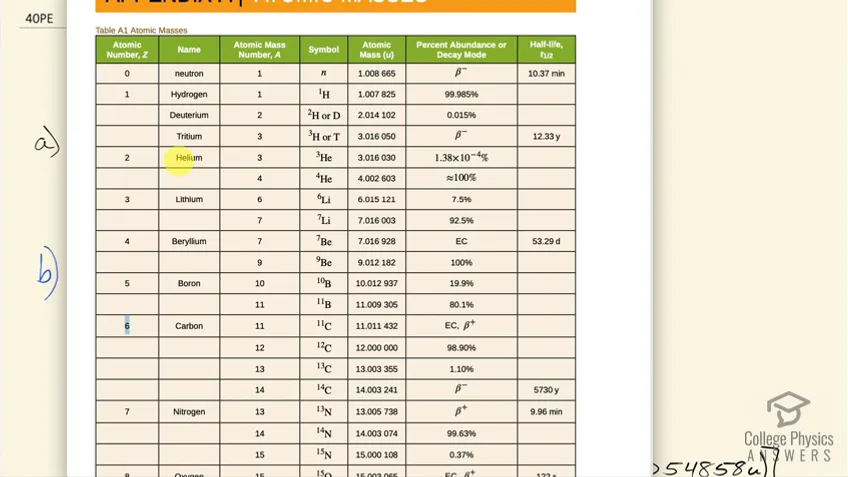 4:59PreviewProblem 40Full video with free trial(a) Write the complete equation for . (b) Calculate the energy released in the decay. The masses of and are and , respectively.
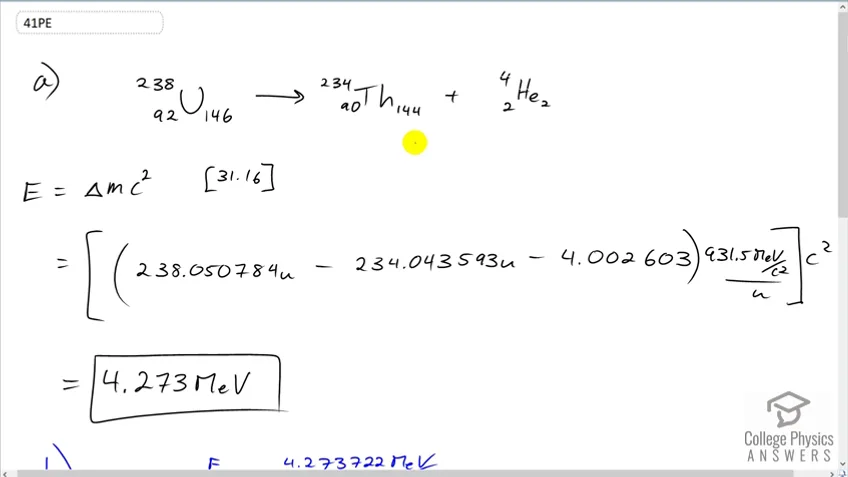 2:20PreviewProblem 41Full video with free trial(a) Calculate the energy released in the decay of (b) What fraction of the mass of a single is destroyed in the decay? The mass of is 234.043593 u. (c) Although the fractional mass loss is large for a single nucleus, it is difficult to observe for an entire macroscopic sample of uranium. Why is this?
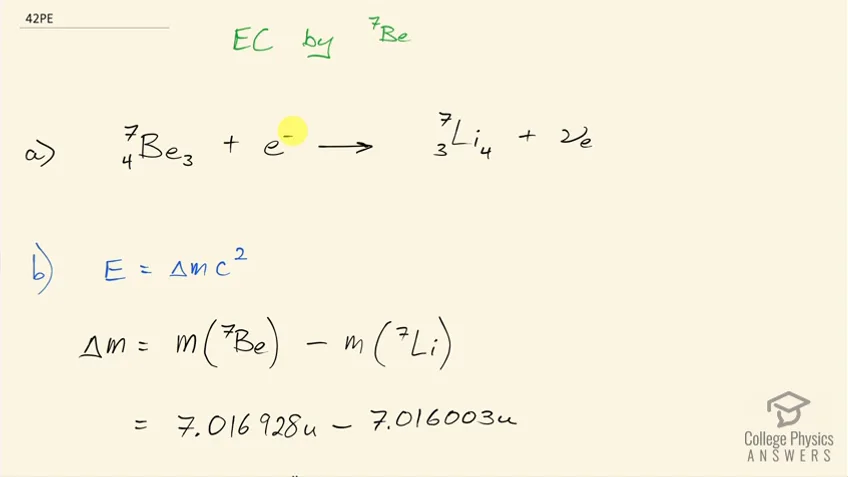 2:45PreviewProblem 42Full video with free trial(a) Write the complete reaction equation for electron capture by . (b) Calculate the energy released.
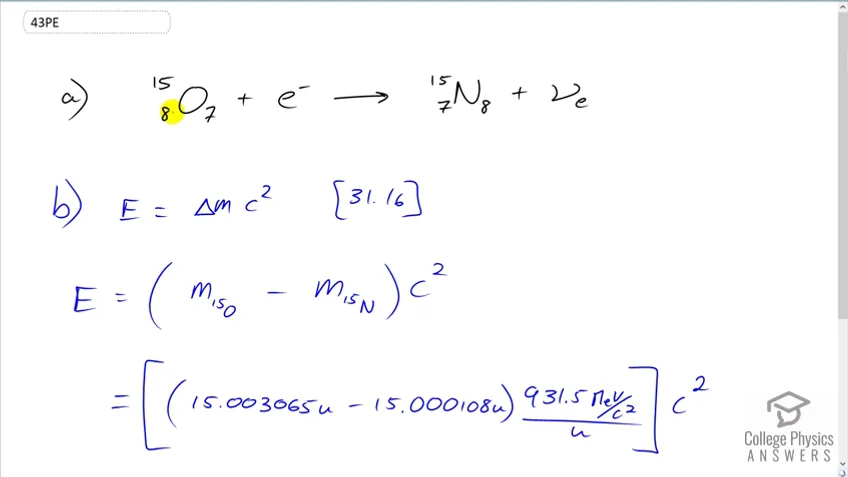 3:34PreviewProblem 43Full video with free trial(a) Write the complete reaction equation for electron capture by . (b) Calculate the energy released.
31.5 Half-Life and Activity
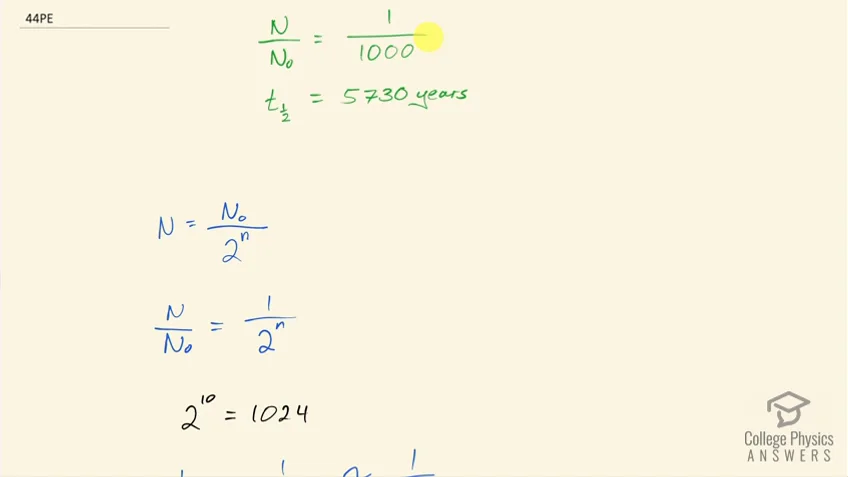 2:56PreviewProblem 44Full video with free trialAn old campfire is uncovered during an archaeological dig. Its charcoal is found to contain less than 1/1000 the normal amount of . Estimate the minimum age of the charcoal, noting that .
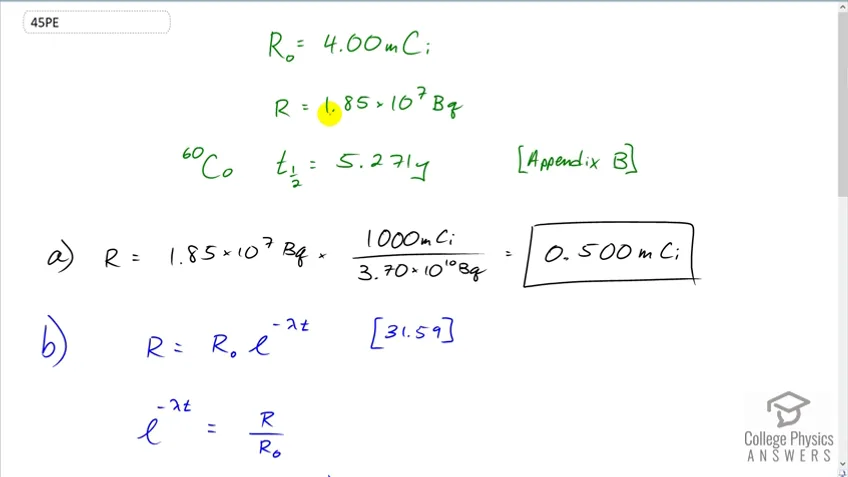 3:05PreviewProblem 45Full video with free trialA source is labeled 4.00 mCi, but its present activity is found to be . (a) What is the present activity in mCi? (b) How long ago did it actually have a 4.00-mCi activity?
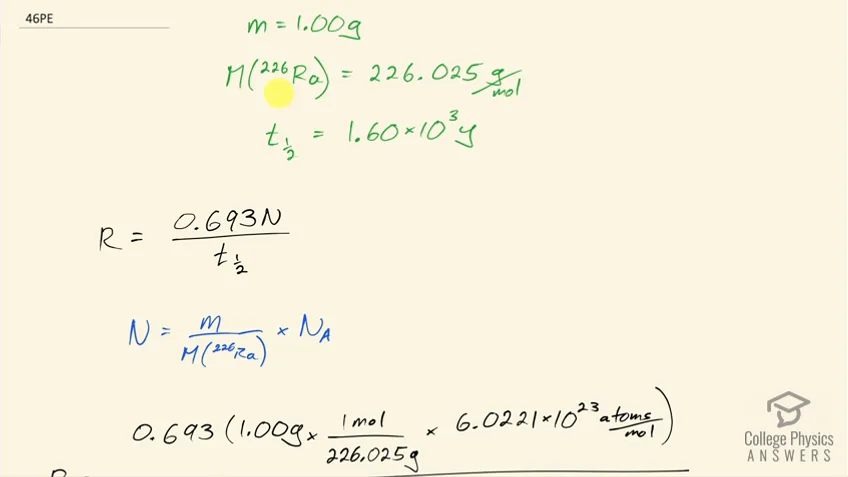 2:29PreviewProblem 46Full video with free trial(a) Calculate the activity R in curies of 1.00 g of . (b) Discuss why your answer is not exactly 1.00 Ci, given that the curie was originally supposed to be exactly the activity of a gram of radium.
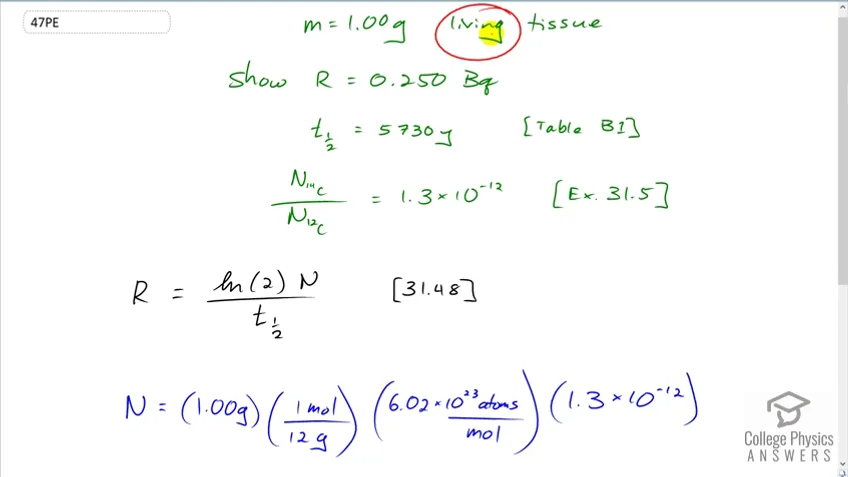 2:56PreviewProblem 47Full video with free trialShow that the activity of the in 1.00 g of found in living tissue is 0.250 Bq.
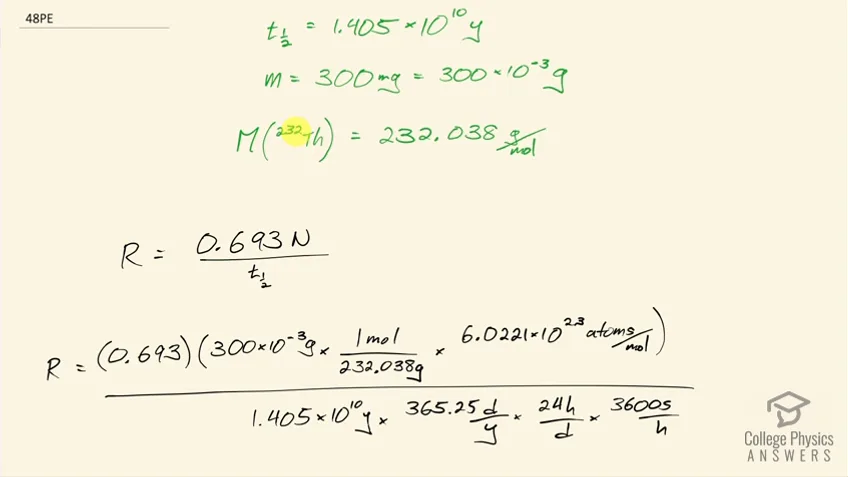 1:24PreviewProblem 48Full video with free trialMantles for gas lanterns contain thorium, because it forms an oxide that can survive being heated to incandescence for long periods of time. Natural thorium is almost 100% , with a half-life of . If an average lantern mantle contains 300 mg of thorium, what is its activity?
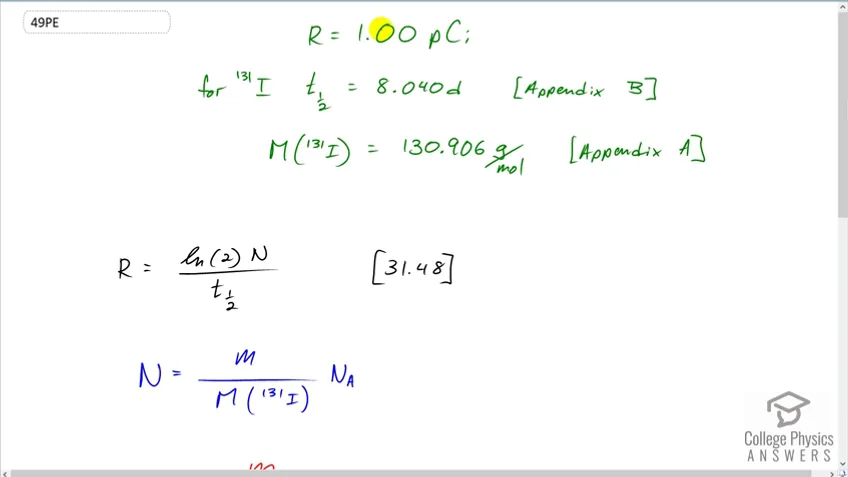 2:57PreviewProblem 49Full video with free trialCow’s milk produced near nuclear reactors can be tested for as little as 1.00 pCi of per liter, to check for possible reactor leakage. What mass of has this activity?
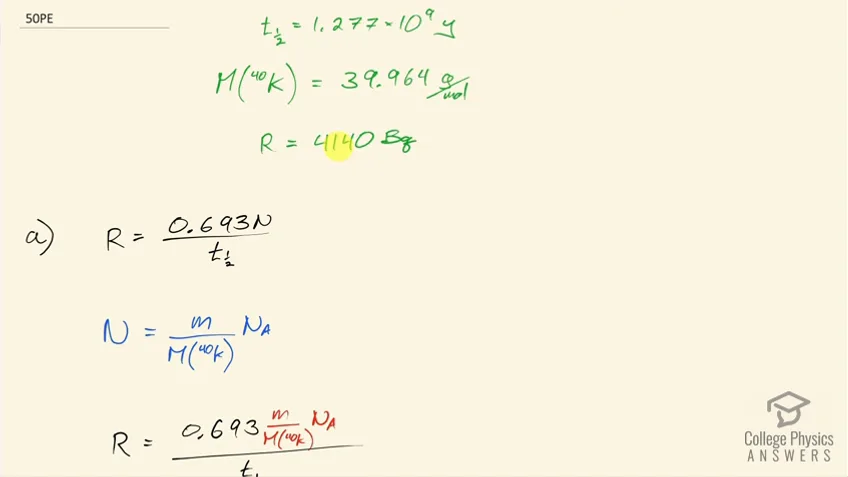 3:04PreviewProblem 50Full video with free trial(a) Natural potassium contains , which has a half-life of . What mass of in a person would have a decay rate of 4140 Bq? (b) What is the fraction of in natural potassium, given that the person has 140 g in his body? (These numbers are typical for a 70-kg adult.)
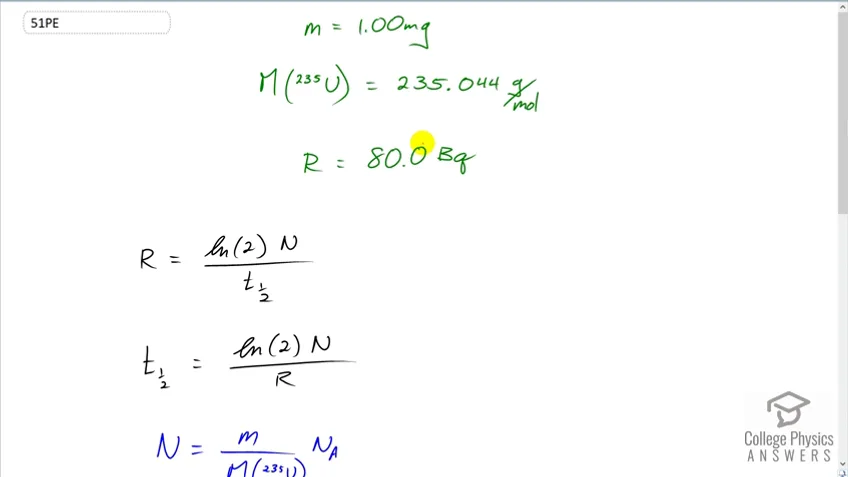 3:14PreviewProblem 51Full video with free trialThere is more than one isotope of natural uranium. If a researcher isolates 1.00 mg of the relatively scarce and finds this mass to have an activity of 80.0 Bq, what is its half-life in years?
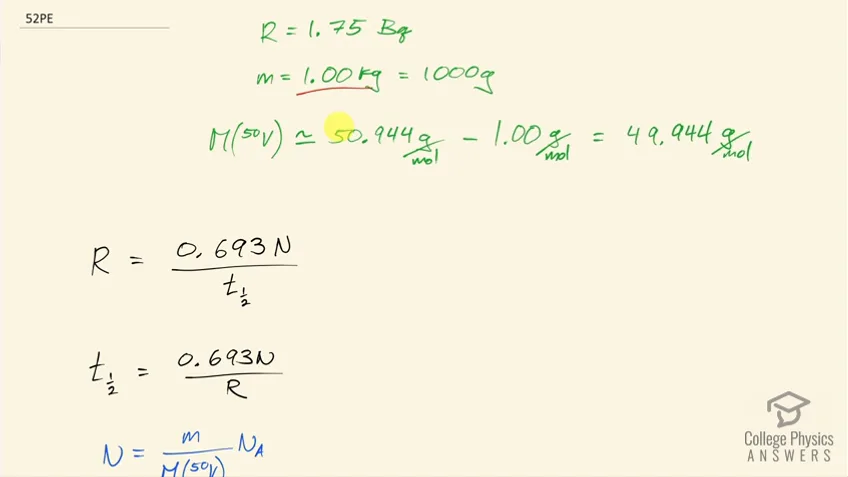 2:50PreviewProblem 52Full video with free trialhas one of the longest known radioactive half-lives. In a difficult experiment, a researcher found that the activity of 1.00 kg of is 1.75 Bq. What is the half-life in years?
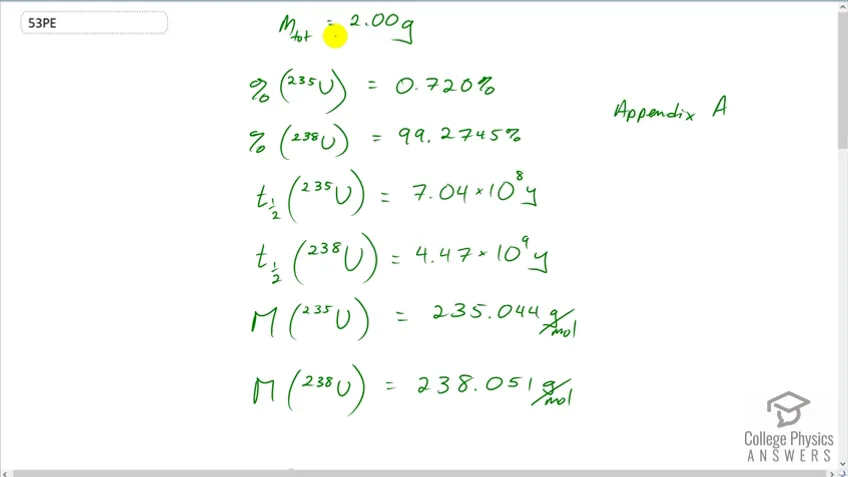 3:20PreviewProblem 53Full video with free trialYou can sometimes find deep red crystal vases in antique stores, called uranium glass because their color was produced by doping the glass with uranium. Look up the natural isotopes of uranium and their half-lives, and calculate the activity of such a vase assuming it has 2.00 g of uranium in it. Neglect the activity of any daughter nuclides.
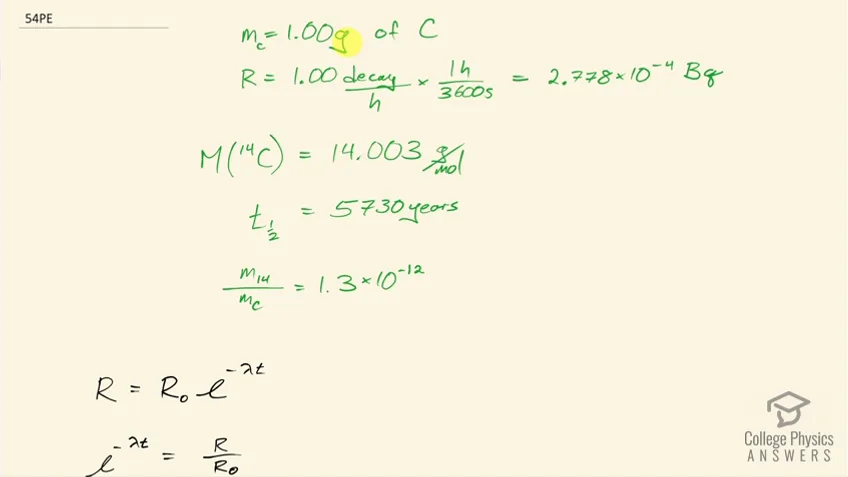 5:23PreviewProblem 54Full video with free trialA tree falls in a forest. How many years must pass before the activity in 1.00 g of the tree’s carbon drops to 1.00 decay per hour?
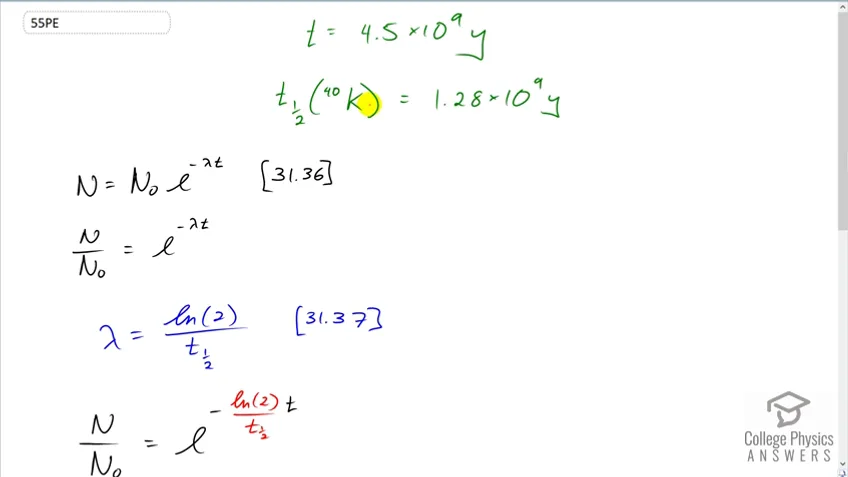 2:12PreviewProblem 55Full video with free trialWhat fraction of the that was on Earth when it formed years ago is left today?
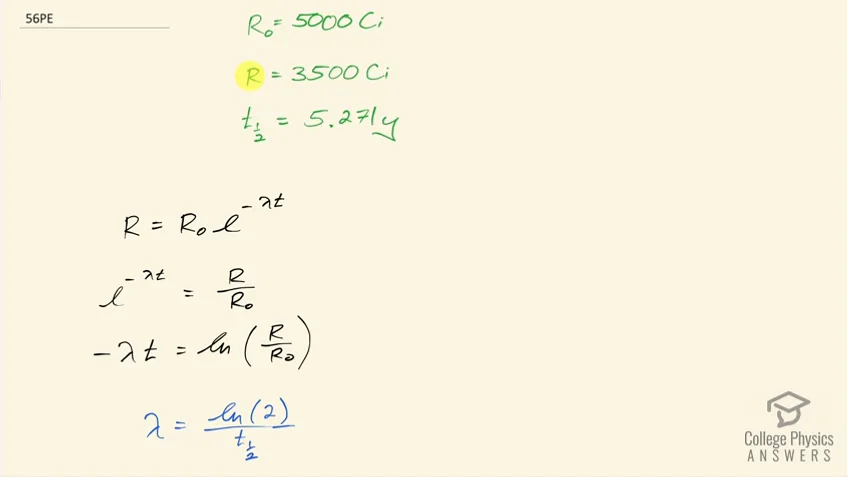 1:53PreviewProblem 56Full video with free trialA 5000-Ci source used for cancer therapy is considered too weak to be useful when its activity falls to 3500 Ci. How long after its manufacture does this happen?
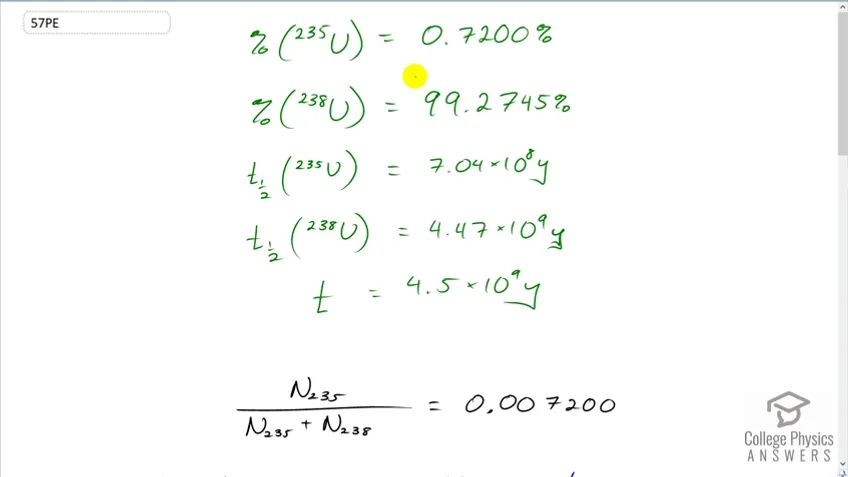 3:58PreviewProblem 57Full video with free trialNatural uranium is 0.7200% and 99.27% . What were the percentages of and in natural uranium when Earth formed years ago?
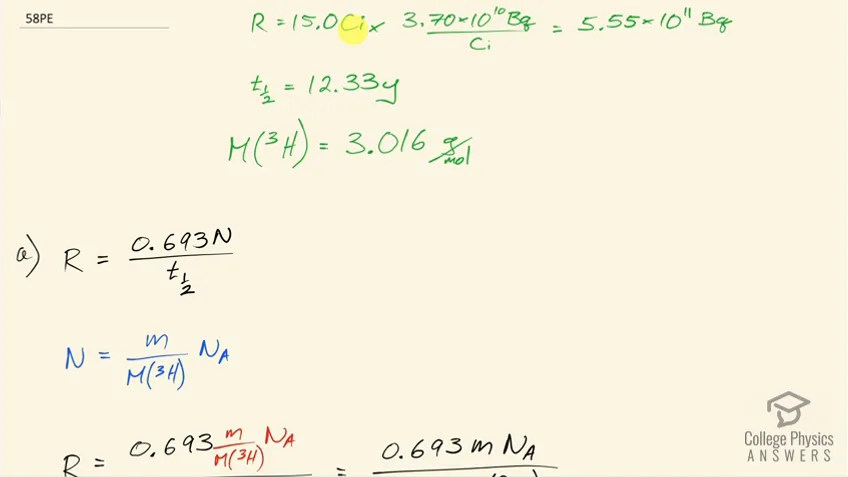 2:32PreviewProblem 58Full video with free trialThe particles emitted in the decay of (tritium) interact with matter to create light in a glow-in-the-dark exit sign. At the time of manufacture, such a sign contains 15.0 Ci of . (a) What is the mass of the tritium? (b) What is its activity 5.00 y after manufacture?
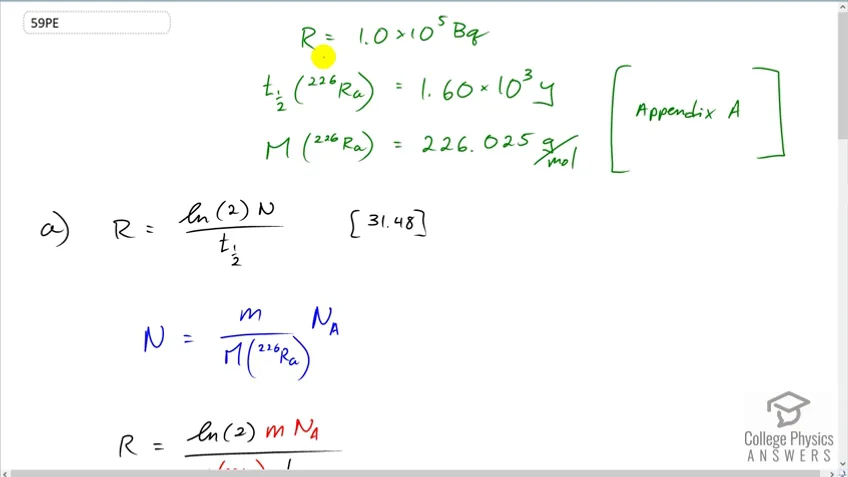 3:49PreviewProblem 59Full video with free trialWorld War II aircraft had instruments with glowing radium- painted dials (see Figure 31.2). The activity of one such instrument was when new. (a) What mass of was present? (b) After some years, the phosphors on the dials deteriorated chemically, but the radium did not escape. What is the activity of this instrument 57.0 years after it was made?
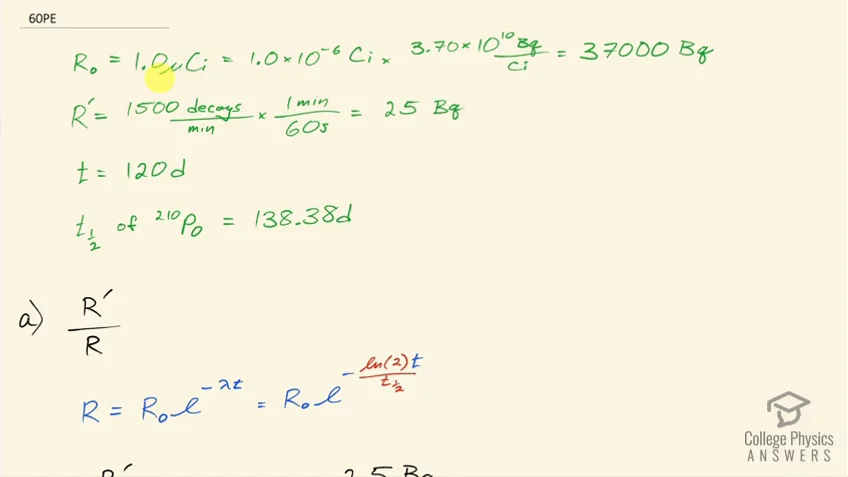 3:41PreviewProblem 60Full video with free trial(a) The source used in a physics laboratory is labeled as having an activity of on the date it was prepared. A student measures the radioactivity of this source with a Geiger counter and observes 1500 counts per minute. She notices that the source was prepared 120 days before her lab. What fraction of the decays is she observing with her apparatus? (b) Identify some of the reasons that only a fraction of the α s emitted are observed by the detector.
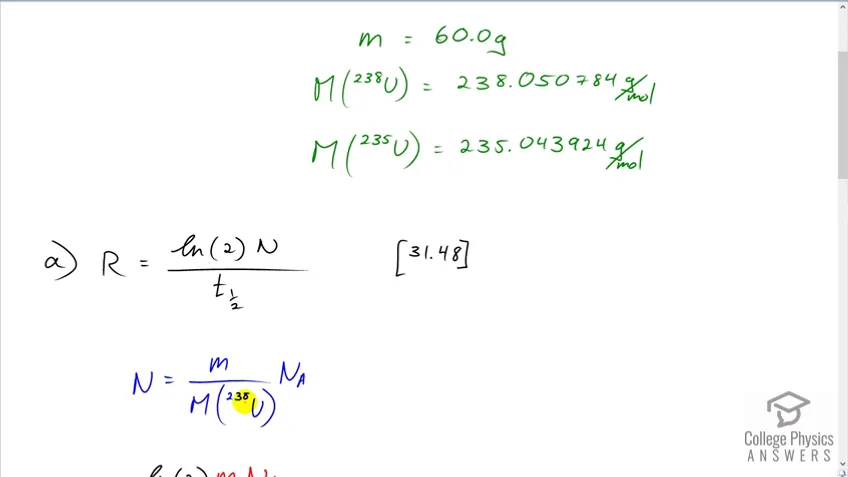 3:25PreviewProblem 61Full video with free trialArmor-piercing shells with depleted uranium cores are fired by aircraft at tanks. (The high density of the uranium makes them effective.) The uranium is called depleted because it has had its removed for reactor use and is nearly pure . Depleted uranium has been erroneously called non-radioactive. To demonstrate that this is wrong: (a) Calculate the activity of 60.0 g of pure . (b) Calculate the activity of 60.0 g of natural uranium, neglecting the and all daughter nuclides.
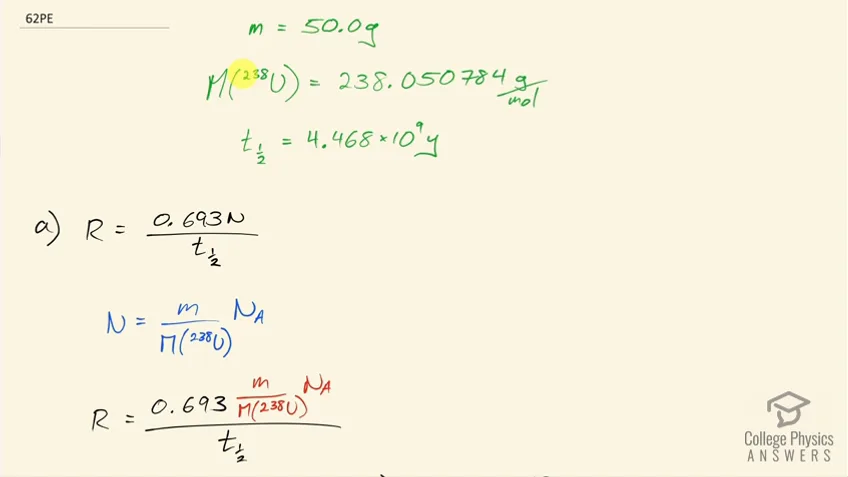 3:29PreviewProblem 62Full video with free trialThe ceramic glaze on a red-orange Fiestaware plate is and contains 50.0 grams of , but very little . (a) What is the activity of the plate? (b) Calculate the total energy that will be released by the decay. (c) If energy is worth 12.0 cents per , what is the monetary value of the energy emitted? (These plates went out of production some 30 years ago, but are still available as collectibles.)
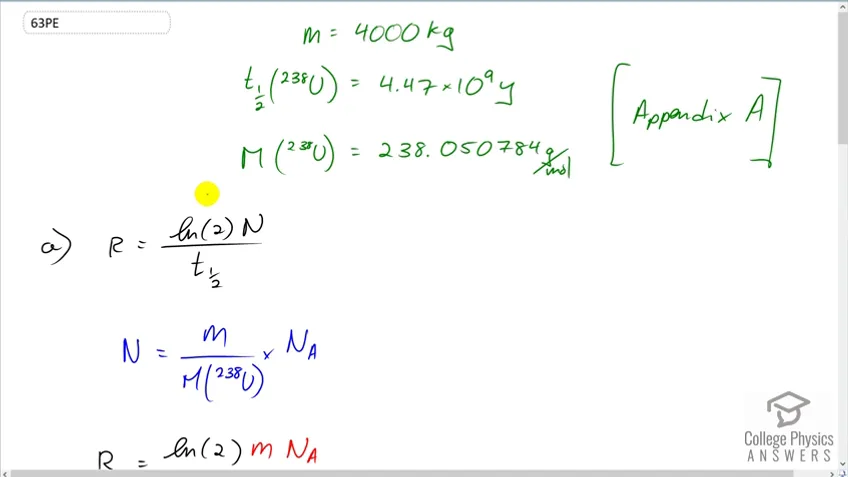 4:24PreviewProblem 63Full video with free trialLarge amounts of depleted uranium () are available as a by-product of uranium processing for reactor fuel and weapons. Uranium is very dense and makes good counter weights for aircraft. Suppose you have a 4000-kg block of . (a) Find its activity. (b) How many calories per day are generated by thermalization of the decay energy? (c) Do you think you could detect this as heat? Explain.
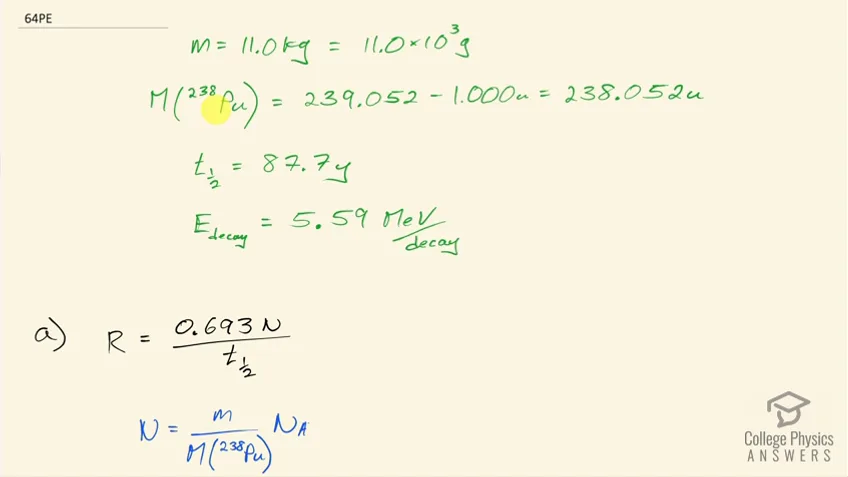 3:51PreviewProblem 64Full video with free trialThe Galileo space probe was launched on its long journey past several planets in 1989, with an ultimate goal of Jupiter. Its power source is 11.0 kg of , a by-product of nuclear weapons plutonium production. Electrical energy is generated thermoelectrically from the heat produced when the 5.59-MeV particles emitted in each decay crash to a halt inside the plutonium and its shielding. The half-life of is 87.7 years. (a) What was the original activity of the in becquerel? (b) What power was emitted in kilowatts? (c) What power was emitted 12.0 y after launch? You may neglect any extra energy from daughter nuclides and any losses from escaping rays.
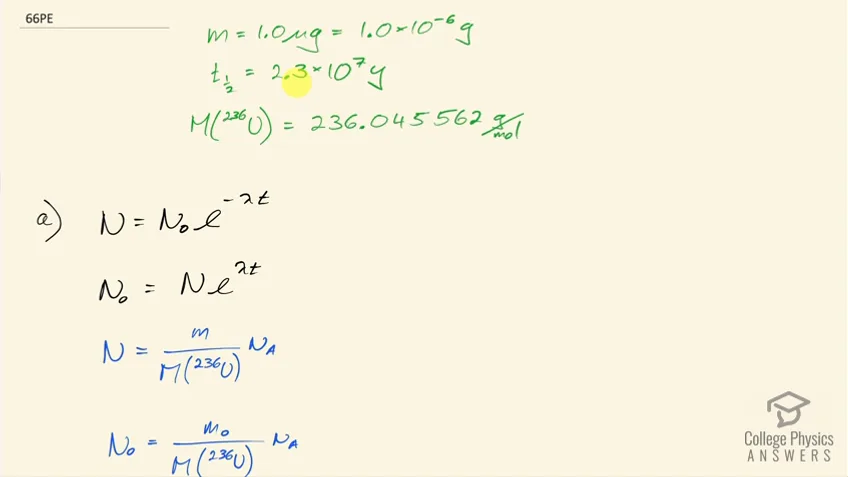 2:29PreviewProblem 66Full video with free trialA nuclear physicist find of in a piece of uranium ore and assumes it is primordial since its half-life is . (a) Calculate the amount of that would had to have been on Earth when it formed ago for to be left today. (b) What is unreasonable about this result? (c) What assumption is responsible?
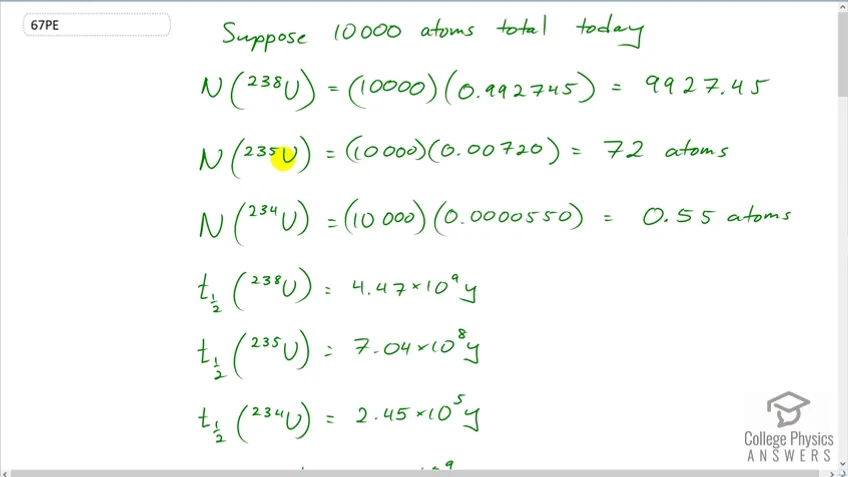 5:13PreviewProblem 67Full video with free trialNatural uranium is 0.7200% , 99.27% , and 0.0055% . (a) What were the percentages of , , and in natural uranium when Earth formed years ago? (b) What is unreasonable about this result? (c) What assumption is responsible? (d) Where does come from if it is not primordial?
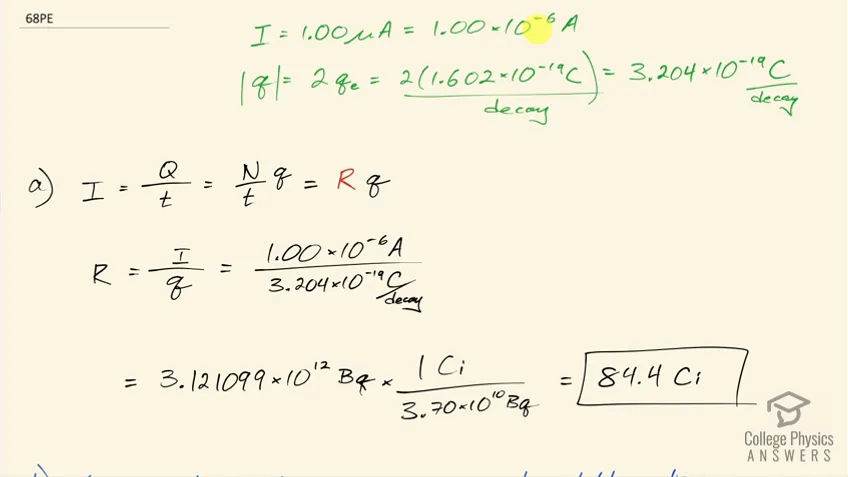 1:51PreviewProblem 68Full video with free trialThe manufacturer of a smoke alarm decides that the smallest current of radiation he can detect is . (a) Find the activity in curies of an emitter that produces a current of particles. (b) What is unreasonable about this result? (c) What assumption is responsible?
31.6 Binding Energy
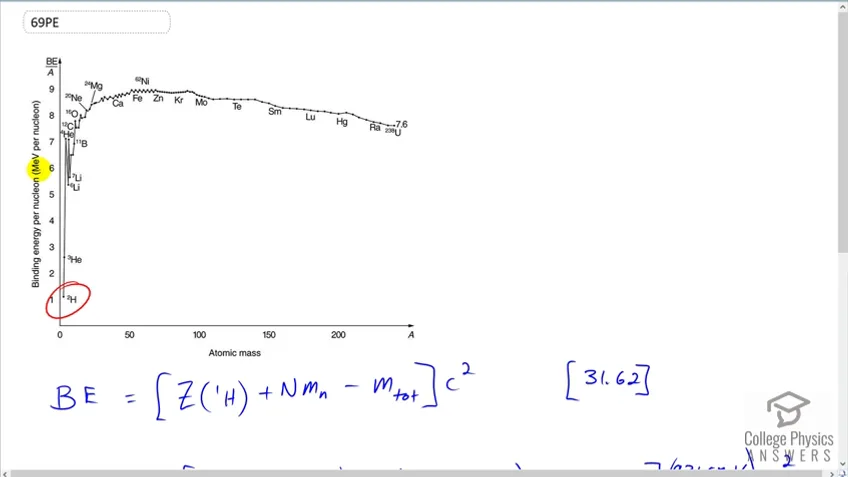 2:08PreviewProblem 69Full video with free trialis a loosely bound isotope of hydrogen. Called deuterium or heavy hydrogen, it is stable but relatively rare—it is 0.015% of natural hydrogen. Note that deuterium has Z = N , which should tend to make it more tightly bound, but both are odd numbers. Calculate BE/A , the binding energy per nucleon, for and compare it with the approximate value obtained from the graph in Figure 31.27.
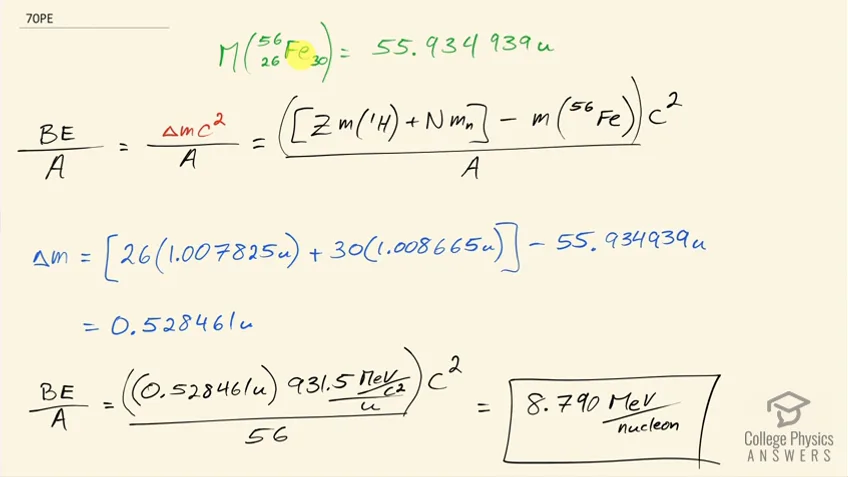 2:42PreviewProblem 70Full video with free trialis among the most tightly bound of all nuclides. It is more than 90% of natural iron. Note that has even numbers of both protons and neutrons. Calculate , the binding energy per nucleon, for and compare it with the approximate value obtained from the graph in Figure 31.27.
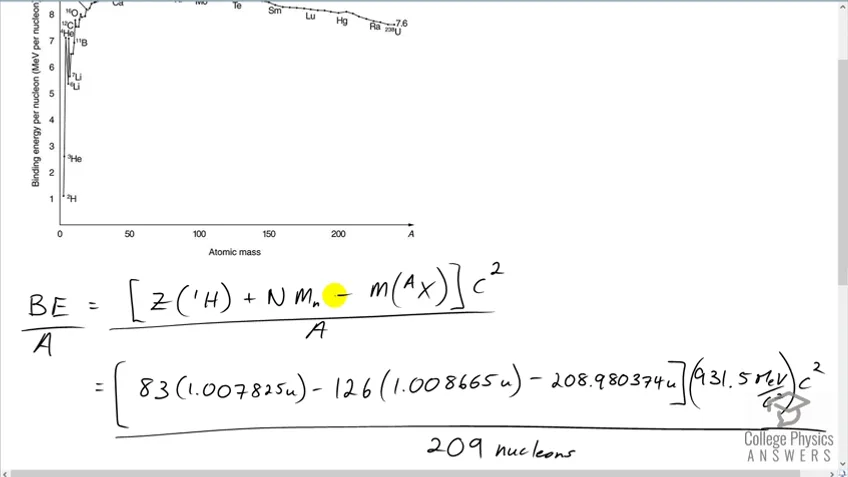 1:44PreviewProblem 71Full video with free trialis the heaviest stable nuclide, and its BE / A is low compared with medium-mass nuclides. Calculate BE/A , the binding energy per nucleon, for and compare it with the approximate value obtained from the graph in Figure 31.26.
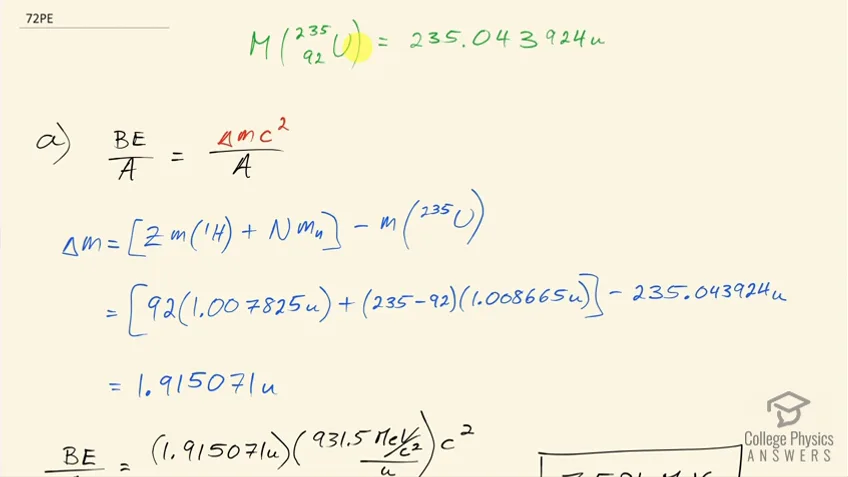 4:41PreviewProblem 72Full video with free trial(a) Calculate BE / A for , the rarer of the two most common uranium isotopes. (b) Calculate BE / A for . (Most of uranium is .) Note that has even numbers of both protons and neutrons. Is the BE / A of significantly different from that of ?
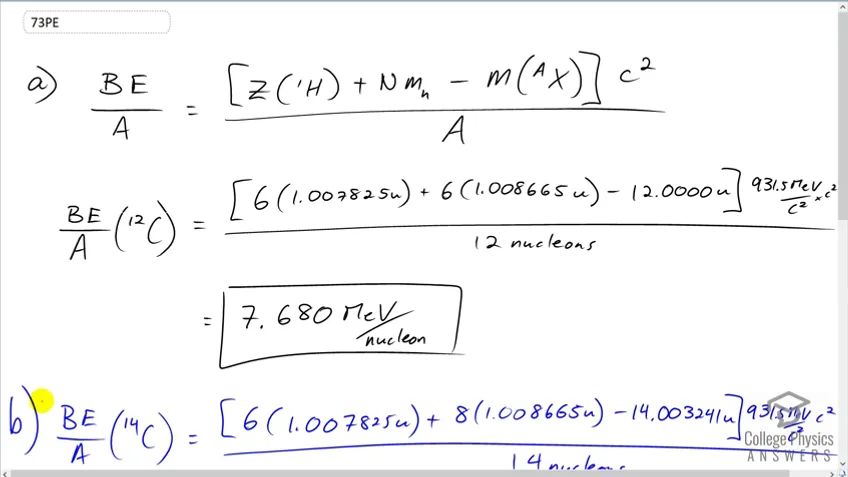 2:39PreviewProblem 73Full video with free trial(a) Calculate BE / A for . Stable and relatively tightly bound, this nuclide is most of natural carbon. (b) Calculate BE / A for . Is the difference in BE / A between and significant? One is stable and common, and the other is unstable and rare.
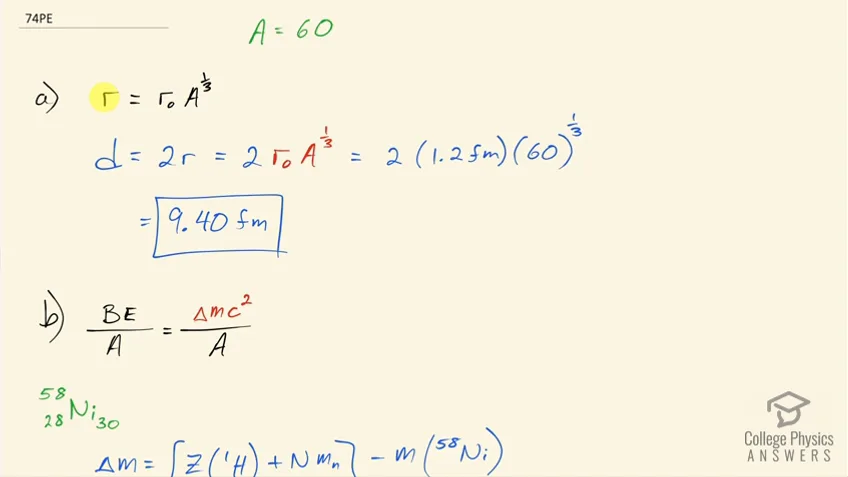 4:26PreviewProblem 74Full video with free trialThe fact that BE / A is greatest for near 60 implies that the range of the nuclear force is about the diameter of such nuclides. (a) Calculate the diameter of an nucleus. (b) Compare BE / A for and . The first is one of the most tightly bound nuclides, while the second is larger and less tightly bound.
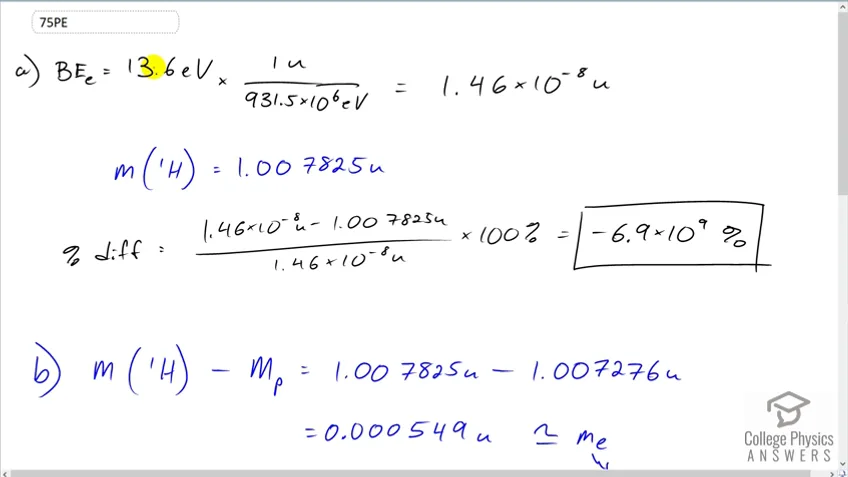 2:57PreviewProblem 75Full video with free trialThe purpose of this problem is to show in three ways that the binding energy of the electron in a hydrogen atom is negligible compared with the masses of the proton and electron. (a) Calculate the mass equivalent in u of the 13.6-eV binding energy of an electron in a hydrogen atom, and compare this with the mass of the hydrogen atom obtained from Appendix A. (b) Subtract the mass of the proton given in Table 31.2 from the mass of the hydrogen atom given in Appendix A. You will find the difference is equal to the electron’s mass to three digits, implying the binding energy is small in comparison. (c) Take the ratio of the binding energy of the electron (13.6 eV) to the energy equivalent of the electron’s mass (0.511 MeV). (d) Discuss how your answers confirm the stated purpose of this problem.
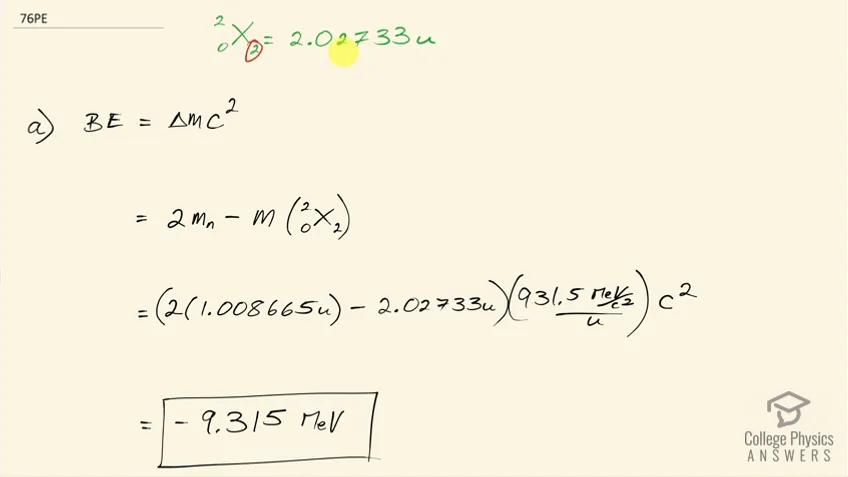 1:03PreviewProblem 76Full video with free trialA particle physicist discovers a neutral particle with a mass of 2.02733 u that he assumes is two neutrons bound together. (a) Find the binding energy. (b) What is unreasonable about this result? (c) What assumptions are unreasonable or inconsistent?
31.7 Tunneling
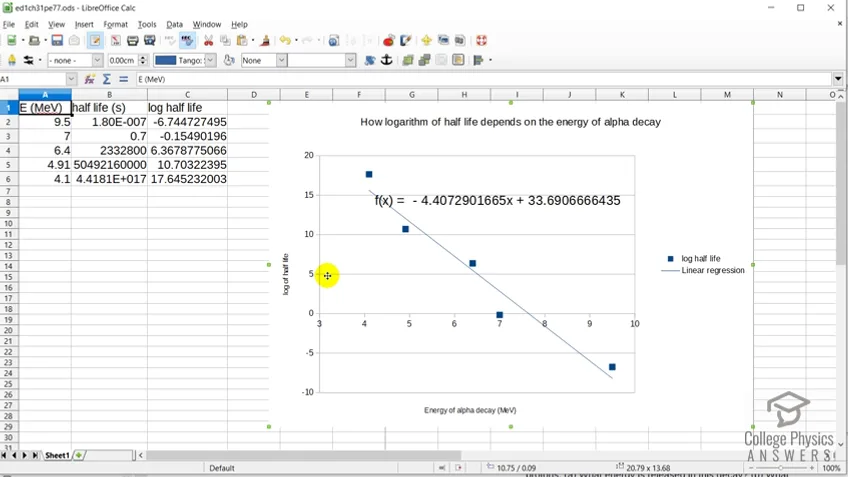 1:31PreviewProblem 77Full video with free trial
Derive an approximate relationship between the energy of decay and half-life using the following data. It may be useful to graph the log of against to find some straight-line relationship.
Nuclide (MeV) 9.5 0.18 7.0 0.7 s 6.4 27 d 4.91 1600 y 4.1 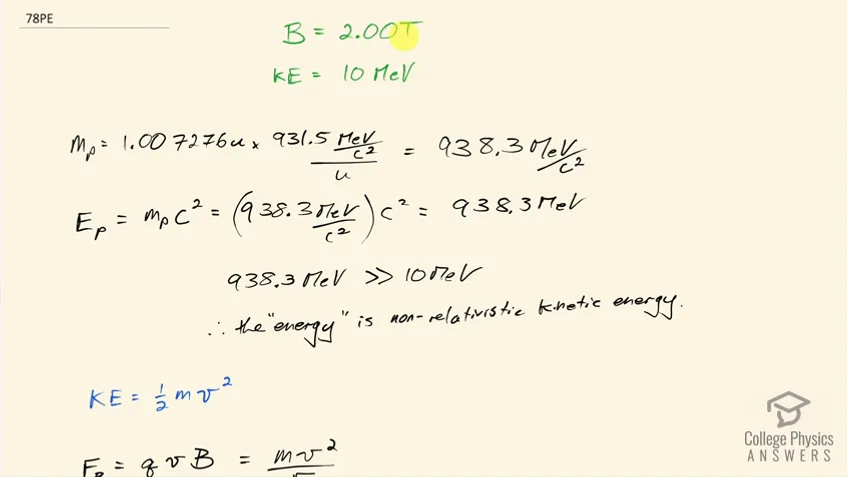 3:06PreviewProblem 78Full video with free trialA 2.00-T magnetic field is applied perpendicular to the path of charged particles in a bubble chamber. What is the radius of curvature of the path of a 10 MeV proton in this field? Neglect any slowing along its path.
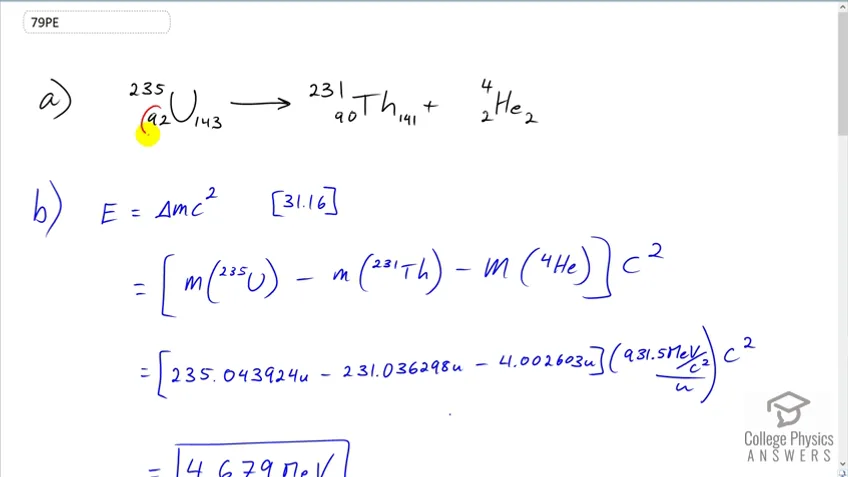 4:20PreviewProblem 79Full video with free trial(a) Write the decay equation for the α decay of . (b) What energy is released in this decay? The mass of the daughter nuclide is 231.036298 u. (c) Assuming the residual nucleus is formed in its ground state, how much energy goes to the particle?
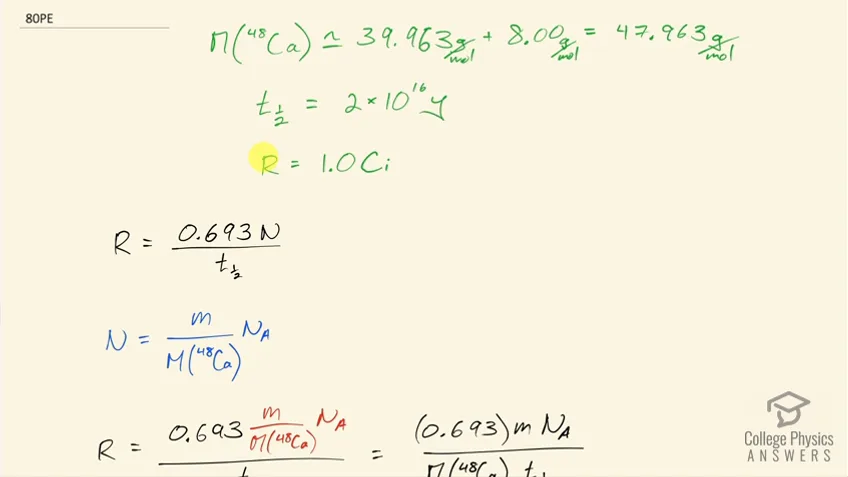 2:48PreviewProblem 80Full video with free trialThe relatively scarce naturally occurring calcium isotope has a half-life of about . (a) A small sample of this isotope is labeled as having an activity of 1.0 Ci. What is the mass of the in the sample? (b) What is unreasonable about this result? (c) What assumption is responsible?
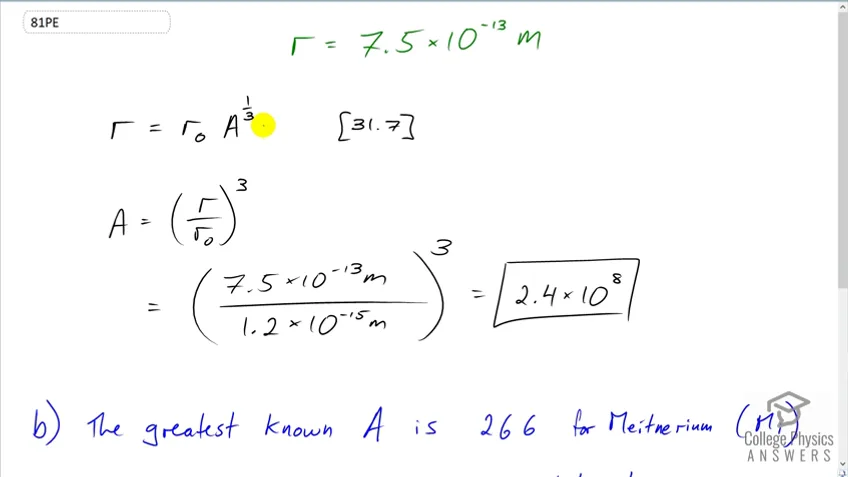 1:09PreviewProblem 81Full video with free trialA physicist scatters rays from a substance and sees evidence of a nucleus in radius. (a) Find the atomic mass of such a nucleus. (b) What is unreasonable about this result? (c) What is unreasonable about the assumption?
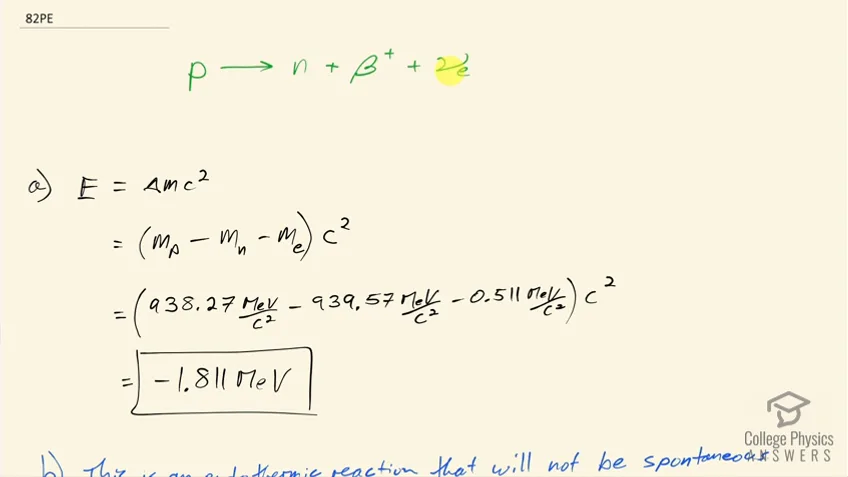 1:54PreviewProblem 82Full video with free trialA frazzled theoretical physicist reckons that all conservation laws are obeyed in the decay of a proton into a neutron, positron, and neutrino (as in decay of a nucleus) and sends a paper to a journal to announce the reaction as a possible end of the universe due to the spontaneous decay of protons. (a) What energy is released in this decay? (b) What is unreasonable about this result? (c) What assumption is responsible?