Question
What frequency is received by a mouse just before being dispatched by a hawk flying at it at 25.0 m/s and emitting a screech of frequency 3500 Hz? Take the speed of sound to be 331 m/s.
Final Answer
Solution video

This is a 15-second preview. Get access to the full video by starting your free 7-day trial.
This is a 15-second preview. Get access to the full video by starting your free 7-day trial.
Calculator Screenshots
Video Transcript
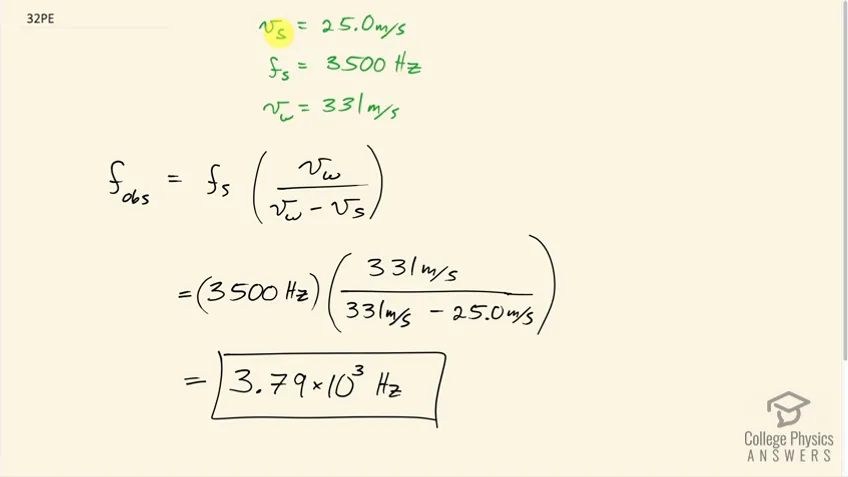
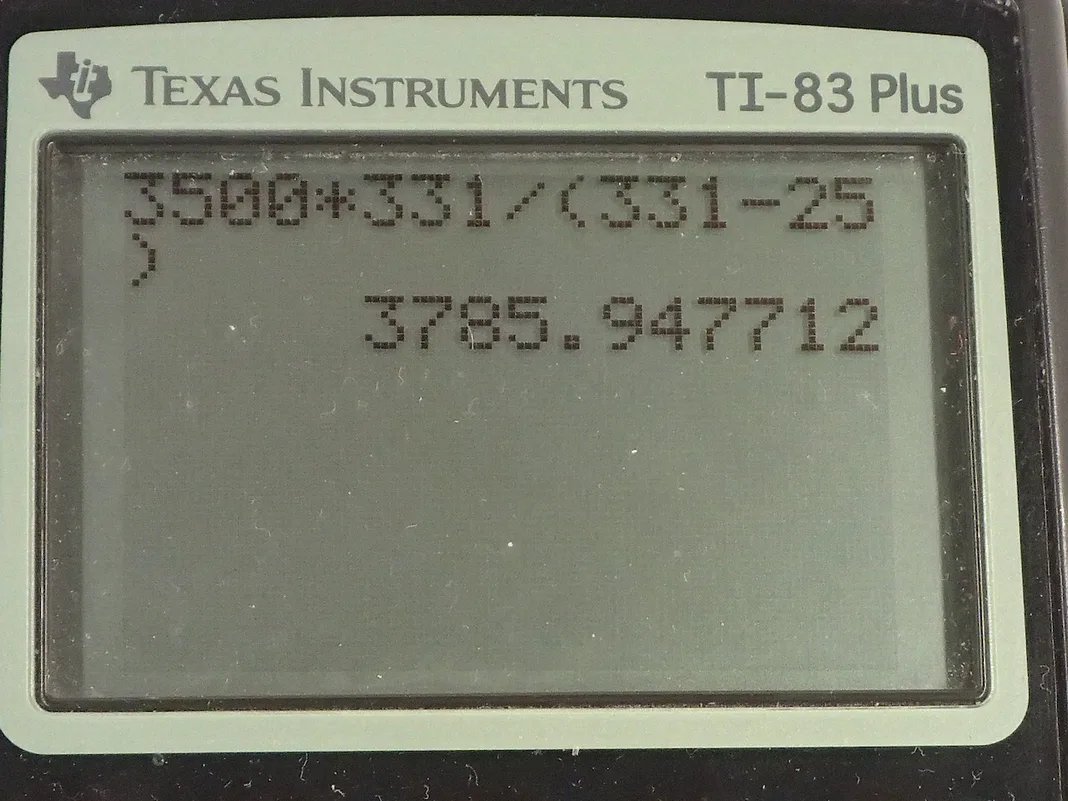
This is College Physics Answers with Shaun Dychko. The hawk is the source of the sound here and its source frequency is 3500 hertz and it's approaching this mouse at a speed of 331 meters per second and we are taking the speed of sound or the speed of the wave that's moving as 331 meters per second. So the Doppler effect formula is that the frequency observed by this poor mouse is going to be the frequency of the source, which is the hawk, times the speed of sound divided by speed of sound minus the speed of the source. So it's 3500 hertz times 331 meters per second divided by 331 minus 25.0 meters per second and that is 3.79 times 10 to the 3 hertz. And we should always do a reality check in questions like this: with the hawk approaching the mouse, we should expect the observed frequency to be higher as a result of the hawk approaching and sure enough, it is... it's 3790 hertz versus 3500 hertz.
Comments
No comments yet.