Chapter 32: Medical Application of Nuclear Physics
71 problems solved · Free preview of every solution shows how it’s started · Watch the full videos with a free 7-day trial →


Section
32.1 Diagnostics and Medical Imaging
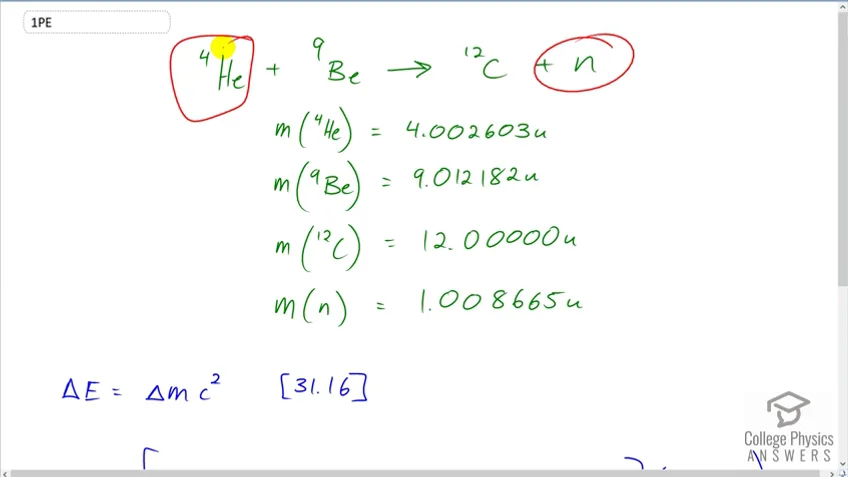 1:25Problem 1FreeA neutron generator uses an source, such as radium, to bombard beryllium, inducing the reaction . Such neutron sources are called RaBe sources, or PuBe sources if they use plutonium to get the s. Calculate the energy output of the reaction in MeV.
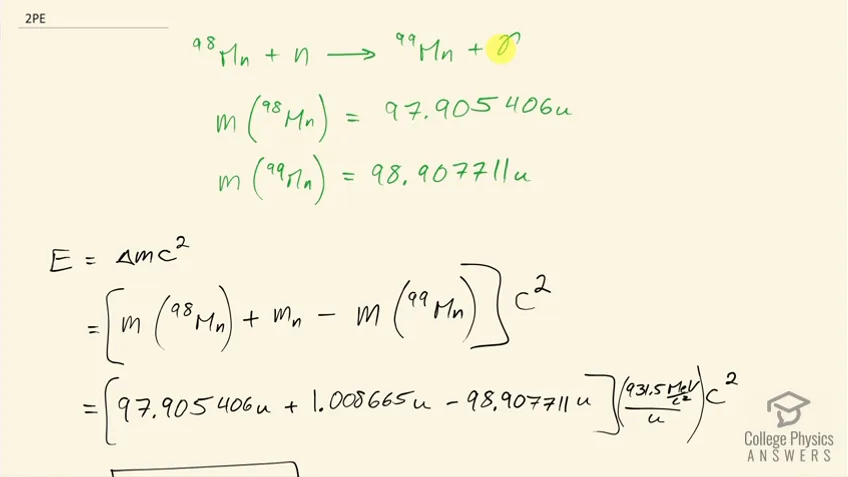 1:52PreviewProblem 2Full video with free trialNeutrons from a source (perhaps the one discussed in the x-ray series) bombard natural molybdenum, which is 24 percent . What is the energy output of the reaction ? The mass of is given in Appendix A: Atomic Masses, and that of is 98.907711 u.
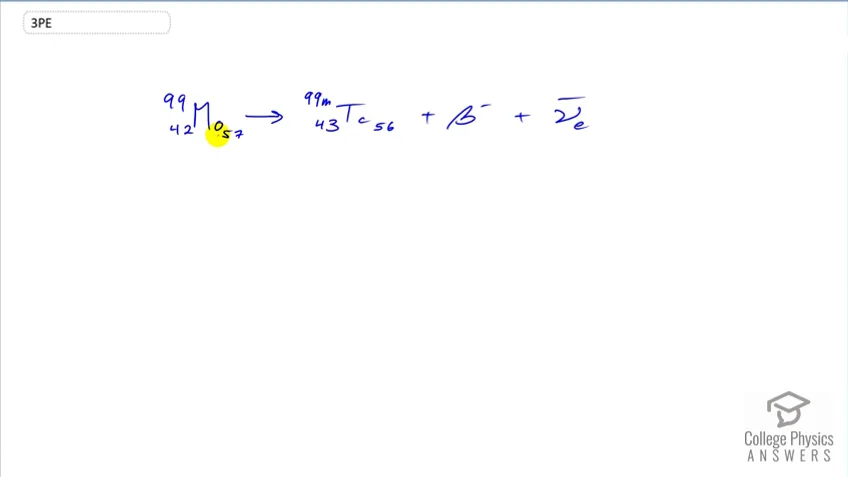 1:37PreviewProblem 3Full video with free trialThe purpose of producing (usually by neutron activation of natural molybdenum, as in the preceding problem) is to produce . Using the rules, verify that the decay of produces . (Most nuclei produced in this decay are left in a metastable excited state denoted .)
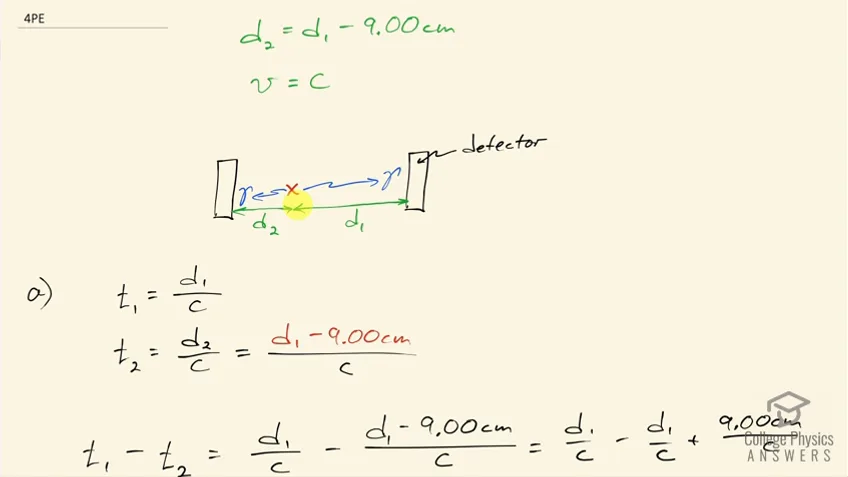 2:18PreviewProblem 4Full video with free trial(a) Two annihilation rays in a PET scan originate at the same point and travel to detectors on either side of the patient. If the point of origin is 9.00 cm closer to one of the detectors, what is the difference in arrival times of the photons? (This could be used to give position information, but the time difference is small enough to make it difficult.) (b) How accurately would you need to be able to measure arrival time differences to get a position resolution of 1.00 mm?
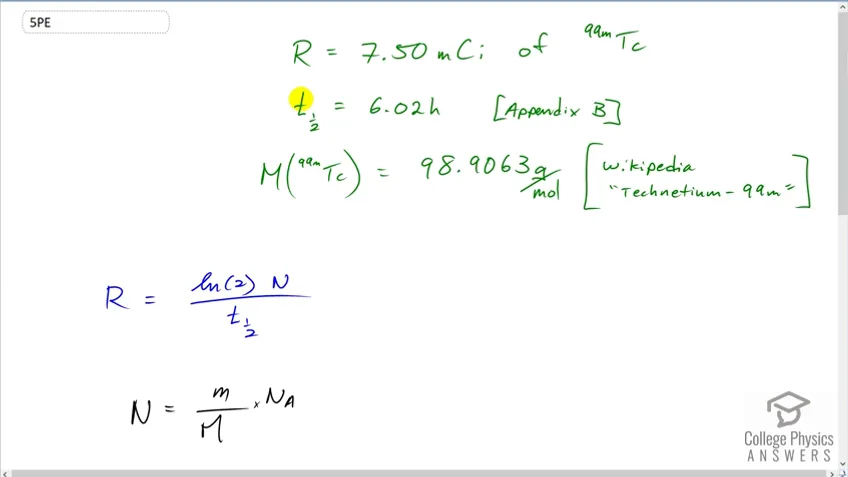 2:49PreviewProblem 5Full video with free trialTable 32.1 indicates that 7.50 mCi of is used in a brain scan. What is the mass of technetium?
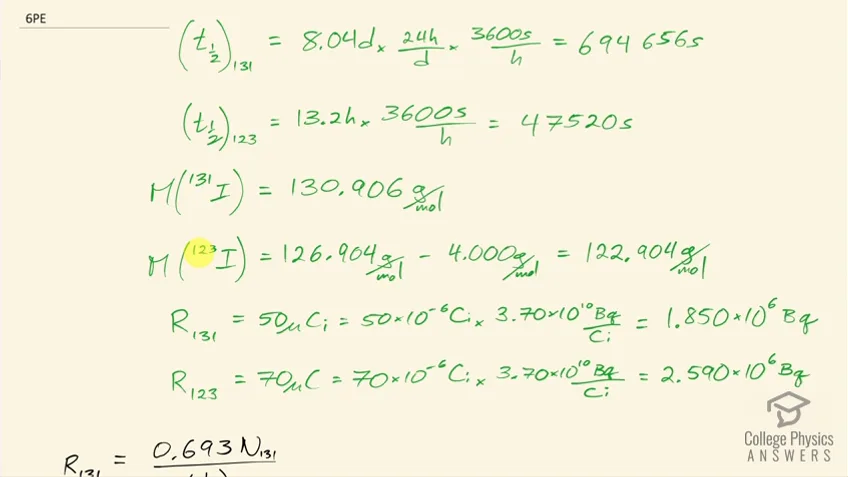 4:04PreviewProblem 6Full video with free trialThe activities of and used in thyroid scans are given in Table 32.1 to be and , respectively. Find and compare the masses of 131 I and 123 I in such scans, given their respective half-lives are 8.04 d and 13.2 h. The masses are so small that the radioiodine is usually mixed with stable iodine as a carrier to ensure normal chemistry and distribution in the body.
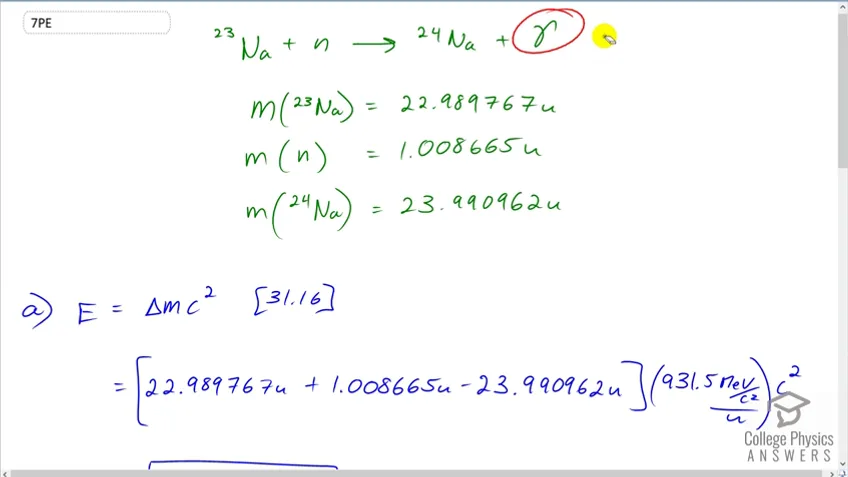 3:25PreviewProblem 7Full video with free trial(a) Neutron activation of sodium, which is 100% , produces , which is used in some heart scans, as seen in Table 32.1. The equation for the reaction is . Find its energy output, given the mass of is 23.990962 u.
32.2 Biological Effects of Ionizing Radiation
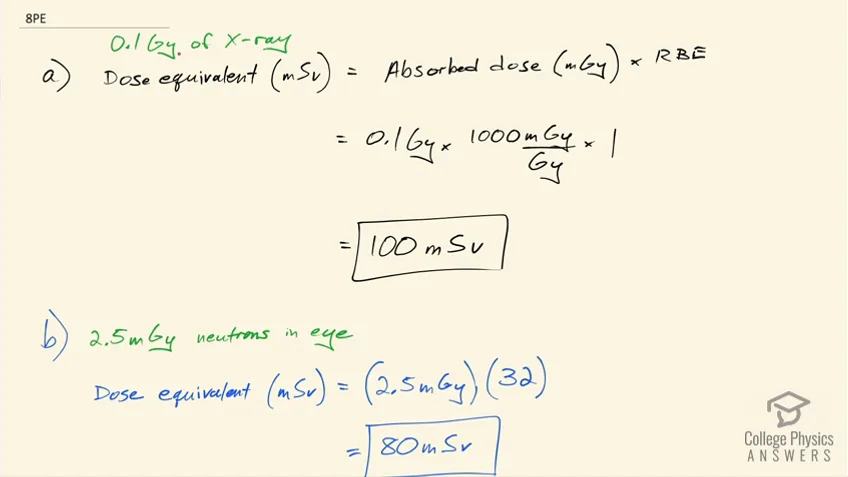 2:08PreviewProblem 8Full video with free trialWhat is the dose in mSv for: (a) a 0.1 Gy x-ray? (b) 2.5 mGy of neutron exposure to the eye? (c) 1.5 mGy of exposure?
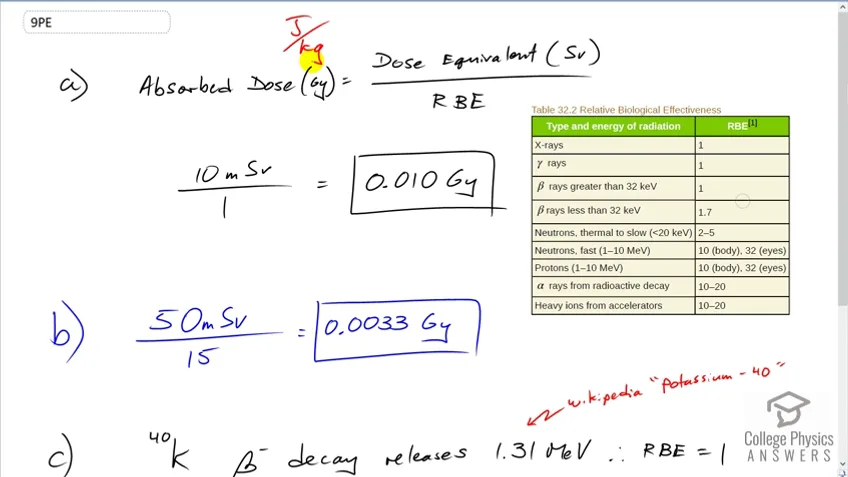 3:48PreviewProblem 9Full video with free trialFind the radiation dose in Gy for: (a) A 10-mSv fluoroscopic x-ray series. (b) 50 mSv of skin exposure by an emitter. (c) 160 mSv of and rays from the in your body.
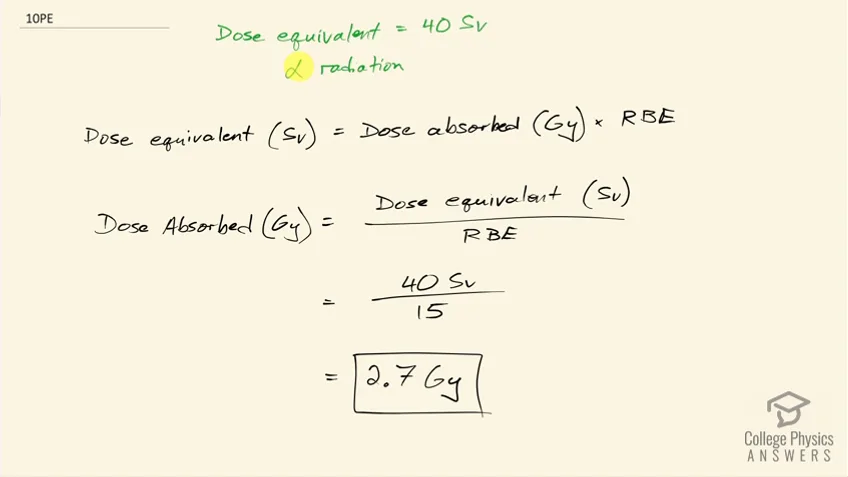 0:54PreviewProblem 10Full video with free trialHow many Gy of exposure is needed to give a cancerous tumor a dose of 40 Sv if it is exposed to activity?
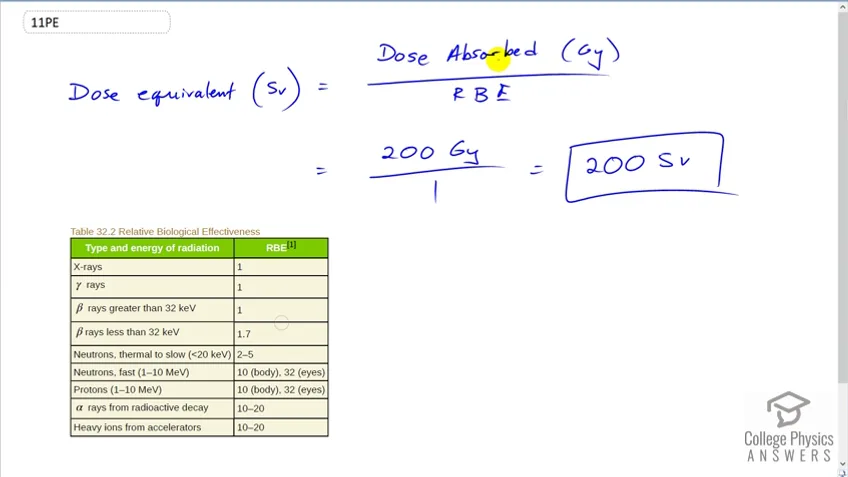 0:31PreviewProblem 11Full video with free trialWhat is the dose in Sv in a cancer treatment that exposes the patient to 200 Gy of γ rays?
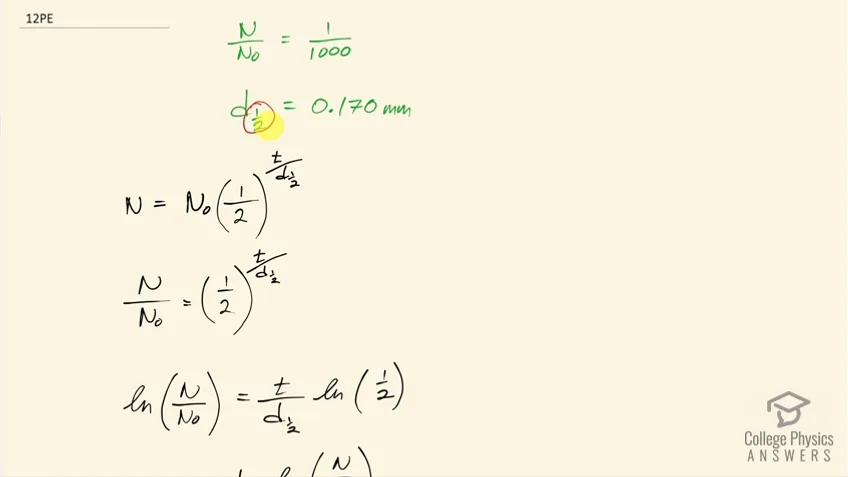 3:13PreviewProblem 12Full video with free trialOne half the rays from are absorbed by a 0.170-mm-thick lead shielding. Half of the rays that pass through the first layer of lead are absorbed in a second layer of equal thickness. What thickness of lead will absorb all but one in 1000 of these rays?
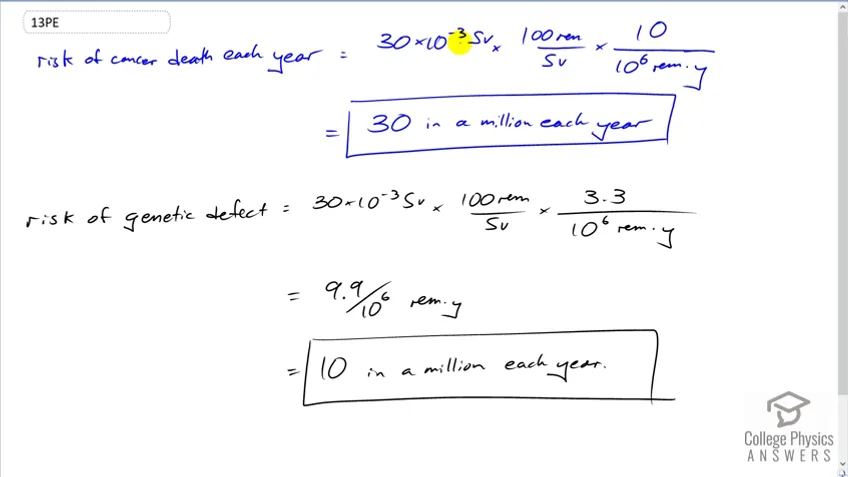 1:35PreviewProblem 13Full video with free trialA plumber at a nuclear power plant receives a whole-body dose of 30 mSv in 15 minutes while repairing a crucial valve. Find the radiation-induced yearly risk of death from cancer and the chance of genetic defect from this maximum allowable exposure.
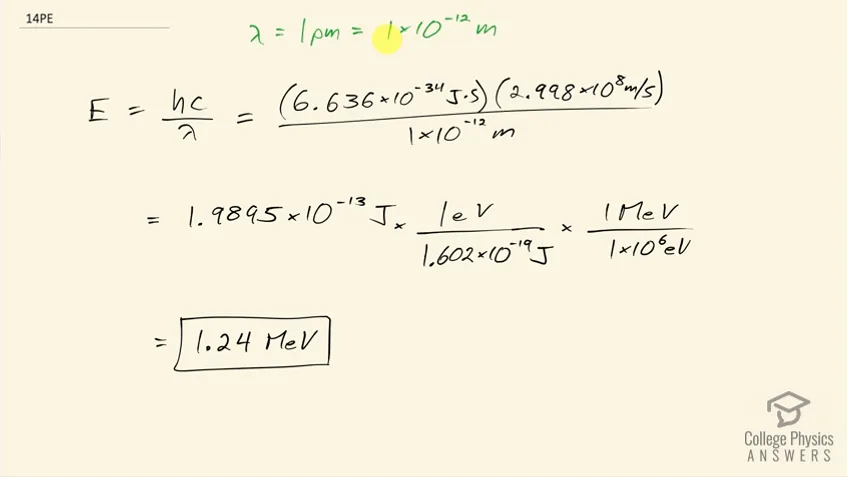 0:48PreviewProblem 14Full video with free trialIn the 1980s, the term picowave was used to describe food irradiation in order to overcome public resistance by playing on the well-known safety of microwave radiation. Find the energy in MeV of a photon having a wavelength of a picometer.
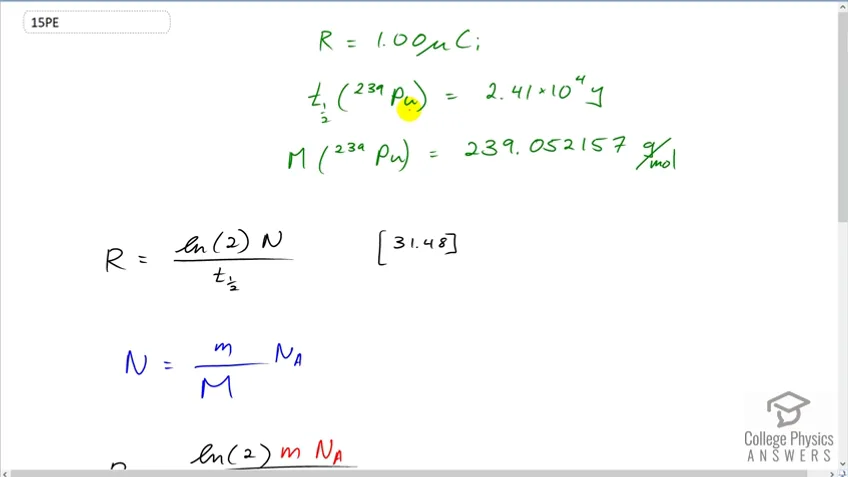 2:00PreviewProblem 15Full video with free trialFind the mass of that has an activity of .
32.3 Therapeutic Uses of Ionizing Radiation
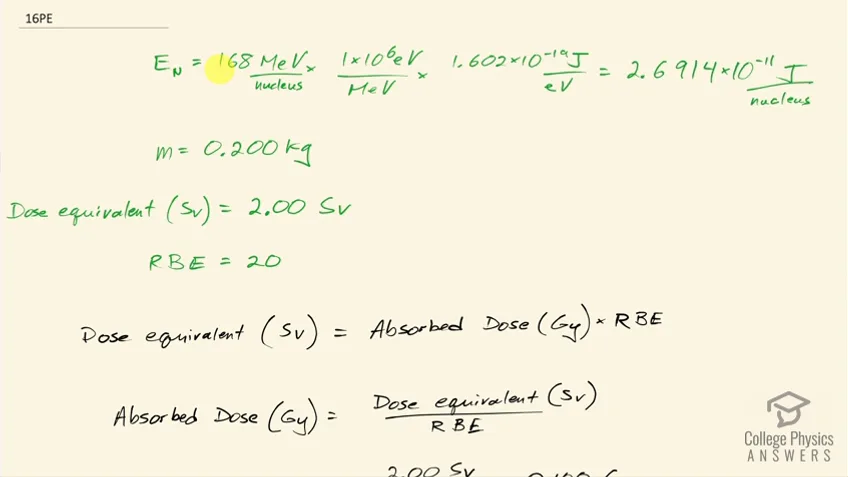 2:11PreviewProblem 16Full video with free trialA beam of 168-MeV nitrogen nuclei is used for cancer therapy. If this beam is directed onto a 0.200-kg tumor and gives it a 2.00-Sv dose, how many nitrogen nuclei were stopped? (Use an RBE of 20 for heavy ions.)
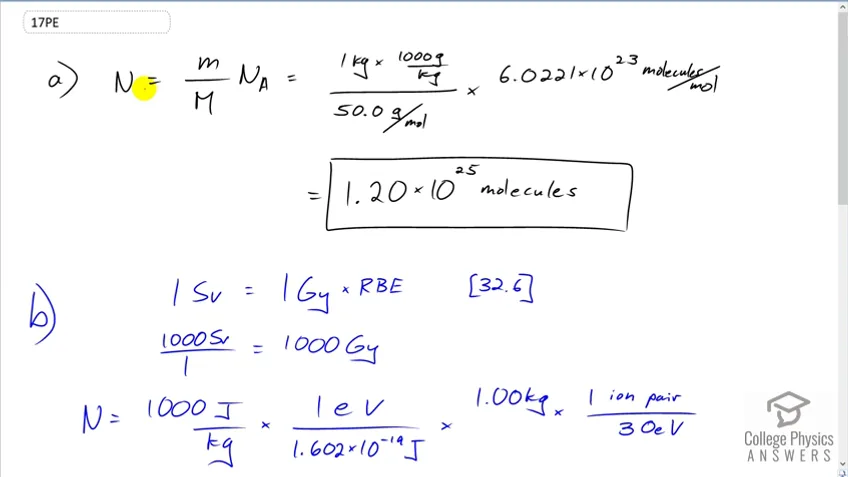 4:27PreviewProblem 17Full video with free trial(a) If the average molecular mass of compounds in food is 50.0 g, how many molecules are there in 1.00 kg of food? (b) How many ion pairs are created in 1.00 kg of food, if it is exposed to 1000 Sv and it takes 32.0 eV to create an ion pair? (c) Find the ratio of ion pairs to molecules. (d) If these ion pairs recombine into a distribution of 2000 new compounds, how many parts per billion is each?
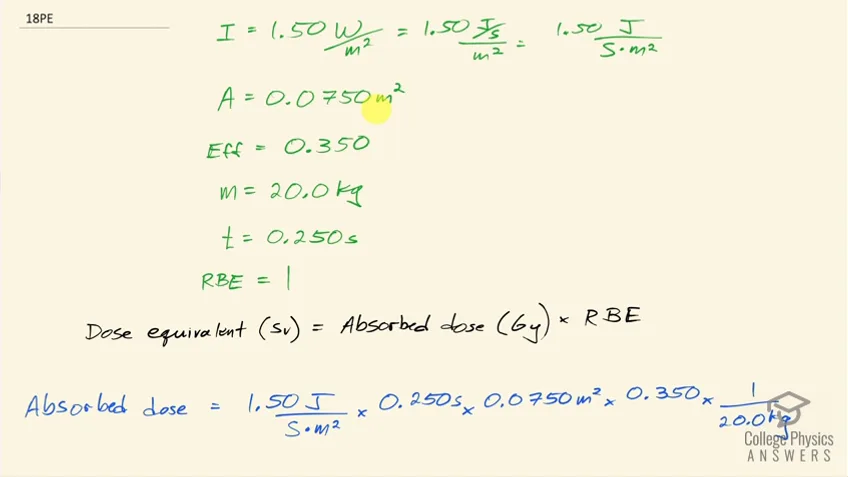 2:29PreviewProblem 18Full video with free trialCalculate the dose in Sv to the chest of a patient given an x-ray under the following conditions. The x-ray beam intensity is , the area of the chest exposed is , 35.0% of the x-rays are absorbed in 20.0 kg of tissue, and the exposure time is 0.250 s.
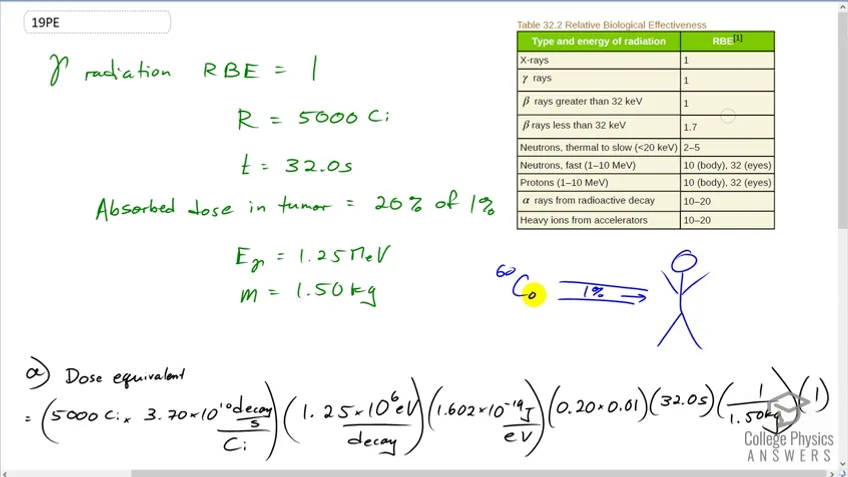 4:10PreviewProblem 19Full video with free trial(a) A cancer patient is exposed to γ rays from a 5000-Ci transillumination unit for 32.0 s. The rays are collimated in such a manner that only 1.00% of them strike the patient. Of those, 20.0% are absorbed in a tumor having a mass of 1.50 kg. What is the dose in rem to the tumor, if the average energy per decay is 1.25 MeV? None of the s from the decay reach the patient. (b) Is the dose consistent with stated therapeutic doses?
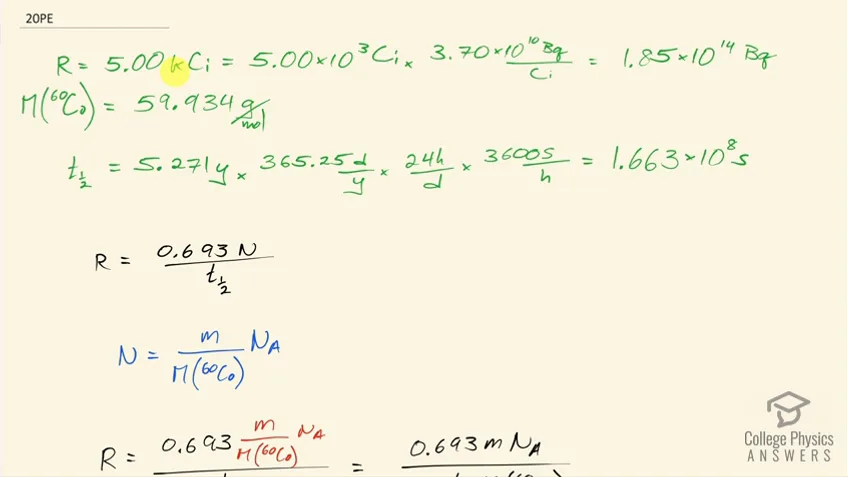 2:17PreviewProblem 20Full video with free trialWhat is the mass of in a cancer therapy transillumination unit containing 5.00 kCi of
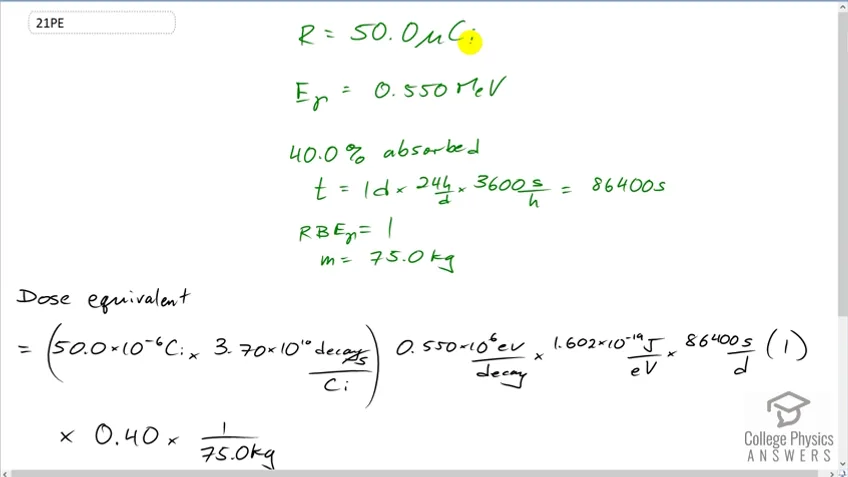 2:53PreviewProblem 21Full video with free trialLarge amounts of are produced in copper exposed to accelerator beams. While machining contaminated copper, a physicist ingests of . Each decay emits an average -ray energy of , 40.0% of which is absorbed in the scientist's 75.0 kg body. What dose in mSv is caused by this in one day?
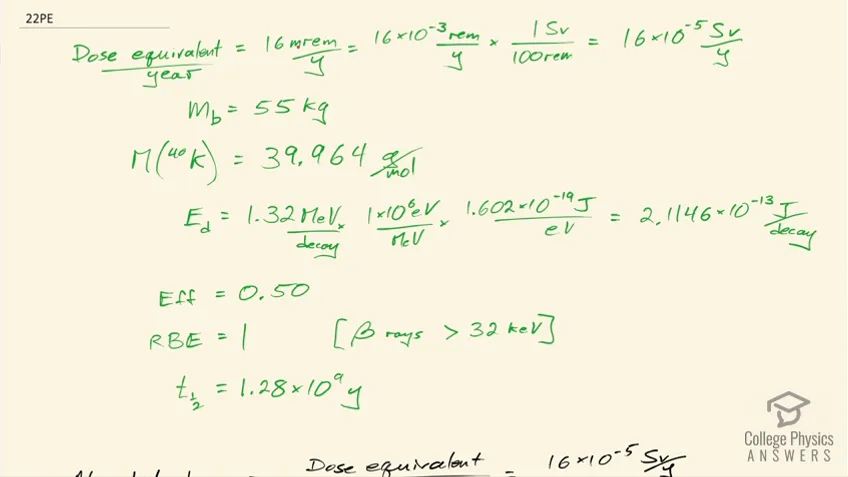 5:36PreviewProblem 22Full video with free trialNaturally occurring is listed as responsible for 16 mrem/y of background radiation. Calculate the mass of that must be inside the 55-kg body of a woman to produce this dose. Each decay emits a 1.32-MeV , and 50% of the energy is absorbed inside the body.
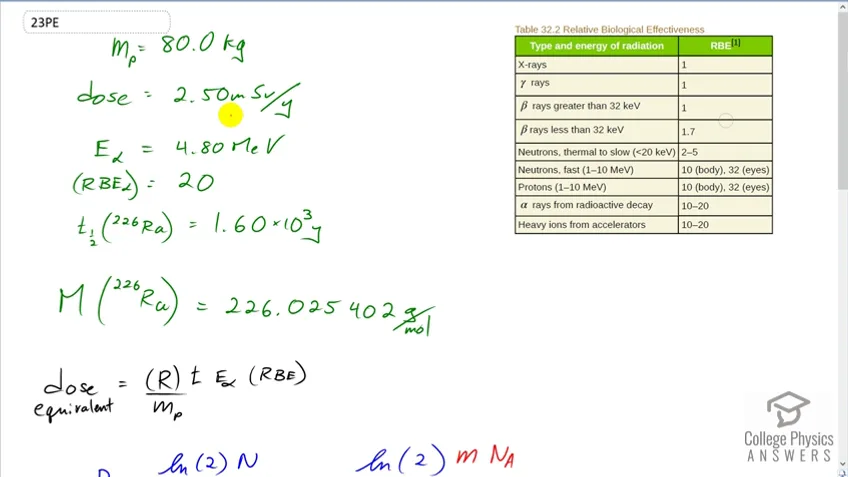 4:24PreviewProblem 23Full video with free trial(a) Background radiation due to averages only 0.01 mSv/y, but it can range upward depending on where a person lives. Find the mass of in the 80.0-kg body of a man who receives a dose of 2.50-mSv/y from it, noting that each decay emits a 4.80-MeV particle. You may neglect dose due to daughters and assume a constant amount, evenly distributed due to balanced ingestion and bodily elimination. (b) Is it surprising that such a small mass could cause a measurable radiation dose? Explain.
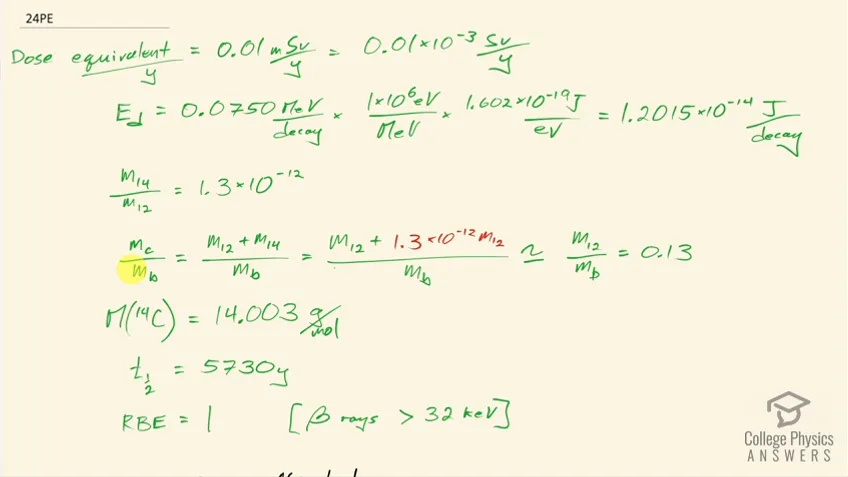 7:18PreviewProblem 24Full video with free trialThe annual radiation dose from in our bodies is 0.01 mSv/y. Each decay emits a averaging 0.0750 MeV. Taking the fraction of to be of normal , and assuming the body is 13% carbon, estimate the fraction of the decay energy absorbed. (The rest escapes, exposing those close to you.)
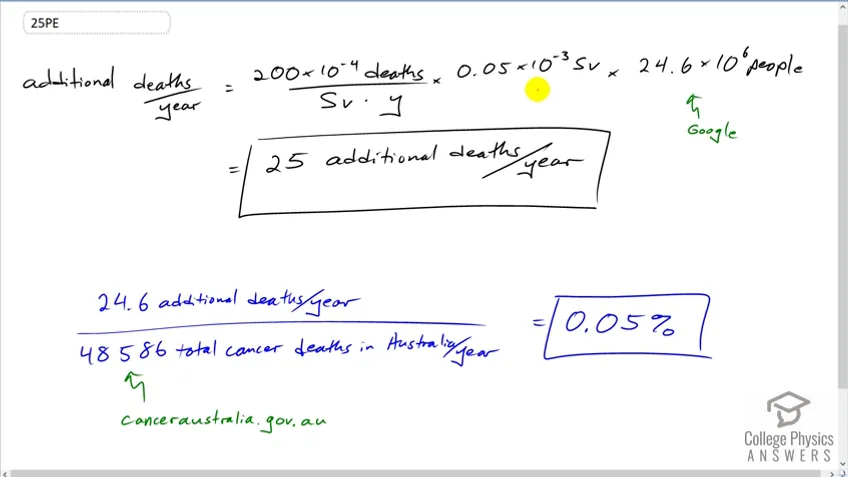 1:11PreviewProblem 25Full video with free trialIf everyone in Australia received an extra 0.05 mSv per year of radiation, what would be the increase in the number of cancer deaths per year? (Assume that time had elapsed for the effects to become apparent.) Assume that there are deaths per Sv of radiation per year. What percent of the actual number of cancer deaths recorded is this?
32.5 Fusion
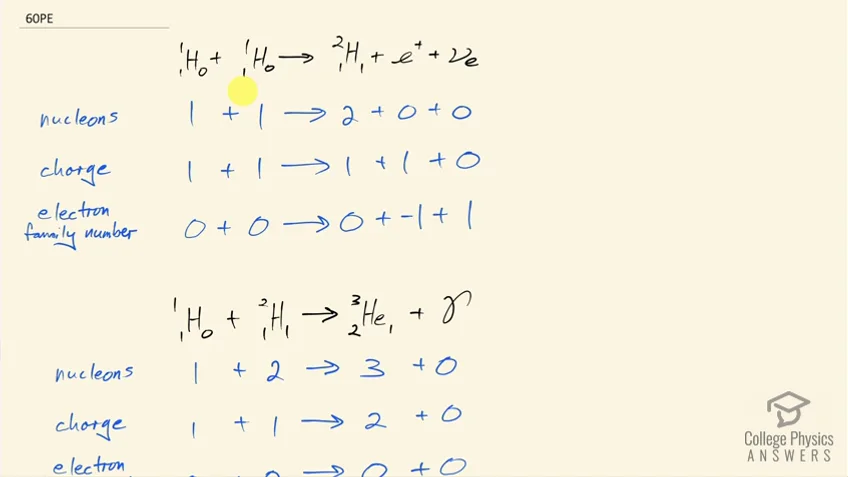 3:11PreviewProblem 26Full video with free trialVerify that the total number of nucleons, total charge, and electron family number are conserved for each of the fusion reactions in the proton-proton cycle in
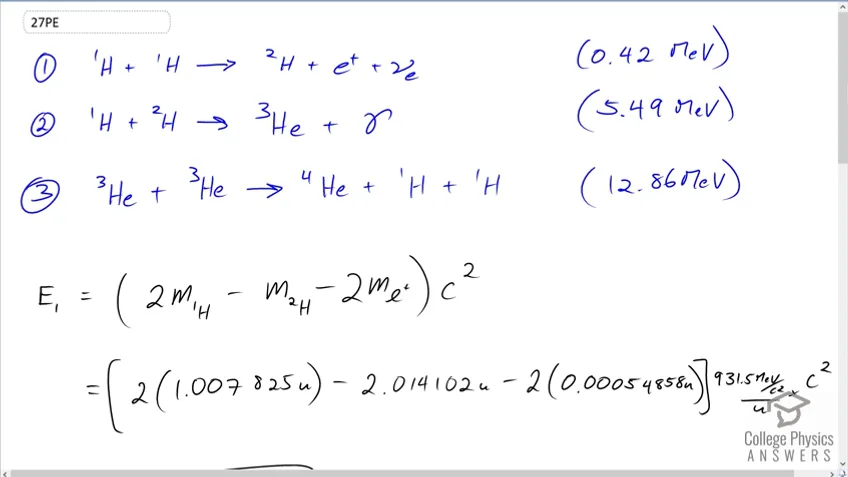 5:51PreviewProblem 27Full video with free trialCalculate the energy output in each of the fusion reactions in the proton-proton cycle, and verify the values given in the above summary.
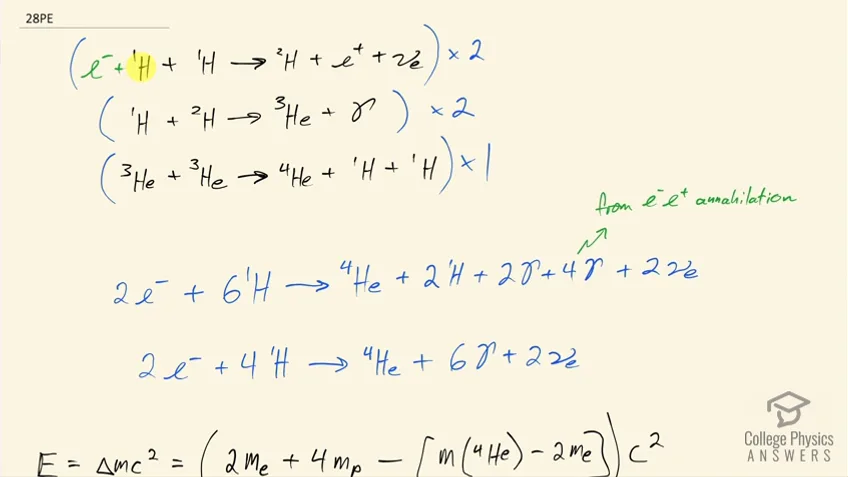 6:21PreviewProblem 28Full video with free trialShow that the total energy released in the proton-proton cycle is 26.7 MeV, considering the overall effect in
and being certain to include the annihilation energy.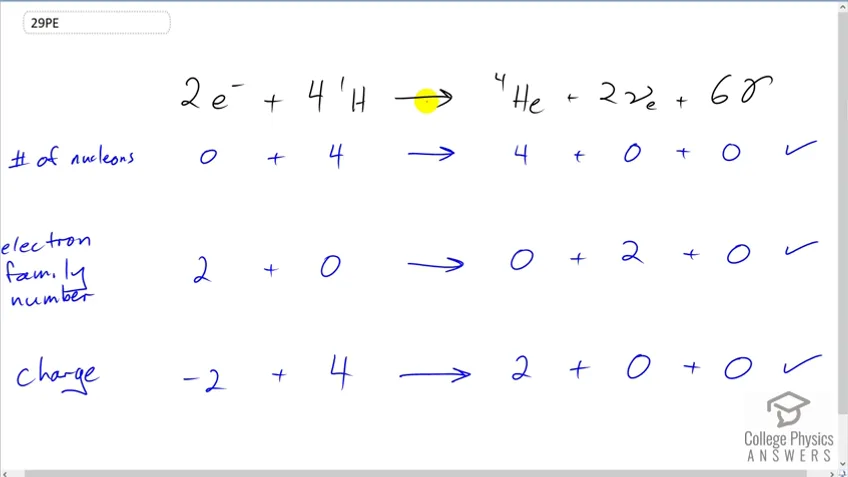 1:49PreviewProblem 29Full video with free trialVerify by listing the number of nucleons, total charge, and electron family number before and after the cycle that these quantities are conserved in the overall proton-proton cycle in .
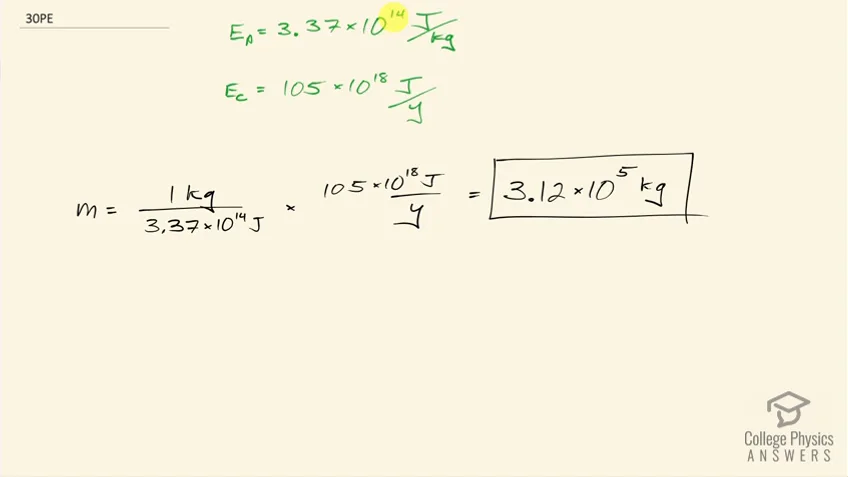 1:16PreviewProblem 30Full video with free trialThe energy produced by the fusion of a 1.00-kg mixture of deuterium and tritium was found in Example Calculating Energy and Power from Fusion. Approximately how many kilograms would be required to supply the annual energy use in the United States?
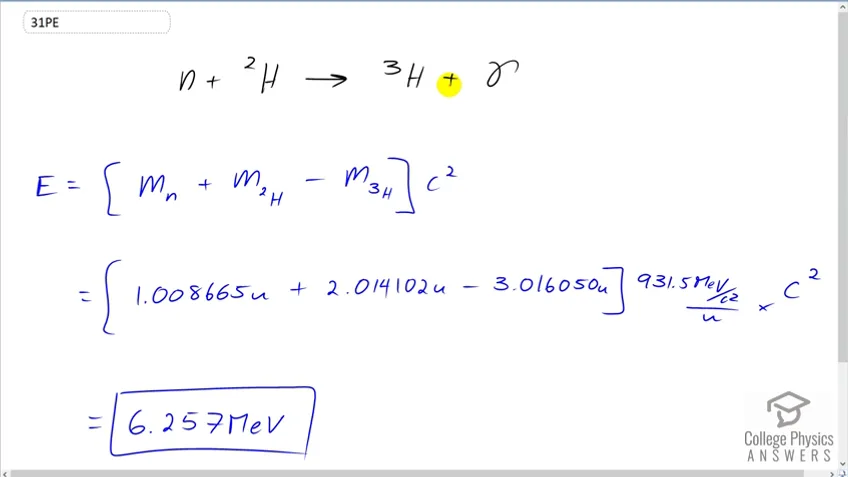 1:16PreviewProblem 31Full video with free trialTritium is naturally rare, but can be produced by the reaction . How much energy in MeV is released in this neutron capture?
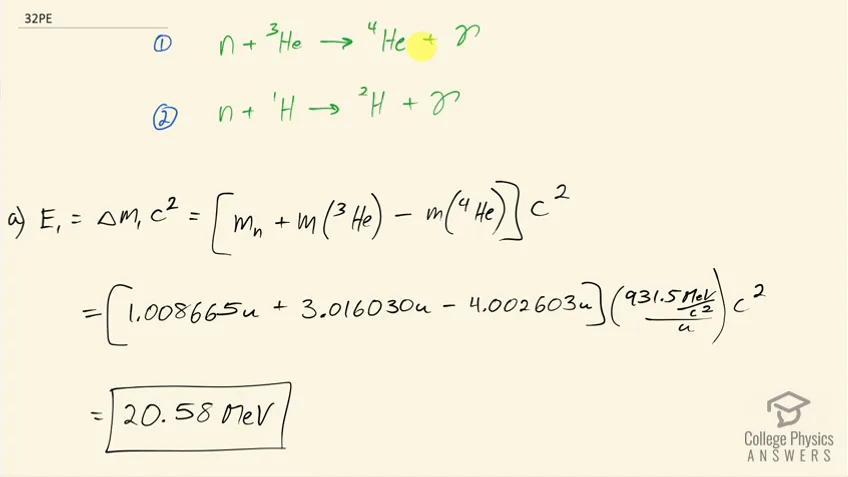 2:49PreviewProblem 32Full video with free trialTwo fusion reactions mentioned in the text are
and
Both reactions release energy, but the second also creates more fuel. Confirm that the energies produced in the reactions are 20.58 and 2.22 MeV, respectively. Comment on which product nuclide is most tightly bound, or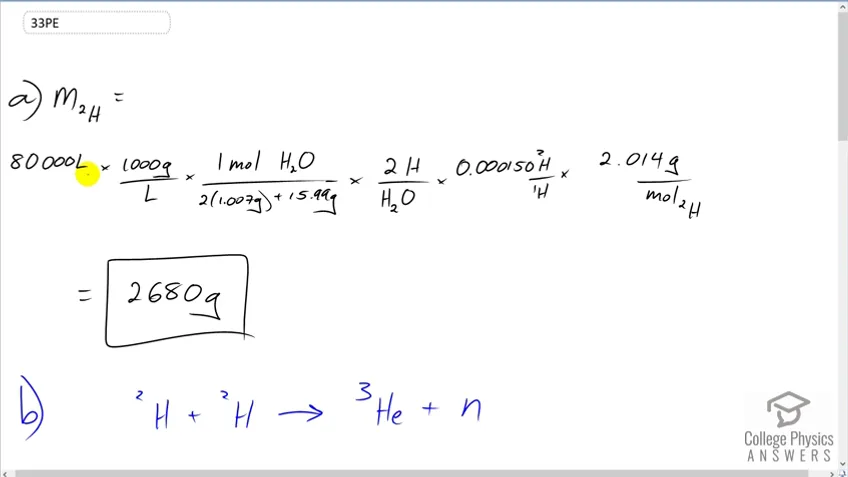 6:30PreviewProblem 33Full video with free trial(a) Calculate the number of grams of deuterium in an 80,000-L swimming pool, given deuterium is 0.0150% of natural hydrogen. (b) Find the energy released in joules if this deuterium is fused via the reaction . (c) Could the neutrons be used to create more energy? (d) Discuss the amount of this type of energy in a swimming pool as compared to that in, say, a gallon of gasoline, also taking into consideration that water is far more abundant.
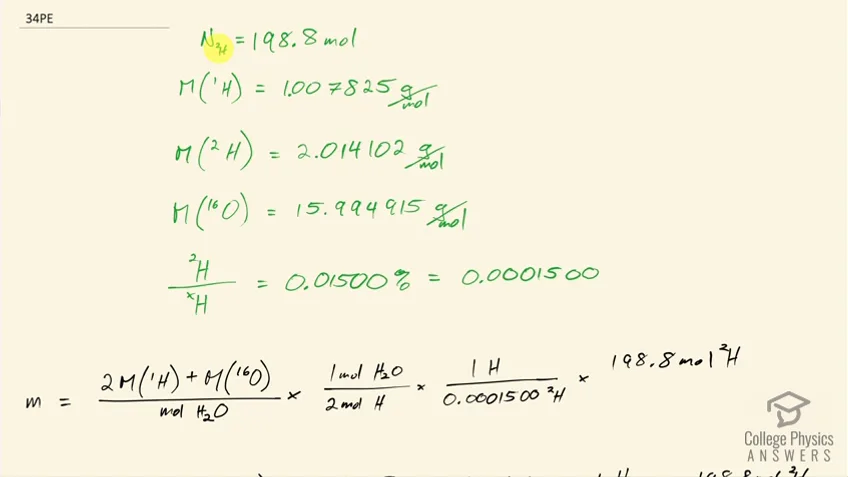 3:22PreviewProblem 34Full video with free trialHow many kilograms of water are needed to obtain the 198.8 mol of deuterium, assuming that deuterium is 0.01500% (by number) of natural hydrogen?
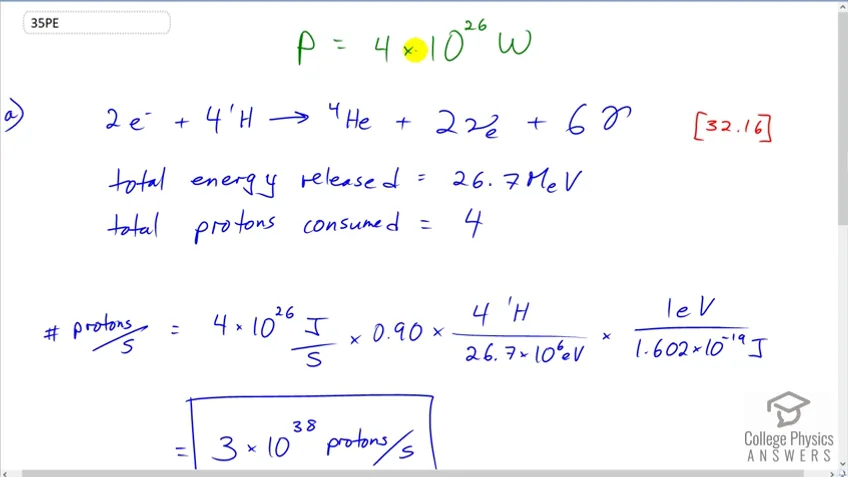 2:31PreviewProblem 35Full video with free trialThe power output of the Sun is . (a) If 90% of this is supplied by the proton-proton cycle, how many protons are consumed per second? (b) How many neutrinos per second should there be per square meter at the Earth from this process? This huge number is indicative of how rarely a neutrino interacts, since large detectors observe very few per day.
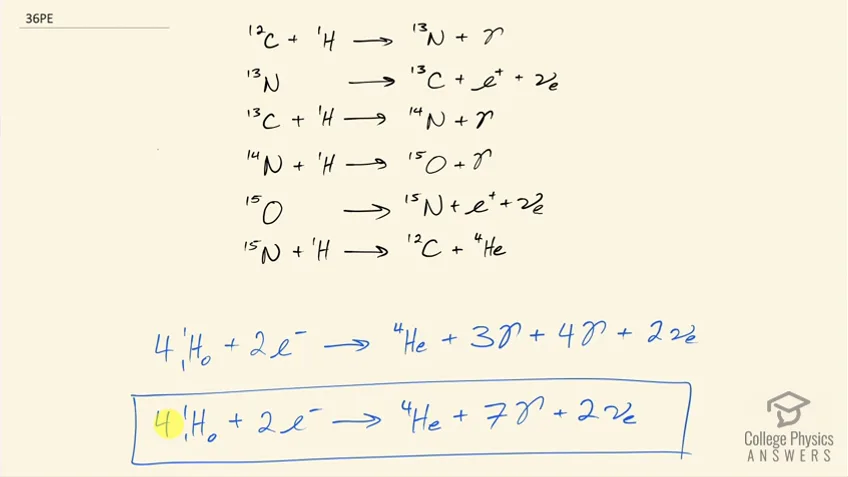 3:11PreviewProblem 36Full video with free trialAnother set of reactions that result in the fusing of hydrogen into helium in the Sun and especially in hotter stars is called the carbon cycle. It is
Write down the overall effect of hte carbon cycle (as was done for the proton-proton cycle in ). Note the number of protons () required and assume that the positrons () annihilate electrons to form more rays.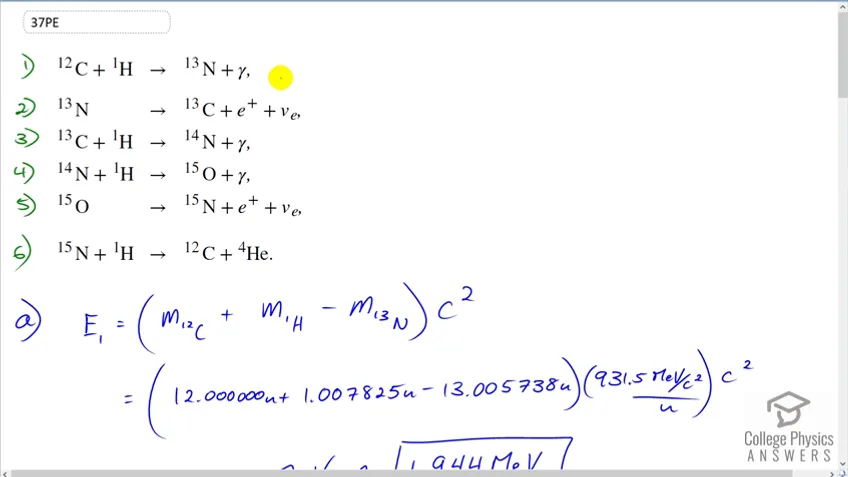 7:32PreviewProblem 37Full video with free trial(a) Find the total energy released in MeV in each carbon cycle (elaborated below) including the annihilation energy. (b) How does this compare with the proton-proton cycle output?
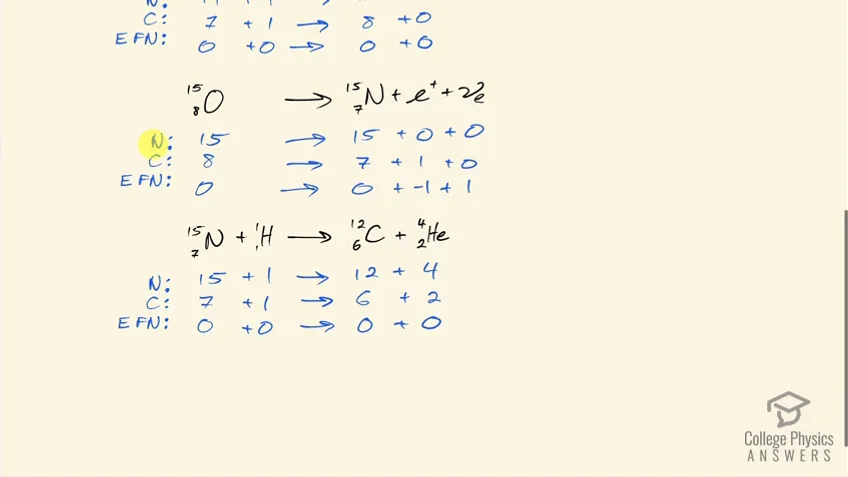 3:40PreviewProblem 38Full video with free trialVerify that the total number of nucleons, total charge, and electron family number are conserved for each of the fusion reactions in the carbon cycle given in the above problem. (List the value of each of the conserved quantities before and after each of the reactions.)
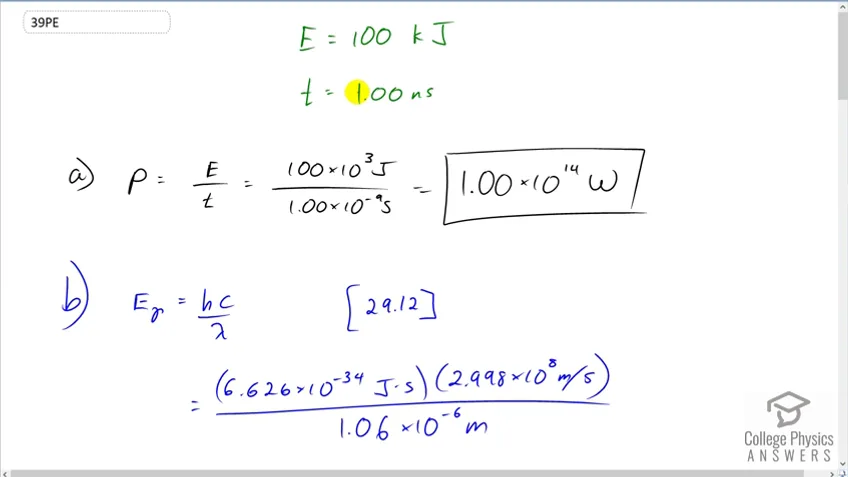 5:03PreviewProblem 39Full video with free trialThe laser system tested for inertial confinement can produce a 100-kJ pulse only 1.00 ns in duration. (a) What is the power output of the laser system during the brief pulse? (b) How many photons are in the pulse, given their wavelength is 1.06 μm? (c) What is the total momentum of all these photons? (d) How does the total photon momentum compare with that of a single 1.00 MeV deuterium nucleus?
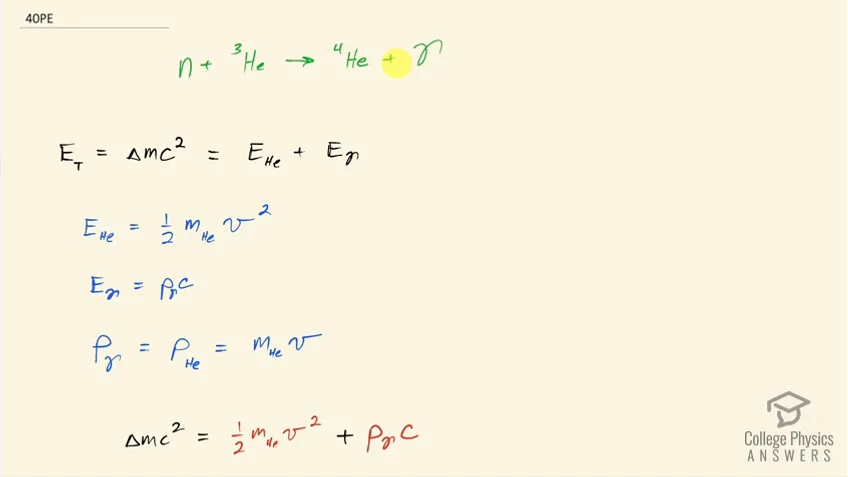 7:20PreviewProblem 40Full video with free trialFind the amount of energy given to the nucleus and to the ray in the reaction , using the conservation of momentum principle and taking the reactants to be initially at rest. This should confirm the contention that most of the energy goes to the ray.
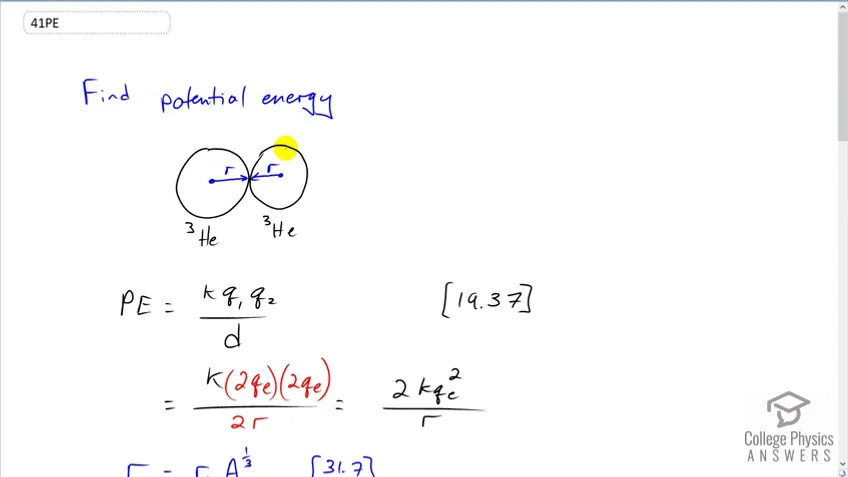 3:37PreviewProblem 41Full video with free trial(a) What temperature gas would have atoms moving fast enough to bring two nuclei into contact? Note that, because both are moving, the average kinetic energy only needs to be half the electric potential energy of these doubly charged nuclei when just in contact with one another. (b) Does this high temperature imply practical difficulties for doing this in controlled fusion?
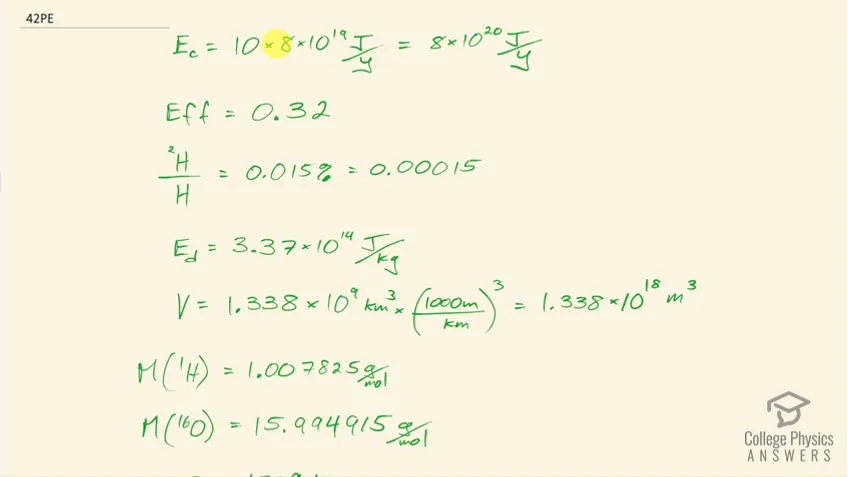 5:52PreviewProblem 42Full video with free trial(a) Estimate the years that the deuterium fuel in the oceans could supply the energy needs of the world. Assume world energy consumption to be ten times that of the United States which is and that the deuterium in the oceans could be converted to energy with an efficiency of 32%. You must estimate or look up the amount of water in the oceans and take the deuterium content to be 0.015% of natural hydrogen to find the mass of deuterium available. Note that approximate energy yield of deuterium is . (b) Comment on how much time this is by any human measure. (It is not an unreasonable result, only an impressive one.)
32.6 Fission
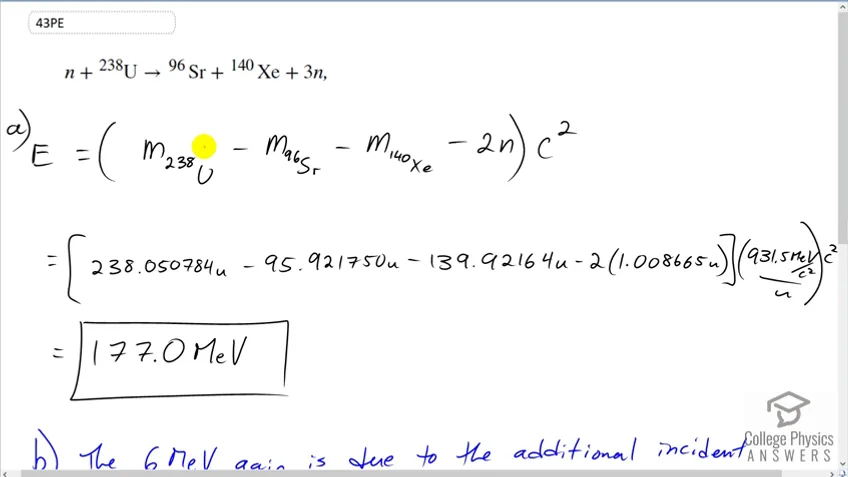 2:24PreviewProblem 43Full video with free trial(a) Calculate the energy released in the neutron-induced fission (similar to the spontaneous fission in Example 32.3 where
given that and . (b) This result is about 6 MeV greater than the result for spontaneous fission. Why? (c) Confirm that the total number of nucleons and total charge are conserved in this reaction.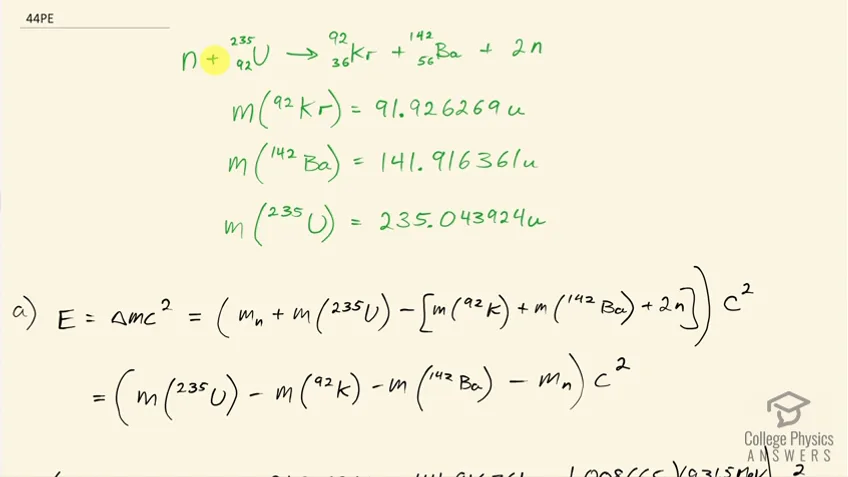 2:22PreviewProblem 44Full video with free trial(a) Calculate the energy released in the neutron-induced fission reaction given and . (b) Confirm that the total number of nucleons and total charge are conserved in this reaction.
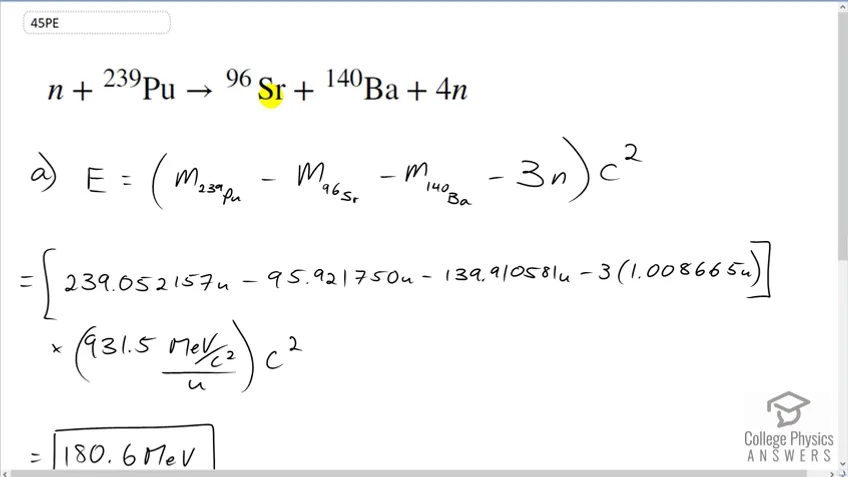 1:46PreviewProblem 45Full video with free trial(a) Calculate the energy released in the neutron-induced fission reaction
given that and . (b) Confirm that the total number of nucleons and total charge are conserved in this reaction.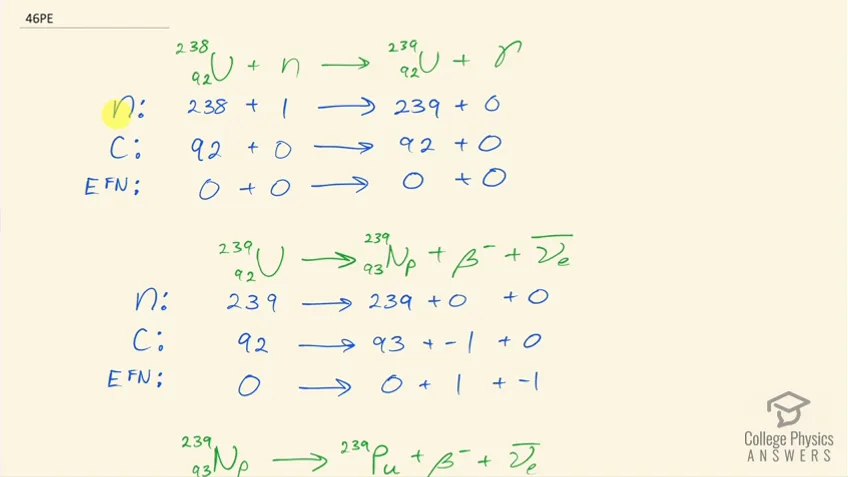 2:33PreviewProblem 46Full video with free trialConfirm that each of the reactions listed for plutonium breeding just following Example 32.4 conserves the total number of nucleons, the total charge, and electron family number.
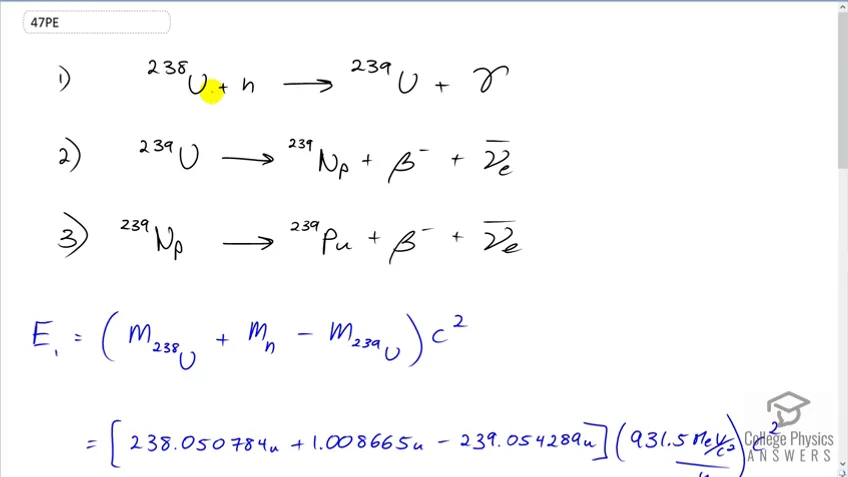 1:44PreviewProblem 47Full video with free trialBreeding plutonium produces energy even before any plutonium is fissioned. (The primary purpose of the four nuclear reactors at Chernobyl was breeding plutonium for weapons. Electrical power was a by-product used by the civilian population.) Calculate the energy produced in each of the reactions listed for plutonium breeding just following Example 32.4. The pertinent masses are , , and .
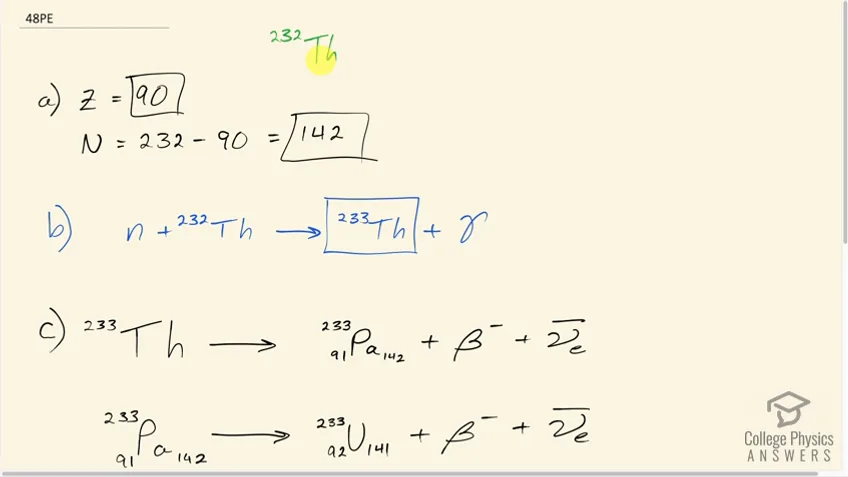 3:04PreviewProblem 48Full video with free trialThe naturally occurring radioactive isotope does not make good fission fuel, because it has an even number of neutrons; however, it can be bred into a suitable fuel (much as is bred into ). (a) What are and for (b) Write the reaction equation for neutron capture by and identify the nuclide produced in . (c) The product nucleus decays, as does its daughter. Write the decay equations for each, and identify the final nucleus. (d) Confirm that the final nucleus has an odd number of neutrons, making it a better fission fuel. (e) Look up the half-life of the final nucleus to see if it lives long enough to be a useful fuel.
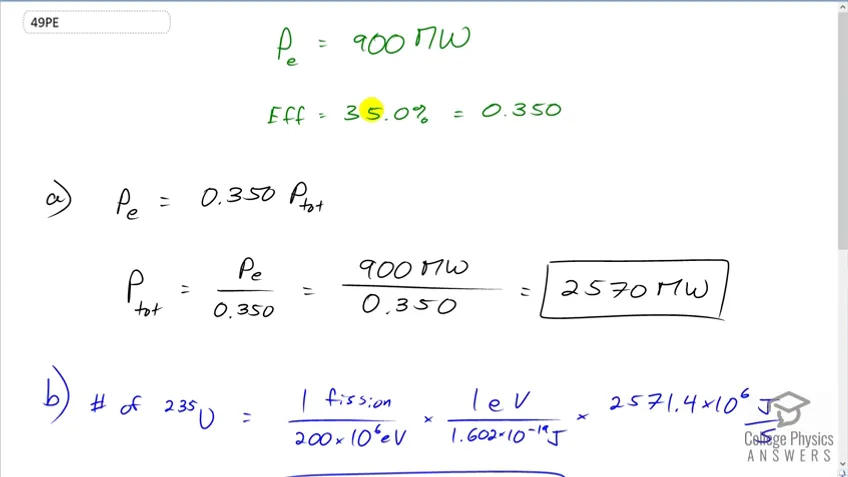 2:47PreviewProblem 49Full video with free trialThe electrical power output of a large nuclear reactor facility is 900 MW. It has a 35.0% efficiency in converting nuclear power to electrical. (a) What is the thermal nuclear power output in megawatts? (b) How many nuclei fission each second, assuming the average fission produces 200 MeV? (c) What mass of is fissioned in one year of full-power operation?
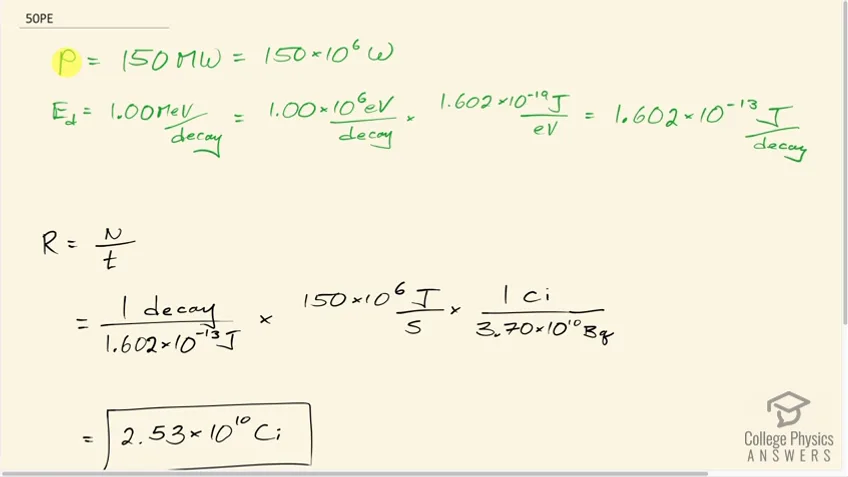 1:38PreviewProblem 50Full video with free trialA large power reactor that has been in operation for some months is turned off, but residual activity in the core still produces 150 MW of power. If the average energy per decay of the fission products is 1.00 MeV, what is the core activity in curies?
32.7 Nuclear Weapons
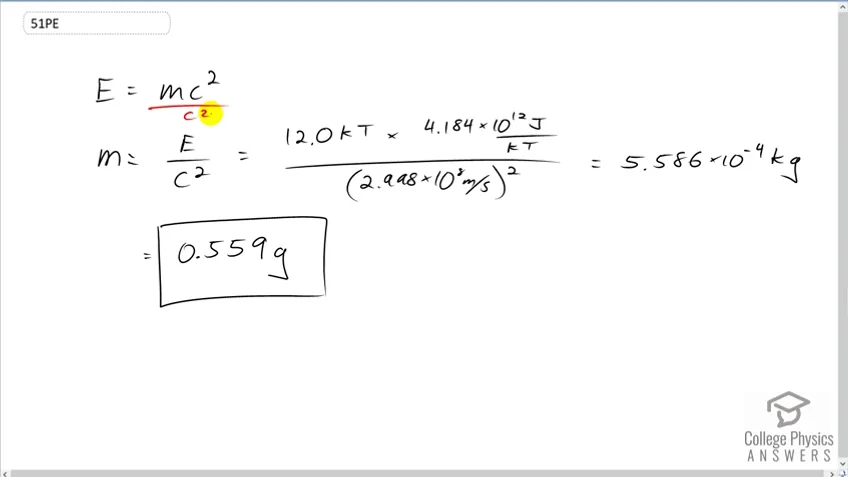 0:33PreviewProblem 51Full video with free trialFind the mass converted into energy by a 12.0-kT bomb.
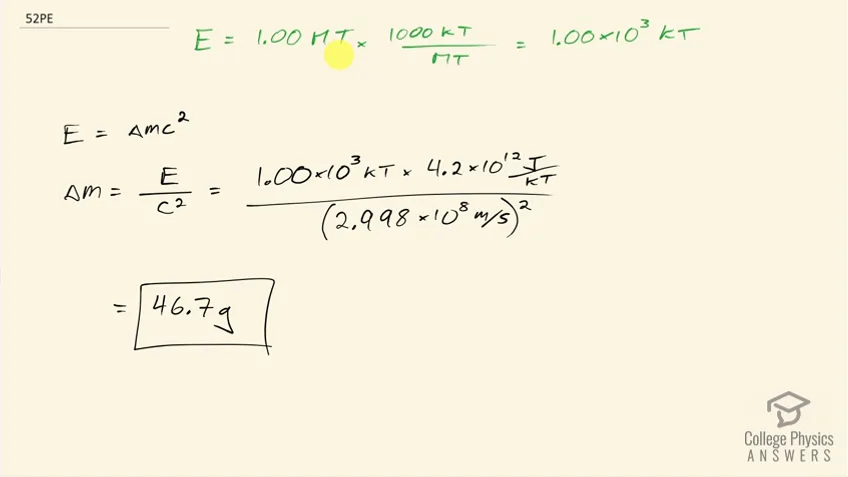 0:49PreviewProblem 52Full video with free trialWhat mass is converted into energy by a 1.00-MT bomb?
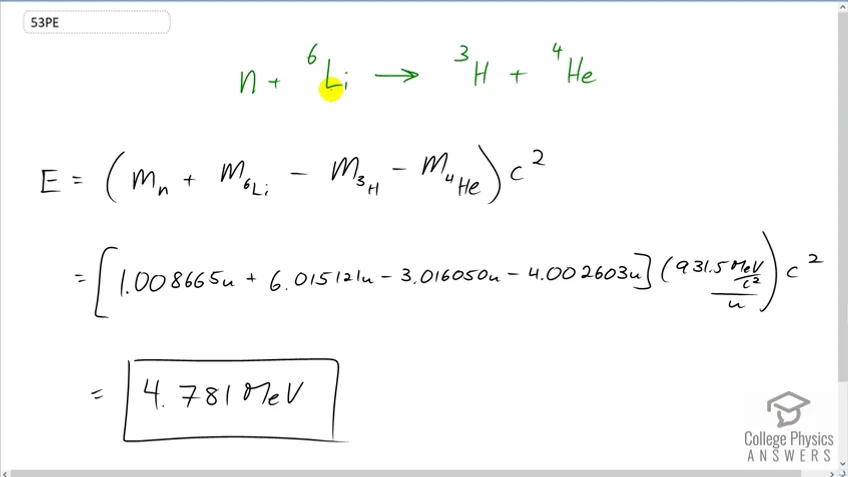 1:18PreviewProblem 53Full video with free trialFusion bombs use neutrons from their fission trigger to create tritium fuel in the reaction . What is the energy released by this reaction in MeV?
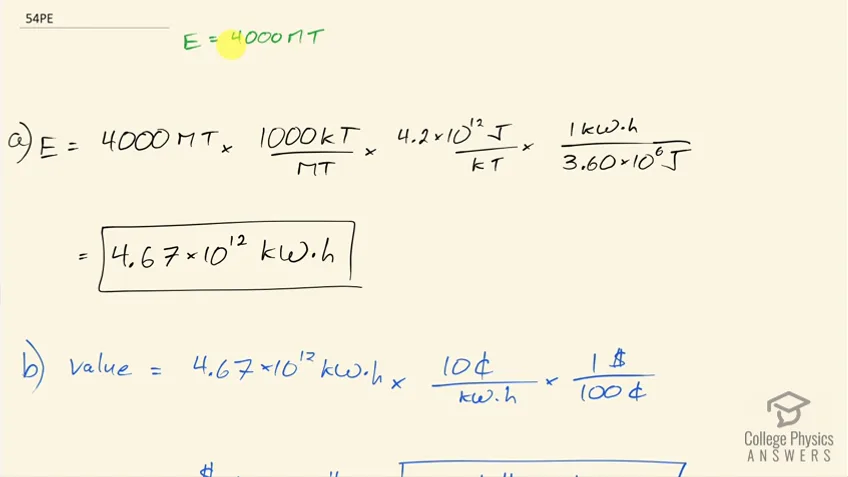 1:08PreviewProblem 54Full video with free trialIt is estimated that the total explosive yield of all the nuclear bombs in existence currently is about 4,000 MT. (a) Convert this amount of energy to kilowatt-hours, noting that . (b) What would the monetary value of this energy be if it could be converted to electricity costing 10 cents per ?
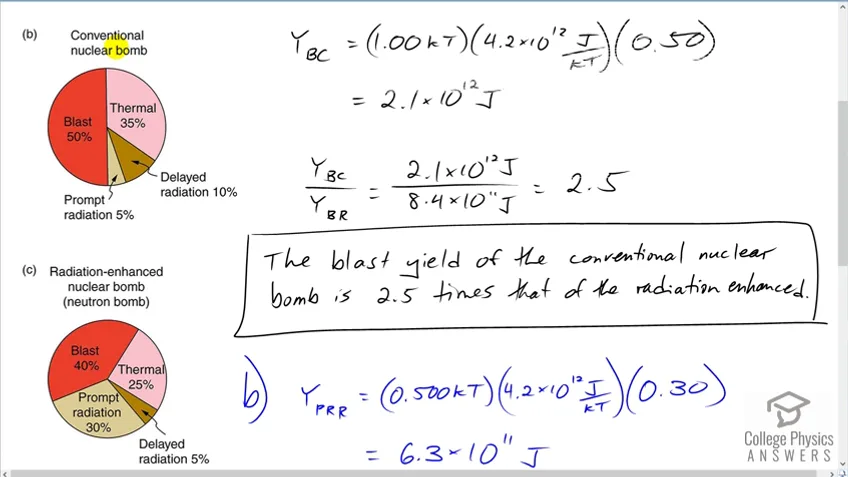 3:36PreviewProblem 55Full video with free trialA radiation-enhanced nuclear weapon (or neutron bomb) can have a smaller total yield and still produce more prompt radiation than a conventional nuclear bomb. This allows the use of neutron bombs to kill nearby advancing enemy forces with radiation without blowing up your own forces with the blast. For a 0.500-kT radiation-enhanced weapon and a 1.00-kT conventional nuclear bomb: (a) Compare the blast yields. (b) Compare the prompt radiation yields.
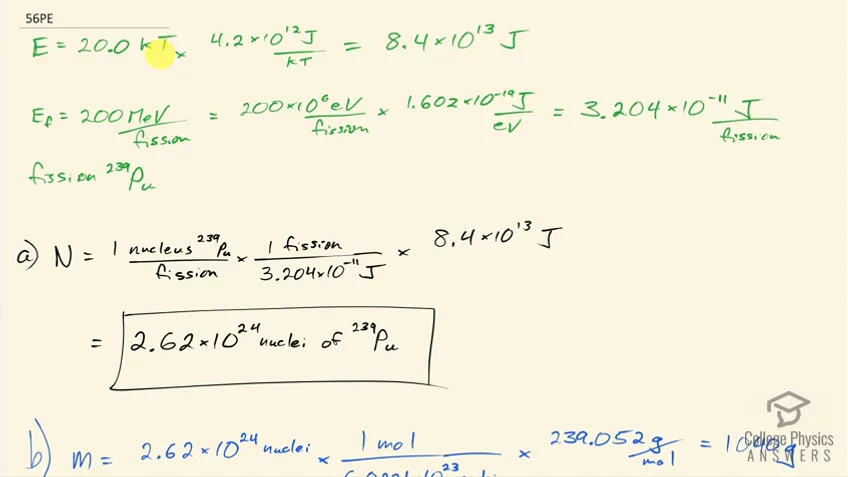 1:37PreviewProblem 56Full video with free trial(a) How many nuclei must fission to produce a 20.0-kT yield, assuming 200 MeV per fission? (b) What is the mass of this much ?
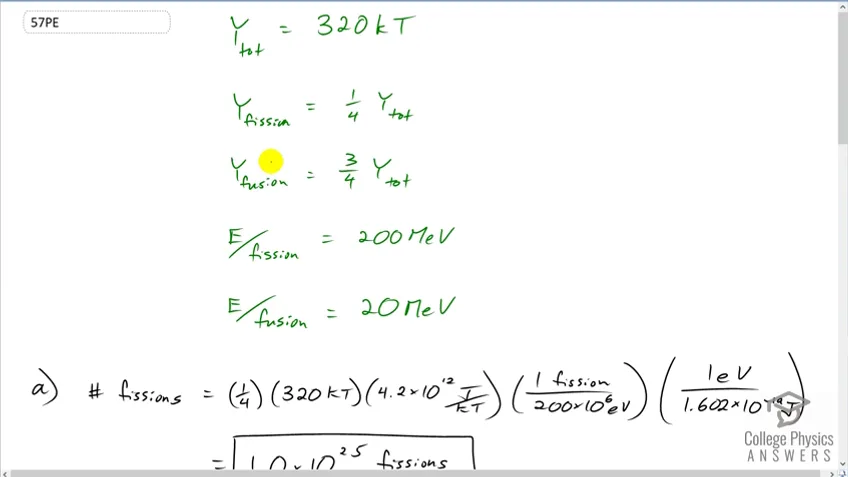 3:45PreviewProblem 57Full video with free trialAssume one-fourth of the yield of a typical 320-kT strategic bomb comes from fission reactions averaging 200 MeV and the remainder from fusion reactions averaging 20 MeV. (a) Calculate the number of fissions and the approximate mass of uranium and plutonium fissioned, taking the average atomic mass to be 238. (b) Find the number of fusions and calculate the approximate mass of fusion fuel, assuming an average total atomic mass of the two nuclei in each reaction to be 5. (c) Considering the masses found, does it seem reasonable that some missiles could carry 10 warheads? Discuss, noting that the nuclear fuel is only a part of the mass of a warhead.
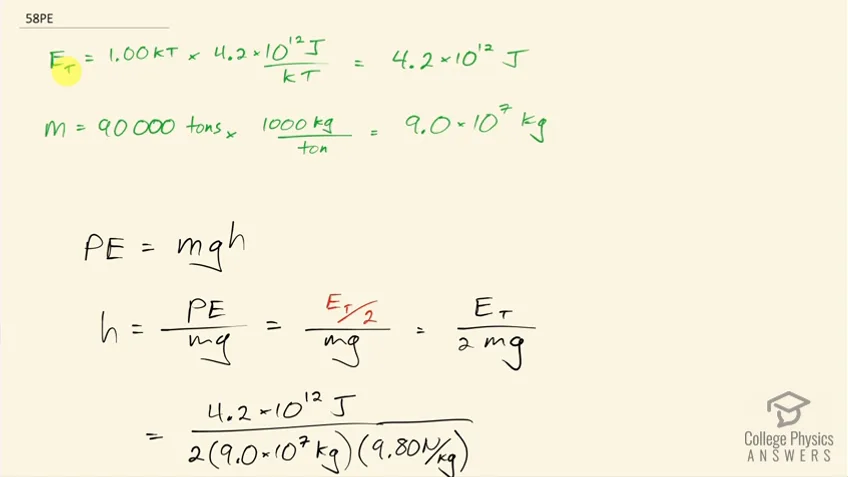 1:23PreviewProblem 58Full video with free trialThis problem gives some idea of the magnitude of the energy yield of a small tactical bomb. Assume that half the energy of a 1.00-kT nuclear depth charge set off under an aircraft carrier goes into lifting it out of the water—that is, into gravitational potential energy. How high is the carrier lifted if its mass is 90,000 tons?
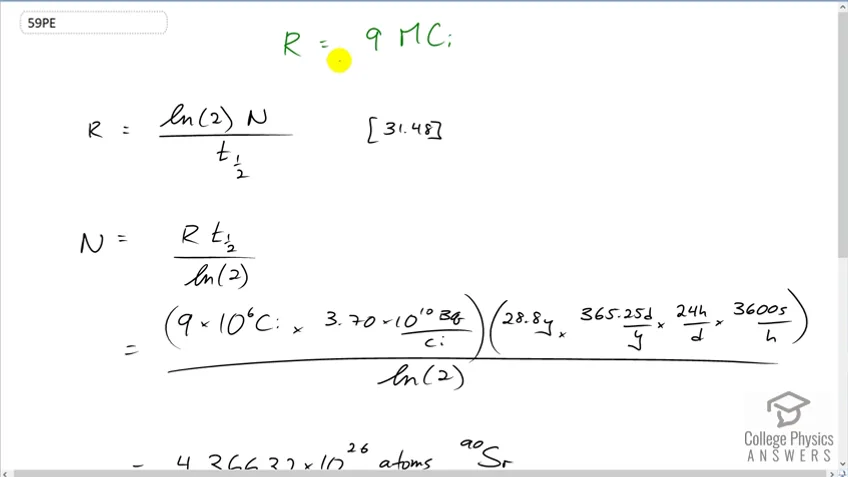 1:59PreviewProblem 59Full video with free trialIt is estimated that weapons tests in the atmosphere have deposited approximately 9 MCi of on the surface of the earth. Find the mass of this amount of .
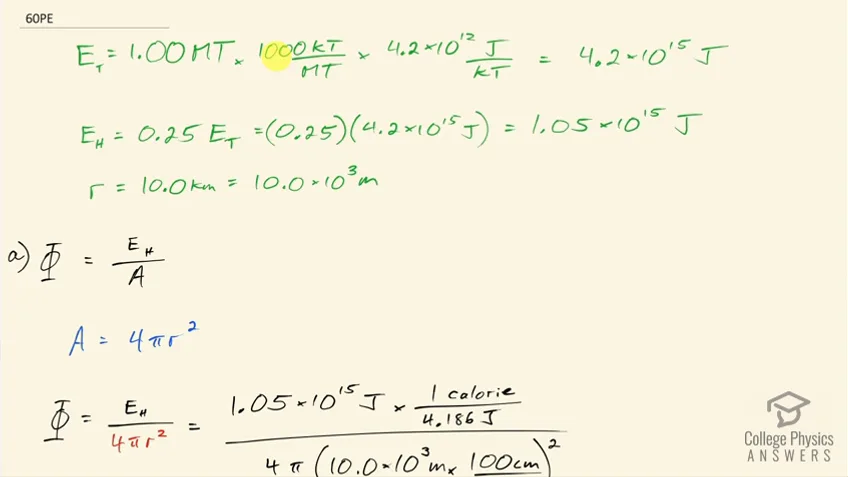 4:59PreviewProblem 60Full video with free trialA 1.00-MT bomb exploded a few kilometers above the ground deposits 25.0% of its energy into radiant heat. (a) Find the calories per at a distance of 10.0 km by assuming a uniform distribution over a spherical surface of that radius. (b) If this heat falls on a person's body, what temperature increase does it cause in the affected tissue, assuming it is absorbed in a layer 1.00-cm deep?
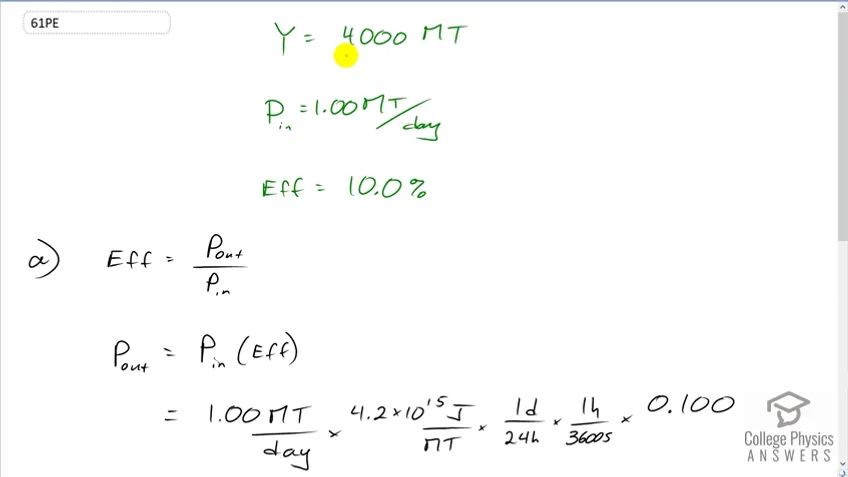 2:18PreviewProblem 61Full video with free trialOne scheme to put nuclear weapons to nonmilitary use is to explode them underground in a geologically stable region and extract the geothermal energy for electricity production. There was a total yield of about 4,000 MT in the combined arsenals in 2006. If 1.00 MT per day could be converted to electricity with an efficiency of 10.0%: (a) What would the average electrical power output be? (b) How many years would the arsenal last at this rate?
Test Prep for AP® Courses
32.2 Biological Effects of Ionizing Radiation
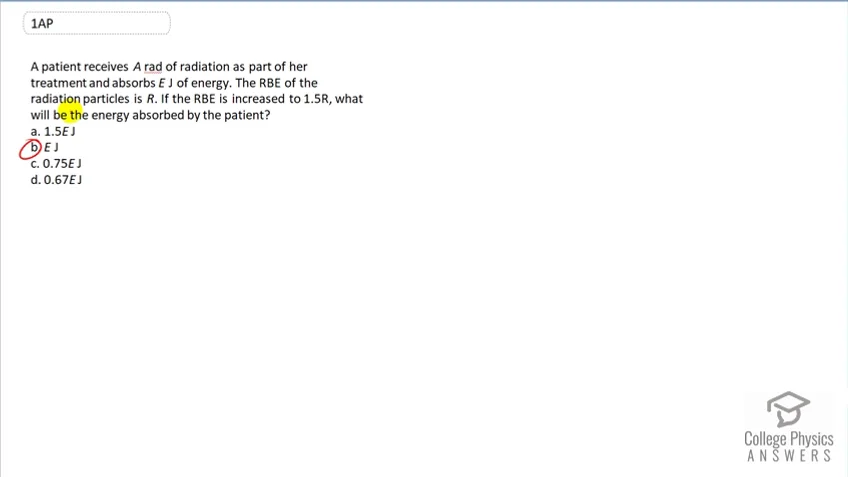 1:45PreviewProblem 1Full video with free trialA patient receives A rad of radiation as part of her treatment and absorbs E J of energy. The RBE of the radiation particles is R. If the RBE is increased to 1.5R, what will be the energy absorbed by the patient? (a)
(b)
(c)
(d)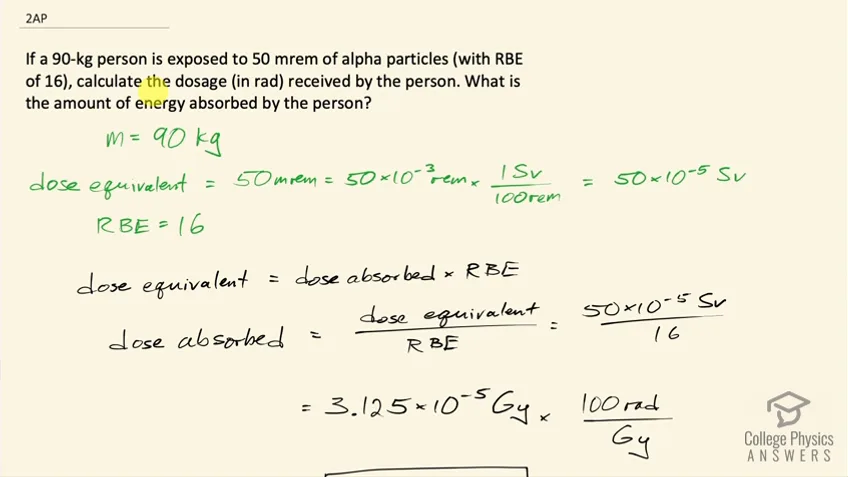 1:34PreviewProblem 2Full video with free trialIf a 90-kg person is exposed to 50 mrem of alpha particles (with RBE of 16), calculate the dosage (in rad) received by the person. What is the amount of energy absorbed by the person?
32.5 Fusion
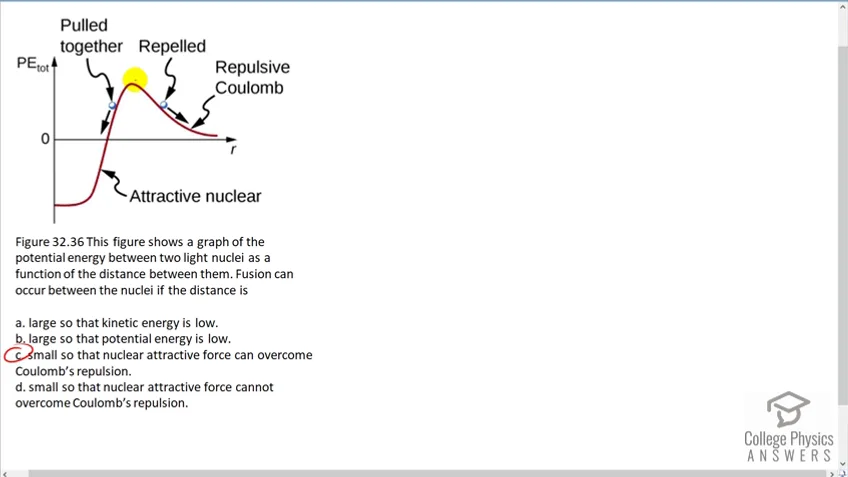 0:52PreviewProblem 3Full video with free trialFigure 32.36 shows a graph of the potential energy between two light nuclei as a function of the distance between them. Fusion can occur between the nuclei if the distance is (a) large so that kinetic energy is low.
(b) large so that potential energy is low.
(c) small so that nuclear attractive force can overcome Coulomb’s repulsion.
(d) small so that nuclear attractive force cannot overcome Coulomb’s repulsion.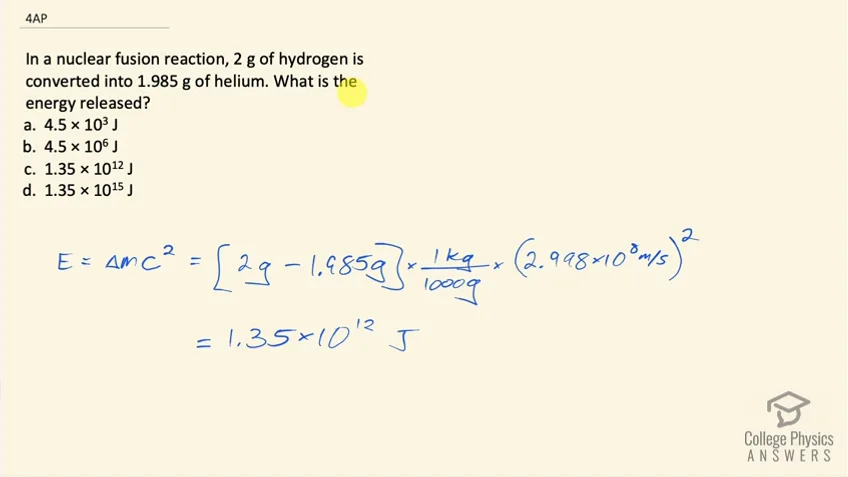 0:37PreviewProblem 4Full video with free trialIn a nuclear fusion reaction, 2 g of hydrogen is converted into 1.985 g of helium. What is the energy released? (a)
(b)
(c)
(d)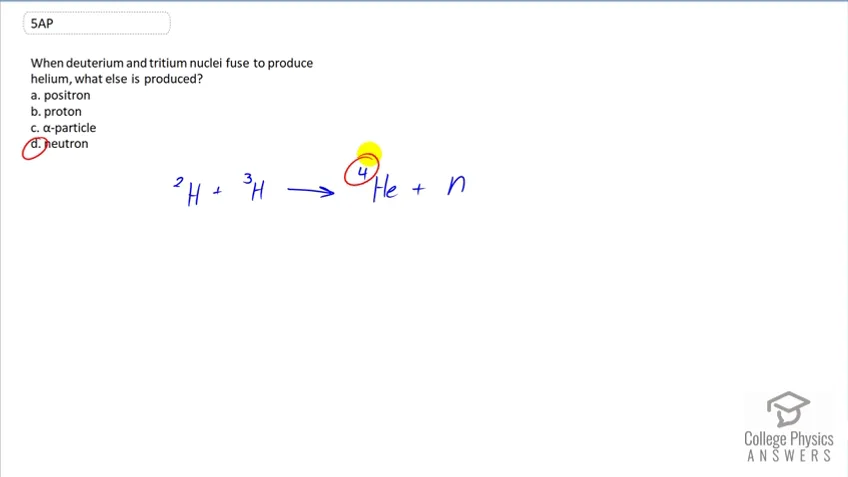 0:25PreviewProblem 5Full video with free trialWhen deuterium and tritium nuclei fuse to produce helium, what else is produced? (a) positron
(b) proton
(c) -particle- neutron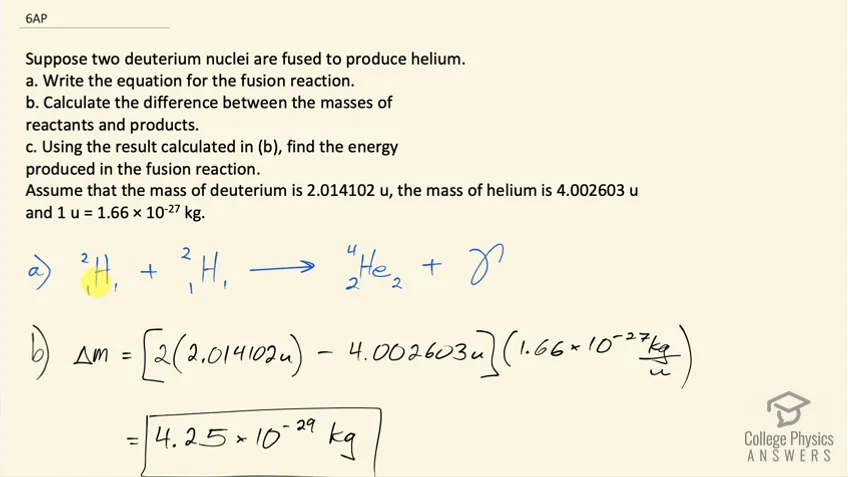 2:06PreviewProblem 6Full video with free trialSuppose two deuterium nuclei are fused to produce helium. (a) Write the equation for the fusion reaction.
(b) Calculate the difference between the masses of reactants and products.
(c) Using the result calculated in (b), find the energy produced in the fusion reaction. Assume that the mass of deuterium is 2.014102 u, the mass of helium is 4.002603 u and 1 u = 1.66 × 10⁻²⁷ kg.
32.6 Fission
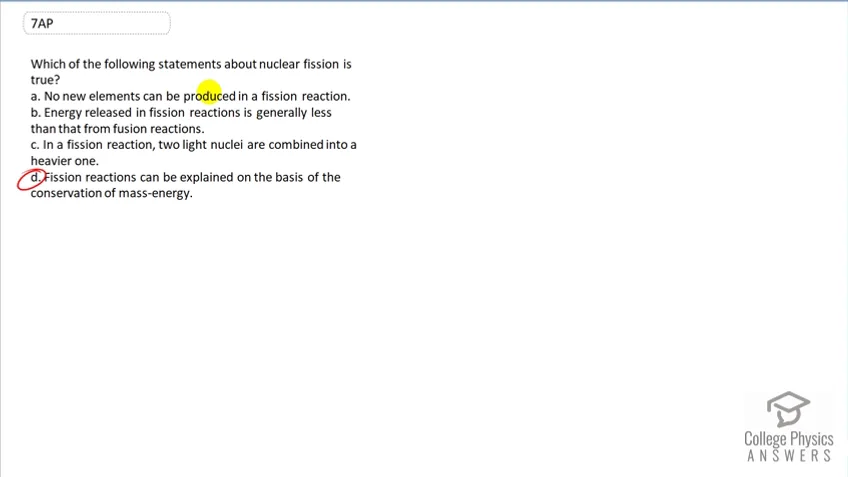 1:53PreviewProblem 7Full video with free trialWhich of the following statements about nuclear fission is true? (a) No new elements can be produced in a fission reaction.
(b) Energy released in fission reactions is generally less than that from fusion reactions.
(c) In a fission reaction, two light nuclei are combined into a heavier one.
(d) Fission reactions can be explained on the basis of the conservation of mass-energy.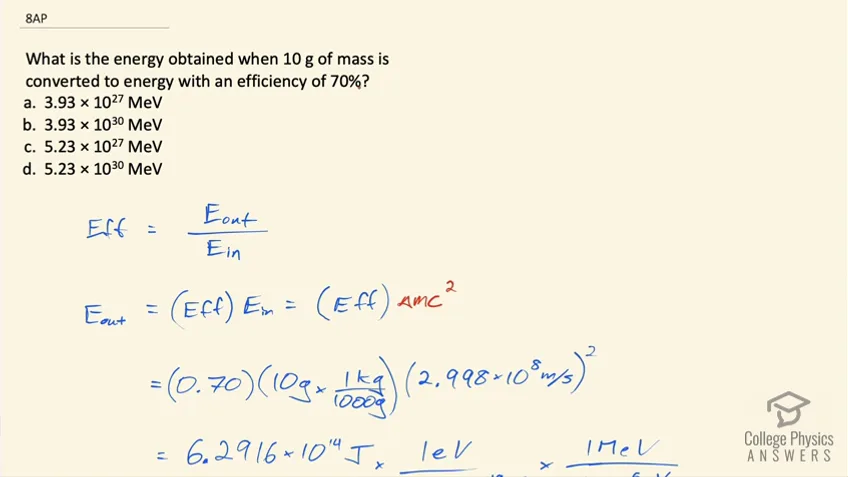 1:13PreviewProblem 8Full video with free trialWhat is the energy obtained when 10 g of mass is converted to energy with an efficiency of 70%? (a)
(b)
(c)
(d)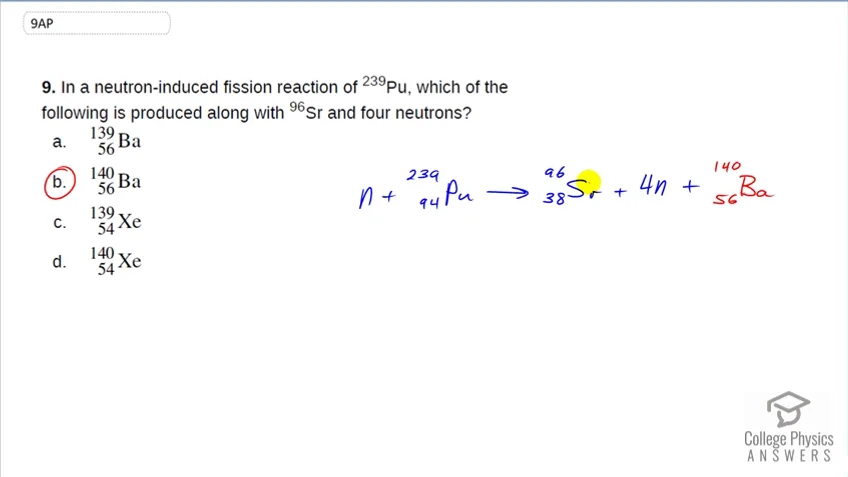 1:03PreviewProblem 9Full video with free trialIn a neutron-induced fission reaction of , which of the following is produced along with and four neutrons? (a)
(b)
(c)
(d)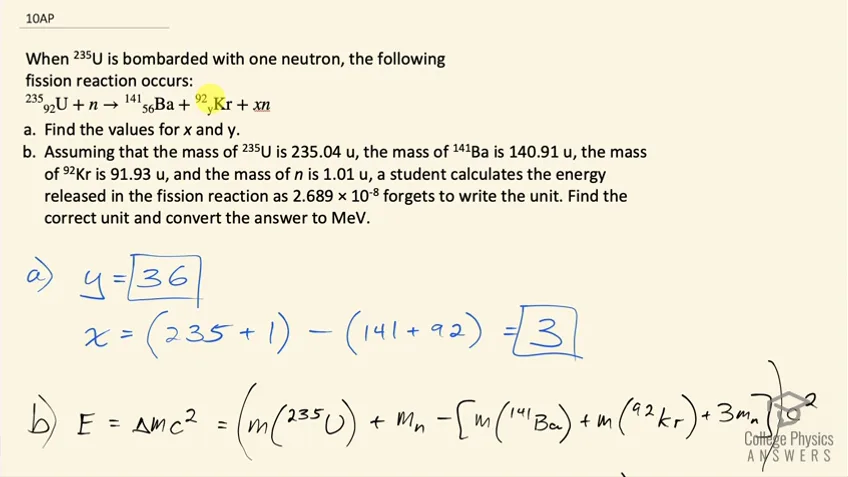 3:00PreviewProblem 10Full video with free trialWhen is bombarded with one neutron, the following fission reaction occurs:
(a) Find the values for x and y.
(b) Assuming that the mass of is 235.04 u, the mass of is 140.91 u, the mass of is 91.93 u, and the mass of is 1.01 u, a student calculates the energy released in the fission reaction as , but forgets to write the unit. Find the correct unit and convert the answer to MeV.