Question
The velocity of a proton in an accelerator is known to an accuracy of 0.250% of the speed of light. (This could be small compared with its velocity.) What is the smallest possible uncertainty in its position?
Final Answer
Solution video

This is a 18-second preview. Get access to the full video by starting your free 7-day trial.
This is a 18-second preview. Get access to the full video by starting your free 7-day trial.
Calculator Screenshots
Video Transcript
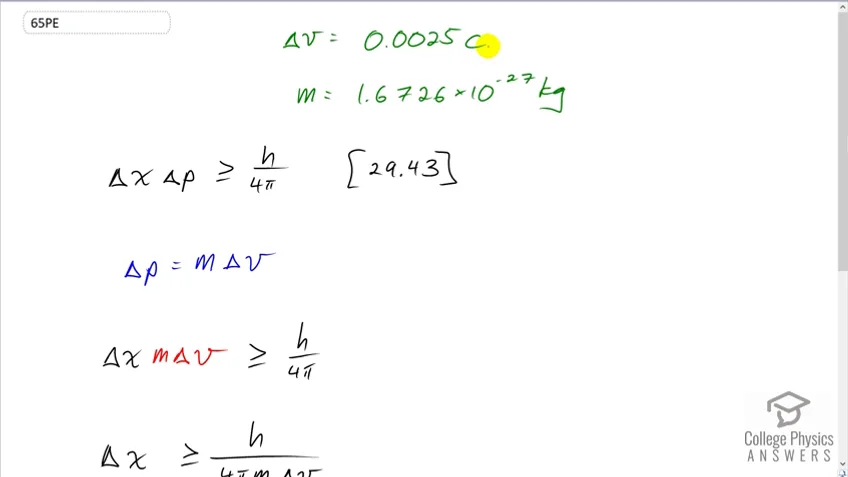
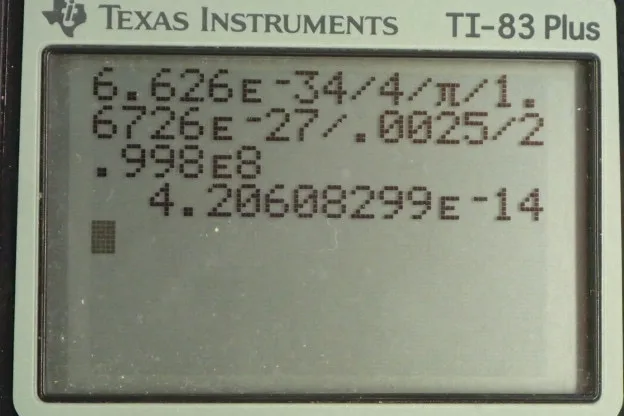
This is College Physics Answers with Shaun Dychko. We know the uncertainty in the velocity of a proton that is 0.0025 times the speed of light and the mass of a proton, we know, is 1.6726 times 10 to the minus 27 kilograms and we'll assume that this is known with no uncertainty. The Heisenberg uncertainty principle; equation [29.43], says that the uncertainty in position mutliplied by uncertainty in momentum has to be more than or equal to Planck's constant divided by 4π. And we'll assume that the uncertainty in momentum can be attributed entirely to the uncertainty in velocity assuming that we know mass perfectly, in which case, ΔP will equal m Δv and we'll substitute that in place of Δp here. And let's solve this for Δx by dividing both sides by m Δv. And we get that the uncertainty in position then is more than or equal to Planck's constant over 4π times mass times uncertainty in velocity. So that's Planck's constant divided by 4π times the mass of a proton times 0.0025 times the speed of light, which at a minimum then the uncertainty in position is 42.1 femtometers.
Comments
No comments yet.