Question
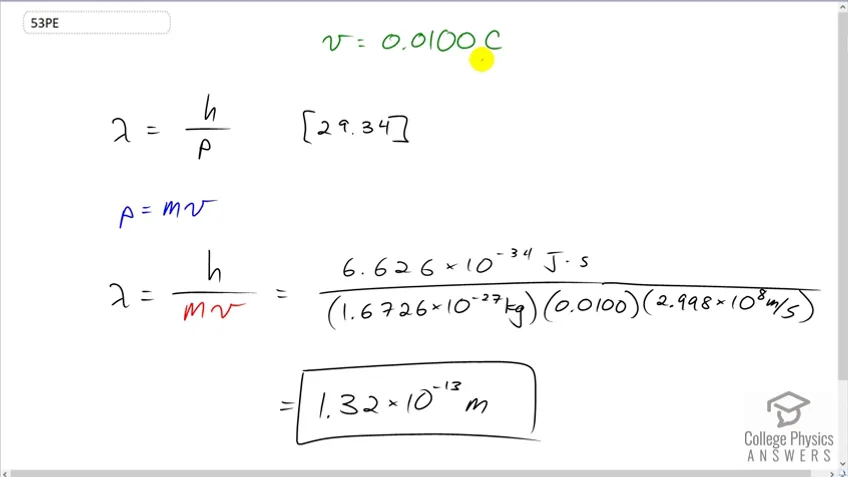
Find the wavelength of a proton moving at 1.00% of the speed of light.
Final Answer
Solution video

This is a 15-second preview. Get access to the full video by starting your free 7-day trial.
This is a 15-second preview. Get access to the full video by starting your free 7-day trial.
5.0 (2)
54 views
Calculator Screenshots
Video Transcript
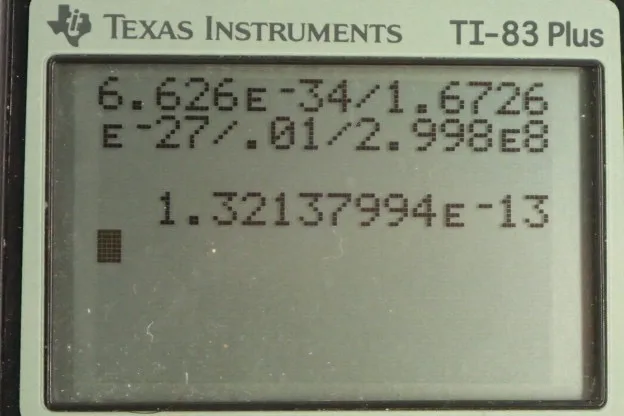
This is College Physics Answers with Shaun Dychko. We are going to find the wavelength of a proton moving at a speed of 1 percent the speed of light so that's 0.0100 times c. The wavelength is going to be Planck's constant divided by momentum and momentum is mass times velocity which we then substitute in for p here. And so the wavelength then is Planck's constant—expressed in units of joule seconds— divided by the mass of a proton times 0.01 multiplied by the speed of light giving us 1.32 times 10 to the minus 13 meters.
Comments
No comments yet.