Question
A microwave oven produces electromagnetic radiation in the radio portion of the spectrum. These microwave photons are absorbed by water molecules, resulting in an increase in the molecules’ rotational energies. This added energy is transferred by heat to the surrounding food, which as a result becomes hot very quickly. If the energy absorbed by a water molecule is , what is the corresponding wavelength of the microwave photons?
(a) 1.22 GHz
(b) 2.45 GHz
(c) 4.90 GHz
(d) 9.80 GHz
Final Answer
(b)
Solution video

This is a 16-second preview. Get access to the full video by starting your free 7-day trial.
This is a 16-second preview. Get access to the full video by starting your free 7-day trial.
Calculator Screenshots
Video Transcript
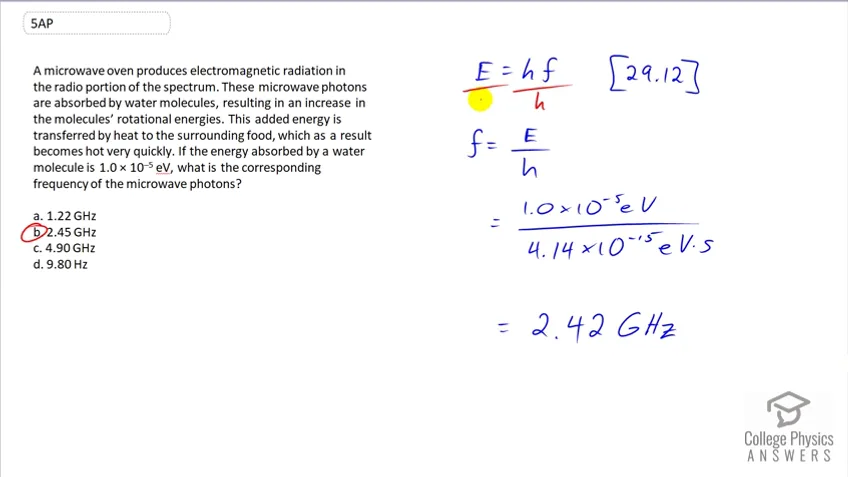
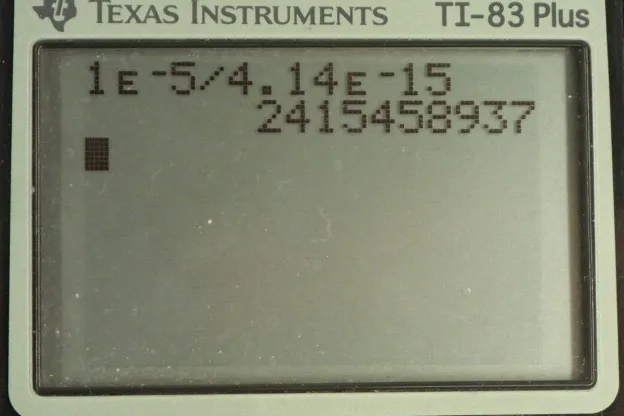
This is College Physics Answers with Shaun Dychko. We know from equation [29.12] that the energy of a photon is Planck's constant times its frequency. So we'll divide both sides by h to solve for f because we know what the energy of the photon has to be—1 times 10 to the minus 5 electron volts. So the frequency is energy divided by Planck's constant. So that's 1 times 10 to the minus 5 electron volts divided by 4.14 times 10 to the minus 15 electron volts seconds; choosing these convenient units for Planck's constant so that when these electron volts cancel, we are left with 1 over seconds, which is Hertz. And this is 2.42 Gigahertz and that is the frequency that every microwave uses.
Comments
No comments yet.