Chapter 29: Introduction to Quantum Physics
102 problems solved · Free preview of every solution shows how it’s started · Watch the full videos with a free 7-day trial →


Section
29.1 Quantization of Energy
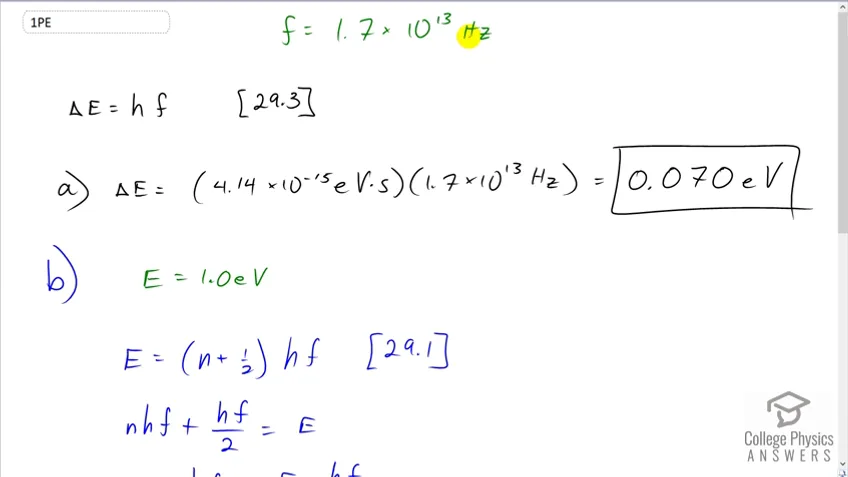 2:20Problem 1FreeA LiBr molecule oscillates with a frequency of . (a) What is the difference in energy in eV between allowed oscillator states? (b) What is the approximate value of n for a state having an energy of 1.0 eV?
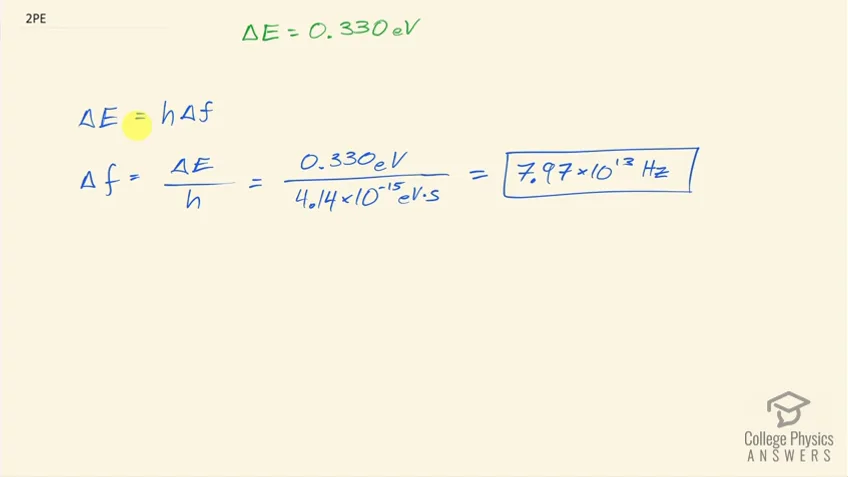 0:54PreviewProblem 2Full video with free trialThe difference in energy between allowed oscillator states in HBr molecules is 0.330 eV. What is the oscillation frequency of this molecule?
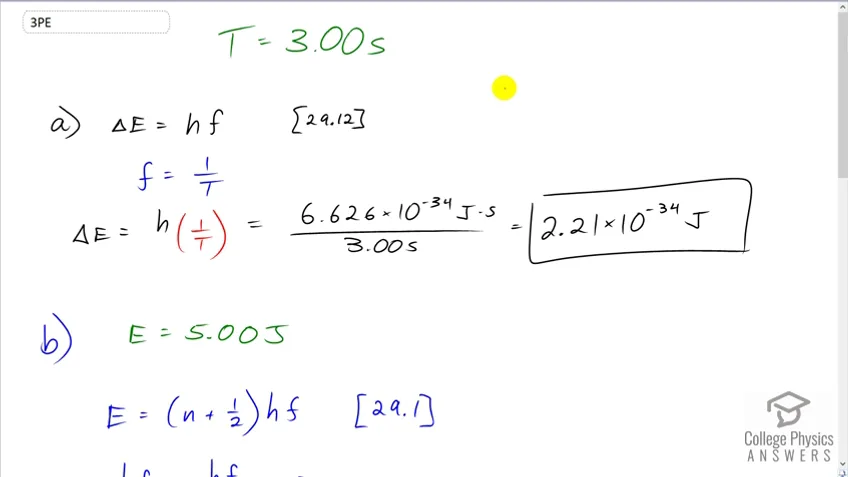 2:25PreviewProblem 3Full video with free trialA physicist is watching a 15-kg orangutan at a zoo swing lazily in a tire at the end of a rope. He (the physicist) notices that each oscillation takes 3.00 s and hypothesizes that the energy is quantized. (a) What is the difference in energy in joules between allowed oscillator states? (b) What is the value of n for a state where the energy is 5.00 J? (c) Can the quantization be observed?
29.2 The Photoelectric Effect
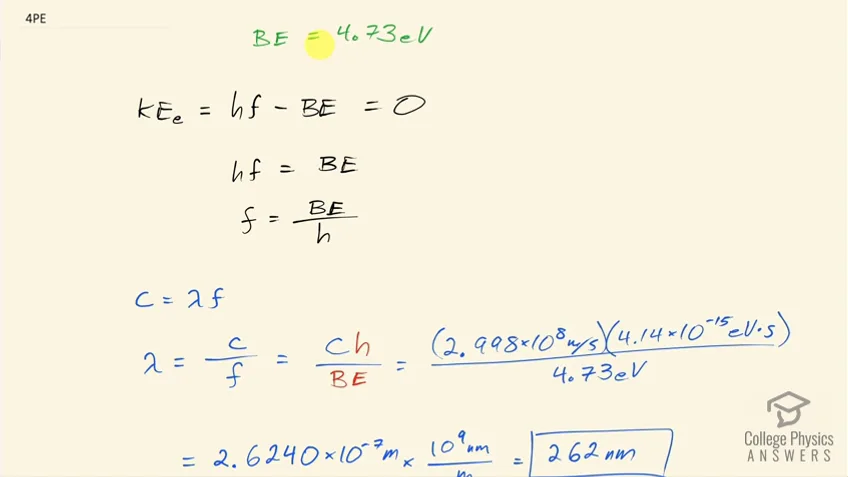 2:00PreviewProblem 4Full video with free trialWhat is the longest-wavelength EM radiation that can eject a photoelectron from silver, given that the binding energy is 4.73 eV? Is this in the visible range?
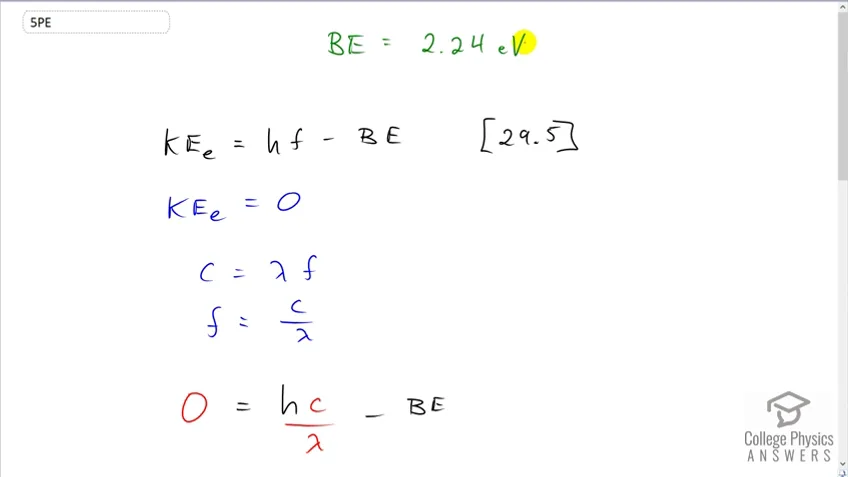 2:07PreviewProblem 5Full video with free trialFind the longest-wavelength photon that can eject an electron from potassium, given that the binding energy is 2.24 eV. Is this visible EM radiation?
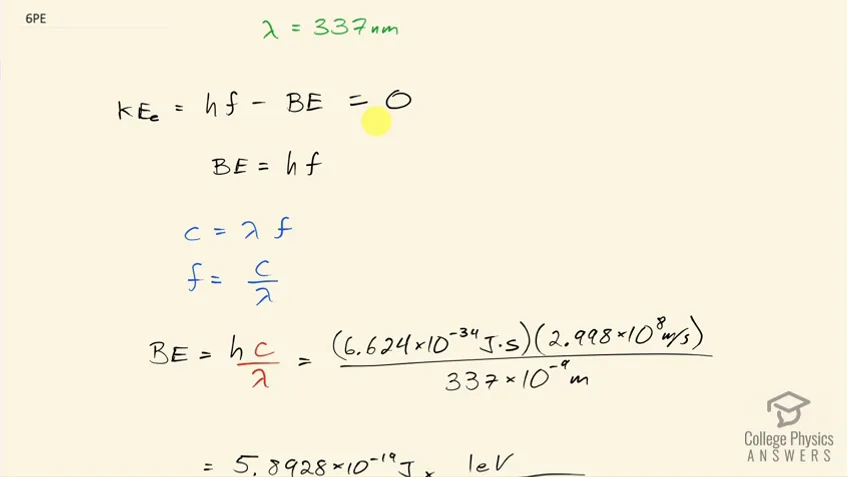 2:14PreviewProblem 6Full video with free trialWhat is the binding energy in eV of electrons in magnesium, if the longest-wavelength photon that can eject electrons is 337 nm?
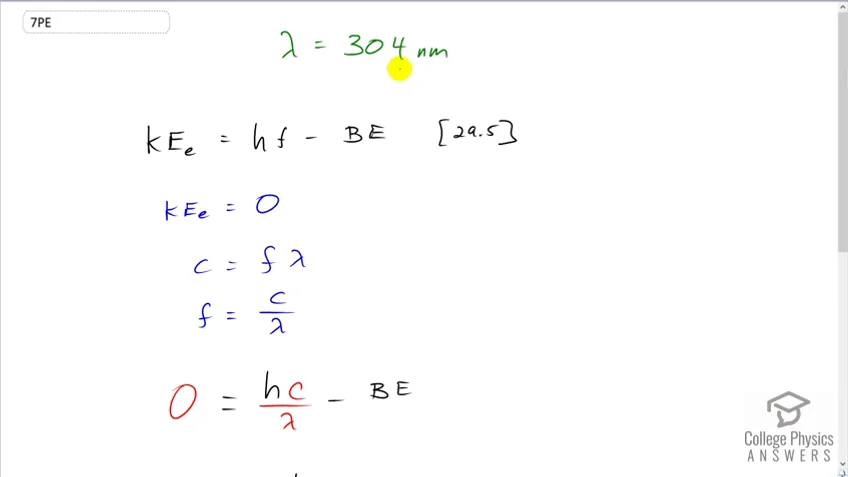 1:49PreviewProblem 7Full video with free trialCalculate the binding energy in eV of electrons in aluminum, if the longest-wavelength photon that can eject them is 304 nm.
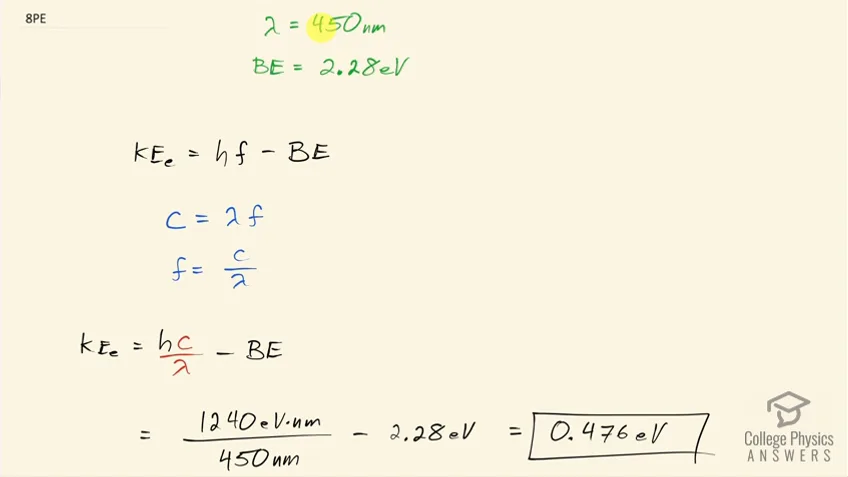 1:29PreviewProblem 8Full video with free trialWhat is the maximum kinetic energy in eV of electrons ejected from sodium metal by 450-nm EM radiation, given that the binding energy is 2.28 eV?
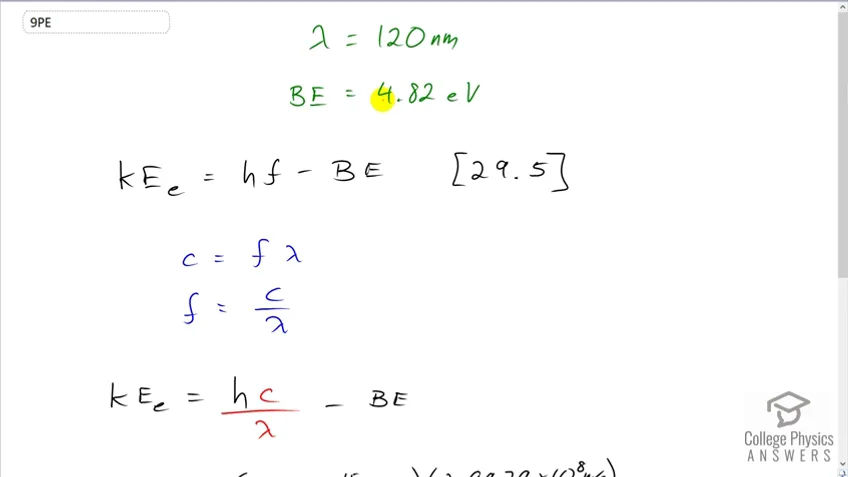 1:34PreviewProblem 9Full video with free trialUV radiation having a wavelength of 120 nm falls on gold metal, to which electrons are bound by 4.82 eV. What is the maximum kinetic energy of the ejected photoelectrons?
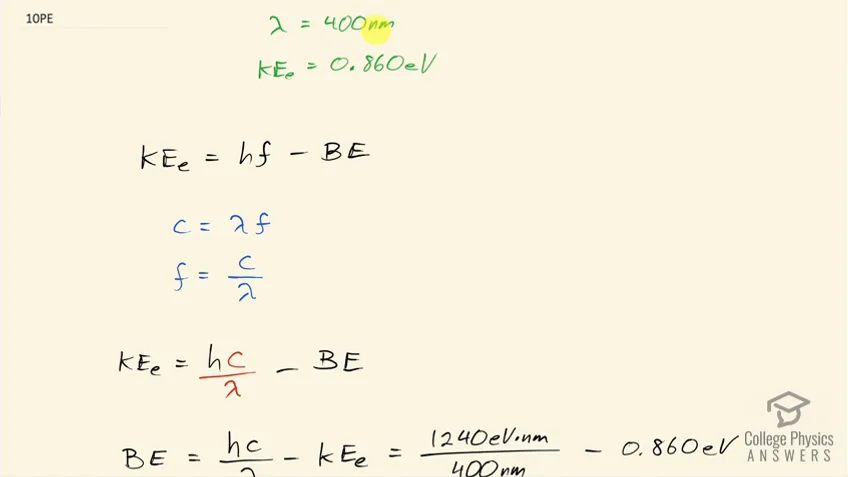 1:56PreviewProblem 10Full video with free trialViolet light of wavelength 400 nm ejects electrons with a maximum kinetic energy of 0.860 eV from sodium metal. What is the binding energy of electrons to sodium metal?
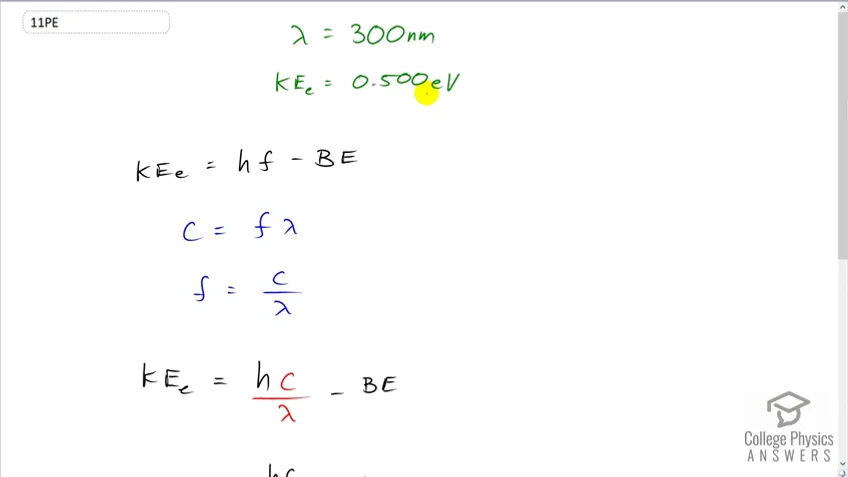 1:34PreviewProblem 11Full video with free trialUV radiation having a 300-nm wavelength falls on uranium metal, ejecting 0.500-eV electrons. What is the binding energy of electrons to uranium metal?
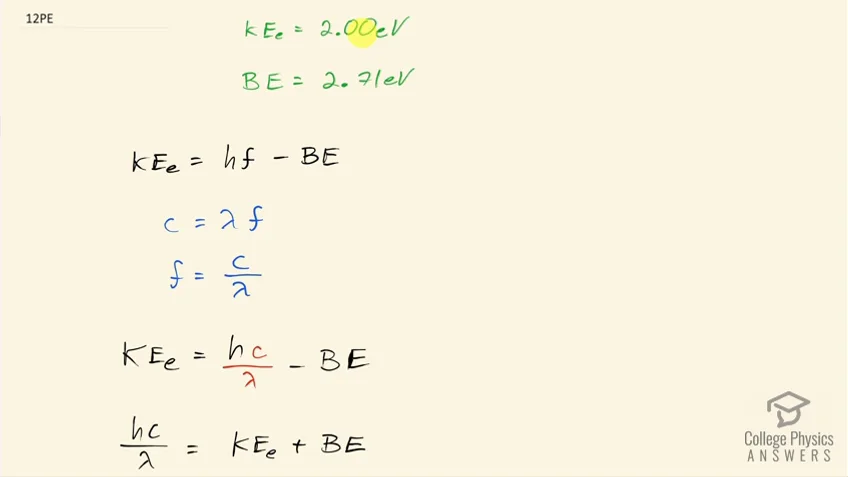 1:56PreviewProblem 12Full video with free trialWhat is the wavelength of EM radiation that ejects 2.00-eV electrons from calcium metal, given that the binding energy is 2.71 eV? What type of EM radiation is this?
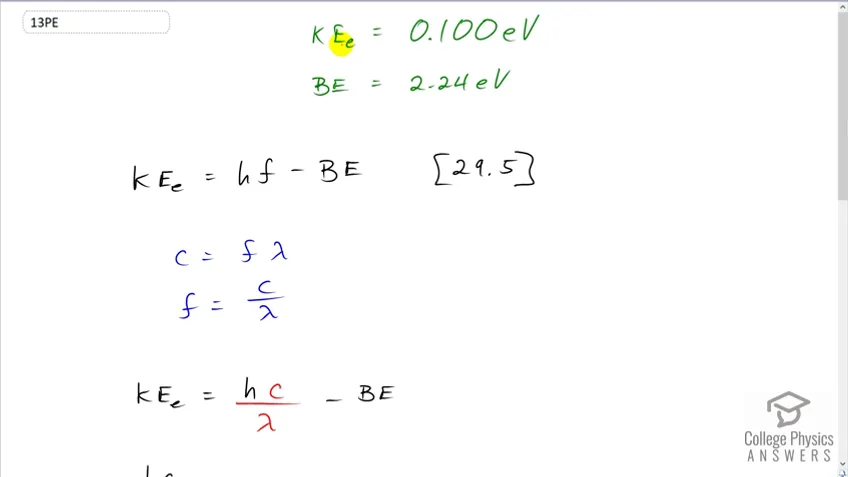 1:52PreviewProblem 13Full video with free trialFind the wavelength of photons that eject 0.100-eV electrons from potassium, given that the binding energy is 2.24 eV. Are these photons visible?
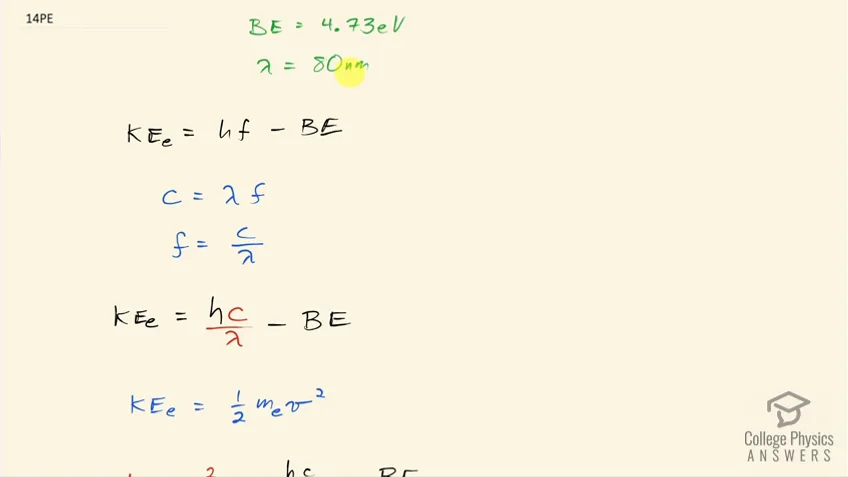 2:32PreviewProblem 14Full video with free trialWhat is the maximum velocity of electrons ejected from a material by 80-nm photons, if they are bound to the material by 4.73 eV?
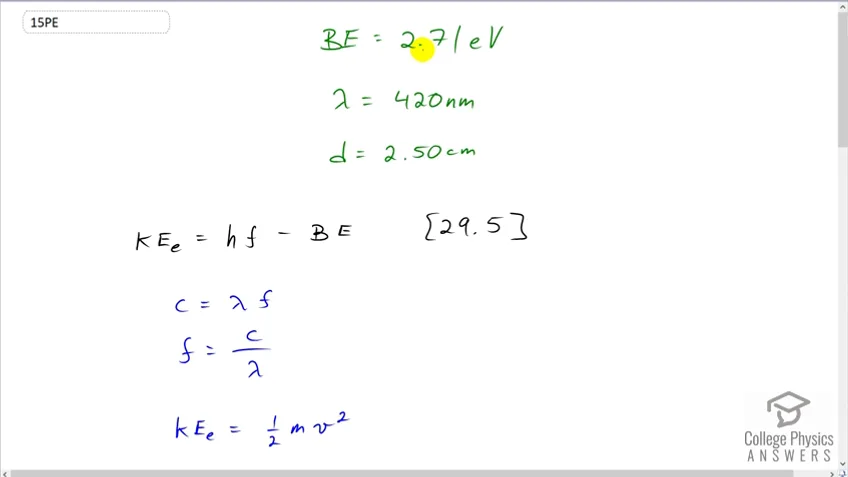 3:07PreviewProblem 15Full video with free trialPhotoelectrons from a material with a binding energy of 2.71 eV are ejected by 420-nm photons. Once ejected, how long does it take these electrons to travel 2.50 cm to a detection device?
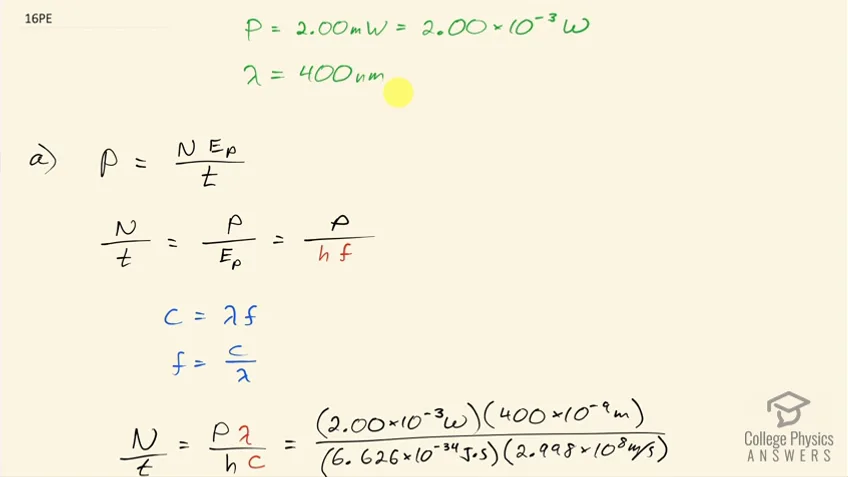 3:14PreviewProblem 16Full video with free trialA laser with a power output of 2.00 mW at a wavelength of 400 nm is projected onto calcium metal. (a) How many electrons per second are ejected? (b) What power is carried away by the electrons, given that the binding energy is 2.71 eV?
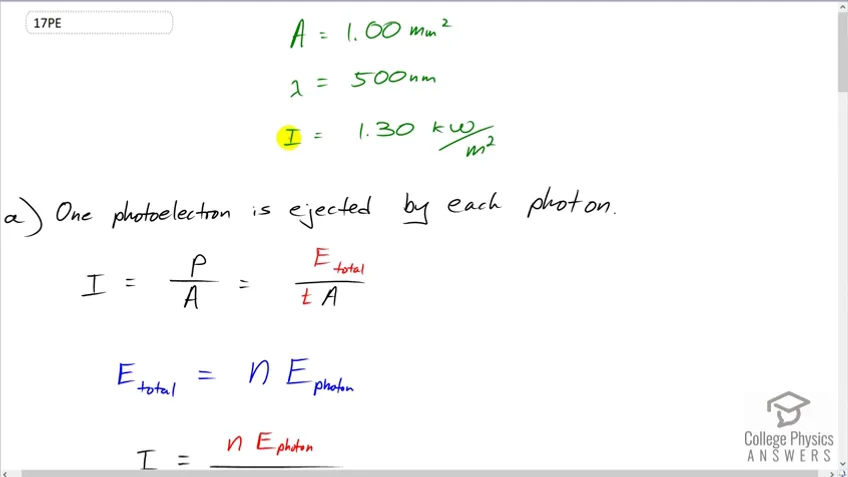 7:41PreviewProblem 17Full video with free trial(a) Calculate the number of photoelectrons per second ejected from a area of sodium metal by 500-nm EM radiation having an intensity of (the intensity of sunlight above the Earth’s atmosphere). (b) Given that the binding energy is 2.28 eV, what power is carried away by the electrons? (c) The electrons carry away less power than brought in by the photons. Where does the other power go? How can it be recovered?
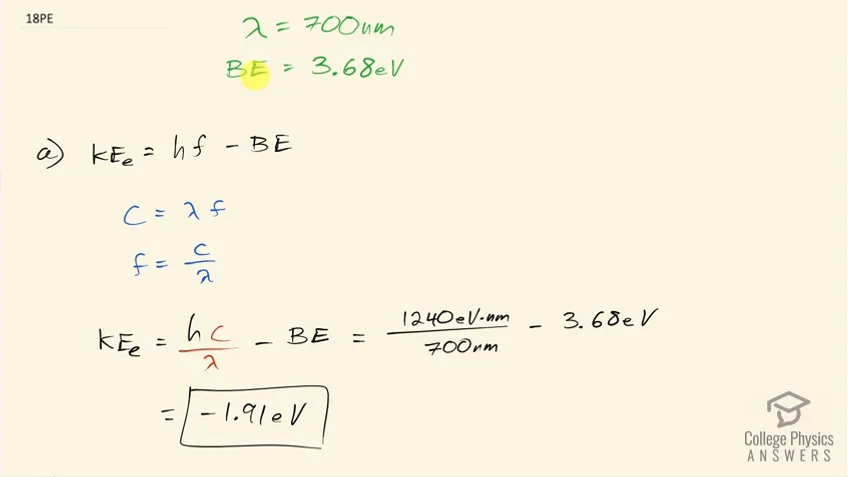 1:22PreviewProblem 18Full video with free trialRed light having a wavelength of 700 nm is projected onto magnesium metal to which electrons are bound by 3.68 eV. (a) Use to calculate the kinetic energy of e the ejected electrons. (b) What is unreasonable about this result? (c) Which assumptions are unreasonable or inconsistent?
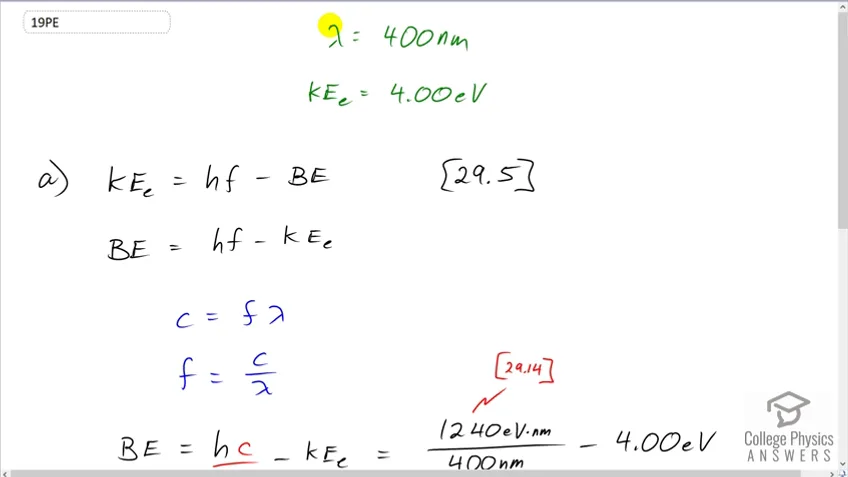 1:44PreviewProblem 19Full video with free trial(a) What is the binding energy of electrons to a material from which 4.00-eV electrons are ejected by 400-nm EM radiation? (b) What is unreasonable about this result? (c) Which assumptions are unreasonable or inconsistent?
29.3 Photon Energies and the Electromagnetic Spectrum
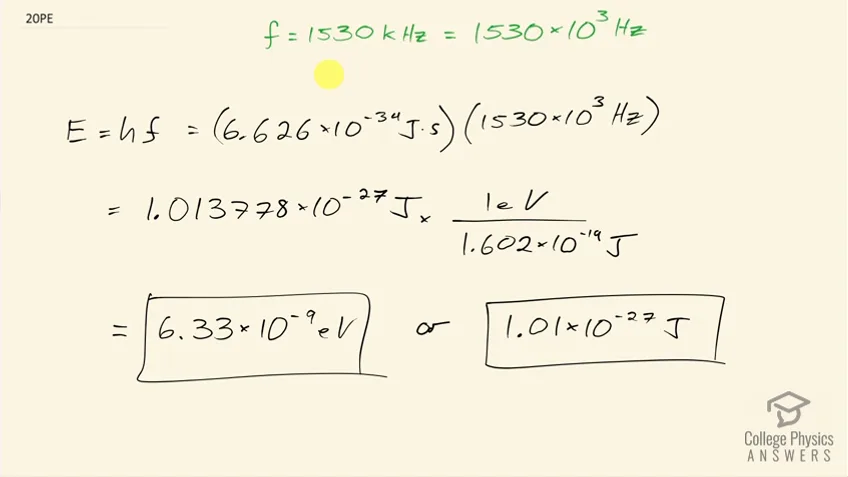 0:54PreviewProblem 20Full video with free trialWhat is the energy in joules and eV of a photon in a radio wave from an AM station that has a 1530-kHz broadcast frequency?
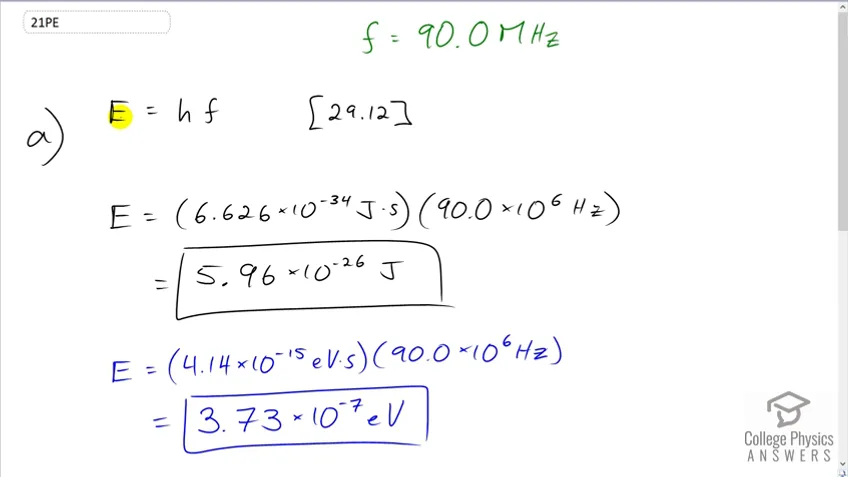 1:33PreviewProblem 21Full video with free trial(a) Find the energy in joules and eV of photons in radio waves from an FM station that has a 90.0-MHz broadcast frequency. (b) What does this imply about the number of photons per second that the radio station must broadcast?
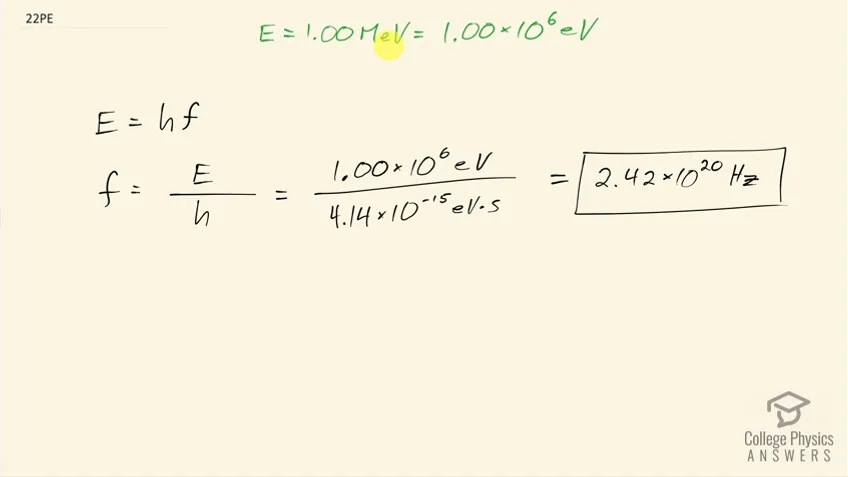 0:59PreviewProblem 22Full video with free trialCalculate the frequency in hertz of a 1.00-MeV -ray photon.
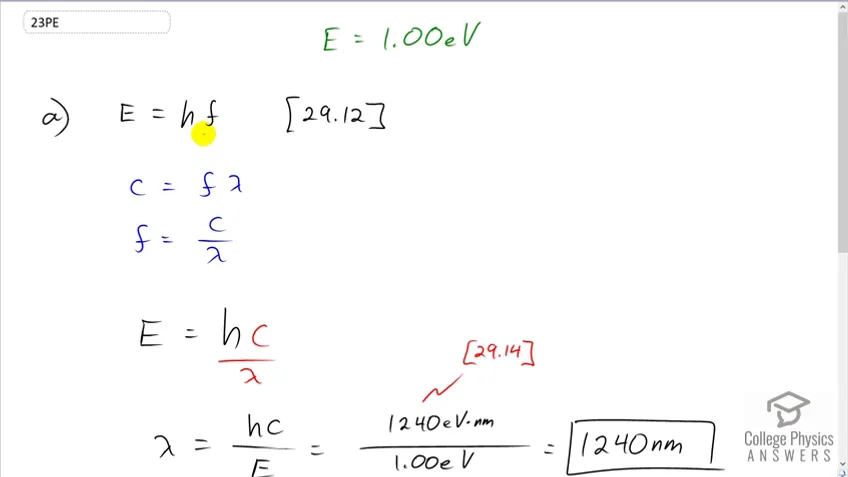 2:04PreviewProblem 23Full video with free trial(a) What is the wavelength of a 1.00-eV photon? (b) Find its frequency in hertz. (c) Identify the type of EM radiation.
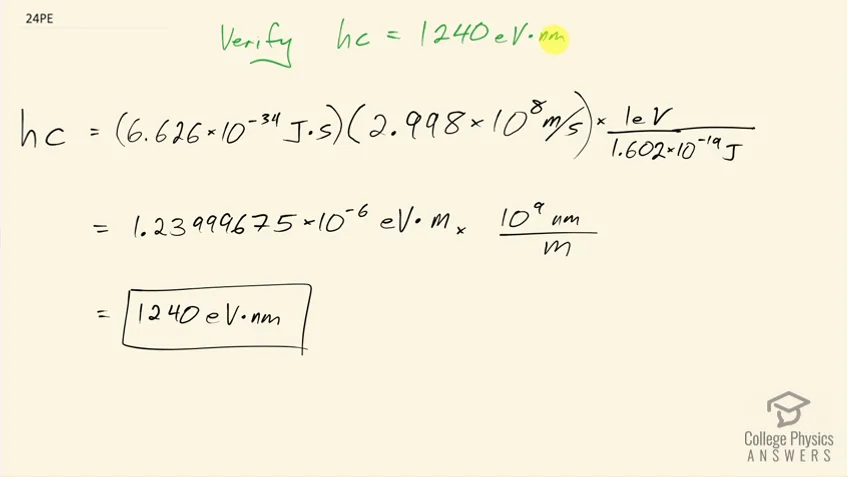 1:11PreviewProblem 24Full video with free trialDo the unit conversions necessary to show that , as stated in the text.
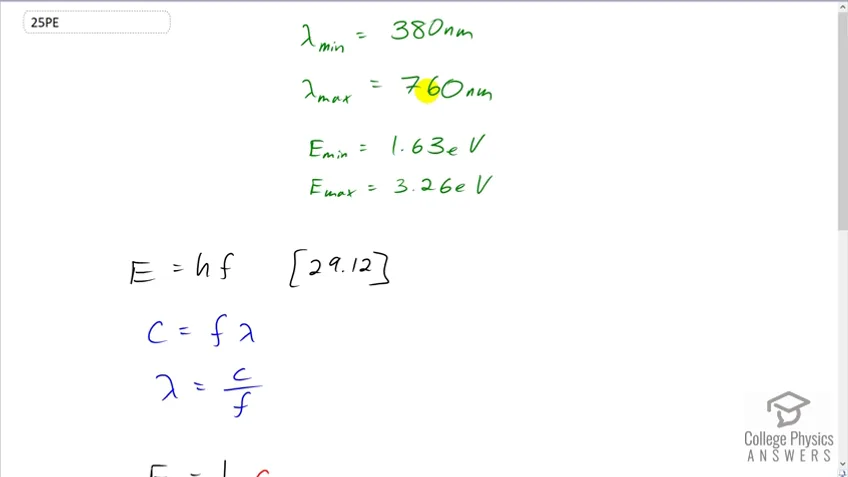 1:51PreviewProblem 25Full video with free trialConfirm the statement in the text that the range of photon energies for visible light is 1.63 to 3.26 eV, given that the range of visible wavelengths is 380 to 760 nm.
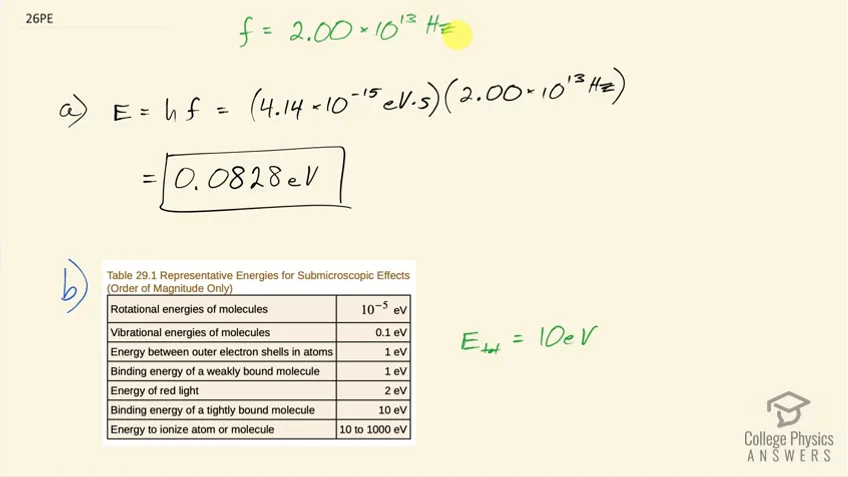 3:01PreviewProblem 26Full video with free trial(a) Calculate the energy in eV of an IR photon of frequency . (b) How many of these photons would need to be absorbed simultaneously by a tightly bound molecule to break it apart? (c) What is the energy in eV of a ray of frequency ? (d) How many tightly bound molecules could a single such γ ray break apart?
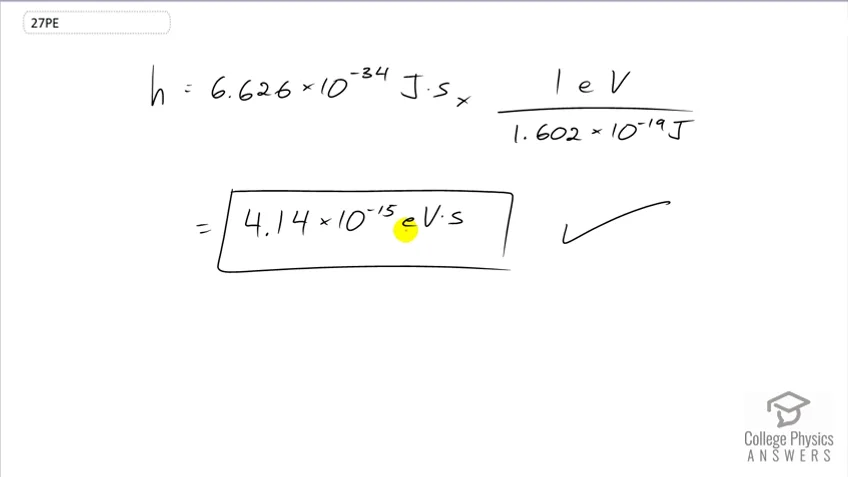 0:22PreviewProblem 27Full video with free trialProve that, to three-digit accuracy, , as stated in the text.
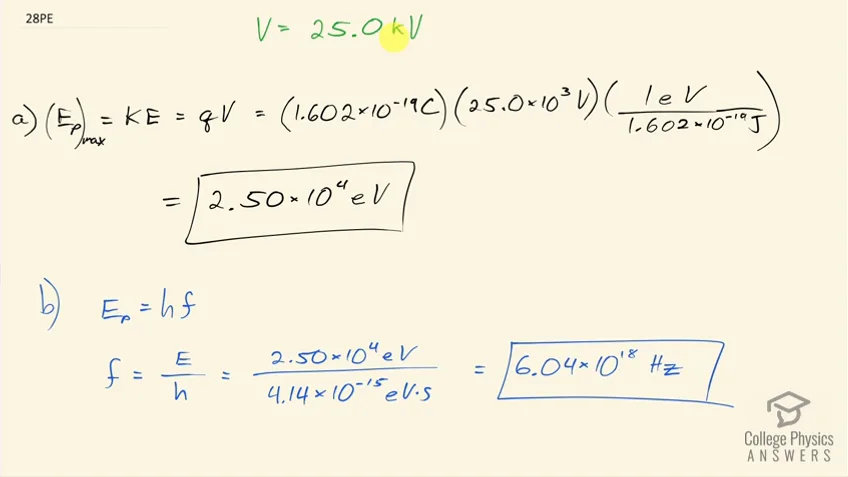 1:49PreviewProblem 28Full video with free trial(a) What is the maximum energy in eV of photons produced in a CRT using a 25.0-kV accelerating potential, such as a color TV? (b) What is their frequency?
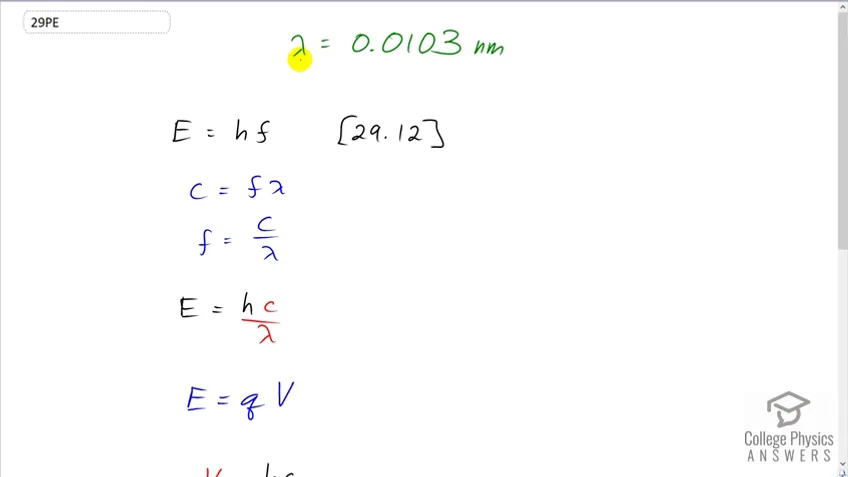 2:15PreviewProblem 29Full video with free trialWhat is the accelerating voltage of an x-ray tube that produces x-rays with a shortest wavelength of 0.0103 nm?
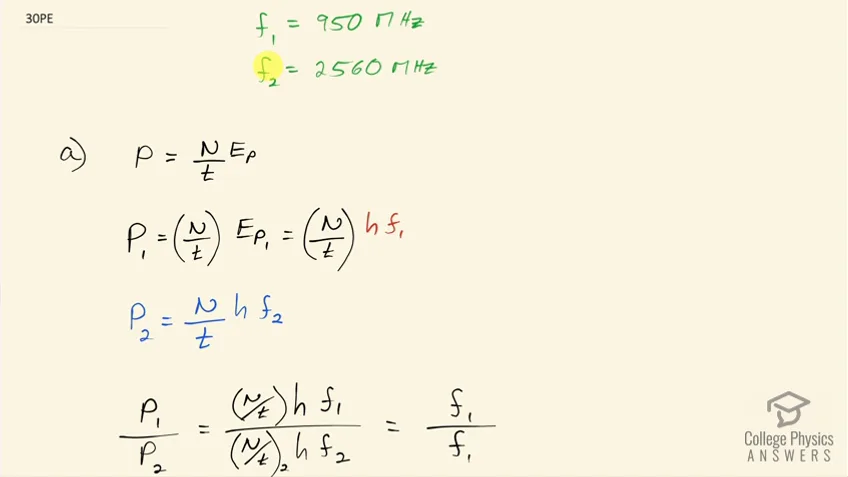 3:04PreviewProblem 30Full video with free trial(a) What is the ratio of power outputs by two microwave ovens having frequencies of 950 and 2560 MHz, if they emit the same number of photons per second? (b) What is the ratio of photons per second if they have the same power output?
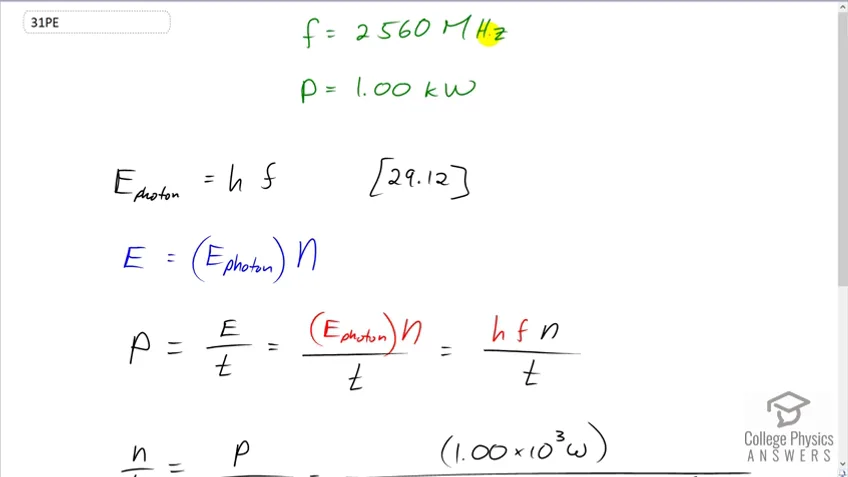 2:00PreviewProblem 31Full video with free trialHow many photons per second are emitted by the antenna of a microwave oven, if its power output is 1.00 kW at a frequency of 2560 MHz?
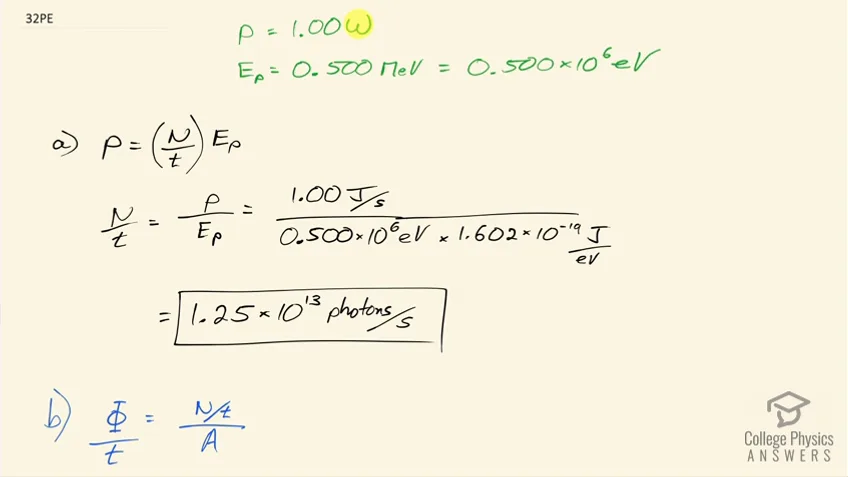 3:02PreviewProblem 32Full video with free trialSome satellites use nuclear power. (a) If such a satellite emits a 1.00-W flux of rays having an average energy of 0.500 MeV, how many are emitted per second? (b) These γ rays affect other satellites. How far away must another satellite be to only receive one γ ray per second per square meter?
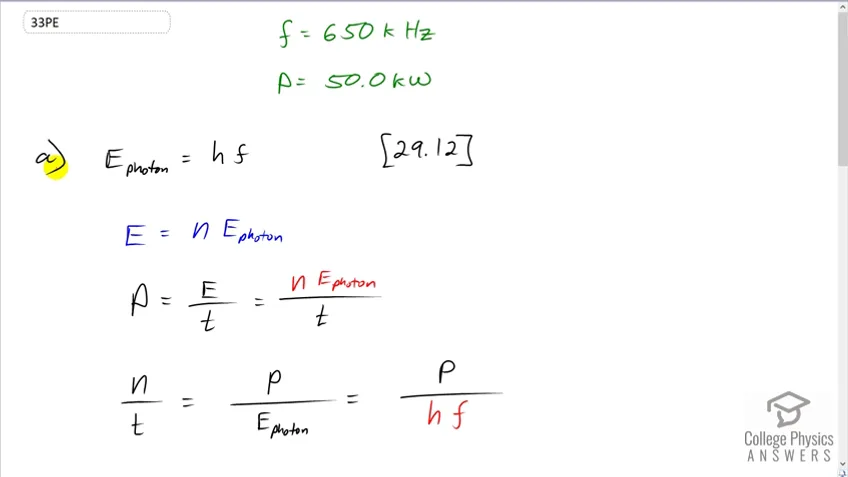 3:33PreviewProblem 33Full video with free trial(a) If the power output of a 650-kHz radio station is 50.0 kW, how many photons per second are produced? (b) If the radio waves are broadcast uniformly in all directions, find the number of photons per second per square meter at a distance of 100 km. Assume no reflection from the ground or absorption by the air.
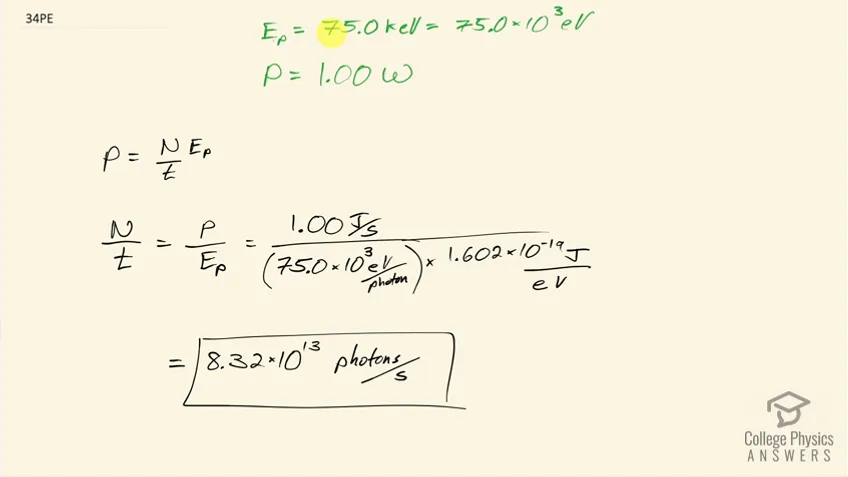 1:21PreviewProblem 34Full video with free trialHow many x-ray photons per second are created by an x- ray tube that produces a flux of x rays having a power of 1.00 W? Assume the average energy per photon is 75.0 keV.
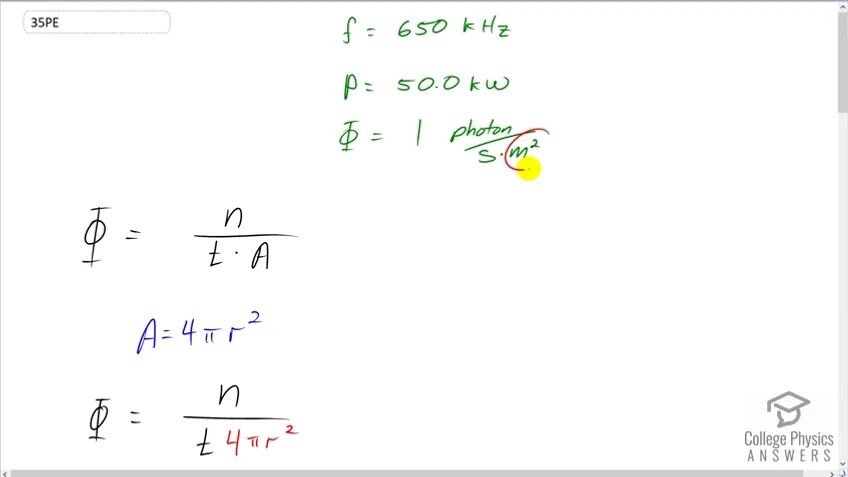 3:33PreviewProblem 35Full video with free trial(a) How far away must you be from a 650-kHz radio station with power 50.0 kW for there to be only one photon per second per square meter? Assume no reflections or absorption, as if you were in deep outer space. (b) Discuss the implications for detecting intelligent life in other solar systems by detecting their radio broadcasts.
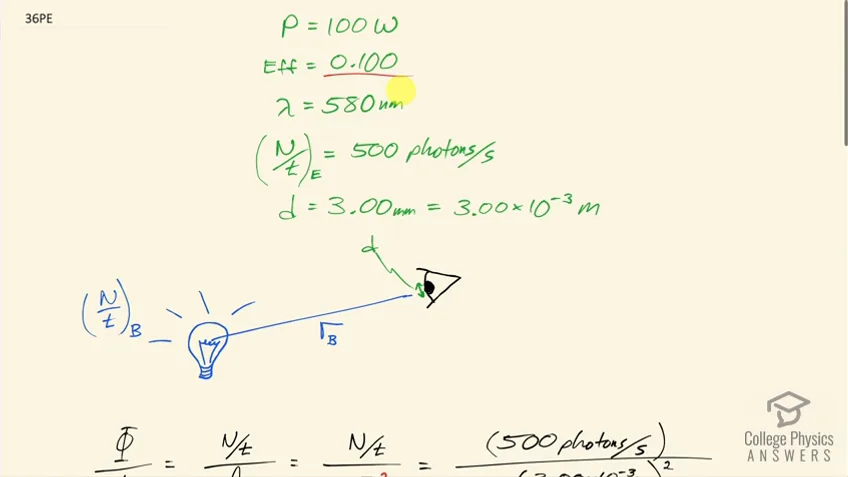 6:43PreviewProblem 36Full video with free trialAssuming that 10.0% of a 100-W light bulb’s energy output is in the visible range (typical for incandescent bulbs) with an average wavelength of 580 nm, and that the photons spread out uniformly and are not absorbed by the atmosphere, how far away would you be if 500 photons per second enter the 3.00-mm diameter pupil of your eye? (This number easily stimulates the retina.)
29.4 Photon Momentum
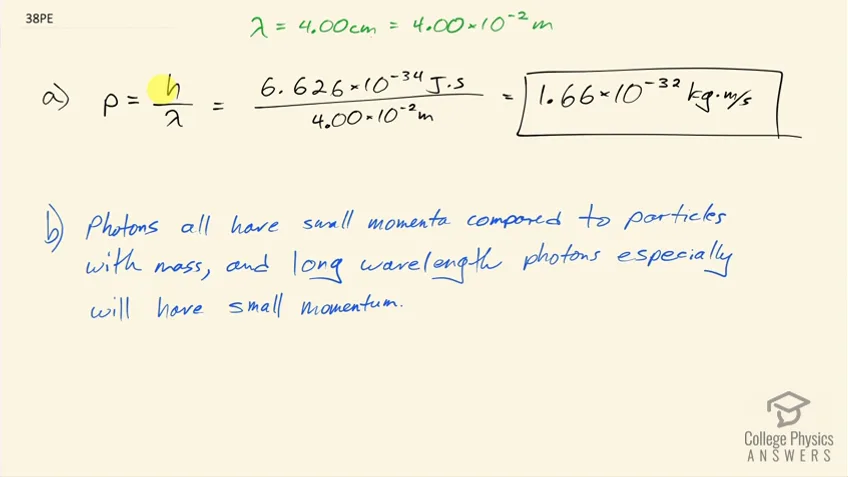 0:51PreviewProblem 38Full video with free trial(a) Find the momentum of a 4.00-cm-wavelength microwave photon. (b) Discuss why you expect the answer to (a) to be very small.
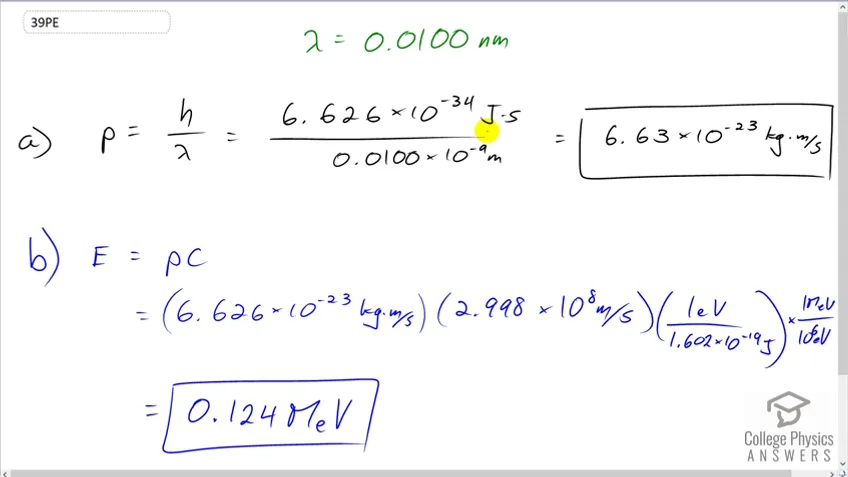 1:02PreviewProblem 39Full video with free trial(a) What is the momentum of a 0.0100-nm-wavelength photon that could detect details of an atom? (b) What is its energy in MeV?
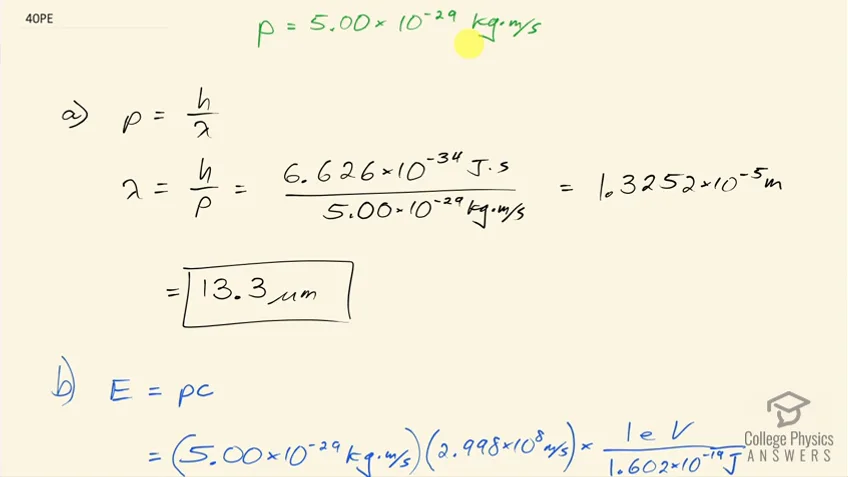 1:37PreviewProblem 40Full video with free trial(a) What is the wavelength of a photon that has a momentum of ? (b) Find its energy in eV.
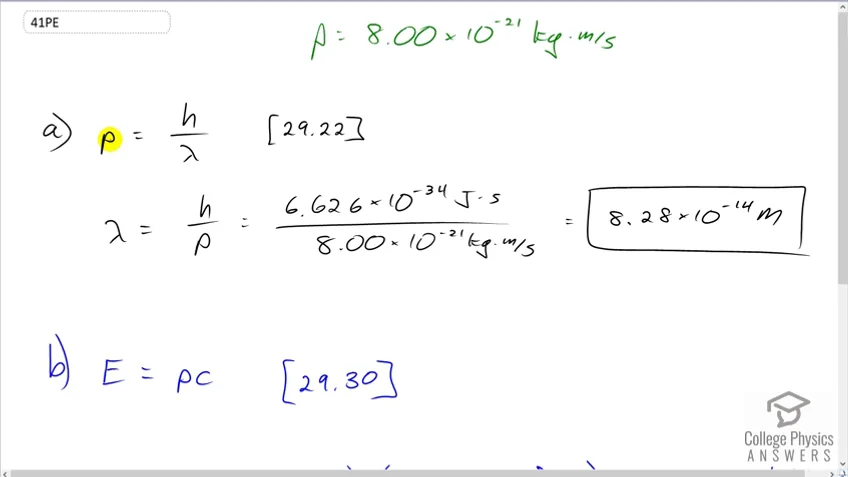 1:34PreviewProblem 41Full video with free trial(a) A -ray photon has a momentum of . What is its wavelength? (b) Calculate its energy in MeV.
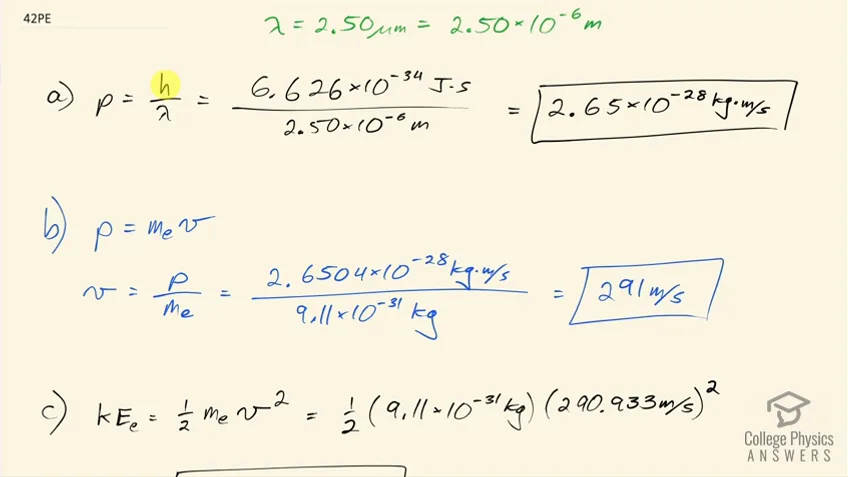 2:01PreviewProblem 42Full video with free trial(a) Calculate the momentum of a photon having a wavelength of . (b) Find the velocity of an electron having the same momentum. (c) What is the kinetic energy of the electron, and how does it compare with that of the photon?
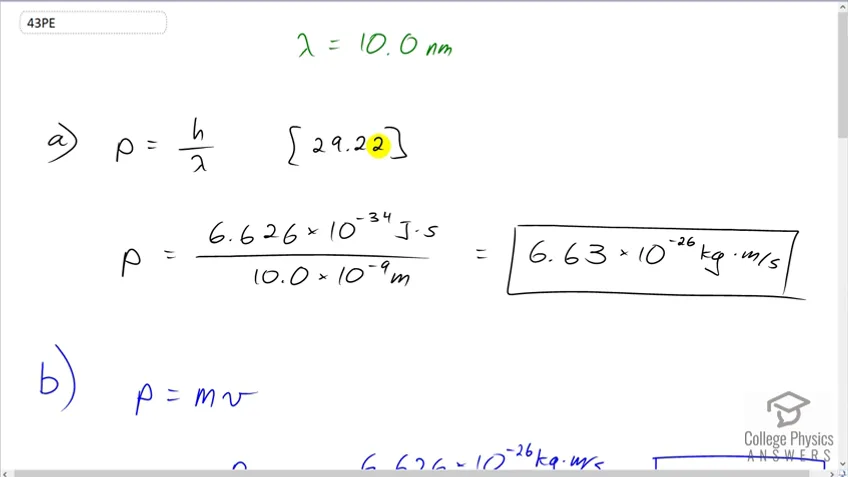 3:17PreviewProblem 43Full video with free trial(a) Calculate the momentum of a photon having a wavelength of (b) Find the velocity of an electron having the same momentum. (c) What is the kinetic energy of the electron, and how does it compare with that of the photon?
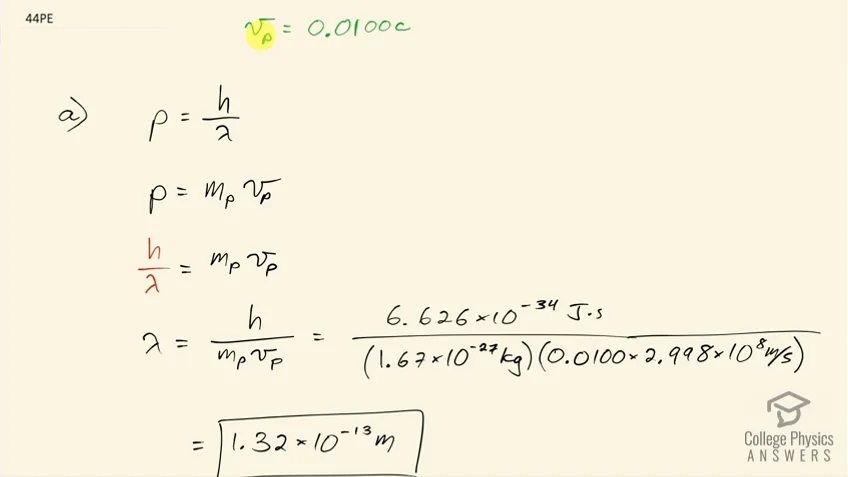 2:27PreviewProblem 44Full video with free trial(a) Calculate the wavelength of a photon that has the same momentum as a proton moving at 1.00% of the speed of light. (b) What is the energy of the photon in MeV? (c) What is the kinetic energy of the proton in MeV?
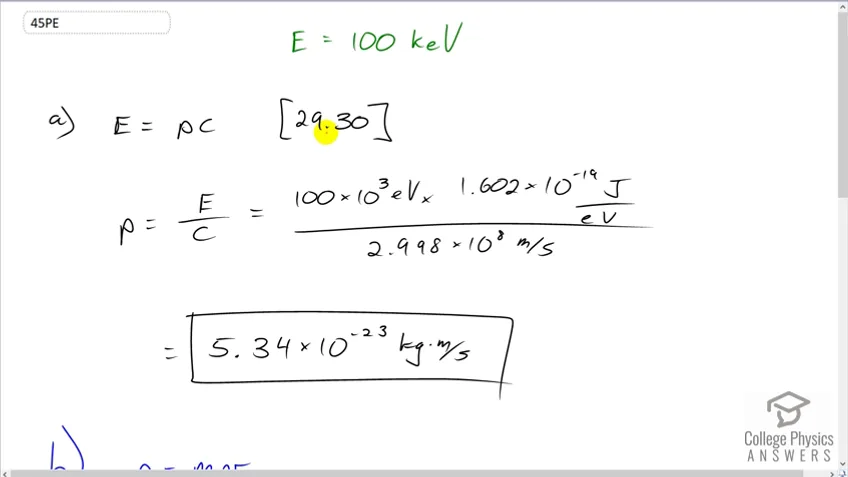 2:06PreviewProblem 45Full video with free trial(a) Find the momentum of a 100-keV x-ray photon. (b) Find the equivalent velocity of a neutron with the same momentum. (c) What is the neutron’s kinetic energy in keV?
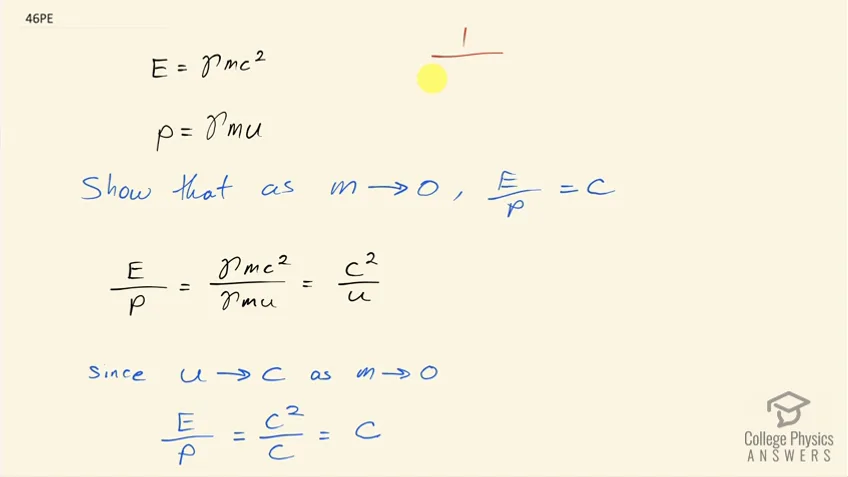 2:15PreviewProblem 46Full video with free trialTake a ratio of relativistic rest energy, , to relativistic momentum, , and show that in the limit that mass approaches zero, you find .
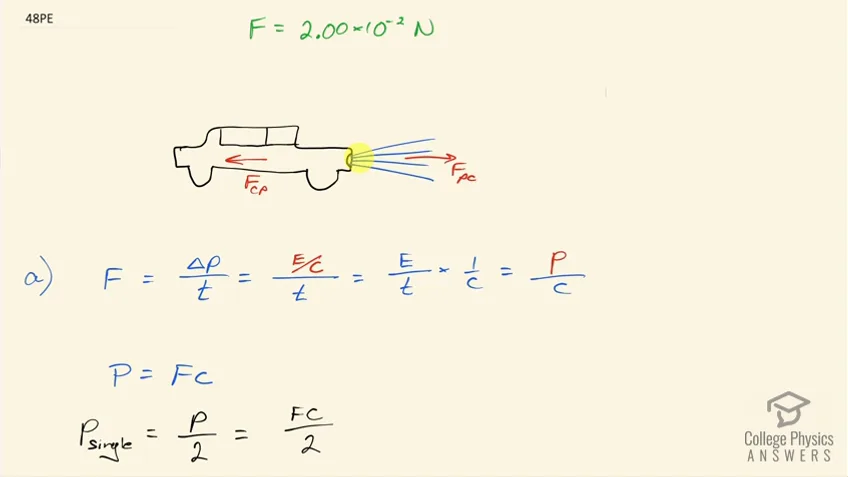 2:37PreviewProblem 48Full video with free trialA car feels a small force due to the light it sends out from its headlights, equal to the momentum of the light divided by the time in which it is emitted. (a) Calculate the power of each headlight, if they exert a total force of backward on the car. (b) What is unreasonable about this result? (c) Which assumptions are unreasonable or inconsistent?
29.6 The Wave Nature of Matter
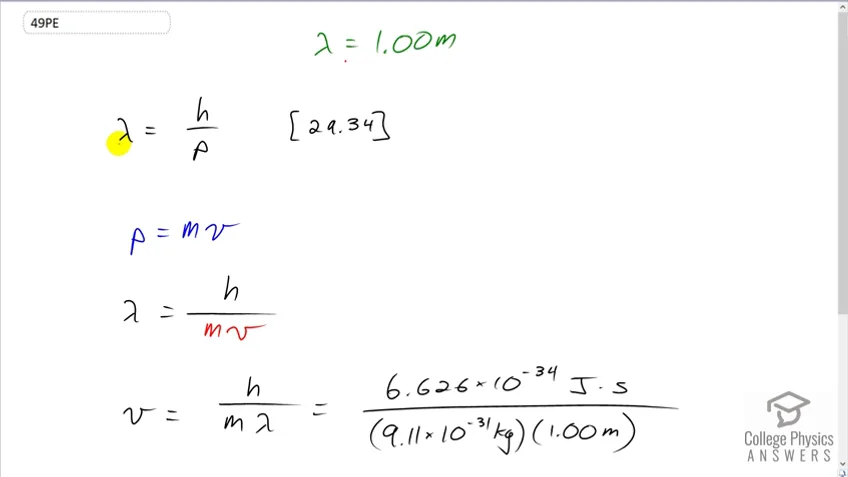 0:45PreviewProblem 49Full video with free trialAt what velocity will an electron have a wavelength of 1.00 m?
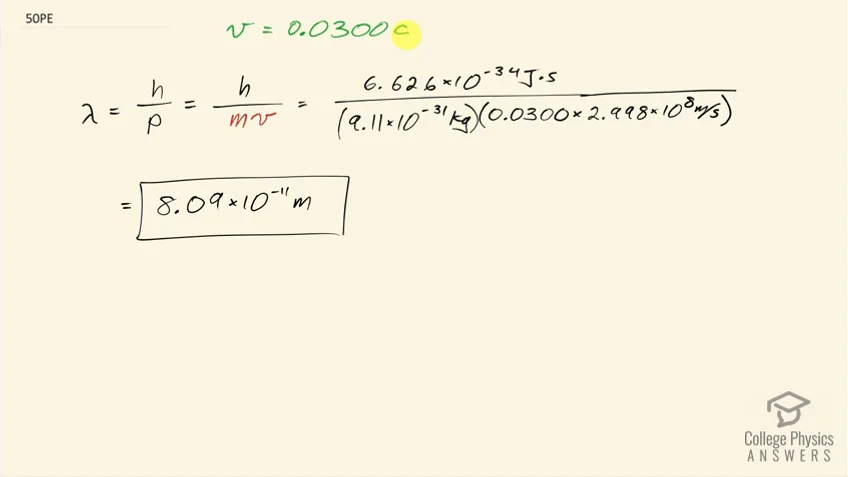 0:38PreviewProblem 50Full video with free trialWhat is the wavelength of an electron moving at 3.00% of the speed of light?
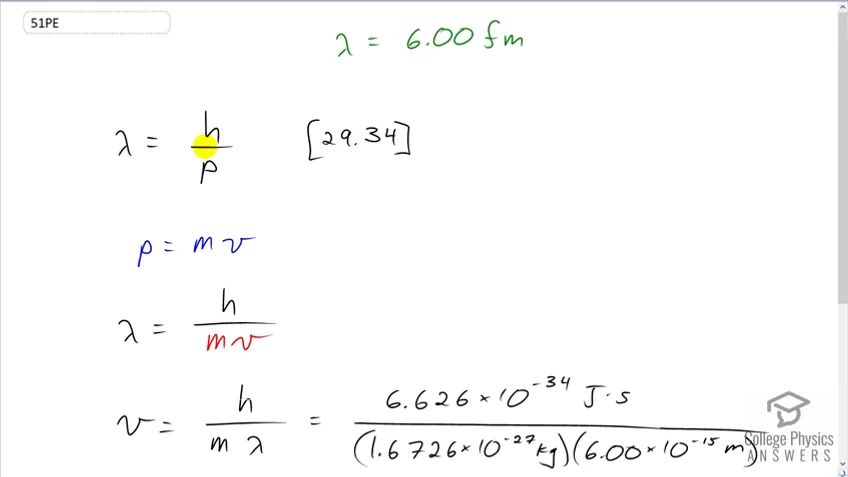 0:53PreviewProblem 51Full video with free trialAt what velocity does a proton have a 6.00-fm wavelength (about the size of a nucleus)? Assume the proton is nonrelativistic. (1 femtometer = . )
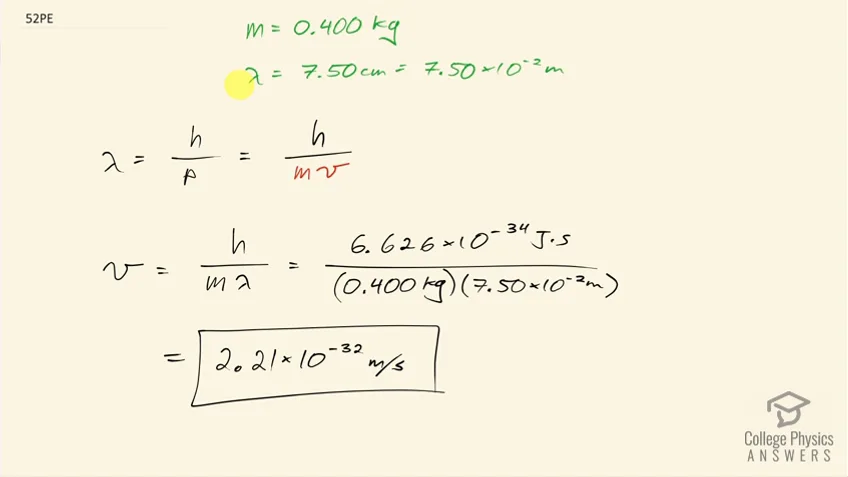 0:51PreviewProblem 52Full video with free trialWhat is the velocity of a 0.400-kg billiard ball if its wavelength is 7.50 cm (large enough for it to interfere with other billiard balls)?
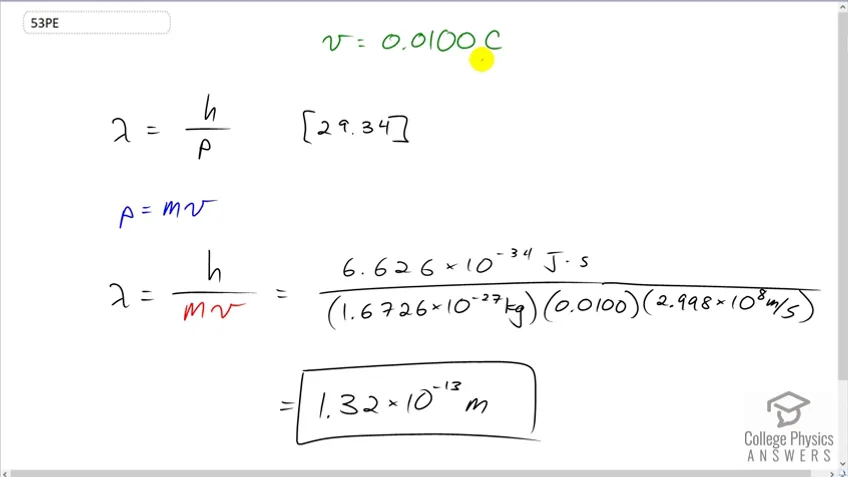 0:34PreviewProblem 53Full video with free trialFind the wavelength of a proton moving at 1.00% of the speed of light.
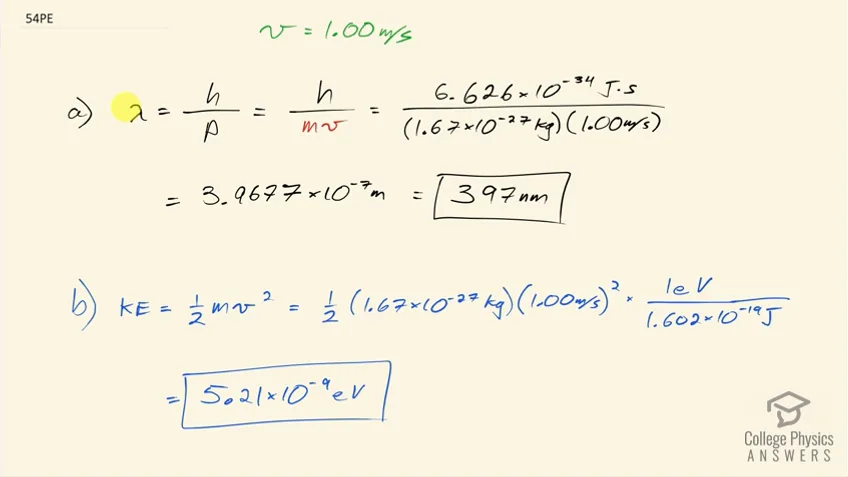 0:59PreviewProblem 54Full video with free trialExperiments are performed with ultracold neutrons having velocities as small as 1.00 m/s. (a) What is the wavelength of such a neutron? (b) What is its kinetic energy in eV?
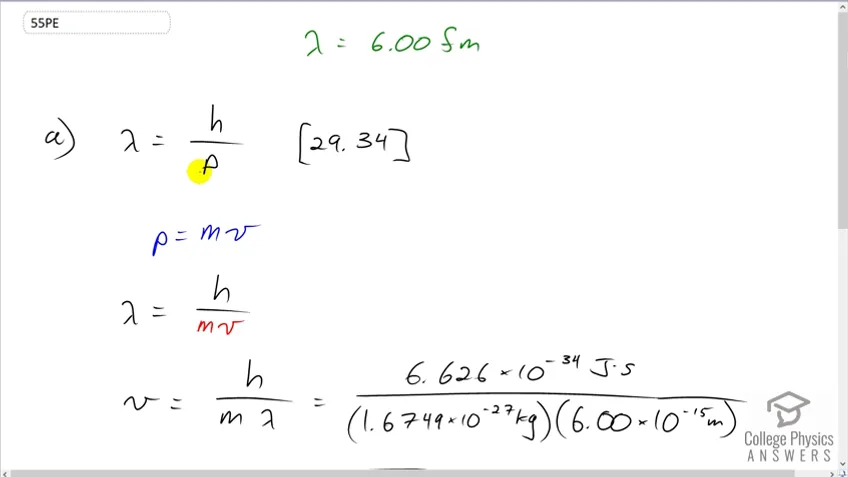 1:28PreviewProblem 55Full video with free trial(a) Find the velocity of a neutron that has a 6.00-fm wavelength (about the size of a nucleus). Assume the neutron is nonrelativistic. (b) What is the neutron’s kinetic energy in MeV?
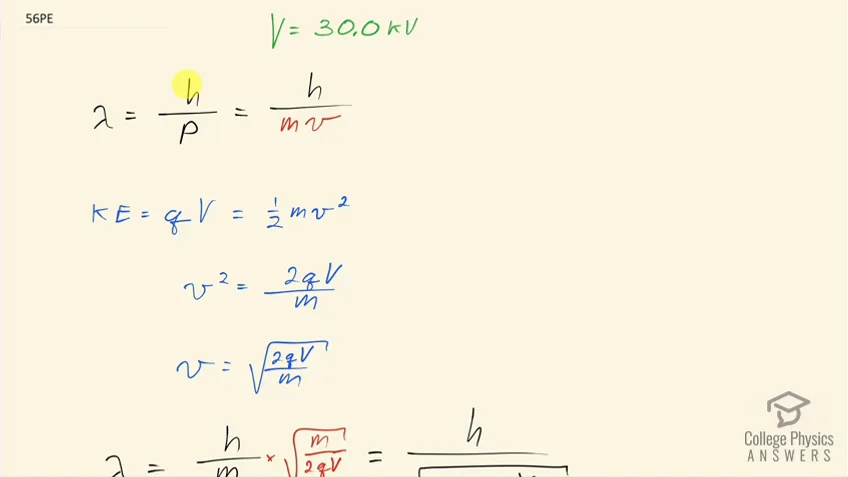 1:57PreviewProblem 56Full video with free trialWhat is the wavelength of an electron accelerated through a 30.0-kV potential, as in a TV tube?
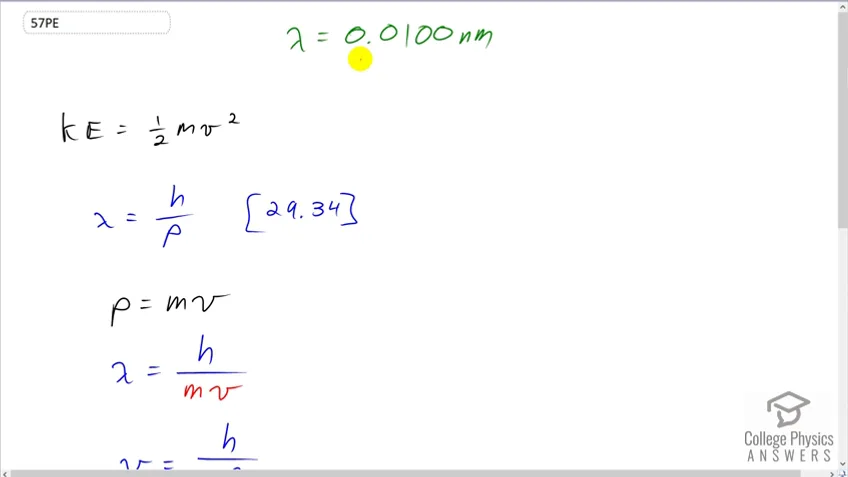 1:34PreviewProblem 57Full video with free trialWhat is the kinetic energy of an electron in a TEM having a 0.0100-nm wavelength?
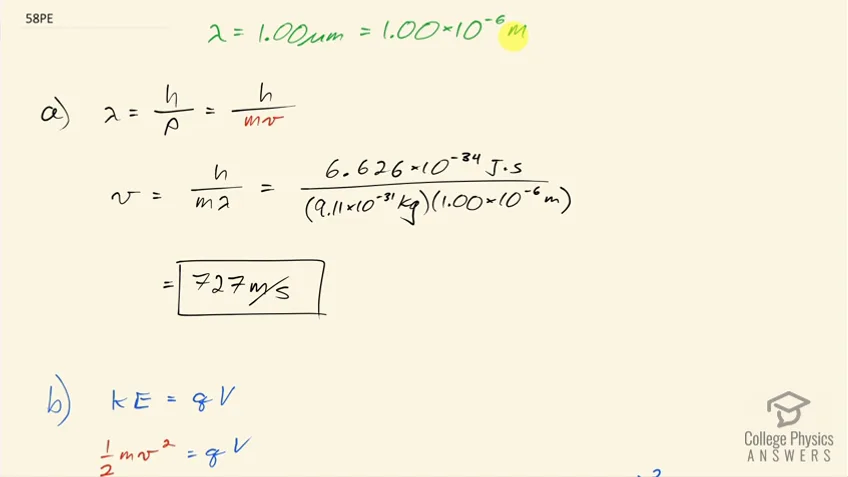 1:57PreviewProblem 58Full video with free trial(a) Calculate the velocity of an electron that has a wavelength of . (b) Through what voltage must the electron be accelerated to have this velocity?
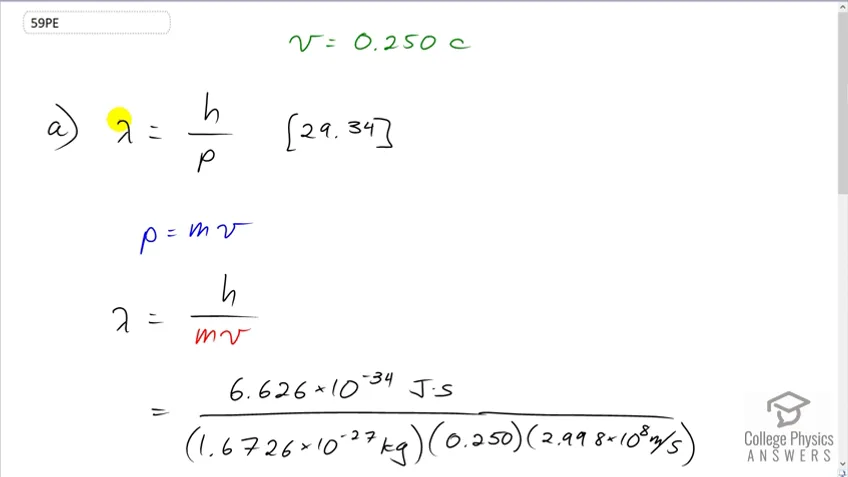 1:27PreviewProblem 59Full video with free trialThe velocity of a proton emerging from a Van de Graaff accelerator is 25.0% of the speed of light. (a) What is the proton’s wavelength? (b) What is its kinetic energy, assuming it is nonrelativistic? (c) What was the equivalent voltage through which it was accelerated?
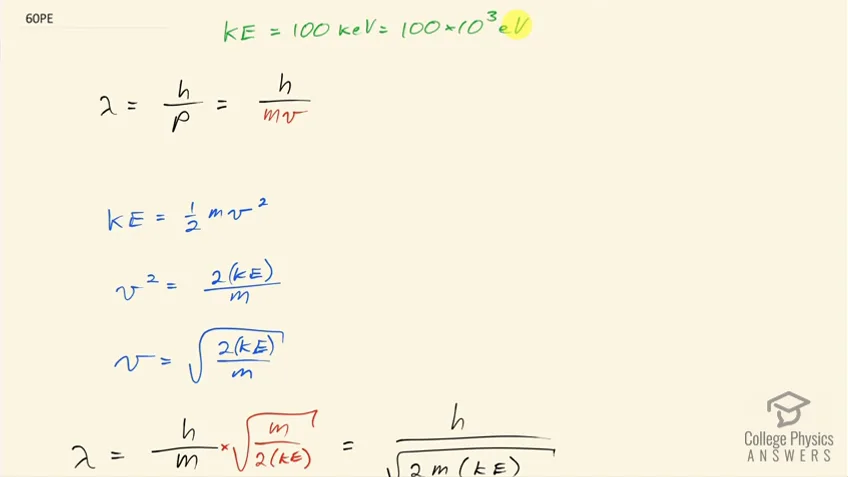 2:22PreviewProblem 60Full video with free trialThe kinetic energy of an electron accelerated in an x-ray tube is 100 keV. Assuming it is nonrelativistic, what is its wavelength?
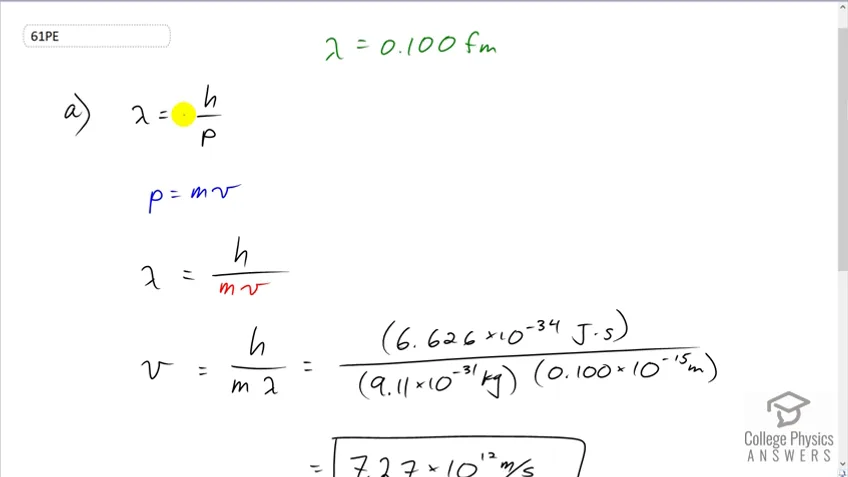 1:10PreviewProblem 61Full video with free trial(a) Assuming it is nonrelativistic, calculate the velocity of an electron with a 0.100-fm wavelength (small enough to detect details of a nucleus). (b) What is unreasonable about this result? (c) Which assumptions are unreasonable or inconsistent?
29.7 Probability: The Heisenberg Uncertainty Principle
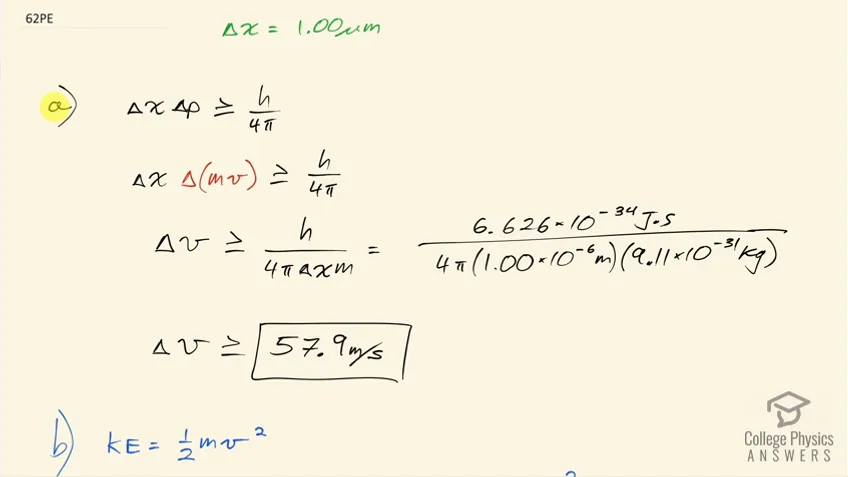 2:32PreviewProblem 62Full video with free trial(a) If the position of an electron in a membrane is measured to an accuracy of , what is the electron’s minimum uncertainty in velocity? (b) If the electron has this velocity, what is its kinetic energy in eV? (c) What are the implications of this energy, comparing it to typical molecular binding energies?
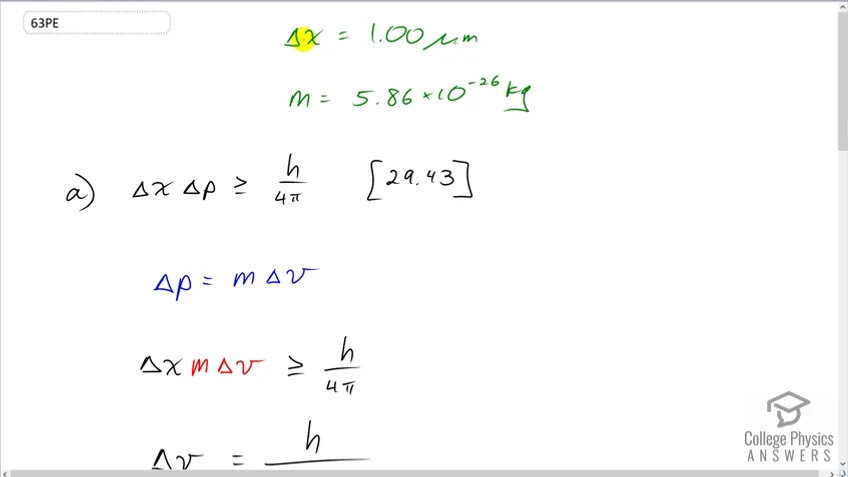 2:27PreviewProblem 63Full video with free trial(a) If the position of a chlorine ion in a membrane is measured to an accuracy of 1.00 μm , what is its minimum uncertainty in velocity, given its mass is (b) If the ion has this velocity, what is its kinetic energy in eV, and how does this compare with typical molecular binding energies?
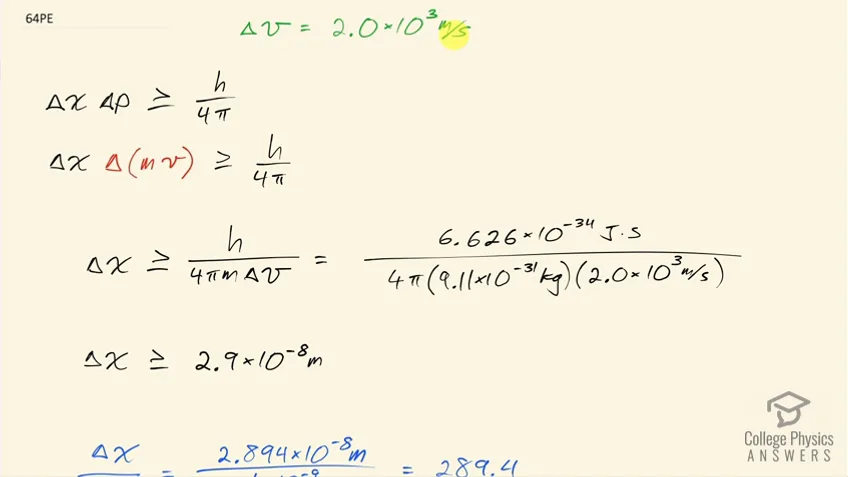 1:59PreviewProblem 64Full video with free trialSuppose the velocity of an electron in an atom is known to an accuracy of (reasonably accurate compared with orbital velocities). What is the electron’s minimum uncertainty in position, and how does this compare with the approximate 0.1-nm size of the atom?
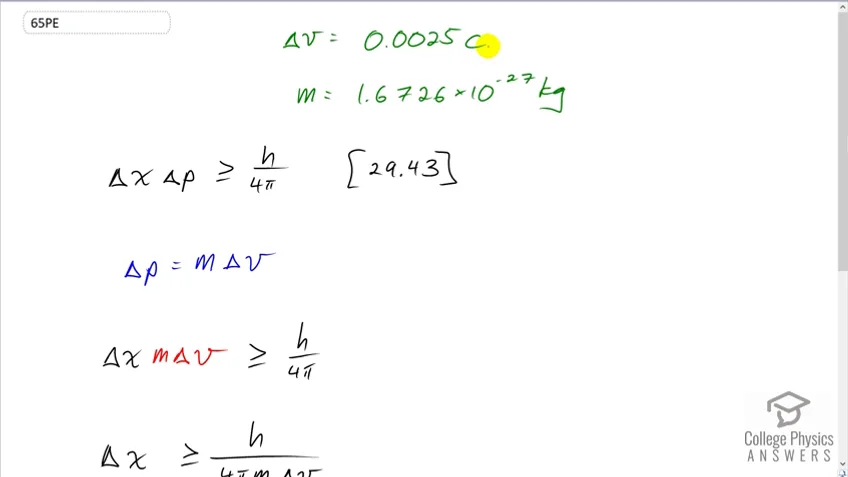 1:18PreviewProblem 65Full video with free trialThe velocity of a proton in an accelerator is known to an accuracy of 0.250% of the speed of light. (This could be small compared with its velocity.) What is the smallest possible uncertainty in its position?
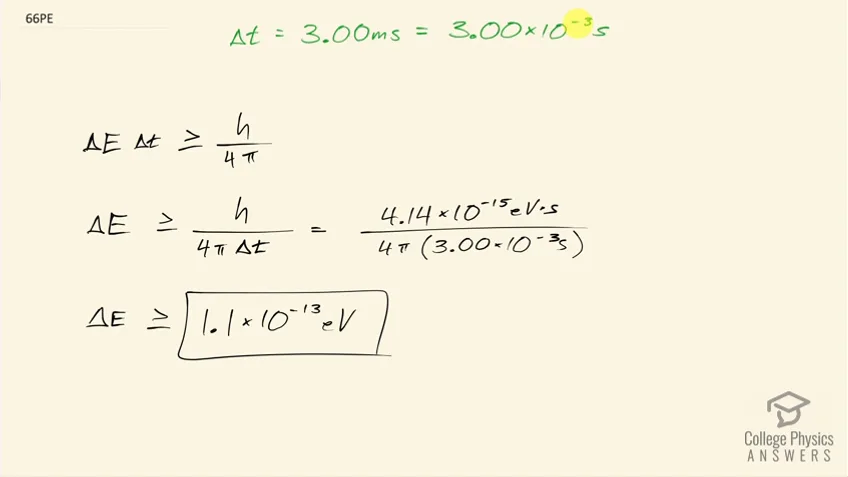 1:14PreviewProblem 66Full video with free trialA relatively long-lived excited state of an atom has a lifetime of 3.00 ms. What is the minimum uncertainty in its energy?
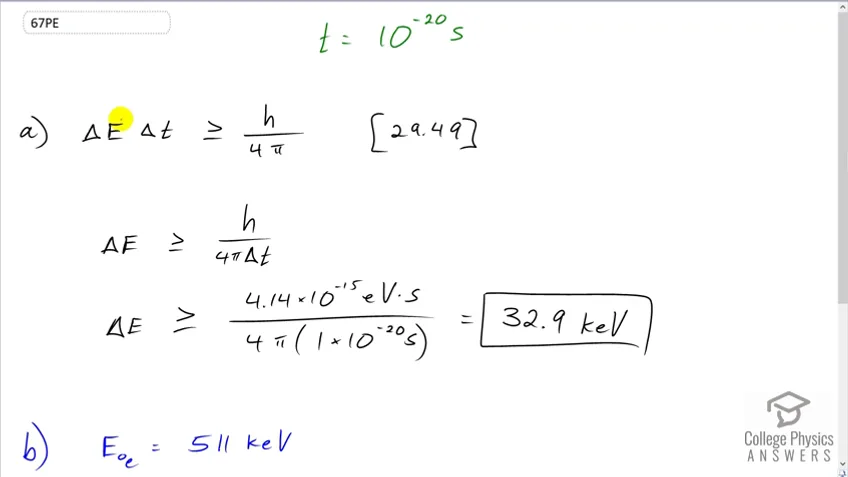 1:33PreviewProblem 67Full video with free trial(a) The lifetime of a highly unstable nucleus is 10−20 s . What is the smallest uncertainty in its decay energy? (b) Compare this with the rest energy of an electron.
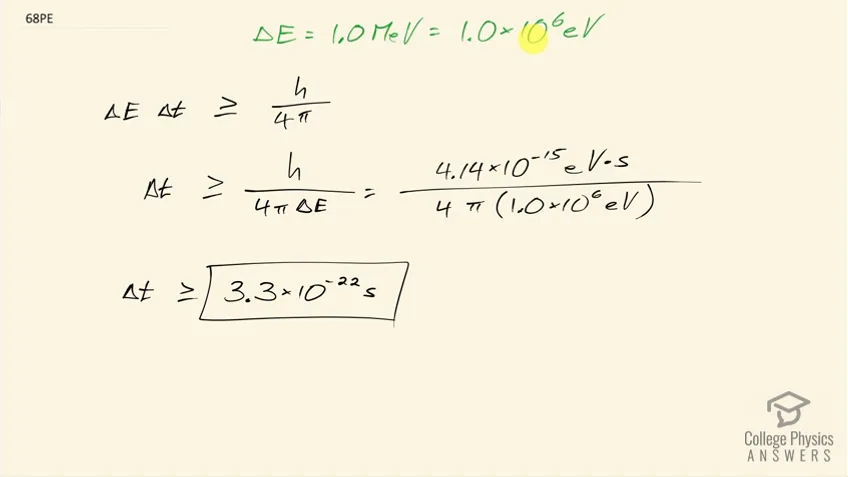 1:11PreviewProblem 68Full video with free trialThe decay energy of a short-lived particle has an uncertainty of 1.0 MeV due to its short lifetime. What is the smallest lifetime it can have?
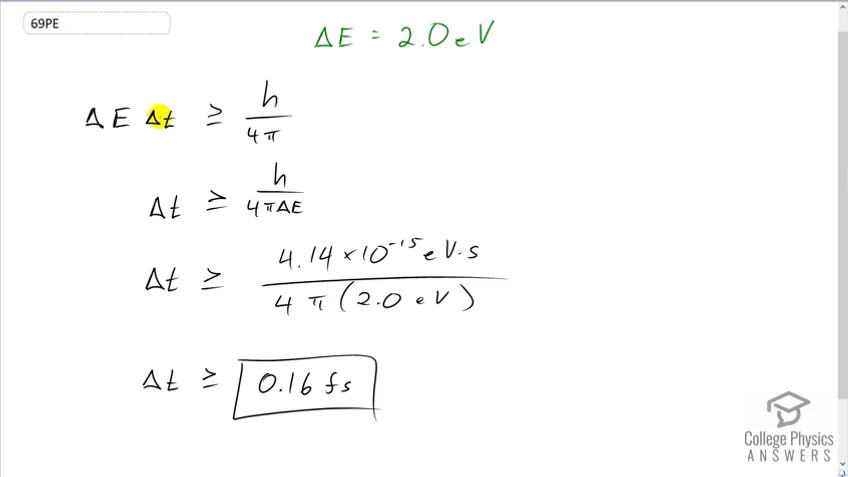 0:45PreviewProblem 69Full video with free trialThe decay energy of a short-lived nuclear excited state has an uncertainty of 2.0 eV due to its short lifetime. What is the smallest lifetime it can have?
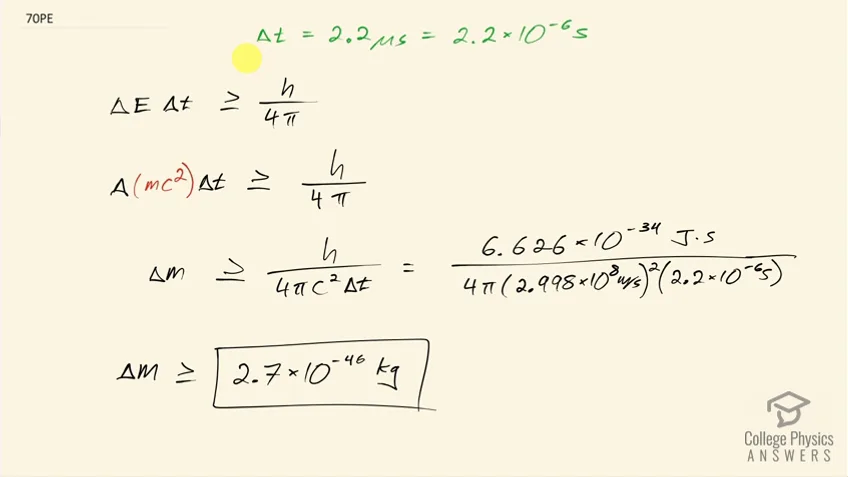 1:33PreviewProblem 70Full video with free trialWhat is the approximate uncertainty in the mass of a muon, as determined from its decay lifetime?
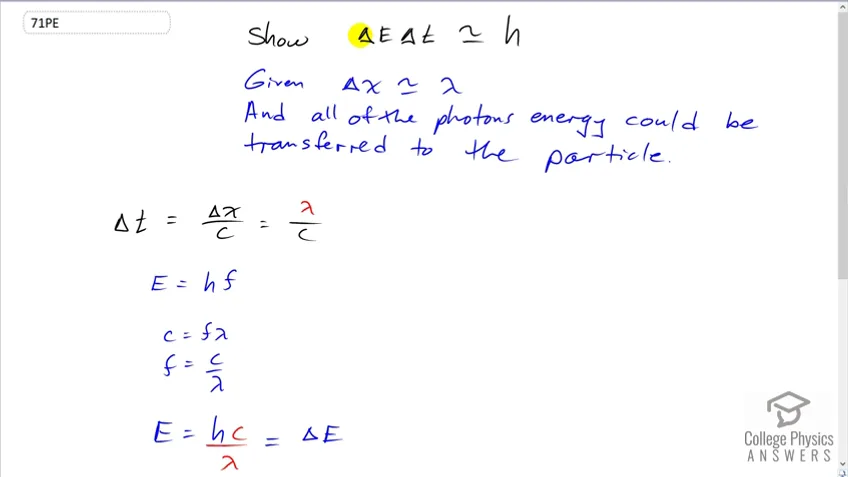 2:08PreviewProblem 71Full video with free trialDerive the approximate form of Heisenberg’s uncertainty principle for energy and time, , using the following arguments: Since the position of a particle is uncertain by , where is the wavelength of the photon used to examine it, there is an uncertainty in the time the photon takes to traverse . Furthermore, the photon has an energy related to its wavelength, and it can transfer some or all of this energy to the object being examined. Thus the uncertainty in the energy of the object is also related to . Find and ; then multiply them to give the approximate uncertainty principle.
29.8 The Particle-Wave Duality Reviewed
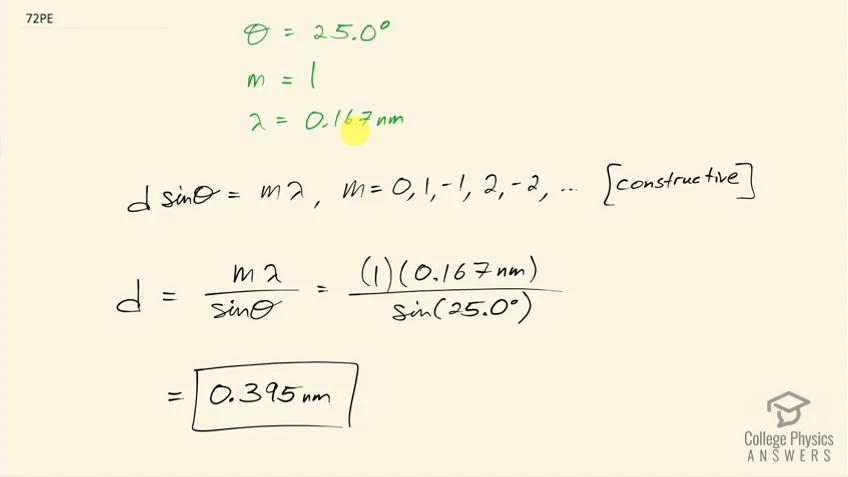 1:07PreviewProblem 72Full video with free trialThe 54.0-eV electron in Example 29.7 has a 0.167-nm wavelength. If such electrons are passed through a double slit and have their first maximum at an angle of 25.0o , what is the slit separation d ?
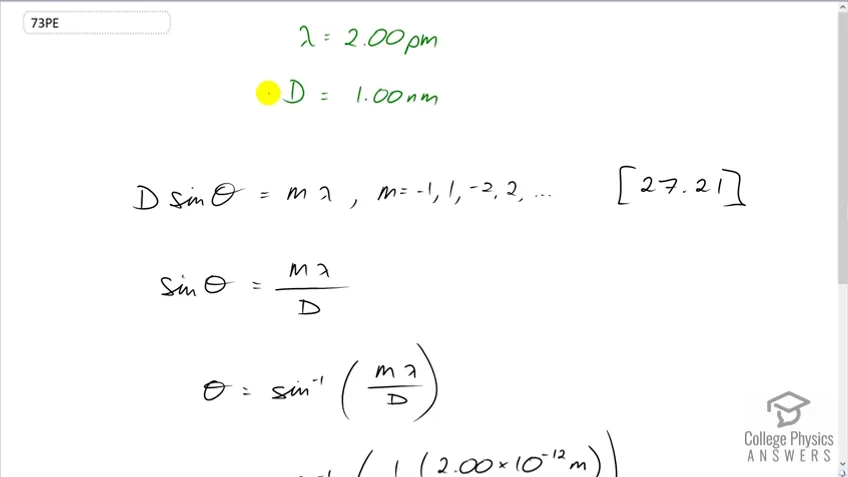 1:29PreviewProblem 73Full video with free trialAn electron microscope produces electrons with a 2.00-pm wavelength. If these are passed through a 1.00-nm single slit, at what angle will the first diffraction minimum be found?
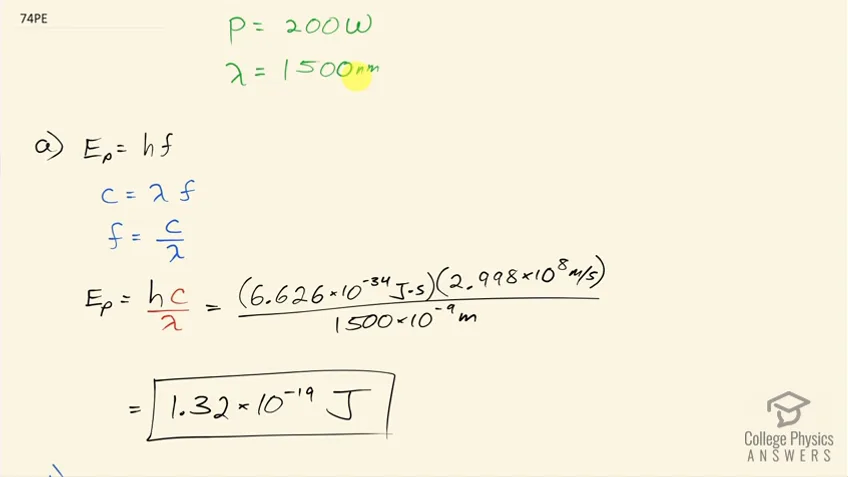 3:48PreviewProblem 74Full video with free trialA certain heat lamp emits 200 W of mostly IR radiation averaging 1500 nm in wavelength. (a) What is the average photon energy in joules? (b) How many of these photons are required to increase the temperature of a person’s shoulder by , assuming the affected mass is 4.0 kg with a specific heat of . Also assume no other significant heat transfer. (c) How long does this take?
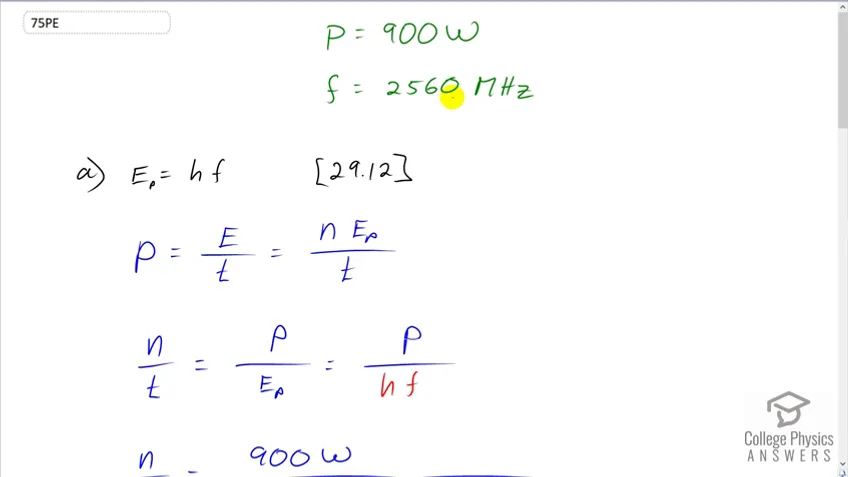 4:00PreviewProblem 75Full video with free trialOn its high power setting, a microwave oven produces 900 W of 2560 MHz microwaves. (a) How many photons per second is this? (b) How many photons are required to increase the temperature of a 0.500-kg mass of pasta by , assuming a specific heat of ? Neglect all other heat transfer. (c) How long must the microwave operator wait for their pasta to be ready?
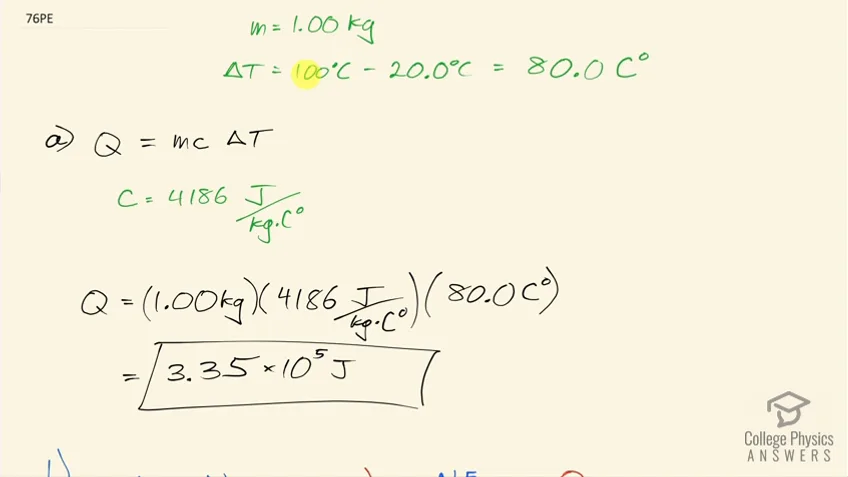 2:34PreviewProblem 76Full video with free trial(a) Calculate the amount of microwave energy in joules needed to raise the temperature of 1.00 kg of soup from to . (b) What is the total momentum of all the microwave photons it takes to do this? (c) Calculate the velocity of a 1.00-kg mass with the same momentum. (d) What is the kinetic energy of this mass?
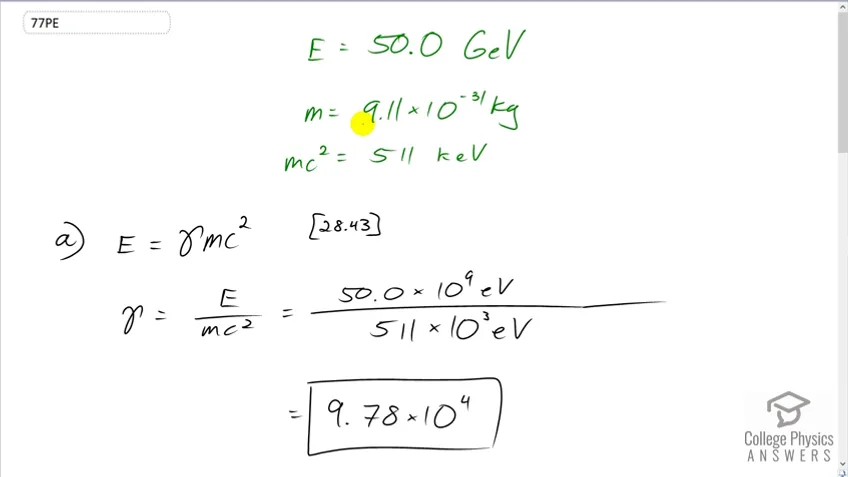 2:51PreviewProblem 77Full video with free trial(a) What is for an electron emerging from the Stanford Linear Accelerator with a total energy of 50.0 GeV? (b) Find its momentum. (c) What is the electron’s wavelength?
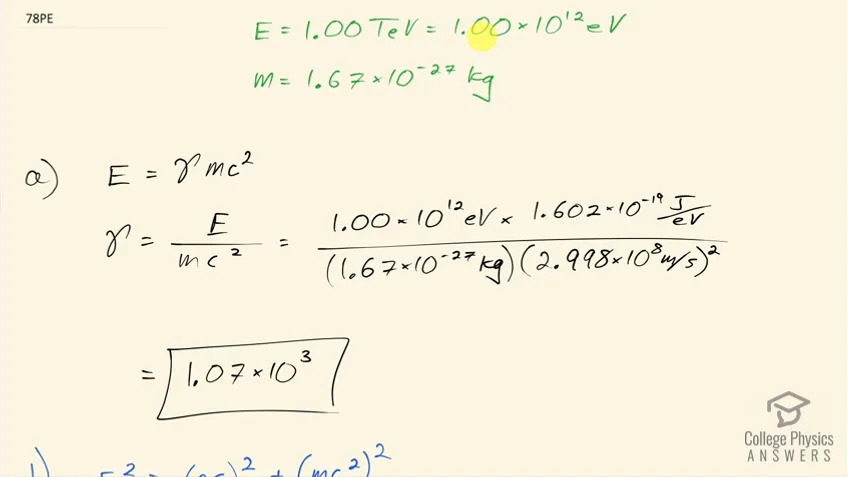 2:20PreviewProblem 78Full video with free trial(a) What is for a proton having an energy of 1.00 TeV, produced by the Fermilab accelerator? (b) Find its momentum. (c) What is the proton’s wavelength?
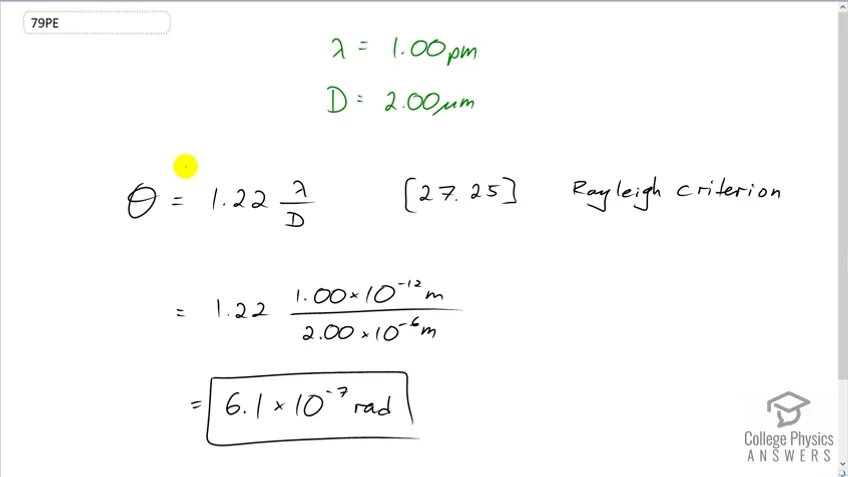 0:53PreviewProblem 79Full video with free trialAn electron microscope passes 1.00-pm-wavelength electrons through a circular aperture in diameter. What is the angle between two just-resolvable point sources for this microscope?
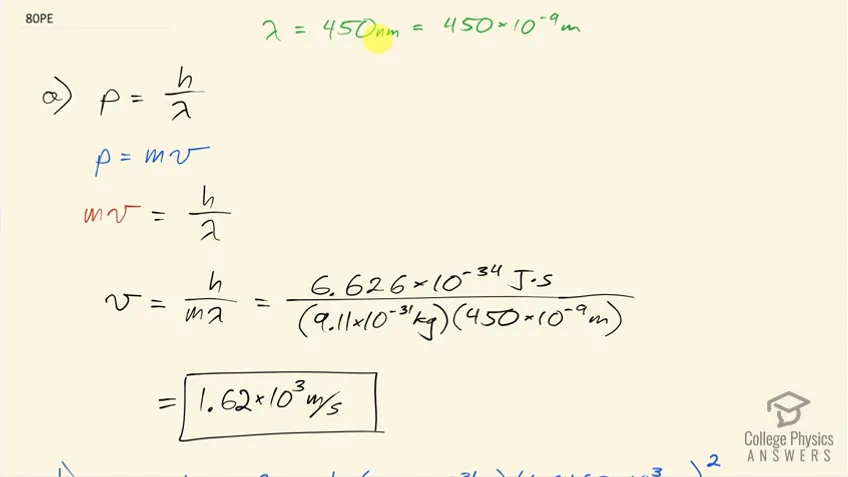 2:14PreviewProblem 80Full video with free trial(a) Calculate the velocity of electrons that form the same pattern as 450-nm light when passed through a double slit. (b) Calculate the kinetic energy of each and compare them. (c) Would either be easier to generate than the other? Explain.
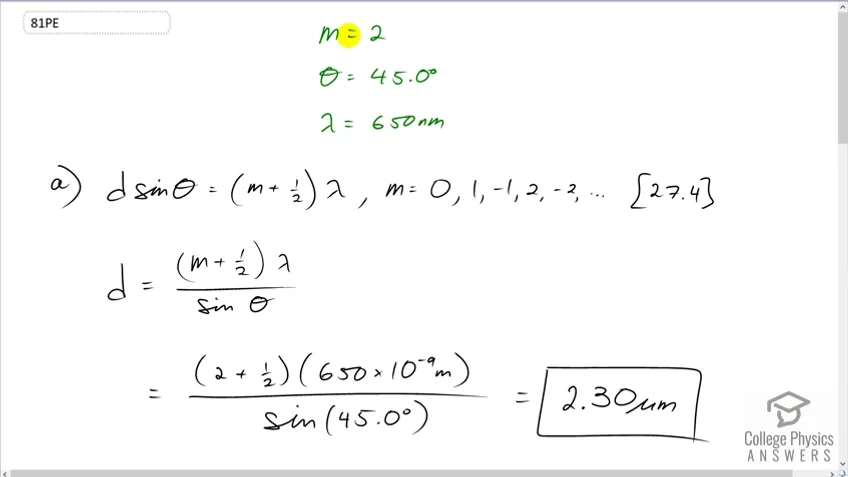 4:11PreviewProblem 81Full video with free trial(a) What is the separation between double slits that produces a second-order minimum at for 650-nm light? (b) What slit separation is needed to produce the same pattern for 1.00-keV protons.
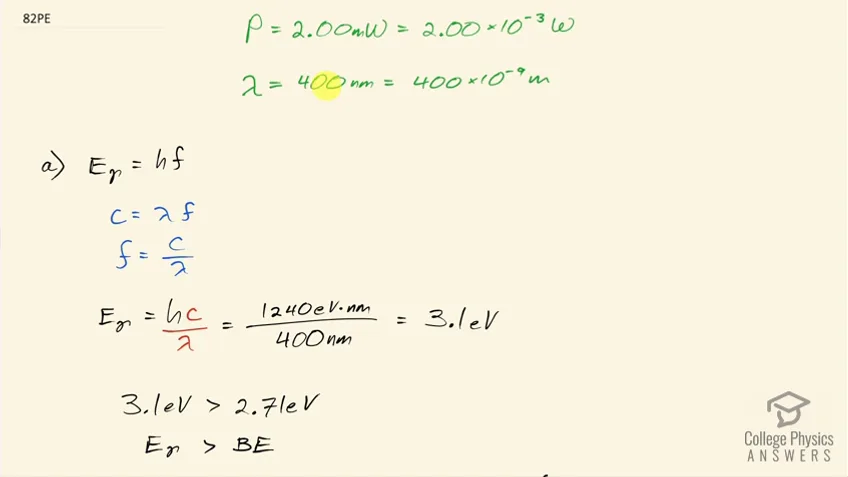 7:57PreviewProblem 82Full video with free trialA laser with a power output of 2.00 mW at a wavelength of 400 nm is projected onto calcium metal. (a) How many electrons per second are ejected? (b) What power is carried away by the electrons, given that the binding energy is 2.71 eV? (c) Calculate the current of ejected electrons. (d) If the photoelectric material is electrically insulated and acts like a 2.00-pF capacitor, how long will current flow before the capacitor voltage stops it?
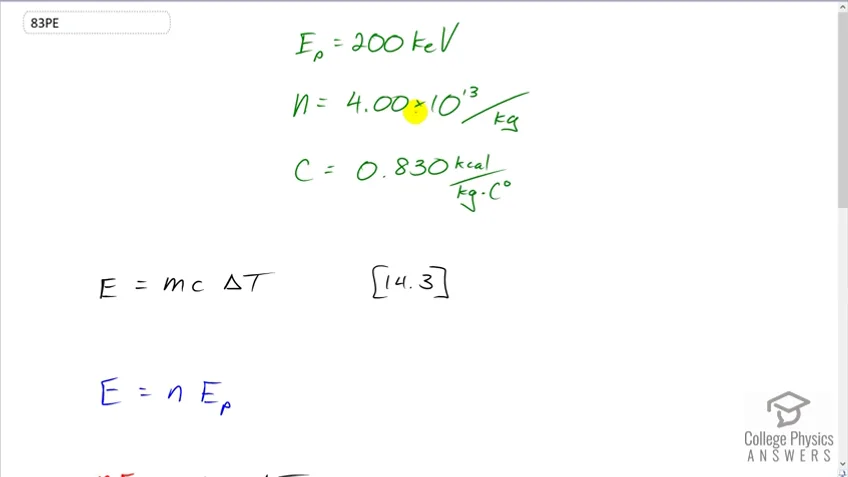 2:41PreviewProblem 83Full video with free trialOne problem with x-rays is that they are not sensed. Calculate the temperature increase of a researcher exposed in a few seconds to a nearly fatal accidental dose of x-rays under the following conditions. The energy of the x-ray photons is 200 keV, and of them are absorbed per kilogram of tissue, the specific heat of which is . (Note that medical diagnostic x-ray machines cannot produce an intensity this great.)
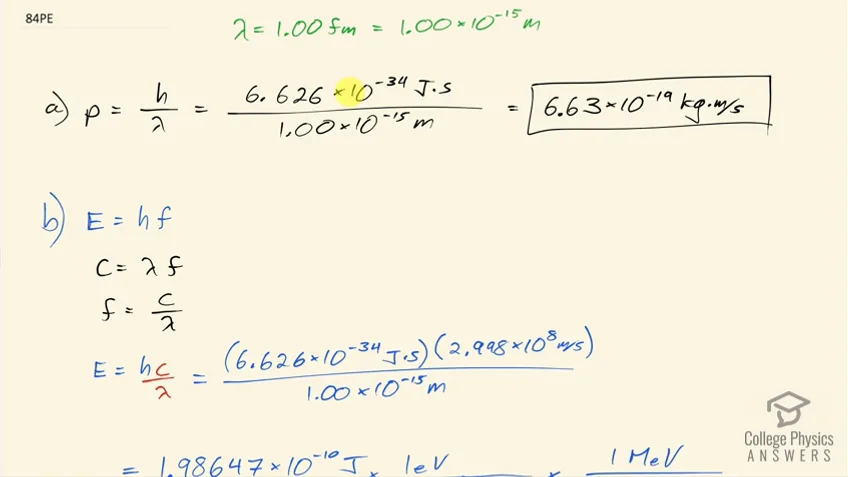 5:58PreviewProblem 84Full video with free trialA 1.00-fm photon has a wavelength short enough to detect some information about nuclei. (a) What is the photon momentum? (b) What is its energy in joules and MeV? (c) What is the (relativistic) velocity of an electron with the same momentum? (d) Calculate the electron’s kinetic energy.
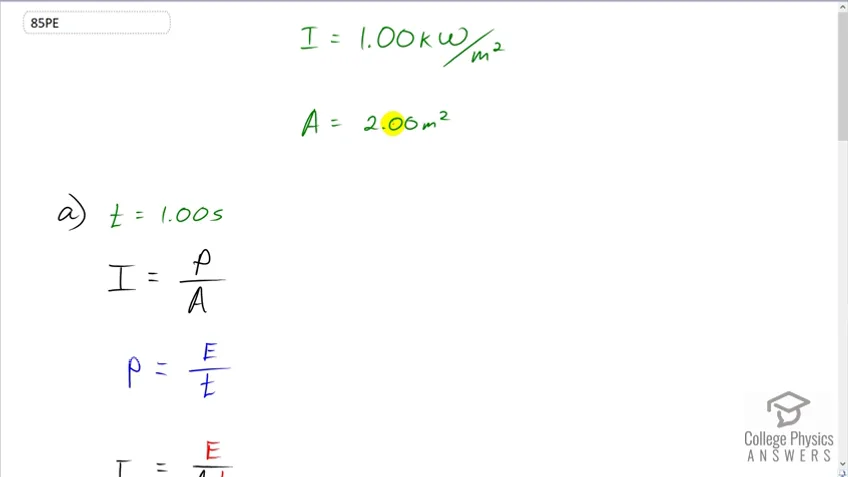 3:09PreviewProblem 85Full video with free trialThe momentum of light is exactly reversed when reflected straight back from a mirror, assuming negligible recoil of the mirror. Thus the change in momentum is twice the photon momentum. Suppose light of intensity reflects from a mirror of area . (a) Calculate the energy reflected in 1.00 s. (b) What is the momentum imparted to the mirror? (c) Using the most general form of Newton’s second law, what is the force on the mirror? (d) Does the assumption of no mirror recoil seem reasonable?
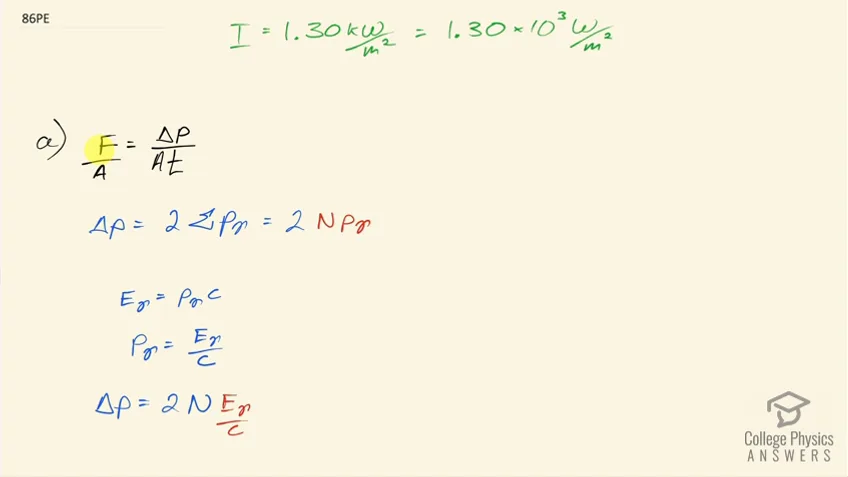 5:02PreviewProblem 86Full video with free trialSunlight above the Earth’s atmosphere has an intensity of . If this is reflected straight back from a mirror that has only a small recoil, the light’s momentum is exactly reversed, giving the mirror twice the incident momentum. (a) Calculate the force per square meter of mirror. (b) Very low mass mirrors can be constructed in the near weightlessness of space, and attached to a spaceship to sail it. Once done, the average mass per square meter of the spaceship is 0.100 kg. Find the acceleration of the spaceship if all other forces are balanced. (c) How fast is it moving 24 hours later?
Test Prep for AP® Courses
29.1 Quantization of Energy
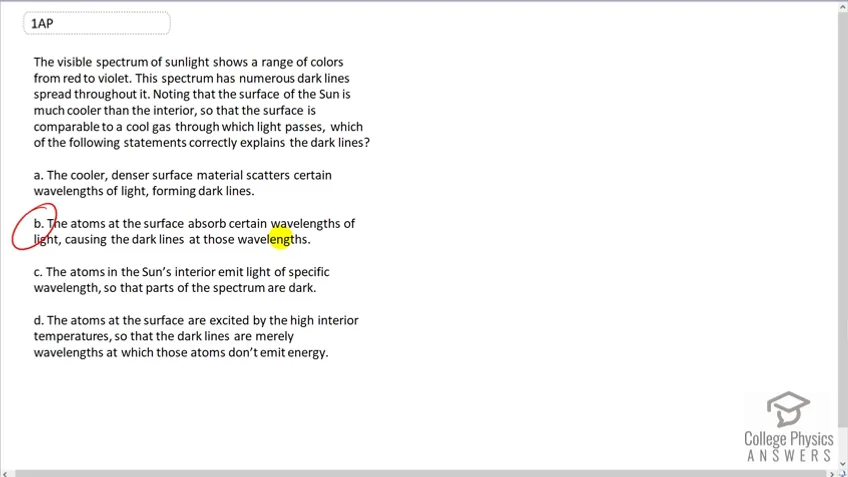 0:28PreviewProblem 1Full video with free trialThe visible spectrum of sunlight shows a range of colors from red to violet. This spectrum has numerous dark lines spread throughout it. Noting that the surface of the Sun is much cooler than the interior, so that the surface is comparable to a cool gas through which light passes, which of the following statements correctly explains the dark lines? (a) The cooler, denser surface material scatters certain wavelengths of light, forming dark lines.
(b) The atoms at the surface absorb certain wavelengths of light, causing the dark lines at those wavelengths.
(c) The atoms in the Sun’s interior emit light of specific wavelength, so that parts of the spectrum are dark.
(d) The atoms at the surface are excited by the high interior temperatures, so that the dark lines are merely wavelengths at which those atoms don’t emit energy.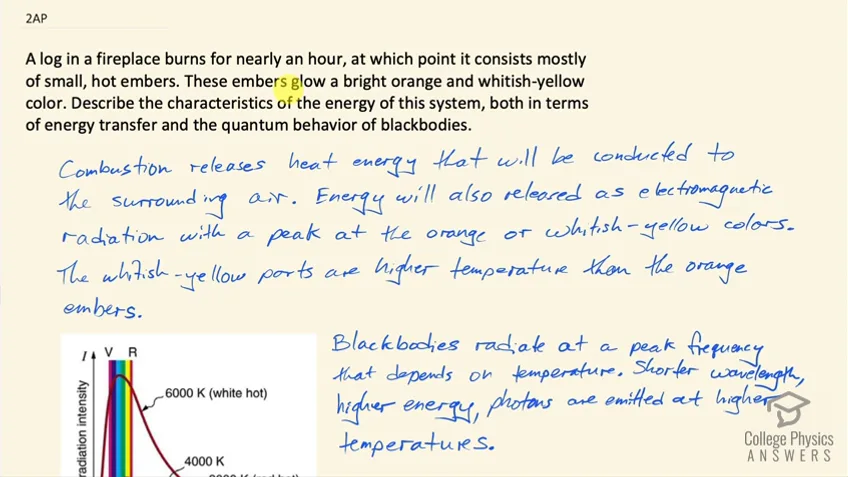 2:44PreviewProblem 2Full video with free trialA log in a fireplace burns for nearly an hour, at which point it consists mostly of small, hot embers. These embers glow a bright orange and whitish-yellow color. Describe the characteristics of the energy of this system, both in terms of energy transfer and the quantum behavior of blackbodies.
29.2 The Photoelectric Effect
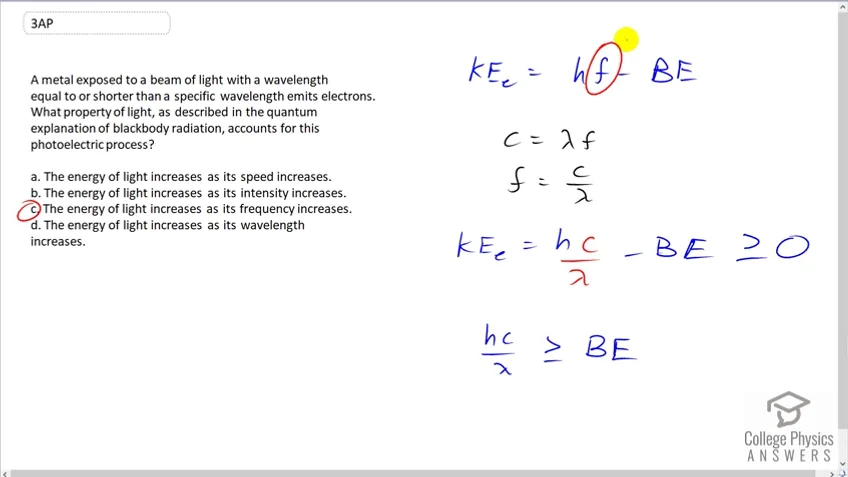 1:49PreviewProblem 3Full video with free trialA metal exposed to a beam of light with a wavelength equal to or shorter than a specific wavelength emits electrons. What property of light, as described in the quantum explanation of blackbody radiation, accounts for this photoelectric process? (a) The energy of light increases as its speed increases.
(b) The energy of light increases as its intensity increases.
(c) The energy of light increases as its frequency increases.
(d) The energy of light increases as its wavelength increases.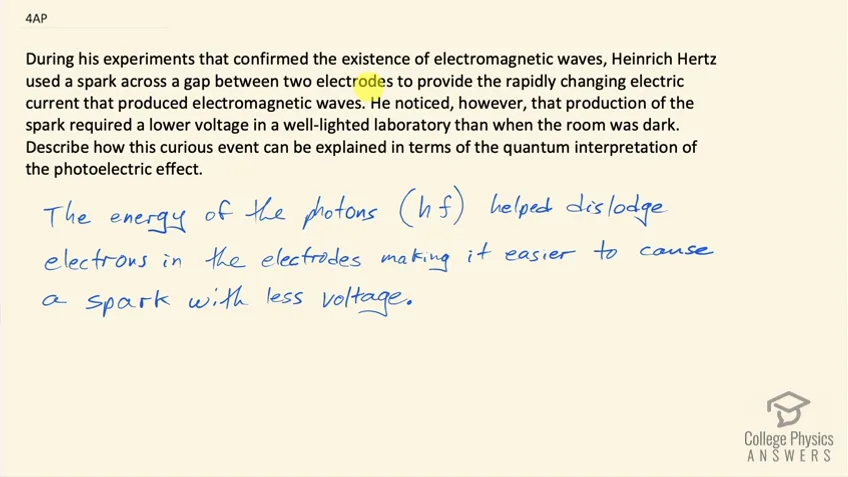 1:22PreviewProblem 4Full video with free trialDuring his experiments that confirmed the existence of electromagnetic waves, Heinrich Hertz used a spark across a gap between two electrodes to provide the rapidly changing electric current that produced electromagnetic waves. He noticed, however, that production of the spark required a lower voltage in a well-lighted laboratory than when the room was dark. Describe how this curious event can be explained in terms of the quantum interpretation of the photoelectric effect.
29.3 Photon Energies and the Electromagnetic Spectrum
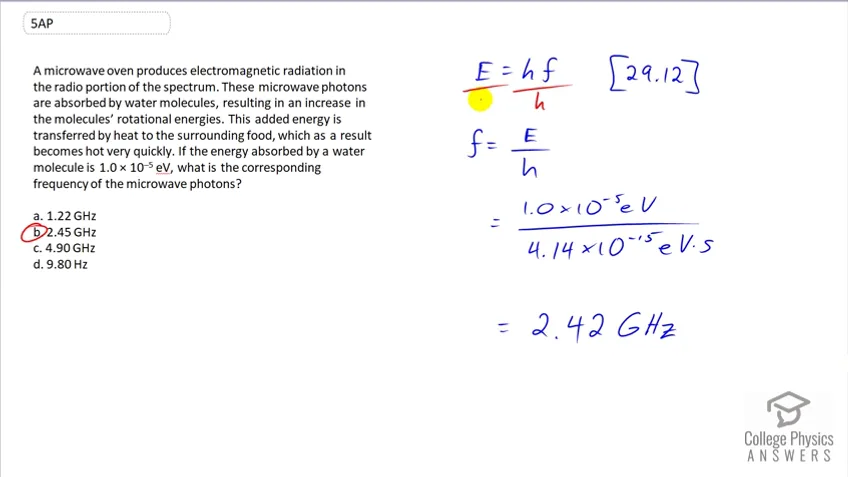 0:39PreviewProblem 5Full video with free trialA microwave oven produces electromagnetic radiation in the radio portion of the spectrum. These microwave photons are absorbed by water molecules, resulting in an increase in the molecules’ rotational energies. This added energy is transferred by heat to the surrounding food, which as a result becomes hot very quickly. If the energy absorbed by a water molecule is , what is the corresponding wavelength of the microwave photons?
(a) 1.22 GHz
(b) 2.45 GHz
(c) 4.90 GHz
(d) 9.80 GHz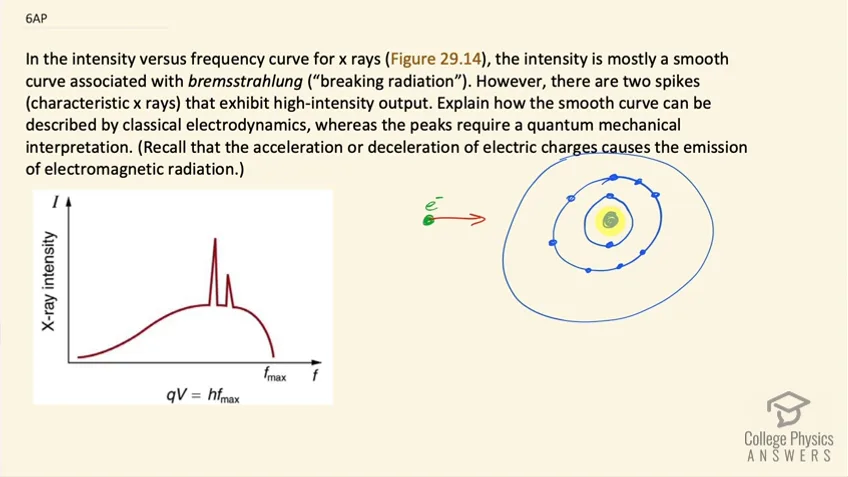 3:25PreviewProblem 6Full video with free trialIn the intensity versus frequency curve for x rays (Figure 29.14), the intensity is mostly a smooth curve associated with bremsstrahlung (“breaking radiation”). However, there are two spikes (characteristic x rays) that exhibit high-intensity output. Explain how the smooth curve can be described by classical electrodynamics, whereas the peaks require a quantum mechanical interpretation. (Recall that the acceleration or deceleration of electric charges causes the emission of electromagnetic radiation.)
29.4 Photon Momentum
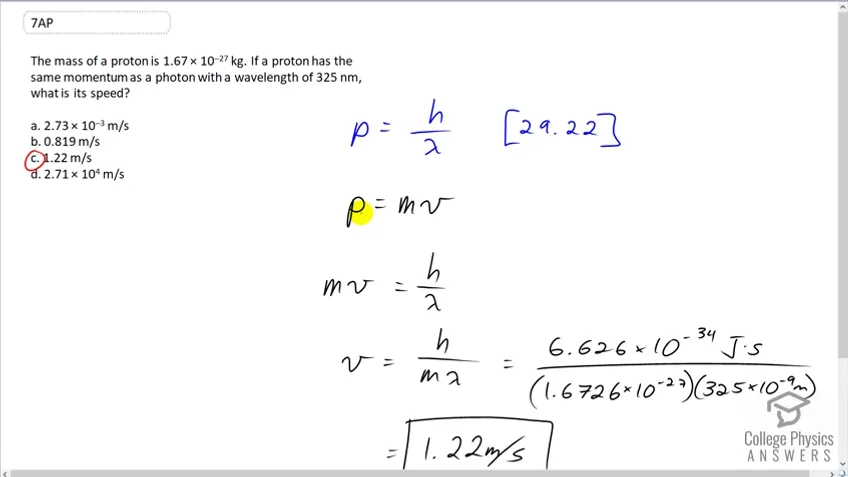 0:44PreviewProblem 7Full video with free trialThe mass of a proton is . If a proton has the same momentum as a photon with a wavelength of 325 nm, what is its speed? (a)
(b)
(c)
(d)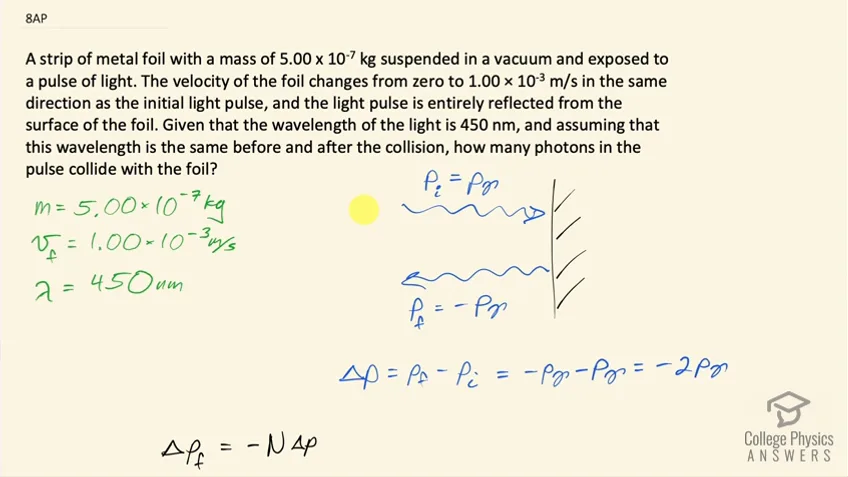 3:38PreviewProblem 8Full video with free trialA strip of metal foil with a mass of suspended in a vacuum and exposed to a pulse of light. The velocity of the foil changes from zero to in the same direction as the initial light pulse, and the light pulse is entirely reflected from the surface of the foil. Given that the wavelength of the light is 450 nm, and assuming that this wavelength is the same before and after the collision, how many photons in the pulse collide with the foil?
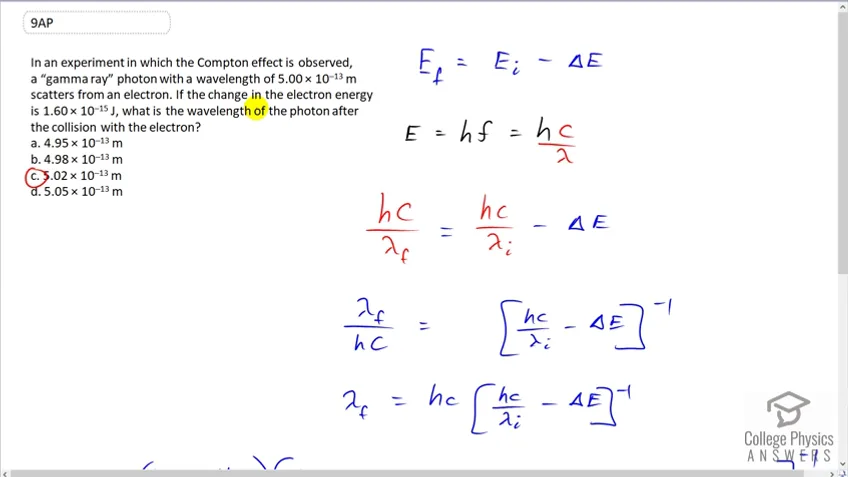 3:11PreviewProblem 9Full video with free trialIn an experiment in which the Compton effect is observed, a “gamma ray” photon with a wavelength of scatters from an electron. If the change in the electron energy is , what is the wavelength of the photon after the collision with the electron? (a)
(b)
(c)
(d)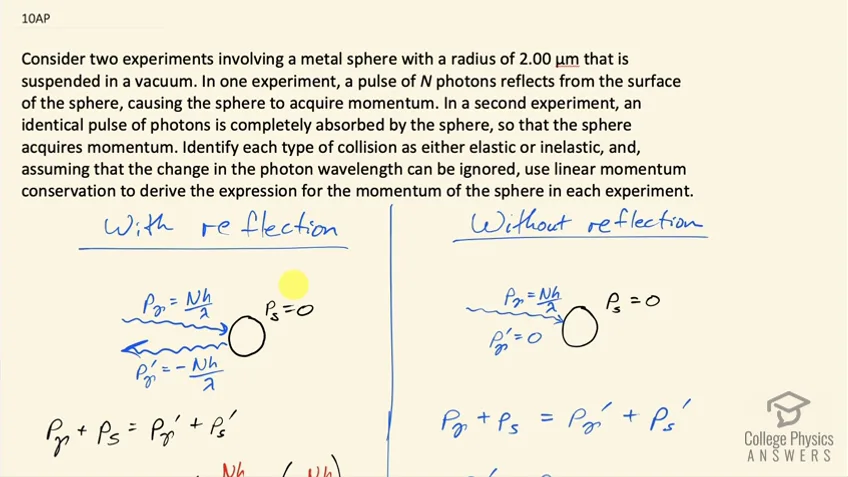 3:58PreviewProblem 10Full video with free trialConsider two experiments involving a metal sphere with a radius of that is suspended in a vacuum. In one experiment, a pulse of photons reflects from the surface of the sphere, causing the sphere to acquire momentum. In a second experiment, an identical pulse of photons is completely absorbed by the sphere, so that the sphere acquires momentum. Identify each type of collision as either elastic or inelastic, and, assuming that the change in the photon wavelength can be ignored, use linear momentum conservation to derive the expression for the momentum of the sphere in each experiment.
29.5 The Particle-Wave Duality
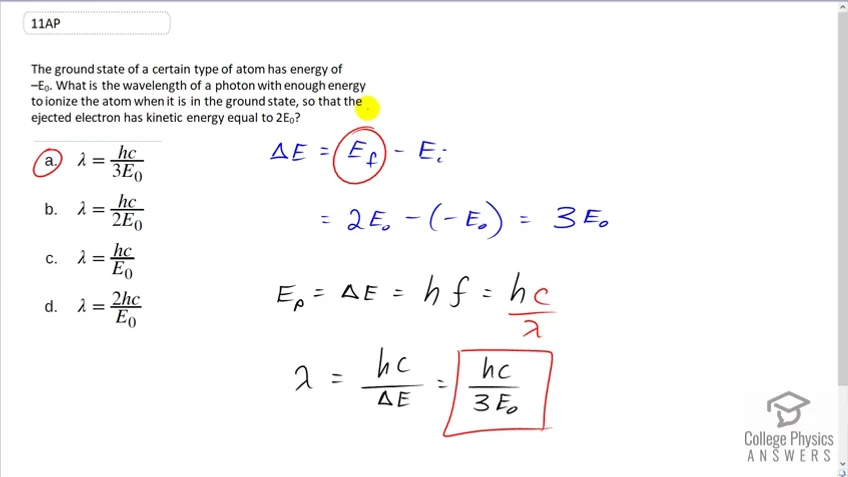 1:01PreviewProblem 11Full video with free trialThe ground state of a certain type of atom has energy of . What is the wavelength of a photon with enough energy to ionize the atom when it is in the ground state, so that the ejected electron has kinetic energy equal to ? (a)
(b)
(c)
(d)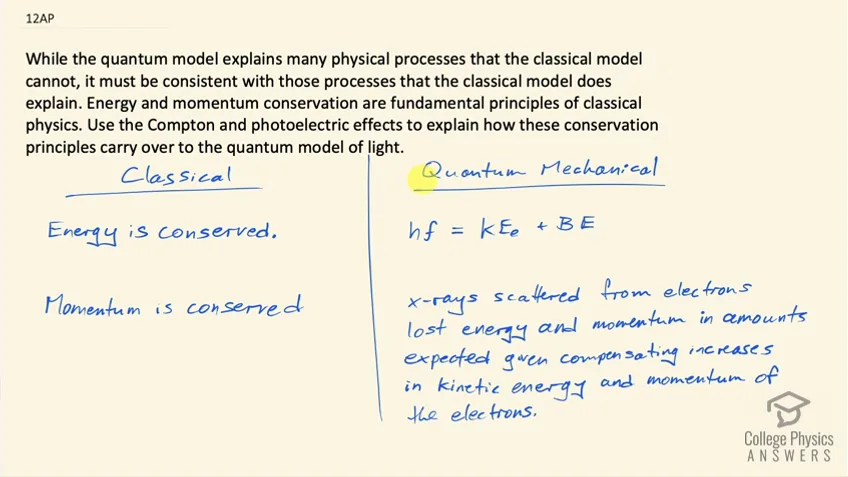 2:15PreviewProblem 12Full video with free trialWhile the quantum model explains many physical processes that the classical model cannot, it must be consistent with those processes that the classical model does explain. Energy and momentum conservation are fundamental principles of classical physics. Use the Compton and photoelectric effects to explain how these conservation principles carry over to the quantum model of light.
29.6 The Wave Nature of Matter
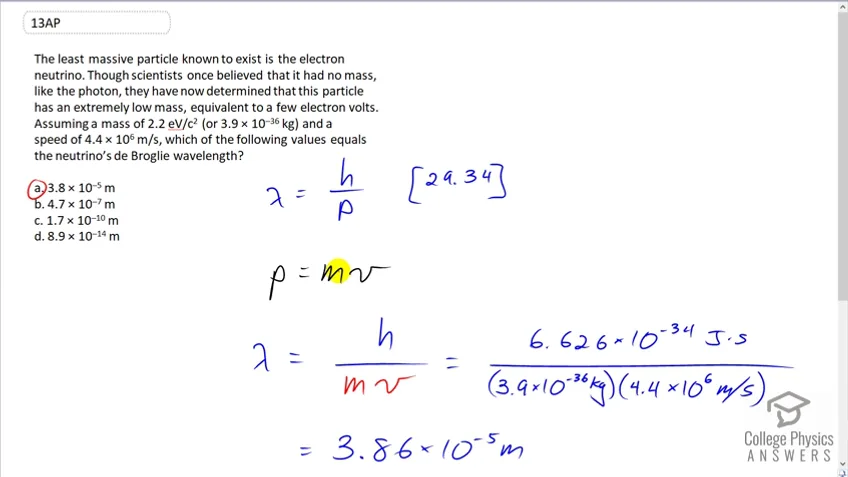 0:42PreviewProblem 13Full video with free trialThe least massive particle known to exist is the electron neutrino. Though scientists once believed that it had no mass, like the photon, they have now determined that this particle has an extremely low mass, equivalent to a few electron volts. Assuming a mass of (or ) and a speed of , which of the following values equals the neutrino’s de Broglie wavelength? (a)
(b)
(c)
(d)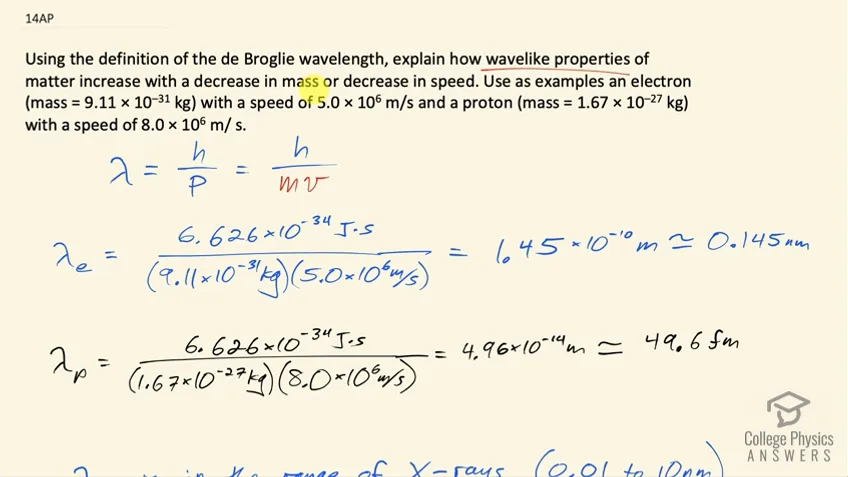 2:51PreviewProblem 14Full video with free trialUsing the definition of the de Broglie wavelength, explain how wavelike properties of matter increase with a decrease in mass or decrease in speed. Use as examples an electron (mass = ) with a speed of and a proton (mass = ) with a speed of .
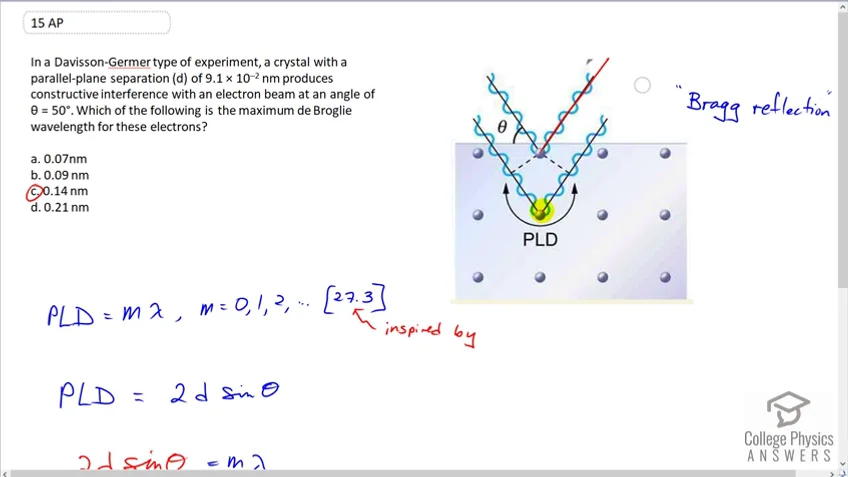 2:47PreviewProblem 15Full video with free trialIn a Davisson-Germer type of experiment, a crystal with a parallel-plane separation, , of produces constructive interference with an electron beam at an angle of . Which of the following is the maximum de Broglie wavelength for these electrons? (a)
(b)
(c)
(d)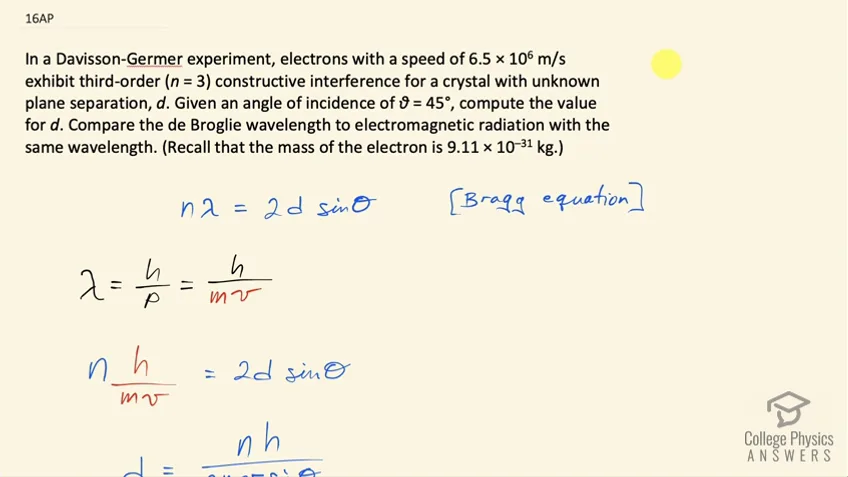 2:37PreviewProblem 16Full video with free trialIn a Davisson-Germer experiment, electrons with a speed of exhibit third-order (n = 3) constructive interference for a crystal with unknown plane separation, . Given an angle of incidence of , compute the value for . Compare the de Broglie wavelength to electromagnetic radiation with the same wavelength. (Recall that the mass of the electron is .)
29.8 The Particle-Wave Duality Reviewed
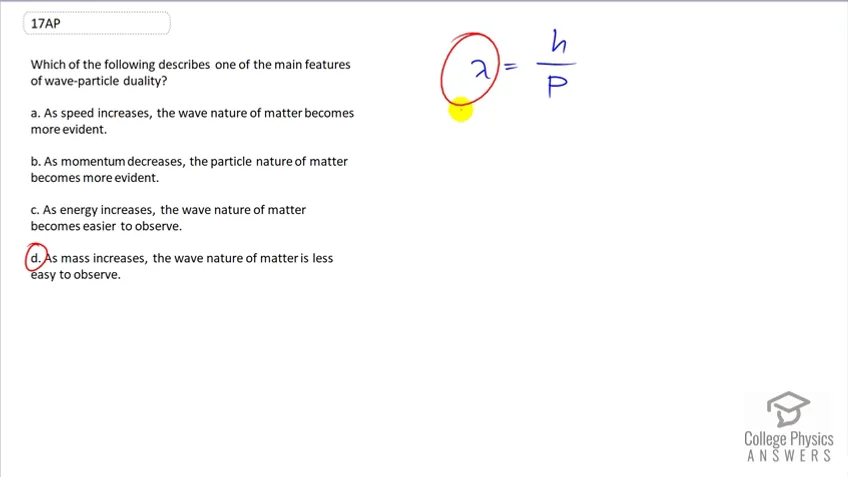 2:20PreviewProblem 17Full video with free trialWhich of the following describes one of the main features of wave-particle duality? (a) As speed increases, the wave nature of matter becomes more evident.
(b) As momentum decreases, the particle nature of matter becomes more evident.
(c) As energy increases, the wave nature of matter becomes easier to observe.
(d) As mass increases, the wave nature of matter is less easy to observe.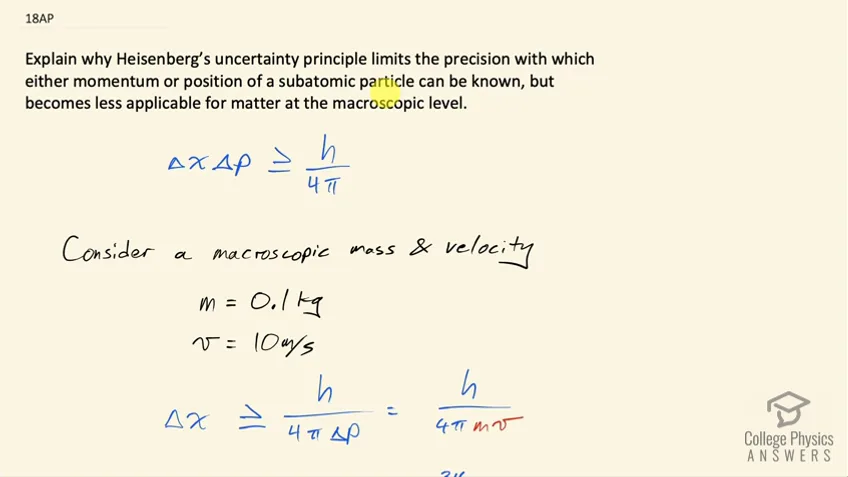 3:04PreviewProblem 18Full video with free trialExplain why Heisenberg’s uncertainty principle limits the precision with which either momentum or position of a subatomic particle can be known, but becomes less applicable for matter at the macroscopic level.