Question
This is a 16-second preview. Get access to the full video by starting your free 7-day trial.

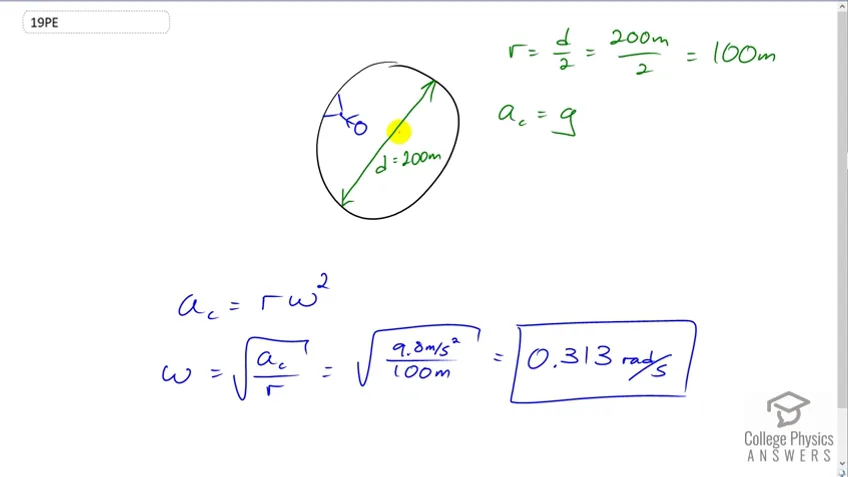
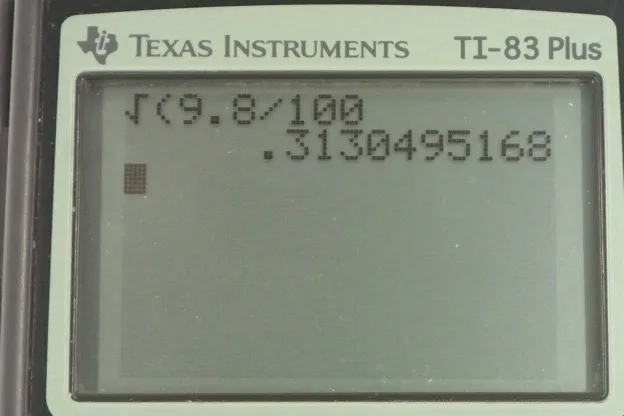
This is College Physics Answers with Shaun Dychko. This space station has some simulated gravity by rotating the space station around and we're told the diameter of it is 200 meters. We'll find the radius by dividing that by two so we get 100 meter radius. We're meant to have an acceleration that is experienced by this astronaut here equal to what the acceleration due to gravity would be at the surface of the earth. So, centripetal acceleration is g in other words. Now, centripetal acceleration is the radius multiplied by the angular velocity squared and we're asked to find out what angular velocity would be needed in order to have acceleration due to gravity be the same as the centripetal acceleration. So we divide both sides by r here, and then take the square root of both sides and switch the sides around and that solves for omega. So the angular velocity is the square root of centripetal acceleration over r, and so that's the square root of 9.8 meters per second squared divided by 100 meters, which gives 0.313 radians per second.