Question
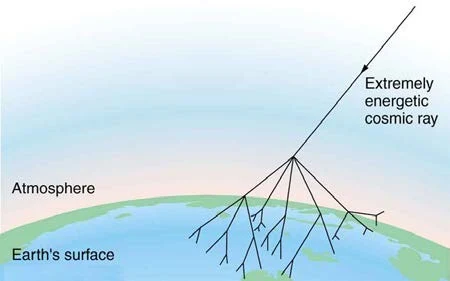
The intensity of cosmic ray radiation decreases rapidly with increasing energy, but there are occasionally extremely energetic cosmic rays that create a shower of radiation from all the particles they create by striking a nucleus in the atmosphere as seen in the figure given below. Suppose a cosmic ray particle having an energy of converts its energy into particles with masses averaging . (a) How many particles are created? (b) If the particles rain down on a area, how many particles are there per square meter?
Final Answer
Solution video

This is a 22-second preview. Get access to the full video by starting your free 7-day trial.
This is a 22-second preview. Get access to the full video by starting your free 7-day trial.
Calculator Screenshots
Video Transcript
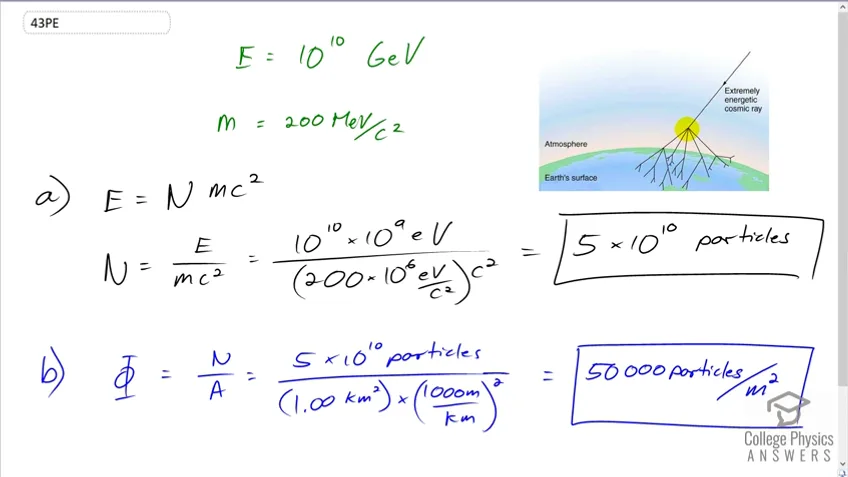
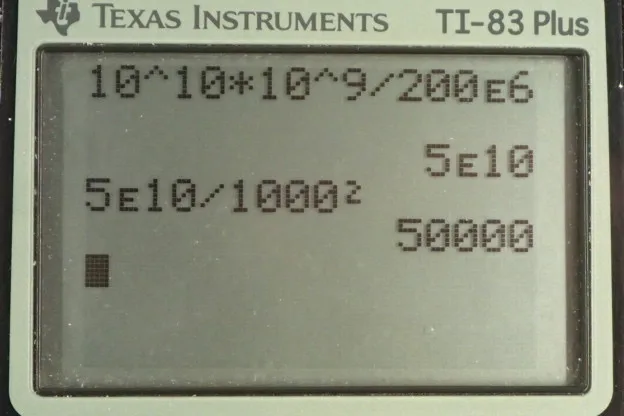
This is College Physics Answers with Shaun Dychko. We imagine that there's a cosmic ray particle with an extremely high energy of 10 to the 10 gigaelectron volts. It will hit a nucleus in the atmosphere and break it apart into particles of an average mass of 200 megaelectron volts per c squared and the question in part (a) is how many particles with this mass will it create? And so the total energy of all the particles is going to be the number of particles which we have to find times the energy of each one. So we'll solve for capital M by dividing by mc squared. So N is going to be the total energy which is 10 to the 10 giga which is times 10 to the positive 9 electron volts divided by the mass of each one— 200 times 10 to the 6 electron volts per c squared—times by c squared and we end up with 5 times 10 to the 10 particles. And then the question is, in one square kilometer, how many particles do you expect to find? So that's another way of saying flux which is a number per area. So that's 5 times 10 to the 10 particles divided by 1 square kilometer converted into square meters by multiplying by 1000 meters per kilometer two times and we end up with 50,000 particles in every square meter resulting from the collision of this single 10 to the 10 gigaelectron volt cosmic ray.
Comments
No comments yet.