
gracereed77·
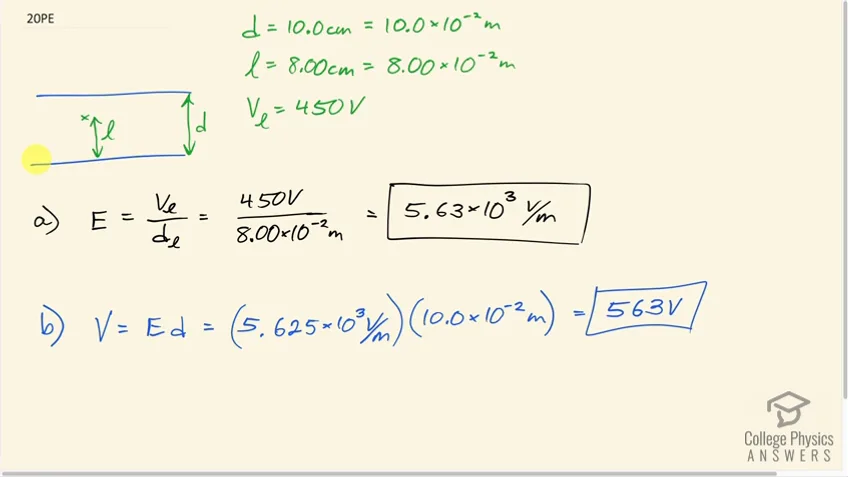
I thought electric field should point in the direction of decreasing potential, meaning that it should point downward toward the 0V plate (rather than upward toward the higher potential plate as you drew it). Am I missing something here?
Like
ShaunDychko·
Hi gracereed, sorry for the late reply here - I hope you receive this before your final exam. You are indeed correct to stay that electric field lines point in the direction of decreasing potential. Part b) of this solution gives the **magnitude** of the potential _difference_ between the plates. With the bottom plate defined as potential 0V, this means the top plate has a potential of $-563 \\textrm{ V}$. Notice the negative sign there to indicate it is at a lower potential. The 0V of the bottom plate is greater than $-563 \\textrm{V}$. Hope this helps, Shaun
Like