Chapter 19: Electric Potential and Electric Field
112 problems solved · Free preview of every solution shows how it’s started · Watch the full videos with a free 7-day trial →
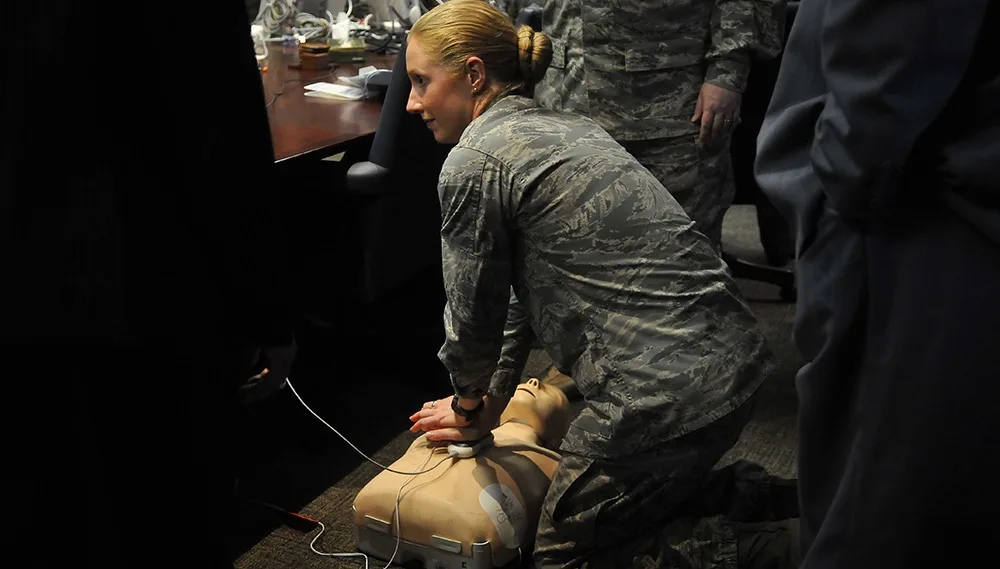
Image: credit: U.S. Defense Department photo/Tech. Sgt. Suzanne M. Day


Section
19.1 Electric Potential Energy: Potential Difference
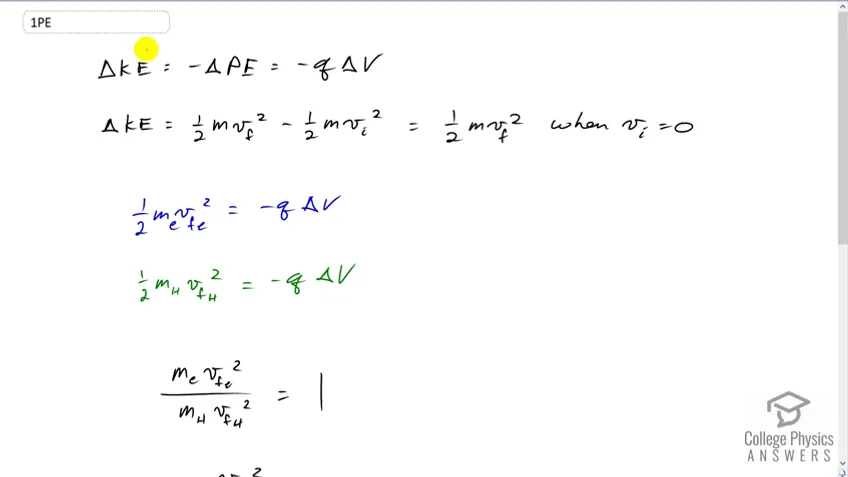 2:58Problem 1FreeFind the ratio of speeds of an electron and a negative hydrogen ion (one having an extra electron) accelerated through the same voltage, assuming non-relativistic final speeds. Take the mass of the hydrogen ion to be .
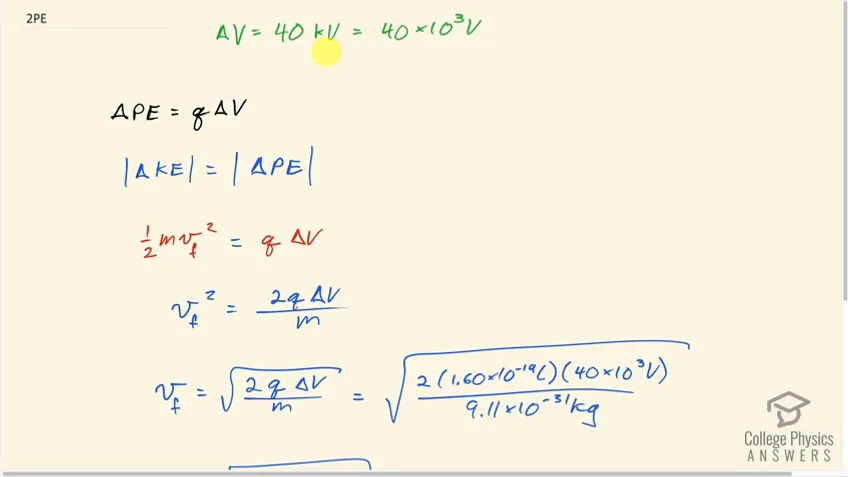 1:47PreviewProblem 2Full video with free trialAn evacuated tube uses an accelerating voltage of 40 kV to accelerate electrons to hit a copper plate and produce x rays. Non-relativistically, what would be the maximum speed of these electrons?
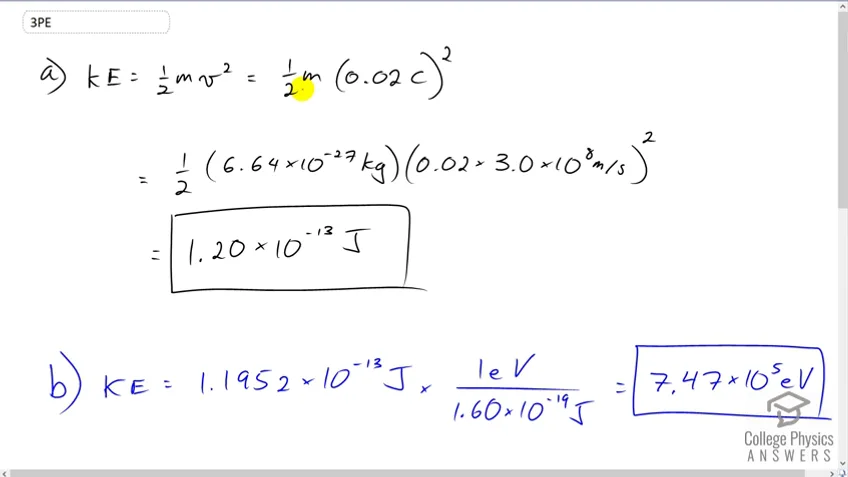 3:16PreviewProblem 3Full video with free trialA bare helium nucleus has two positive charges and a mass of (a) Calculate its kinetic energy in joules at 2.00% of the speed of light. (b) What is this in electron volts? (c) What voltage would be needed to obtain this energy?
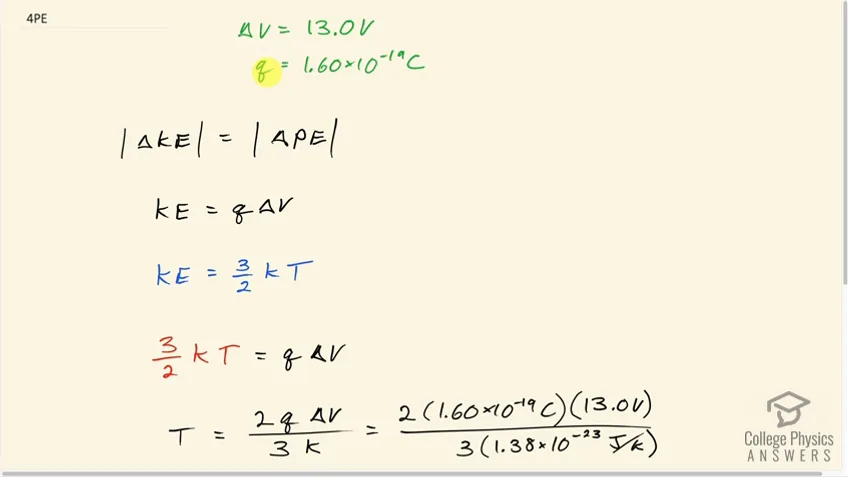 1:41PreviewProblem 4Full video with free trialSingly charged gas ions are accelerated from rest through a voltage of 13.0 V. At what temperature will the average kinetic energy of gas molecules be the same as that given these ions?
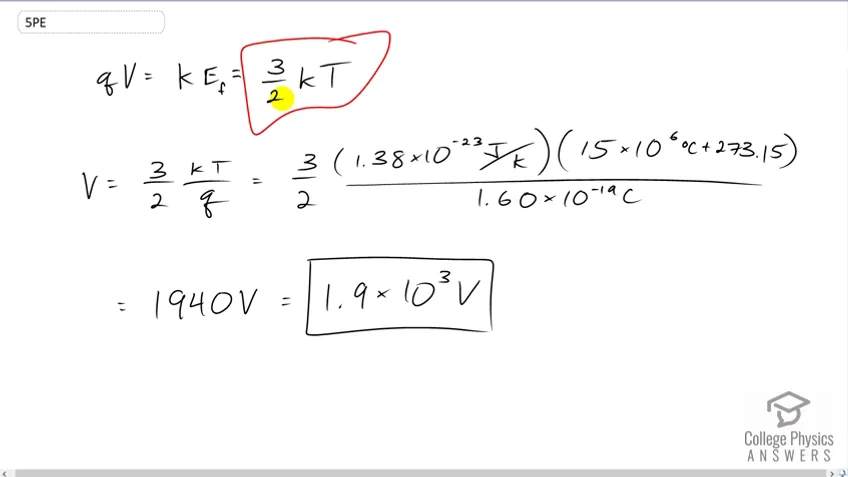 1:33PreviewProblem 5Full video with free trialThe temperature near the center of the Sun is thought to be 15 million degrees Celsius (). Through what voltage must a singly charged ion be accelerated to have the same energy as the average kinetic energy of ions at this temperature?
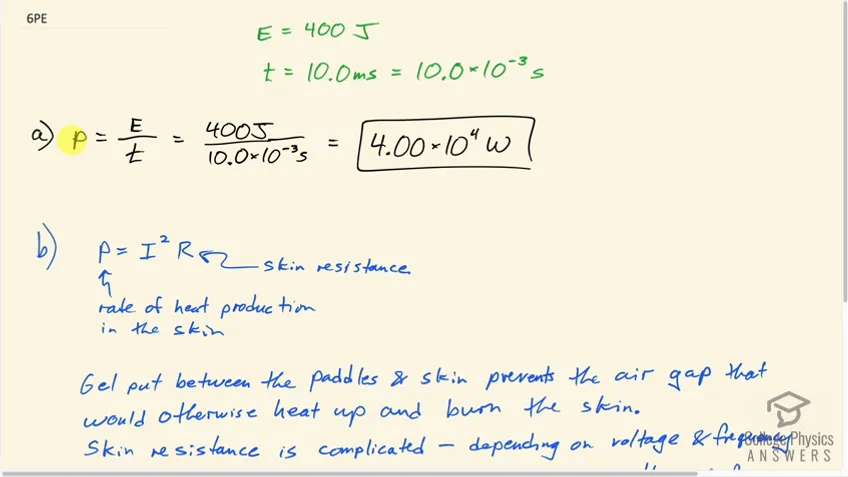 2:08PreviewProblem 6Full video with free trial(a) What is the average power output of a heart defibrillator that dissipates 400 J of energy in 10.0 ms? (b) Considering the high-power output, why doesn’t the defibrillator produce serious burns?
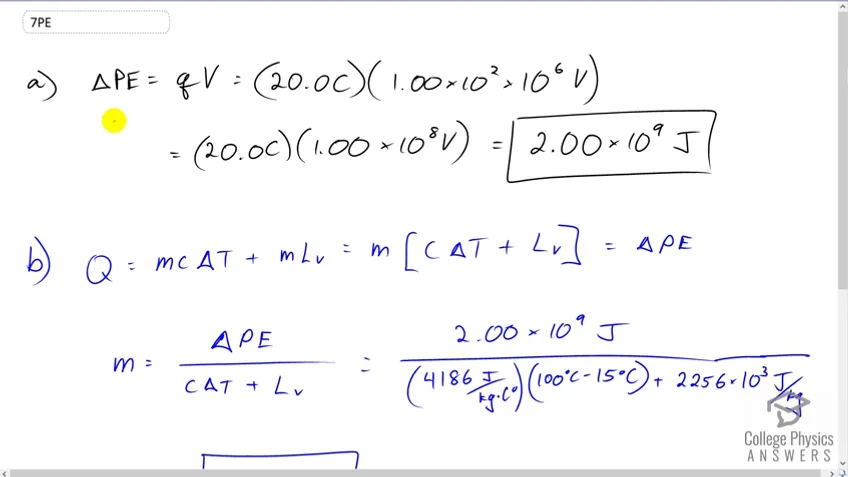 2:34PreviewProblem 7Full video with free trialA lightning bolt strikes a tree, moving 20.0 C of charge through a potential difference of . (a) What energy was dissipated? (b) What mass of water could be raised from to the boiling point and then boiled by this energy? (c) Discuss the damage that could be caused to the tree by the expansion of the boiling steam.
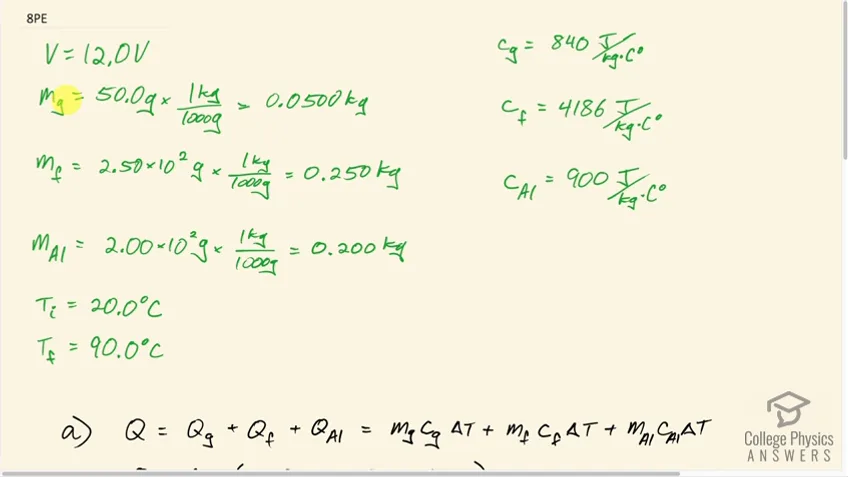 4:00PreviewProblem 8Full video with free trialA battery operated bottle warmer heats 50.0 g of glass, of baby formula, and of aluminum from to . (a) How much charge is moved by the battery? (b) How many electrons per second flow if it takes 5.00 min to warm the formula? (Hint: Assume that the specific heat of baby formula is about the same as the specific heat of water.)
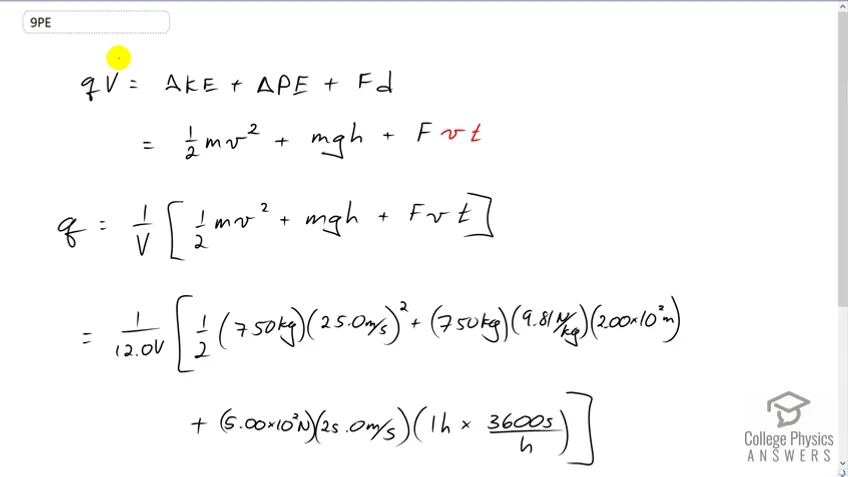 2:17PreviewProblem 9Full video with free trialA battery-operated car utilizes a 12.0 V system. Find the charge the batteries must be able to move in order to accelerate the 750 kg car from rest to 25.0 m/s, make it climb a high hill, and then cause it to travel at a constant 25.0 m/s by exerting a force for an hour.
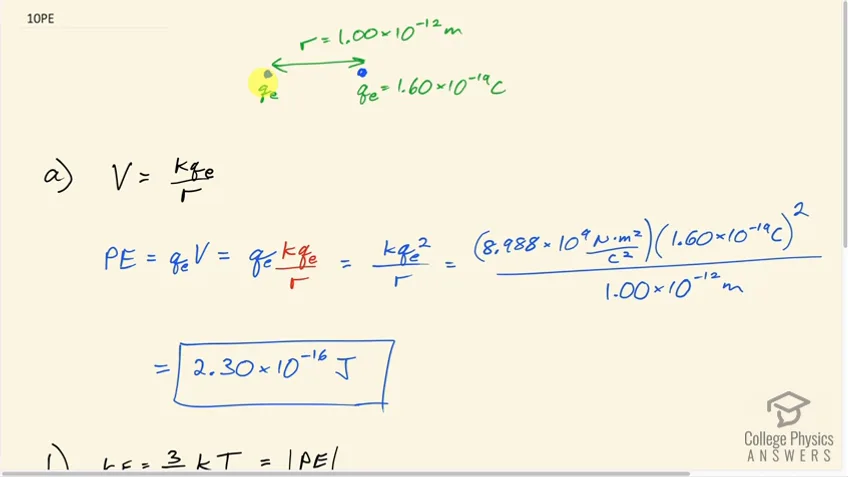 3:19PreviewProblem 10Full video with free trialFusion probability is greatly enhanced when appropriate nuclei are brought close together, but mutual Coulomb repulsion must be overcome. This can be done using the kinetic energy of high-temperature gas ions or by accelerating the nuclei toward one another. (a) Calculate the potential energy of two singly charged nuclei separated by by finding the voltage of one at that distance and multiplying by the charge of the other. (b) At what temperature will atoms of a gas have an average kinetic energy equal to this needed electrical potential energy?
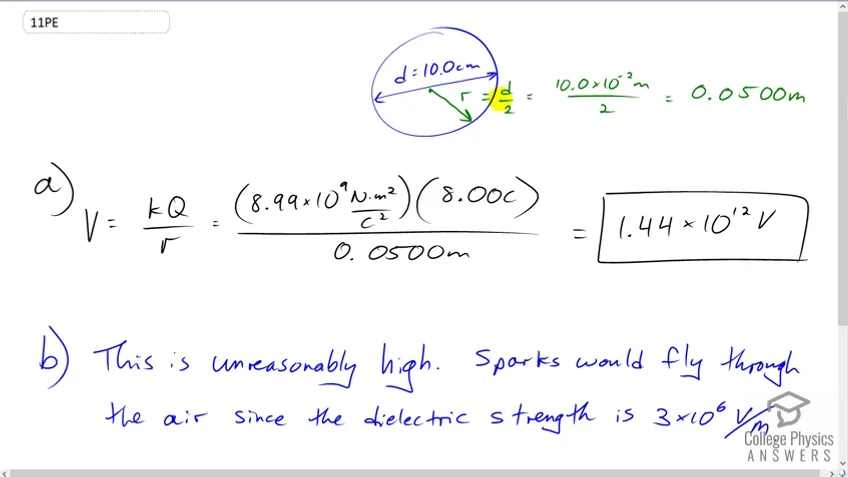 1:42PreviewProblem 11Full video with free trial(a) Find the voltage near a 10.0 cm diameter metal sphere that has 8.00 C of excess positive charge on it. (b) What is unreasonable about this result? (c) Which assumptions are responsible?
19.2 Electric Potential in a Uniform Electric Field
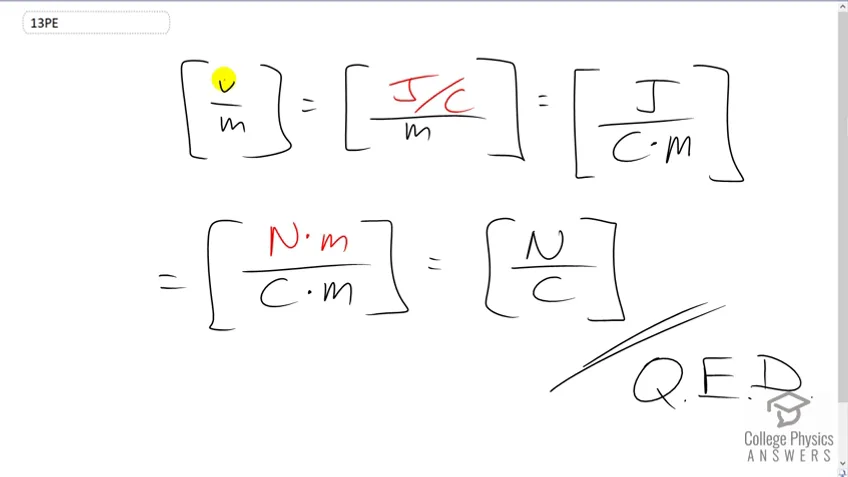 1:07PreviewProblem 13Full video with free trialShow that units of V/m and N/C for electric field strength are indeed equivalent.
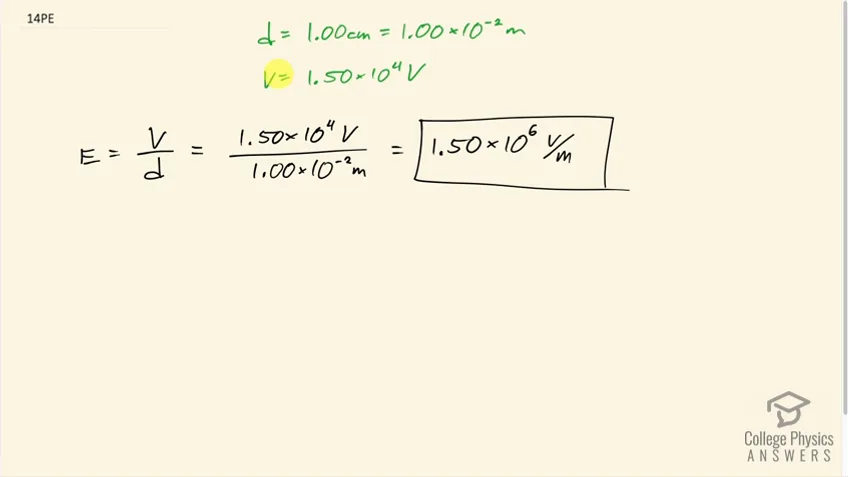 0:40PreviewProblem 14Full video with free trialWhat is the strength of the electric field between two parallel conducting plates separated by 1.00 cm and having a potential difference (voltage) between them of ?
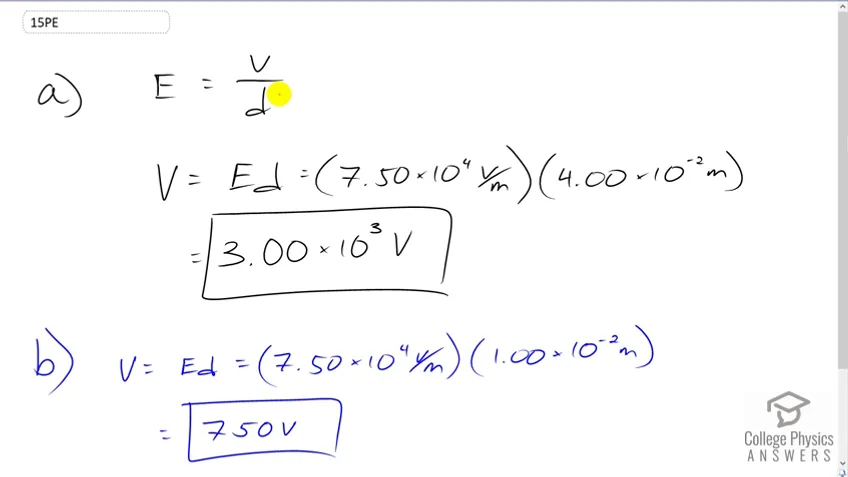 1:05PreviewProblem 15Full video with free trialThe electric field strength between two parallel conducting plates separated by 4.00 cm is . (a) What is the potential difference between the plates? (b) The plate with the lowest potential is taken to be at zero volts. What is the potential 1.00 cm from that plate (and 3.00 cm from the other)?
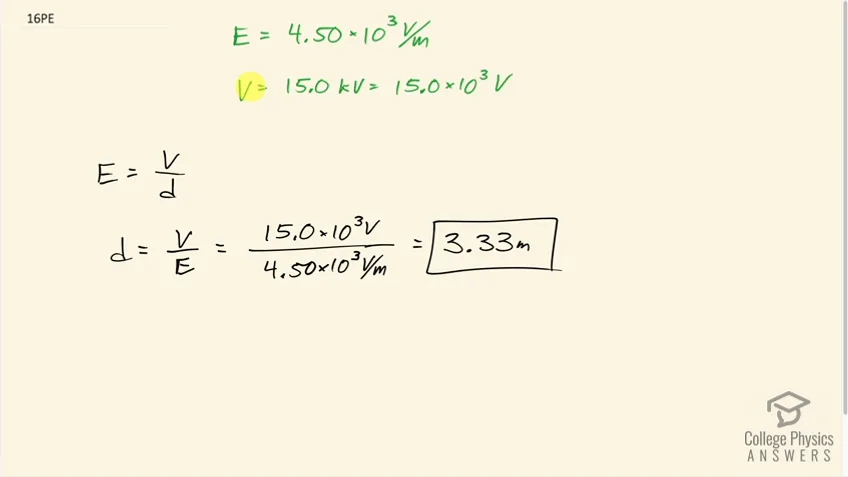 0:39PreviewProblem 16Full video with free trialHow far apart are two conducting plates that have an electric field strength of between them, if their potential difference is 15.0 kV?
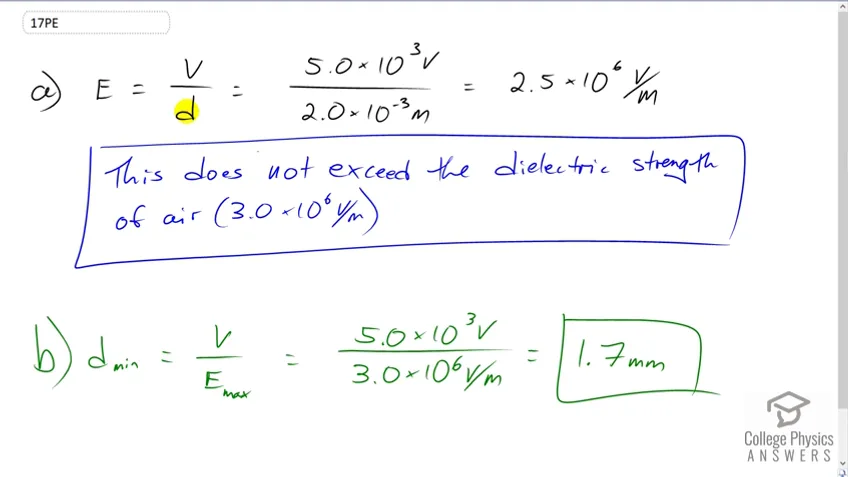 0:52PreviewProblem 17Full video with free trial(a) Will the electric field strength between two parallel conducting plates exceed the breakdown strength for air () if the plates are separated by 2.00 mm and a potential difference of is applied? (b) How close together can the plates be with this applied voltage?
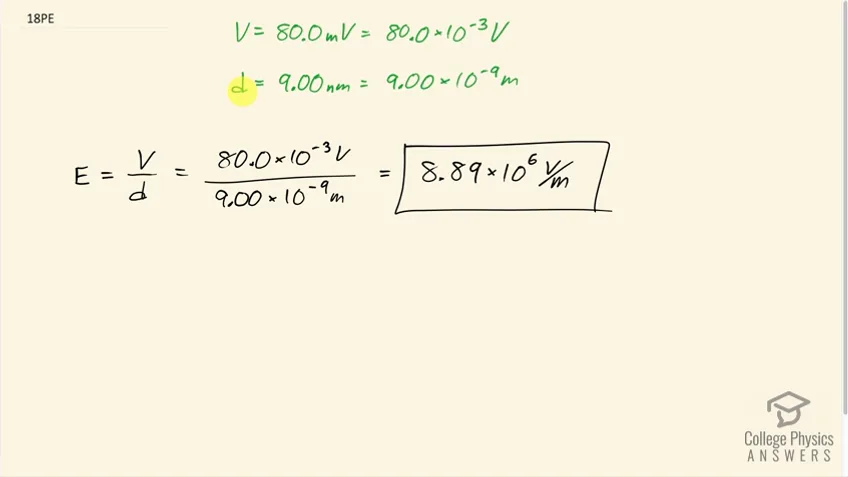 0:36PreviewProblem 18Full video with free trialThe voltage across a membrane forming a cell wall is 80.0 mV and the membrane is 9.00 nm thick. What is the electric field strength? (The value is surprisingly large, but correct. Membranes are discussed in Capacitors and Dielectrics and Nerve Conduction—Electrocardiograms.) You may assume a uniform electric field.
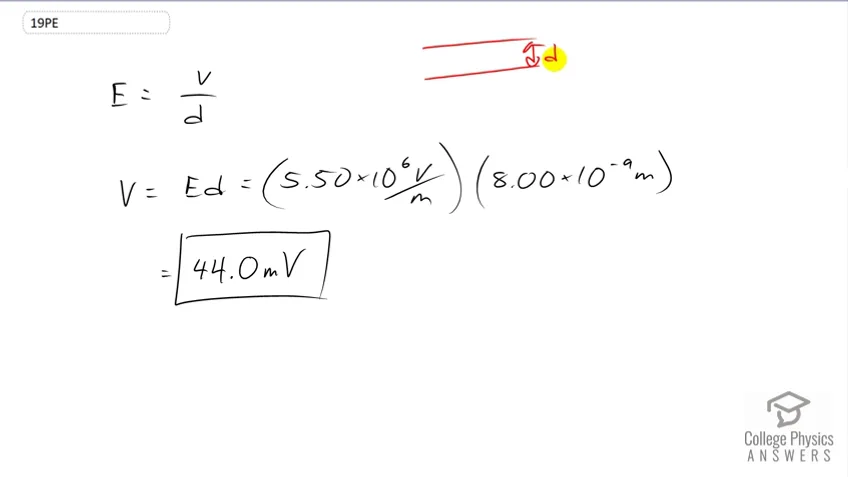 0:56PreviewProblem 19Full video with free trialMembrane walls of living cells have surprisingly large electric fields across them due to separation of ions. (Membranes are discussed in some detail in Nerve Conduction—Electrocardiograms.) What is the voltage across an 8.00 nm–thick membrane if the electric field strength across it is 5.50 MV/m? You may assume a uniform electric field.
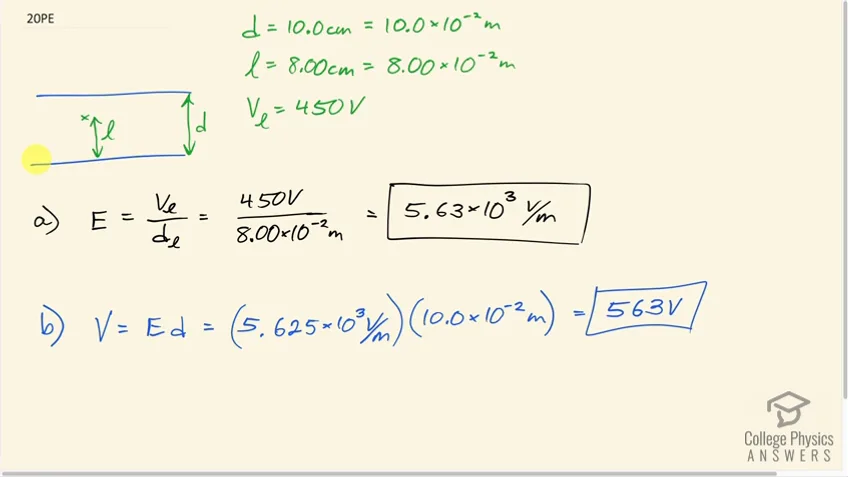 1:13PreviewProblem 20Full video with free trialTwo parallel conducting plates are separated by 10.0 cm, and one of them is taken to be at zero volts. (a) What is the electric field strength between them, if the potential 8.00 cm from the zero volt plate (and 2.00 cm from the other) is 450 V? (b) What is the voltage between the plates?
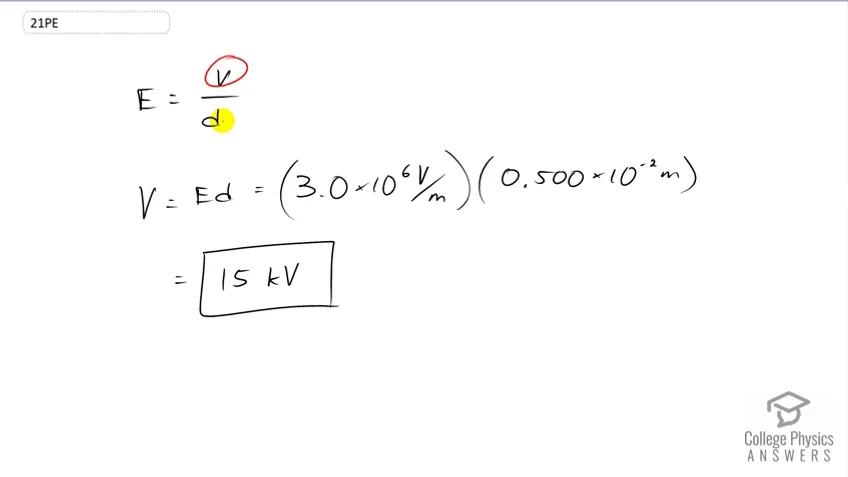 0:38PreviewProblem 21Full video with free trialFind the maximum potential difference between two parallel conducting plates separated by 0.500 cm of air, given the maximum sustainable electric field strength in air to be
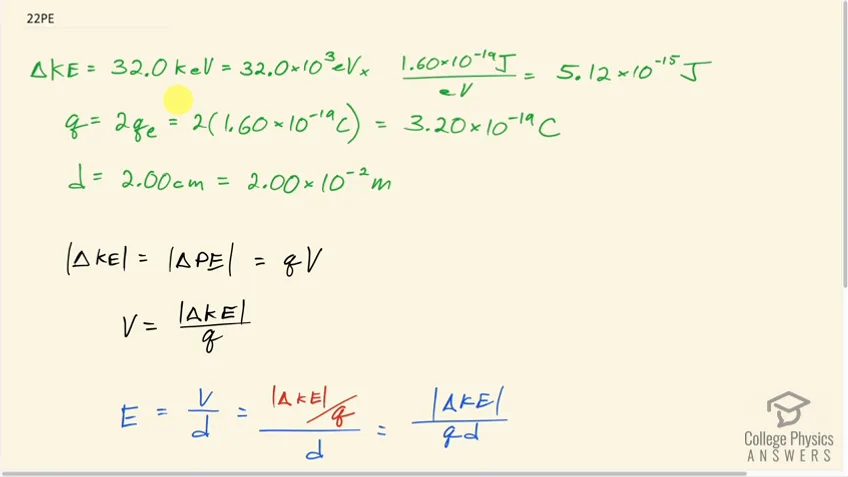 2:43PreviewProblem 22Full video with free trialA doubly charged ion is accelerated to an energy of 32.0 keV by the electric field between two parallel conducting plates separated by 2.00 cm. What is the electric field strength between the plates?
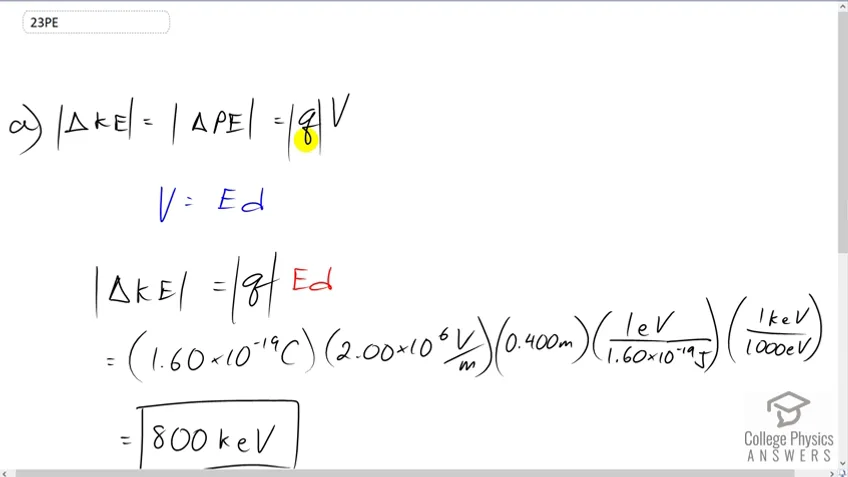 2:44PreviewProblem 23Full video with free trialAn electron is to be accelerated in a uniform electric field having a strength of . (a) What energy in keV is given to the electron if it is accelerated through 0.400 m? (b) Over what distance would it have to be accelerated to increase its energy by 50.0 GeV?
19.3 Electrical Potential Due to a Point Charge
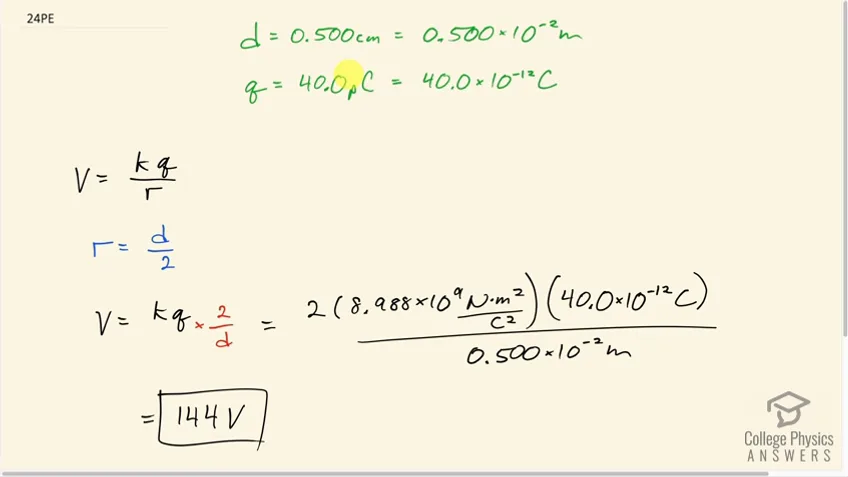 1:09PreviewProblem 24Full video with free trialA 0.500 cm diameter plastic sphere, used in a static electricity demonstration, has a uniformly distributed 40.0 pC charge on its surface. What is the potential near its surface?
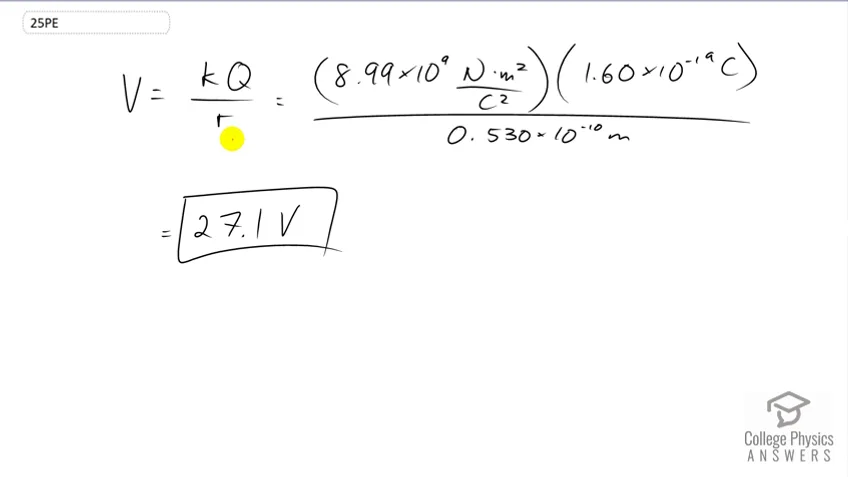 0:41PreviewProblem 25Full video with free trialWhat is the potential from a proton (the average distance between the proton and electron in a hydrogen atom)?
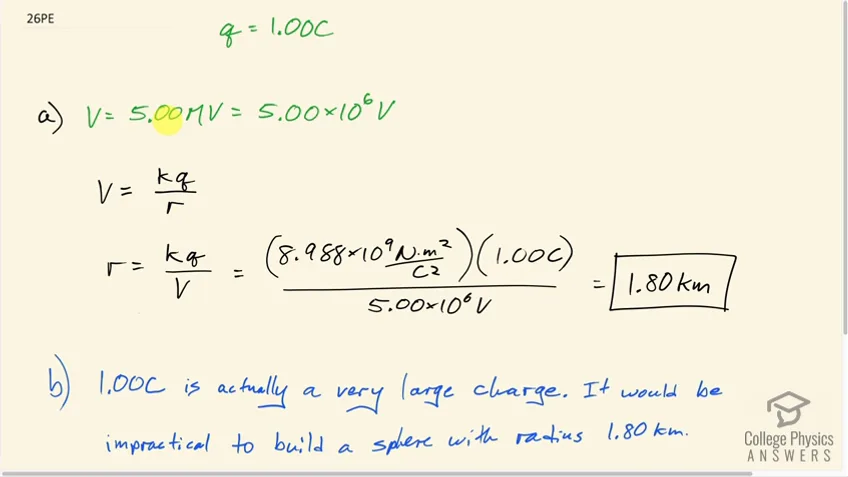 0:57PreviewProblem 26Full video with free trial(a) A sphere has a surface uniformly charged with 1.00 C. At what distance from its center is the potential 5.00 MV? (b) What does your answer imply about the practical aspect of isolating such a large charge?
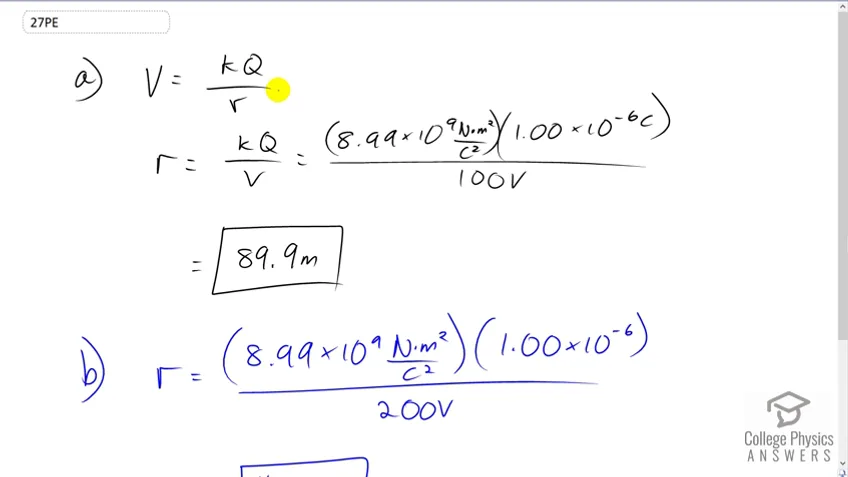 0:40PreviewProblem 27Full video with free trialHow far from a point charge will the potential be 100 V? At what distance will it be ?
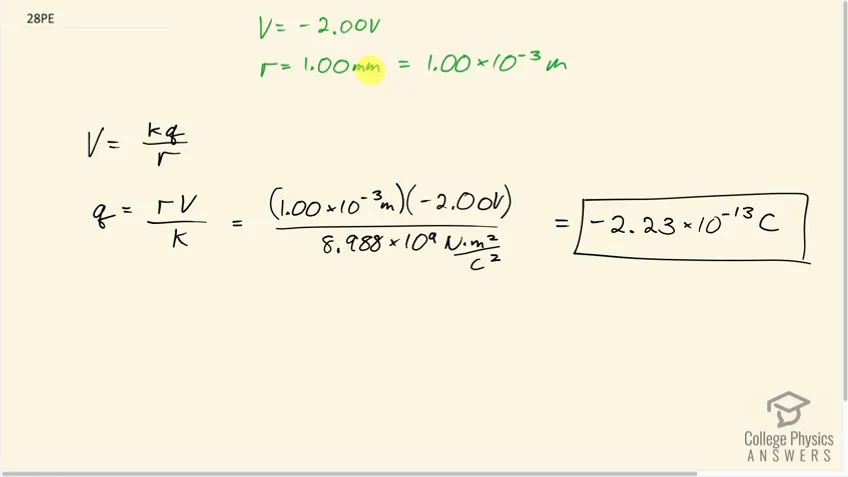 0:42PreviewProblem 28Full video with free trialWhat are the sign and magnitude of a point charge that produces a potential of –2.00 V at a distance of 1.00 mm?
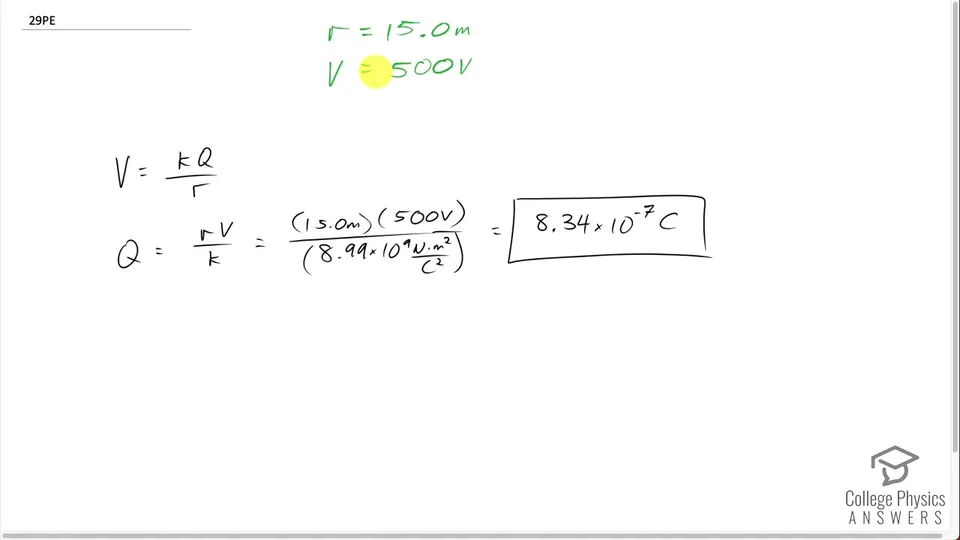 0:46PreviewProblem 29Full video with free trialIf the potential due to a point charge is at a distance of 15.0 m, what are the sign and magnitude of the charge?
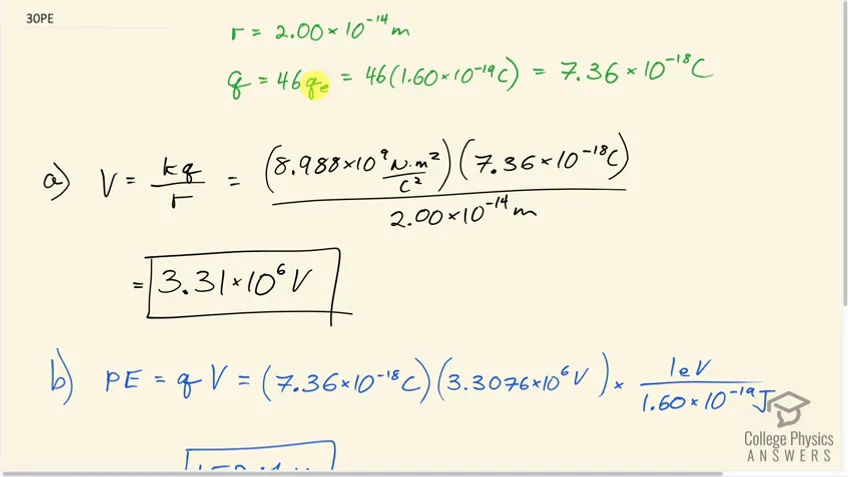 1:16PreviewProblem 30Full video with free trialIn nuclear fission, a nucleus splits roughly in half. (a) What is the potential from a fragment that has 46 protons in it? (b) What is the potential energy in MeV of a similarly charged fragment at this distance?
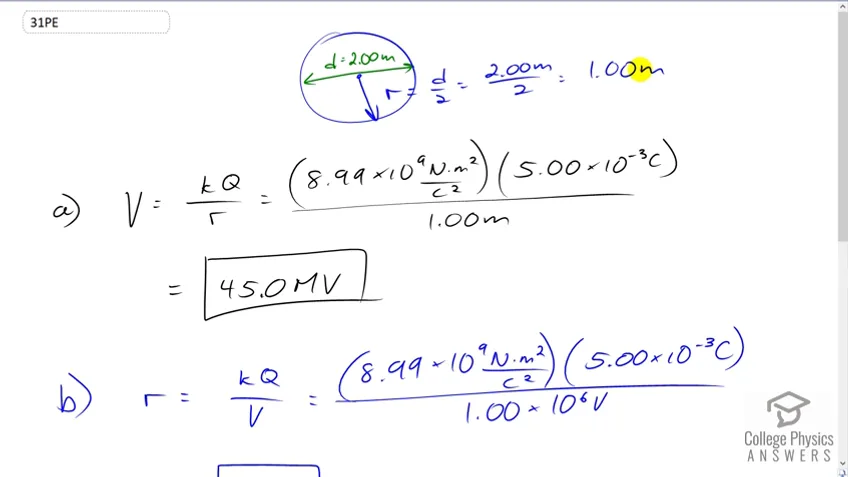 2:38PreviewProblem 31Full video with free trialA research Van de Graaff generator has a 2.00-m- diameter metal sphere with a charge of 5.00 mC on it. (a) What is the potential near its surface? (b) At what distance from its center is the potential 1.00 MV? (c) An oxygen atom with three missing electrons is released near the Van de Graaff generator. What is its energy in MeV at this distance?
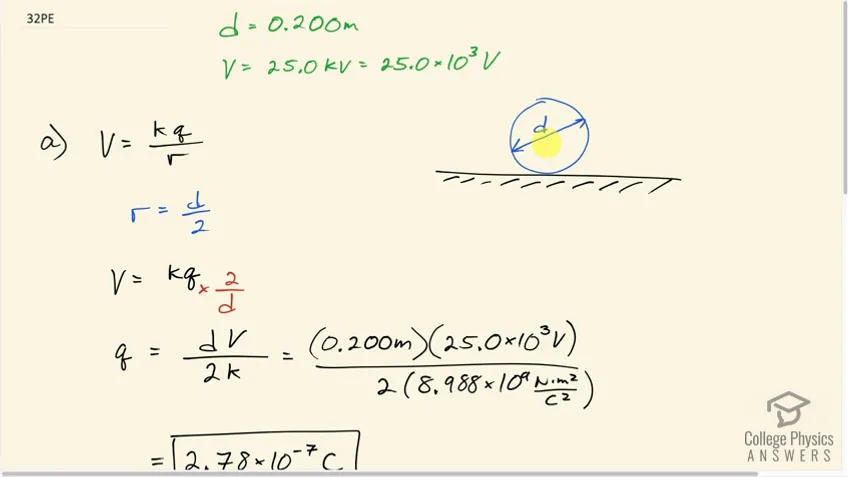 2:36PreviewProblem 32Full video with free trialAn electrostatic paint sprayer has a 0.200-m-diameter metal sphere at a potential of 25.0 kV that repels paint droplets onto a grounded object. (a) What charge is on the sphere? (b) What charge must a 0.100-mg drop of paint have to arrive at the object with a speed of 10.0 m/s?
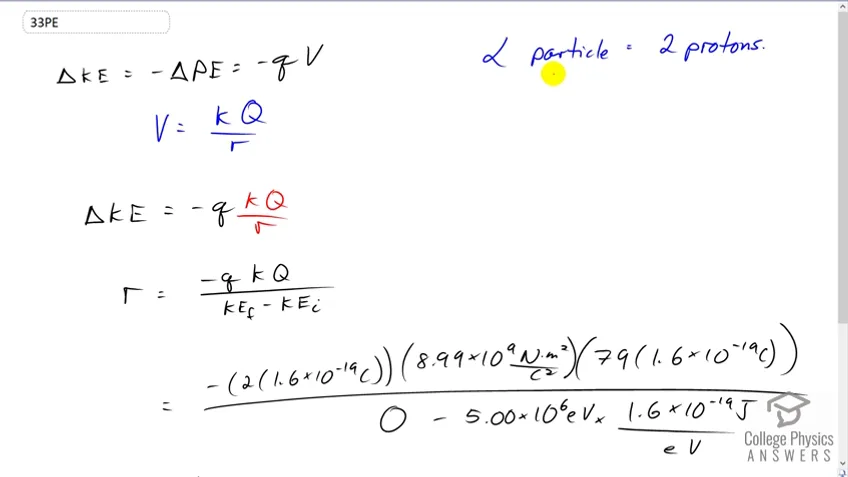 2:41PreviewProblem 33Full video with free trialIn one of the classic nuclear physics experiments at the beginning of the 20th century, an alpha particle was accelerated toward a gold nucleus, and its path was substantially deflected by the Coulomb interaction. If the energy of the doubly charged alpha nucleus was 5.00 MeV, how close to the gold nucleus (79 protons) could it come before being deflected?
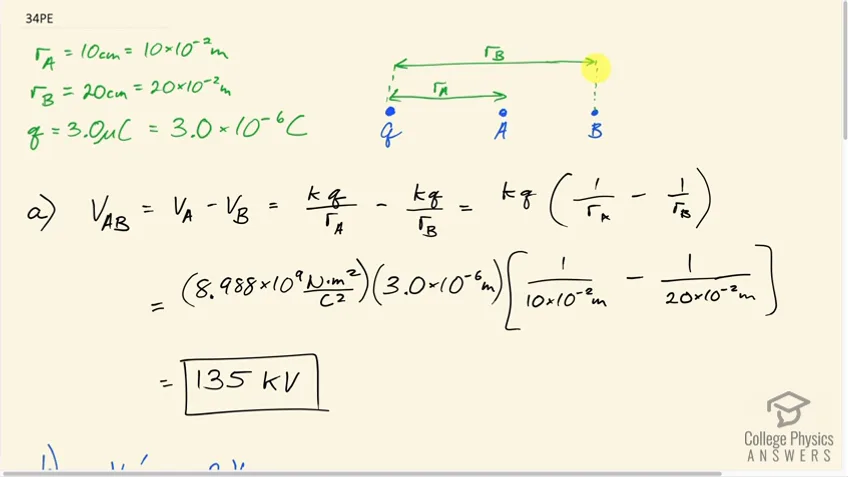 4:01PreviewProblem 34Full video with free trial(a) What is the potential between two points situated 10 cm and 20 cm from a point charge? (b) To what location should the point at 20 cm be moved to increase this potential difference by a factor of two?
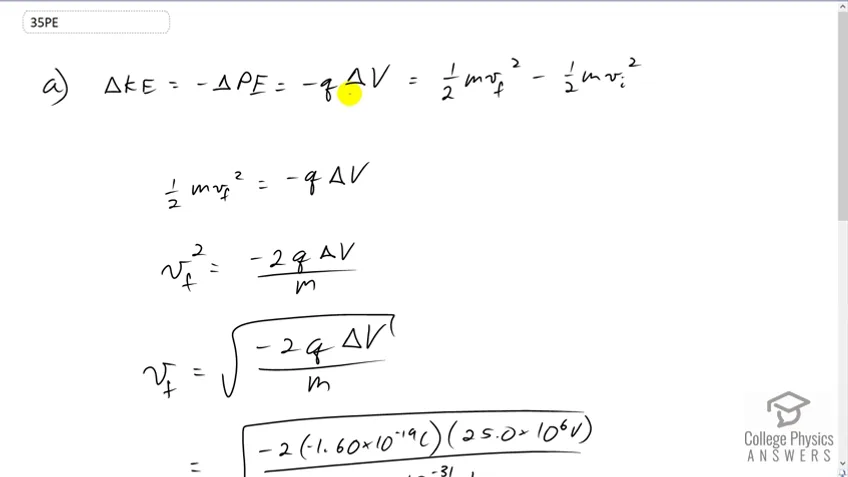 1:45PreviewProblem 35Full video with free trial(a) What is the final speed of an electron accelerated from rest through a voltage of 25.0 MV by a negatively charged Van de Graaff terminal? (b) What is unreasonable about this result? (c) Which assumptions are responsible?
19.4 Equipotential Lines
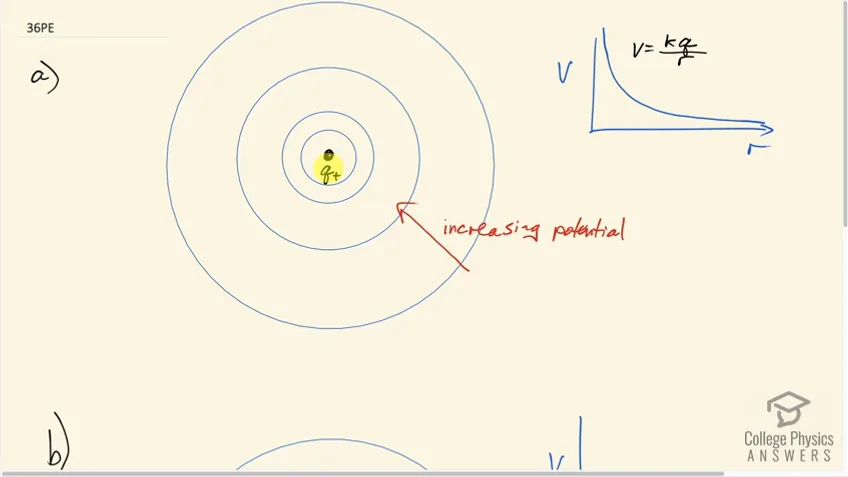 3:52PreviewProblem 36Full video with free trial(a) Sketch the equipotential lines near a point charge . Indicate the direction of increasing potential. (b) Do the same for a point charge .
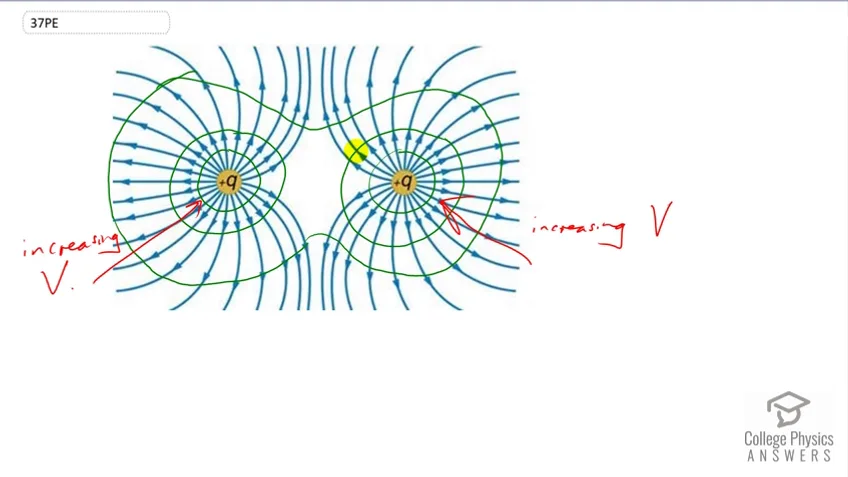 2:32PreviewProblem 37Full video with free trialSketch the equipotential lines for the two equal positive charges shown in Figure 19.26. Indicate the direction of increasing potential.
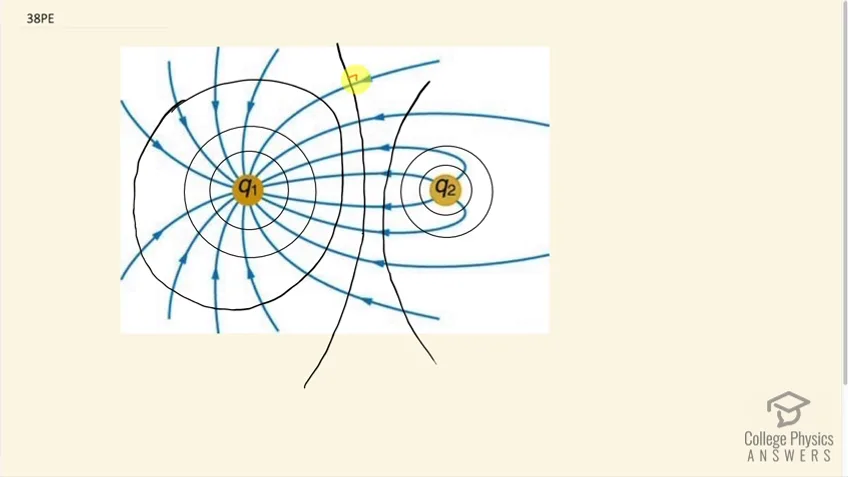 3:27PreviewProblem 38Full video with free trialFigure 19.34 shows the electric field lines near two charges and , the first having a magnitude four times that of the second. Sketch the equipotential lines for these two charges, and indicate the direction of increasing potential.
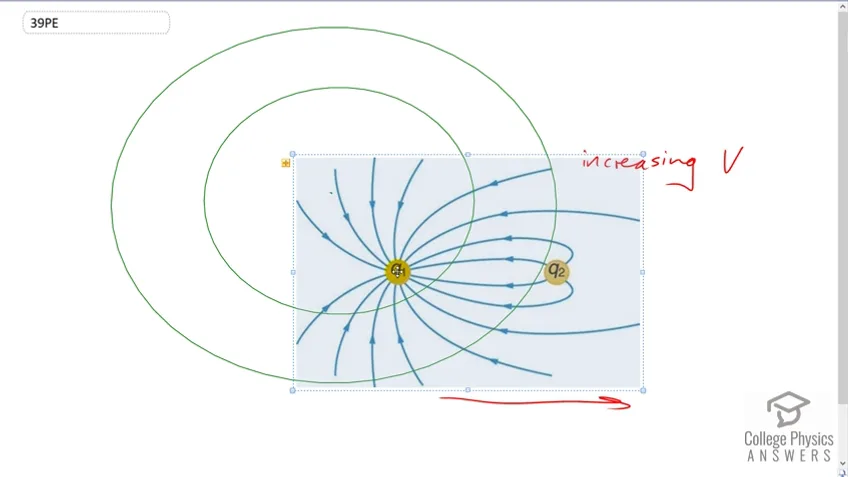 2:01PreviewProblem 39Full video with free trialSketch the equipotential lines a long distance from the charges shown in Figure 19.27. Indicate the direction of increasing potential.
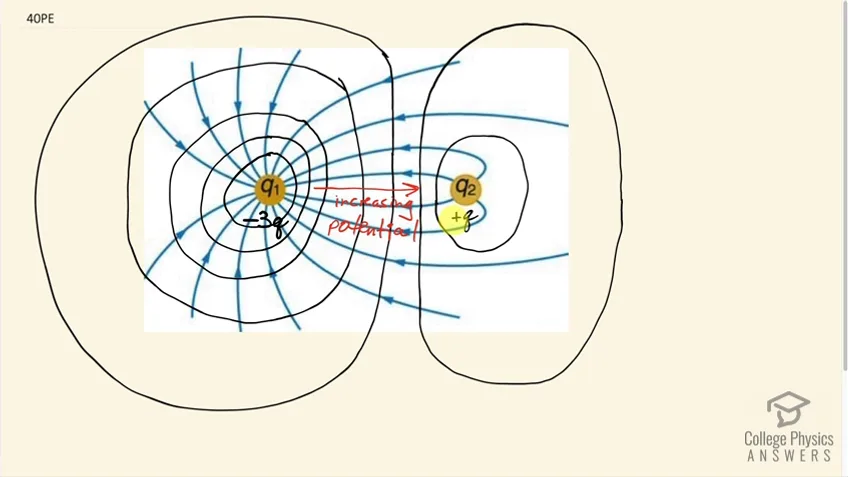 2:50PreviewProblem 40Full video with free trialSketch the equipotential lines in the vicinity of two opposite charges, where the negative charge is three times as great in magnitude as the positive. See Figure 19.34 for a similar situation. Indicate the direction of increasing potential.
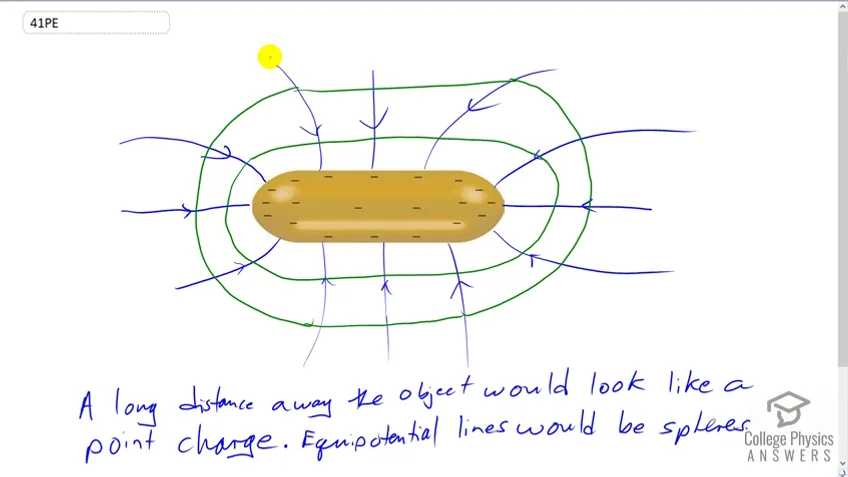 1:25PreviewProblem 41Full video with free trialSketch the equipotential lines in the vicinity of the negatively charged conductor in Figure 19.28. How will these equipotentials look a long distance from the object?
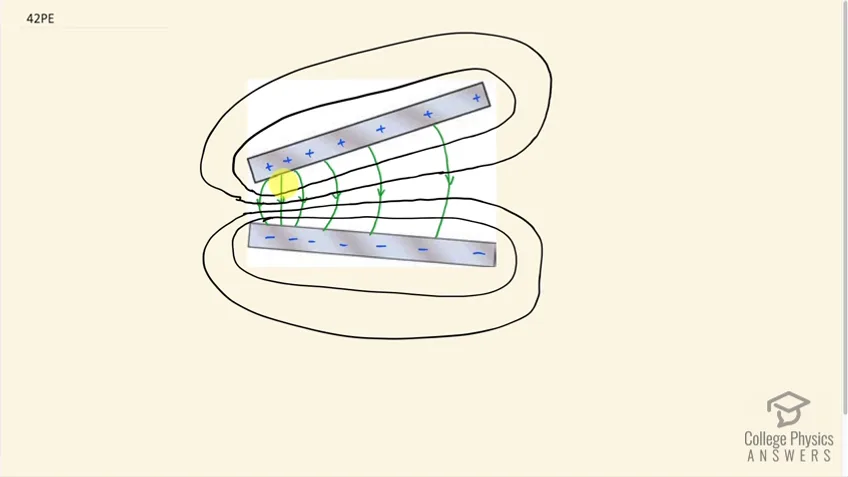 2:10PreviewProblem 42Full video with free trialSketch the equipotential lines surrounding the two conducting plates shown in Figure 19.36, given the top plate is positive and the bottom plate has an equal amount of negative charge. Be certain to indicate the distribution of charge on the plates. Is the field strongest where the plates are closest? Why should it be?
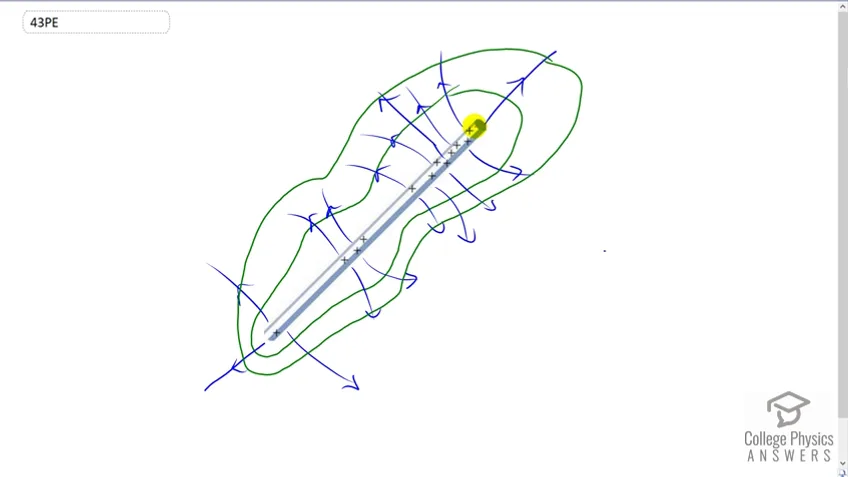 1:05PreviewProblem 43Full video with free trial(a) Sketch the electric field lines in the vicinity of the charged insulator in Figure 19.30. Note its non-uniform charge distribution. (b) Sketch equipotential lines surrounding the insulator. Indicate the direction of increasing potential.
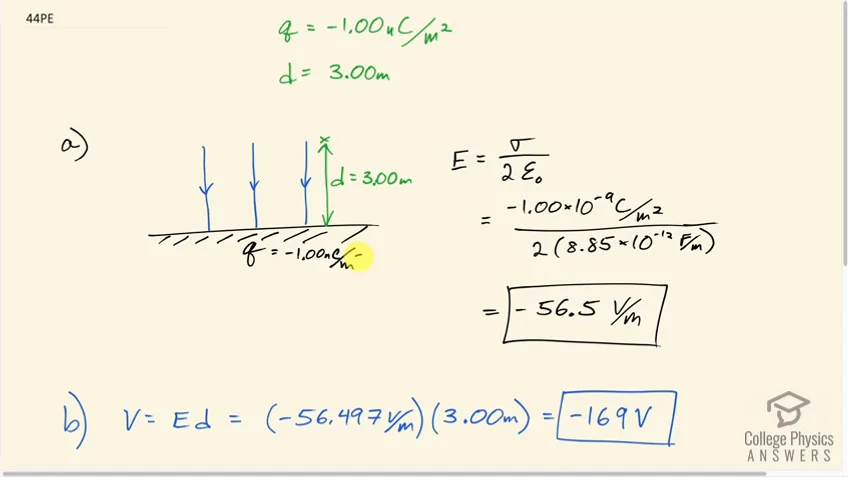 1:45PreviewProblem 44Full video with free trialThe naturally occurring charge on the ground on a fine day out in the open country is –1.00 nC/m2 . (a) What is the electric field relative to ground at a height of 3.00 m? (b) Calculate the electric potential at this height. (c) Sketch electric field and equipotential lines for this scenario.
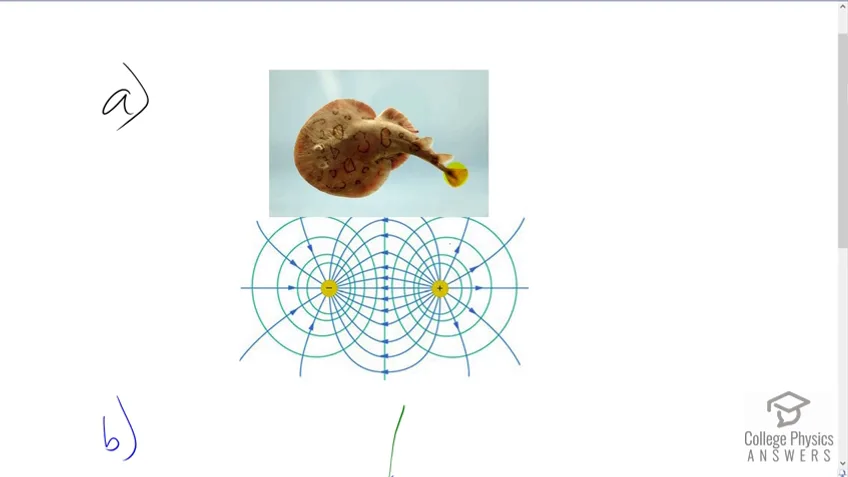 1:24PreviewProblem 45Full video with free trialThe lesser electric ray (Narcine bancroftii) maintains an incredible charge on its head and a charge equal in magnitude but opposite in sign on its tail (Figure 19.31). (a) Sketch the equipotential lines surrounding the ray. (b) Sketch the equipotentials when the ray is near a ship with a conducting surface. (c) How could this charge distribution be of use to the ray?
19.5 Capacitors and Dielectrics
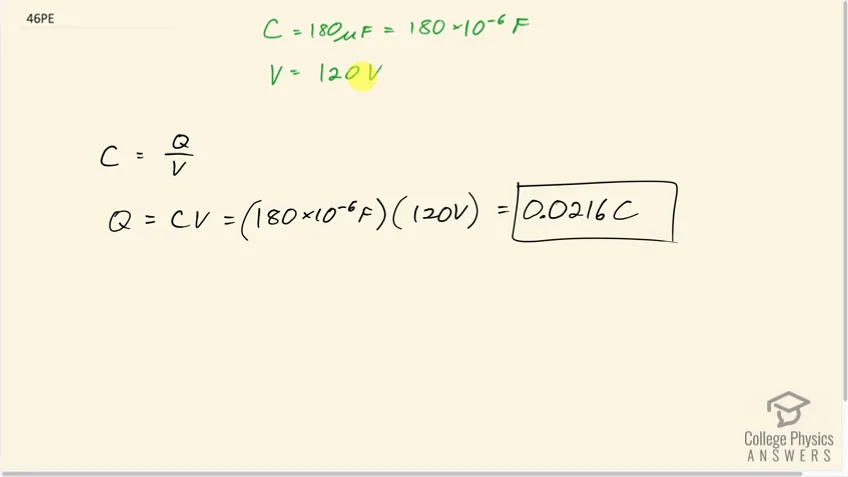 0:33PreviewProblem 46Full video with free trialWhat charge is stored in a capacitor when 120 V is applied to it?
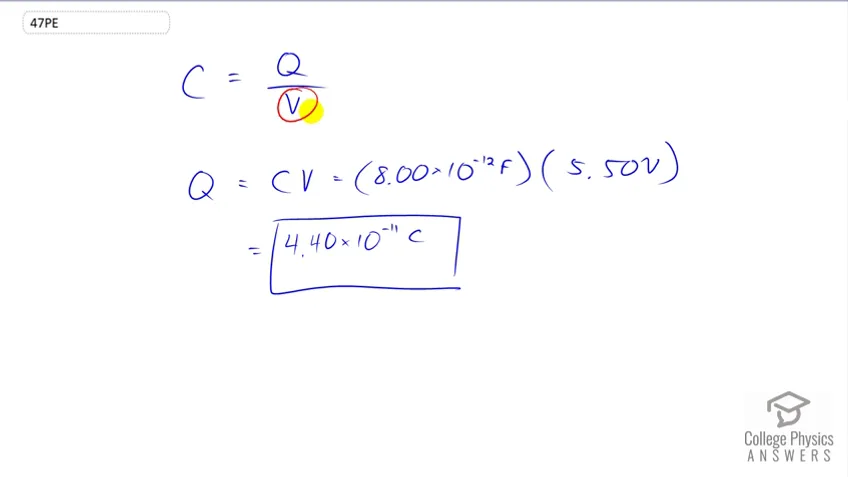 0:28PreviewProblem 47Full video with free trialFind the charge stored when 5.50 V is applied to an 8.00 pF capacitor.
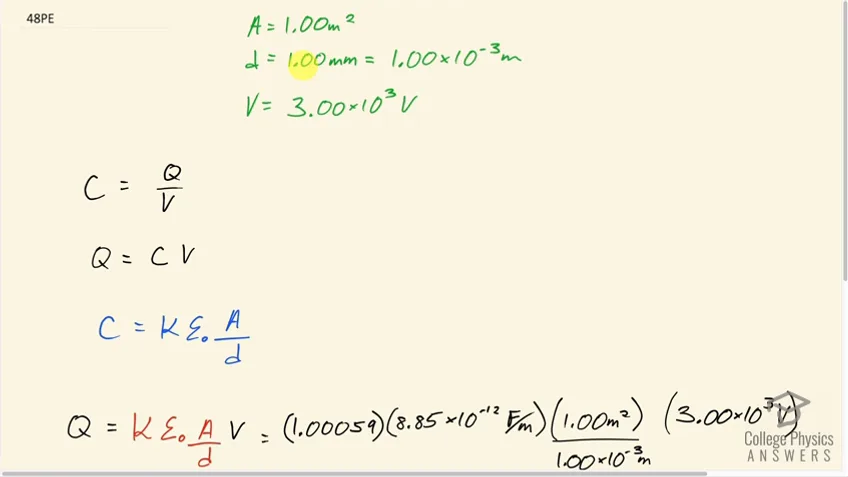 1:30PreviewProblem 48Full video with free trialWhat charge is stored on a parallel plate capacitor with metal plates, each of area , separated by 1.00 mm, when is applied across it?
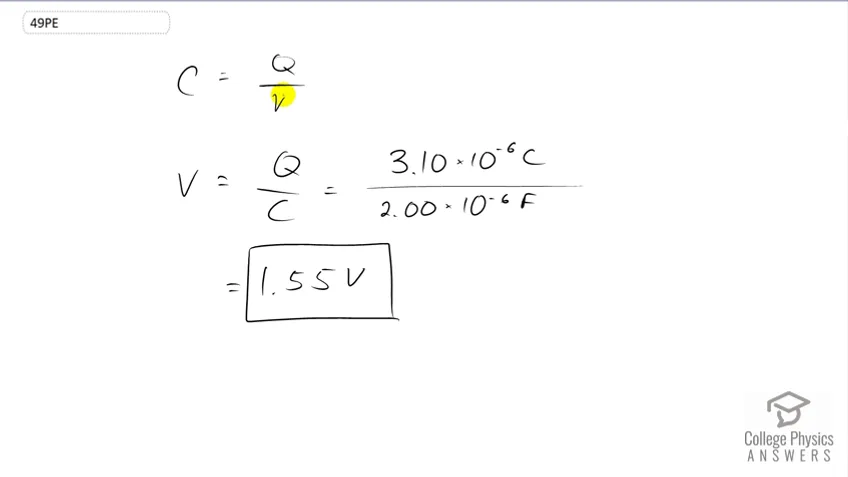 0:43PreviewProblem 49Full video with free trialCalculate the voltage applied to a capacitor when it holds of charge.
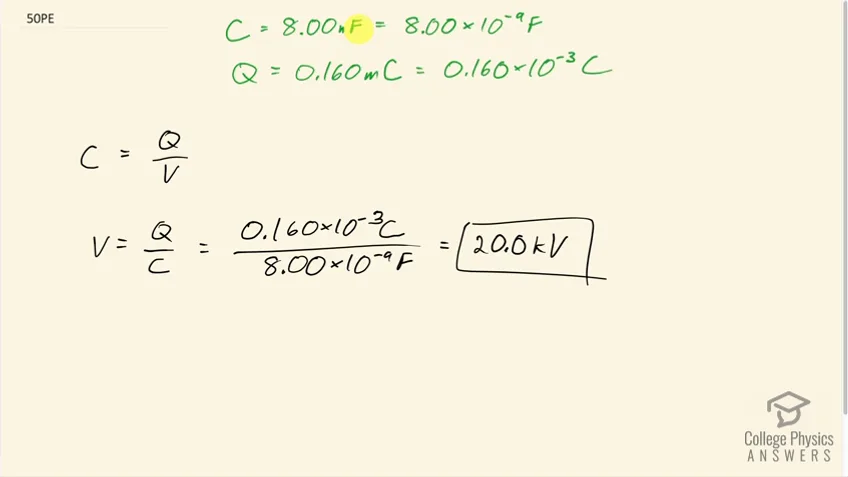 0:46PreviewProblem 50Full video with free trialWhat voltage must be applied to an 8.00 nF capacitor to store 0.160 mC of charge?
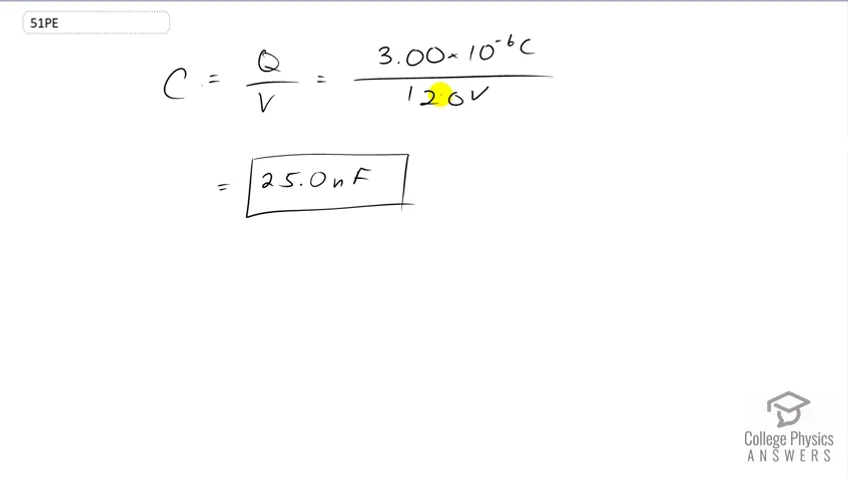 0:22PreviewProblem 51Full video with free trialWhat capacitance is needed to store of charge at a voltage of 120 V?
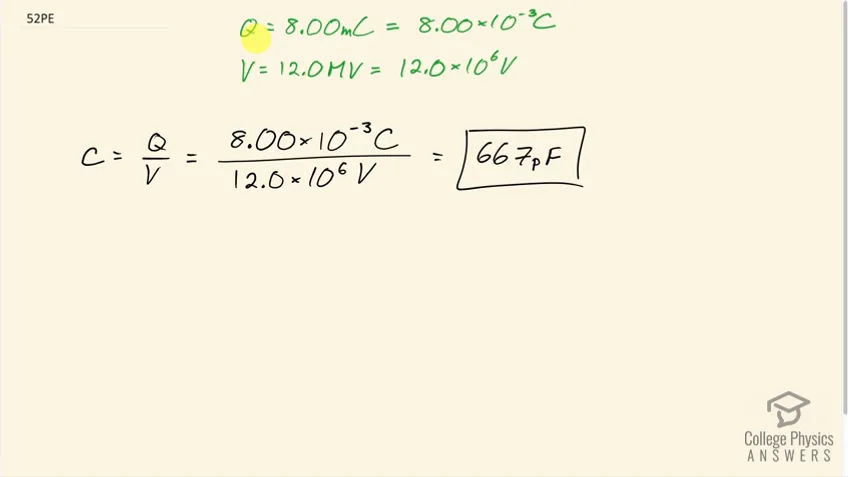 0:30PreviewProblem 52Full video with free trialWhat is the capacitance of a large Van de Graaff generator’s terminal, given that it stores 8.00 mC of charge at a voltage of 12.0 MV?
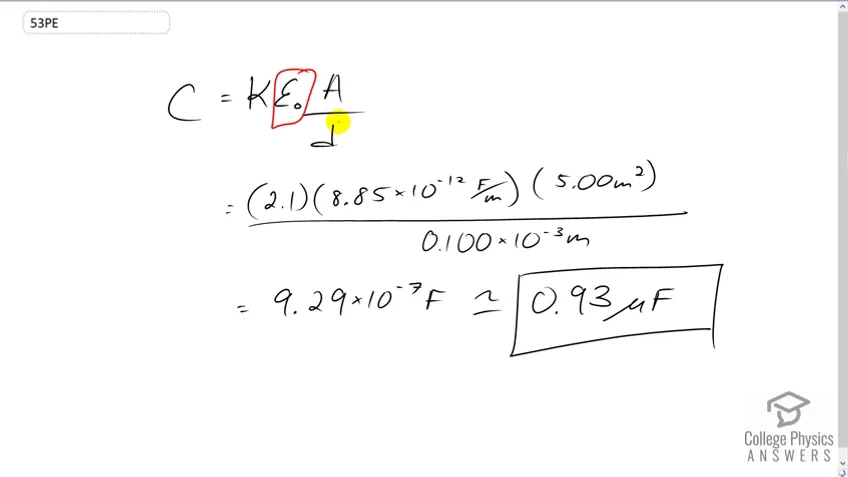 0:50PreviewProblem 53Full video with free trialFind the capacitance of a parallel plate capacitor having plates of area that are separated by 0.100 mm of Teflon.
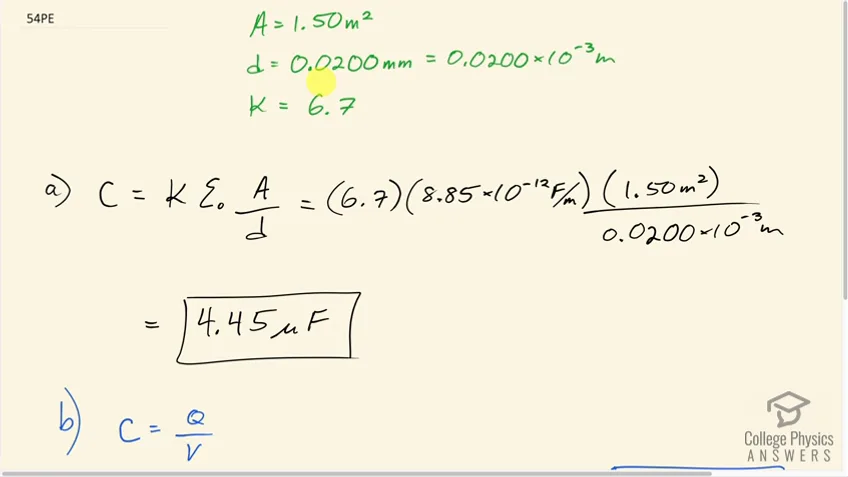 1:15PreviewProblem 54Full video with free trial(a) What is the capacitance of a parallel plate capacitor having plates of area that are separated by 0.0200 mm of neoprene rubber? (b) What charge does it hold when 9.00 V is applied to it?
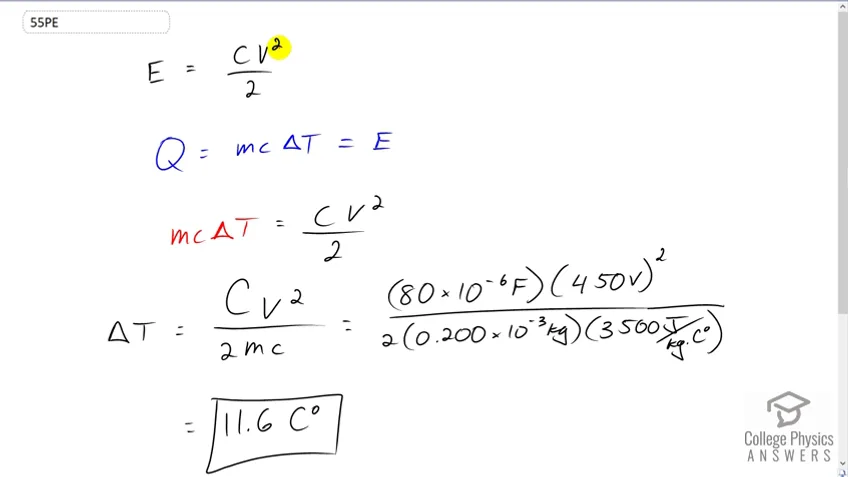 2:09PreviewProblem 55Full video with free trialA prankster applies 450 V to an capacitor and then tosses it to an unsuspecting victim. The victim’s finger is burned by the discharge of the capacitor through 0.200 g of flesh. What is the temperature increase of the flesh? Is it reasonable to assume no phase change?
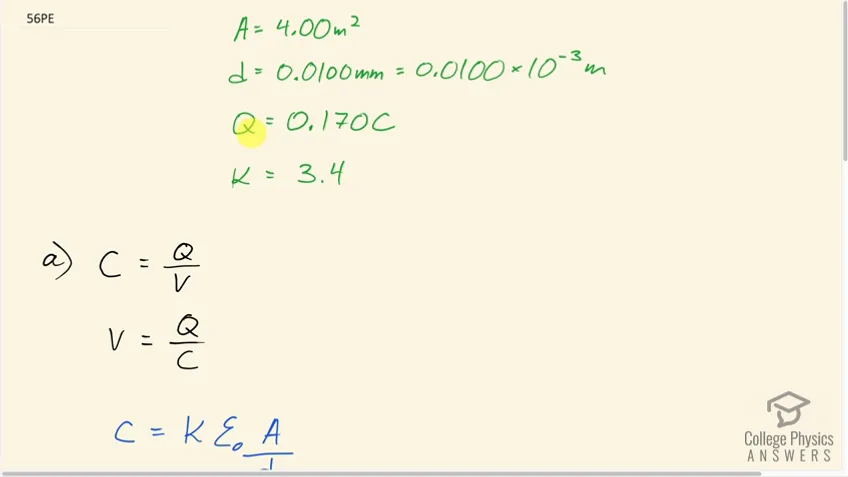 2:49PreviewProblem 56Full video with free trial(a) A certain parallel plate capacitor has plates of area , separated by 0.0100 mm of nylon, and stores 0.170 C of charge. What is the applied voltage? (b) What is unreasonable about this result? (c) Which assumptions are responsible or inconsistent?
19.6 Capacitors in Series and Parallel
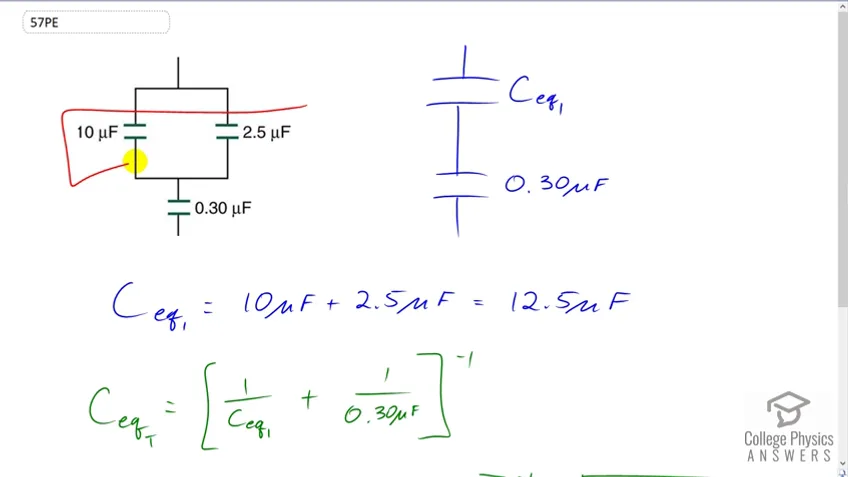 1:12PreviewProblem 57Full video with free trialFind the total capacitance of the combination of capacitors in Figure 19.32.
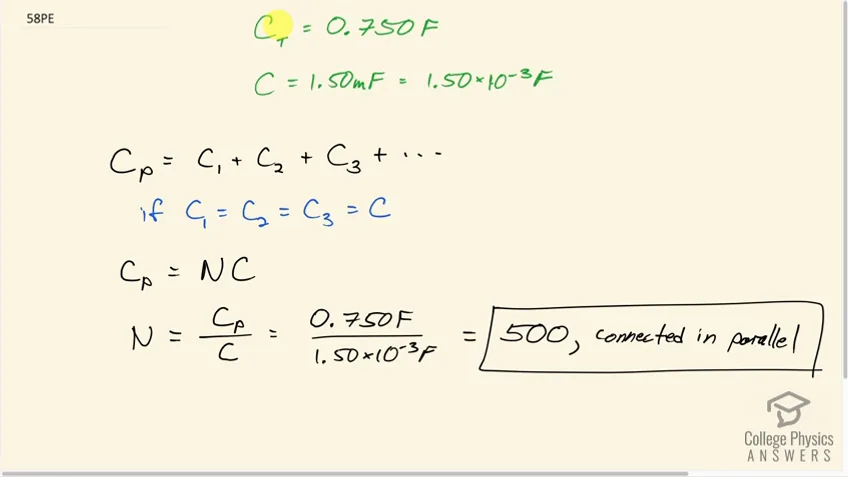 1:10PreviewProblem 58Full video with free trialSuppose you want a capacitor bank with a total capacitance of 0.750 F and you possess numerous 1.50 mF capacitors. What is the smallest number you could hook together to achieve your goal, and how would you connect them?
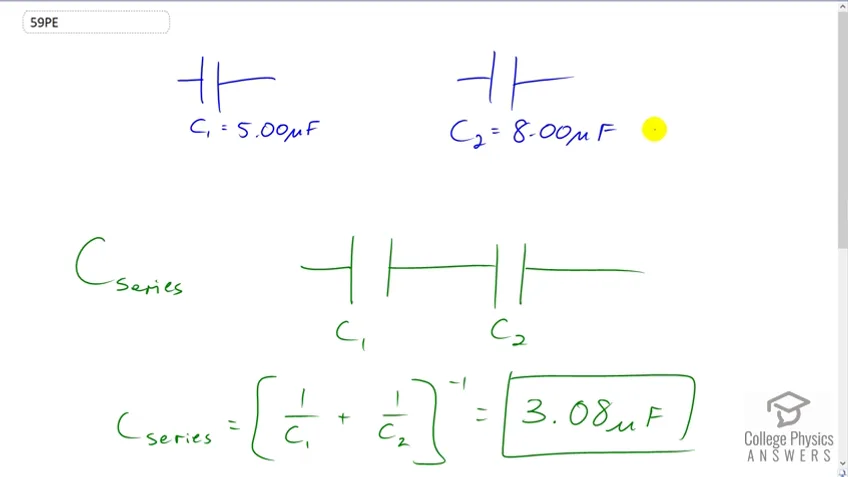 1:33PreviewProblem 59Full video with free trialWhat total capacitances can you make by connecting a and an capacitor together?
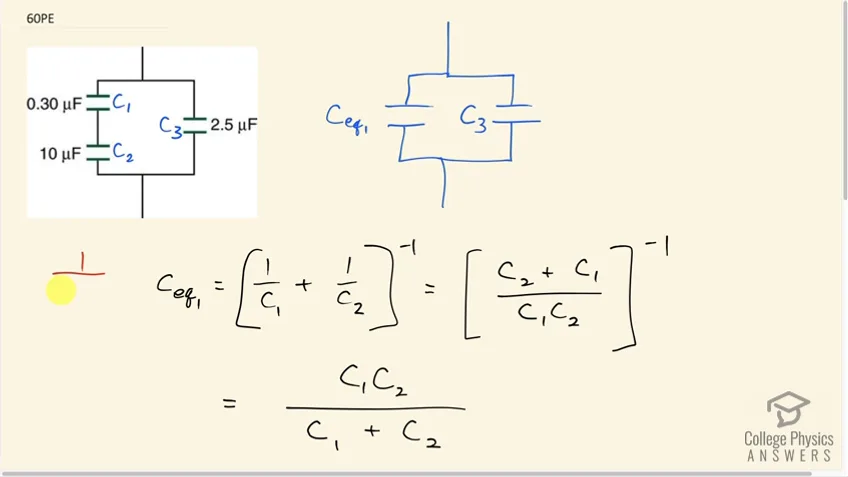 3:10PreviewProblem 60Full video with free trialFind the total capacitance of the combination of capacitors shown in Figure 19.33.
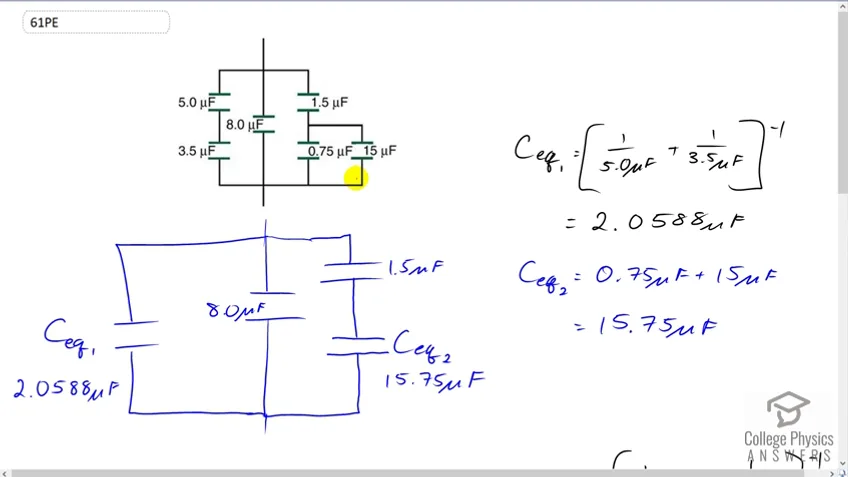 2:28PreviewProblem 61Full video with free trialFind the total capacitance of the combination of capacitors shown in Figure 19.34.
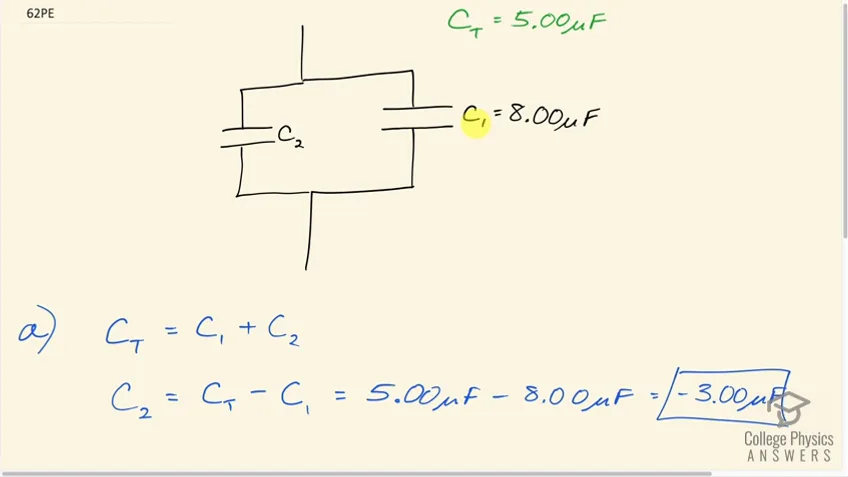 1:03PreviewProblem 62Full video with free trial(a) An capacitor is connected in parallel to another capacitor, producing a total capacitance of . What is the capacitance of the second capacitor? (b) What is unreasonable about this result? (c) Which assumptions are unreasonable or inconsistent?
19.7 Energy Stored in Capacitors
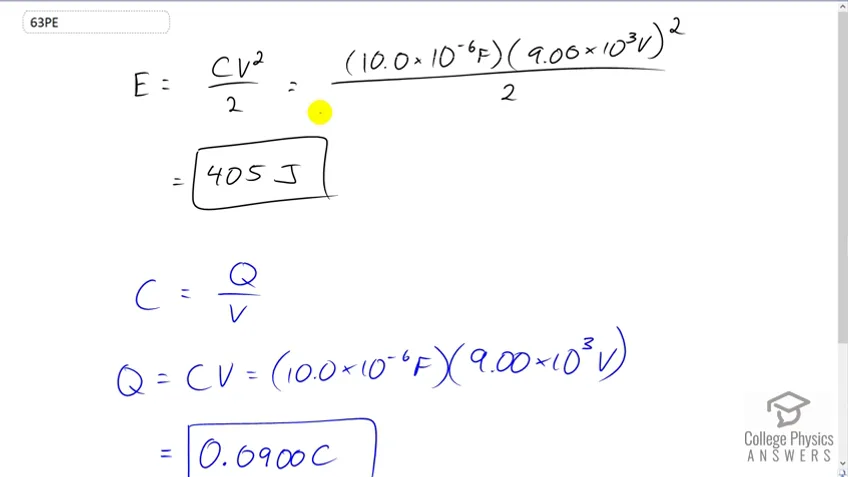 0:52PreviewProblem 63Full video with free trial(a) What is the energy stored in the capacitor of a heart defibrillator charged to ? (b) Find the amount of stored charge.
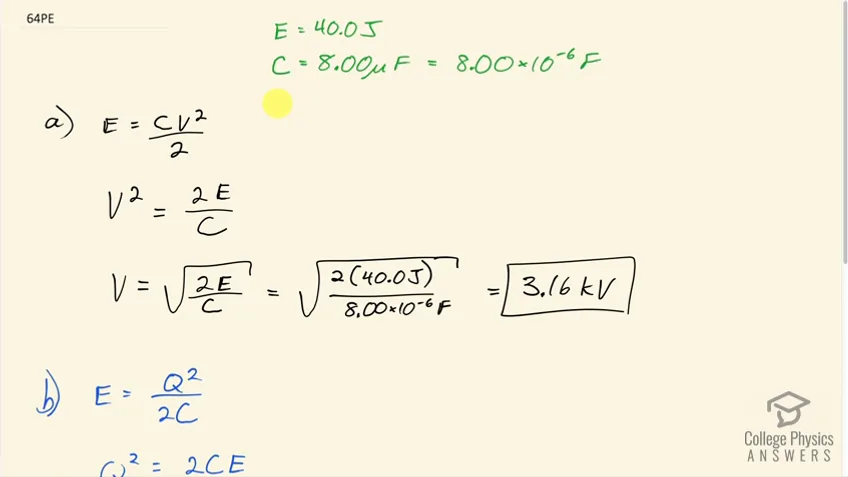 1:17PreviewProblem 64Full video with free trialIn open heart surgery, a much smaller amount of energy will defibrillate the heart. (a) What voltage is applied to the capacitor of a heart defibrillator that stores 40.0 J of energy? (b) Find the amount of stored charge.
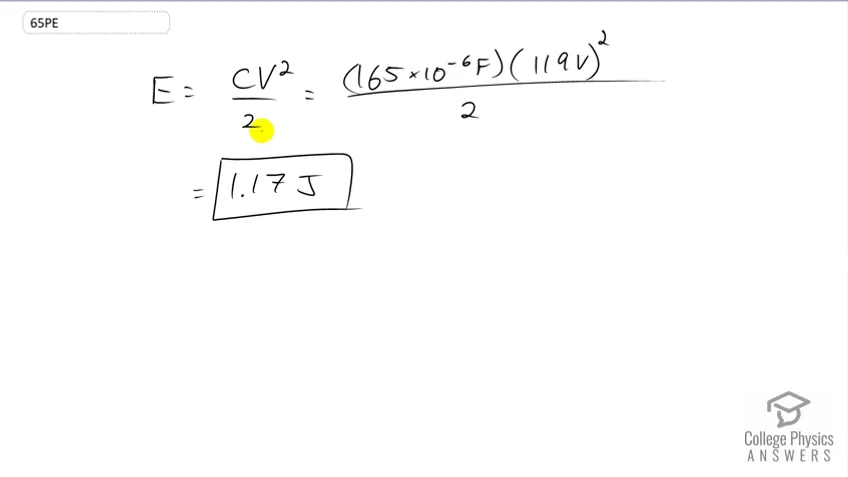 0:27PreviewProblem 65Full video with free trialA capacitor is used in conjunction with a motor. How much energy is stored in it when 119 V is applied?
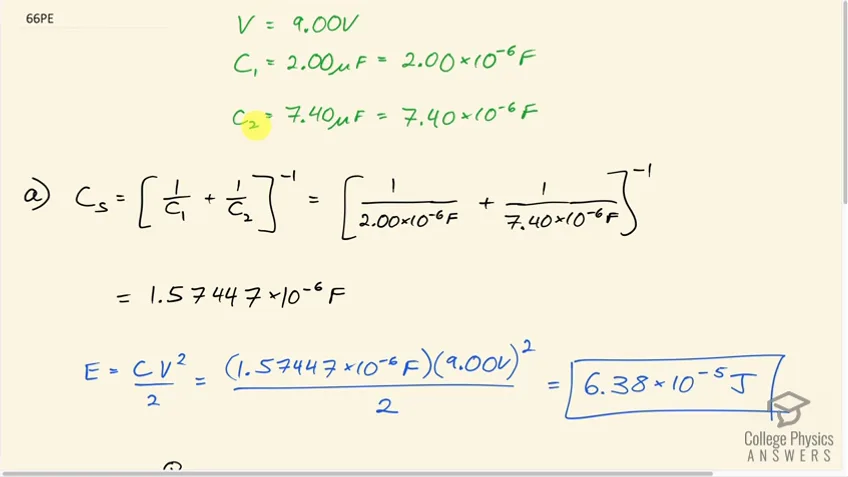 2:28PreviewProblem 66Full video with free trialSuppose you have a 9.00 V battery, a capacitor, and a capacitor. (a) Find the charge and energy stored if the capacitors are connected to the battery in series. (b) Do the same for a parallel connection.
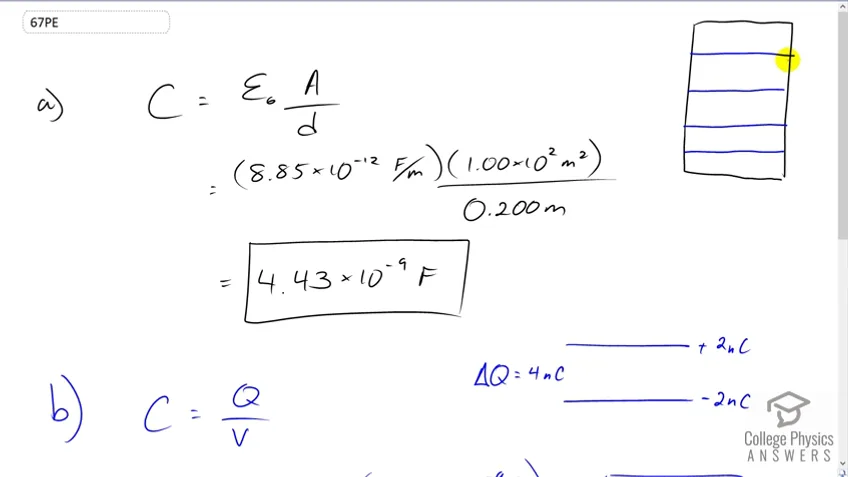 2:48PreviewProblem 67Full video with free trialA nervous physicist worries that the two metal shelves of his wood frame bookcase might obtain a high voltage if charged by static electricity, perhaps produced by friction. (a) What is the capacitance of the empty shelves if they have area and are 0.200 m apart? (b) What is the voltage between them if opposite charges of magnitude 2.00 nC are placed on them? (c) To show that this voltage poses a small hazard, calculate the energy stored.
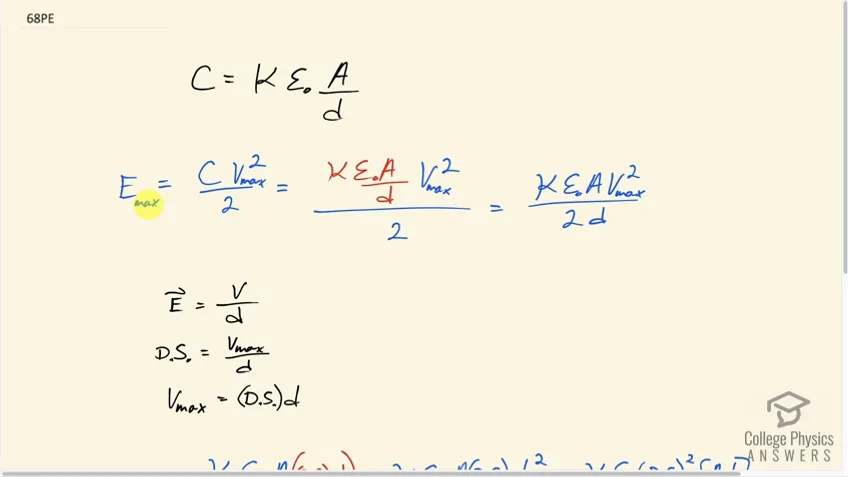 2:43PreviewProblem 68Full video with free trialShow that for a given dielectric material the maximum energy a parallel plate capacitor can store is directly proportional to the volume of dielectric ( ). Note that the applied voltage is limited by the dielectric strength.
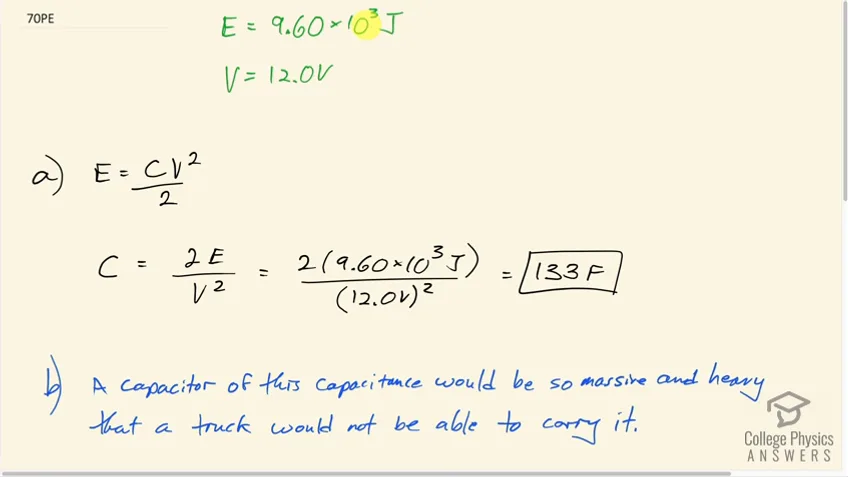 2:12PreviewProblem 70Full video with free trial(a) On a particular day, it takes of electric energy to start a truck’s engine. Calculate the capacitance of a capacitor that could store that amount of energy at 12.0 V. (b) What is unreasonable about this result? (c) Which assumptions are responsible?
Test Prep for AP® Courses
19.1 Electric Potential Energy: Potential Difference
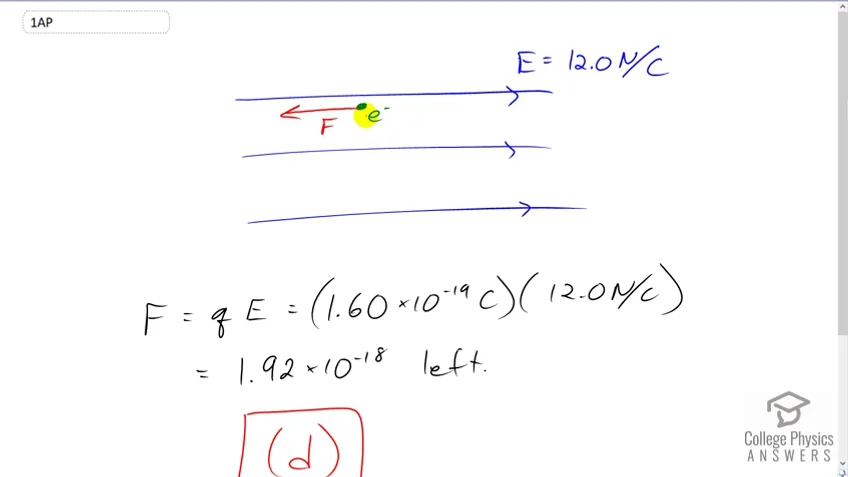 0:48PreviewProblem 1Full video with free trialAn electron is placed in an electric field of to the right. What is the resulting force on the electron? (a)
(b)
(c) $1.92 \times 10^{-18} \textrm{ N right}
(d)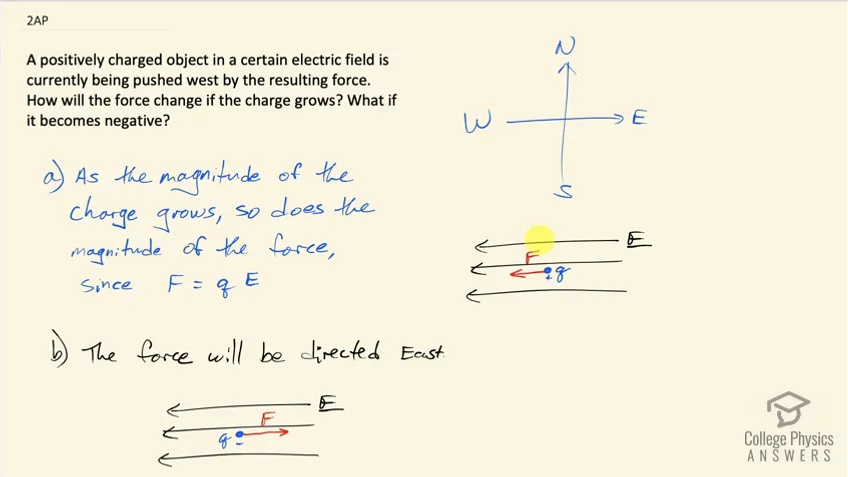 0:54PreviewProblem 2Full video with free trialA positively charged object in a certain electric field is currently being pushed west by the resulting force. How will the force change if the charge grows? What if it becomes negative?
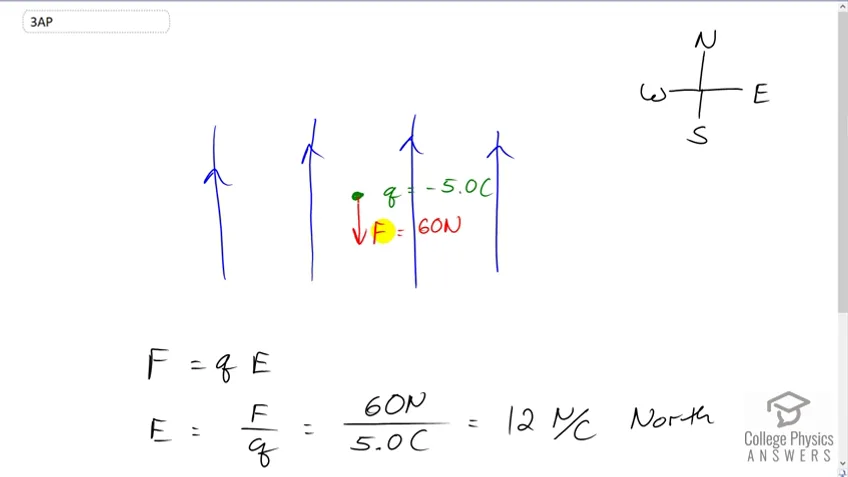 0:52PreviewProblem 3Full video with free trialA −5.0 C charge is being forced south by a 60 N force. What are the magnitude and direction of the local electric field? (a)
(b) $12 \textrm{ N/C North}
(c) $300 \textrm{ N/C South}
(d)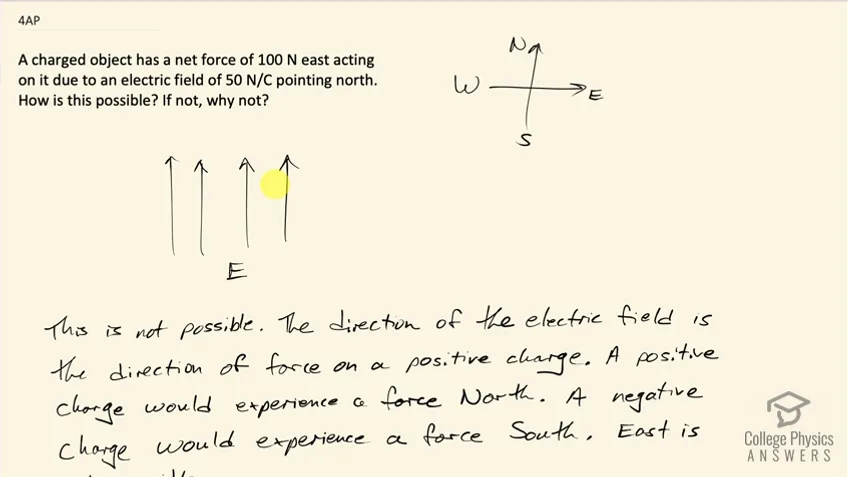 0:47PreviewProblem 4Full video with free trialA charged object has a net force of 100 N east acting on it due to an electric field of 50 N/C pointing north. How is this possible? If not, why not?
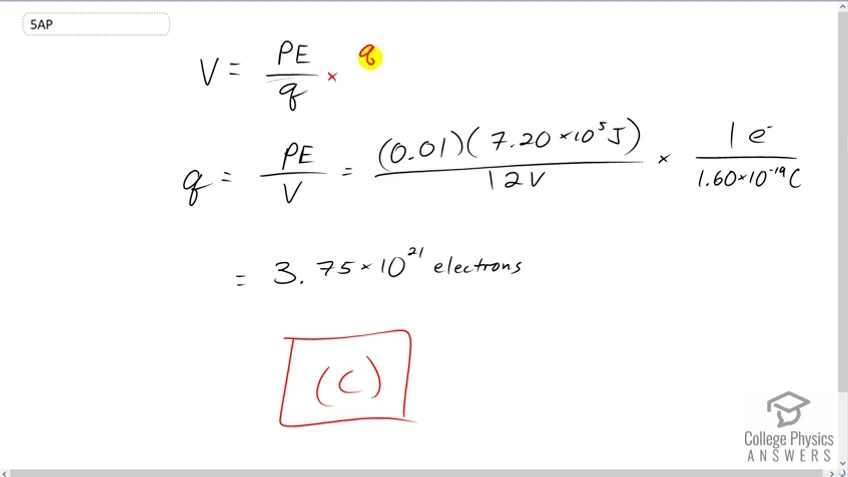 1:03PreviewProblem 5Full video with free trialHow many electrons have to be moved by a car battery containing at 12 V to reduce the energy by 1%? (a)
(b)
(c)
(d) $3.13 \times 10^{20}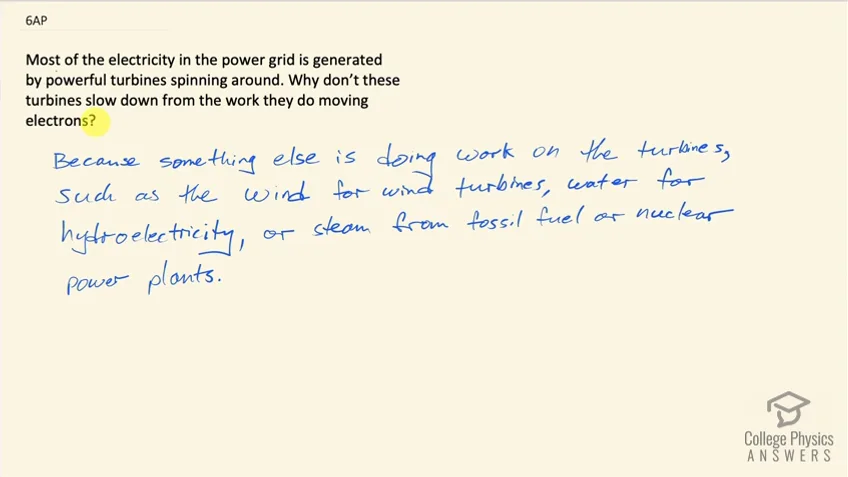 1:22PreviewProblem 6Full video with free trialMost of the electricity in the power grid is generated by powerful turbines spinning around. Why don’t these turbines slow down from the work they do moving electrons?
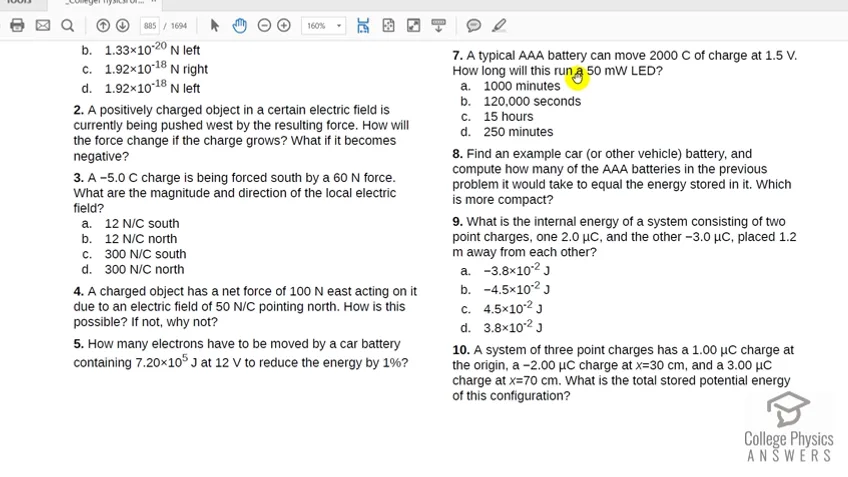 1:26PreviewProblem 7Full video with free trialA typical AAA battery can move 2000 C of charge at 1.5 V. How long will this run a 50 mW LED? (a) 1000 minutes
(b) 120,000 seconds
(c) 15 hours
(d) 250 minutes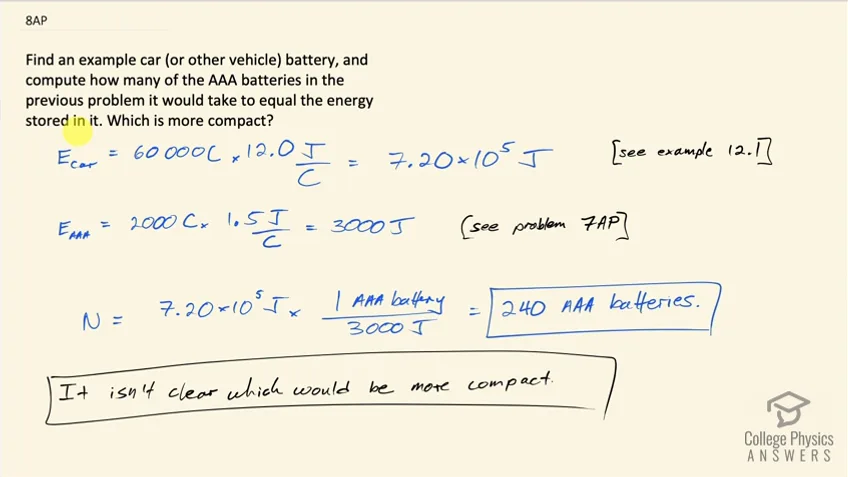 1:12PreviewProblem 8Full video with free trialFind an example car (or other vehicle) battery, and compute how many of the AAA batteries in the previous problem it would take to equal the energy stored in it. Which is more compact?
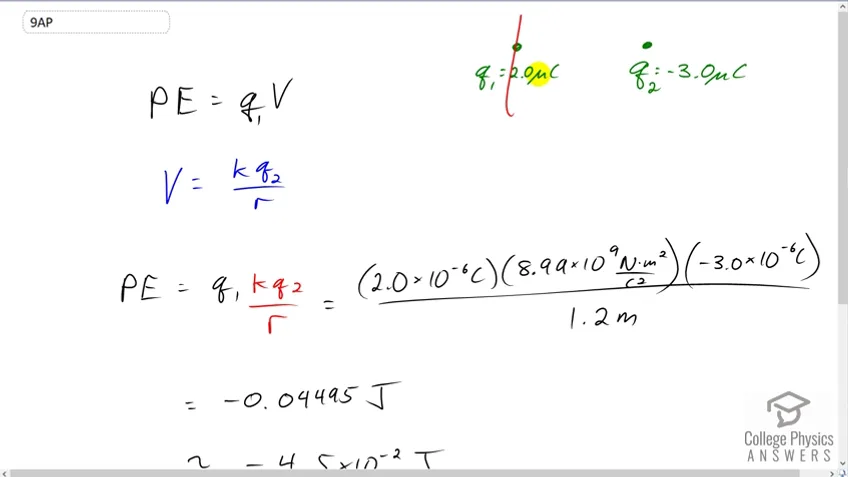 1:23PreviewProblem 9Full video with free trialWhat is the internal energy of a system consisting of two point charges, one 2.0 μC, and the other −3.0 μC, placed 1.2 m away from each other? (a)
(b)
(c)
(d)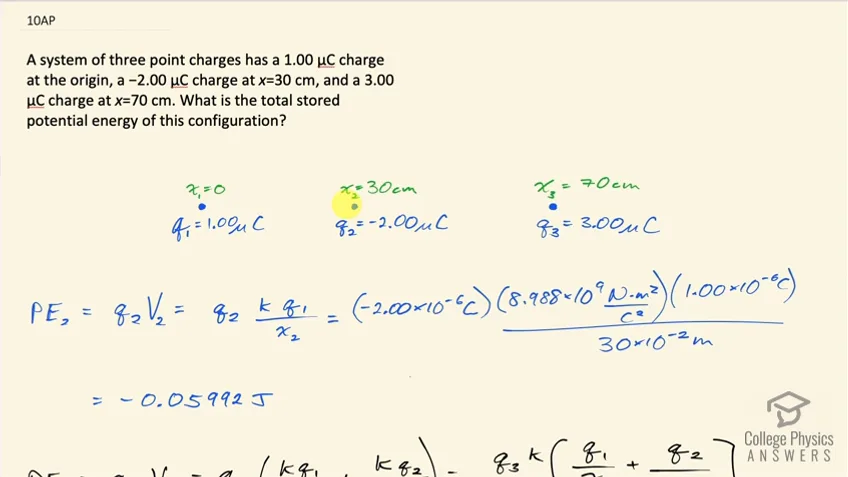 6:06PreviewProblem 10Full video with free trialA system of three point charges has a 1.00 μC charge at the origin, a −2.00 μC charge at x=30 cm, and a 3.00 μC charge at x=70 cm. What is the total stored potential energy of this configuration?
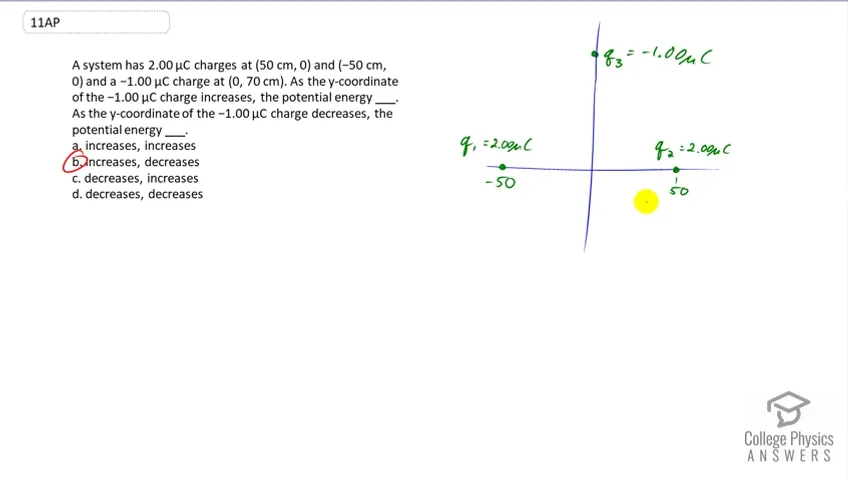 1:59PreviewProblem 11Full video with free trialA system has 2.00 μC charges at (50 cm, 0) and (−50 cm, 0) and a −1.00 μC charge at (0, 70 cm). As the y-coordinate of the −1.00 μC charge increases, the potential energy ___. As the y-coordinate of the −1.00 μC charge decreases, the potential energy ___. (a) increases, increases
(b) increases, decreases
(c) decreases, increases
(d) decreases, decreases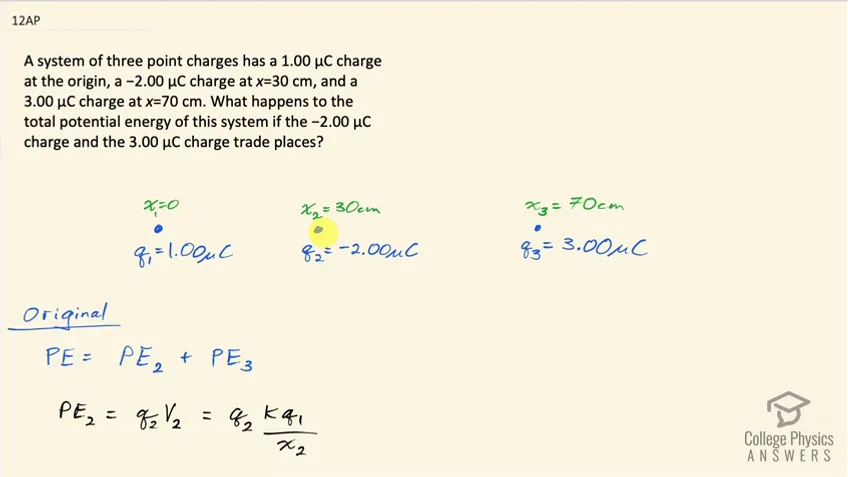 8:53PreviewProblem 12Full video with free trialA system of three point charges has a 1.00 μC charge at the origin, a −2.00 μC charge at x=30 cm, and a 3.00 μC charge at x=70 cm. What happens to the total potential energy of this system if the −2.00 μC charge and the 3.00 μC charge trade places?
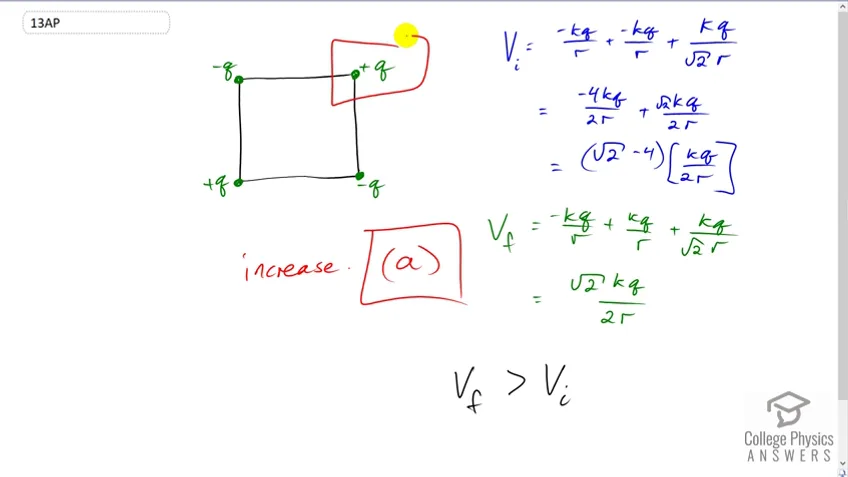 2:42PreviewProblem 13Full video with free trialTake a square configuration of point charges, two positive and two negative, all of the same magnitude, with like charges sharing diagonals. What will happen to the internal energy of this system if one of the negative charges becomes a positive charge of the same magnitude? (a) increase
(b) decrease
(c) no change
(d) not enough information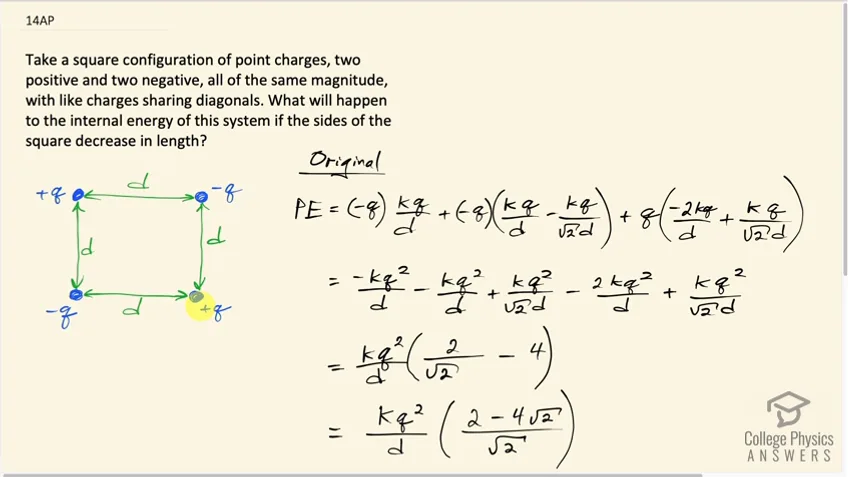 4:48PreviewProblem 14Full video with free trialTake a square configuration of point charges, two positive and two negative, all of the same magnitude, with like charges sharing diagonals. What will happen to the internal energy of this system if the sides of the square decrease in length?
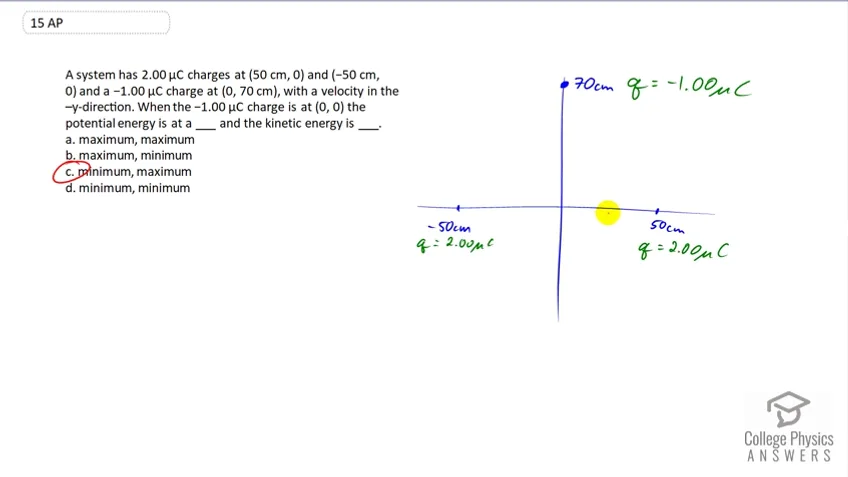 2:07PreviewProblem 15Full video with free trialA system has 2.00 μC charges at (50 cm, 0) and (−50 cm, 0) and a −1.00 μC charge at (0, 70 cm), with a velocity in the –y-direction. When the −1.00 μC charge is at (0, 0) the potential energy is at a ___ and the kinetic energy is ___. (a) maximum, maximum
(b) maximum, minimum
(c) minimum, maximum
(d) minimum, minimum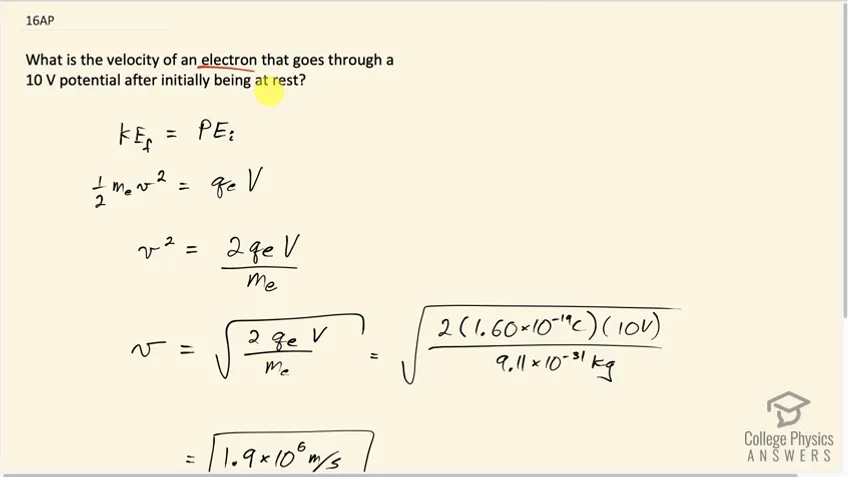 1:15PreviewProblem 16Full video with free trialWhat is the velocity of an electron that goes through a 10 V potential after initially being at rest?
19.2 Electric Potential in a Uniform Electric Field
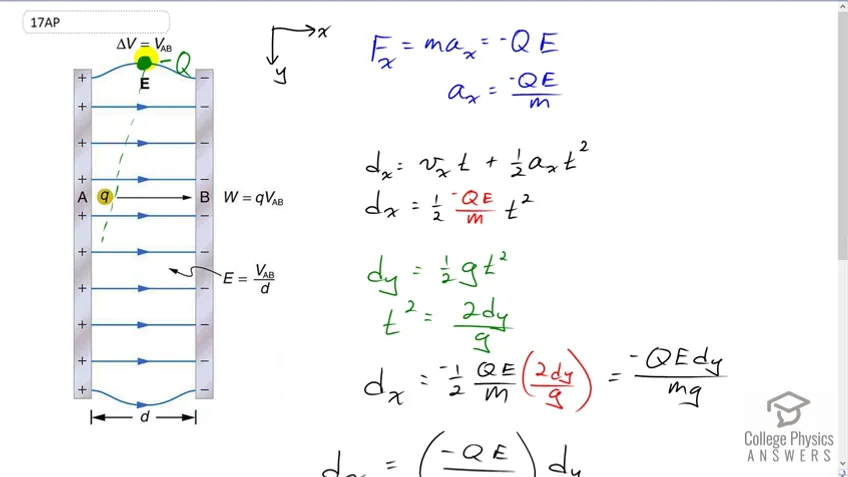 7:28PreviewProblem 17Full video with free trialA negatively charged massive particle is dropped from above the two plates in Figure 19.7 into the space between them. Which best describes the trajectory it takes? (a) A rightward-curving parabola
(b) A leftward-curving parabola
(c) A rightward-curving section of a circle
(d) A leftward-curving section of a circle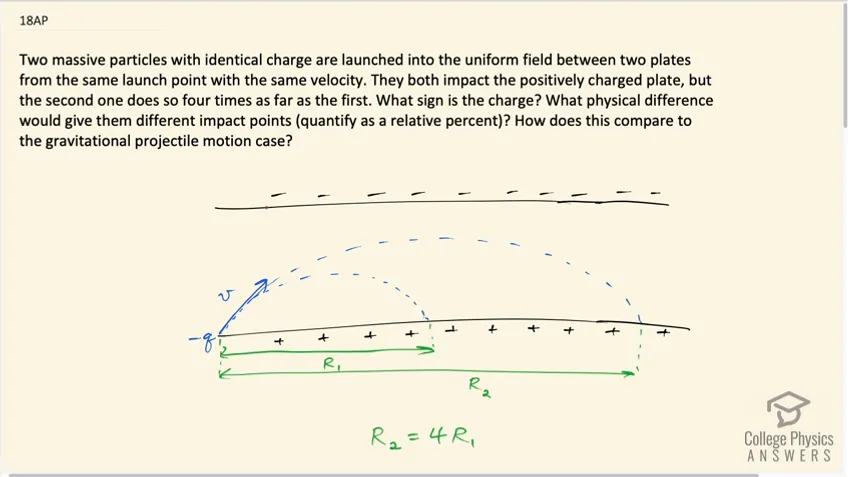 8:21PreviewProblem 18Full video with free trialTwo massive particles with identical charge are launched into the uniform field between two plates from the same launch point with the same velocity. They both impact the positively charged plate, but the second one does so four times as far as the first. What sign is the charge? What physical difference would give them different impact points (quantify as a relative percent)? How does this compare to the gravitational projectile motion case?
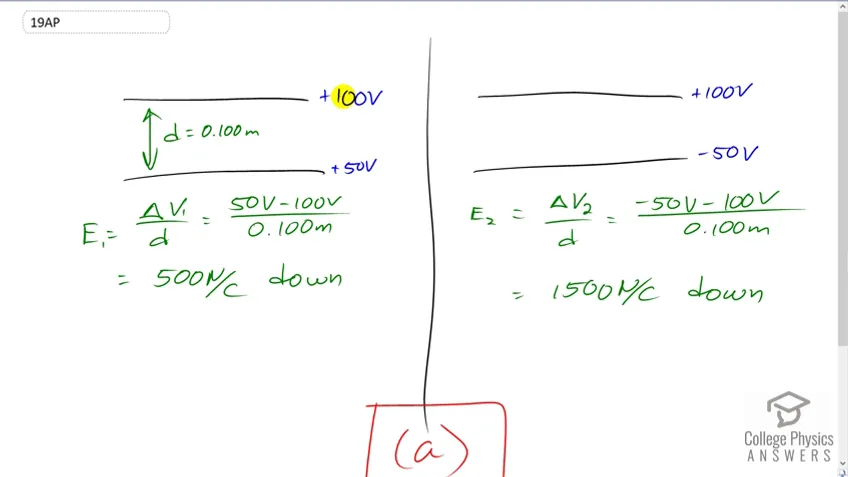 0:55PreviewProblem 19Full video with free trialTwo plates are lying horizontally, but stacked with one 10.0 cm above the other. If the upper plate is held at +100 V, what is the magnitude and direction of the electric field between the plates if the lower is held at +50.0 V? -50.0 V? (a) 500 V/m, 1500 V/m, down
(b) 500 V/m, 1500 V/m, up
(c) 1500 V/m, 500 V/m, down
(d) 1500 V/m, 500 V/m, up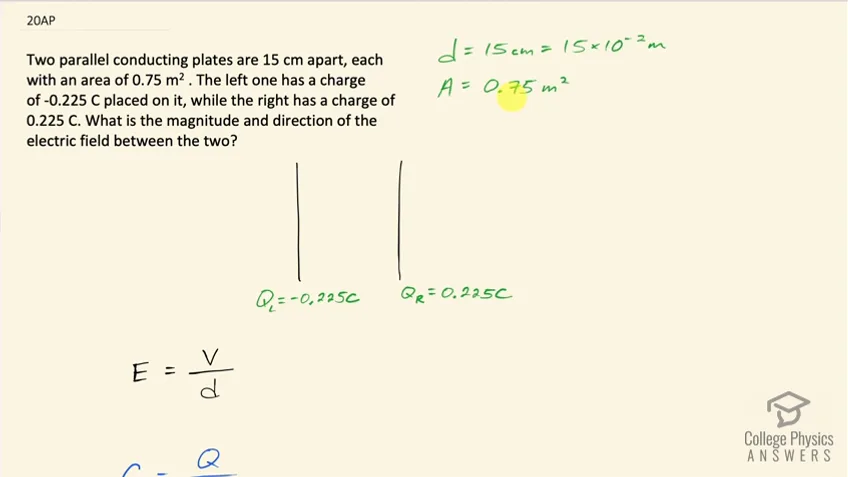 2:34PreviewProblem 20Full video with free trialTwo parallel conducting plates are 15 cm apart, each with an area of . The left one has a charge of -0.225 C placed on it, while the right has a charge of 0.225 C. What is the magnitude and direction of the electric field between the two?
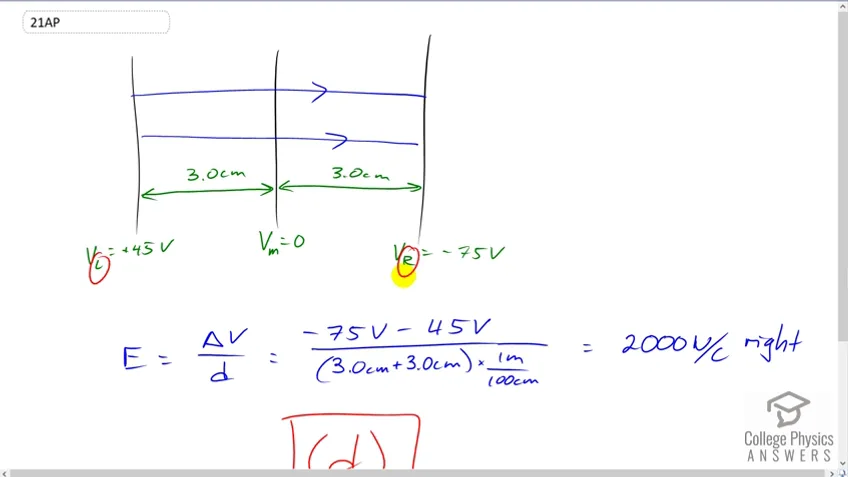 2:26PreviewProblem 21Full video with free trialConsider three parallel conducting plates, with a space of 3.0 cm between them. The leftmost one is at a potential of +45 V, the middle one is held at ground, and the rightmost is at a potential of -75 V. What is the magnitude of the average electric field on an electron traveling between the plates? (Assume that the middle one has holes for the electron to go through.) (a) 1500 V/m
(b) 2500 V/m
(c) 4000 V/m
(d) 2000 V/m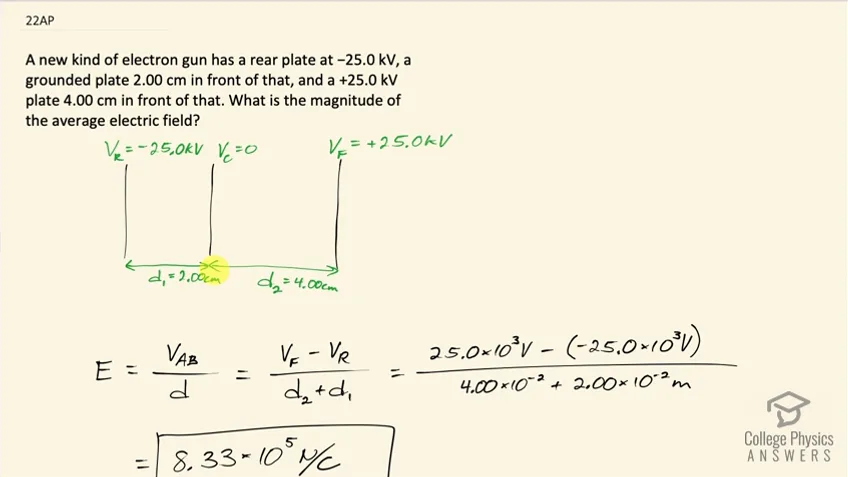 3:10PreviewProblem 22Full video with free trialA new kind of electron gun has a rear plate at −25.0 kV, a grounded plate 2.00 cm in front of that, and a +25.0 kV plate 4.00 cm in front of that. What is the magnitude of the average electric field?
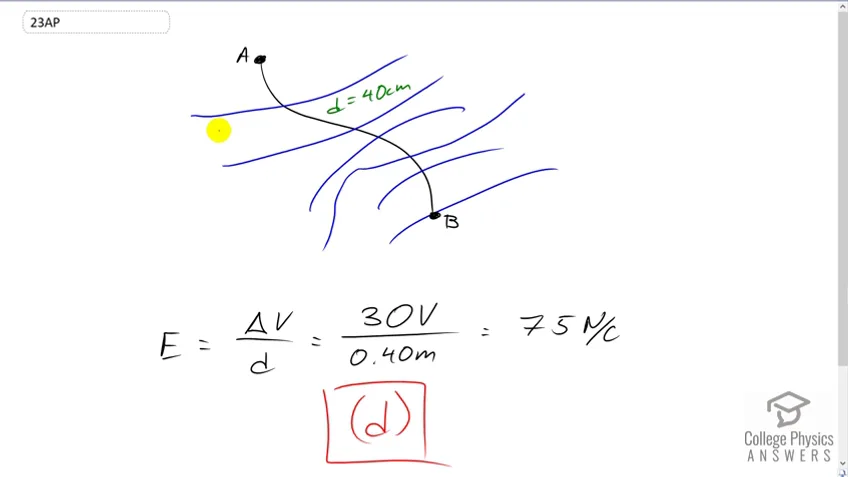 0:51PreviewProblem 23Full video with free trialA certain electric potential isoline graph has isolines every 5.0 V. If six of these lines cross a 40 cm path drawn between two points of interest, what is the (magnitude of the average) electric field along this path? (a) 750 V/m
(b) 150 V/m
(c) 38 V/m
(d) 75 V/m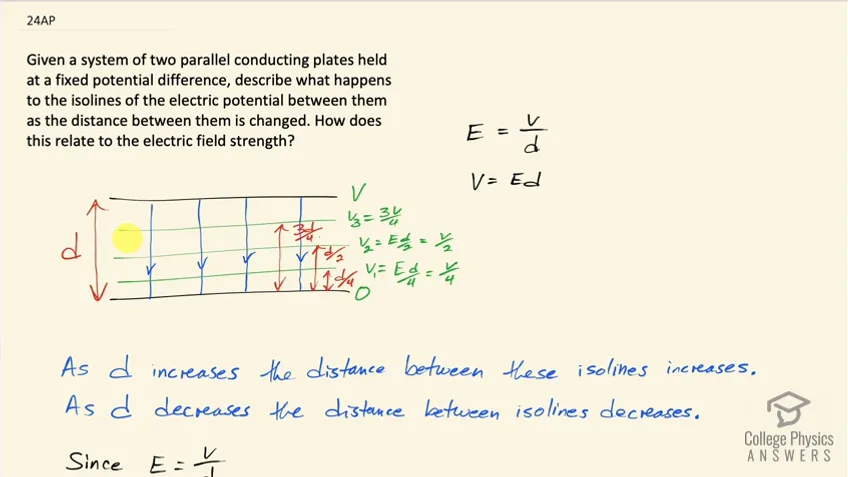 2:54PreviewProblem 24Full video with free trialGiven a system of two parallel conducting plates held at a fixed potential difference, describe what happens to the isolines of the electric potential between them as the distance between them is changed. How does this relate to the electric field strength?
19.4 Equipotential Lines
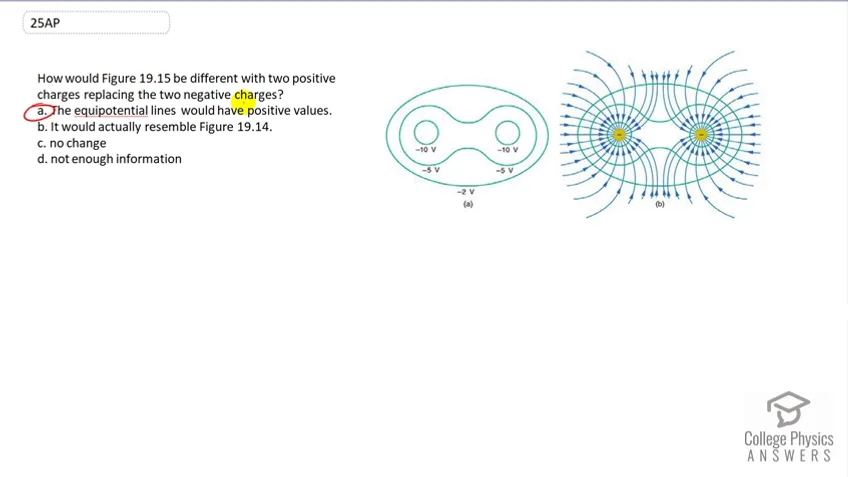 1:01PreviewProblem 25Full video with free trialHow would Figure 19.15 be different with two positive charges replacing the two negative charges? (a) The equipotential lines would have positive values.
(b) It would actually resemble Figure 19.14.
(c) no change
(d) not enough information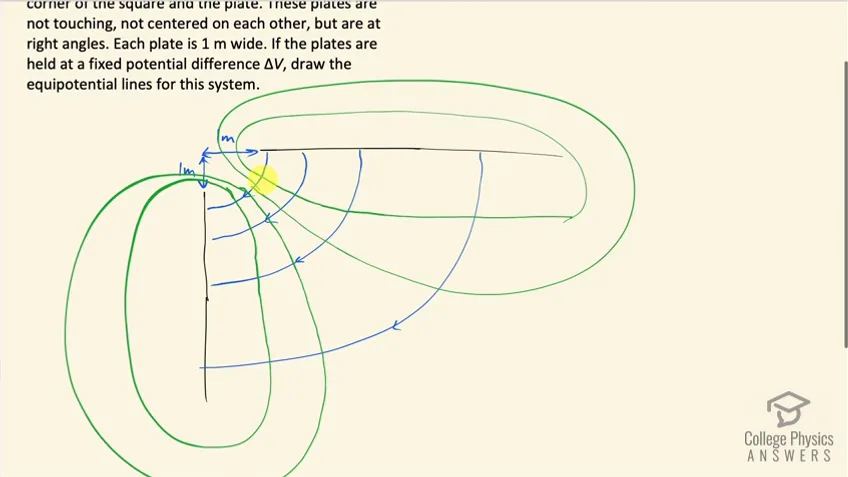 3:47PreviewProblem 26Full video with free trialConsider two conducting plates, placed on adjacent sides of a square, but with a 1-m space between the corner of the square and the plate. These plates are not touching, not centered on each other, but are at right angles. Each plate is 1 m wide. If the plates are held at a fixed potential difference , draw the equipotential lines for this system.
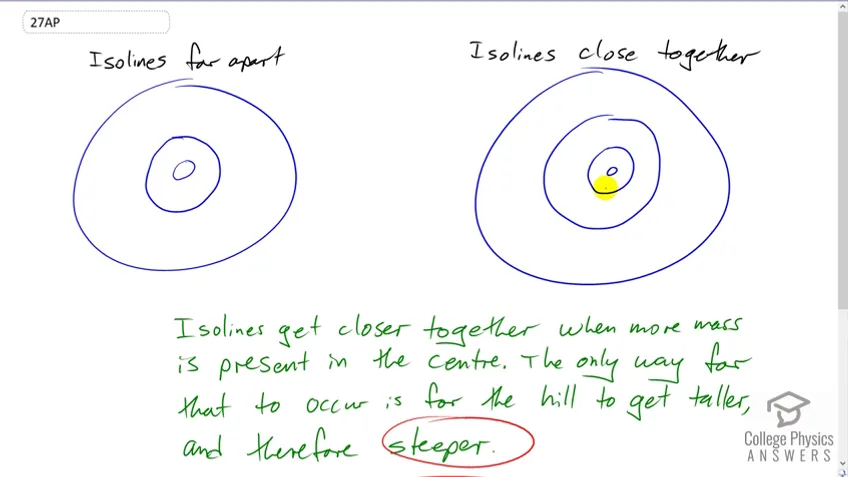 0:42PreviewProblem 27Full video with free trialAs isolines of electric potential get closer together, the electric field gets stronger. What shape would a hill have as the isolines of gravitational potential get closer together? (a) constant slope
(b) steeper slope
(c) shallower slope
(d) a U-shape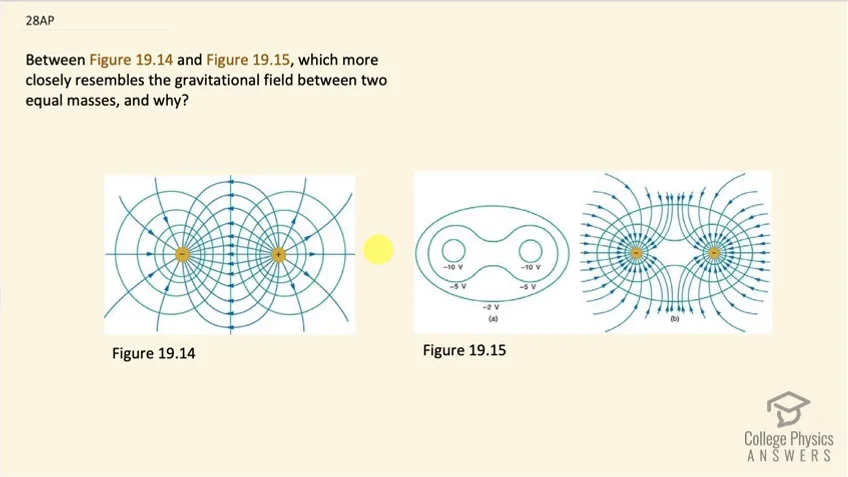 1:56PreviewProblem 28Full video with free trialBetween Figure 19.14 and Figure 19.15, which more closely resembles the gravitational field between two equal masses, and why?
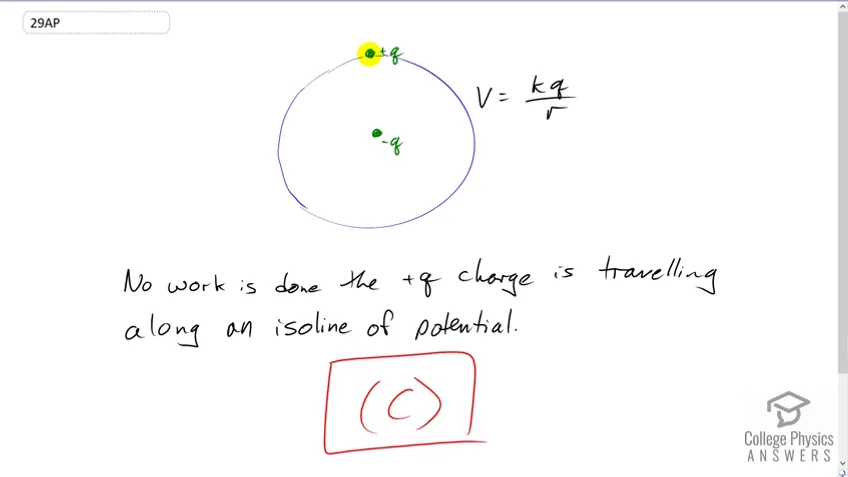 0:44PreviewProblem 29Full video with free trialHow much work is necessary to keep a positive point charge in orbit around a negative point charge? (a) A lot; this system is unstable.
(b) Just a little; the isolines are far enough apart that crossing them doesn’t take much work.
(c) None; we’re traveling along an isoline, which requires no work.
(d) There’s not enough information to tell.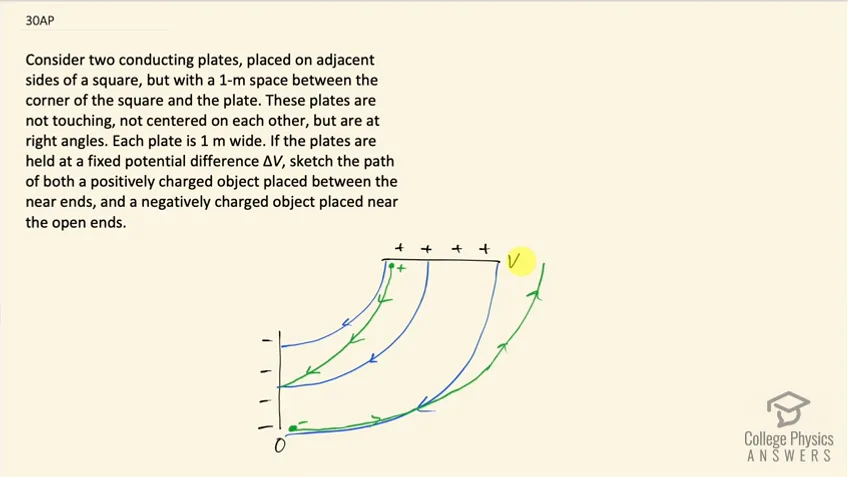 2:24PreviewProblem 30Full video with free trialConsider two conducting plates, placed on adjacent sides of a square, but with a 1-m space between the corner of the square and the plate. These plates are not touching, not centered on each other, but are at right angles. Each plate is 1 m wide. If the plates are held at a fixed potential difference ΔV, sketch the path of both a positively charged object placed between the near ends, and a negatively charged object placed near the open ends.
19.5 Capacitors and Dielectrics
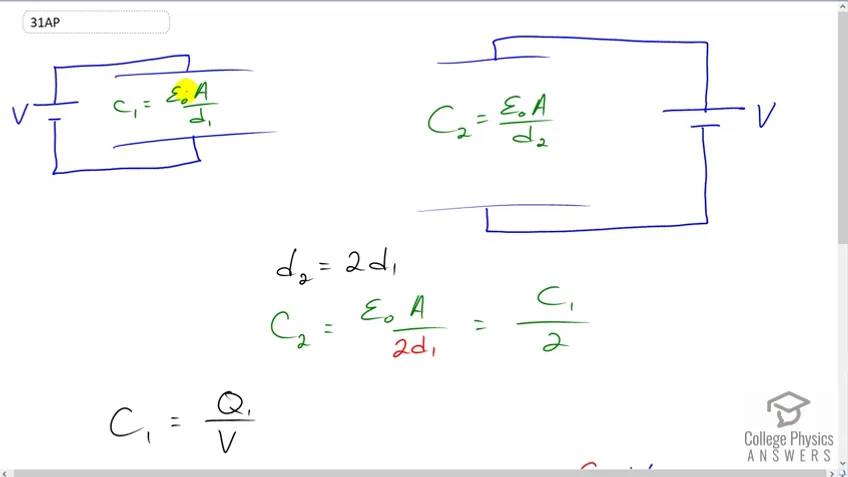 2:07PreviewProblem 31Full video with free trialTwo parallel plate capacitors are otherwise identical, except the second one has twice the distance between the plates of the first. If placed in otherwise identical circuits, how much charge will the second plate have on it compared to the first? (a) four times as much
(b) twice as much
(c) the same
(d) half as much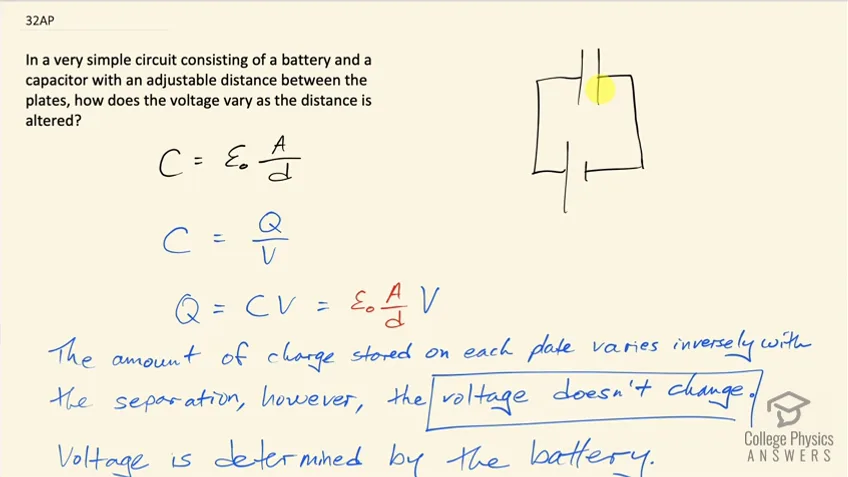 1:26PreviewProblem 32Full video with free trialIn a very simple circuit consisting of a battery and a capacitor with an adjustable distance between the plates, how does the voltage vary as the distance is altered?
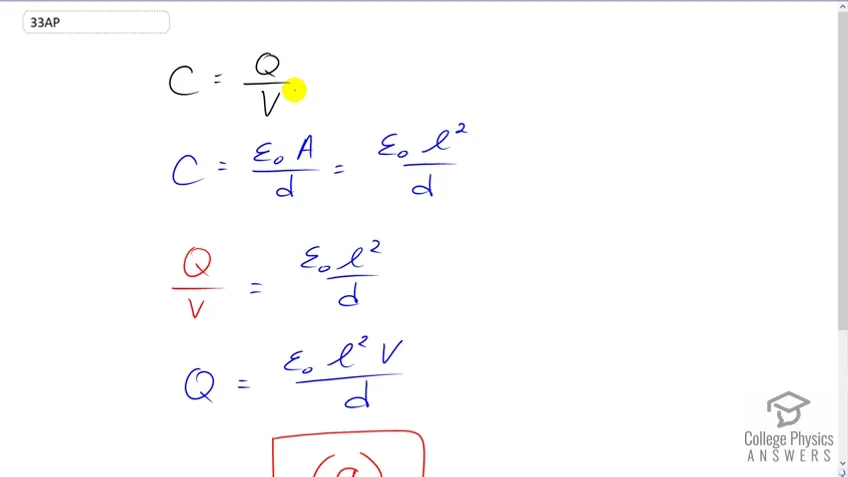 1:05PreviewProblem 33Full video with free trialA parallel plate capacitor with adjustable-size square plates is placed in a circuit. How does the charge on the capacitor change as the length of the sides of the plates is increased? (a) it grows proportional to
(b) it grows proportional to length
(c) it shrinks proportional to length
(d) it shrinks proportional to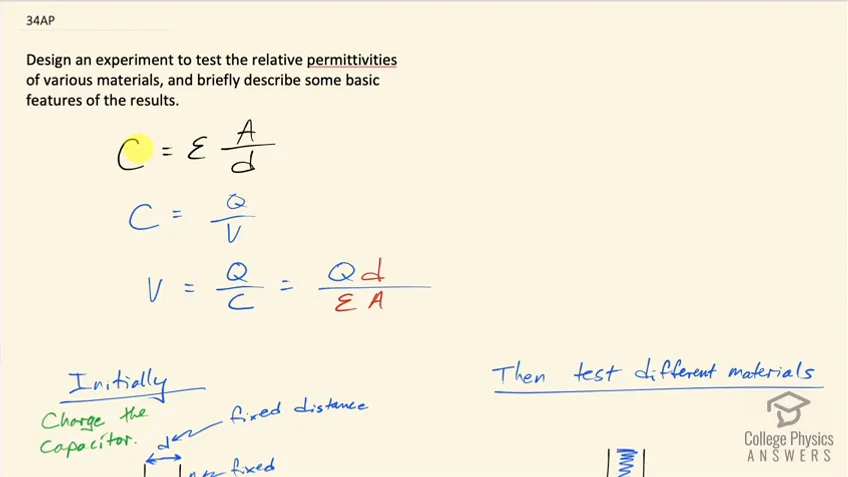 4:28PreviewProblem 34Full video with free trialDesign an experiment to test the relative permittivities of various materials, and briefly describe some basic features of the results.
 3:53PreviewProblem 35Full video with free trial
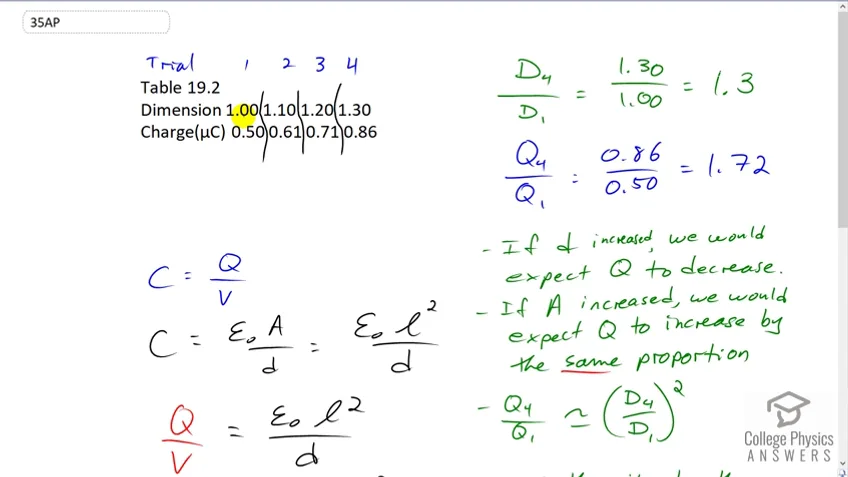
A student was changing one of the dimensions of a square parallel plate capacitor and measuring the resultant charge in a circuit with a battery. However, the student forgot which dimension was being varied, and didn’t write it or any units down. Given the table, which dimension was it?
Table 19.2 Dimension 1.00 1.10 1.20 1.30 Charge () 0.50 0.61 0.71 0.86 (a) The distance between the plates
(b) The area
(c) The length of a side
(d) Both the area and the length of a side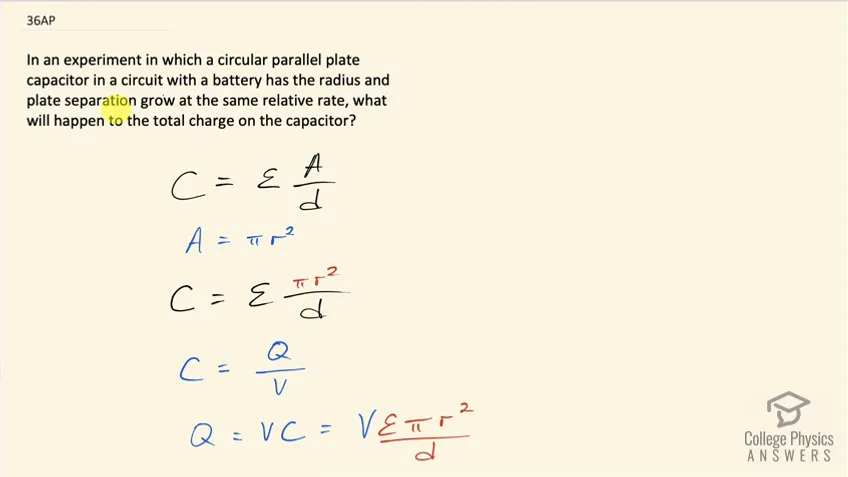 2:47PreviewProblem 36Full video with free trialIn an experiment in which a circular parallel plate capacitor in a circuit with a battery has the radius and plate separation grow at the same relative rate, what will happen to the total charge on the capacitor?
19.7 Energy Stored in Capacitors
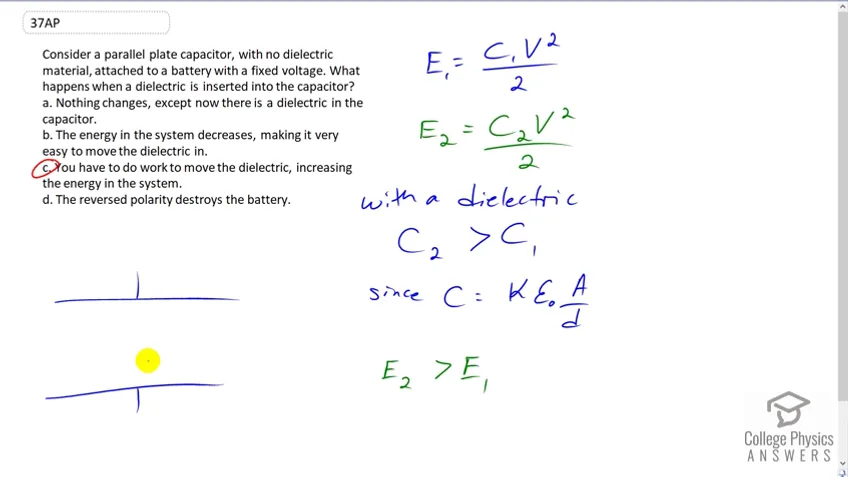 1:26PreviewProblem 37Full video with free trialConsider a parallel plate capacitor, with no dielectric material, attached to a battery with a fixed voltage. What happens when a dielectric is inserted into the capacitor? (a) Nothing changes, except now there is a dielectric in the capacitor.
(b) The energy in the system decreases, making it very easy to move the dielectric in.
(c) You have to do work to move the dielectric, increasing the energy in the system.
(d) The reversed polarity destroys the battery.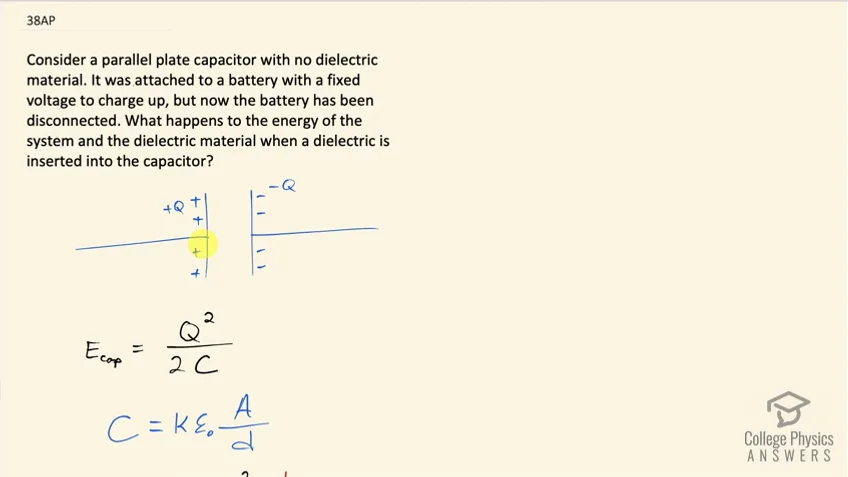 2:23PreviewProblem 38Full video with free trialConsider a parallel plate capacitor with no dielectric material. It was attached to a battery with a fixed voltage to charge up, but now the battery has been disconnected. What happens to the energy of the system and the dielectric material when a dielectric is inserted into the capacitor?
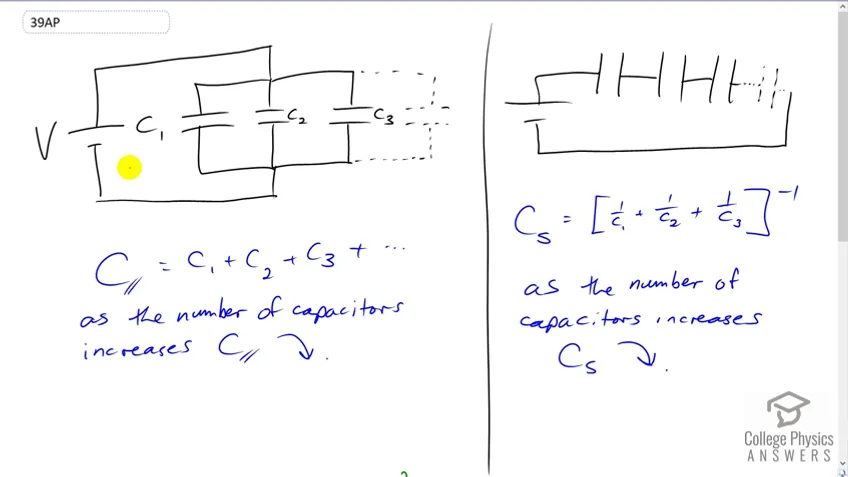 2:43PreviewProblem 39Full video with free trialWhat happens to the energy stored in a circuit as you increase the number of capacitors connected in parallel? Series? (a) increases, increases
(b) increases, decreases
(c) decreases, increases
(d) decreases, decreases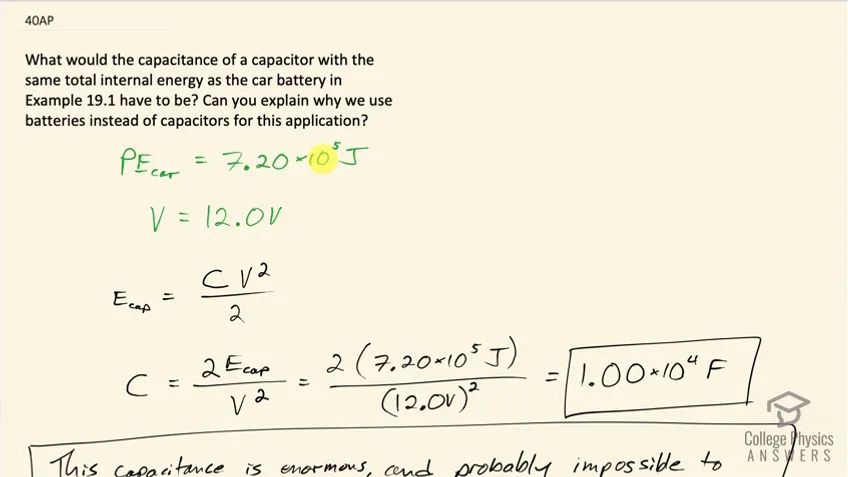 0:57PreviewProblem 40Full video with free trialWhat would the capacitance of a capacitor with the same total internal energy as the car battery in Example 19.1 have to be? Can you explain why we use batteries instead of capacitors for this application?
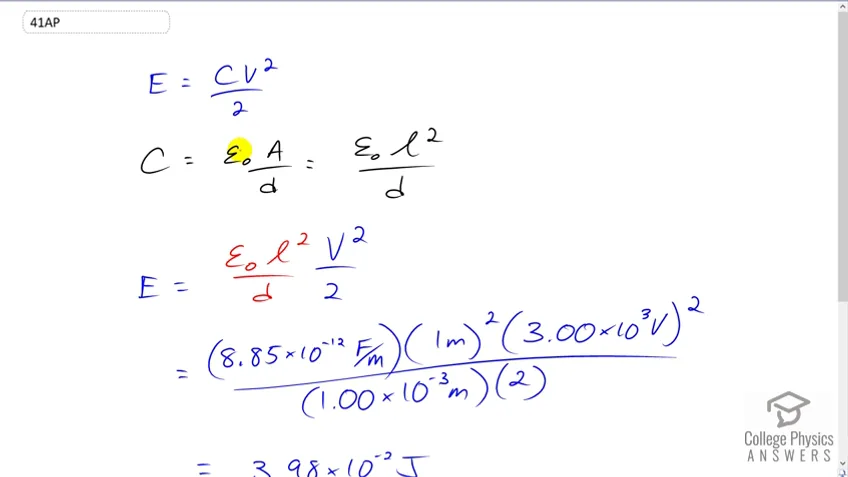 0:56PreviewProblem 41Full video with free trialConsider a parallel plate capacitor with metal plates, each of square shape of 1.00 m on a side, separated by 1.00 mm. What is the energy of this capacitor with applied to it? (a)
(b)
(c)
(d)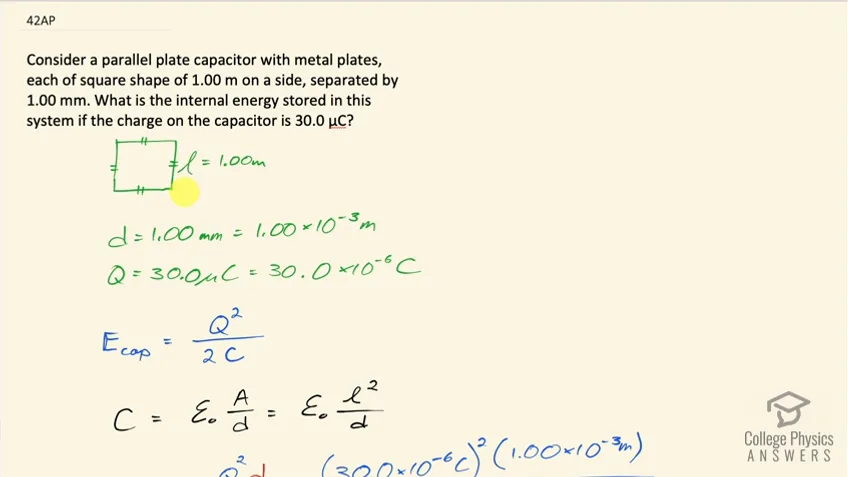 1:42PreviewProblem 42Full video with free trialConsider a parallel plate capacitor with metal plates, each of square shape of 1.00 m on a side, separated by 1.00 mm. What is the internal energy stored in this system if the charge on the capacitor is 30.0 μC?
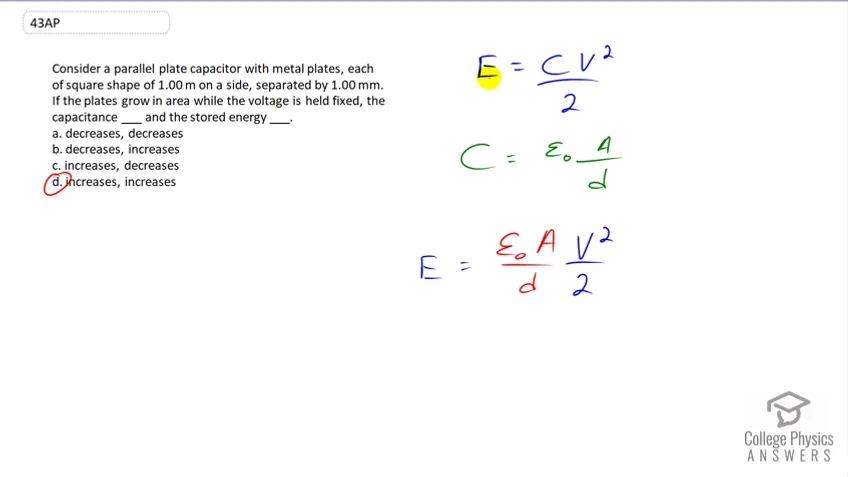 0:54PreviewProblem 43Full video with free trialConsider a parallel plate capacitor with metal plates, each of square shape of 1.00 m on a side, separated by 1.00 mm. If the plates grow in area while the voltage is held fixed, the capacitance ___ and the stored energy ___. (a) decreases, decreases
(b) decreases, increases
(c) increases, decreases
(d) increases, increases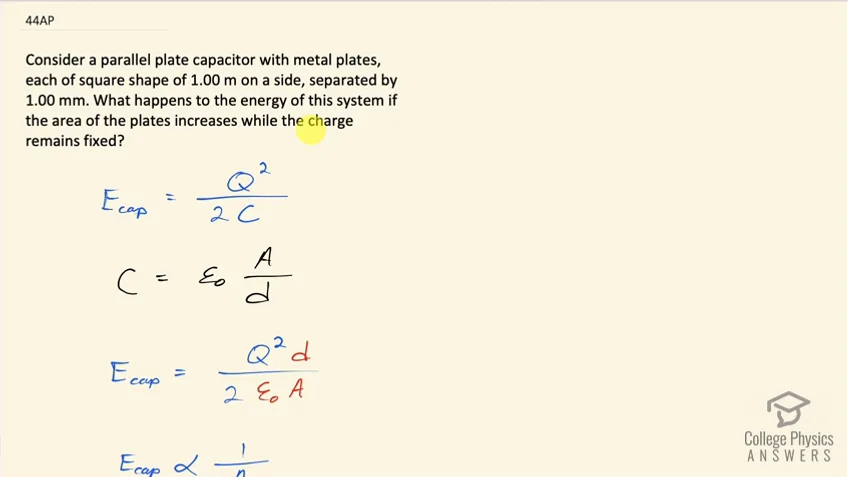 1:39PreviewProblem 44Full video with free trialConsider a parallel plate capacitor with metal plates, each of square shape of 1.00 m on a side, separated by 1.00 mm. What happens to the energy of this system if the area of the plates increases while the charge remains fixed?