Problem38
Section 18.7: Conductors and Electric Fields in Static Equilibrium

Question

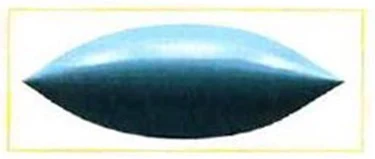
Sketch the electric field lines in the vicinity of the conductor in Figure 18.49 given the field was originally uniform and parallel to the object's long axis. Is the resulting field small near the long side of the object?

Figure 18.49 An ellipsoid conductor
Question by OpenStax is licensed under CC BY 4.0

Final Answer

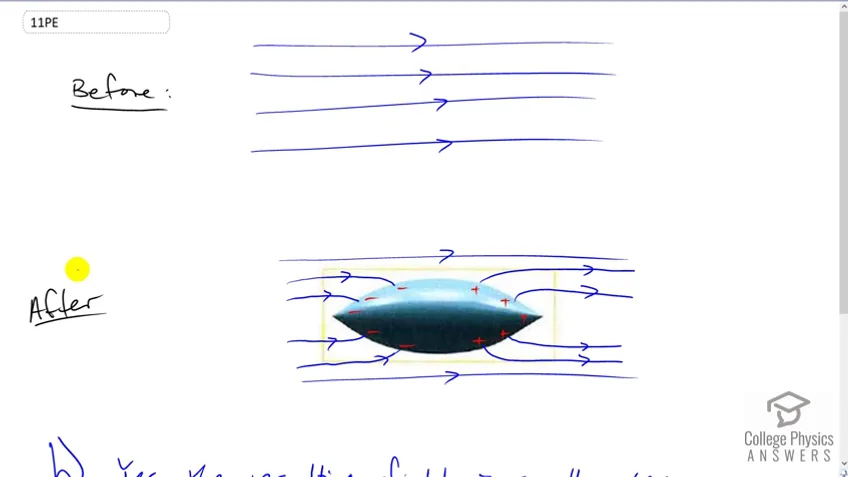
  1. see solution video for drawing
  2. Yes, the resulting field is smaller near the long side.

Solution video

1:32

This is a 20-second preview. Get access to the full video by starting your free 7-day trial.

5.0 (2)
85 views

Video Transcript

This is College Physics Answers with Shaun Dychko. Initially we have an electric field of parallel lines pointing to the right side, and afterwards we introduce this conducting object into that field. And what it’s going to do is the field will result in charge distribution in this conductor. We can think of electric field lines as pointing in the direction of the force that would be applied on a positive charge, so you can think of it as pushing positive charges away to the right hand side, although we know that positive charges are in the nucleus so they don’t actually move. And so instead what happens is negative charges are attracted towards this end here. So we have negative charges on this end, positive charges on this end, and so these field lines are going to stop on the object. And then sort of continue from the other side, and this is resulting in fewer field lines on the long side of this object. So the answer to part b is the resulting field is going to be smaller here because we see only one field line near this location here whereas before there were two field lines you could say. But this field line has now been intercepted and then reemerged you might say from the other side. There we go.

Comments

masonflanagan·
The question was changed in the version of the textbook for college classes, not the version for AP classes. Here above, I believe the college class version is identified as "PE". Question #11 in PE Chapter 18 is as stated by kmcmullen above.
Like
ShaunDychko·
Ah, thank you very much for clarifying that. I should look into making two separate menus for the two versions of the text.
Like
kmcmullen·
I believe the question for this chapter has changed: a) How strong is the attractive force between a glass rod with a 0.700 μC charge and a silk cloth with a –0.600 μC charge, which are 12.0 cm apart, using the approximation that they act like point charges? (b) Discuss how the answer to this problem might be affected if the charges are distributed over some area and do not act like point charges.
Like
ShaunDychko·
Hello kmcmullen, thank you for the comment. I always appreciate hearing feedback. I downloaded the latest PDF of College Physics for AP Courses from https://openstax.org/details/books/college-physics-ap-courses and did a search for the question you pasted. In the latest PDF your question shows as #25 in Chapter 18. Are you using a different resource than the PDF? All the best, Shaun
Like