Problem70
Section 16.11: Energy in Waves: Intensity

Question

A microphone receiving a pure sound tone feeds an oscilloscope, producing a wave on its screen. If the sound intensity is originally , but is turned up until the amplitude increases by 30.0%, what is the new intensity?

Question by OpenStax is licensed under CC BY 4.0

Final Answer

3.38×10⁵ W/m23.38\times 10^{-5}\textrm{ W/m}^2

Solution video

1:48

This is a 20-second preview. Get access to the full video by starting your free 7-day trial.

5.0 (1)
61 views

Calculator Screenshots

Calculator screenshot

Video Transcript

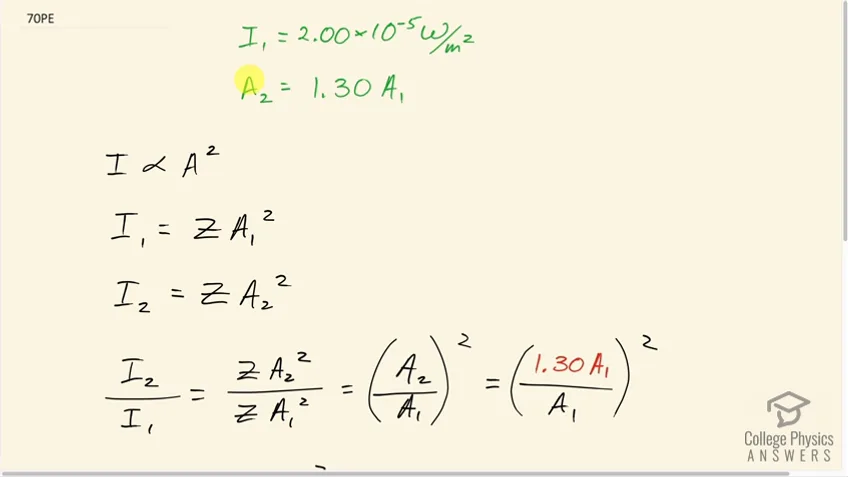
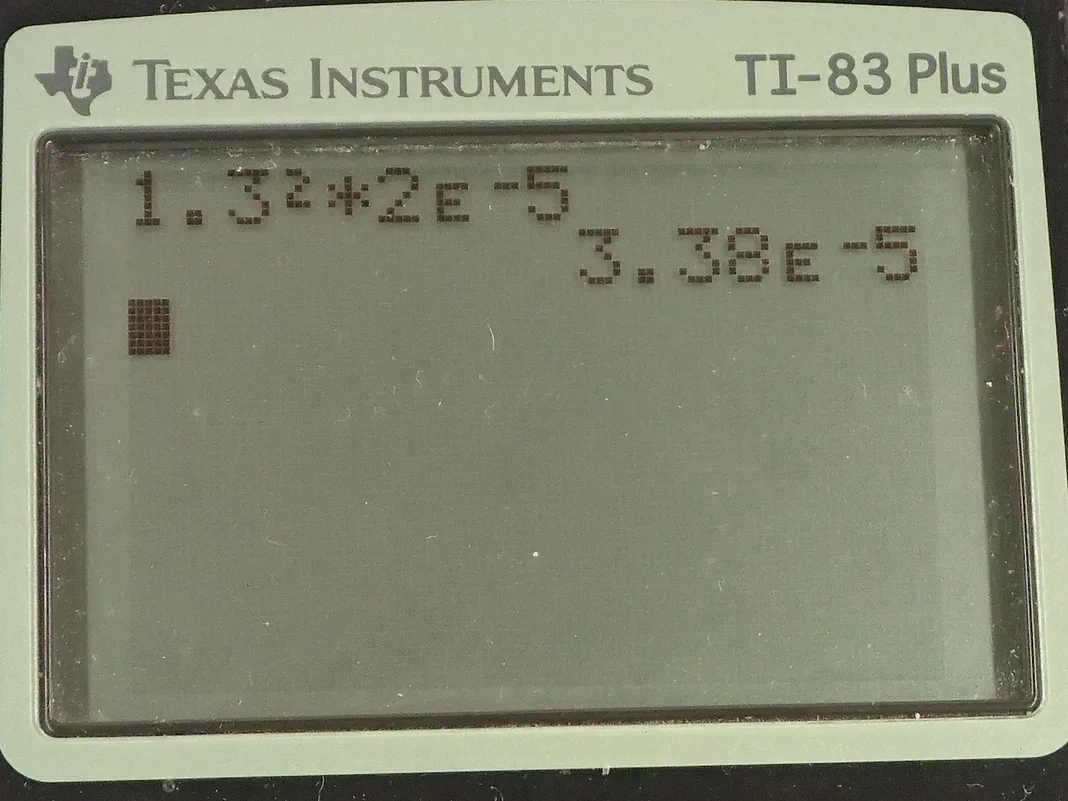
This is College Physics Answers with Shaun Dychko. The intensity of a sound wave in the first case is 2.00 times 10 to the minus 5 watts per square meter and we are told that the amplitude of the sound is increased such that it will now be 30 percent more than the amplitude was when the original intensity was measured. So to say that the amplitude is gonna be 30 percent more is to say that A 2 will be 1.30 times A 1. So we know that intensity is proportional to amplitude squared which means that I 1—the first intensity— equals some constant of proportionality— whatever it is doesn't matter— multiplied by A 1 squared. because when you say something is proportional to something else, you are saying that it equals some factor multiplied by that thing. So that means I 1 equals some factor Z times A 1 squared; I 2 will be the same factor multiplied by A 2 squared and it's the same factor because it's the same microphone being used with the same area and so on. Now I 2 divided by I 1 will be ZA 2 squared divided by ZA 1 squared and the Z's cancel meaning we have A 2 divided by A 1 squared and A 2 we know is 1.30 times A 1 so we make that substitution in place of A 2 and the A 1's cancel leaving us with 1.30 squared is the ratio of I 2 over I 1. So that means I 2 equals 1.30 squared times I 1. So that's 1.30 squared times 2 times 10 to the minus 5 watts per square meter which is an intensity of 3.38 times 10 to the minus 5 watts per square meter.

Comments

sailornomoon·
I am confused on how we know to derive 1.3 from 30%
Like
ShaunDychko·
Hello, thank you for your question. This problem says the amplitude _increases_ by 30%. This is to say that the new amplitude will be the old amplitude _plus_ 30% of the old amplitude, which can be written as $A\_2 = A\_1 + .3 \\times A\_1$, or more concisely by collecting the two $A\_1$ terms on the right, $A\_2 = 1.3 A\_1$. Hope this helps, Shaun
Like
vanessabudo·
Isn't intensity inversely proportional to area? I keep getting $(1.30)^2I_{2}=I_{1}$. The final answer I get is $1.18E-5$.
Like
ShaunDychko·
Hi vanessabudo, thank you for the question. You're quite right that intensity if inversely proportional to area, however, the "A" in the video represents **amplitude**, not area. That's confusing, I totally understand. The textbook reminds us [here](https://openstax.org/books/college-physics/pages/16-11-energy-in-waves-intensity#eip-942) that the work done by the wave is proportional to amplitude squared (represented as _x_ in that formula 16.74). Work is implicit in the power term _P_ in equation [16.75](https://openstax.org/books/college-physics/pages/16-11-energy-in-waves-intensity#eip-460), which could be rewritten as $I = \\dfrac{W/t}{A} = \\dfrac{W}{tA}$. _A_ is **area**, and since $W \\propto \\textrm{amplitude}^2$ (where I've written the word amplitude instead of the letter A to avoid confusion with area) then so is intensity. Hope this helps, Shaun
Like