Question
A diver on a diving board is undergoing simple harmonic motion. Her mass is 55.0 kg and the period of her motion is 0.800 s. The next diver is a male whose period of simple harmonic oscillation is 1.05 s. What is his mass if the mass of the board is negligible?
Final Answer
Solution video

This is a 20-second preview. Get access to the full video by starting your free 7-day trial.
This is a 20-second preview. Get access to the full video by starting your free 7-day trial.
Calculator Screenshots
Video Transcript
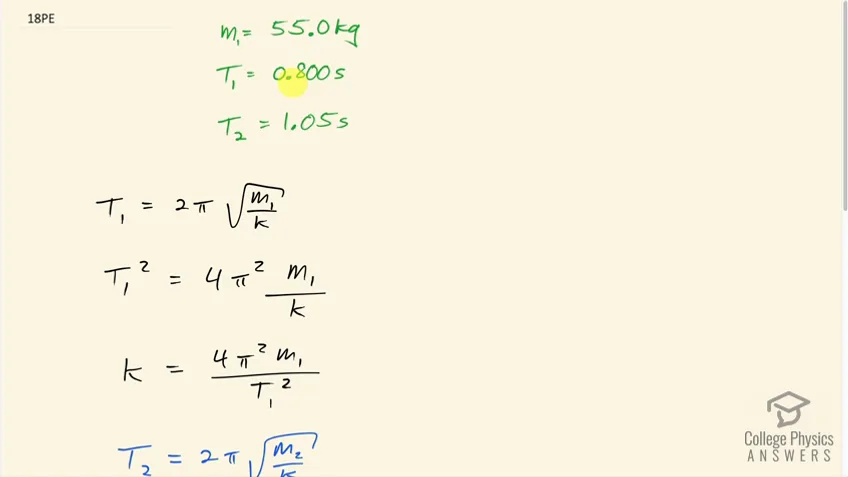
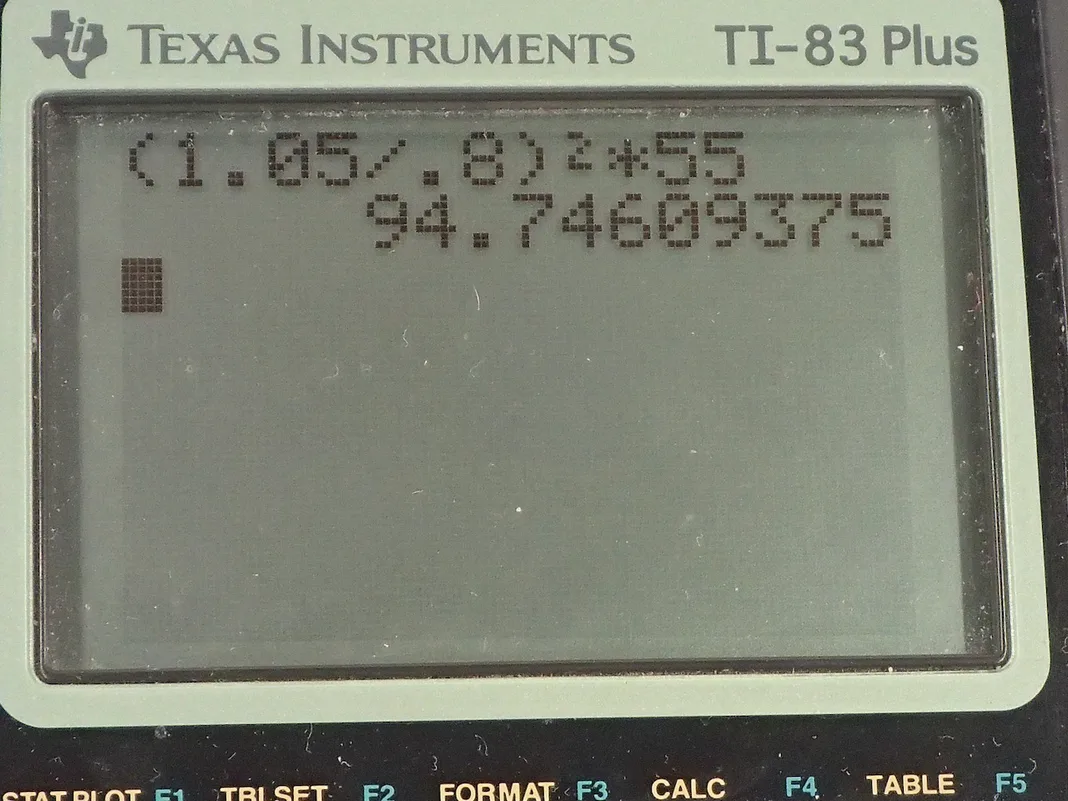
This is College Physics Answers with Shaun Dychko. We are told that a woman diver of mass 55.0 kilograms has a period on the diving board of 0.800 seconds and this second diver has a period of 1.05 seconds and the question is what is this other diver's mass, m 2? So we can use the first diver to figure out what is the spring constant of the diving board so T 1 equals 2π times square root m 1 over k; we are gonna solve for k. And we'll start by squaring both sides here and we have T 1 squared equals 4π squared m 1 over k and then multiply both sides by k over T 1 squared and you get k equals 4π squared m 1 over T 1 squared. And then we turn our attention to diver two and his period is gonna be 2π times square root m 2 divided by k and we have to solve this for m 2 and then we'll substitute in this for k later on. So we'll square both sides and we get T 2 squared equals 4π squared m 2 over k and then we'll multiply both sides by k over 4π squared to solve for m 2. So m 2 is kT 2 squared over 4π squared. Now k though is this fraction, which we substitute in here, so that's 4π squared m 1 over T 1 squared multiplied by T 2 squared over 4π squared the 4π squared's cancel and we can write this T 2 squared over T 1 squared as T 2 over T 1 all squared if you like and that gets multiplied by m 1 and that's gonna be m 2. So we have T 2 is 1.05 seconds, T 1 is 0.800 seconds; we divide those, square that quotient multiply by 55.0 kilograms and we get 94.7 kilograms is the second diver's mass.
Comments
No comments yet.