
shaundychko3·
Here's a comment.
Like
shaunInstructor·
Here's a reply.
Like
shaundychko3·
I'm replying to my own comment.
Like
Question
This is a 15-second preview. Get access to the full video by starting your free 7-day trial.
This is a 15-second preview. Get access to the full video by starting your free 7-day trial.
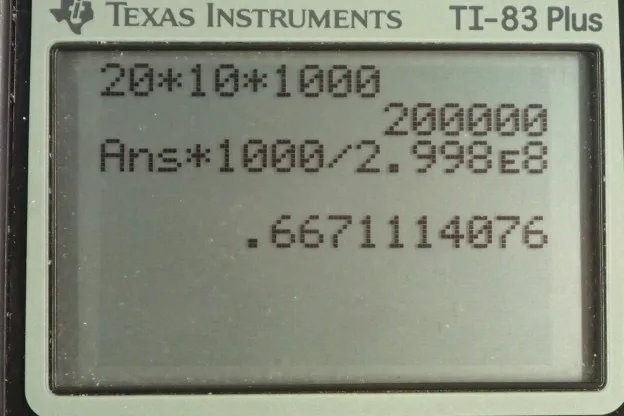
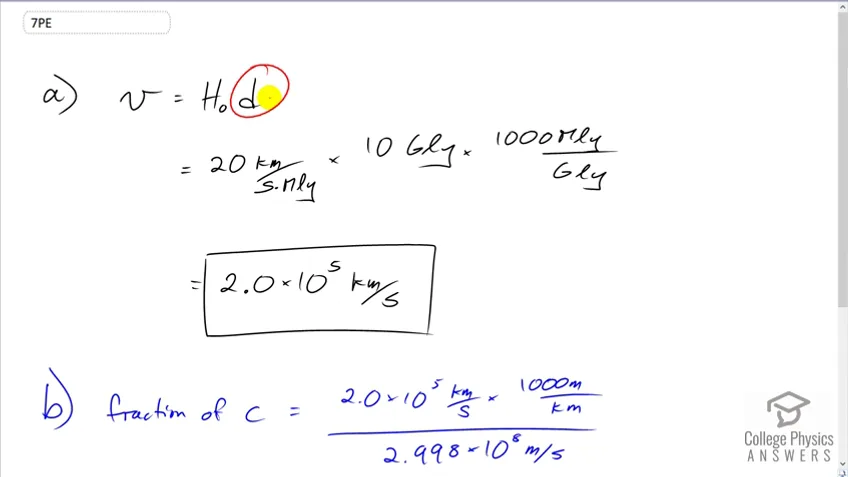
This is College Physics Answers with Shaun Dychko. We are going to measure the speed at which a galaxy that is located at the greatest possible distance that we can observe from us and we are gonna multiply Hubble's constant by this distance of 10 gigalight-years and we'll convert the gigalight-years into units of megalight-years since Hubble's constant contains megalight-years in the denominator. And this works out to 2.0 times 10 to the 5 kilometers per second and our units are kilometers per second since Hubble's constant has kilometers per second here. So the megalight-years cancel and as do the gigalight-years leaving us with kilometers per second. And as a fraction of the speed of light, we convert that into meters per second since I have the speed of light in meters per second memorized— 2.998 times 10 to the 8 meters per second— and this works out to 0.67 so this is two-thirds the speed of light is the recessional velocity of this galaxy from us.