Question
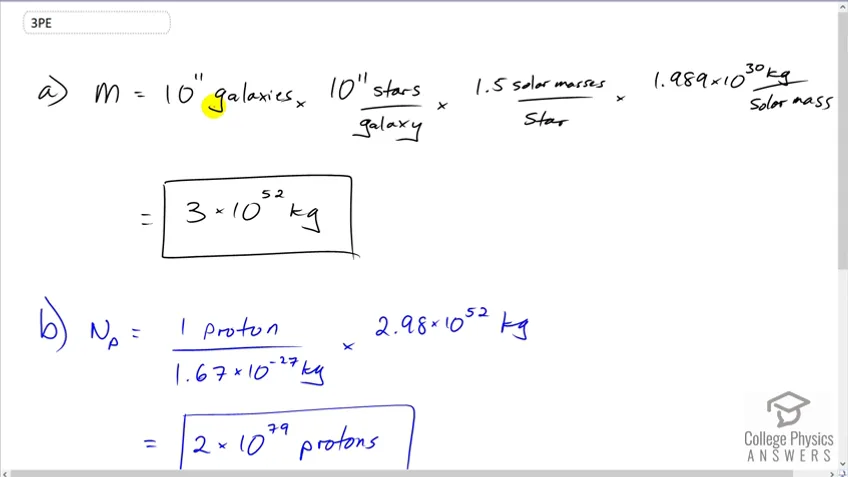
(a) Estimate the mass of the luminous matter in the known universe, given there are galaxies, each containing stars of average mass 1.5 times that of our Sun. (b) How many protons (the most abundant nuclide) are there in this mass? (c) Estimate the total number of particles in the observable universe by multiplying the answer to (b) by two, since there is an electron for each proton, and then by , since there are far more particles (such as photons and neutrinos) in space than in luminous matter.
Final Answer
Solution video

This is a 20-second preview. Get access to the full video by starting your free 7-day trial.
This is a 20-second preview. Get access to the full video by starting your free 7-day trial.
Calculator Screenshots
Video Transcript
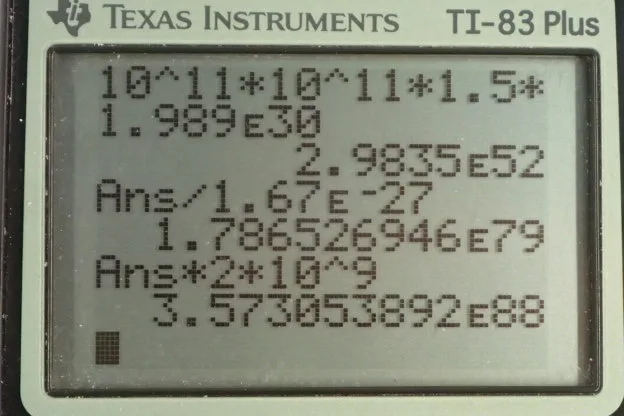
This is College Physics Answers with Shaun Dychko. We estimate the mass of all the luminous matter in the universe by saying that there are about 10 to the 11 galaxies in the universe each of which contains about 10 to the 11 stars and each of those stars has an average mass of one and a half times the mass of our Sun so it is one and a half solar masses per star and then we multiply by the number of kilograms in the Sun. And this works out to about 3 times 10 to the 52 kilograms is the mass of all the luminous or shining matter that is emitting light in the universe. And the number of protons this would represent is well, there's one proton for every 1.67 times 10 to the minus 27 kilograms and we multiply that by this number of kilograms total luminous mass in the universe and this works out to 2 times 10 to the 79 protons. And this is making an assumption that most mass is made up of protons so hydrogen in other words. And well, there are other particles in the universe and there's probably one electron for every proton so that's why we are multiplying by 2 to get the total number of particles in this many hydrogen atoms and then we multiply by 10 to the 9 to account for other particles like neutrinos or neutrons and so on. And this works out to 4 times 10 to the 88 particles of things in the universe.
Comments
No comments yet.