Question
(a) A particle and its antiparticle are at rest relative to an observer and annihilate (completely destroying both masses), creating two γ rays of equal energy. What is the characteristic γ -ray energy you would look for if searching for evidence of proton-antiproton annihilation? (The fact that such radiation is rarely observed is evidence that there is very little antimatter in the universe.) (b) How does this compare with the 0.511-MeV energy associated with electron-positron annihilation?
Final Answer
Solution video

This is a 19-second preview. Get access to the full video by starting your free 7-day trial.
This is a 19-second preview. Get access to the full video by starting your free 7-day trial.
Calculator Screenshots
Video Transcript
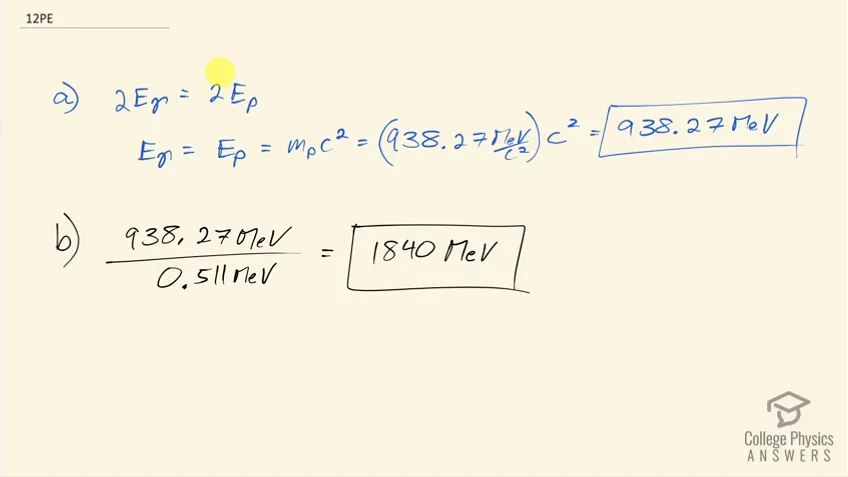
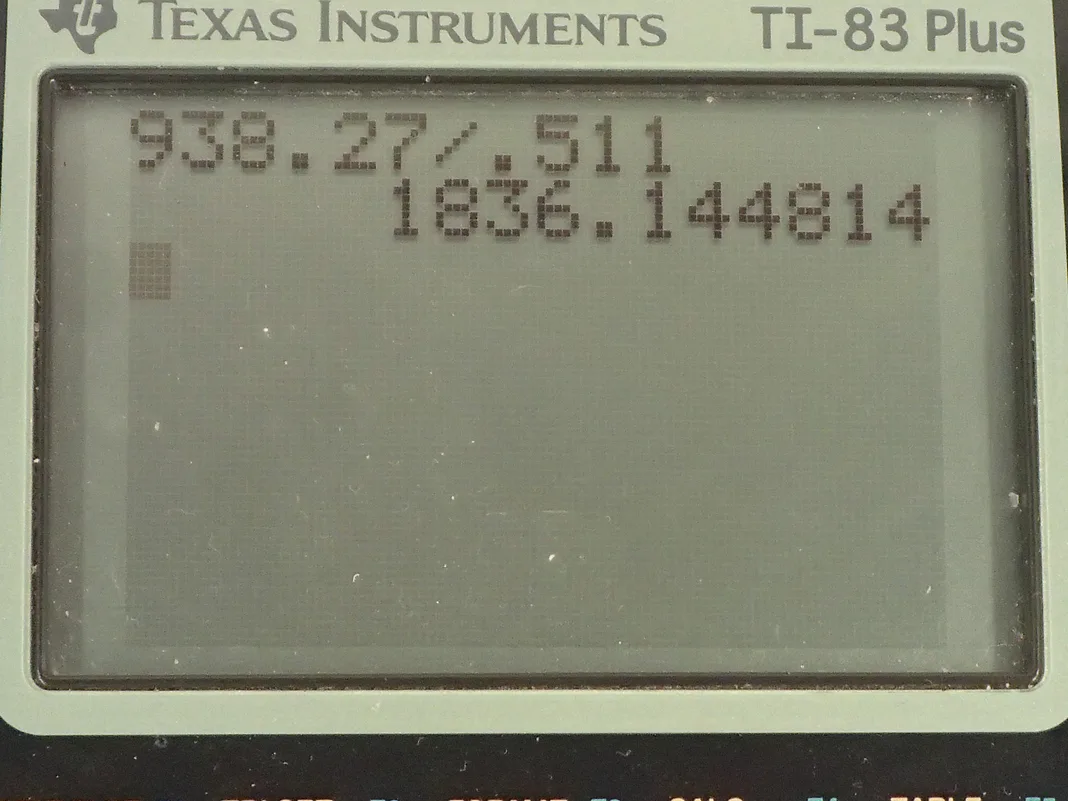
This is College Physics Answers with Shaun Dychko. Suppose a proton and an anti-proton annihilate, the question is what energy of gamma rays would we expect to see from that annihilation? So there would be two gamma rays produced so 2 times the energy of a single gamma ray. It's going to be 2 times the energy of a single proton— the proton and positron energies are the same— and so we can just divide both sides by 2 and so the energy of the gamma ray we expect to see is the energy of a proton. So the mass of the proton times c squared is 938.27 megaelectron volts per c squared times c squared gives an energy of 938.27 megaelectron volts. And this energy is not observed by telescopes very often which suggests that proton, anti-proton annihilation is not common in the universe, which suggests that there's not very much anti-matter. We are asked to compare this with the energy you would expect in a gamma ray from electron-positron annihilation which is 0.511 megaelectron volts so we divide the 2 and this energy due to the proton, anti-proton annihilation is greater than the energy from electron-positron annihilation by a factor of 1840.
Comments
No comments yet.