Question
Assume one-fourth of the yield of a typical 320-kT strategic bomb comes from fission reactions averaging 200 MeV and the remainder from fusion reactions averaging 20 MeV. (a) Calculate the number of fissions and the approximate mass of uranium and plutonium fissioned, taking the average atomic mass to be 238. (b) Find the number of fusions and calculate the approximate mass of fusion fuel, assuming an average total atomic mass of the two nuclei in each reaction to be 5. (c) Considering the masses found, does it seem reasonable that some missiles could carry 10 warheads? Discuss, noting that the nuclear fuel is only a part of the mass of a warhead.
Final Answer
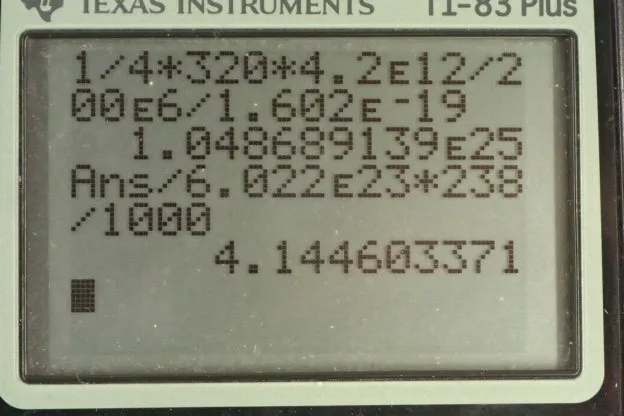
- fissions from 4.1 kg of fissionable material.
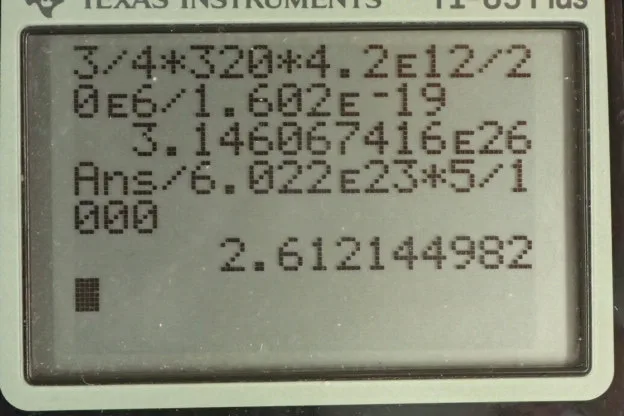
- fusions from 2.6 kg of fusion fuel.
- The total nuclear payload is 6.7 kg which is a small mass for a rocket to carry. If this is only 10 percent of the total mass of a warhead, the warhead mass would be 67 kg. Ten warheads would be 670kg, which is a reasonable mass for a rocket to carry. Consider that two booster rockets can lift the massive space shuttle.
Solution video

This is a 31-second preview. Get access to the full video by starting your free 7-day trial.
This is a 31-second preview. Get access to the full video by starting your free 7-day trial.
Calculator Screenshots
Video Transcript
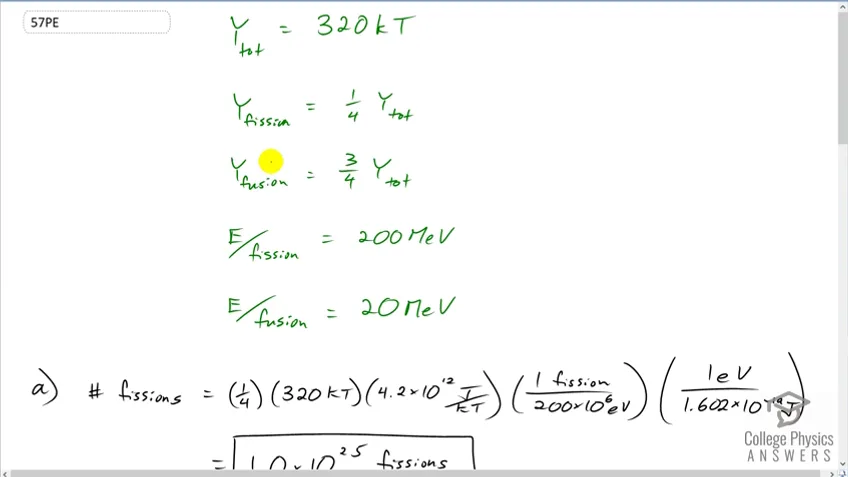
This is College Physics Answers with Shaun Dychko. The total yield of a nuclear warhead is 320 kilotons and it's a fission and fusion warhead; we are told that one quarter of its output is due to the fission reactions which will then catalyze a fusion reaction which accounts for the remaining three quarters of the total yield. And the energy per fission reaction is 200 megaelectron volts and the energy per fusion is only 20 megaelectron volts. And part (a) says how many fissions are there and what mass of uranium-238 will be consumed to do those fissions and then how many fusions are there and what mass of material is needed for the fusion reaction? OK So for the number of fissions we have one quarter of the total yield is the energy output of the fission and we convert that into joules by multiplying by 4.2 times 10 to the 12 joules per kiloton and we are told that for every fission, there is about 200 megaelectron volts released which we convert into joules and so now the joules cancel with these joules the electron volts cancel the kilotons cancel and this is number of fissions— that is 1.0 times 10 to the 25 fissions occur. And the mass of uranium-238 needed to do this many fissions is that many nuclei times well turn it into mols by dividing by Avogadro's number so 1 mol for every 6.022 times 10 to the 23 nuclei and then times by 238 grams per mol then convert that into kilograms and we end up with 4.1 kilograms. So this is the mass of uranium-238 that will be consumed and turned into energy during the fissioning. Now for the fusions, three quarters of the total yield is due to fusion and we convert that into joules and then for each fusion releases 20 megaelectron volts written as 20 times 10 to the 6 electron volts convert that into joules and we end up with the number of fusions and that is 3.1 times 10 to the 26 fusions. And we expected more fusions than fissions and we see that they are more by a factor of 10 because the fusion accounts for more of the energy released plus there is less energy released per fusion than there is for the fission. So then the atomic mass of the material that is fusing is 5 grams per mol and we multiply that by the number of mols which is the number of fusions divided by Avogadro's number and then convert that into kilograms and that is 2.6 kilograms. So the total nuclear payload then is 6.7 kilograms which is small for a rocket to carry and if that only represents 10 percent of the total mass of the warhead then the warhead mass must be 67 kilograms say and 10 warheads would be 670 kilograms and this number although it's large, it is reasonable for a large rocket to carry that much and you can consider how massive the space shuttle must be in it only needs two rockets to get it going well at least the initial stage booster rockets anyhow. So yeah, it is possible to have 10 warheads on a single rocket.
Comments
No comments yet.