Question
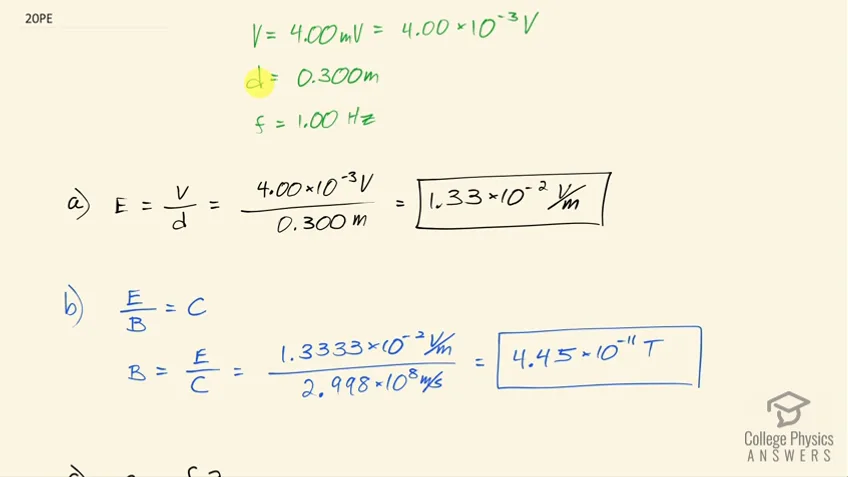
During normal beating, the heart creates a maximum 4.00-mV potential across 0.300 m of a person’s chest, creating a 1.00-Hz electromagnetic wave. (a) What is the maximum electric field strength created? (b) What is the corresponding maximum magnetic field strength in the electromagnetic wave? (c) What is the wavelength of the electromagnetic wave?
Final Answer
Solution video

This is a 16-second preview. Get access to the full video by starting your free 7-day trial.
This is a 16-second preview. Get access to the full video by starting your free 7-day trial.
Calculator Screenshots
Video Transcript
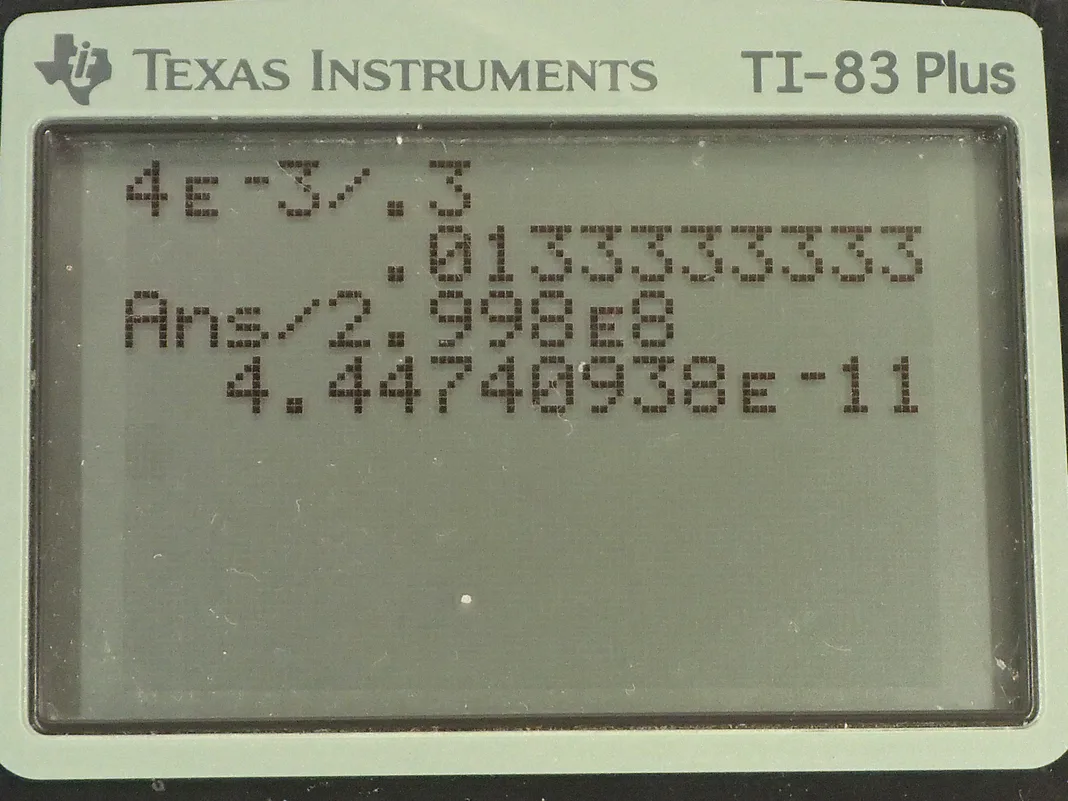
This is College Physics Answers with Shaun Dychko. The beating of a person's heart creates a potential of 4.00 millivolts, which is 4.00 times 10 to the minus 3 volts over a distance of 0.300 meters and it creates electromagnetic radiation of a frequency of 1.00 hertz. So the question in part (a) is what is the electric field strength of this potential over this distance and that is the potential divided by the distance. So that's 4.00 times 10 to the minus 3 volts divided by 0.300 meters and we get 1.33 times 10 to the minus 2 volts per meter. This unit could also be expressed as newtons per coulomb if you prefer but either way they are equivalent. Part (b) is asking what is the corresponding maximum magnetic field strength in this electromagnetic wave? So we know the ratio of the electric field strength divided by the magnetic field strength is the speed of light and so we can solve this for B by multiplying both sides by B over C and so we have the magnetic field strength equals the electric field strength divided by the speed of light. So that's 1.3333 times 10 to the minus 2 volts per meter— as we found in part (a)— divided by 2.998 times 10 to the 8 meters per second and that is 4.45 times 10 to the minus 11 tesla. Part (c) is asking what the wavelength of the electromagnetic wave is? So the wave equation says that the speed of the wave equals its frequency multiplied by its wavelength and we have figured out... well, we know what the frequency is, it's given to us and we can figure out the wavelength by solving for λ here by dividing both sides by f. So the wavelength then is the speed of light divided by its frequency 2.998 times 10 to the 8 meters per second divided by 1.00 hertz, which is 3.00 times 10 to the 8 meters.
Comments
No comments yet.