
Chapter 24: Electromagnetic Waves
62 problems solved · Free preview of every solution shows how it’s started · Watch the full videos with a free 7-day trial →


Section
24.1 Maxwell's Equations: Electromagnetic Waves Predicted and Observed
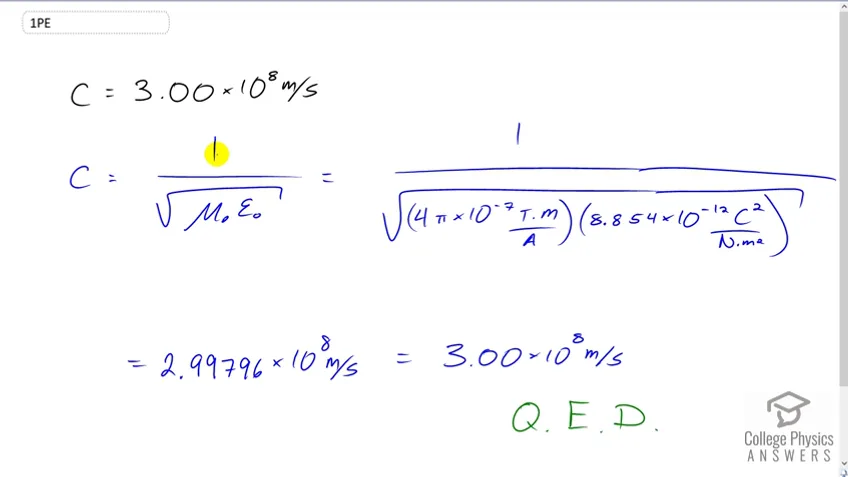 0:36Problem 1FreeVerify that the correct value for the speed of light is obtained when numerical values for the permeability and permittivity of free space ( and ) are entered into the equation .
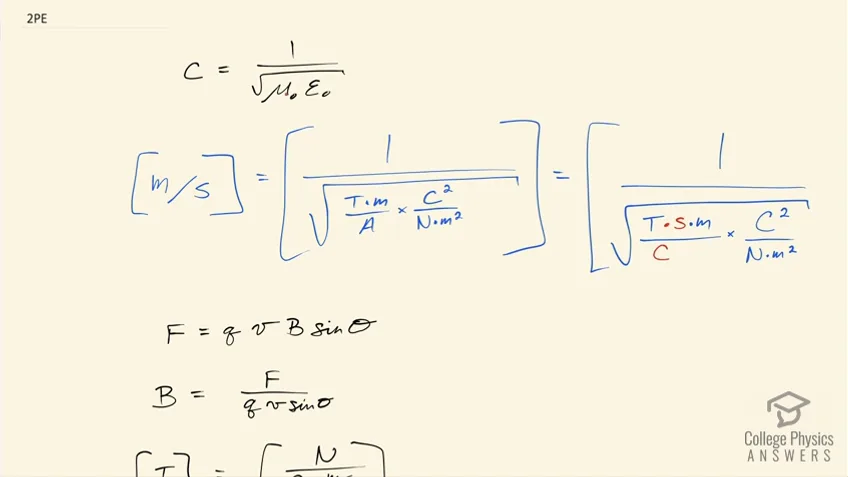 2:47PreviewProblem 2Full video with free trialShow that, when SI units for and are entered, the units given by the right-hand side of the equation are m/s.
24.2 Production of Electromagnetic Waves
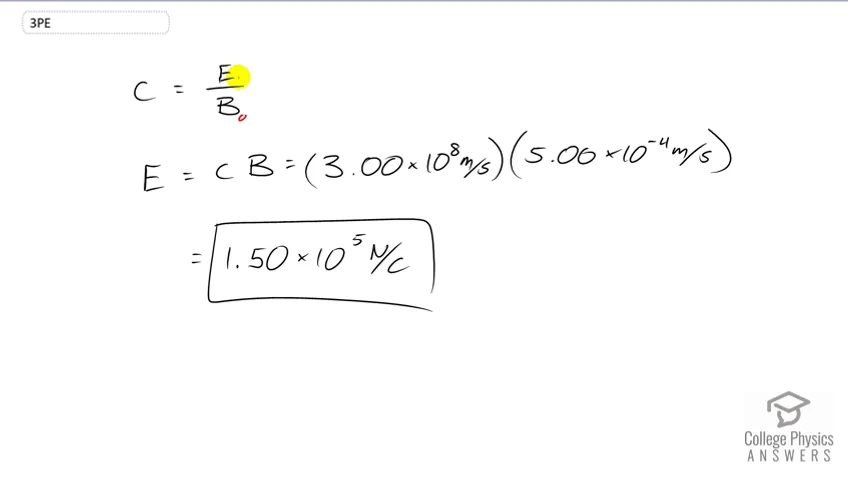 0:37PreviewProblem 3Full video with free trialWhat is the maximum electric field strength in an electromagnetic wave that has a maximum magnetic field strength of (about 10 times the Earth’s)?
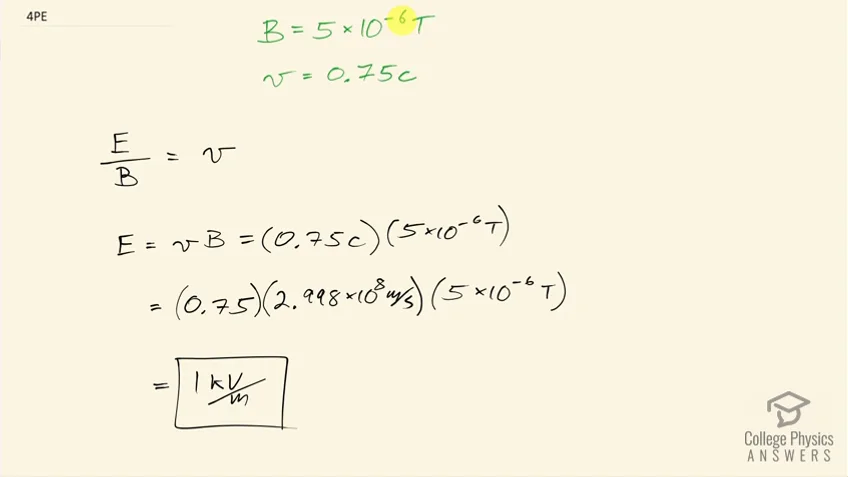 0:45PreviewProblem 4Full video with free trialThe maximum magnetic field strength of an electromagnetic field is . Calculate the maximum electric field strength if the wave is traveling in a medium in which the speed of the wave is .
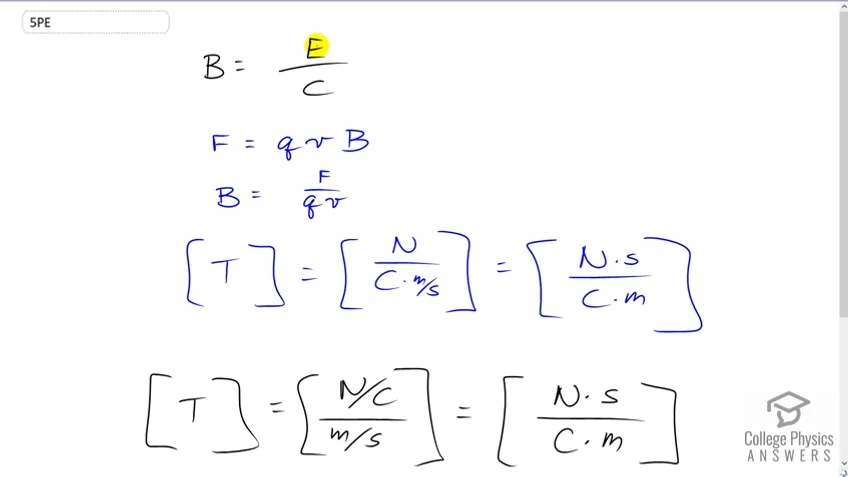 1:56PreviewProblem 5Full video with free trialVerify the units obtained for magnetic field strength in Example 24.1 (using the equation ) are in fact teslas (T).
24.3 The Electromagnetic Spectrum
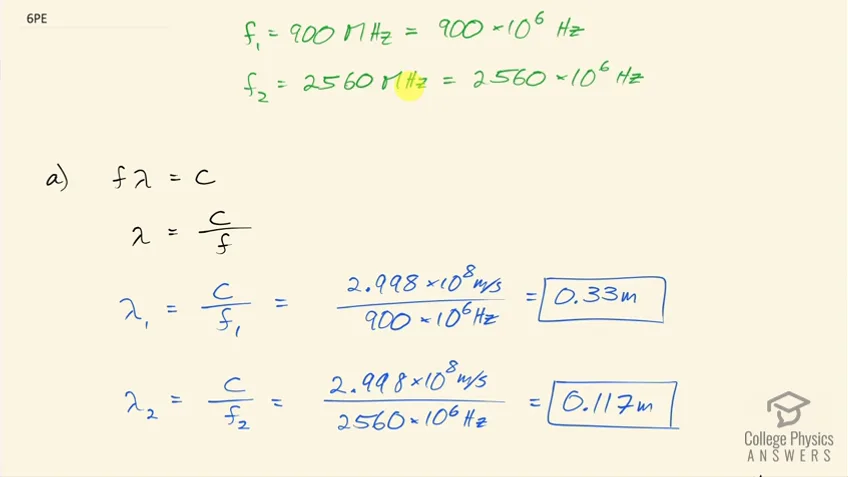 1:25PreviewProblem 6Full video with free trial(a) Two microwave frequencies are authorized for use in microwave ovens: 900 and 2560 MHz. Calculate the wavelength of each. (b) Which frequency would produce smaller hot spots in foods due to interference effects?
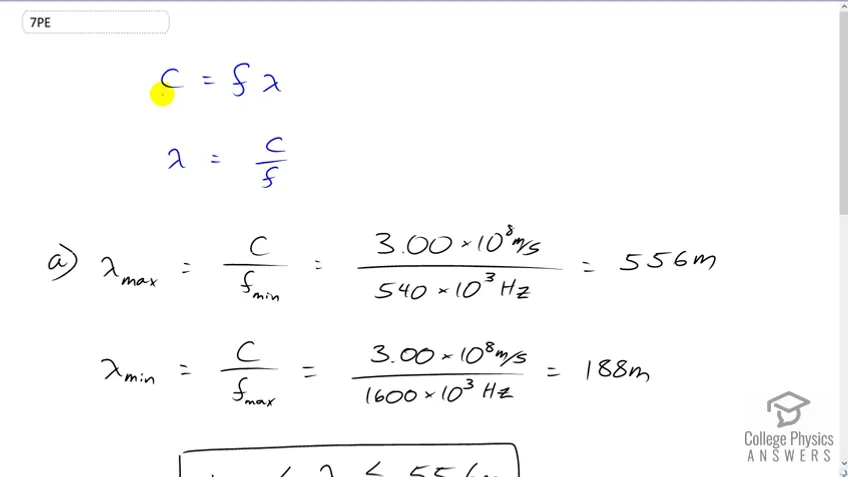 1:25PreviewProblem 7Full video with free trial(a) Calculate the range of wavelengths for AM radio given its frequency range is 540 to 1600 kHz. (b) Do the same for the FM frequency range of 88.0 to 108 MHz.
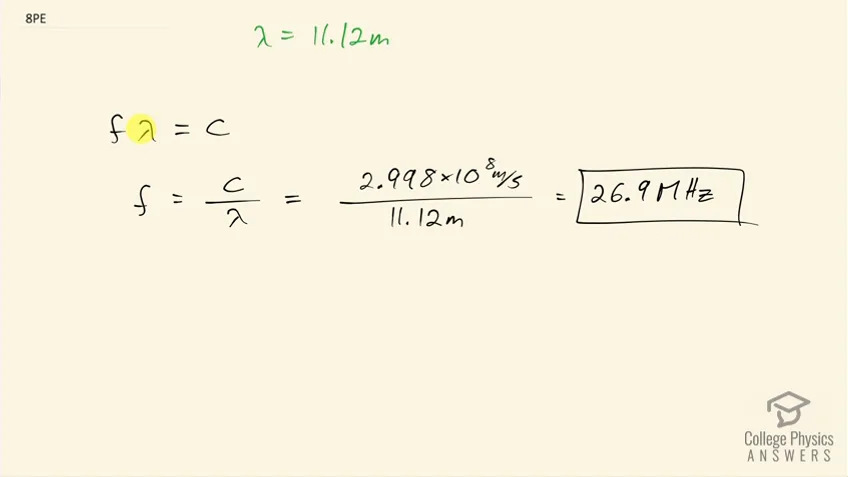 0:35PreviewProblem 8Full video with free trialA radio station utilizes frequencies between commercial AM and FM. What is the frequency of a 11.12-m-wavelength channel?
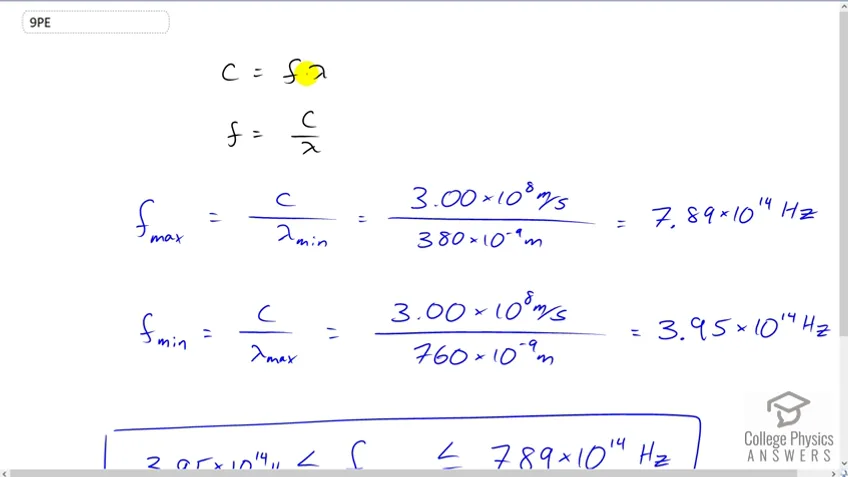 0:54PreviewProblem 9Full video with free trialFind the frequency range of visible light, given that it encompasses wavelengths from 380 to 760 nm.
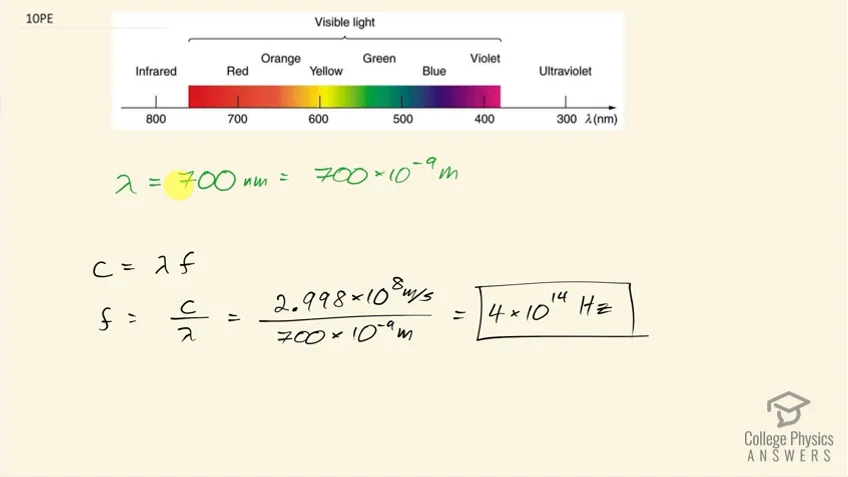 1:26PreviewProblem 10Full video with free trialCombing your hair leads to excess electrons on the comb. How fast would you have to move the comb up and down to produce red light?
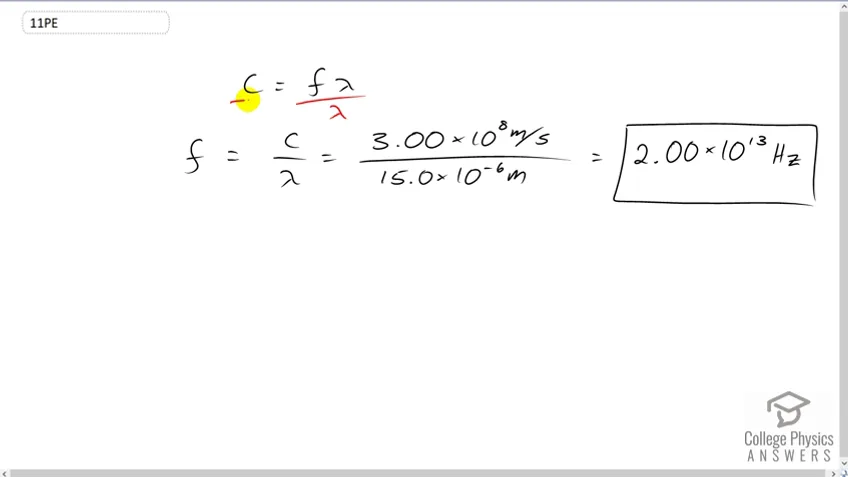 0:29PreviewProblem 11Full video with free trialElectromagnetic radiation having a wavelength is classified as infrared radiation. What is its frequency?
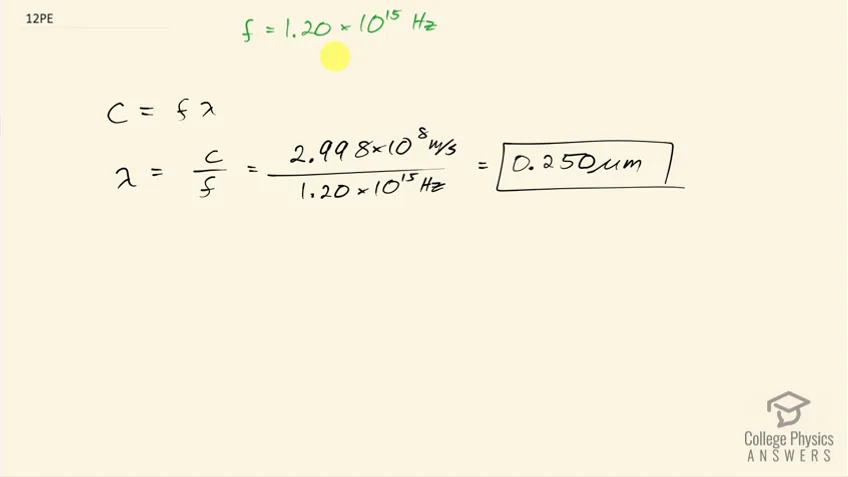 0:48PreviewProblem 12Full video with free trialApproximately what is the smallest detail observable with a microscope that uses ultraviolet light of frequency ?
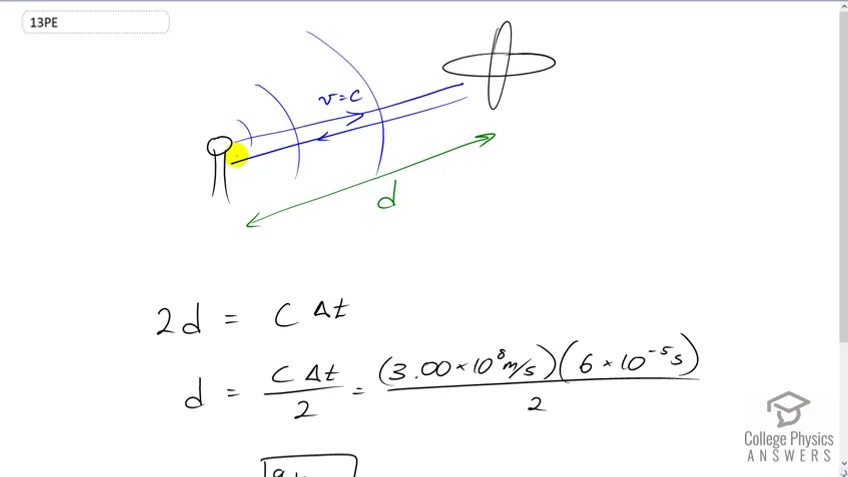 1:03PreviewProblem 13Full video with free trialA radar used to detect the presence of aircraft receives a pulse that has reflected off an object after it was transmitted. What is the distance from the radar station to the reflecting object?
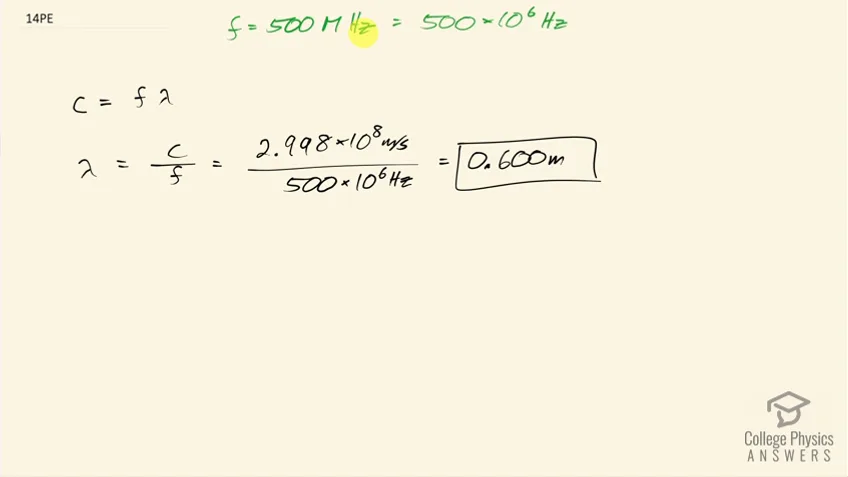 0:56PreviewProblem 14Full video with free trialSome radar systems detect the size and shape of objects such as aircraft and geological terrain. Approximately what is the smallest observable detail utilizing 500-MHz radar?
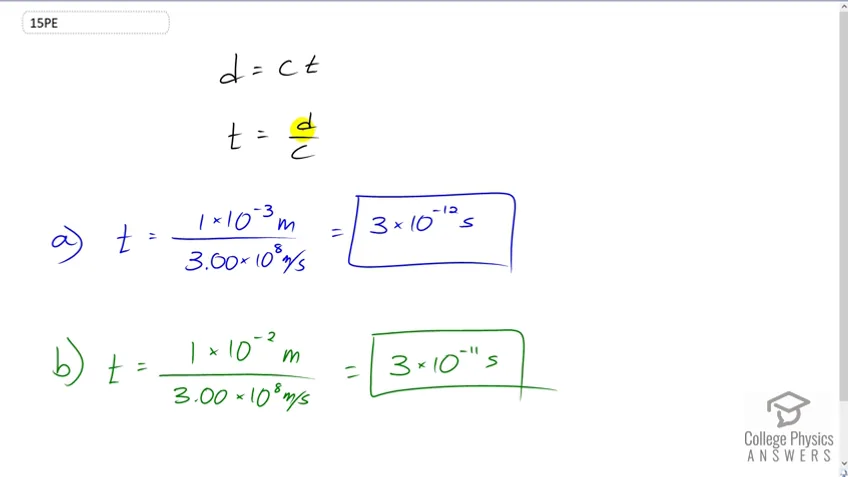 0:45PreviewProblem 15Full video with free trialDetermine the amount of time it takes for X-rays of frequency to travel (a) 1 mm and (b) 1 cm.
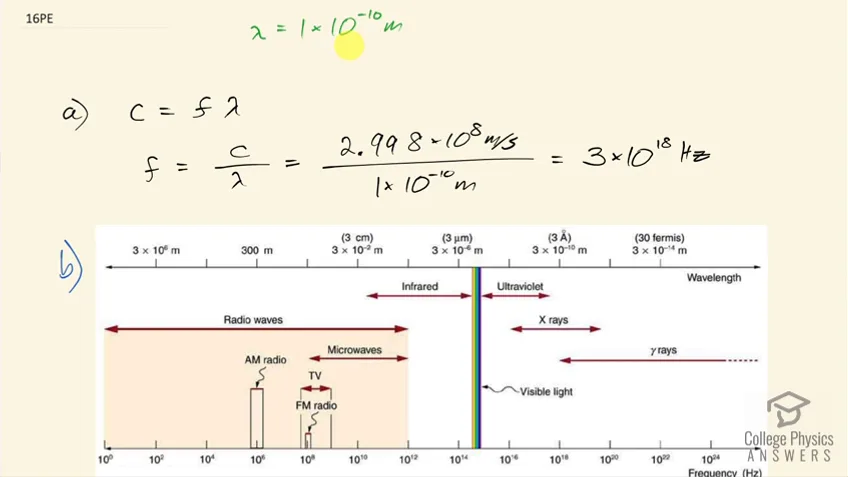 0:53PreviewProblem 16Full video with free trialIf you wish to detect details of the size of atoms (about ) with electromagnetic radiation, it must have a wavelength of about this size. (a) What is its frequency? (b) What type of electromagnetic radiation might this be?
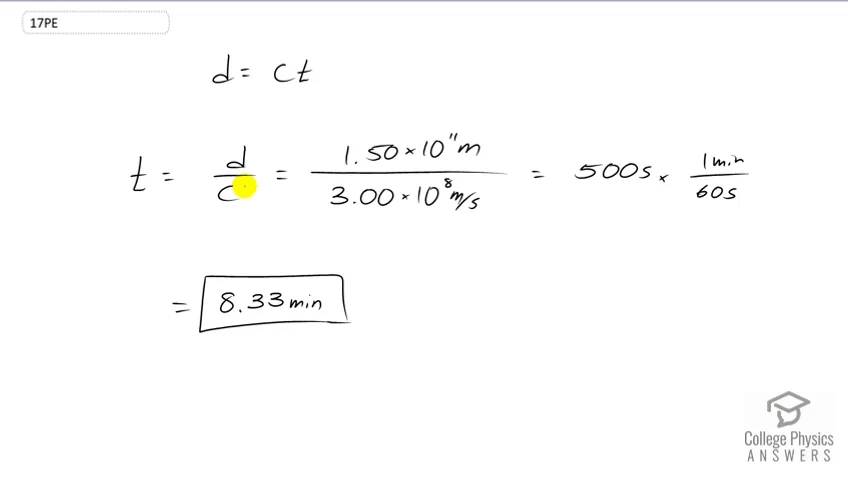 0:37PreviewProblem 17Full video with free trialIf the Sun suddenly turned off, we would not know it until its light stopped coming. How long would that be, given that the Sun is away?
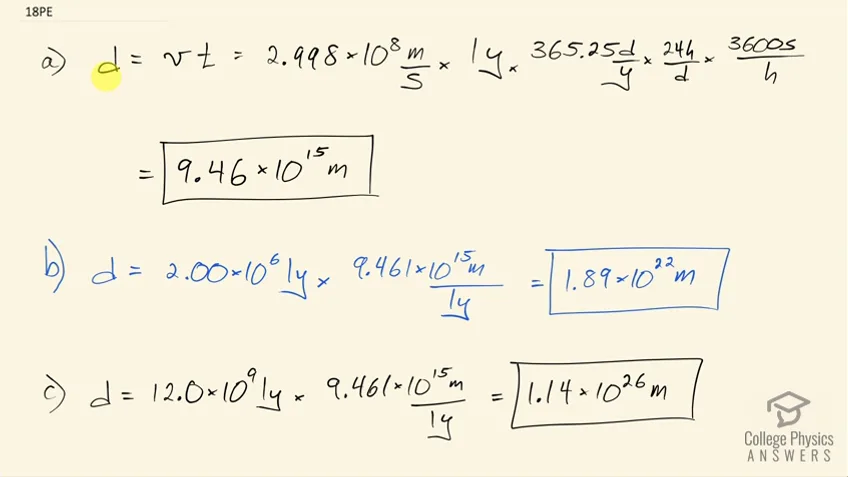 1:34PreviewProblem 18Full video with free trialDistances in space are often quoted in units of light years, the distance light travels in one year. (a) How many meters is a light year? (b) How many meters is it to Andromeda, the nearest large galaxy, given that it is light years away? (c) The most distant galaxy yet discovered is light years away. How far is this in meters?
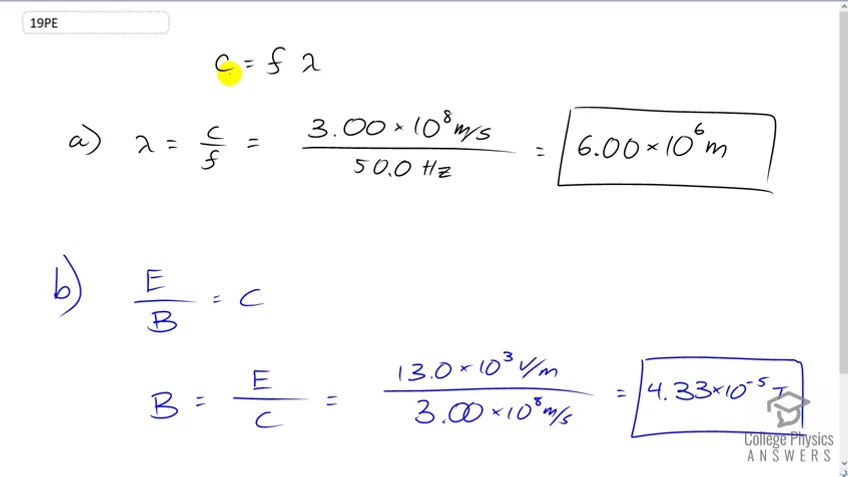 1:04PreviewProblem 19Full video with free trialA certain 50.0-Hz AC power line radiates an electromagnetic wave having a maximum electric field strength of 13.0 kV/m. (a) What is the wavelength of this very low frequency electromagnetic wave? (b) What is its maximum magnetic field strength?
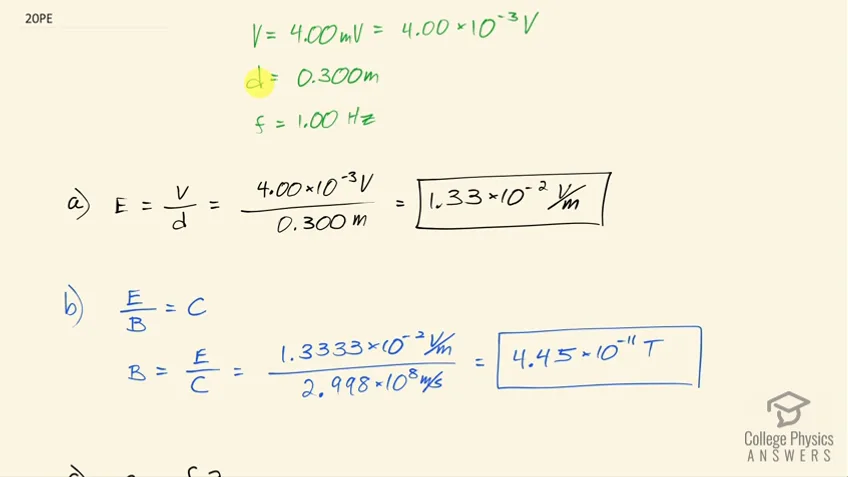 1:51PreviewProblem 20Full video with free trialDuring normal beating, the heart creates a maximum 4.00-mV potential across 0.300 m of a person’s chest, creating a 1.00-Hz electromagnetic wave. (a) What is the maximum electric field strength created? (b) What is the corresponding maximum magnetic field strength in the electromagnetic wave? (c) What is the wavelength of the electromagnetic wave?
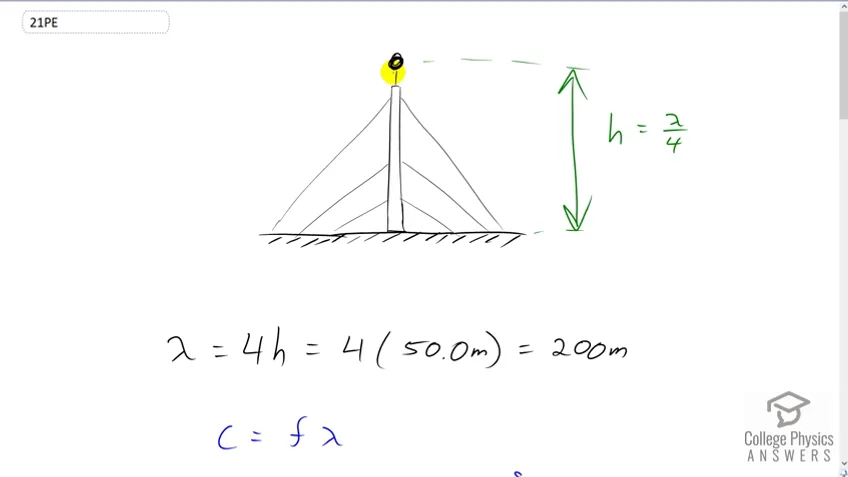 3:11PreviewProblem 21Full video with free trial(a) The ideal size (most efficient) for a broadcast antenna with one end on the ground is one-fourth the wavelength () of the electromagnetic radiation being sent out. If a new radio station has such an antenna that is 50.0 m high, what frequency does it broadcast most efficiently? Is this in the AM or FM band? (b) Discuss the analogy of the fundamental resonant mode of an air column closed at one end to the resonance of currents on an antenna that is one- fourth their wavelength.
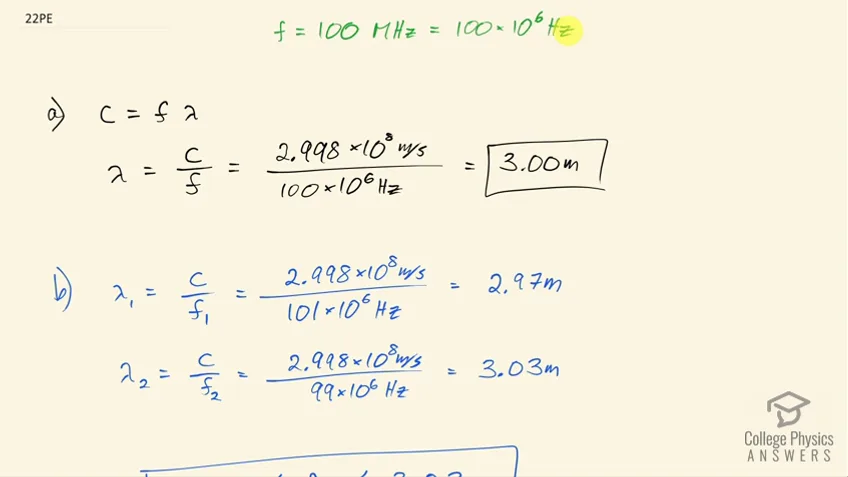 1:22PreviewProblem 22Full video with free trial(a) What is the wavelength of 100-MHz radio waves used in an MRI unit? (b) If the frequencies are swept over a range centered on 100 MHz, what is the range of wavelengths broadcast?
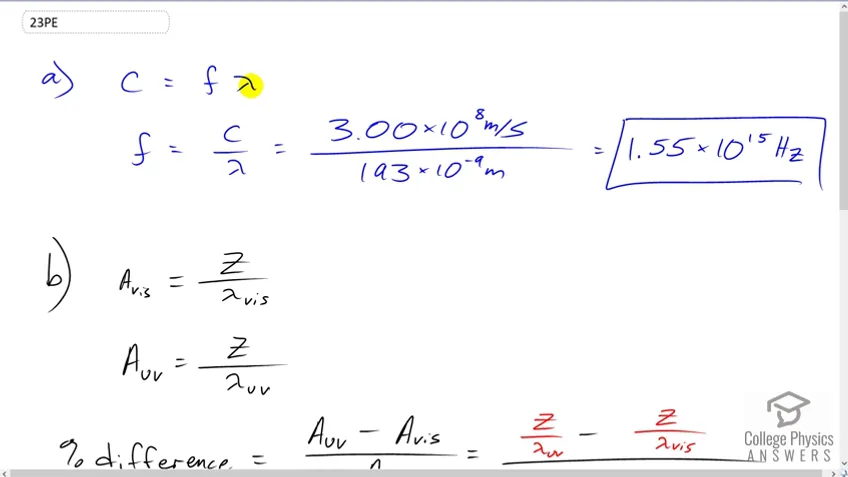 3:42PreviewProblem 23Full video with free trial(a) What is the frequency of the 193-nm ultraviolet radiation used in laser eye surgery? (b) Assuming the accuracy with which this EM radiation can ablate the cornea is inversely proportional to wavelength, how much more accurate can this UV be than the shortest visible wavelength of light?
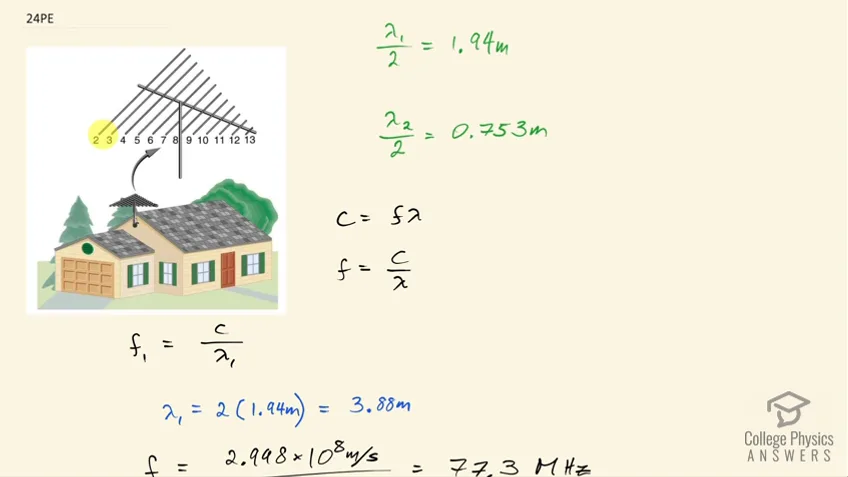 2:04PreviewProblem 24Full video with free trialTV-reception antennas for VHF are constructed with cross wires supported at their centers, as shown in Figure 24.27. The ideal length for the cross wires is one-half the wavelength to be received, with the more expensive antennas having one for each channel. Suppose you measure the lengths of the wires for particular channels and find them to be 1.94 and 0.753 m long, respectively. What are the frequencies for these channels?
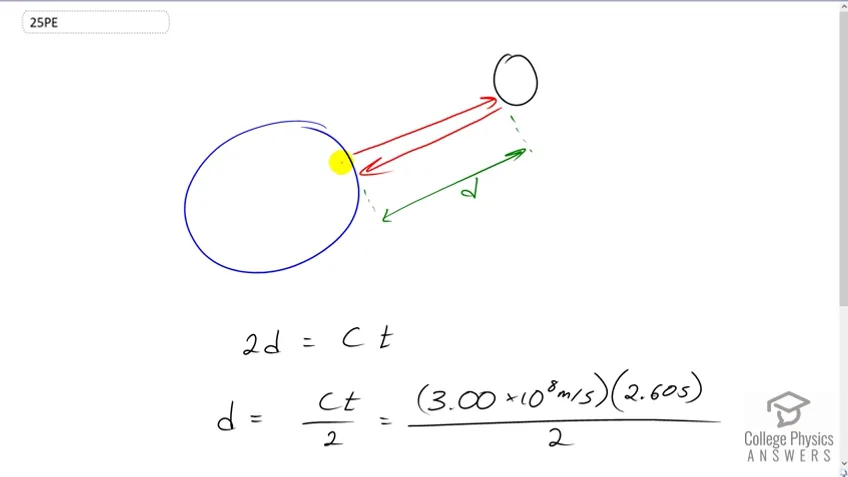 1:16PreviewProblem 25Full video with free trialConversations with astronauts on lunar walks had an echo that was used to estimate the distance to the Moon. The sound spoken by the person on Earth was transformed into a radio signal sent to the Moon, and transformed back into sound on a speaker inside the astronaut’s space suit. This sound was picked up by the microphone in the space suit (intended for the astronaut’s voice) and sent back to Earth as a radio echo of sorts. If the round-trip time was 2.60 s, what was the approximate distance to the Moon, neglecting any delays in the electronics?
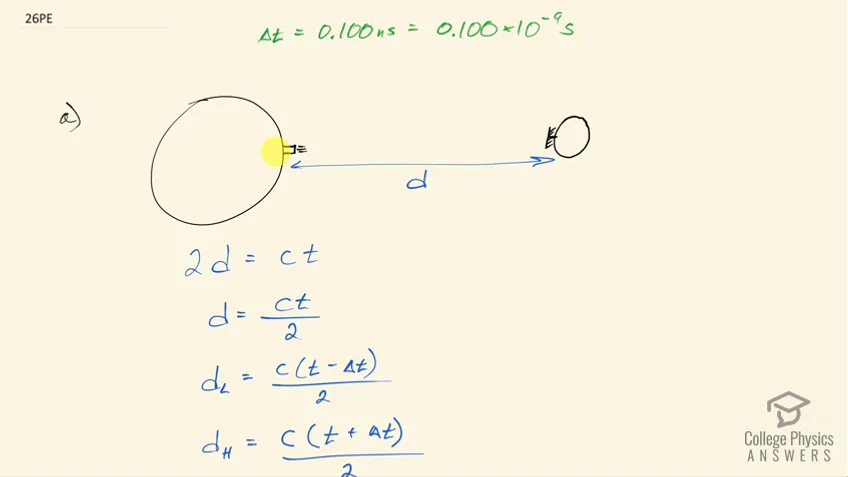 3:55PreviewProblem 26Full video with free trialLunar astronauts placed a reflector on the Moon’s surface, off which a laser beam is periodically reflected. The distance to the Moon is calculated from the round-trip time. (a) To what accuracy in meters can the distance to the Moon be determined, if this time can be measured to 0.100 ns? (b) What percent accuracy is this, given the average distance to the Moon is ?
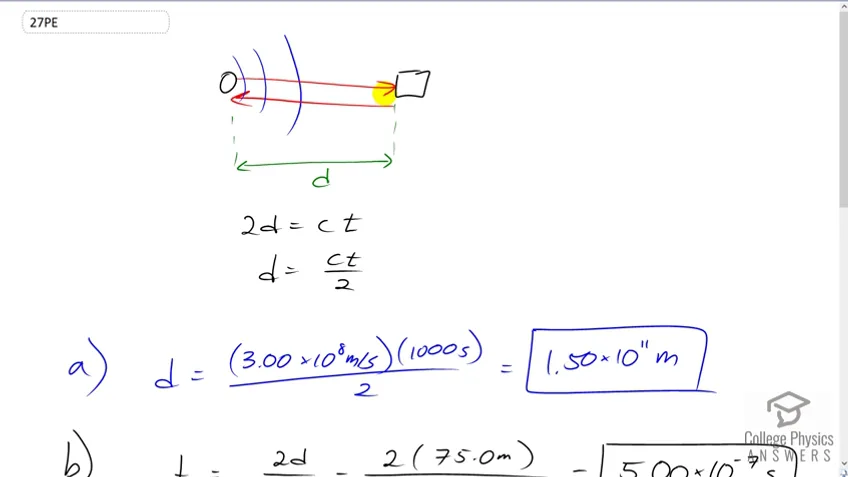 2:53PreviewProblem 27Full video with free trialRadar is used to determine distances to various objects by measuring the round-trip time for an echo from the object. (a) How far away is the planet Venus if the echo time is 1000 s? (b) What is the echo time for a car 75.0 m from a Highway Police radar unit? (c) How accurately (in nanoseconds) must you be able to measure the echo time to an airplane 12.0 km away to determine its distance within 10.0 m?
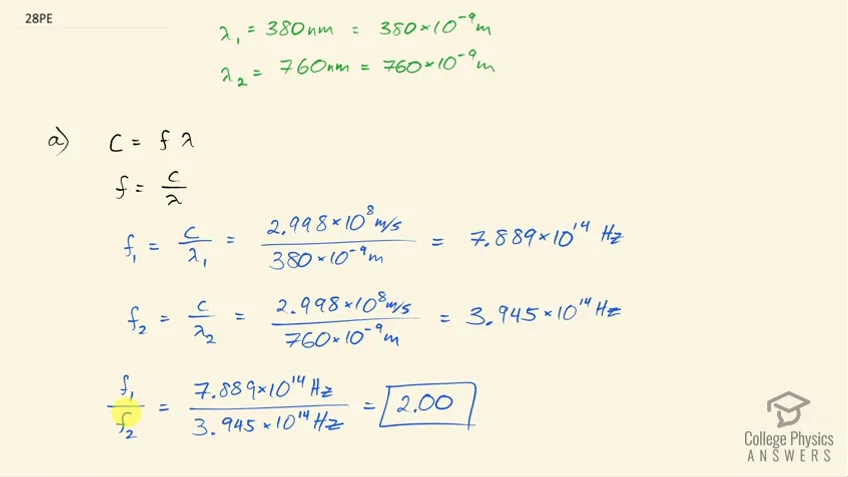 1:46PreviewProblem 28Full video with free trial(a) Calculate the ratio of the highest to lowest frequencies of electromagnetic waves the eye can see, given the wavelength range of visible light is from 380 to 760 nm. (b) Compare this with the ratio of highest to lowest frequencies the ear can hear.
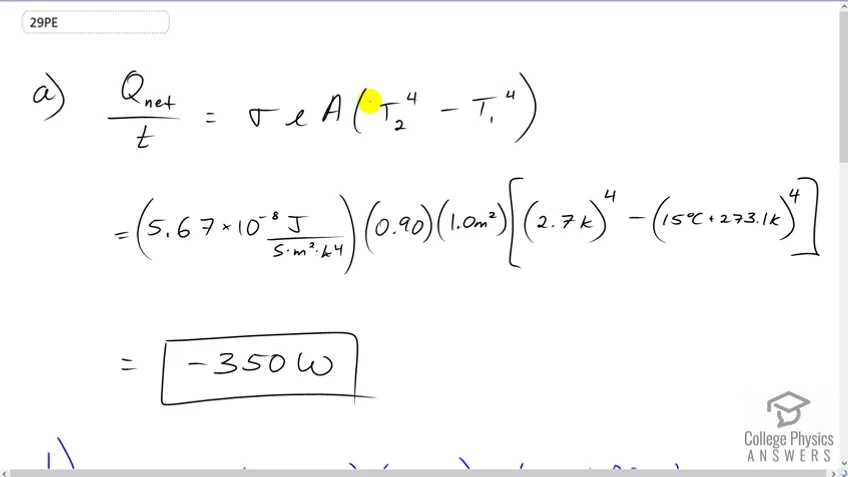 3:10PreviewProblem 29Full video with free trial(a) Calculate the rate in watts at which heat transfer through radiation occurs (almost entirely in the infrared) from of the Earth’s surface at night. Assume the emissivity is 0.90, the temperature of the Earth is , and that of outer space is 2.7 K. (b) Compare the intensity of this radiation with that coming to the Earth from the Sun during the day, which averages about , only half of which is absorbed. (c) What is the maximum magnetic field strength in the outgoing radiation, assuming it is a continuous wave?
24.4 Energy in Electromagnetic Waves
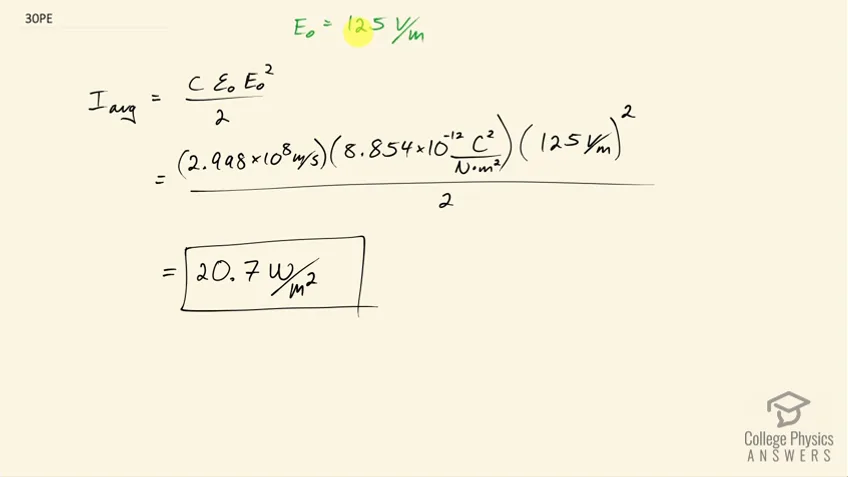 0:42PreviewProblem 30Full video with free trialWhat is the intensity of an electromagnetic wave with a peak electric field strength of 125 V/m?
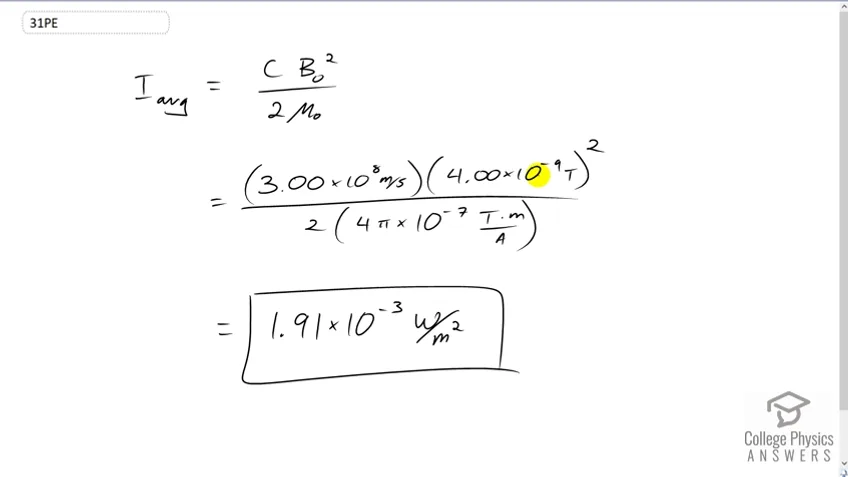 0:32PreviewProblem 31Full video with free trialFind the intensity of an electromagnetic wave having a peak magnetic field strength of
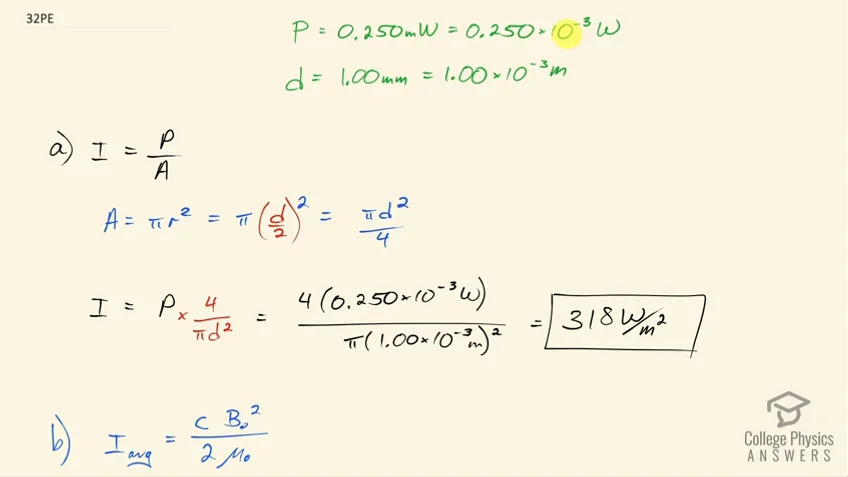 3:09PreviewProblem 32Full video with free trialAssume the helium-neon lasers commonly used in student physics laboratories have power outputs of 0.250 mW. (a) If such a laser beam is projected onto a circular spot 1.00 mm in diameter, what is its intensity? (b) Find the peak magnetic field strength. (c) Find the peak electric field strength.
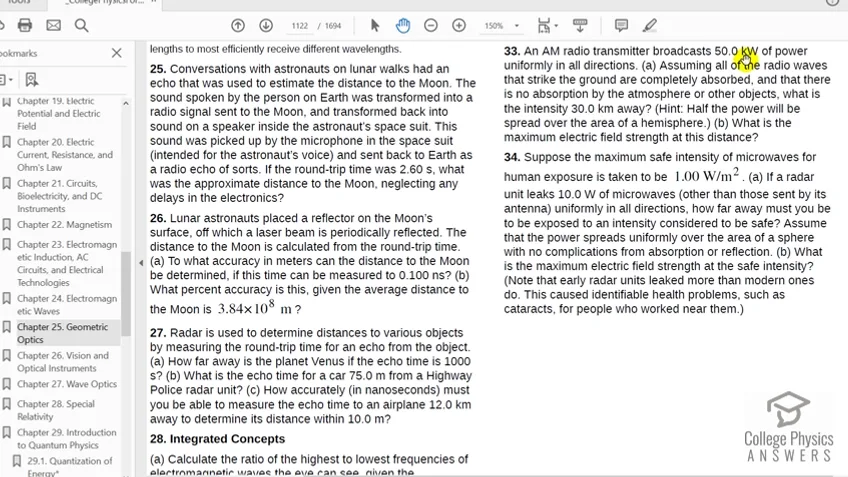 2:23PreviewProblem 33Full video with free trialAn AM radio transmitter broadcasts 50.0 kW of power uniformly in all directions. (a) Assuming all of the radio waves that strike the ground are completely absorbed, and that there is no absorption by the atmosphere or other objects, what is the intensity 30.0 km away? (Hint: Half the power will be spread over the area of a hemisphere.) (b) What is the maximum electric field strength at this distance?
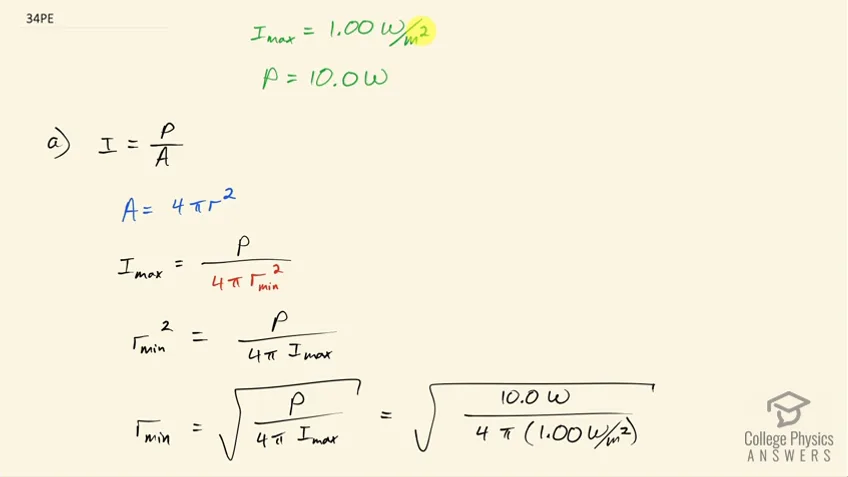 2:55PreviewProblem 34Full video with free trialSuppose the maximum safe intensity of microwaves for human exposure is taken to be . (a) If a radar unit leaks 10.0 W of microwaves (other than those sent by its antenna) uniformly in all directions, how far away must you be to be exposed to an intensity considered to be safe? Assume that the power spreads uniformly over the area of a sphere with no complications from absorption or reflection. (b) What is the maximum electric field strength at the safe intensity? (Note that early radar units leaked more than modern ones do. This caused identifiable health problems, such as cataracts, for people who worked near them.)
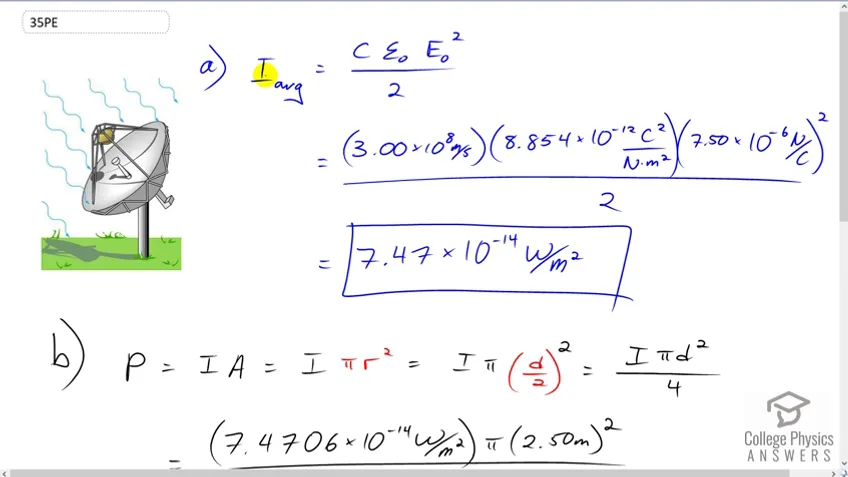 1:47PreviewProblem 35Full video with free trialA 2.50-m-diameter university communications satellite dish receives TV signals that have a maximum electric field strength (for one channel) of . (See Figure 24.28.) (a) What is the intensity of this wave? (b) What is the power received by the antenna? (c) If the orbiting satellite broadcasts uniformly over an area of (a large fraction of North America), how much power does it radiate?
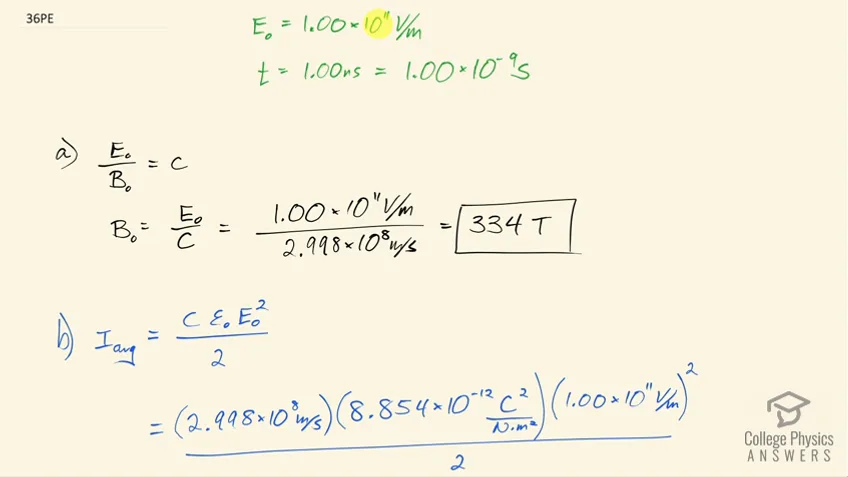 2:19PreviewProblem 36Full video with free trialLasers can be constructed that produce an extremely high intensity electromagnetic wave for a brief time—called pulsed lasers. They are used to ignite nuclear fusion, for example. Such a laser may produce an electromagnetic wave with a maximum electric field strength of for a time of 1.00 ns. (a) What is the maximum magnetic field strength in the wave? (b) What is the intensity of the beam? (c) What energy does it deliver on a area?
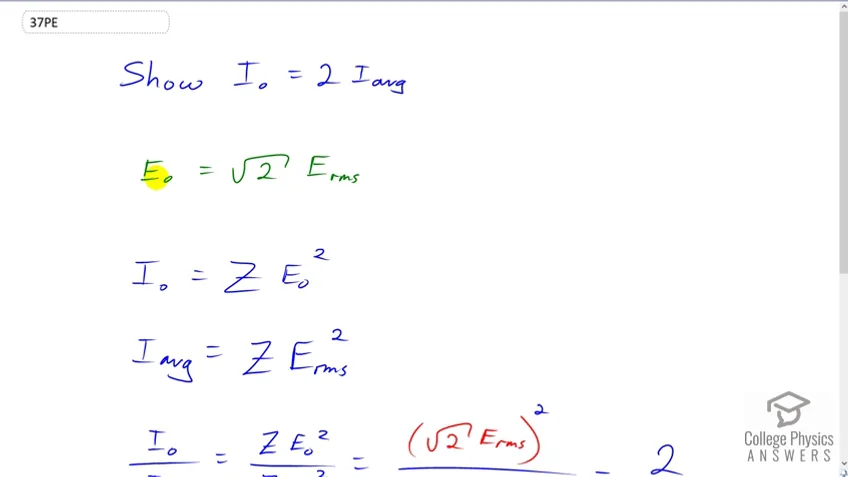 1:45PreviewProblem 37Full video with free trialShow that for a continuous sinusoidal electromagnetic wave, the peak intensity is twice the average intensity (, using either the fact that , or , where "rms" means average (actually root mean square, a type of average).
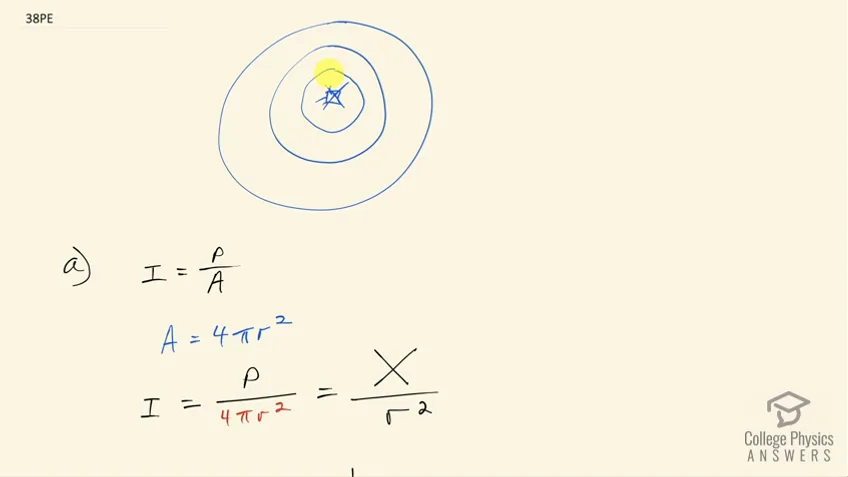 3:29PreviewProblem 38Full video with free trialSuppose a source of electromagnetic waves radiates uniformly in all directions in empty space where there are no absorption or interference effects. (a) Show that the intensity is inversely proportional to , the distance from the source squared. (b) Show that the magnitudes of the electric and magnetic fields are inversely proportional to .
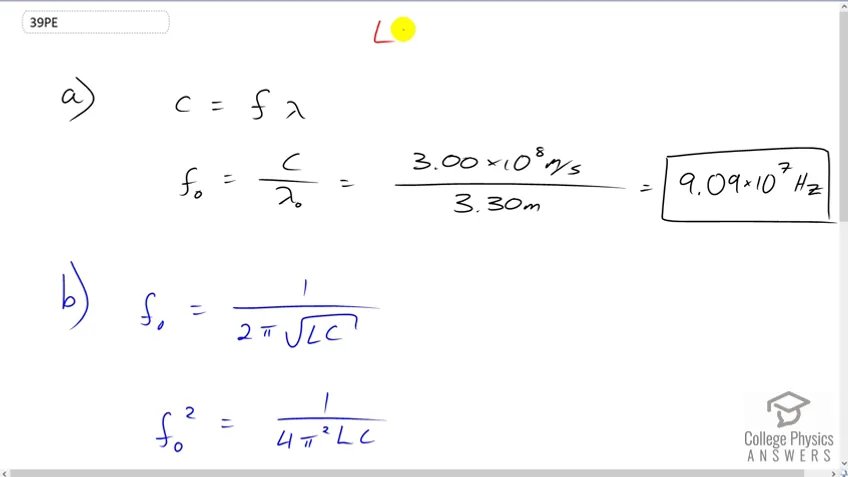 1:34PreviewProblem 39Full video with free trialAn circuit with a 5.00-pF capacitor oscillates in such a manner as to radiate at a wavelength of 3.30 m. (a) What is the resonant frequency? (b) What inductance is in series with the capacitor?
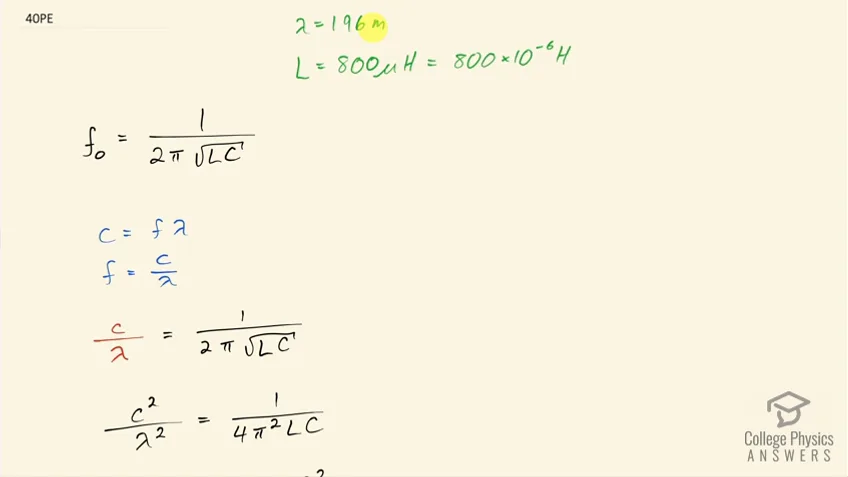 2:18PreviewProblem 40Full video with free trialWhat capacitance is needed in series with an inductor to form a circuit that radiates a wavelength of 196 m?
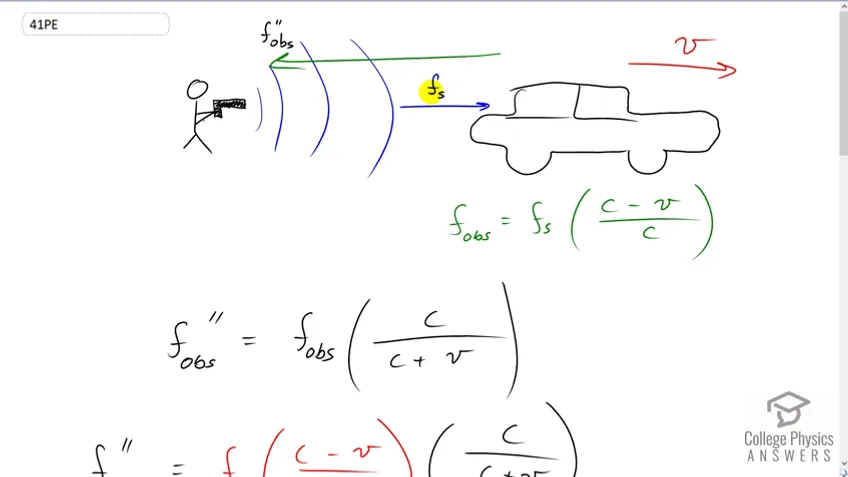 6:34PreviewProblem 41Full video with free trialPolice radar determines the speed of motor vehicles using the same Doppler-shift technique employed for ultrasound in medical diagnostics. Beats are produced by mixing the double Doppler-shifted echo with the original frequency. If microwaves are used and a beat frequency of 150 Hz is produced, what is the speed of the vehicle? (Assume the same Doppler-shift formulas are valid with the speed of sound replaced by the speed of light.)
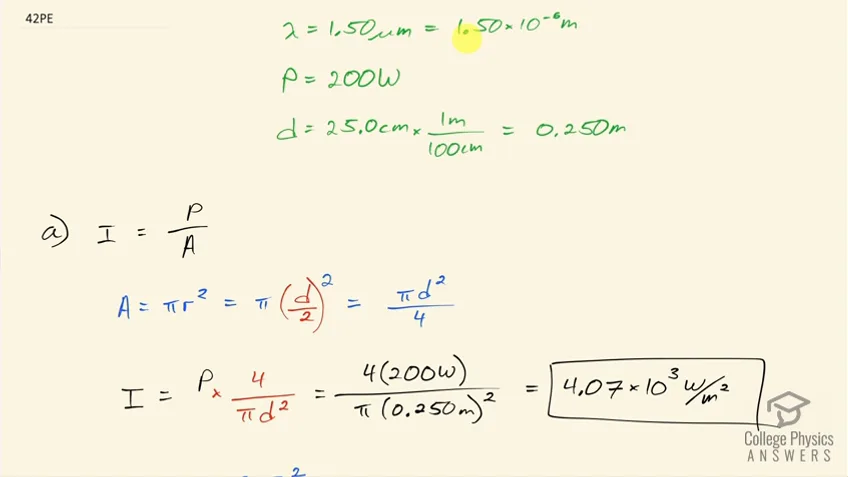 4:08PreviewProblem 42Full video with free trialAssume the mostly infrared radiation from a heat lamp acts like a continuous wave with wavelength . (a) If the lamp’s 200-W output is focused on a person’s shoulder, over a circular area 25.0 cm in diameter, what is the intensity in ? (b) What is the peak electric field strength? (c) Find the peak magnetic field strength. (d) How long will it take to increase the temperature of the 4.00-kg shoulder by , assuming no other heat transfer and given that its specific heat is ?
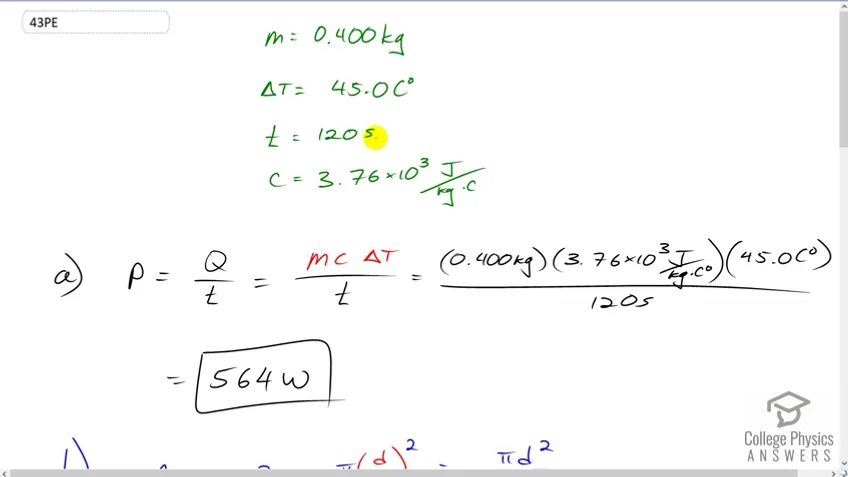 3:29PreviewProblem 43Full video with free trialOn its highest power setting, a microwave oven increases the temperature of 0.400 kg of spaghetti by in 120 s. (a) What was the rate of power absorption by the spaghetti, given that its specific heat is ? (b) Find the average intensity of the microwaves, given that they are absorbed over a circular area 20.0 cm in diameter. (c) What is the peak electric field strength of the microwave? (d) What is its peak magnetic field strength?
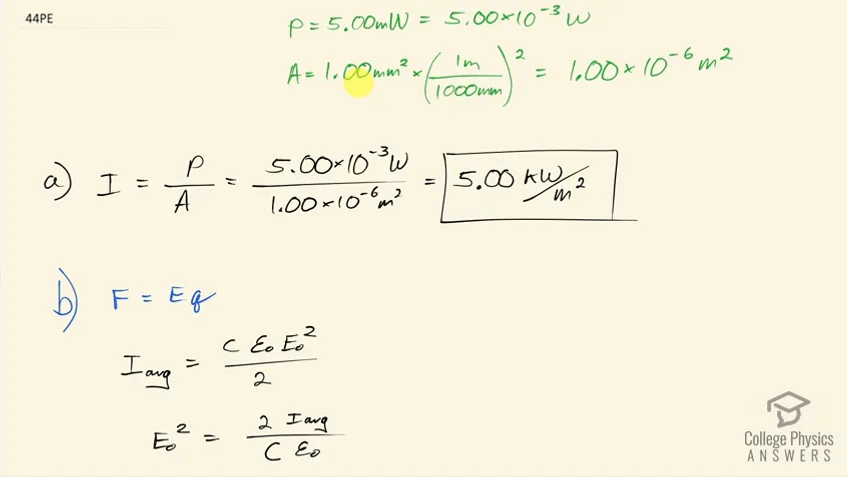 3:29PreviewProblem 44Full video with free trialElectromagnetic radiation from a 5.00-mW laser is concentrated on a area. (a) What is the intensity in ? (b) Suppose a 2.00-nC static charge is in the beam. What is the maximum electric force it experiences? (c) If the static charge moves at 400 m/s, what maximum magnetic force can it feel?
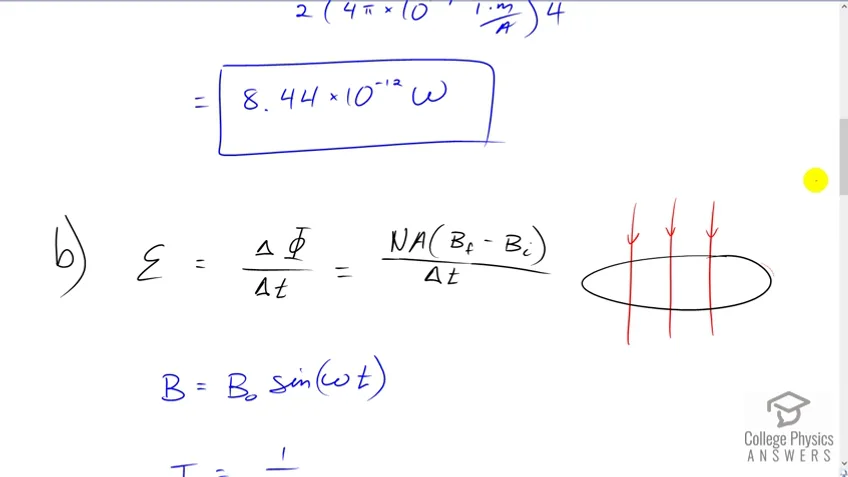 5:57PreviewProblem 45Full video with free trialA 200-turn flat coil of wire 30.0 cm in diameter acts as an antenna for FM radio at a frequency of 100 MHz. The magnetic field of the incoming electromagnetic wave is perpendicular to the coil and has a maximum strength of . (a) What power is incident on the coil? (b) What average emf is induced in the coil over one-fourth of a cycle? (c) If the radio receiver has an inductance of , what capacitance must it have to resonate at 100 MHz?
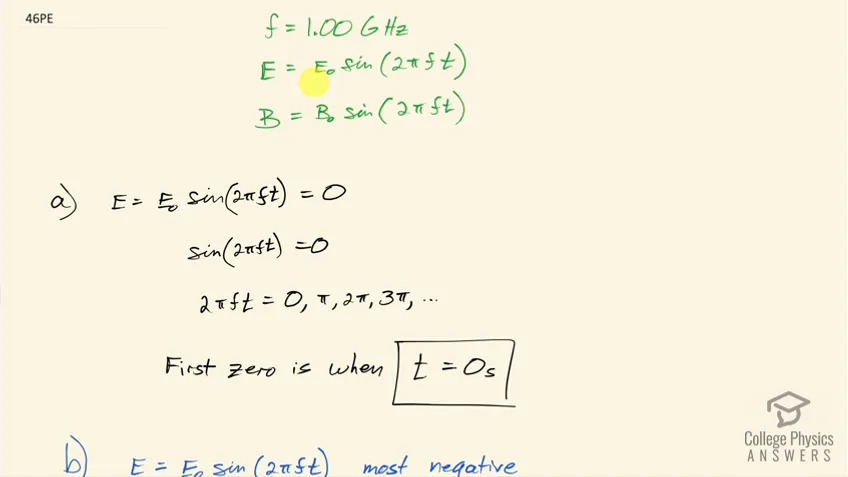 2:38PreviewProblem 46Full video with free trialIf electric and magnetic field strengths vary sinusoidally in time, being zero at , then and . Let here. (a) When are the field strengths first zero? (b) When do they reach their most negative value? (c) How much time is needed for them to complete one cycle?
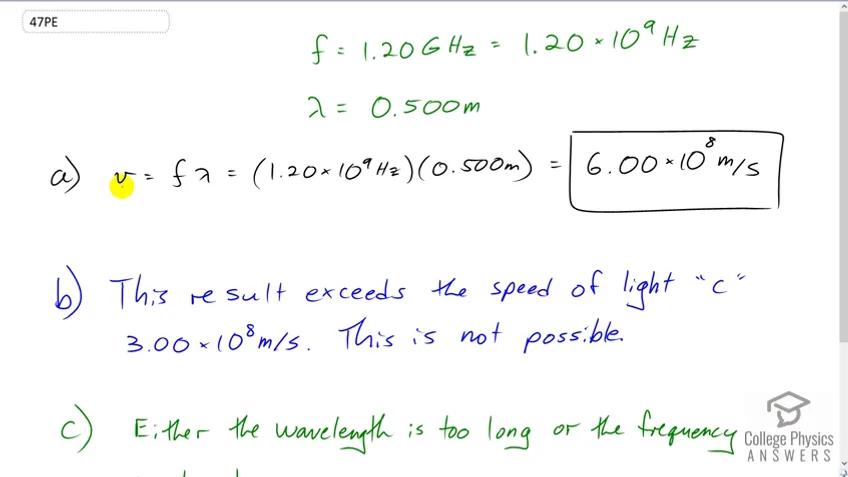 0:45PreviewProblem 47Full video with free trialA researcher measures the wavelength of a 1.20-GHz electromagnetic wave to be 0.500 m. (a) Calculate the speed at which this wave propagates. (b) What is unreasonable about this result? (c) Which assumptions are unreasonable or inconsistent?
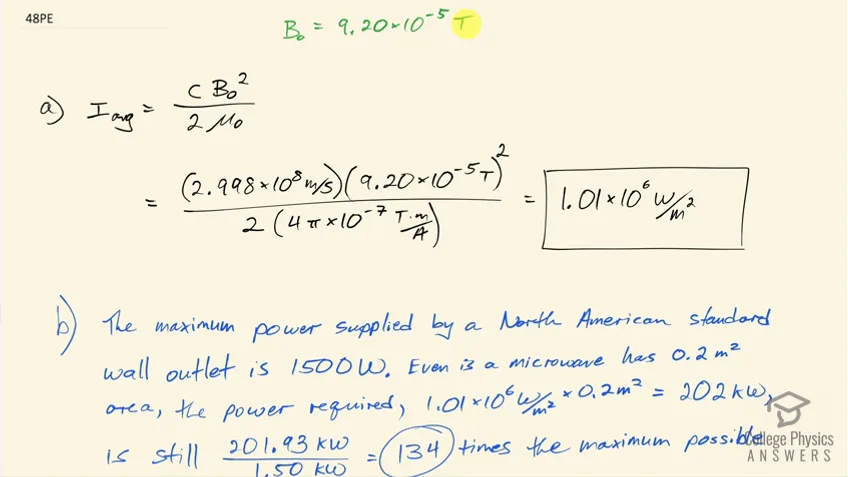 1:19PreviewProblem 48Full video with free trialThe peak magnetic field strength in a residential microwave oven is . (a) What is the intensity of the microwave? (b) What is unreasonable about this result? (c) What is wrong about the premise?
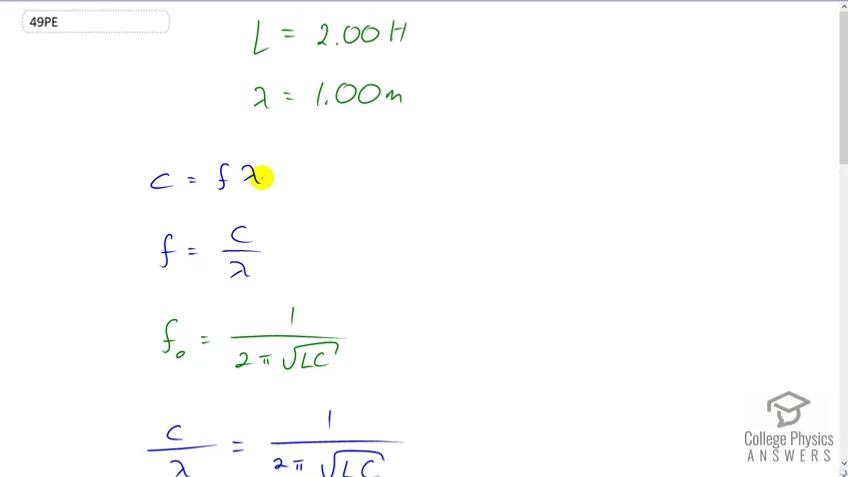 2:45PreviewProblem 49Full video with free trialAn circuit containing a 2.00-H inductor oscillates at such a frequency that it radiates at a 1.00-m wavelength. (a) What is the capacitance of the circuit? (b) What is unreasonable about this result? (c) Which assumptions are unreasonable or inconsistent?
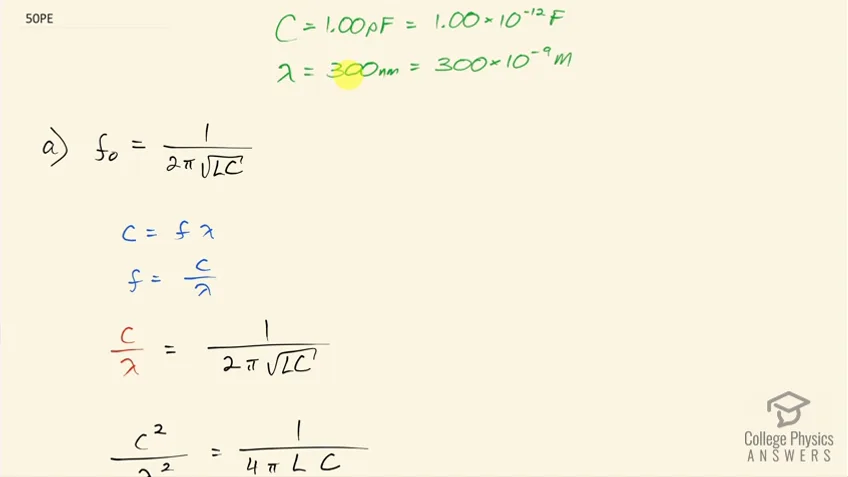 2:19PreviewProblem 50Full video with free trialAn circuit containing a 1.00-pF capacitor oscillates at such a frequency that it radiates at a 300-nm wavelength. (a) What is the inductance of the circuit? (b) What is unreasonable about this result? (c) Which assumptions are unreasonable or inconsistent?
Test Prep for AP® Courses
24.2 Production of Electromagnetic Waves
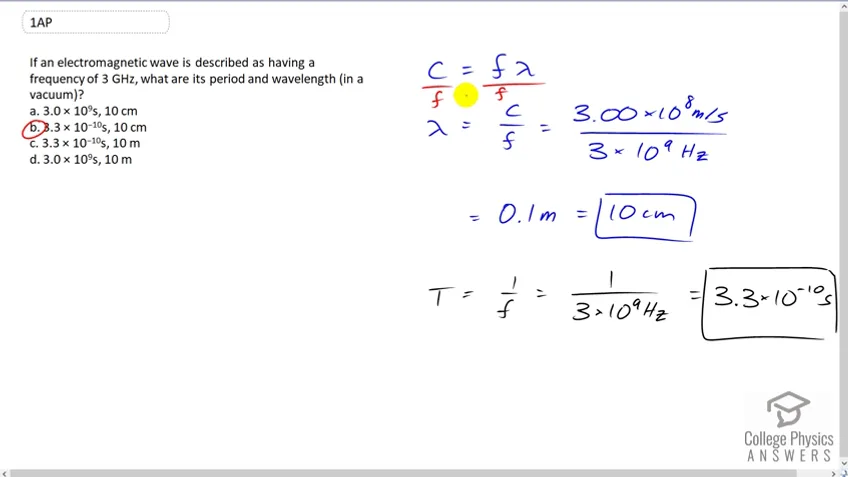 0:52PreviewProblem 1Full video with free trialIf an electromagnetic wave is described as having a frequency of 3 GHz, what are its period and wavelength (in a vacuum)? (a) , 10 cm
(b) , 10 cm
(c) , 10 m
(d) , 10 m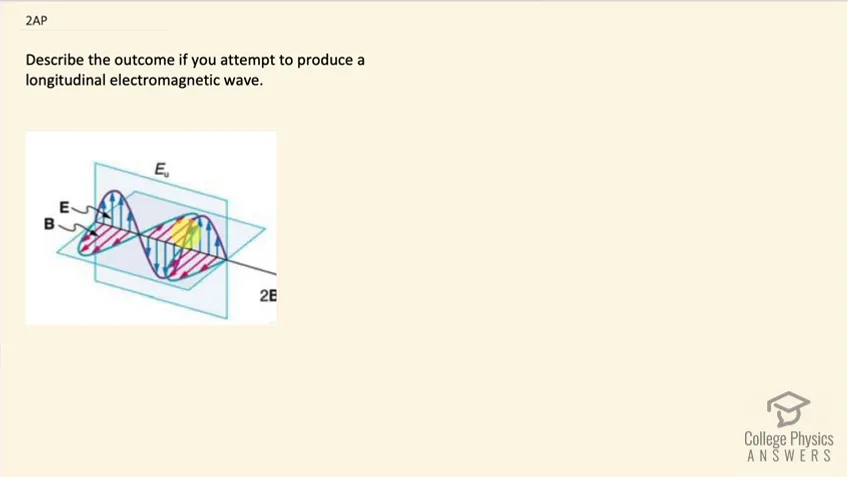 0:52PreviewProblem 2Full video with free trialDescribe the outcome if you attempt to produce a longitudinal electromagnetic wave.
 2:02PreviewProblem 3Full video with free trialA wave is travelling through a medium until it hits the end of the medium and there is nothing but vacuum beyonWhat happens to a mechanical wave? Electromagnetic wave? (a) reflects backward, continues on
(b) reflects backward, reflects backward
(c) continues on, continues on
(d) stops, continues on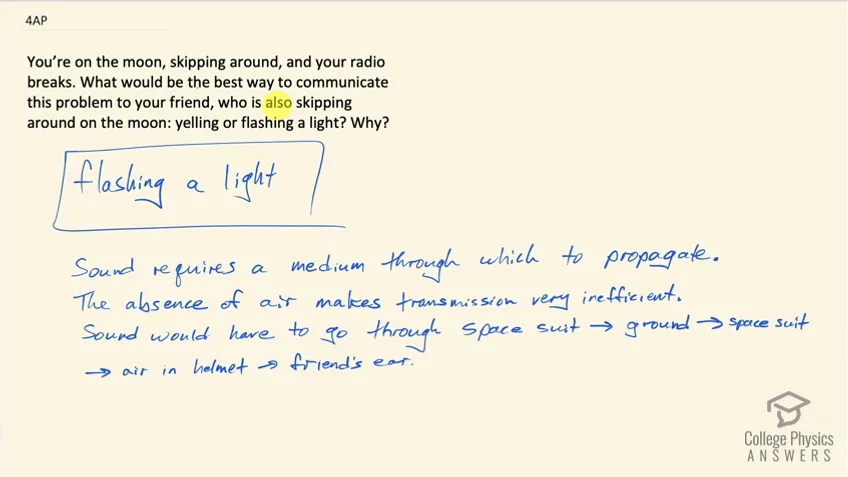 1:12PreviewProblem 4Full video with free trialYou’re on the moon, skipping around, and your radio breaks. What would be the best way to communicate this problem to your friend, who is also skipping around on the moon: yelling or flashing a light? Why?
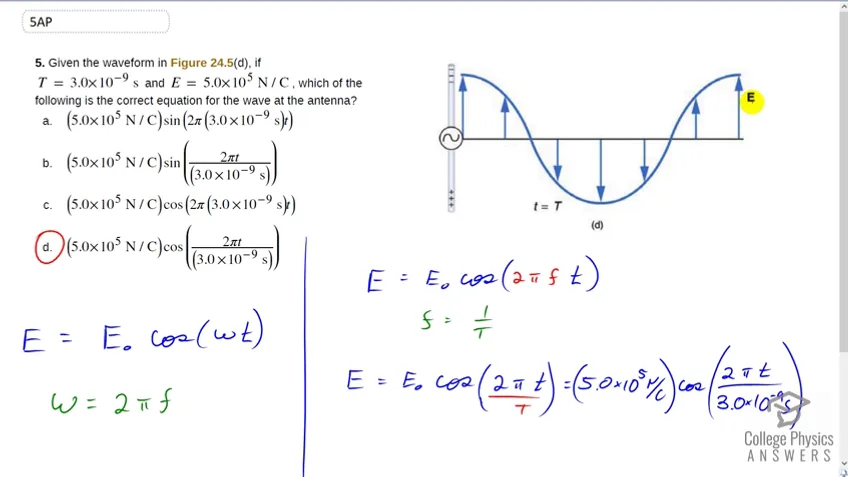 1:35PreviewProblem 5Full video with free trialGiven the waveform in Figure 24.5(d), if and , which of the following is the correct equation for the wave at the antenna? (a)
(b)
(c)
(d)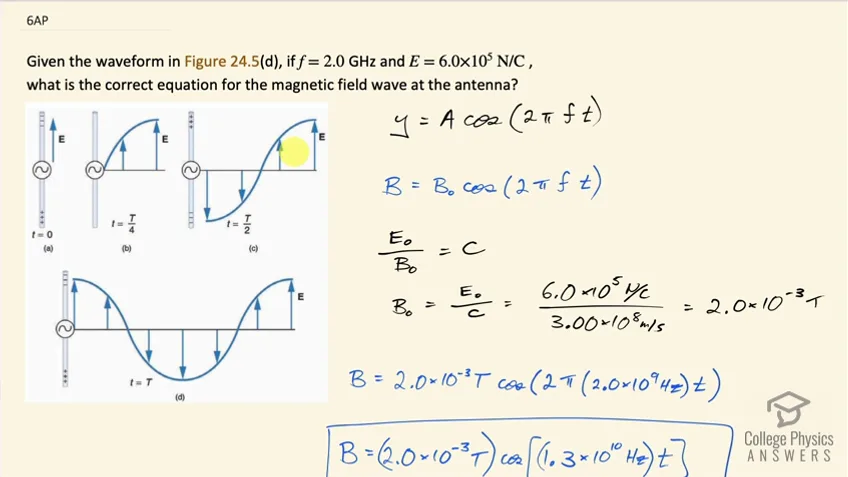 2:53PreviewProblem 6Full video with free trialGiven the waveform in Figure 24.5(d), if and what is the correct equation for the magnetic field wave at the antenna?
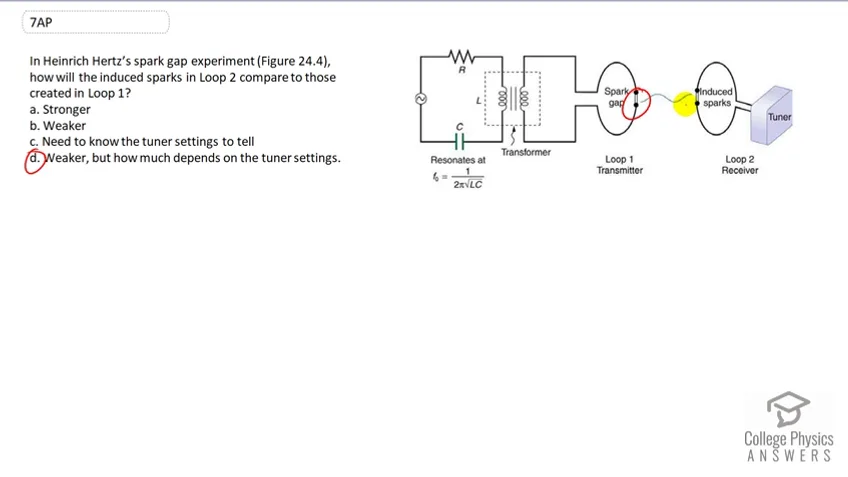 1:32PreviewProblem 7Full video with free trialIn Heinrich Hertz’s spark gap experiment (Figure 24.4), how will the induced sparks in Loop 2 compare to those created in Loop 1? (a) Stronger
(b) Weaker
(c) Need to know the tuner settings to tell
(d) Weaker, but how much depends on the tuner settings.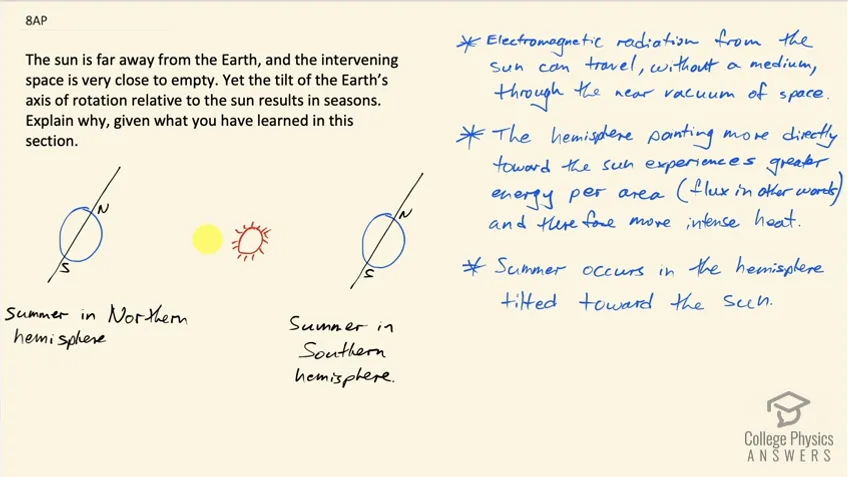 2:32PreviewProblem 8Full video with free trialThe sun is far away from the Earth, and the intervening space is very close to empty. Yet the tilt of the Earth’s axis of rotation relative to the sun results in seasons. Explain why, given what you have learned in this section.
24.3 The Electromagnetic Spectrum
 1:37PreviewProblem 9Full video with free trialThe correct ordering from least to greatest wavelength is: (a) ELF, FM radio, microwaves, infrared, red, green, ultraviolet, x-ray, gamma ray
(b) ELF, FM radio, microwaves, infrared, green, red, ultraviolet, x-ray, gamma ray
(c) gamma ray, x-ray, ultraviolet, red, green, infrared, microwaves, FM radio, ELF
(d) gamma ray, x-ray, ultraviolet, green, red, infrared, microwaves, FM radio, ELF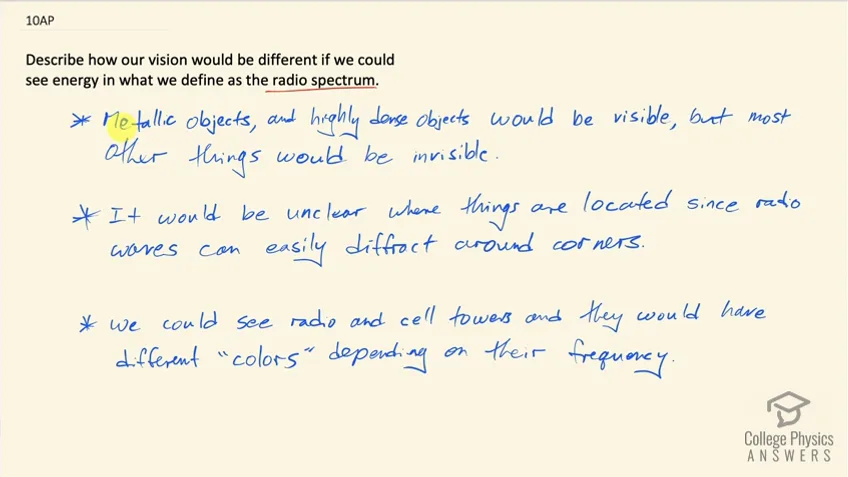 2:53PreviewProblem 10Full video with free trialDescribe how our vision would be different if we could see energy in what we define as the radio spectrum.
24.4 Energy in Electromagnetic Waves
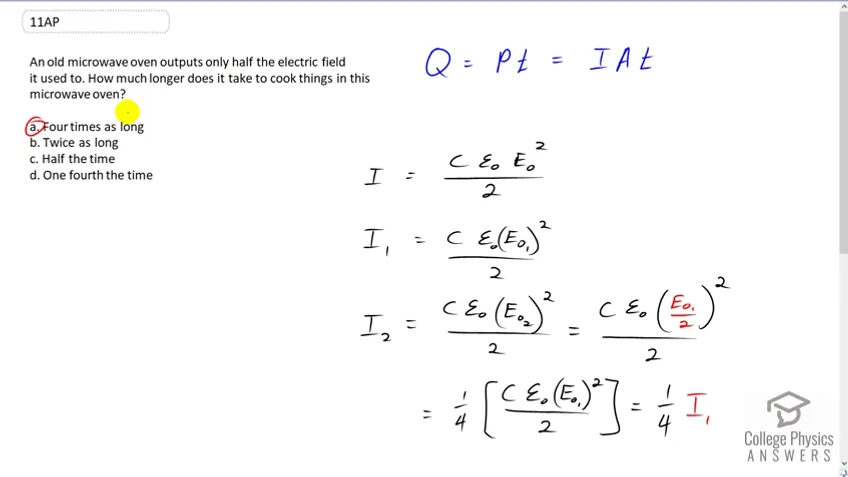 2:23PreviewProblem 11Full video with free trialAn old microwave oven outputs only half the electric field it used to. How much longer does it take to cook things in this microwave oven? (a) Four times as long
(b) Twice as long
(c) Half the time
(d) One fourth the time 1:30PreviewProblem 12Full video with free trialDescribe at least two improvements you could make to a radar set to make it more sensitive (able to detect things at longer ranges). Explain why these would work.