Chapter 15: Thermodynamics
77 problems solved · Free preview of every solution shows how it’s started · Watch the full videos with a free 7-day trial →


Section
15.1 The First Law of Thermodynamics
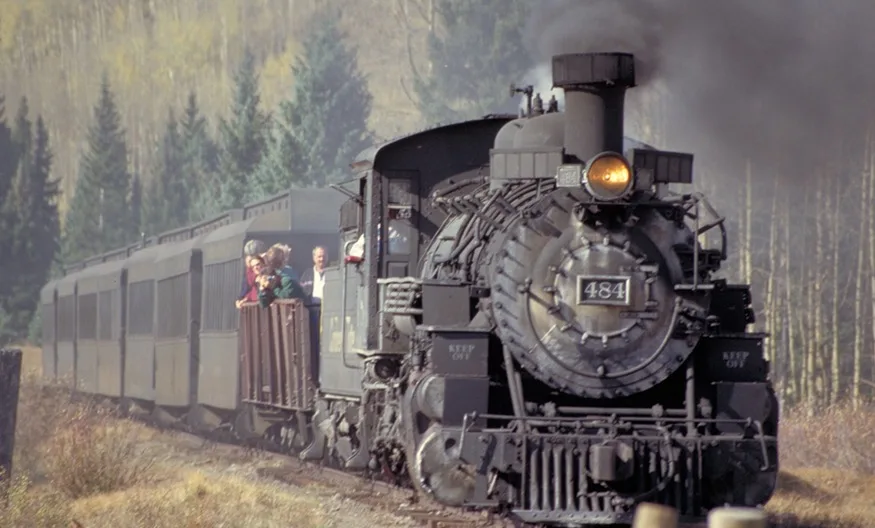
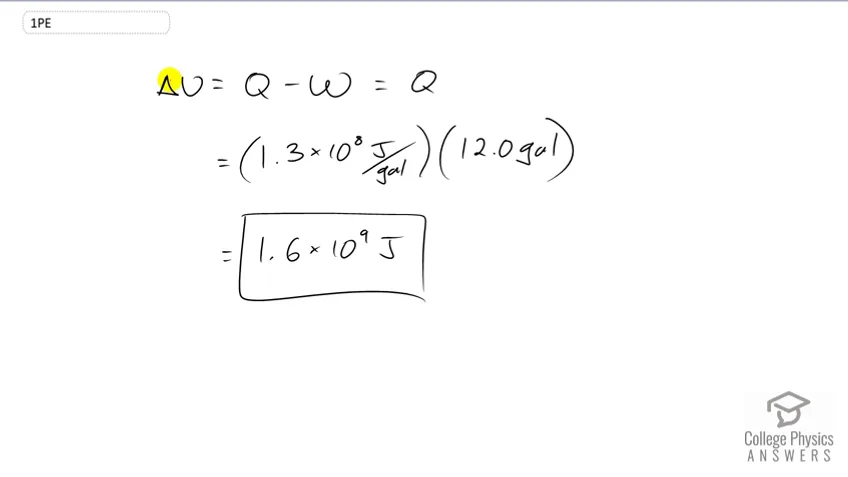 0:57Problem 1FreeWhat is the change in internal energy of a car if you put 12.0 gal of gasoline into its tank? The energy content of gasoline is . All other factors, such as the car's temperature, are constant.
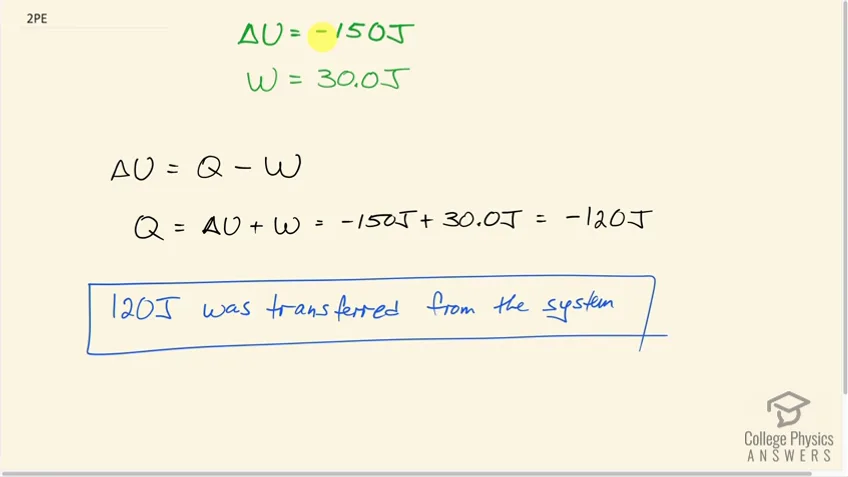 1:01PreviewProblem 2Full video with free trialHow much heat transfer occurs from a system, if its internal energy decreased by 150 J while it was doing 30.0 J of work?
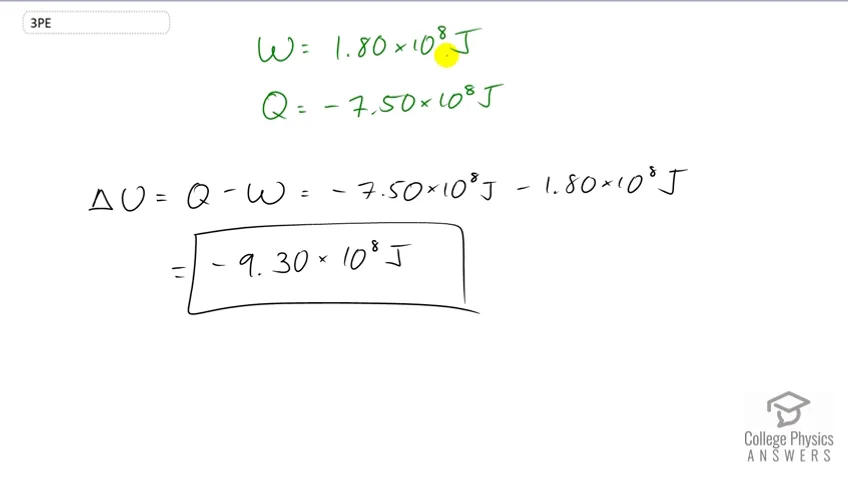 0:51PreviewProblem 3Full video with free trialA system does of work while of heat transfer occurs to the environment. What is the change in internal energy of the system assuming no other changes (such as in temperature or by the addition of fuel)?
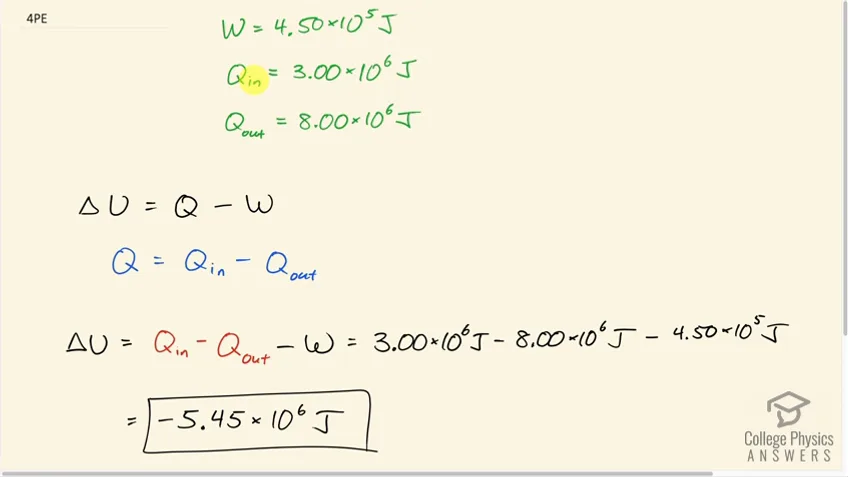 1:00PreviewProblem 4Full video with free trialWhat is the change in internal energy of a system which does of work while of heat transfer occurs into the system, and of heat transfer occurs to the environment?
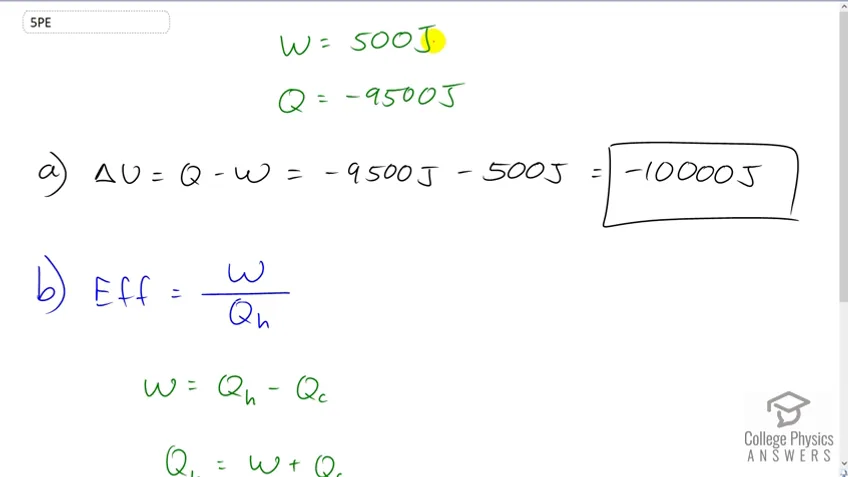 1:39PreviewProblem 5Full video with free trialSuppose a woman does 500 J of work and 9500 J of heat transfer occurs into the environment in the process. (a) What is the decrease in her internal energy, assuming no change in temperature or consumption of food? (That is, there is no other energy transfer.) (b) What is her efficiency?
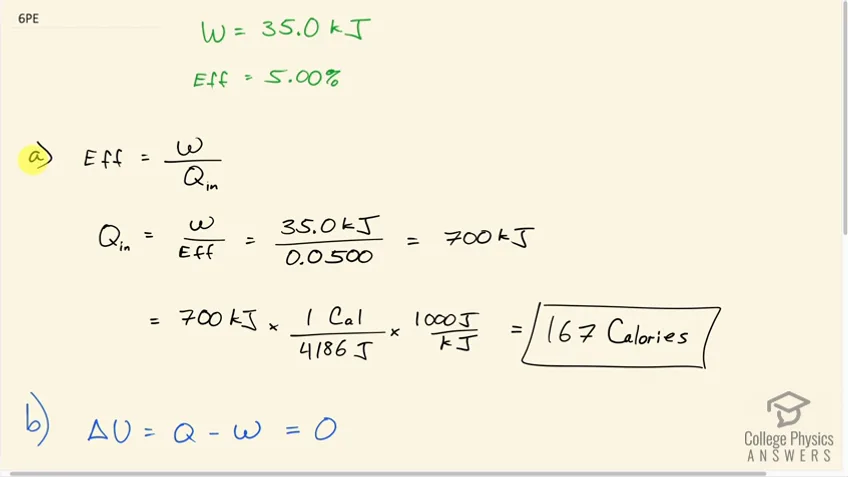 1:49PreviewProblem 6Full video with free trial(a) How much food energy will a man metabolize in the process of doing 35.0 kJ of work with an efficiency of 5.00%? (b) How much heat transfer occurs to the environment to keep his temperature constant? Explicitly show how you follow the steps in the Problem-Solving Strategy for thermodynamics found in Problem-Solving Strategies for Thermodynamics.
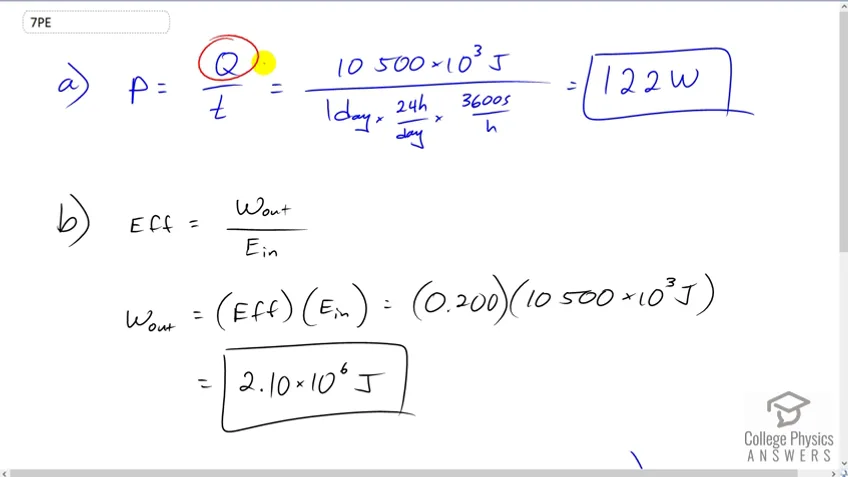 1:55PreviewProblem 7Full video with free trial(a) What is the average metabolic rate in watts of a man who metabolizes 10,500 kJ of food energy in one day? (b) What is the maximum amount of work in joules he can do without breaking down fat, assuming a maximum efficiency of 20.0%? (c) Compare his work output with the daily output of a 187-W (0.250-horsepower) motor.
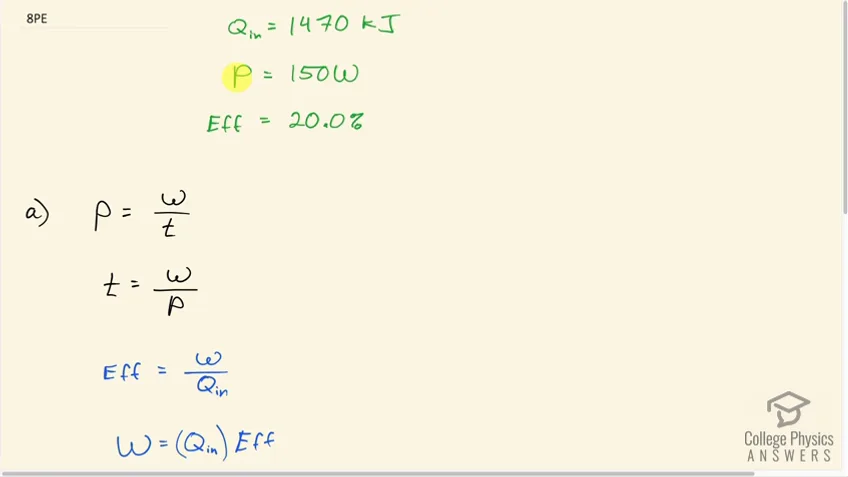 1:41PreviewProblem 8Full video with free trial(a) How long will the energy in a 1470-kJ (350-kcal) cup of yogurt last in a woman doing work at the rate of 150 W with an efficiency of 20.0% (such as in leisurely climbing stairs)? (b) Does the time found in part (a) imply that it is easy to consume more food energy than you can reasonably expect to work off with exercise?
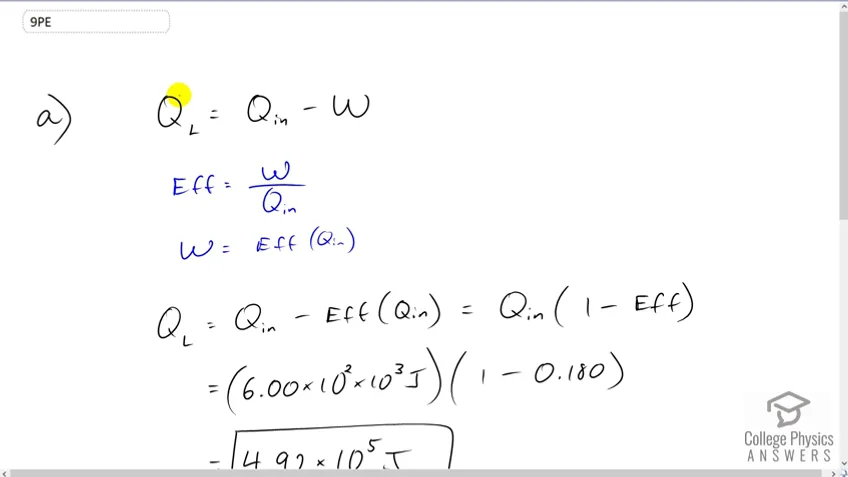 3:00PreviewProblem 9Full video with free trial(a) A woman climbing the Washington Monument metabolizes of food energy. If her efficiency is 18.0%, how much heat transfer occurs to the environment to keep her temperature constant? (b) Discuss the amount of heat transfer found in (a). Is it consistent with the fact that you quickly warm up when exercising?
15.2 The First Law of Thermodynamics and Some Simple Processes
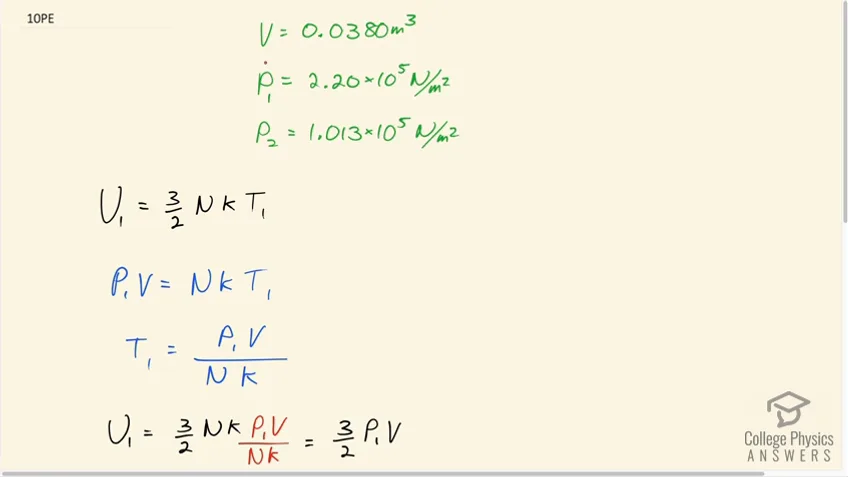 2:07PreviewProblem 10Full video with free trialA car tire contains of air at a pressure of (about 32 psi). How much more internal energy does this gas have than the same volume has at zero gauge pressure (which is equivalent to normal atmospheric pressure)?
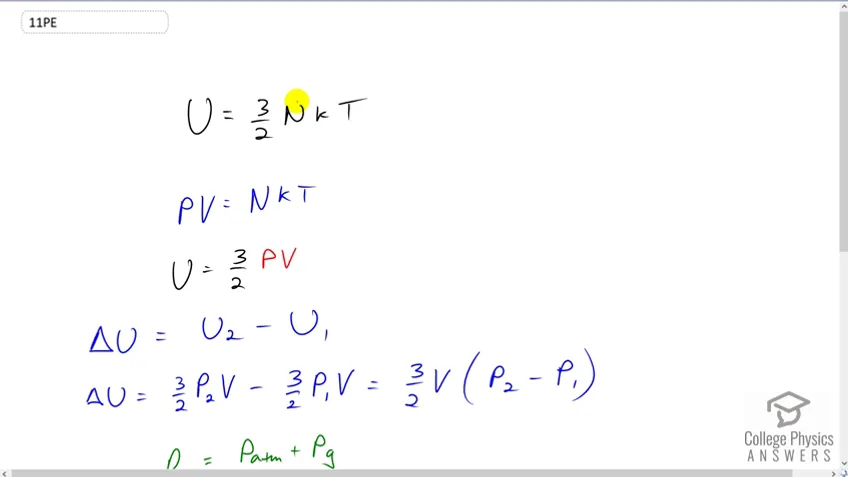 2:53PreviewProblem 11Full video with free trialA helium-filled toy balloon has a gauge pressure of 0.200 atm and a volume of 10.0 L. How much greater is the internal energy of the helium in the balloon than it would be at zero gauge pressure?
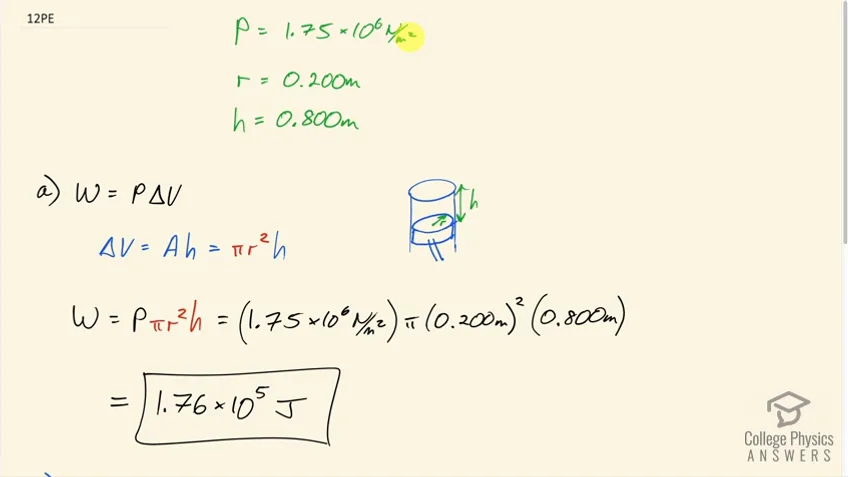 1:43PreviewProblem 12Full video with free trialSteam to drive an old-fashioned steam locomotive is supplied at a constant gauge pressure of (about 250 psi) to a piston with a 0.200-m radius. (a) By calculating , find the work done by the steam when the piston moves 0.800 m. Note that this is the net work output, since gauge pressure is used. (b) Now find the amount of work by calculating the force exerted times the distance traveled. Is the answer the same as in part (a)?
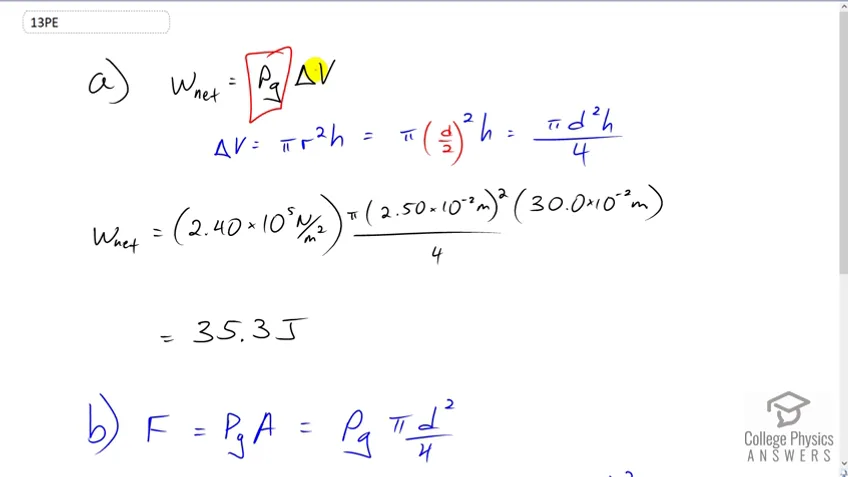 1:37PreviewProblem 13Full video with free trialA hand-driven tire pump has a piston with a 2.50-cm diameter and a maximum stroke of 30.0 cm. (a) How much work do you do in one stroke if the average gauge pressure is (about 35 psi)? (b) What average force do you exert on the piston, neglecting friction and gravitational force?
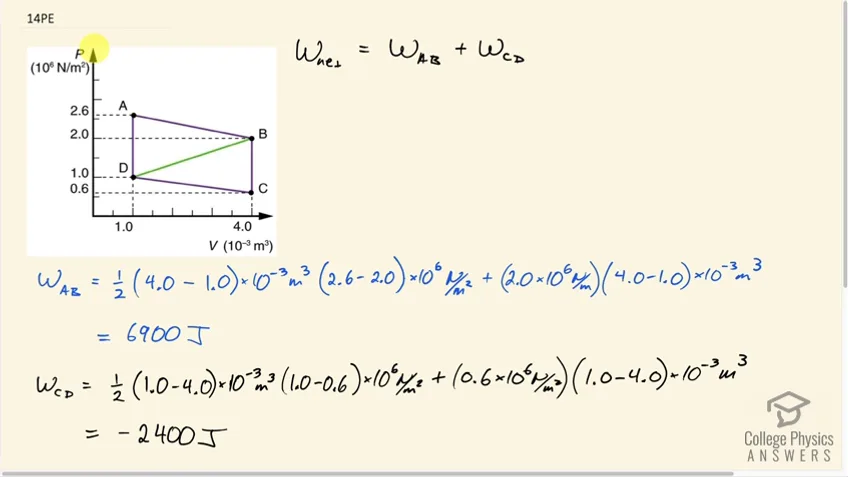 3:25PreviewProblem 14Full video with free trialCalculate the net work output of a heat engine following path ABCDA in the figure below.
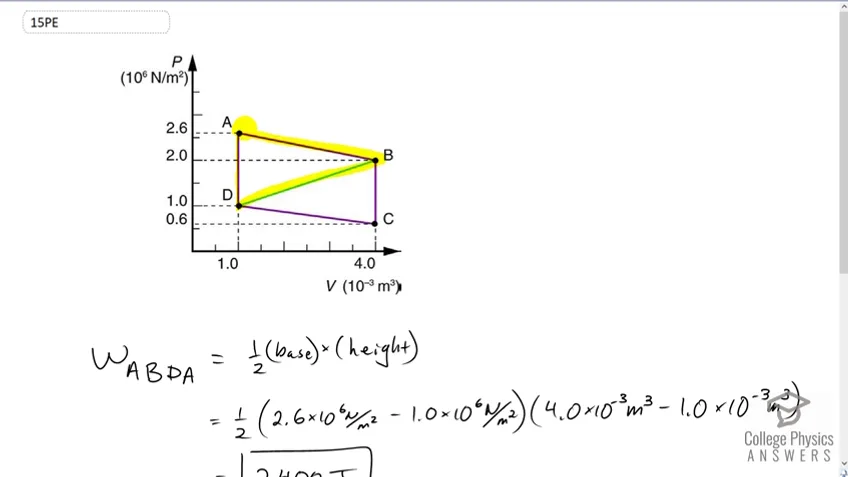 1:53PreviewProblem 15Full video with free trialWhat is the net work output of a heat engine that follows path ABDA in the figure above, with a straight line from B to D? Why is the work output less than for path ABCDA? Explicitly show how you follow the steps in the Problem- Solving Strategies for Thermodynamics.
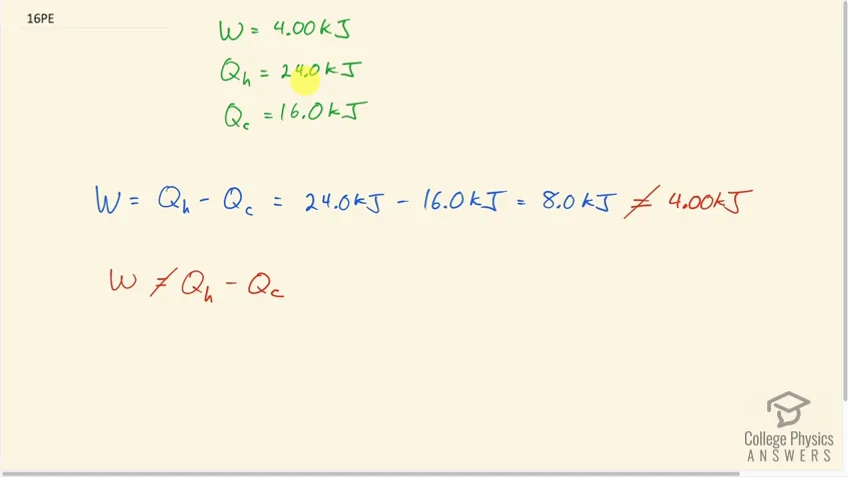 0:54PreviewProblem 16Full video with free trialWhat is wrong with the claim that a cyclical heat engine does 4.00 kJ of work on an input of 24.0 kJ of heat transfer while 16.0 kJ of heat transfers to the environment?
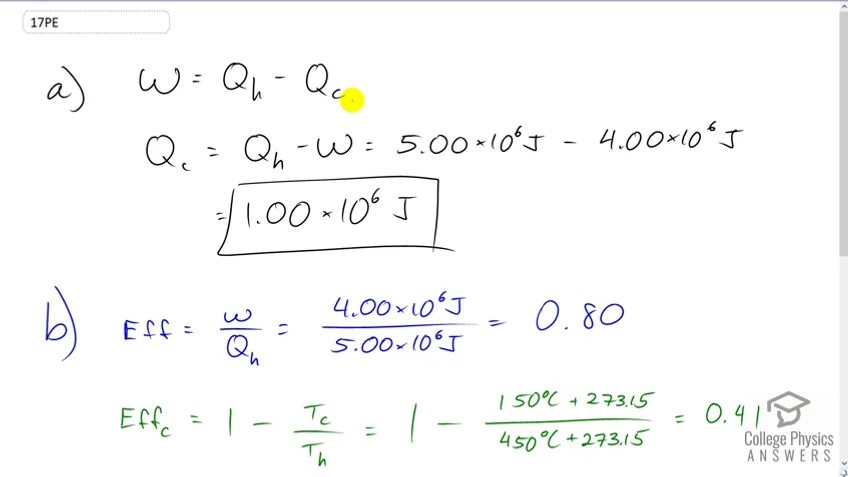 1:44PreviewProblem 17Full video with free trial(a) A cyclical heat engine, operating between temperatures of and produces 4.00 MJ of work on a heat transfer of 5.00 MJ into the engine. How much heat transfer occurs to the environment? (b) What is unreasonable about the engine? (c) Which premise is unreasonable?
15.3 Introduction to the Second Law of Thermodynamics: Heat Engines and Their Efficiency
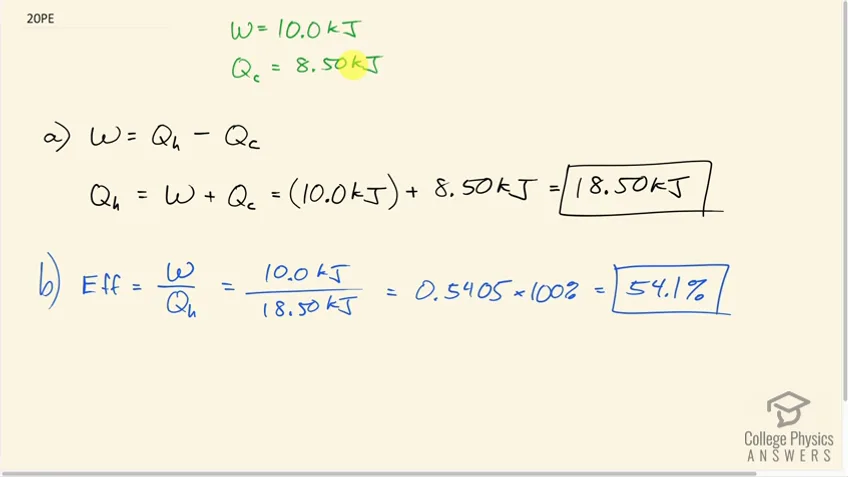 0:58PreviewProblem 20Full video with free trialA certain heat engine does 10.0 kJ of work and 8.50 kJ of heat transfer occurs to the environment in a cyclical process. (a) What was the heat transfer into this engine? (b) What was the engine’s efficiency?
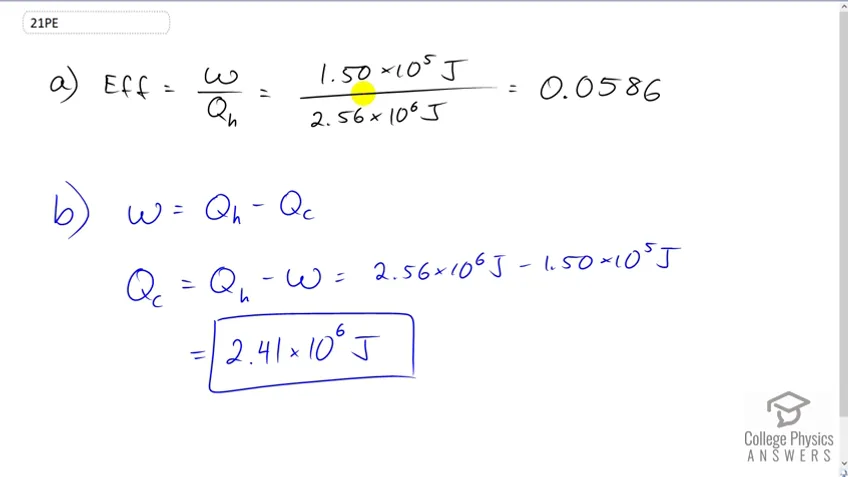 1:06PreviewProblem 21Full video with free trialWith of heat transfer into this engine, a given cyclical heat engine can do only of work. (a) What is the engine's efficiency? (b) How much heat transfer to the environment takes place?
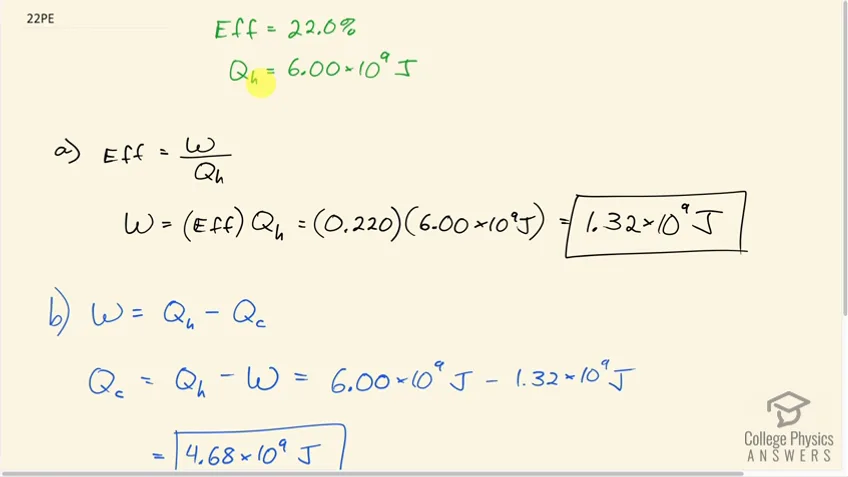 1:00PreviewProblem 22Full video with free trial(a) What is the work output of a cyclical heat engine having a 22.0% efficiency and of heat transfer into the engine? (b) How much heat transfer occurs to the environment?
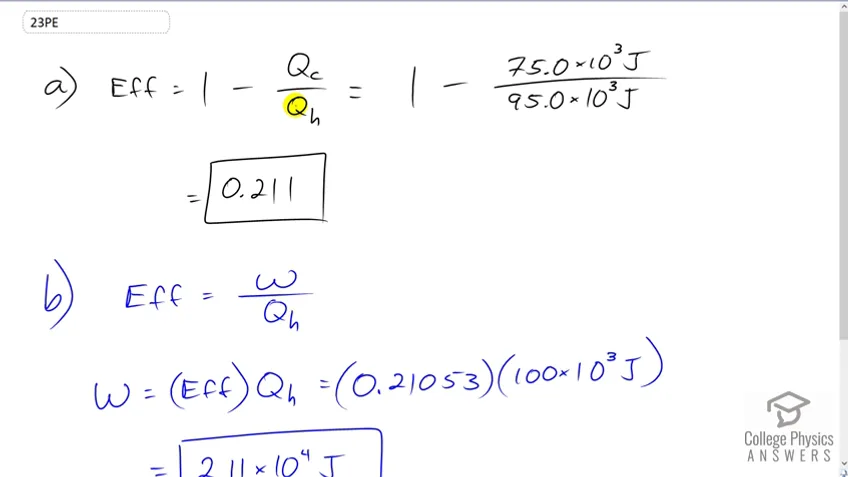 0:53PreviewProblem 23Full video with free trial(a) What is the efficiency of a cyclical heat engine in which 75.0 kJ of heat transfer occurs to the environment for every 95.0 kJ of heat transfer into the engine? (b) How much work does it produce for 100 kJ of heat transfer into the engine?
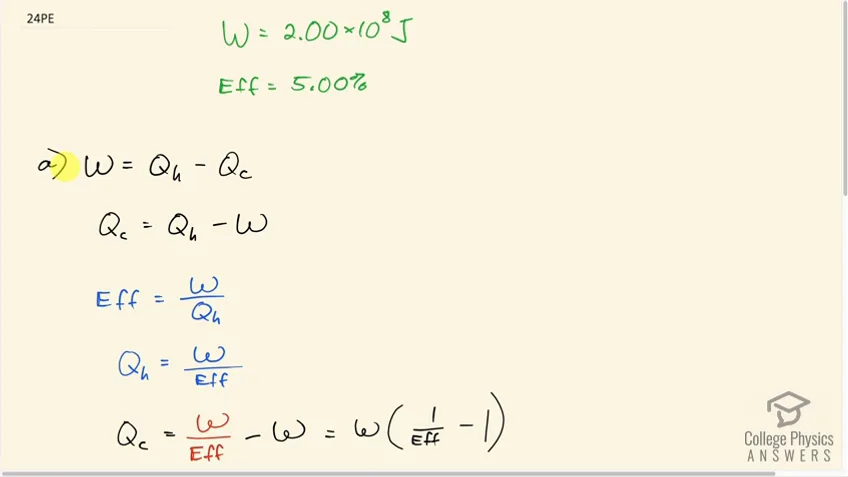 2:03PreviewProblem 24Full video with free trialThe engine of a large ship does of work with an efficiency of 5.00%. (a) How much heat transfer occurs to the environment? (b) How many barrels of fuel are consumed, if each barrel produces of heat transfer when burned?
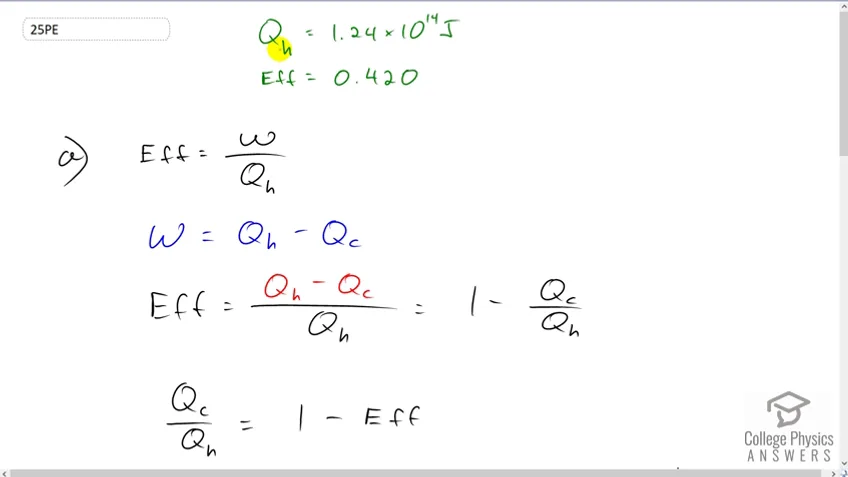 3:43PreviewProblem 25Full video with free trial(a) How much heat transfer occurs to the environment by an electrical power station that uses of heat transfer into the engine with an efficiency of 42.0%? (b) What is the ratio of heat transfer to the environment to work output? (c) How much work is done?
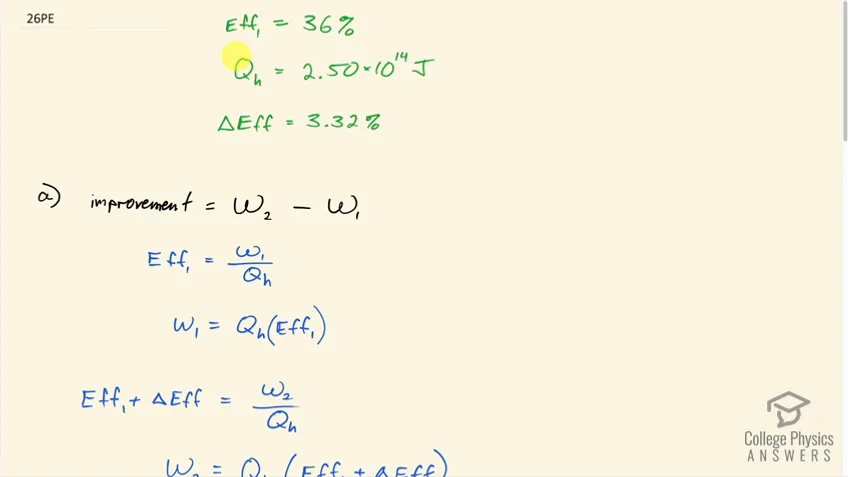 3:45PreviewProblem 26Full video with free trialAssume that the turbines at a coal-powered power plant were upgraded, resulting in an improvement in efficiency of 3.32%. Assume that prior to the upgrade the power station had an efficiency of 36% and that the heat transfer into the engine in one day is still the same at . (a) How much more electrical energy is produced due to the upgrade? (b) How much less heat transfer occurs to the environment due to the upgrade?
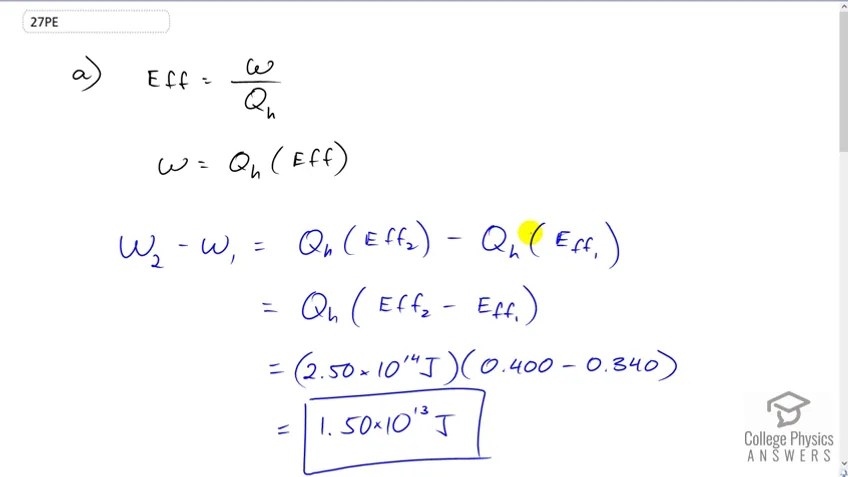 3:46PreviewProblem 27Full video with free trialThis problem compares the energy output and heat transfer to the environment by two different types of nuclear power stations—one with the normal efficiency of 34.0%, and another with an improved efficiency of 40.0%. Suppose both have the same heat transfer into the engine in one day, . (a) How much more electrical energy is produced by the more efficient power station? (b) How much less heat transfer occurs to the environment by the more efficient power station? (One type of more efficient nuclear power station, the gas-cooled reactor, has not been reliable enough to be economically feasible in spite of its greater efficiency.)
15.4 Carnot's Perfect Heat Engine: The Second Law of Thermodynamics Restated
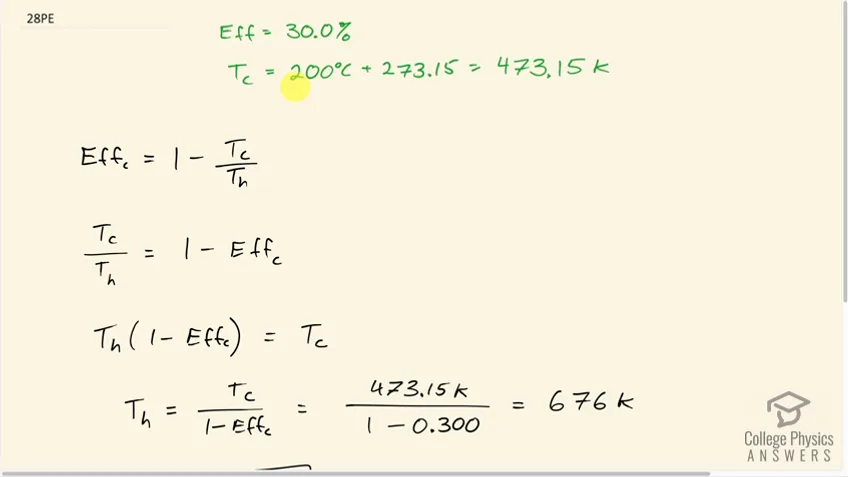 1:45PreviewProblem 28Full video with free trialA certain gasoline engine has an efficiency of 30.0%. What would the hot reservoir temperature be for a Carnot engine having that efficiency, if it operates with a cold reservoir temperature of ?
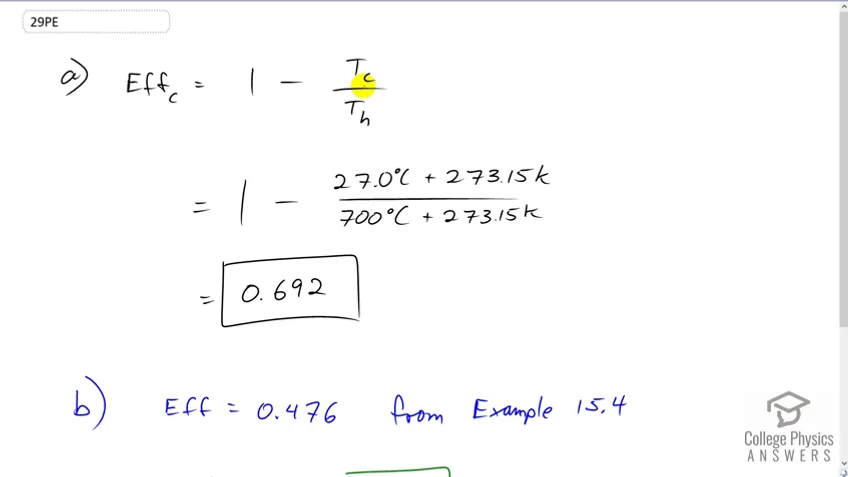 0:46PreviewProblem 29Full video with free trialA gas-cooled nuclear reactor operates between hot and cold reservoir temperatures of and . (a) What is the maximum efficiency of a heat engine operating between these temperatures? (b) Find the ratio of this efficiency to the Carnot efficiency of a standard nuclear reactor (found in Example 15.4).
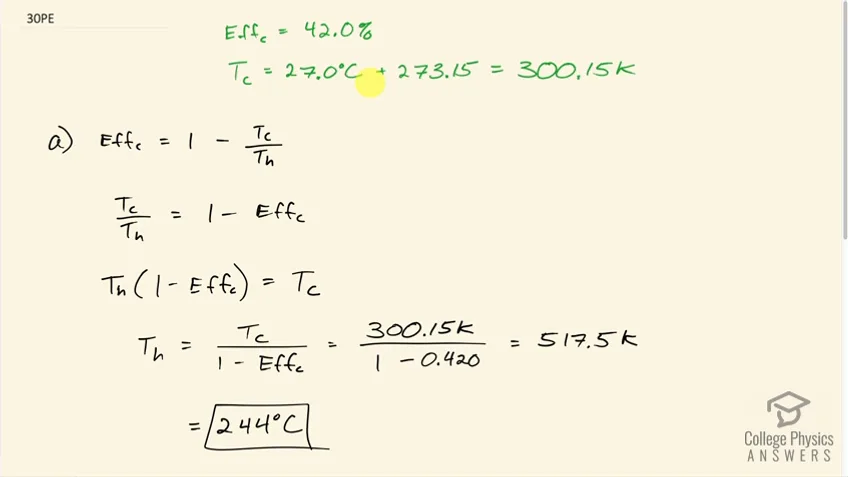 2:28PreviewProblem 30Full video with free trial(a) What is the hot reservoir temperature of a Carnot engine that has an efficiency of 42.0% and a cold reservoir temperature of ? (b) What must the hot reservoir temperature be for a real heat engine that achieves 0.700 of the maximum efficiency, but still has an efficiency of 42.0% (and a cold reservoir at )? (c) Does your answer imply practical limits to the efficiency of car gasoline engines?
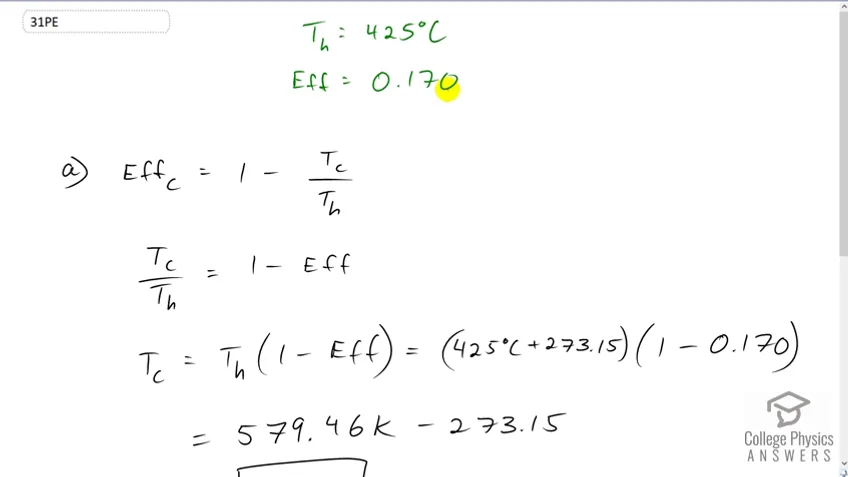 1:56PreviewProblem 31Full video with free trialSteam locomotives have an efficiency of 17.0% and operate with a hot steam temperature of . (a) What would the cold reservoir temperature be if this were a Carnot engine? (b) What would the maximum efficiency of this steam engine be if its cold reservoir temperature were ?
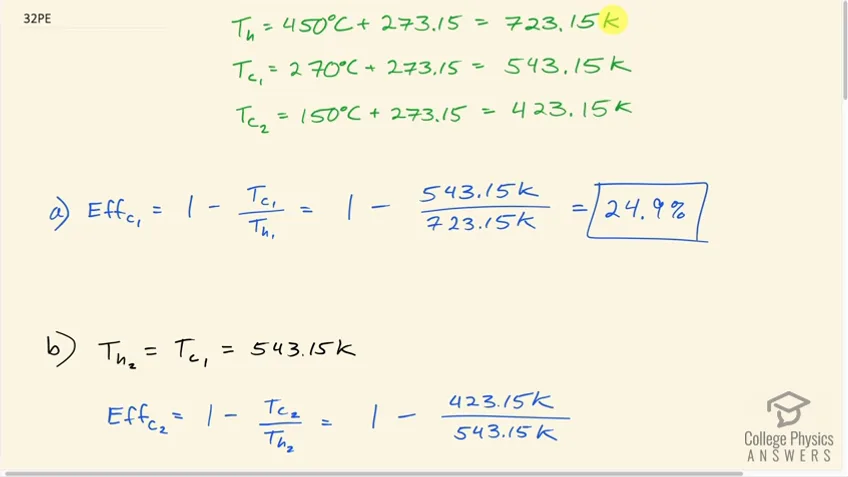 6:38PreviewProblem 32Full video with free trialPractical steam engines utilize steam, which is later exhausted at . (a) What is the maximum efficiency that such a heat engine can have? (b) Since steam is still quite hot, a second steam engine is sometimes operated using the exhaust of the first. What is the maximum efficiency of the second engine if its exhaust has a temperature of ? (c) What is the overall efficiency of the two engines? (d) Show that this is the same efficiency as a single Carnot engine operating between and . Explicitly show how you follow the steps in the Problem-Solving Strategies for Thermodynamics.
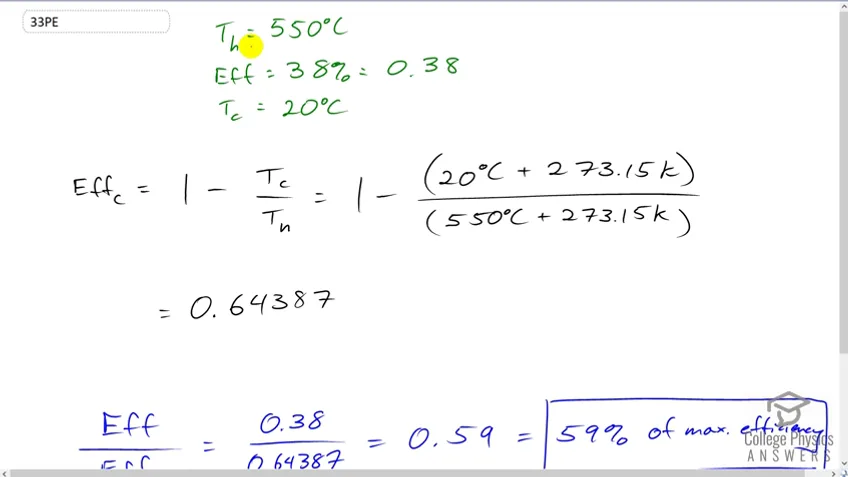 1:10PreviewProblem 33Full video with free trialA coal-fired electrical power station has an efficiency of 38%. The temperature of the steam leaving the boiler is . What percentage of the maximum efficiency does this station obtain? (Assume the temperature of the environment is .)
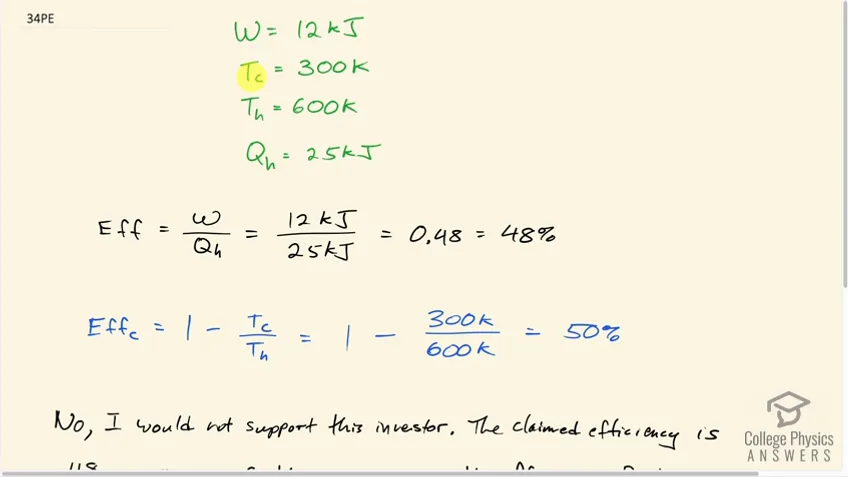 0:57PreviewProblem 34Full video with free trialWould you be willing to financially back an inventor who is marketing a device that she claims has 25 kJ of heat transfer at 600 K, has heat transfer to the environment at 300 K, and does 12 kJ of work? Explain your answer.
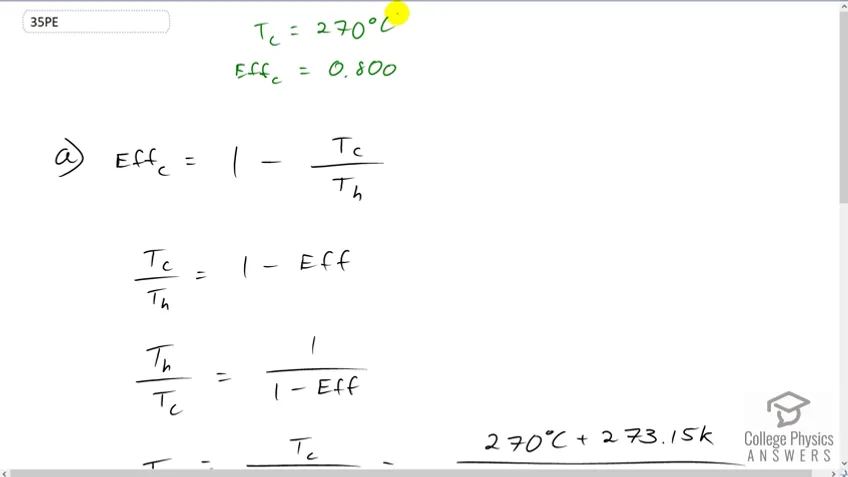 3:01PreviewProblem 35Full video with free trial(a) Suppose you want to design a steam engine that has heat transfer to the environment at and has a Carnot efficiency of 0.800. What temperature of hot steam must you use? (b) What is unreasonable about the temperature? (c) Which premise is unreasonable?
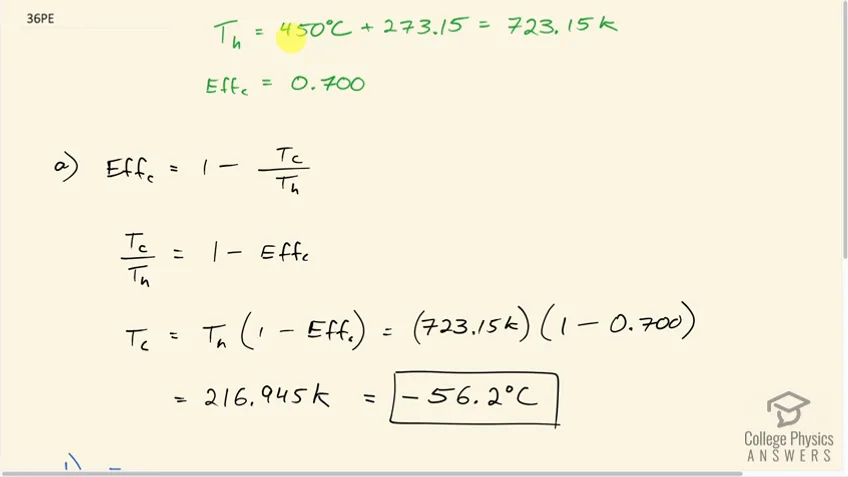 1:21PreviewProblem 36Full video with free trialCalculate the cold reservoir temperature of a steam engine that uses hot steam at and has a Carnot efficiency of 0.700. (b) What is unreasonable about the temperature? (c) Which premise is unreasonable?
15.5 Applications of Thermodynamics: Heat Pumps and Refrigerators
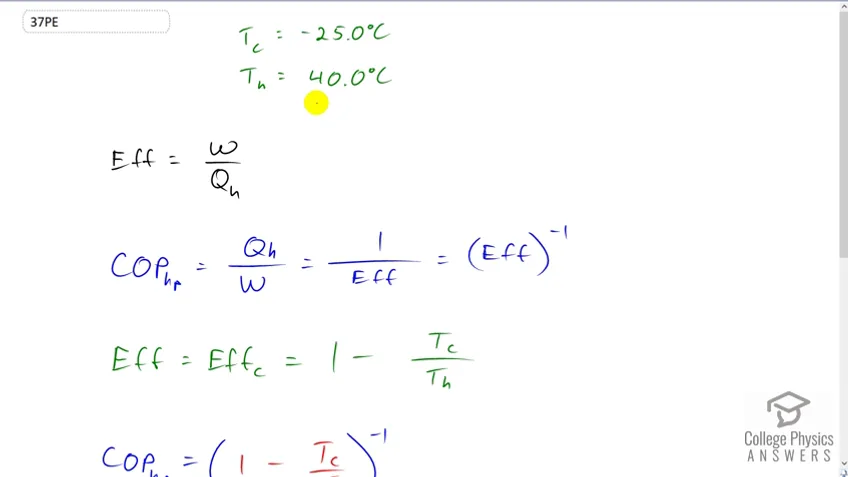 1:22PreviewProblem 37Full video with free trialWhat is the coefficient of performance of an ideal heat pump that has heat transfer from a cold temperature of to a hot temperature of ?
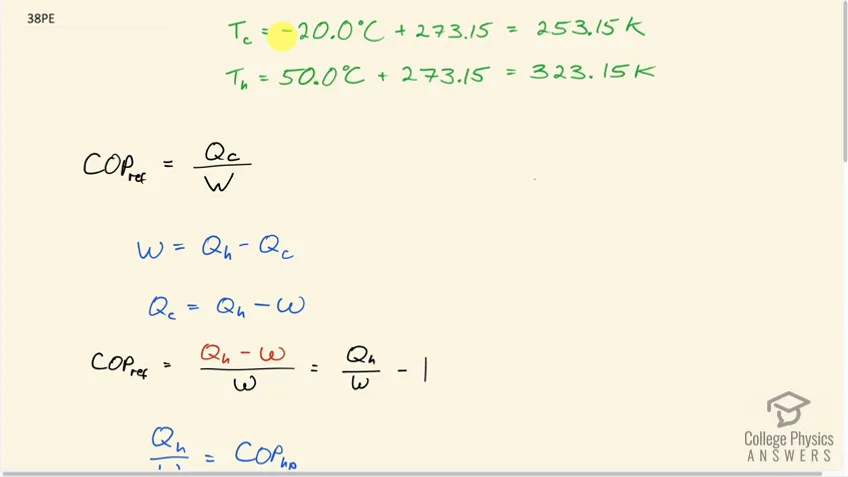 4:23PreviewProblem 38Full video with free trialSuppose you have an ideal refrigerator that cools an environment at and has heat transfer to another environment at . What is its coefficient of performance?
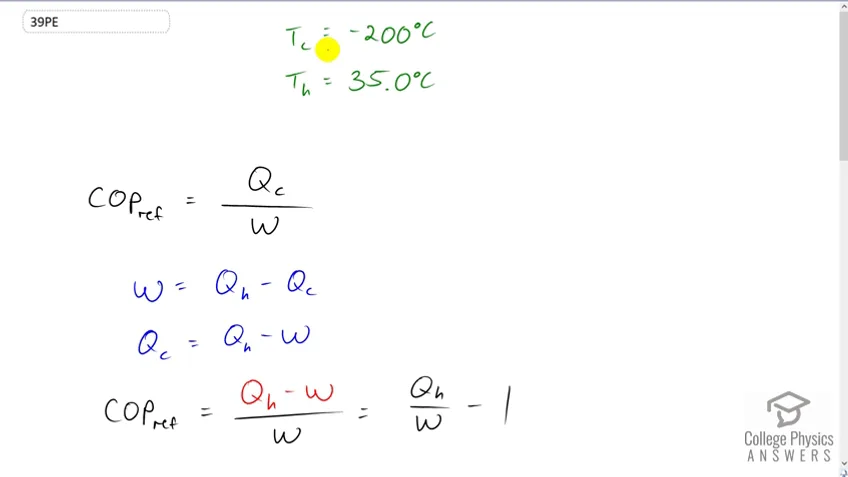 4:55PreviewProblem 39Full video with free trialWhat is the best coefficient of performance possible for a hypothetical refrigerator that could make liquid nitrogen at and has heat transfer to the environment at ?
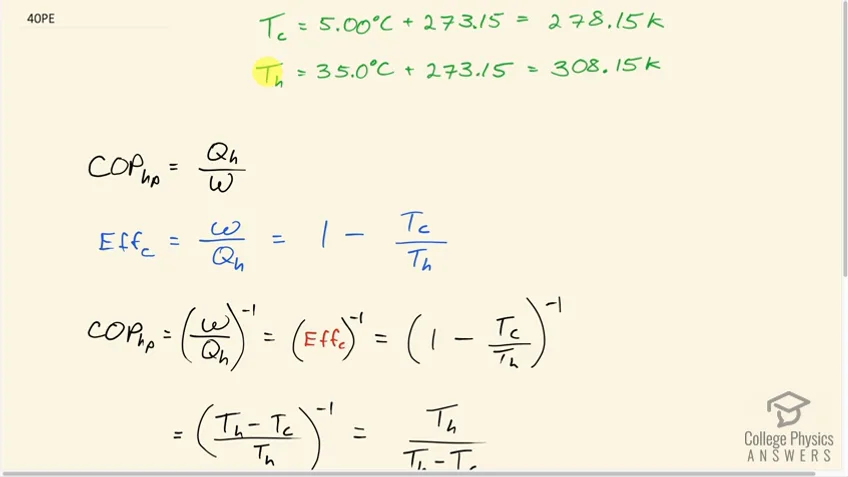 1:36PreviewProblem 40Full video with free trialIn a very mild winter climate, a heat pump has heat transfer from an environment at to one at . What is the best possible coefficient of performance for these temperatures? Explicitly show how you follow the steps in the Problem-Solving Strategies for Thermodynamics.
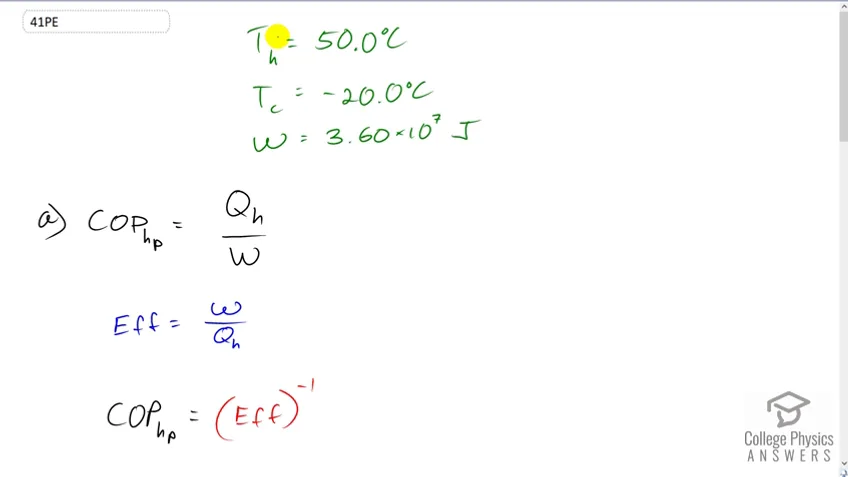 4:13PreviewProblem 41Full video with free trial(a) What is the best coefficient of performance for a heat pump that has a hot reservoir temperature of and a cold reservoir temperature of ? (b) How much heat transfer occurs into the warm environment if of work () is put into it? (c) If the cost of this work input is , how does its cost compare with the direct heat transfer achieved by burning natural gas at a cost of 85.0 cents per therm. (A therm is a common unit of energy for natural gas and equals .)
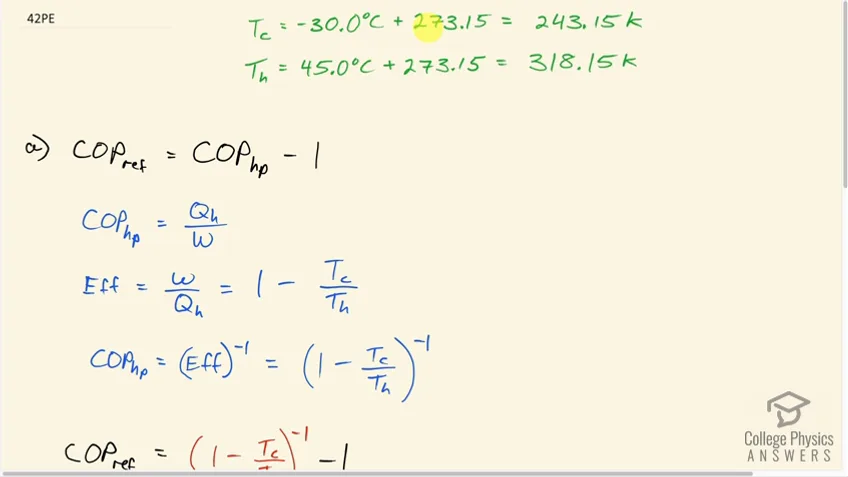 3:02PreviewProblem 42Full video with free trial(a) What is the best coefficient of performance for a refrigerator that cools an environment at and has heat transfer to another environment at ? (b) How much work in joules must be done for a heat transfer of 4186 kJ from the cold environment? (c) What is the cost of doing this if the work costs 10.0 cents per (a kilowatt-hour)? (d) How many kJ of heat transfer occurs into the warm environment? (e) Discuss what type of refrigerator might operate between these temperatures.
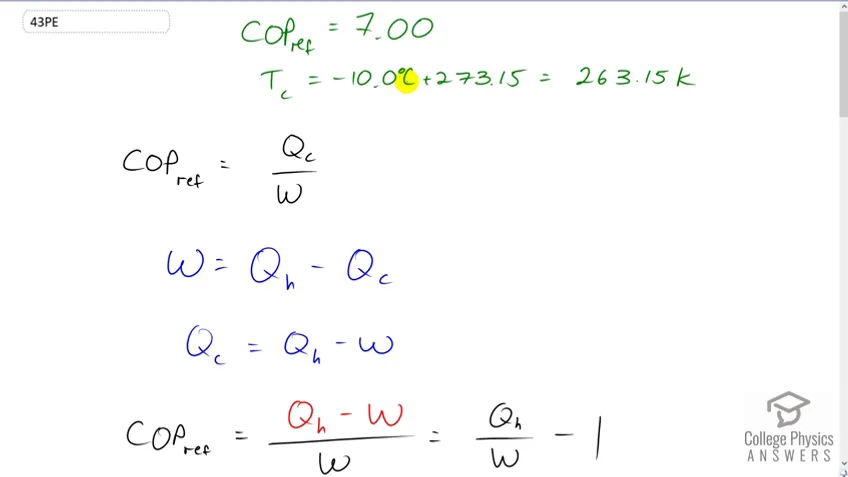 4:16PreviewProblem 43Full video with free trialSuppose you want to operate an ideal refrigerator with a cold temperature of , and you would like it to have a coefficient of performance of 7.00. What is the hot reservoir temperature for such a refrigerator?
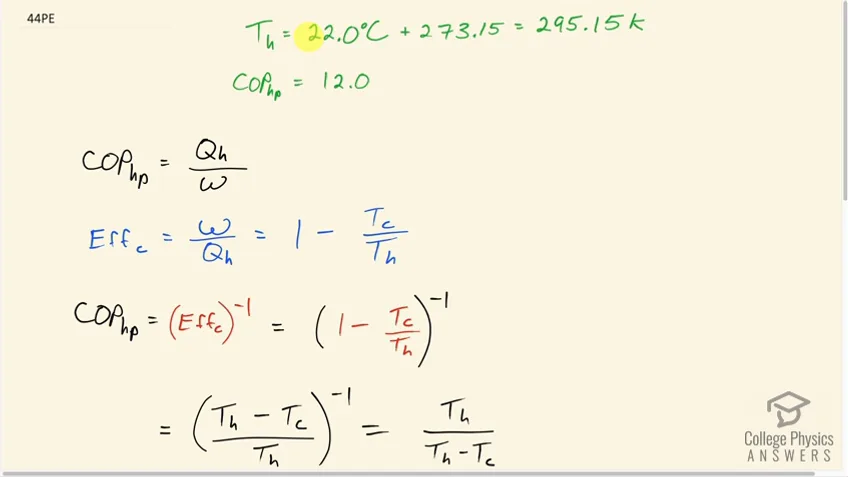 2:58PreviewProblem 44Full video with free trialAn ideal heat pump is being considered for use in heating an environment with a temperature of . What is the cold reservoir temperature if the pump is to have a coefficient of performance of 12.0?
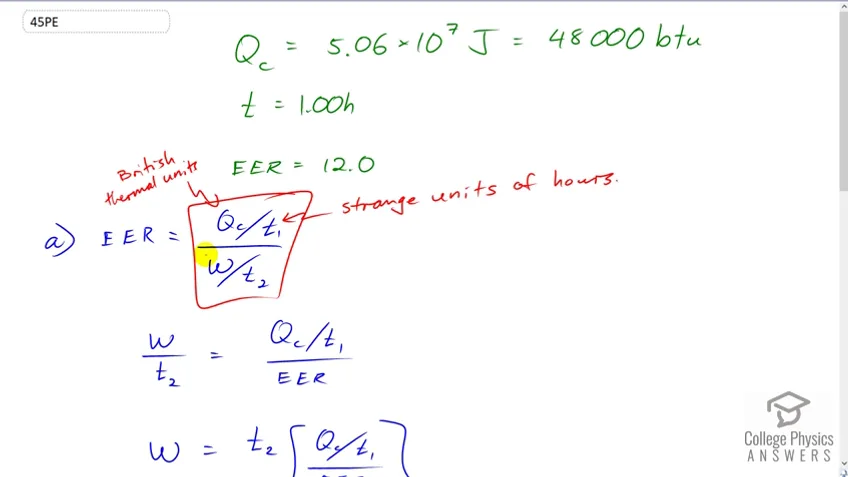 2:59PreviewProblem 45Full video with free trialA 4-ton air conditioner removes (48,000 British thermal units) from a cold environment in 1.00 h. (a) What energy input in joules is necessary to do this if the air conditioner has an energy efficiency rating (EER) of 12.0? (b) What is the cost of doing this if the work costs 10.0 cents per (one kilowatt-hour)? (c) Discuss whether this cost seems realistic. Note that the energy efficiency rating (EER) of an air conditioner or refrigerator is defined to be the number of British thermal units of heat transfer from a cold environment per hour divided by the watts of power input.
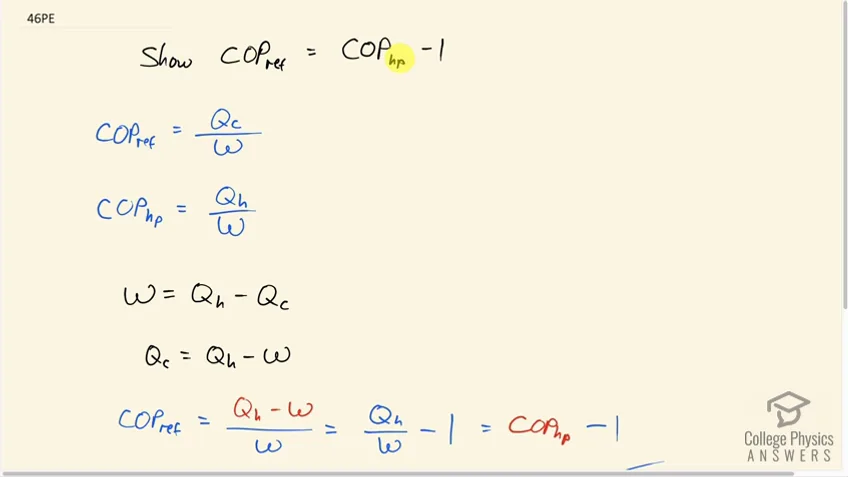 1:20PreviewProblem 46Full video with free trialShow that the coefficients of performance of refrigerators and heat pumps are related by $\textrm{COP}\textrm{ref} = \textrm{COP}\textrm{hp}-1$. Start with the definitions of the 's and the conservation of energy relationship between , , and .
15.6 Entropy and the Second Law of Thermodynamics
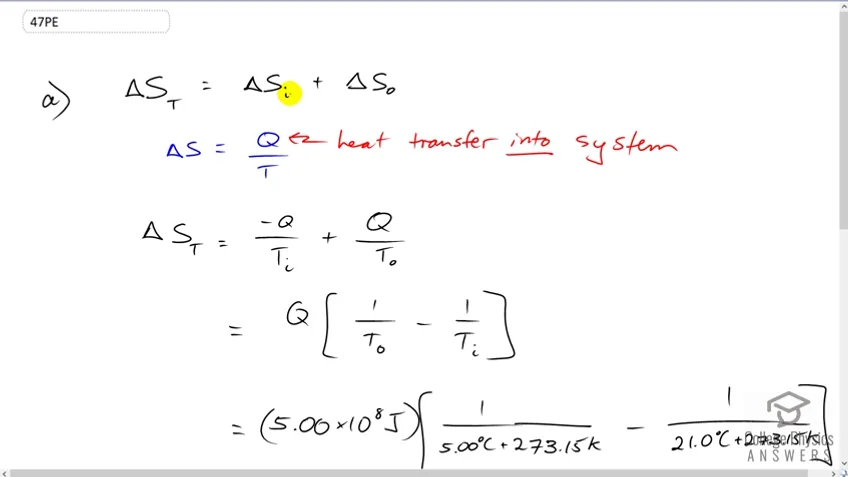 2:53PreviewProblem 47Full video with free trial(a) On a winter day, a certain house loses of heat to the outside (about 500,000 Btu). What is the total change in entropy due to this heat transfer alone, assuming an average indoor temperature of and an average outdoor temperature of ? (b) This large change in entropy implies a large amount of energy has become unavailable to do work. Where do we find more energy when such energy is lost to us?
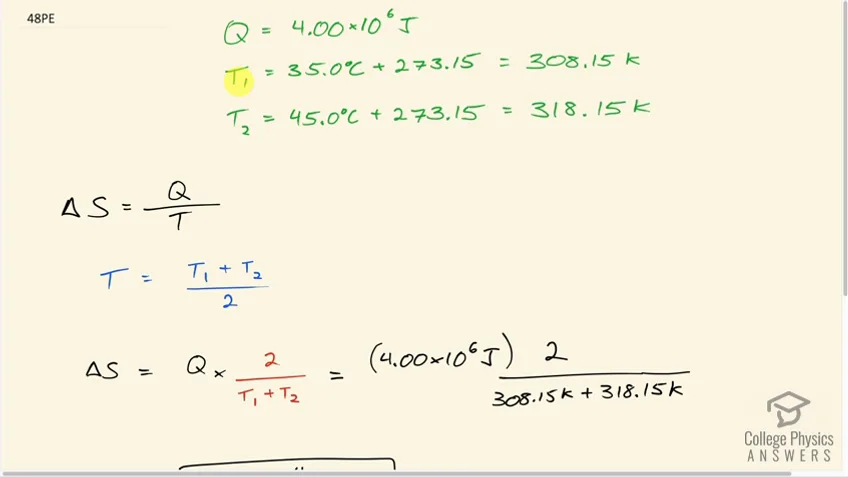 1:01PreviewProblem 48Full video with free trialOn a hot summer day, of heat transfer into a parked car takes place, increasing its temperature from to . What is the increase in entropy of the car due to this heat transfer alone?
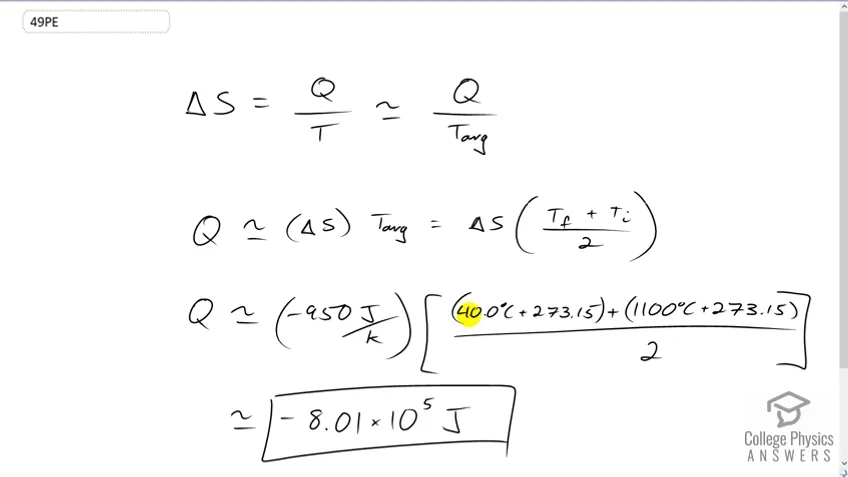 1:31PreviewProblem 49Full video with free trialA hot rock ejected from a volcano's lava fountain cools from to , and its entropy decreases by 950 J/K. How much heat transfer occurs from the rock?
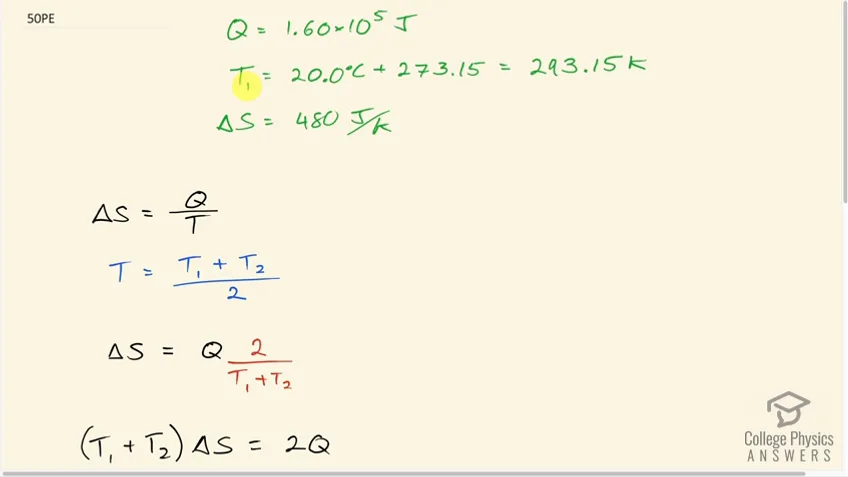 2:03PreviewProblem 50Full video with free trialWhen of heat transfer occurs into a meat pie initially at , its entropy increases by 480 J/K. What is its final temperature?
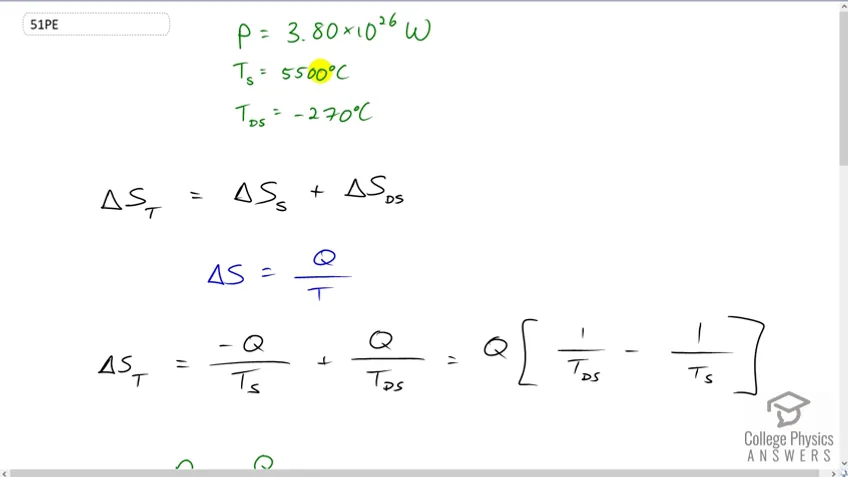 2:45PreviewProblem 51Full video with free trialThe Sun radiates energy at the rate of from its surface into dark empty space (a negligible fraction radiates onto Earth and the other planets). The effective temperature of deep space is . (a) What is the increase in entropy in one day due to this heat transfer? (b) How much work is made unavailable?
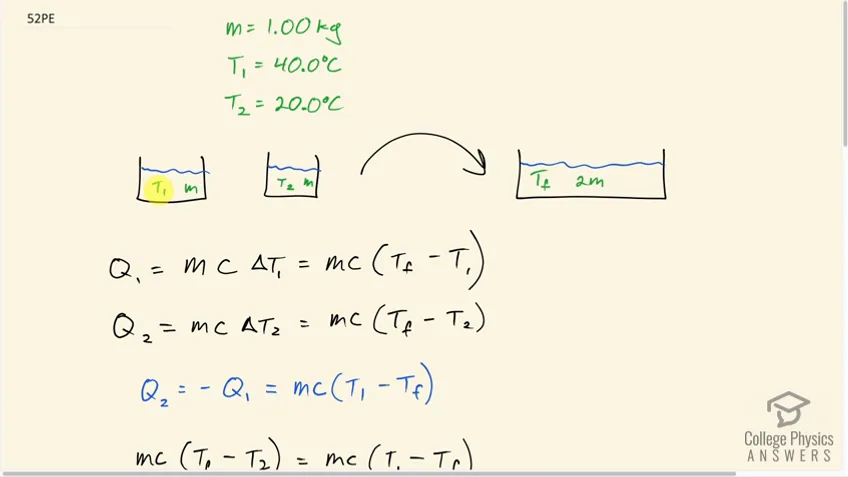 4:32PreviewProblem 52Full video with free trial(a) In reaching equilibrium, how much heat transfer occurs from 1.00 kg of water at when it is placed in contact with 1.00 kg of water in reaching equilibrium? (b) What is the change in entropy due to this heat transfer? (c) How much work is made unavailable, taking the lowest temperature to be ? Explicitly show how you follow the steps in the Problem-Solving Strategies for Entropy.
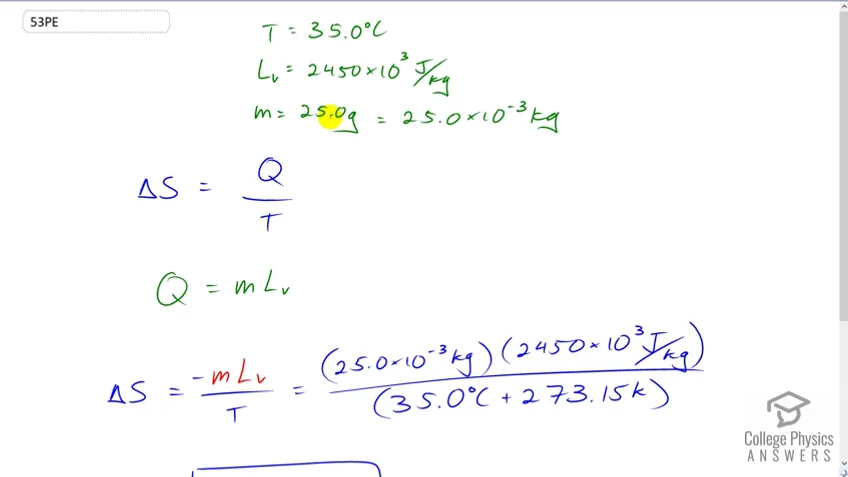 1:28PreviewProblem 53Full video with free trialWhat is the decrease in entropy of 25.0 g of water that condenses on a bathroom mirror at a temperature of , assuming no change in temperature and given the latent heat of vaporization to be 2450 kJ/kg?
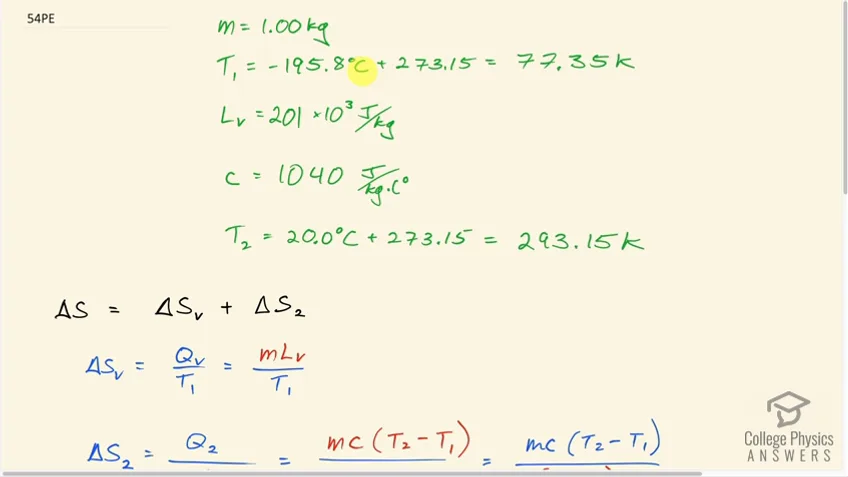 2:30PreviewProblem 54Full video with free trialFind the increase in entropy of 1.00 kg of liquid nitrogen that starts at its boiling temperature, boils, and warms to at constant pressure.
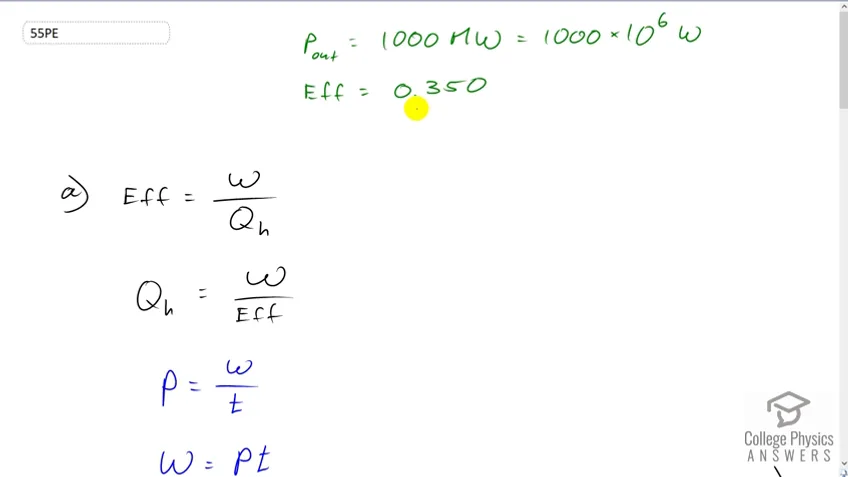 5:13PreviewProblem 55Full video with free trialA large electrical power station generates 1000 MW of electricity with an efficiency of 35.0%. (a) Calculate the heat transfer to the power station, , in one day. (b) How much heat transfer occurs to the environment in one day? (c) If the heat transfer in the cooling towers is from water into the local air mass, which increases in temperature from to , what is the total increase in entropy due to this heat transfer? (d) How much energy becomes unavailable to do work because of this increase in entropy, assuming an lowest temperature? (Part of could be utilized to operate heat engines or for simply heating the surroundings, but it rarely is.)
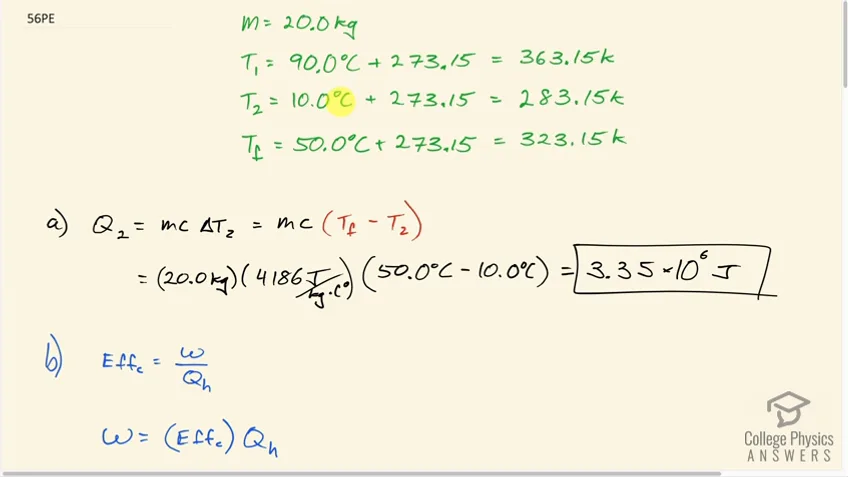 5:39PreviewProblem 56Full video with free trial(a) How much heat transfer occurs from 20.0 kg of water placed in contact with 20.0 kg of water, producing a final temperature of ? (b) How much work could a Carnot engine do with this heat transfer, assuming it operates between two reservoirs at constant temperatures of and ? (c) What increase in entropy is produced by mixing 20.0 kg of water with 20.0 kg of water? (d) Calculate the amount of work made unavailable by this mixing using a low temperature of , and compare it with the work done by the Carnot engine. Explicitly show how you follow the steps in the Problem-Solving Strategies for Entropy. (e) Discuss how everyday processes make increasingly more energy unavailable to do work, as implied by this problem.
15.7 Statistical Interpretation of Entropy and the Second Law of Thermodynamics: The Underlying Explanation
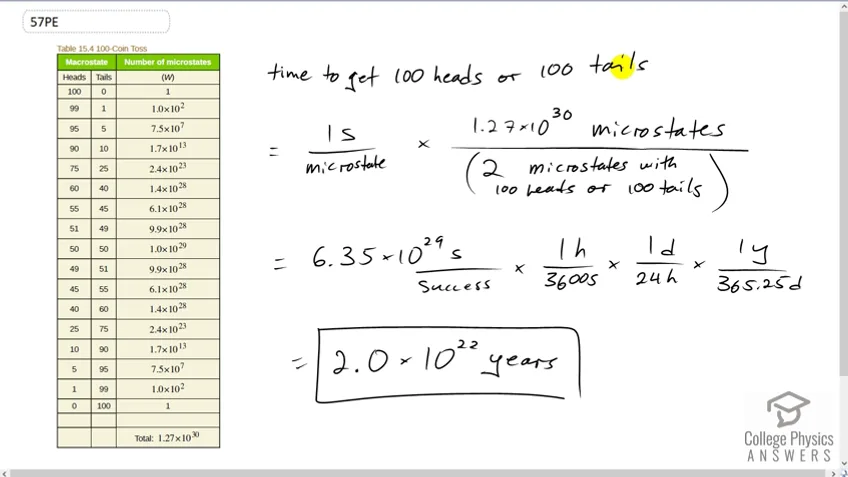 2:00PreviewProblem 57Full video with free trialUsing Table 15.4, verify the contention that if you toss 100 coins each second, you can expect to get 100 heads or 100 tails once in ; calculate the time to two- digit accuracy.
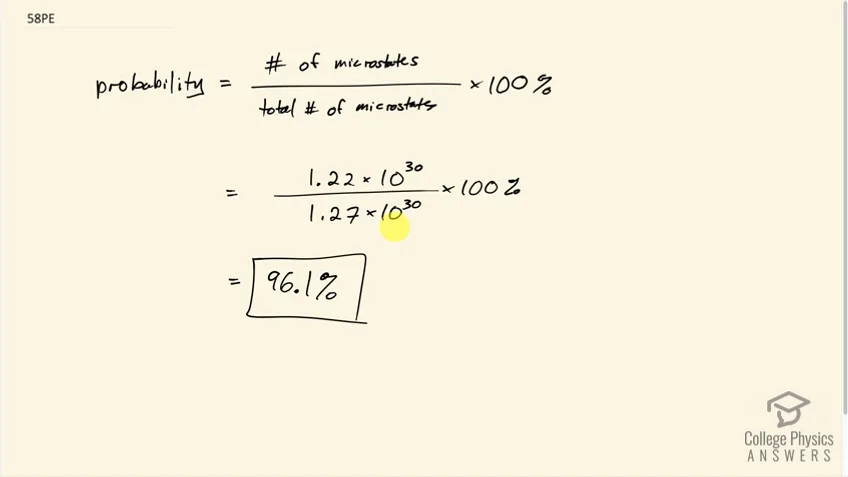 0:33PreviewProblem 58Full video with free trialWhat percent of the time will you get something in the range from 60 heads and 40 tails through 40 heads and 60 tails when tossing 100 coins? The total number of microstates in that range is . (Consult Table 15.4.)
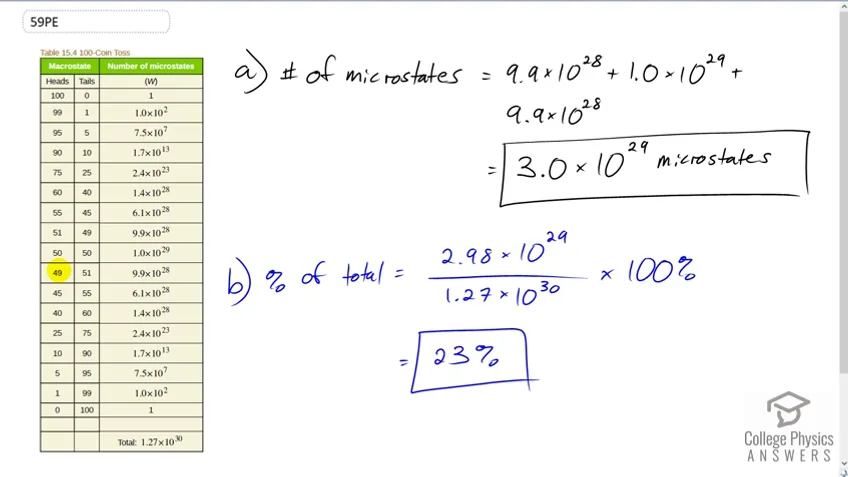 1:04PreviewProblem 59Full video with free trial(a) If tossing 100 coins, how many ways (microstates) are there to get the three most likely macrostates of 49 heads and 51 tails, 50 heads and 50 tails, and 51 heads and 49 tails? (b) What percent of the total possibilities is this? (Consult Table 15.4.)
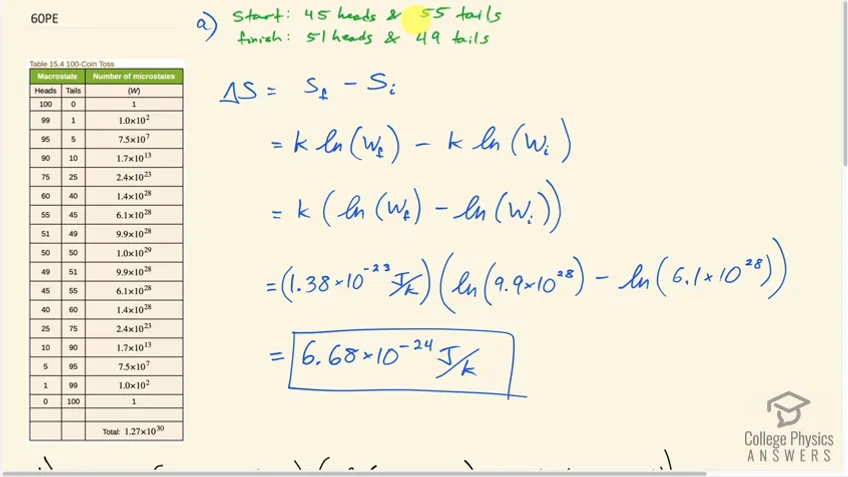 3:25PreviewProblem 60Full video with free trial(a) What is the change in entropy if you start with 100 coins in the 45 heads and 55 tails macrostate, toss them, and get 51 heads and 49 tails? (b) What if you get 75 heads and 25 tails? (c) How much more likely is 51 heads and 49 tails than 75 heads and 25 tails? (d) Does either outcome violate the second law of thermodynamics?
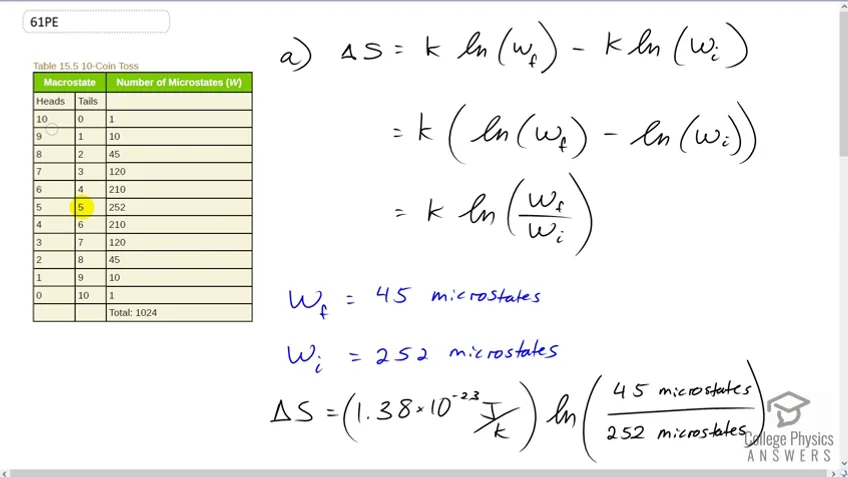 5:12PreviewProblem 61Full video with free trial(a) What is the change in entropy if you start with 10 coins in the 5 heads and 5 tails macrostate, toss them, and get 2 heads and 8 tails? (b) How much more likely is 5 heads and 5 tails than 2 heads and 8 tails? (Take the ratio of the number of microstates to find out.) (c) If you were betting on 2 heads and 8 tails would you accept odds of 252 to 45? Explain why or why not.
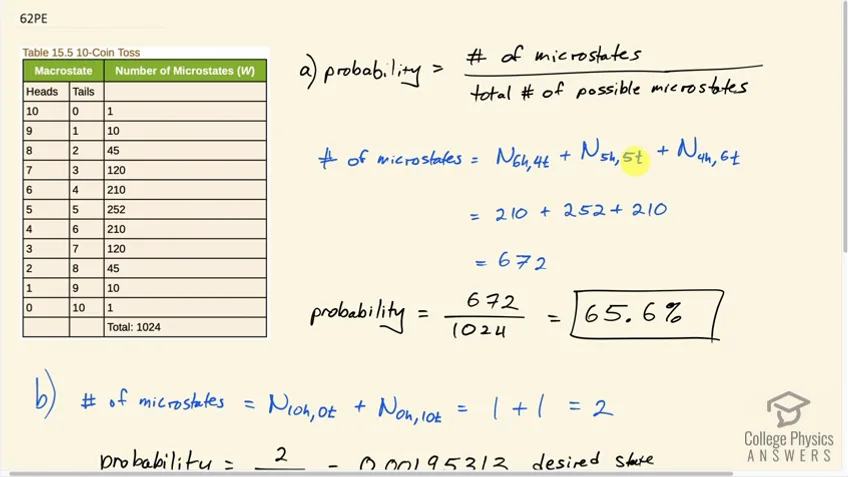 2:05PreviewProblem 62Full video with free trial(a) If you toss 10 coins, what percent of the time will you get the three most likely macrostates (6 heads and 4 tails, 5 heads and 5 tails, 4 heads and 6 tails)? (b) You can realistically toss 10 coins and count the number of heads and tails about twice a minute. At that rate, how long will it take on average to get either 10 heads and 0 tails or 0 heads and 10 tails?
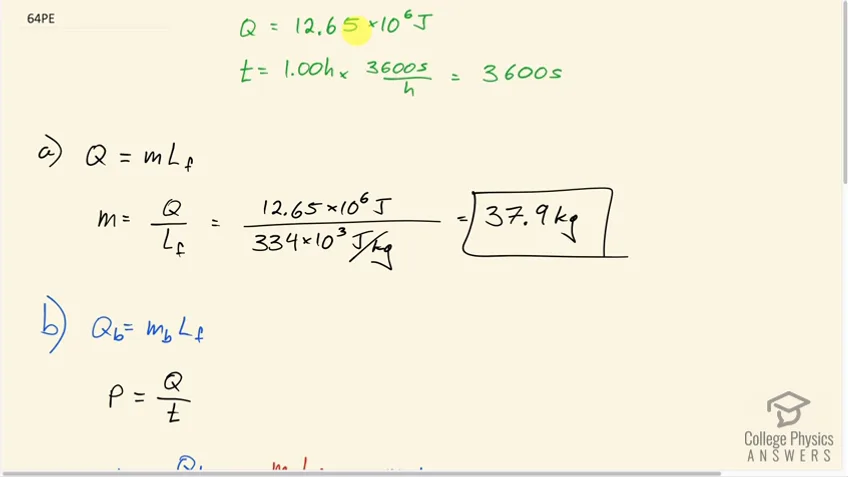 3:46PreviewProblem 64Full video with free trialIn an air conditioner, 12.65 MJ of heat transfer occurs from a cold environment in 1.00 h. (a) What mass of ice melting would involve the same heat transfer? (b) How many hours of operation would be equivalent to melting 900 kg of ice? (c) If ice costs 20 cents per kg, do you think the air conditioner could be operated more cheaply than by simply using ice? Describe in detail how you evaluate the relative costs.
Test Prep for AP® Courses
15.1 The First Law of Thermodynamics
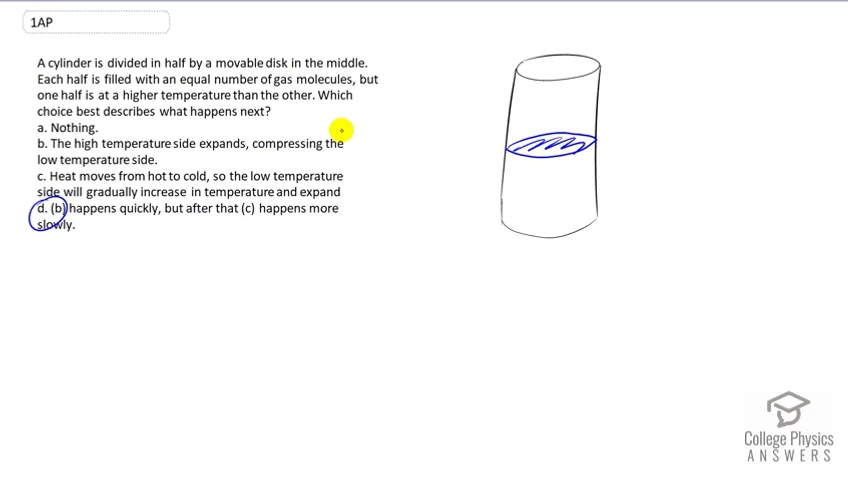 1:07PreviewProblem 1Full video with free trialA cylinder is divided in half by a movable disk in the middlEach half is filled with an equal number of gas molecules, but one half is at a higher temperature than the other. Which choice best describes what happens next?
(a) Nothing.
(b) The high temperature side expands, compressing the low temperature side.
(c) Heat moves from hot to cold, so the low temperature. side will gradually increase in temperature and expand
(d) (b) happens quickly, but after that (c) happens more slowly.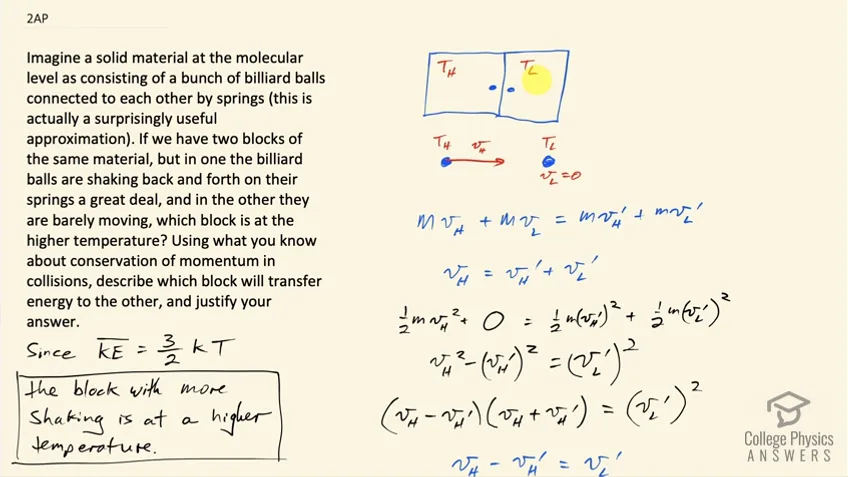 5:00PreviewProblem 2Full video with free trialImagine a solid material at the molecular level as consisting of a bunch of billiard balls connected to each other by springs (this is actually a surprisingly useful approximation). If we have two blocks of the same material, but in one the billiard balls are shaking back and forth on their springs a great deal, and in the other they are barely moving, which block is at the higher temperature? Using what you know about conservation of momentum in collisions, describe which block will transfer energy to the other, and justify your answer.
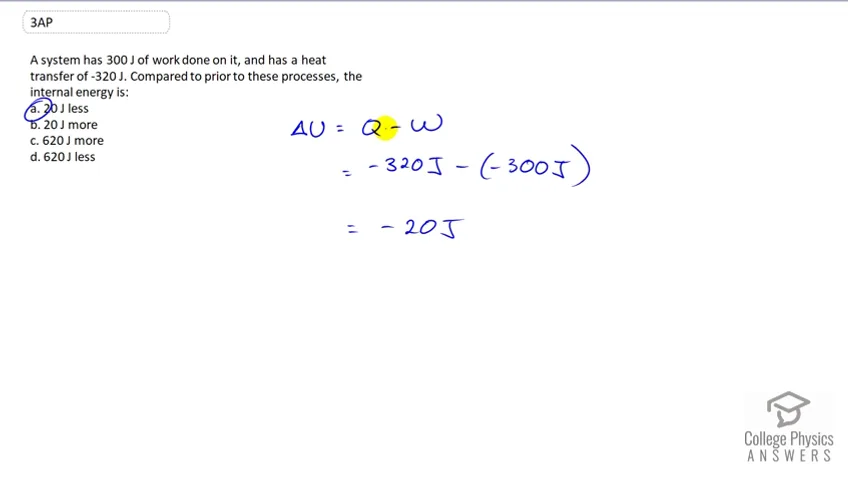 0:43PreviewProblem 3Full video with free trialA system has 300 J of work done on it, and has a heat transfer of -320 J. Compared to prior to these processes, the internal energy is: (a) 20 J less
(b) 20 J more
(c) 620 J more
(d) 620 J less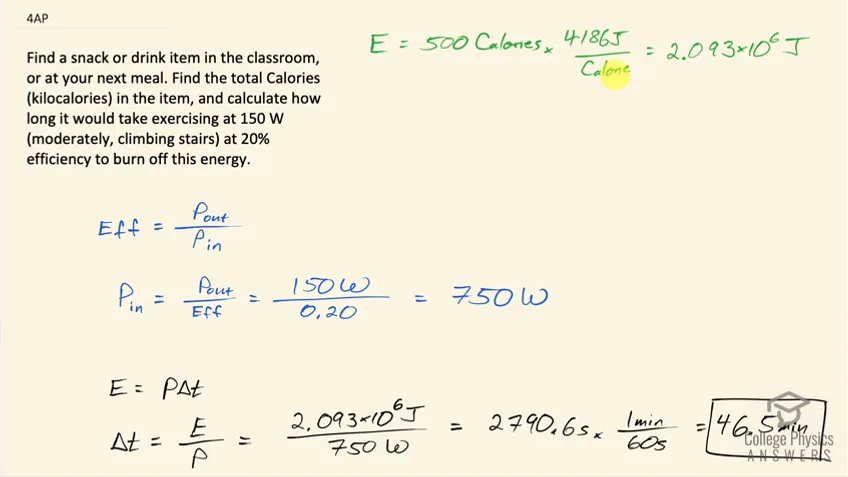 1:34PreviewProblem 4Full video with free trialFind a snack or drink item in the classroom, or at your next meal. Find the total Calories (kilocalories) in the item, and calculate how long it would take exercising at 150 W (moderately, climbing stairs) at 20% efficiency to burn off this energy.
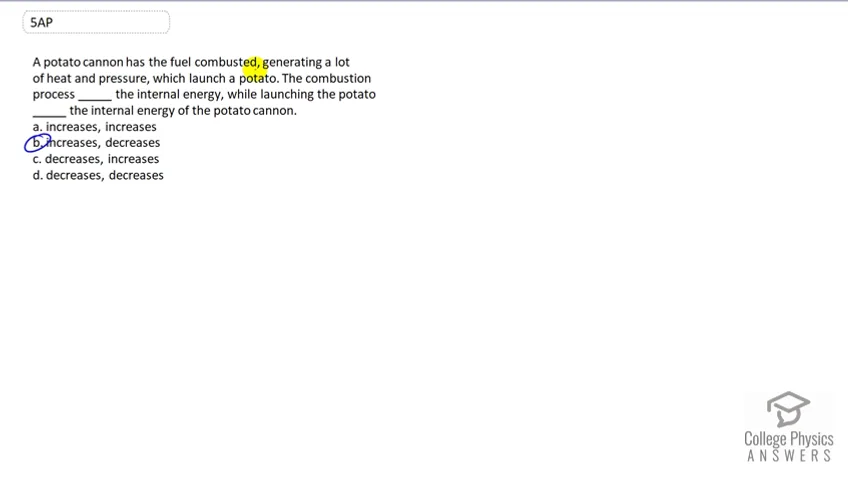 0:44PreviewProblem 5Full video with free trialA potato cannon has the fuel combusted, generating a lot of heat and pressure, which launch a potato. The combustion process _____ the internal energy, while launching the potato _____ the internal energy of the potato cannon. (a) increases, increases
(b) increases, decreases
(c) decreases, increases
(d) decreases, decreases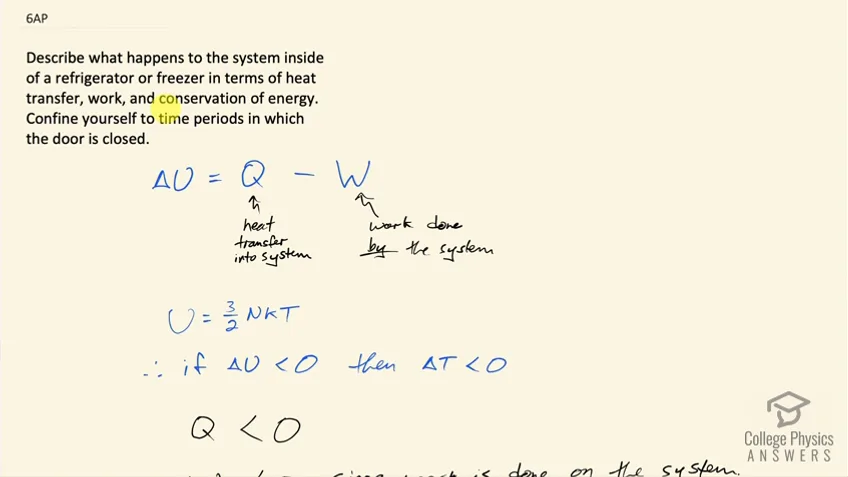 2:48PreviewProblem 6Full video with free trialDescribe what happens to the system inside of a refrigerator or freezer in terms of heat transfer, work, and conservation of energy. Confine yourself to time periods in which the door is closed.
15.2 The First Law of Thermodynamics and Some Simple Processes
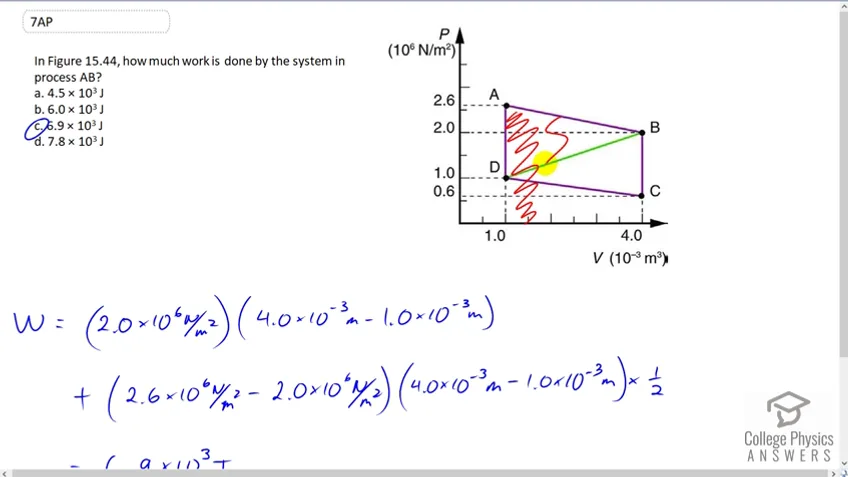 1:27PreviewProblem 7Full video with free trialIn Figure 15.44, how much work is done by the system in process AB? (a)
(b)
(c)
(d)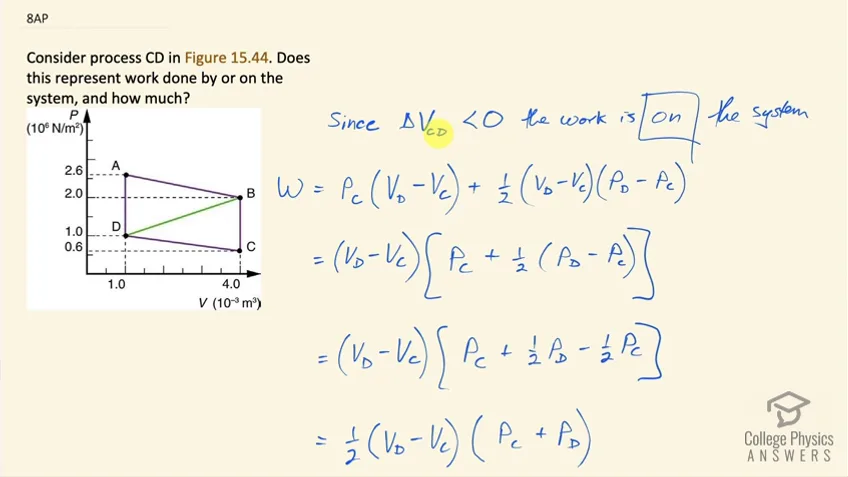 2:13PreviewProblem 8Full video with free trialConsider process CD in Figure 15.44. Does this represent work done by or on the system, and how much?
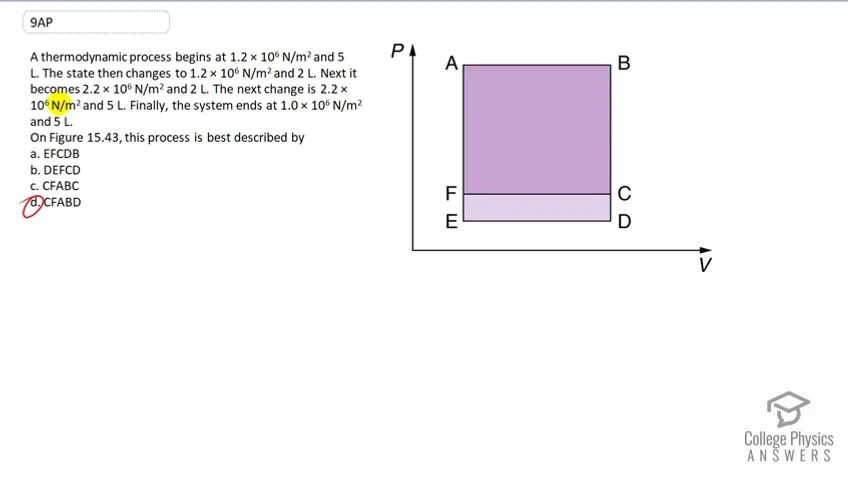 1:24PreviewProblem 9Full video with free trialA thermodynamic process begins at and 5 L. The state then changes to and 2 L. Next it becomes and 2 L. The next change is and 5 L. Finally, the system ends at and 5 L.
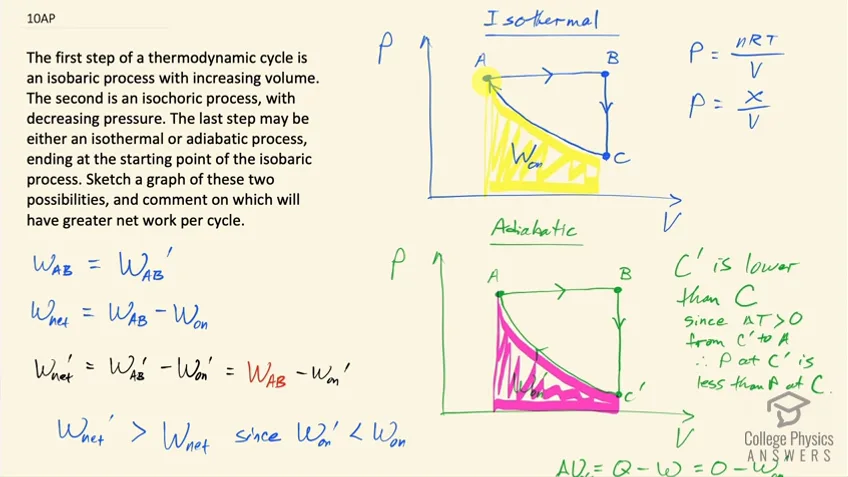 6:09PreviewProblem 10Full video with free trialThe first step of a thermodynamic cycle is an isobaric process with increasing volume. The second is an isochoric process, with decreasing pressure. The last step may be either an isothermal or adiabatic process, ending at the starting point of the isobaric process. Sketch a graph of these two possibilities, and comment on which will have greater net work per cycle.
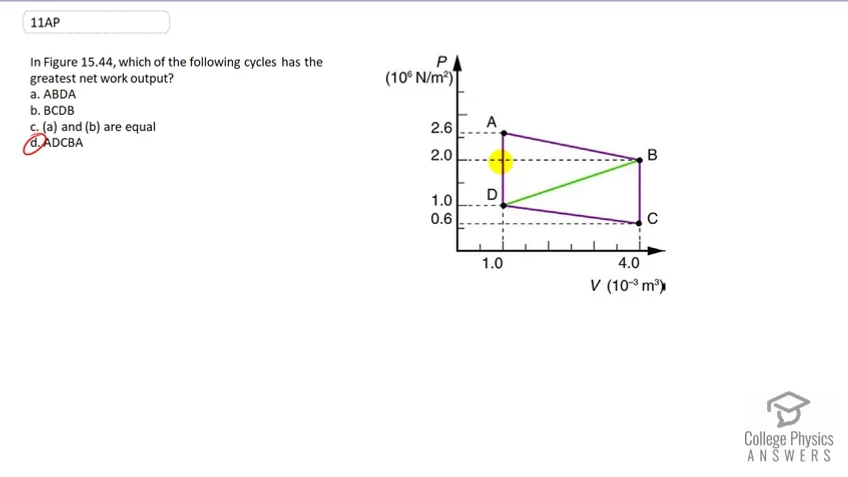 0:49PreviewProblem 11Full video with free trialIn Figure 15.44, which of the following cycles has the greatest net work output? (a) ABDA
(b) BCDB
(c) (a) and (b) are equal
(d) ADCBA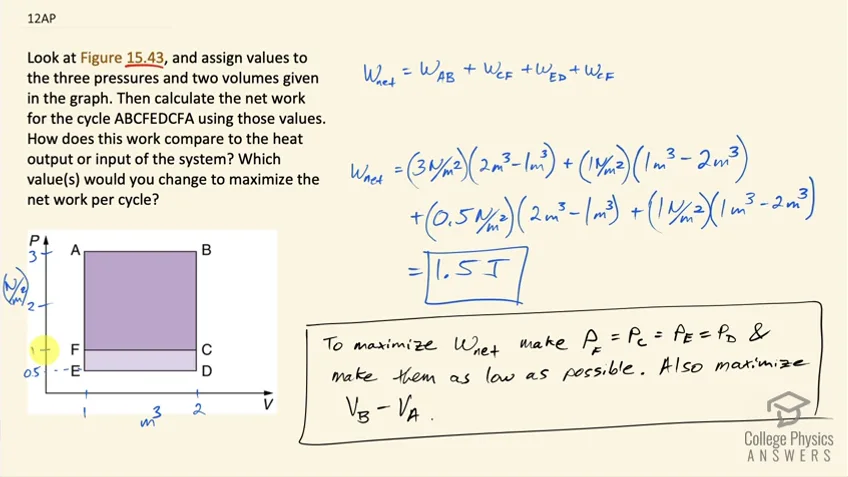 4:24PreviewProblem 12Full video with free trialLook at Figure 15.43, and assign values to the three pressures and two volumes given in the graph. Then calculate the net work for the cycle ABCFEDCFA using those values. How does this work compare to the heat output or input of the system? Which value(s) would you change to maximize the net work per cycle?
15.6 Entropy and the Second Law of Thermodynamics
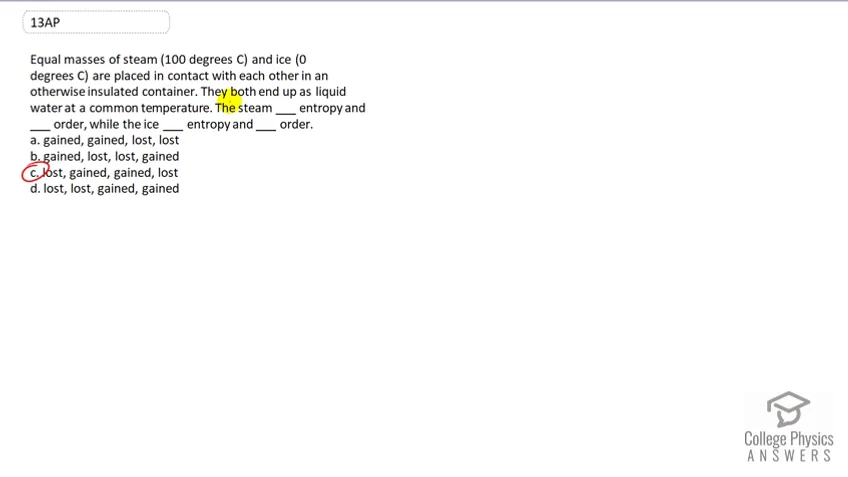 0:54PreviewProblem 13Full video with free trialEqual masses of steam (100 degrees C) and ice (0 degrees C) are placed in contact with each other in an otherwise insulated container. They both end up as liquid water at a common temperaturThe steam ___ entropy and ___ order, while the ice ___ entropy and ___ order. (a) gained, gained, lost, lost
(b) gained, lost, lost, gained
(c) lost, gained, gained, lost
(d) lost, lost, gained, gained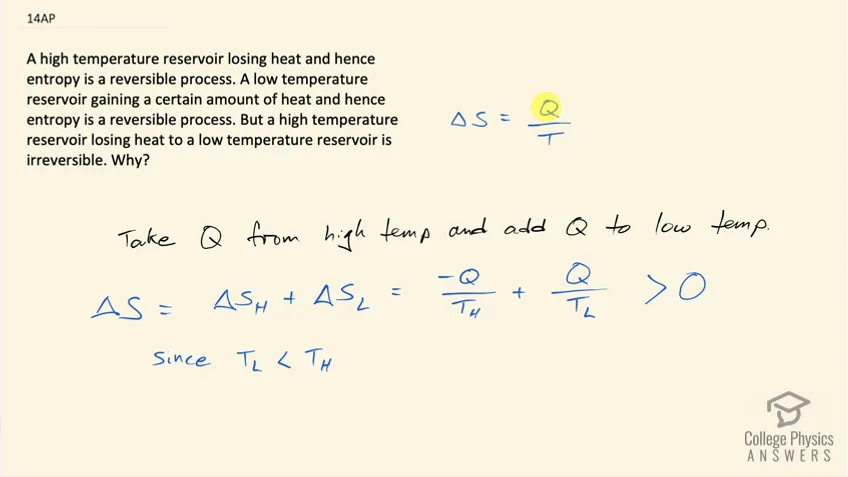 1:38PreviewProblem 14Full video with free trialA high temperature reservoir losing heat and hence entropy is a reversible process. A low temperature reservoir gaining a certain amount of heat and hence entropy is a reversible process. But a high temperature reservoir losing heat to a low temperature reservoir is irreversible. Why?
15.7 Statistical Interpretation of Entropy and the Second Law of Thermodynamics: The Underlying Explanation
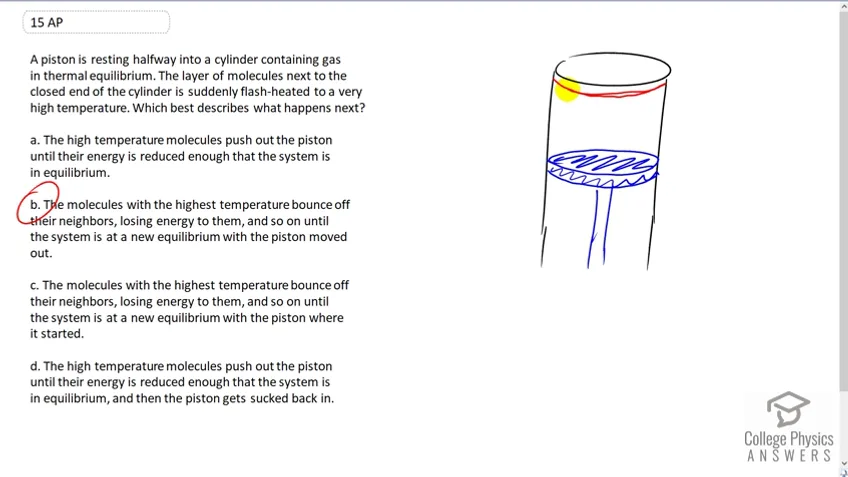 0:39PreviewProblem 15Full video with free trialA piston is resting halfway into a cylinder containing gas in thermal equilibrium. The layer of molecules next to the closed end of the cylinder is suddenly flash-heated to a very high temperature. Which best describes what happens next? (a) The high temperature molecules push out the piston until their energy is reduced enough that the system is in equilibrium.
(b) The molecules with the highest temperature bounce off their neighbors, losing energy to them, and so on until the system is at a new equilibrium with the piston moved out.
(c) The molecules with the highest temperature bounce off their neighbors, losing energy to them, and so on until the system is at a new equilibrium with the piston where it started.
(d) The high temperature molecules push out the piston until their energy is reduced enough that the system is in equilibrium, and then the piston gets sucked back in.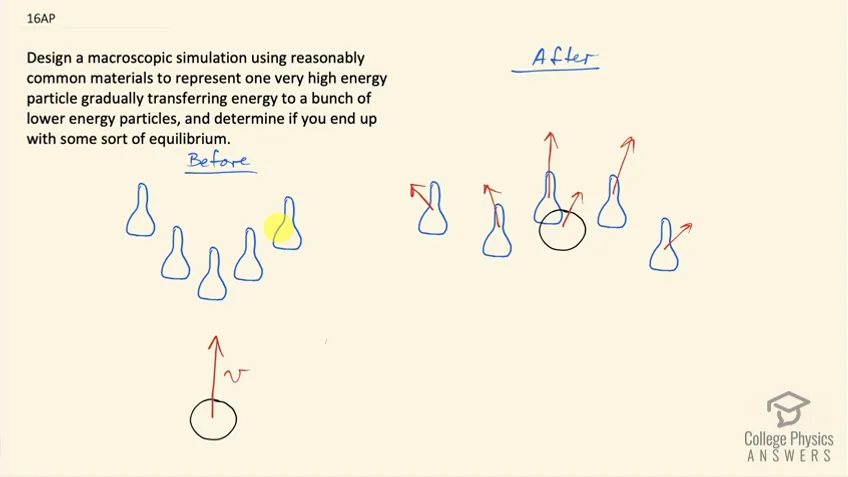 0:48PreviewProblem 16Full video with free trialDesign a macroscopic simulation using reasonably common materials to represent one very high energy particle gradually transferring energy to a bunch of lower energy particles, and determine if you end up with some sort of equilibrium.