Question
The engine of a large ship does of work with an efficiency of 5.00%. (a) How much heat transfer occurs to the environment? (b) How many barrels of fuel are consumed, if each barrel produces of heat transfer when burned?
Final Answer
Solution video

This is a 19-second preview. Get access to the full video by starting your free 7-day trial.
This is a 19-second preview. Get access to the full video by starting your free 7-day trial.
Calculator Screenshots
Video Transcript
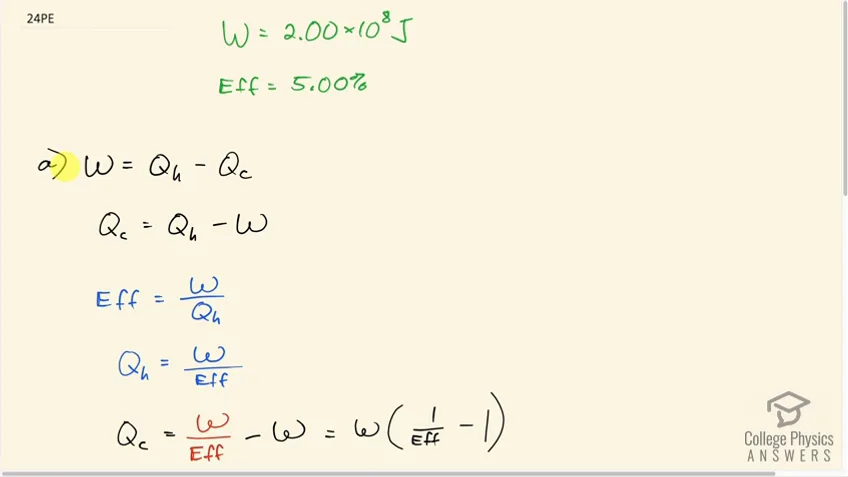
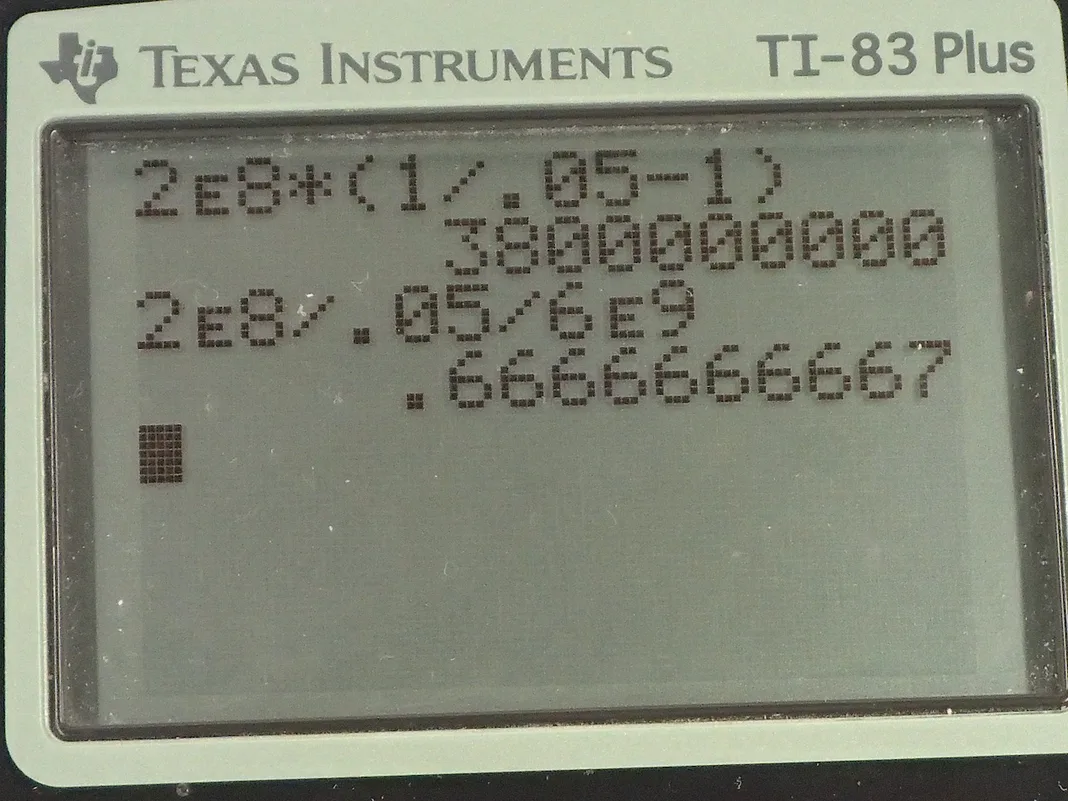
This is College Physics Answers with Shaun Dychko. The engine of a large ship does 2.00 times 10 to the 8 joules of work with an efficiency of 5.00 percent and part (a) asks how much heat is transferred to the environment? Well the work done by a cyclical engine which is a type of engine that any ship would have is going to be the amount of heat absorbed mainly from the burning of the fuel minus the heat expelled to the environment so Q c is what we want to solve for. So add Q c and subtract w from both sides and then we get that Q c is Q h minus w. But we don't know what Q h is but we can find it by using this formula for efficiency which is equal to work divided by the heat absorbed and we can solve for Q h by multiplying both sides by Q h divided by efficiency and we get then that the heat absorbed from the high temperature reservoir is the work done divided by efficiency. So we can substitute this in place of Q h and then we get the Q c then is work divided by efficiency minus work and then work can be factored out and we have work times 1 over efficiency minus 1. So that's 2.00 times 10 to the 8 joules times 1 over 0.0500 minus 1 and that is 3.80 times 10 to the 9 joules is the heat given to the environment. Part (b) asks how many barrels of oil or fuel would be needed to do this work? So that's gonna be the total heat absorbed from the fuel multiplied by 1 barrel for every 6.00 times 10 to the 9 joules and we substitute w divided by efficiency in place of Q h and so that's 2.00 times 10 to the 8 joules divided by 0.0500 times 1 barrel per every 6.00 times 10 to the 9 joules and that's 0.667 barrels.
Comments
No comments yet.