Question
With of heat transfer into this engine, a given cyclical heat engine can do only of work. (a) What is the engine's efficiency? (b) How much heat transfer to the environment takes place?
Final Answer
- 0.0586
Solution video

This is a 15-second preview. Get access to the full video by starting your free 7-day trial.
This is a 15-second preview. Get access to the full video by starting your free 7-day trial.
Calculator Screenshots
Video Transcript
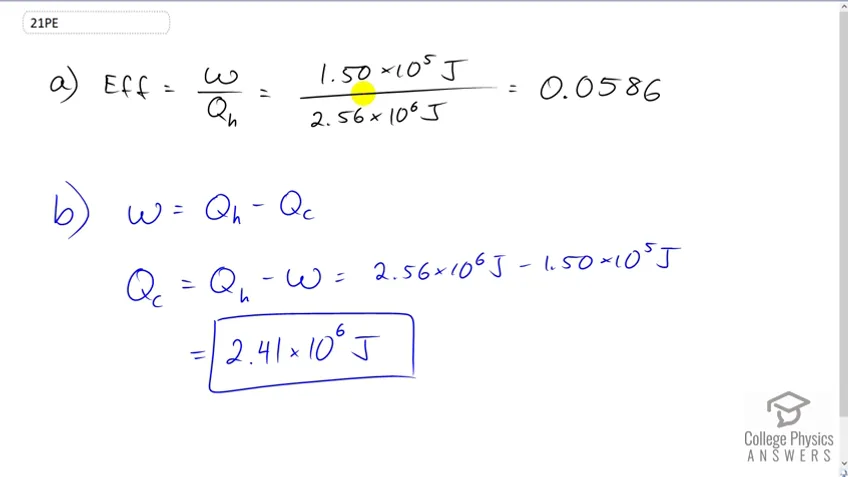
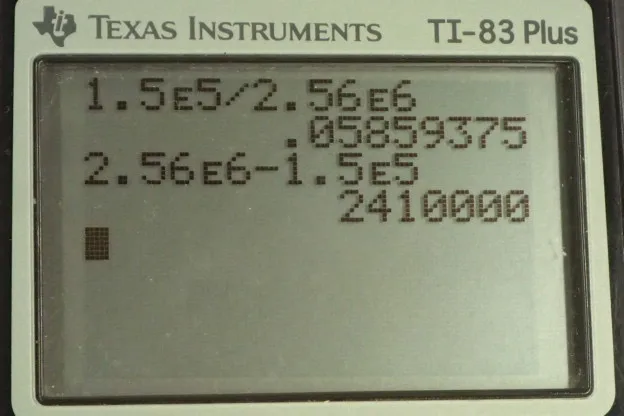
This is College Physics Answers with Shaun Dychko. Efficiency is the amount of work done by the engine divided by the amount of heat energy it absorbs to do that work. So it's 1.5 times 10 to the 5 Joules of work done divided by 2.56 times 10 to the 6 Joules of energy absorbed and that is 0.0586, is the efficiency and in part b, we are asked to figure out how much energy is lost in the environment, now because it’s a cyclical heat engine that means we're allowed to say this, which is that the work done by the engine is the difference between the energy it absorbs minus the energy it loses. And we will solve for Qc by moving this to the left and then moving this to the right and this goes to the left by adding it to both sides and this goes to the right by subtracting it from both sides. So we have Qc is Qh minus W so that's 2.56 times 10 to the 6 Joules of heat energy it absorbed minus 1.5 times 10 to the 5 Joules of work done and that is 2.41 times 10 to the 6 Joules of energy lost to the cold temperature reservoir.
Comments
No comments yet.