Question
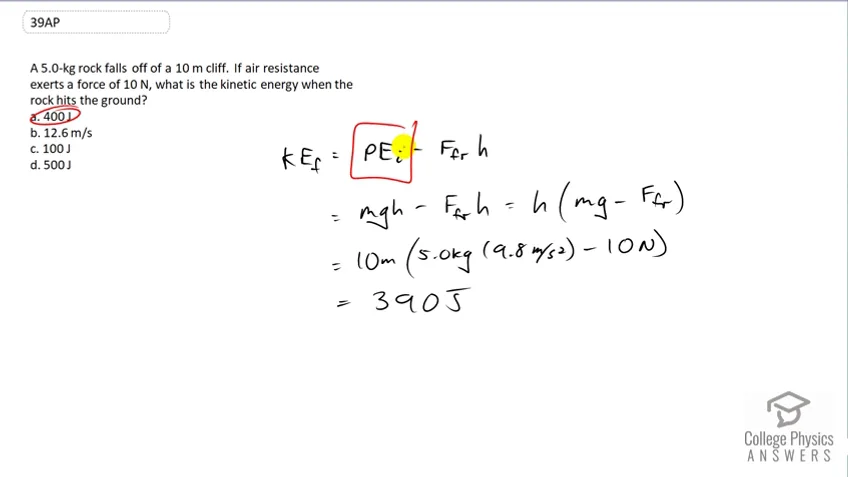
A 5.0-kg rock falls off of a 10 m cliff. If air resistance exerts a force of 10 N, what is the kinetic energy when the rock hits the ground?
(a) 400 J
(b) 12.6 m/s
(c) 100 J
(d) 500 J
Final Answer
(a)
Solution video

This is a 13-second preview. Get access to the full video by starting your free 7-day trial.
This is a 13-second preview. Get access to the full video by starting your free 7-day trial.
Video Transcript
This is College Physics Answers with Shaun Dychko. The final kinetic energy when the rock hits the ground will be the initial potential energy it had at the top of the cliff, minus the energy it dissipated as heat by friction. So the energy dissipated by heat by friction is going to be the force of friction multiplied by the distance through which the rock falls which is the height, and the potential energy initially will be m g h. We can factor out the h and so we have ten meters times five kilograms times 9.8 meters per second squared, minus the ten newtons of friction. This gives 390 joules which is about 400 joules of energy.
Comments
No comments yet.