Question
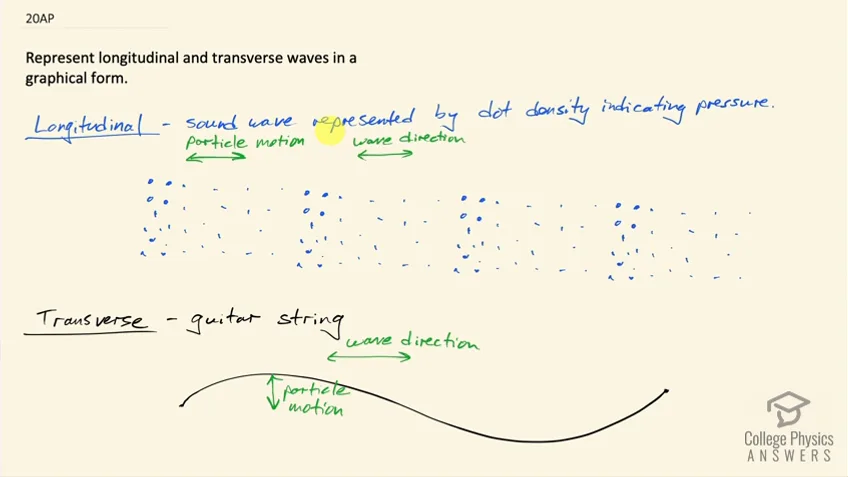
Represent longitudinal and transverse waves in a graphical form.
Final Answer
Please see the solution video.
Solution video

This is a 15-second preview. Get access to the full video by starting your free 7-day trial.
This is a 15-second preview. Get access to the full video by starting your free 7-day trial.
Video Transcript
This is College Physics Answers with Shaun Dychko. We need to draw a longitudinal wave and a transverse wave so for the longitudinal wave, I am going to draw a sound wave which is represented by a dot density that indicates pressure so there's high pressure here with many dots close together and then low pressure here with dots spaced apart and then high pressure and low pressure, high pressure and low pressure and the particles are going to be moving to the left and right here and the wave propagation is also along that same axis and since the particle motion and the wave direction are moving along the same axis, this is a longitudinal wave. A transverse wave occurs when the particles are moving in a direction perpendicular to the direction of the wave propagation. So this is a guitar string and the string particles are going to be moving up and down but the wave will be moving to the left and the right and so they are perpendicular to each other and that is a transverse wave.
Comments
No comments yet.