Question
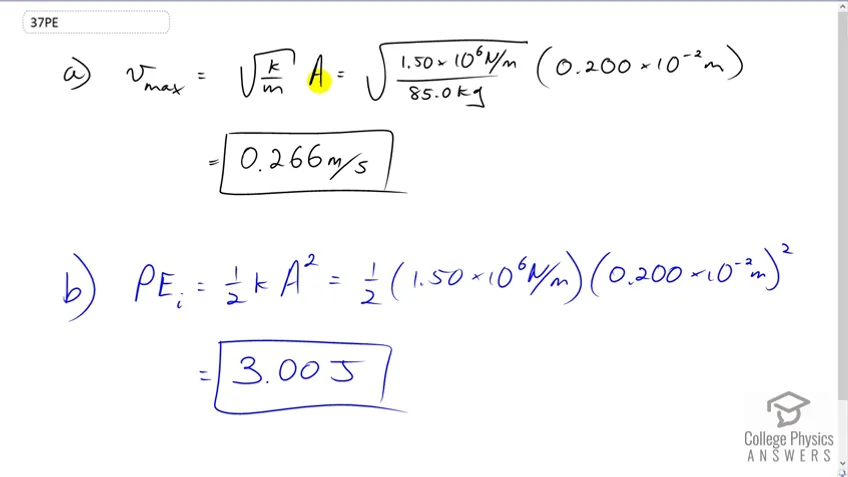
(a)What is the maximum velocity of an 85.0-kg person bouncing on a bathroom scale having a force constant of , if the amplitude of the bounce is 0.200 cm? (b) What is the maximum energy stored in the spring?
Final Answer
Solution video

This is a 12-second preview. Get access to the full video by starting your free 7-day trial.
This is a 12-second preview. Get access to the full video by starting your free 7-day trial.
Calculator Screenshots
Video Transcript
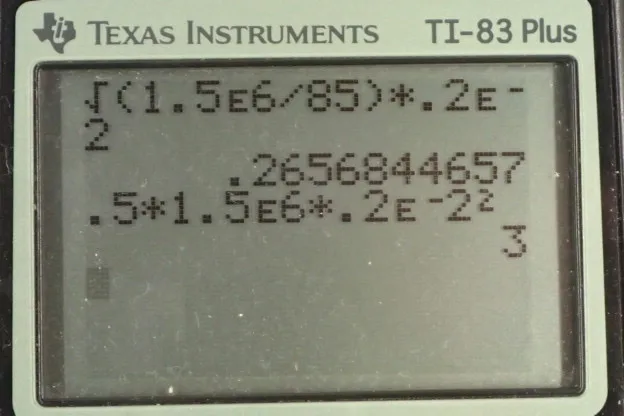
This is College Physics Answers with Shaun Dychko. The maximum speed of a simple harmonic oscillator is the square root of the spring constant divided by mass times the amplitude. That's the maximum displacement from equilibrium. We're told that this has a spring constant of 1.5 times ten to the six newtons per meter and the person is 85 kilograms and the spring in the scale has a amplitude of 0.2 centimeters which we write as 0.2 times ten to the minus two meters. It works out to 0.266 meters per second will be the maximum speed. The maximum potential energy stored in the spring of the scale is going to be one half spring constant times amplitude squared. So that's one half times 1.5 times ten to the six newtons per meter times 0.2 times ten to the minus two meters squared, giving 3.00 Joules.
Comments
No comments yet.