Question
If the spring constant of a simple harmonic oscillator is doubled, by what factor will the mass of the system need to change in order for the frequency of the motion to remain the same?
Final Answer
The mass must also be doubled.
Solution video

This is a 22-second preview. Get access to the full video by starting your free 7-day trial.
This is a 22-second preview. Get access to the full video by starting your free 7-day trial.
Video Transcript
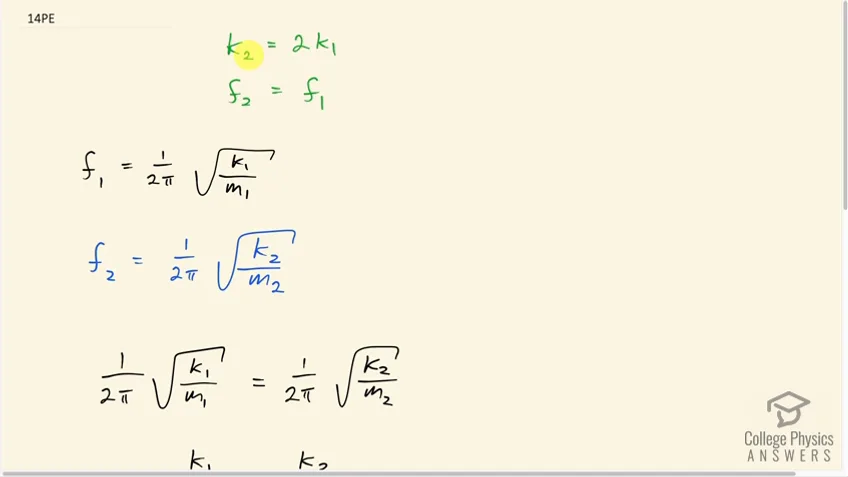
This is College Physics Answers with Shaun Dychko. The spring constant of a simple harmonic oscillator is doubled so that means k for the second simple harmonic oscillator is 2 times the spring constant of the first simple harmonic oscillator and we are told that the frequencies are meant to remain the same so f 2 equals f 1 and the question is by what factor should the mass change for this second simple harmonic oscillator in order to keep these frequencies the same given double the spring constant? So frequency one is 1 over 2π times square root of spring constant one divided by mass one and frequency 2 is 1 over 2π times square root k 2 over m 2 and these frequencies are equal so we can equate these two right hand sides. So we have 1 over 2π times square root k 1 over m 1 equals 1 over 2π times square root k 2 over m 2 and we'll multiply both sides by 2π and that cancels the 2π in other words and then take the square of both sides and we have k 1 over m 1 equals k 2 over m 2. And then we want to get m 2 equals stuff times m 1 so let's put m 2 in the numerator by multiplying both sides by m 2 and then get rid of this other business here on the left side so that m 2 is isolated so we multiply by m 1 over k 1. So we have m 2 equals k 2 times m 1 over k 1. Now k 2 is 2 times k 1 so we make that substitution and then the k 1's cancel and this means m 2 is 2 times m 1. So the mass must increase by a factor of 2 in order to maintain the same frequency when the spring constant is doubled.
Comments
No comments yet.